ON TARGET: If Russia Is Gun Crazy ... America Is Gun Bonkers

https://www.concealedcarry.com

https://www.concealedcarry.com

By Scott Taylor

I happened to catch a news item on CBC’s The National last Thursday night that illustrates how modern Russian society celebrates their association with the world famous Kalashnikov assault rifle.

It is true that, since it was first created by gun designer Mikhail Kalashnikov back in 1947, the weapon that still bears his name has become the most prolific assault rifle around the globe. It is simple to operate and rugged enough to withstand the most inhospitable conditions. It is also relatively cheap to produce and therefore apopular option for armies in developing countries, and guerrilla forces.

However, the spin put on the Kalashnikov by the CBC reporter was that Russians are glorifying a weapon that, in her words, is the “choice of criminals, thugs, and soldiers.” This would of course be a terrible national trait — celebrating criminal armaments — were it even remotely true.

A quick check of the facts reveals that assault weapons are used in less than two per cent of gun-related crimes committed in North America, and of that miniscule fraction, only a small percentage are of the Kalashnikov variety.

To illustrate just how much love Russia has for this historical automatic weapon, the CBC filmed a Moscow nightclub wherein two deactivated AK-47 Kalashnikovs had been cleverly used to replace the handles on the club’s front doors. Those Russians really must be firearm crazy!

Then there was the CBC trip to a kiosk at the Moscow airport operated by none other than the Kalashnikov manufacturing company. The merchandise that seemed to most fascinate the reporter was the collection of Kalashnikov t-shirts that came in — wait for it — children’s sizes. More proof that these whacky Russians begin indoctrinating even their young infants into a sort of gun-worship mentality as soon as they can walk.

Of course it is worth remembering that this kiosk is at the airport, where local citizens are not usually prone to shop for clothing, therefore the merchandise is obviously intended as souvenirs for foreigners.

Still, CBC is our state-funded national broadcaster and they must have had their reasons for providing this segment on Russian gun worship.

A quick bit of research will reveal that there are an estimated 14 million privately owned firearms in Russia. That’s a staggering ratio of 8.9 weapons for every 100 residents.

That seems to be an arsenal worth scarring the bejeezus out of Canadians, especially as we do not worship guns and we pride ourselves on strict gun control laws. Except that Canada’s private gun ownership dwarfs that of Russia with a ratio of 30.8 weapons for every 100 residents.

This could perhaps be partially explained by the fact that we share a common border with the United States. Talk about a scary gun culture! The U.S. has a ratio of 112.6 privately owned firearms in America for every 100 residents. That is three times the Canadian average, and more than nine times the gun owner ratio of Russia.

As for indoctrinating their youth, it took only seconds of research on the Internet to find images of a pink baby girl’s onesie adorned with twin holsters and automatic pistols — for sale in the U.S.A.

As for lionizing individual weapons, American gun aficionados still affectionately refer to the Colt .44 Peacemaker revolver as the “gun that won the West” without any historical reflection on what that meant in terms of displacing Indigenous peoples at the time.

Instead of trying so desperately to demonize the Russians over their comparatively tiny gun ownership, perhaps CBC News should focus more on the real dangers in our own backyard.

ON TARGET: Trump was right, then he was wrong!

Donald Trump Photo: Collegehumor

Donald Trump


Photo: Collegehumor

By Scott Taylor

Last Monday night, when U.S. President Donald Trump made his long-anticipated announcement regarding the war in Afghanistan, even he had to admit that he has his doubts about his chosen path. “My original instinct was to pull out,” said Trump, “and historically, I like following my instincts.”

Senior Pentagon and National Security advisors have instead managed to convince The Donald to ignore his inner voices and give his blessing to yet another continuation of the bloody occupation of Afghanistan.

This time will be different though as Trump assured the American public that under his guidance the U.S. military’s objective will be to win. Unlike his weak-kneed predecessors who attempted to build a nation in Afghanistan, the Trump-led warriors will simply focus on killing bad guys.

Turning their backs on the situation in Afghanistan, Trump claimed, would result in creating another failed state wherein international terrorists could plot and plan attacks against America.

While it is true that al-Qaeda leader Osama bin Laden was residing in Taliban-controlled Afghanistan at the time of the 9/11 attacks, the truth is that there are presently a large number of failed states around the world where terrorist cells abound.

Ironically, many of these black holes of anarchy were created as a result of U.S. meddling and their ill-conceived campaign to eliminate terror. I refer to Libya, Iraq, and Syria where U.S. invasions, interference and subterfuge have destabilized huge swaths of territory and led to the creation of numerous fanatical factions such as Daesh (aka ISIS), al-Nusra and al-Qaeda-linked militias.

To stay in Afghanistan militarily in order to make America safe again would mean that the U.S. needs to begin planning similar occupations of Iraq, Libya, Syria and let’s throw Somalia in there as well.

Trump also said that his renewed commitment to Afghanistan was not a blank cheque, nor will it be open-ended. Unlike former President Barack Obama, Trump declined to put an exit date on the new mission as he insists that victory will be determined by achieving objectives. Of course, he declined to identify what exactly those objectives are.

To achieve his planned reversal of fortunes in the war, Trump will be deploying an additional 4,000 troops to boost the 8,400 U.S. soldiers already based in Afghanistan.

To put this in perspective, Obama’s surge strategy, aimed at winning the war once and for all, saw a troop increase of 30,000 soldiers, which brought the American total force deployed in country to over 100,000. Added to that number were an additional 40,000 international soldiers, including 3,500 Canadians. And let’s not forget the 400,000 Afghan security forces that NATO soldiers have been training since 2001.

Somehow Trump expects to accomplish victory with 12,400 troops when 140,000 NATO and U.S. soldiers failed?

Trump also indicated that the U.S. will continue to focus on the training of Afghans in order to make them self-sufficient. Despite every military apologist and pundit explaining to their audience that it takes time to build a military from scratch, the truth is that the best trainers in the world — including Canadian soldiers — have spent the past 16 years trying to make soldiers out of Afghan recruits. If it hasn’t worked yet — and it hasn’t — then it never will.

To get a sense of the futility of mentoring Afghan security forces I would highly recommend watching the VICE News documentary This is What Winning Looks Like. It is an excellent 90-minute exposé of the rampant drug use, sexual misconduct, corruption and lack of professionalism that embody both the Afghan Army and police forces.

Although the film was produced in 2013, I assure you that things have only gotten worse since the number of NATO and U.S. troops was greatly reduced over the past four years.

This is without a doubt the longest war in U.S. history. Some diehard Afghan war hawks will claim that the Korean War is a frozen conflict, and because the U.S. never withdrew, South Korea has blossomed into an economic dynamo. If U.S. troops were constantly being targeted by South Korean suicide bombers, they definitely would not have stayed there for 70 years.

Afghanistan will never be another South Korea, and there is a good reason that this rugged patch of Central Asia is known as the “Graveyard of Empires.” Trump missed his chance. He should have followed his instincts and pulled out of a war he can never win.


INTERVIEW: www.conversationsthatmatter.tv  

ON TARGET: "Is Trump A Racist?"

Donald TrumpWikimedia

Donald Trump

Wikimedia

By Scott Taylor

In a scene from the 1980 classic comedy movie The Blues Brothers, the title characters are stuck in a traffic jam. The cause of the delay is a group of Nazis blocking a bridge while police restrain a heckling mob of anti-Nazi protestors. When informed by a policeman that the protestors had won a court decision authorizing them to protest, The Brothers ask which organization is responsible, and the policeman informs them it is the Illinois Nazis. Jake Blue states, “I hate Illinois Nazis” and Elwood immediately drives straight into the crowd of Nazis who comically leap into the water below the bridge.

Despite the uncanny similarity, there was nothing funny about the incident in Charlottesville, wherein a white supremacist drove his car head-on into a crowd of anti-Nazi protestors killing one and injuring 19 others. Like the Illinois Nazis in the movie, the alt-right movement, including neo-Nazis and the Klu Klux Klan, had obtained an official permit to demonstrate.

Ostensibly, this collection of white supremacists wanted to express their objection to the Charlottesville city council’s decision to remove a statue of Confederate Civil War General Robert E. Lee.

Lee was a masterful battlefield commander who fought in the failed attempt for 11 southern states to secede from the Union and establish their own confederacy. The confederates were opposed to the abolition of slavery, therefore the tribute to General Lee has become viewed as a symbol glorifying the slave trade.

However, the alt-right gathering in Charlottesville was not an academic assembly of individuals intent on resisting the advance of revisionist history. Instead, it quickly became a blatant demonstration of white supremacy, complete with a Nazi-style torch-lit parade.

To cap it off, James Alex Fields Jr. deliberately drove his car straight into the crowd of anti-Nazi hecklers. Why this is not being called an act of terrorism, I have no idea. When Islamic extremists drove into crowds in Barcelona, London, Berlin, and Nice no one hesitated in labelling them terrorists, and I’m pretty sure those on the receiving end of Fields’ car rampage were just as terrified as those other victims.

Nevertheless, the biggest story to emerge from Charlottesville was the reaction from U.S. President Donald Trump. His first response was to universally condemn “hate,” and went on to express the opinion that this existed “on many sides.” Over the next two days Trump took a tremendous amount of heat for not singling out the alt-right for their responsibility in the incident.

Trump did finally issue a stern rebuke, wherein he named the KKK, neo-Nazis and other white supremacist groups. However, he almost immediately reversed course by once again stating that there was blame on both sides. Describing the anti-Nazis as the alt-left, he pointed out the fact that the alt-right had obtained a legal permit for their demonstration, as if that somehow made it all okay.

By contrast, immediately following last Thursday’s attack in Barcelona, Spain, in which 14 civilians were killed and another 100 wounded by a rampaging vehicle, Trump took to the Twitter-sphere to denounce the attackers.

As Daesh (aka ISIS) claimed responsibility for the attack, Trump revised a long-debunked myth regarding how the perpetrators of the Barcelona attack should be dealt with just as U.S. General John Pershing had done in the Philippines in 1899. Although historians are adamant that it never actually happened, Trump claims that Pershing had his soldiers dip their bullets in pigs’ blood before executing captured Muslim terrorists in order to prevent the dead from ascending into heaven. Never mind that this would seriously clog up a rifle, Trump also erroneously claimed that “There was no more Radical Islamic Terror for 35 years!” That is simply not true.

To recap: a neo-Nazi drives into a crowd of anti-Nazis in Charlottesville and Trump points out that the anti-Nazis did not have a permit to assemble. A Muslim extremist drives into a crowd in Barcelona and Trump wants to not only execute them in this life, but deny their souls for eternity.

On the plus side, no one is talking about North Korean nukes or Russians fixing the U.S. election.


For those of you too young to remember 37 years ago….This clip from the Blues Brothers comedy movie will seem incredibly prophetic give the recent incident at a Nazi rally in the US.

Only now it is the Nazis driving through the crowd!

https://www.youtube.com/watch?v=XsxwhRiiWtc 

ON TARGET: North Korea: Is The Fate Of The World In The Hands Of Two Madmen?

Kim Jong-un and Donald Trump Photo: http://fpif.org/donald-trump-kim-jong-un-soul-brothers/

Kim Jong-un and Donald Trump


Photo: http://fpif.org/donald-trump-kim-jong-un-soul-brothers/

By Scott Taylor

With all of the fear-mongering going on these days, one could be forgiven for believing we are on the eve of a nuclear Armageddon between North Korea and the U.S.A. Military experts are coming out of the woodwork to take to the airwaves, all of them eager to convince us just how dangerous North Korean President Kim Jong-un really has become.

Graphic designers have hastily cobbled together detailed diagrams showing all the various ranges of Jong-un’s missile inventory, the latest one clearly showing that Ottawa and Toronto are inside the danger zone.

The usual list of Canadian tub-thumping Colonel Blimps have penned the expected warnings that, although America would be Jong-un’s intended target, his missiles could inadvertently strike a Canadian city. He aims for Chicago and instead wipes Winnipeg off the map. Scary stuff indeed.

One Canadian fear-monger went so far as to plot out an Austin Powers-worthy scheme wherein Doctor Evil, aka Jong-un, is going to use his old 1960s era Soviet submarine to launch a nuclear torpedo into the U.S. Navy’s facility at Bangor, Washington. That port, located on the Kitsap Peninsula near Seattle, is home to the nuclear-armed Trident submarine fleet.

According to the doomsday theorist, Jong-un’s nuke will set off the U.S. Navy’s arsenal of nukes and Vancouver will be vaporized. Terrifying stuff!

Even more alarming was the rhetoric used by President Donald Trump in response to Jong-un’s threats. The Donald told reporters that if North Korea continues to issue threats, they will be faced with “fire and fury like the world has never seen.” People took this statement to mean that Trump would launch a pre-emptive, massive nuclear strike against North Korea.

This position was foretold in 1999 by then billionaire businessman Donald Trump during a television interview on American public affairs program Meet the Press. In that interview Trump said that he would first negotiate with North Korea if possible, but that time would be running out on that option. Trump would not want to wait “for five years [when there will be North Korean] warheads all over the place pointing at New York City.”

For the record, this would have been in 2004, 13 years ago, and even according to the most exaggerated of the graphic diagrams, New York still remains beyond the reach of Jong-un’s missiles.

In fact, Jong-un himself has only threatened to make a demonstration missile test firing towards the U.S. military bases on the Western Pacific island of Guam. To be clear, the North Korean madman is not suggesting he will actually hit Guam, nor has he said the weapon will be armed with any warhead, be it nuclear or conventional.

The threat from North Korea is to land the rocket 30 to 40 kilometres from Guam. It behooves all of those even mildly worried about this current crisis to consult a map showing Guam’s location.

As for all the rumblings about North Korea having successfully miniaturized nuclear warheads and the speculation that Jong-un already possesses 60 of these miniaturized weapons, keep in mind this information is coming directly from U.S. intelligence agencies.

Yes, that would be the same U.S. intelligence agencies that lied to the world in 2003 about Saddam Hussein possessing weapons of mass destruction in order to justify the United States’ illegal invasion of Iraq. Fool me once …

What would be cool would be if someone would contract a graphic designer to illustrate the massive U.S. and allied military countermeasures surrounding North Korea.

This infographic should also include the United States’ nuclear arsenal, which includes more than 4,000 un-miniaturized warheads that are capable of wiping all of North Korea off the planet, hundreds of times over.

The scariest part of this whole equation is not the goofy-looking Korean with his alleged 60 tiny nukes and a wonky missile program; it is the unstable megalomaniac in possession of the U.S. nuclear launch codes who utters threats of delivering “fire and fury.”

It is worth remembering that the only nation in history to have ever actually employed a nuclear bomb against human beings is the United States. In April of this year, Trump authorized the first use of the Massive Ordinance Air Blast (MOAB or Mother of All Bombs) against targets in Afghanistan; the MOAB is the largest non-nuclear explosive device designed to date.

Let’s hope Trump does not decide to up the ante.

Kabul Regime: Making Trump look good by comparison

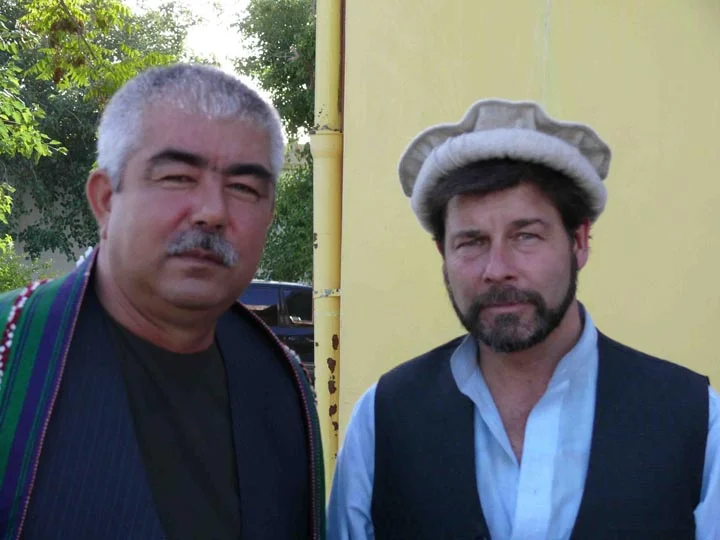
Publisher Scott Taylor and General Abdul Rashid Dostum

Publisher Scott Taylor and General Abdul Rashid Dostum

By: Scott Taylor


While Canada may have concluded a twelve year military commitment to the war in Afghanistan back in the spring of 2014, few taxpayers realize that we continue to spend over $150 million annually in support of the Afghan Security Forces. That is definitely not chump change and as such we should not only be concerned with how effectively that money is being spent, but also we should be following the internal happenings of the Afghan regime that we are paying so much to protect.

In terms of return on investment, the most recent quarterly report from the U.S. Special Inspector General - Afghanistan Reconstruction (SIGAR) paints a pretty bleak picture. From 1 January to 8 May 2017 the Afghan Security Forces have suffered a total of 2,531 soldiers killed and another 4,238 were wounded. That amounts to roughly 45 Afghan Security Force casualties a day, every day, which is at least five times higher than at the peak of fighting when U.S. and NATO forces were handling the combat operations.Despite the billions of dollars spent on weapons, equipment and training, the Afghan Security Forces are getting chewed up on the battlefield at an unsustainable rate.

Even more alarming was the SIGAR statistics for that same four month period, wherein they found at least 12,073 Ministry of Defence personnel were simply “unaccounted for”. This has been a long running theme throughout the rampantly corrupt Afghan forces, which has become commonly known as “Ghost Soldiers”. It is common practice in most units to draw pay and rations for soldiers who were killed, deserted or simply never existed. Likewise the clever Afghans continue to take fuel deliveries for vehicles that were long since disabled in order to sell the gasoline on the black market.

Even weapons and ammunition are sold, often to the very insurgents those troops are ostensibly being paid to fight. The Taliban’s primary source for weapons and ammo is the U.S. Supplied Afghan Security Force, and they have long since realized that it is far easier to simply buy them from disgruntled Afghan government troops than it is to attempt to capture them.

Canada’s $150 million is a drop in the bucket compared to the billions spent annually by the U.S. to prop up this ragtag army, but nevertheless it is a lot of money to be pumping into failed system that ultimately benefits the insurgents we are hoping to thwart.

Then there is the bigger question of what exactly we are hoping to protect with this fourth-rate security force. How corrupt and dysfunctional can the Afghan government really be? Well, let’s take a look at the most recent political developments involving the Vice President. Just last week General Abdul Rashid Dostum attempted to return to Afghanistan from exile in Turkey, but his private plane was refused landing rights by the authority of the government of President Ashraf Ghani and Afghanistan’s Chief Executive Officer Abdullah Abdullah.

Dostum’s alleged crime is the kidnapping and sexual assault of his political rival, Ahmed Eshchi, the governor of Jawzjan Province. What is even more crazy about this is that back in 2010, when I interviewed General Dostum in Kabul he was under house arrest for kidnapping, beating, and raping another of his political rivals. I also interviewed Dostum’s alleged victim in that case, Akbar Bey, a prominent leader of the Afghan Turkmen community. Bey could not believe that Dostum was seemingly above all laws as the Kabul regime needed his continued loyalty and that of his devoted ethnic-Uzbek followers

Dostum has been a notorious war-lord dating back to the Soviet invasion of Afghanistan in 1979. In those days he saw himself as a communist sympathizer, but when the Soviets withdrew he switched sides. Throughout his martial career Dostum has also been accused of numerous war crimes.  However, immediately following the 9-11 terror attacks in 2001, he telephoned then U.S. Secretary of Defense Donald Rumsfeld to say he would be America’s best ally in Afghanistan. Kidnapping, rape, and mass murder allegations aside, the U.S. repaid Dostum’s loyalty by making him the Vice President in 2014.

Now Dostum is not just threatening to return to Kabul, but he has put together a coalition of other former warlords with which he intends to save Afghanistan from the corrupt regime of Ghani and Abdullah. Given this state of affairs is it any wonder that the Afghan Security Forces are demoralized? The outrageous political drama in Kabul makes the Trump White House look like a well oiled machine.

Surely there are better things on which to spend Canada’s $150 million annual stipend?

ON TARGET: Trump And The Transgender

Donald Trump Photo Credit: Gage Skidmore - Flickr

Donald Trump


Photo Credit: Gage Skidmore - Flickr

By Scott Taylor

On July 26, U.S. President Donald Trump sent out a series of tweets to the effect that the American military will no longer “allow or accept” transgender personnel in its ranks.

At the time of sending out the transgender tweets, Trump’s White House was in the midst of the most vicious infighting since The Donald was sworn into office on Jan. 20. If by sending out these unexpected tweets Trump was hoping to generate controversy for the purpose of deflecting the media focus from his embattled regime, then the U.S. president is not as crazy as he looks. The transgender ban blew up an immediate backlash from human rights groups and LGBTQ activists worldwide.

The sheer shocking content of Trump’s transgender ban messages caused pundits to forget that the U.S. military is governed by Congressionally approved policies, not by presidential tweets. In response to the growing controversy, it was none other than U.S. Gen. Joseph Dunford, Chairman of the Joint Chiefs of Staff, who advised the media that “there will be no modifications” to the current policy regarding the employment of transgender personnel.

Under a year-old plan brought in by former president Barrack Obama, there are currently an estimated 15,000 personnel in the U.S. military who identify as transgender, and of that number 6,000 are on active duty. No doubt Trump’s proclamation that “the United States government will not accept or allow transgender individuals to serve in any capacity in the U.S. military” will be incredibly worrisome to this veritable legion of transgender people already in uniform.

The two reasons Trump cited for the ban were the “tremendous medical costs” and the “disruption” to unit cohesion that these individuals generate.

Number crunchers were quick to calculate that the currently serving transgender personnel cost the military health services between $2.4 million and $8.4 million (U.S.) a year.

While this is not chump change, to keep things in perspective, the U.S. military annually spends in excess of $84 million on drugs such as Viagra to remedy erectile dysfunction.

As for Trump’s allegations that transgender soldiers would be a disrupting factor within their units, one need only take a short walk down memory lane.

Up until 1948, racial segregation was the official policy of the U.S. military. Throughout the U.S. civil war, the First World War and the Second World War, black volunteers were segregated into their own units, most often with white officers and usually relegated to a support role rather than frontline combat duties.

Canada similarly segregated blacks and Asians into labour battalions during the First World War, as the racist attitudes of the day led to the common belief that they made inferior soldiers and would be a disruptive factor if merged with the predominantly Anglo-Saxon combat regiments.

Canada was ahead of the U.S. in terms of racial integration, and in 1982 we took a major step in terms of sexually integrating our armed forces by allowing women into heretofore men only combat arms trades. The previous rationale for keeping women out of the frontlines was that their presence would be a disruption. The Canadian military’s performance in the Balkan peacekeeping missions of the 90s and the decade-long deployment to Afghanistan has since proven the merit of co-ed combat units.

The U.S. military quietly followed our lead and began allowing females into combat trades in 2013.

Canada lifted the ban on LGBTQ personnel serving in uniform in 1992, and has subsequently funded dozens of sexual reassignment surgeries over the past 20 years. It is estimated that around 200 personnel serving in the Canadian Armed Forces identify as transgender. Previous thinking was that LGBTQ soldiers would be a disruption to their units. Again, experience on the battlefield and in garrison has proven that this is not the case.

Soldiers put more stock in their comrades’ professionalism and dedication, rather than the colour of their skin, their gender or their sexual preference. But having never served in uniform himself, Trump has no way of knowing that.

ON TARGET: Let Edward Cornwallis Be Remembered For Who He Really Was

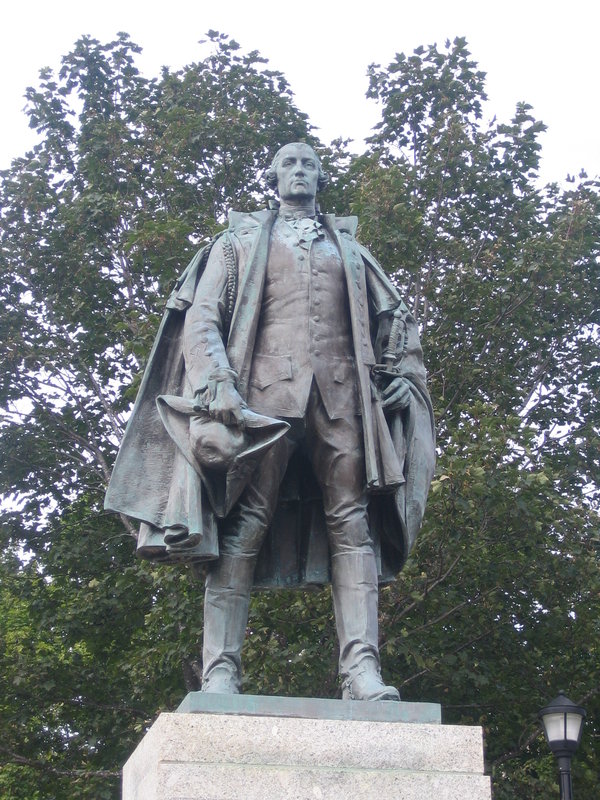
Statue of Edward Cornwallis Photo Credit: http://tari-stock.deviantart.com/

Statue of Edward Cornwallis


Photo Credit: http://tari-stock.deviantart.com/

By Scott Taylor

There has been a lot of controversy recently in Halifax over the statue of Edward Cornwallis, that city’s founder.

On Canada Day, a crowd of Mi’kmaq and their supporters gathered at the base of the statue to decry Cornwallis as a perpetrator of genocide against Indigenous Peoples. In their opinion, Cornwallis symbolizes a ruthless chapter in Canada’s colonization.

Challenging the First Nations demonstrators was a group of five Proud Boys waving the alt-rights adopted symbol of Canada’s old Red Ensign national flag. Embarrassingly, the gaggle of Proud Boys turned out to be members of the Canadian Armed Forces. All five were immediately suspended with pay, and Rear-Admiral John Newton hastily offered a full apology for their actions.

Following up on this incident, on July 15 another crowd gathered in Cornwallis Park with the stated objective of tearing down this alleged tribute to genocide. But cooler heads prevailed and, in the end, the compromise solution was to cover the image of Lord Cornwallis with a tarp. Halifax Mayor Mike Savage was on hand at this second demonstration and he acknowledged that removal of this polemic statue may yet be the final solution.

One could argue that, on the plus side, at least it has generated interest in what was heretofore just another bronze image of a British historical figure in a Canadian public space.

Edward Cornwallis was born into nobility in 1713, and at the age of 18 he purchased a commission in the British Army. His one claim to fame during the War of the Austrian Succession came at the Battle of Fontenoy in 1745, when he stepped up to take command of his battalion. The public mocked him for his subsequent retreat with the appalling loss of 8 officers and 385 of his men.

Cornwallis also fought at the Battle of Culloden in 1746, wherein the English army shattered the Jacobite Highland clans. While he played only a bit part in the battle, in the aftermath of the Scots’ defeat, Cornwallis led a punitive force into the Highlands.

It was here that Cornwallis committed his first atrocities. His orders were to bring back no prisoners, and his elite unit used mass murder and rape to pacify the rebellious Highlanders into submission.

Pleased with his actions, British parliament dispatched Lord Cornwallis to North America in 1749 for the purpose of establishing a colony that could compete with the French foothold of Louisbourg on Cape Breton. The site that Cornwallis chose was Halifax, perfect for its deep harbour and easily defended approaches.

One problem with this location was that it violated a former treaty with the Wabanaki Confederacy of First Nations, which included the Mi’kmaq tribes. The Wabanaki allied themselves with France, and the Acadians and Mi’kmaq did kill British settlers. In retribution, Cornwallis ordered his elite Rangers to hunt down the Mi’kmaq and he made the now-infamous offer to pay a bounty for Mi’kmaq scalps.

This conflict became known as Father Le Loutre’s War and it should be noted that the French also paid the Mi’kmaq for English scalps. It also should be pointed out that Cornwallis left Halifax long before those clashes and massacres were concluded, but nobody has yet to decry his successor, Peregrine Hopson, as a symbol of colonial genocide. But then again there are no statues of him.

Personally, I believe the statue of Cornwallis should remain in place so that it can be used as an educational tool for taking a closer look at the past myths that have shaped our nation’s history. Not only did Lord Cornwallis and other individuals like him commit heinous war crimes against, in his case, the Scots and the Mi’kmaq, but we were so immune to any empathy for his victims, that we actually glorified his ‘accomplishments’ with a statue and street names.

This is the lesson that needs to be taught.

ON TARGET: Mosul: This Is What Victory Looks Like

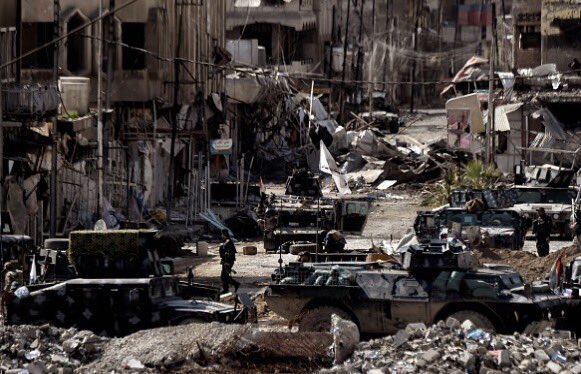
Destroyed City of Mosul Photo credit: https://www.almasdarnews.com

Destroyed City of Mosul


Photo credit: https://www.almasdarnews.com

By Scott Taylor

Last Tuesday, Iraqi Prime Minister Haider al-Abadi officially declared that the brutal nine-month battle to retake the city of Mosul was finally over. However, just four days later, explosions were still rocking the shattered rubble in the city’s downtown core as the last of the Daesh (aka ISIL or ISIS) fighters continued their fanatical resistance.

If one can be dispassionate about Daesh’s evil ideology, then from a purely military perspective their prolonged defence against overwhelming odds was one hell of a martial feat. It was estimated at the outset of the siege that Daesh defenders numbered fewer than 4,500. On the attacking side, the U.S.-led alliance numbered more than 100,000 ground troops plus airpower. This loose-knit coalition of disparate militias included Iraqi government troops, Shiite militia and Kurdish peshmerga.

The professional ‘stiffening’ of these forces was provided by a large number of U.S. and Iranian military advisors. Canada also contributed to the mix with approximately 200 special forces soldiers in an advise-and-assist role. The Canadian troops are attached to the Kurdish militia, which is loyal to the Kurdistan Democratic Party’s leader, Masood Barzani.

Although Canadians have repeatedly been told that our soldiers are not involved in combat operations, the commanders on the ground have taken extreme liberties with the word ‘assist’ in their advise-and-assist mandate.

Such assistance to the Kurds has taken the form of using anti-tank missiles to destroy Daesh vehicles, and a world record sniping shot that killed a Daesh fighter at the incredible range of 3,500 metres.

I am of the perhaps somewhat biased view that Canadian soldiers are not among the best in the world … they are the best in the world. That said, this means that the Daesh defenders of Mosul were not only up against a staggering quantity of attackers, they were also pitted against an impressive quality of warriors.

Add to this mix the fact that the allied forces could call upon the unchallenged might of the U.S.-led aerial armada that included a fleet of unmanned drones capable of around the clock observation and missile strike capabilities.

The fighting may finally be over, but the devastation is nearly complete, particularly in the western area of the city, which was Daesh’s last bastion of resistance. Nearly every building in West Mosul has been destroyed.

To protect the ground troops from possible Daesh vehicle-borne suicide attacks, the allied air force deliberately cratered every intersection in the city with precision bomb strikes. The bridges spanning the Tigris River, which connected East and West Mosul, were all destroyed in the fighting, either by allied aircraft or Daesh demolition.

The pile of rubble is reminiscent of the Second World War’s aftermath of the Battle of Stalingrad. The devastation in Mosel is so complete that it makes Haider al-Abadi’s claim of victory akin to U.S. General Westmoreland’s famous Vietnam War quip that in order to save the village, they needed to destroy the village. Only this time the village was Iraq’s second largest city and the damage is estimated to be in the tens of billions of dollars.

The question now begs as to who will oversee the reconstruction of Mosul? It was the deliberate exclusion of Iraq’s Sunni Arab minority by al-Abadi’s Shiite regime in Baghdad that led Mosul’s Sunni residents to welcome Daesh as liberators in the summer of 2014. That was when Mosul was an undamaged metropolis, not a heap of broken bricks and destroyed infrastructure.

If history repeats itself, as it so often does in the Middle East, the Sunni minority will be further punished by the victorious Shiite militias, many of whom are woefully ill-disciplined and fighting an ideological war of revenge against the Sunnis.

To the west of Mosul, Daesh retains control of the city of Tal Afar, which is a Turkmen enclave. The city is presently besieged by Shiite militia assisted by Iranian advisors. Neighbouring Turkey has warned that it will take military action if the Shia militia is allowed to enter Tal Afar and exact revenge upon the Turkmen.

As each domino falls, it seems this conflict only gets more complex and any notion of a ‘victory’ remains undefined. Canada has no say in resolving any of these major issues, yet we have just committed our military to at least two more years in Iraq. We will very soon need to choose which Iraq we support, because it is very unlikely to continue to exist in its present form.

ON TARGET: Khadr Was A Victim, Not A Terrorist

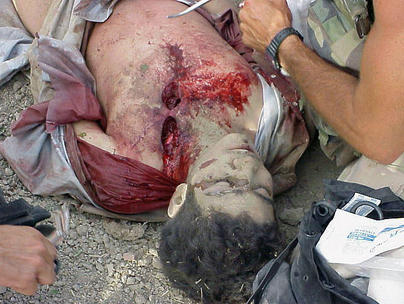
Two soldiers kneel over the wounded Khadr.http://bit.ly/2u52P9Q

Two soldiers kneel over the wounded Khadr.

http://bit.ly/2u52P9Q

By Scott Taylor

The Liberal government certainly stirred up a flurry of emotion with last week’s announcement that Canada will pay out a whopping $10.5-million in compensation to Omar Khadr.  Those who are firmly in the anti-Khadr camp howled with indignity that this payout is in essence a reward for a terrorist.

To back up their argument they point to the fact that Khadr confessed to having thrown a grenade which killed U.S. soldier Christopher Speer and wounded another American infantryman. This makes Khadr a murderer in the eyes of his detractors.

The terms ‘terrorist’ and ‘murderer’ are indeed evocative, but in the case of Khadr they are not warranted. Yes, Khadr’s father Ahmed was indeed a full-fledged member of the notorious al-Qeada terrorist network. Following the post-9/11 U.S. invasion of Afghanistan, Ahmed returned to the land where he had fought against the Soviet occupation in the 1980’s, this time bringing along with him his sons Abdurahman and Omar. Their intention was to resist the U.S. military, whose objective was to round up or eliminate any and all who could be linked to the 9/11 terror attack.

The fact is that Omar Khadr was just 15 years old at the time. This puts him in the same category as boy soldiers of Africa whom Canada considers to be the victims of their circumstance.

There is video footage showing the 15-year-old Omar assembling an improvised explosive device (IED). As these sorts of insidious weapons were responsible for the deaths of 97 Canadian soldiers deployed into Afghanistan, it is easy to understand that this is an emotional sore point for the anti-Khadr crowd.

However, as the name would indicate, an IED is simply a homemade landmine and a rudimentary weapon. Used against other combatants, they are not instruments of terror, no matter how frightening they may be.

Which brings us back to the incident in which young Khadr was captured. This was clearly a firefight with distinct combatants on both sides. Nobody was out to terrorize anybody, and Khadr was equipped with conventional firearms.

To call throwing a grenade in a battle ‘murder’ is ludicrous in the extreme. To follow that logic, given that Khadr was shot twice and suffered shrapnel wounds prior to being captured, the American soldiers involved should be charged with attempted murder.

There is also no clear-cut evidence that Khadr actually threw the grenade that killed Speer. During his lengthy captivity at Guantanamo Bay, Khadr was tortured by his U.S. captors and his ‘confession’ to Speer’s murder was a key condition in securing his release from prison. There was never any independent verification of Khadr’s action.

The compensation being paid now to Khadr is in recognition of the fact that the Canadian government failed to protect Khadr following his capture. He was a Canadian citizen, a minor, caught up in the violent chaos of post-9/11 Afghanistan. He also had the misfortune of having a father who firmly adhered to a jihadist ideology.

That he was allowed to languish in the brutal conditions of the notorious Guantanamo Bay facility amidst hard-core terrorists and equally sadistic U.S. interrogators is indeed a failure on the part of previous Canadian governments.

Does this in turn warrant him a $10.5-million pay day? How can you possibly put a dollar figure on what Khadr went through?

Likewise, the widow and family of Christopher Speer have a court ruling that awards them $134-million (U.S.) from Omar Khadr as a result of him ‘murdering’ the American soldier. With Khadr now in receipt of his payout, the Speers are already seeking to seize that compensation money for themselves.

That Speers was killed while serving his country is indeed a tragic loss. However, I fail to see why his family would be entitled to such a massive sum to offset their loss. He was killed in battle, he was not murdered in his bed.

ON TARGET: Extending Mission In Iraq Is Wrongheaded

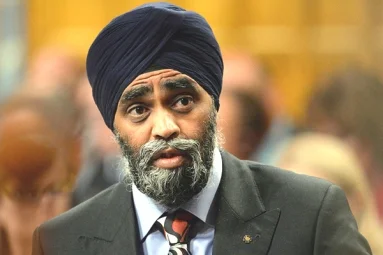
Harjit Sajjan

Harjit Sajjan

By Scott Taylor

Last Thursday the Liberal government gave Canadians a pre-Canada Day gift in the form of a clarification on our military role in Iraq. Defence Minister Harjit Sajjan joined Foreign Affairs Minister Chrystia Freeland at the press conference to announce the extension of the Canadian Armed Forces’ ‘advise and assist’ mission until March 2019. That revised end date was unfortunately about the only thing that is now clear about Canada’s commitment of troops to Iraq.

Since 2014, Canada has deployed special forces personnel to assist Kurdish militia in the battle against Daesh (aka ISIS or ISIL). This effort is part of a U.S.-led coalition operation to wipe out Daesh evildoers. Unfortunately for this hodgepodge collection of allied forces, the only unifying goal they share is eliminating the threat of Daesh.

Once that objective has been achieved, every one of these disparate militias — be they Shiite factions, secular Sunnis or Canadian-trained Kurds — is prepared to fight the other for the spoils.

The Kurds that Canada supports make no secret of the fact they are fighting for an independent state. Masood Barzani, the warlord turned elected president of the Kurdistan Regional Government (KRG), has declared that a referendum on independence will take place this September.

This will, of course, prove an awkward situation for our government as it has always been Global Affairs Canada’s stated policy to support the sovereignty of a unified Iraq.

Our soldiers on the ground — with permission granted by none other than Chief of Defence Staff General Jonathan Vance — have been recklessly flaunting Canada’s stated foreign policy by wearing the flag of Kurdistan on their combat uniforms. Vance’s explanation — that our wearing of Kurdish flags helps to foster good will between the Kurdish soldiers and the Canadian trainers — borders on the absurd: Canadian soldiers should not be wearing foreign flags on their uniforms, especially when that flag is a symbol of a breakaway non-recognized state.

In the joint Sajjan–Freeland announcement, it was stated that Canada will not be solely in support of the Kurds as the war in Iraq moves into the next post-Daesh phase. According to the Liberal government, the Canadian military now has the option to train “new potential partners within the Iraqi security forces.” If that is the case, then someone better tell our soldiers to take off their Kurdistan flags.

It will be interesting to see just which faction or factions Canada chooses to support. Elite soldiers in the Iraqi army loyal to the regime in Baghdad were recently found guilty of vicious war crimes committed during the battle in the city of Mosul, and the Shiite militia has an equally sullied reputation for committing atrocities. There are no white-hatted good guys in the complex factional violence that has gripped Iraq since the U.S. invasion of 2003.

This is the other thing that was notably bizarre about the announced extension. The Canadian government acknowledges that we will keep troops there for at least two more years, but it makes no attempt to even describe what we hope to achieve within that time frame. There is no goal, no objective, no explanation of what victory will look like.

It is simply a promised commitment to keep Canadians in harm’s way for a set period of time. Just like our repeated mission extensions in Afghanistan, there is not even any hint that those running this war expect to be successful anytime soon.

Offsetting the announced extension of the mission in Iraq was the confirmation that, despite pressure from NATO, Canada will not be sending troops back into Afghanistan. Given that there is just as little hope for a successful conclusion in Iraq, that decision is not very comforting.

We are not sure who we will be training in Iraq and we have no idea what we hope to achieve there, but we do know we will stay until March 2019, and that we will spend $378-million doing it.

How do you justify extending a war when you cannot describe what ‘victory’ will look like?

ON TARGET: Real Life Not Imitating Art

Brad Pitt in the movie War Machine

Brad Pitt in the movie War Machine

By Scott Taylor

I recently had the opportunity to watch the new, made for Netflix movie War Machine, starring Brad Pitt. The subject of the film is the U.S. led war in Afghanistan with Pitt playing the fictitiously named Lieutenant-General Glenn McMahon. While the name is changed to provide some Hollywood artistic licence, the movie closely depicts the real life Lieutenant-General Stanley McChrystal and the events that transpired during his command of the Afghan mission in 2009.

The opening scene has Pitt as McMahon strutting through the airport in Dubai along with his attendant staff officers. The narrator sets the scene, telling us that the war in Afghanistan is going poorly and therefore a new General – McMahon is being brought in to jump start the whole allied campaign. The plotline follows McMahon’s attempts to do just that, up until he is fired and the final scene is his successor and a fresh set of staff officers striding through an airport, full of confidence en route to Kabul to turn things around.

War Machine is a brave diversion from the usual rah-rah, war movie genre, propaganda in that it portrays former Afghan President Hamid Karzai as a powerless puppet of the U.S. . In one dramatic scene McMahon pursuesKarzai right into his private Presidential bedroom in order to get the Afghan leader’s permission to launch a large offensive. Karzai replies that both men know such permission is not his to grant – “but thanks for asking” he tells McMahon.

There is also a poignant moment after the big offensive begins and naturally enough, innocent civilians are killed. True to his beliefs, McMahon flies to the front lines to explain to Afghan villagers – through his translator – that the U.S. is intent on bringing Afghans security, democracy and freedom.

The bewildered Afghan elder replies concisely “Just leave.”

It was refreshing to see that a U.S. moviemaker understands that despite all of our good intentions and ideals, since 2001 the West has delivered nothing but violence, corruption and insecurity to the Afghan people.

Then of course came the real life news last week that the U.S. is committing more troops to Afghanistan, and urging NATO allies such as Canada to do the same. There will be a new commander and a new strategy and this time, by golly, we are going to get it right. U.S. Secretary of Defence Jim ‘Mad Dog’ Mattis admitted to a Senate Committee “We are not winning in Afghanistan right now. And we will correct this as soon as possible.”

Of course, Mad Dog neglected to say how the U.S. will do things differently after sixteen years of futile intervention. The only response seems to always be more troops.

Then we had former U.S. General David Petraeus – famous for his briefly successful, but ultimately failed surge strategy in Iraq – telling the media that we should brace ourselves for a “long-haul, generational war” in Afghanistan.

As if sixteen years isn’t already of generational length, Petraeus went on to point out that the U.S. has had a ‘long haul’ military presence in Korea for more than 65 years. Not mentioned by Petraeus was the fact that Korea and Afghanistan are as different as soap and beans. In Korea, the U.S. fought alongside Korean allies to prevent them being overrun by the North Korean Communist forces. This was successfully achieved in 1953 with the ceasefire agreement establishing a clearly defined boundary between North and South Korea. In Afghanistan the U.S. led intervention never eliminated the Afghan insurgency, and the U.S. trained and equipped Afghan forces are woefully inadequate to fight the war on the their own.

A better analogy would be that of the U.S. failure in Vietnam. If the U.S. pulls out of Afghanistan now, the corrupt cabal that they installed in Kabul will collapse just like the South Vietnamese, U.S. backed government did in 1975.

It is for certain that the U.S. would not have spent 65 years in Korea if every day their soldiers were being attacked and killed by fanatical Koreans.

The War Machine Afghan elder had the right answer “just leave”. The Afghan people are hardy survivors who will eventually sort out their own future – even if it does not resemble a western democracy.

ON TARGET: When The Good Guys Are Bad It is Time To Quit Iraq

By Scott Taylor

Earlier this month the Toronto Star published an exposé complete with graphic photographs depicting horrific torture and abuse of prisoners in Iraq. What made the story and images so shocking was that this barbarism was not the handiwork of Daesh (aka ISIS or ISIL) evildoers, but rather that those atrocities were blatantly perpetrated by the Iraqi Emergency Response Division (ERD).

The ERD is considered to be an elite counter-terrorism unit under the command of the Iraqi government’s Ministry of the Interior. The ERD has been a critical factor in the allied effort to recapture the city of Mosul from Daesh.

Canadian Special Operations Forces Command soldiers are working closely with Kurdish militia in that same vicious struggle to retake Mosul. While Canadians are not directly in support of the ERD, the soldiers in this elite unit are very much Canada’s close allies in a common struggle.

That is why the images of the ERD’s torture victims is so disturbing. The photos were taken by Ali Arkady, a photographer embedded with the ERD troops who seemingly had no qualms about allowing themselves to be filmed putting knives to prisoners heads, pressing fingers into eye sockets, or beating trussed up captives suspended from the ceiling.

Even more bizarrely, the ERD soldiers actually provided Arkady with a video depicting the execution of a terrified captive. In other words, there is no shame or guilt associated with their ruthless brutality; these guys are happy to have their violent exploits broadcasted for all to see.

Last week, General Jonathan Vance, Canada’s chief of defence staff, reacted to the torture revelations in an interview with the Toronto Star. “It doesn’t even fall into the category of understandable. In fact it mirrors what Daesh is doing, and you lose if you don’t maintain the moral high ground in this kind of war,” Vance said.

Vance also conceded that Canadians might question why Canada’s military is involved in a conflict wherein our allies are committing the exact same atrocities as those evildoers we are fighting against.

However, instead of questioning Canada’s role, Vance saw the ERD’s brutal behaviour as further proof as to why Canada should stay in Iraq. “They’re horrible. They need training, advice, and assistance,” he said.

To his credit, Vance apparently gets the fact that the ceaseless cycle of violence in Iraq’s interfactional conflict will continue unabated as long as reciprocal revenge is waged.

What Vance does not understand is that this level of barbarity is not going to be stopped by a few more lessons in a classroom, taught by good old Canadian combat soldiers with a firm grasp of the Geneva Convention. We do not have a training plan

that stresses the fact that prisoners are not to be beheaded, eye-gauged, or chained to the ceiling for days at a time. Some things we tend to simply take as a given.

Another problem with Vance’s assertion that training and assistance could turn the ERD around is the fact that they are not some “ragtag militia” as he asserted to the Star. The ERD are among the best-trained and motivated units available to the Iraqi central government in Baghdad.

When Daesh first rolled out of Syria and captured a vast swath of Iraq in 2014, the U.S.-trained and -equipped Iraqi army collapsed without much of a fight. Tens of thousands of soldiers defected en masse, leaving their weapon arsenals and vehicle fleets at the disposal of Daesh fighters.

The only thing that prevented Daesh from seizing Baghdad was a desperate call-out for volunteer Shia militias to stem the Sunni Muslim fanatical Daesh.

Those same Shia militias are still in the fight against Daesh and, therefore, are also ostensibly Canada’s allies in this fight. Unlike the Iraqi government’s ERD unit, these Shia militias are truly ill-disciplined and ragtag.

They are also fighting for purely factional-based revenge against Daesh’s Sunni supporters.

If a photographer embedded with an elite Iraqi government unit can uncover rampant occurrences of torture and execution, one can only imagine what sort of revenge abuse is being meted out by Canada’s even more notorious allies — the Shia militia.

Vance was right in his first assessment of the torture revelations: Canadians should seriously question why we are taking sides in this barbaric bloodletting.

ON TARGET: This Time Canada’s Defence Budget Is Going To The Moon!

Charlie Brown and Lucy 

Charlie Brown and Lucy 

By Scott Taylor

Last Wednesday’s release of Canada’s new Defence Policy reminded me of the old Peanuts cartoon. In a long running gag, Lucy promises to hold the football in place for Charlie Brown to kick it. Charlie brown is always suspicious and reminds Lucy that on every previous occasion she has snatched away the football at the last moment, leaving him kicking at air and landing flat on his back. Somehow, Lucy is always able to convince simple Charlie that this time it will be different. Once he is convinced, Charlie sets himself up with a long run, throughout which he tells himself “This time I’m going to kick this ball clear to the moon.”

That is where all of the self-proclaimed military boosters are right now. They have convinced themselves that this time, Lucy, aka the government of the day is really going to come through on her promise for a whopping 70% increase in the defence budget over the next decade, including the acquisition of all kinds of new equipment. The policy review also calls for an increase in personnel up to 71,000 from the current level of 68,000 – which in reality is fewer than 66,000.

For those of us long enough in the tooth to remember such things, thirty years ago the Progressive Conservative government promised a similarly robust investment in Canada’s military. The 1987 White Paper on Defence advocated the acquisition of twelve nuclear submarines and 400 main battle tanks. The Royal Canadian Navy presently operates four used diesel-electric submarines, and there are but 40 operational tanks in our Army.

 That same blueprint called for the purchase of 820 Northern Terrain Vehicles- an articulated, tracked, multi-purpose utility vehicles which would have equipped Army reserve units across Canada. That project got as far as the factory being built in Calgary to assemble the NTVs, before the whole thing was scrapped.

The original plan for our current Patrol Frigates was to build twelve with an option for an additional six. When six additional frigates were cancelled, it was announced that the Navy would get six ocean going Corvettes instead. That scheme simply disappeared from the books.

 In 2005 the Army announced they were going to invest nearly one billion dollars into something called the Multi-Mission Effects Vehicle. These 30 MMEV’s were essentially a reconfiguration of the 1980’s Air Defence, Anti-Tank (ADAT) system mounted on a wheeled chassis. Like the ADATs, the MMEV never actually entered Canadian service and in 2007 the project was quietly scrubbed.

In the summer of 2009 the Army announced with much fanfare that it was going to spend over $2 billion to purchase 108 Close Combat Vehicles. After conducting not one, but two sets of trials, the decision was taken in December 2013to not by any CCV’s for the Army.

In 2004 Canada announced the Joint Support Ship project which should have had the first of three supply ships built and in operational service by 2012. That procurement was cancelled in 2009, and now the RCN cannot expect delivery of a new supply ship before the year 2021.

The Air Force first announced it was seeking to replace its aging Sea King helicopters in 1983. Thirty-four years later the same old Sea Kings are conducting operations in the Mediterranean.

So forgive me if I don’t join in the current discussion as to how high we are going to kick the football this time. I will believe it when I see it.

The huge projected budget hike did resonate well south of the border it would seem. Trump’s spokesman Michael Short tweeted out a triumphant message that Canada’s 70% increase in defence spending was a case of the Donald “getting results”. Yeah, and Charlie Brown thought he could kick a football to the moon.

ON TARGET: Somalia And Afghanistan Were Failures, We Need To Admit It

A Canadian Forces soldier from A Company, 1 Platoon, 1st Battalion Princess Patricia’s Canadian Light Infantry surveys the perimeter within the Zjarey district, west of Kandahar, in a joint Afghan National Army and Coalition security operation to re…

A Canadian Forces soldier from A Company, 1 Platoon, 1st Battalion Princess Patricia’s Canadian Light Infantry surveys the perimeter within the Zjarey district, west of Kandahar, in a joint Afghan National Army and Coalition security operation to remove Taliban forces from the area. (Photo by MCpl Robert Bottrill, Canadian Forces Combat Camera)

By Scott Taylor

Last week I attended the two-day annual defence and security tradeshow in Ottawa known as CANSEC.

While this exhibition is a great opportunity for the defence industry to showcase their latest technology to military personnel, it is also a rare venue for media to have casual access to a wide variety of serving soldiers.

During one encounter with a veteran of the 1992 mission to Somalia, this ex-paratrooper lamented the controversial decision to disband the Canadian Airborne Regiment in 1995. The Liberal government of the day, under then Prime Minister Jean Chrétien, had taken the decision to disband this heretofore elite unit following revelations of violent atrocities in Somalia and the release of a video tape displaying a vulgar hazing ritual at the Airborne Regiment’s home base in Petawawa. The ex-paratrooper did not downplay the seriousness of those incidents, which were dubbed the ‘Somalia Scandal’ in the press, but he felt that by the time Chrétien ordered the regiment disbanded in disgrace, the unit had redeemed itself. He went on to say that because of the focus on the two violent incidents – one involved the execution of a wounded looter, and the other a beating death of an unarmed teenage prisoner – the people have forgotten that the mission was otherwise quite a success. This of course was the standard solitary response at the time.

While the press concerned themselves with these barbaric and shockingly ‘un-Canadian’ acts of violence and the subsequent top level attempts to cover them both up, all the good news stories were left untold. Yes, it is true that during the Canadian deployment to Somalia as part of a U.S. led coalition, there were some schoolhouses built, some food got delivered, and some wells were dug.

However, one cannot lose sight of the bigger picture. The international community abandoned Somalis to their own fate. Not surprisingly, that war torn country plunged back into a failed state awash in violent anarchy.

Despite whatever good our soldiers may have achieved during their brief deployment we cannot deceive ourselves into believing that the Somali mission was in any way successful. It was a huge cock-up that failed miserably.

Which brings us to Canada’s more recent military intervention in Afghanistan as part of another U.S. led coalition. Many soldiers at CANSEC spoke proudly of their deployment to Kandahar. Despite the sacrifice of 158 of their comrades killed in action, another 2000 suffering physical wounds and an untold legion of veterans coping with PTSD, they spoke of the difference they had made in the lives of the Afghan people. Like the Somali veteran, they reflected on the schoolhouses built and the irrigation systems that were dredged in the Kandahar valley. However, Canada ceased combat operations in Afghanistan in 2011, and shut down the subsequent training mission in 2014.

Since our military’s withdrawal the Afghan insurgency has continued unabated. As witnessed by last Wednesday’s massive bomb attack in the centre of Kabul’s heavily protected diplomatic zone – that left over 100 people dead and 400 people wounded – the Taliban can strike anywhere in Afghanistan. Afghan security forces trained and equipped by NATO are no match for the insurgents who currently control over 40% of Afghanistan's territory. The military power vacuum has allowed the dastardly Daesh (aka ISIS) evil-doers to establish a foothold in Afghanistan’s eastern provinces.

It is only a matter of time before the Americans will weary of putting fresh lipstick on the corpse of their Afghanistan democracy experiment. Once the U.S. troops withdraw, Afghanistan will plunge back into an impoverished failed state awash in violent anarchy.

In other words, despite any temporary progress made during our soldiers decade long deployment and sacrifice, Afghanistan is a huge cock-up that is failing miserably. We need to admit these failures rather than proclaim them to be unrecognized successes in order that we do not repeat such mistakes on future commitments into foreign conflicts.

ON TARGET: Maybe America Should Spend Less On Defence Rather Than NATO Spending More

By Scott Taylor

At last week’s NATO summit meeting, U.S. President Donald Trump surprised no one with his bombastic comments on defence spending.

The Donald has long railed against those NATO member states that do not spend the target goal of 2% of their gross domestic product (GDP) on the military.

Yes, with Canada spending barely 1% of GDP on defence, we would be lumped in with the group Trump refers to as ‘laggards’. We are certainly not short of company in the laggard club as only five NATO countries currently spend that magical 2% of GDP while the other 23 fall short.

In Trump’s opinion, those of us who have failed to meet this defence-spending goal are a burden on the U.S. taxpayers. As we are all responsible for the collective defence and sovereignty of the 28 member states, Trump believes those not pulling their 2% of GDP weight actually owe a debt to the U.S.

That line of reasoning might make sense if NATO was actually at war, or if there was even a tangible threat to the alliance. That the U.S. chooses to spend a whopping 3.6% of their GDP on defence, which amounts to more than double the collective dollar figure of the other 27 NATO countries combined, is purely out of America’s quest to remain a superpower, rather than defending the sovereignty of places like Latvia and Montenegro.

Trump himself described NATO as “obsolete” and the U.S. has shown in recent history that it has no hesitation in wielding its military force without either consent or consultation with the alliance.

To wit, in 2003 U.S. President George W. Bush falsified claims that Saddam Hussein possessed weapons of mass destruction in order to justify illegally invading Iraq. That ill-fated campaign quickly toppled Saddam, but it failed to secure the country. Instead, the U.S. invasion triggered a fanatical insurgency and wholesale inter-factional bloodletting that continues to this day.

The war in Iraq cost U.S. taxpayers trillions of dollars and, given the violent anarchy that resulted and has since spilled over into Syria, the Middle East remains engulfed in the bloodiest conflicts since the Crusades.

Has that vast expenditure of U.S. tax money helped to protect America’s NATO allies? Hell no. Instead, the protracted violence and instability has led to the current migrant crisis, which our European NATO allies are all struggling to cope with.

The U.S. similarly took a lead role in toppling Moammar Gadhafi in Libya in 2011.

Technically, the United Nations Security Council passed a resolution authorizing NATO to enforce a no-fly zone over Libya to prevent Gadhafi from using his air force to punish rebellious civilians.

However, simply keeping the Libyan air force on the ground was never America’s goal. From the outset it was regime change, and the minute they had a UN no-fly zone authorization, the U.S. exceeded its mandate and began bombing Gadhafi loyalists. Gadhafi was prevented from bombing rebels; but the U.S.-led NATO air armada had virtual unrestricted authority to bomb Libyans.

Of course, no one planned for the aftermath of Gadhafi’s removal, and as a result the Libyan rebels immediately began battling among themselves once he was executed. To this day, Libya remains a failed state gripped by violent anarchy. It is also a principal conduit for the masses of African migrants seeking to cross the Mediterranean to seek a better life in Europe.

Instead of buckling under to Trump’s demands to spend more, NATO leaders should take the bullyboy to task for America’s reckless role in all of these unresolved conflicts.

Thanks to the U.S. track record of illegal invasions and regime changes, the world is less safe now than at any point since the end of the Second World War. Maybe the answer is not for the laggards to spend more, but for the U.S. to spend less, and to refrain from kicking over political hornet’s nests around the globe.

ON TARGET: Canada must stay out of any future NATO mission in Afghanistan

By Scott Taylor

On May 25, NATO will host a heads of state summit in Brussels, and at the top of the agenda list will be the war in Afghanistan. The simple truth is that the NATO-trained and -equipped Afghan National Security Forces are losing the war to a resurgent Taliban.

That right folks, after 16 years of being trained, mentored and molded by NATO forces, including Canadians up until 2014, the Afghans need an urgent infusion of more NATO troops or else the Taliban is poised to regain control.

The senior NATO commanders will argue to the heads of state – including Canada’s own Prime Minister Trudeau — that if we, as member states, don’t send reinforcements to Afghanistan, then all of the progress made towards democracy will be lost.

Generals reason that we owe it to all of those NATO soldiers who made the ultimate sacrifice to the Afghan cause, including 158 Canadian soldiers killed, to once again pony up more soldiers, more money and more weapons to shore up the government in Kabul.

This would of course be the pack of murderous thugs and crooks headed by the dual leadership of President Ashraf Ghani and Chief Executive Officer Abdullah Abdullah, which is considered to be one of the most corrupt regimes on the planet. So much for our success in terms of foisting democracy upon the people of Afghanistan.

For those who care to recall, the 2014 presidential election was so rife with corruption and voter fraud that no clear winner could even be determined. Thus it was a compromise solution that led to the creation of a national CEO position, which would allow Abdullah Abdullah to share power equally with Ashraf Ghani.

Trained, equipped and paid by NATO, the Afghan forces took the lead role in the combat mission against the Taliban in 2014. However, since then they have suffered staggering losses, which have resulted in plunging morale, wide-scale desertions and even wholesale defections to the Taliban.

The Afghan National Security Forces are themselves corrupt and inefficient, with no clear-cut motivation to prop up their corrupt, inefficient West- installed leaders.

One of the biggest problems Afghan commanders are facing is what are known as ‘ghost soldiers.’ These are not sinister unearthly spectres, but Afghan soldiers which are on the books collecting pay and rations but who simply do not exist. There have been occasions when Afghan forces were called upon to resist a Taliban attack and, instead of the paper strength Kandak (a battalion of approximately 900 soldiers), only a handful of demoralized troops were actually available for combat.

It is estimated that the resurgent Taliban have reclaimed approximately 40 per cent of Afghan territory and one can only imagine what the situation would be like were it not for the continued presence of 9,000 U.S. troops and an additional 4,000 NATO soldiers.

Despite their so-called ‘train and assist’ mandate, U.S. Special Forces have often been called in to bolster the Afghan National Security Forces to prevent their complete collapse in combat. One must also add to this mix the overwhelming air armada the U.S. has on station to support operations as well as their extensive fleet of armed unmanned aerial vehicles.

At the upcoming summit in Brussels, the NATO commanders will claim that they need member states to pony up more resources, with the excuse that creating an Afghan army that is self-sufficient takes time.

Folks, a reality check will show that we have been training Afghans for longer than the First and Second World War combined. It is not about training more recruits, it is about motivating them to fight. The Taliban are drawn from the same talent pool as the Afghan Security Forces and,  without the benefit of international monitoring and the provision of modern weaponry, have shown themselves to be formidable fighters.

As such, unless there is a sweeping proposal to remove the current Kabul regime and install an interim administration with a clearly defined anti-corruption mandate, Canada should flatly refuse NATO’s request to return to Afghanistan. Remember that Einstein’s definition of insanity is doing the same thing over and over again yet expecting a different result.

Let’s stop the insanity.

ON TARGET: Mission In Latvia A Waste Of Cash And Resources

Cincu, Romania. Corporal Michaël Lafrenais-Dietrich of the Voltigeurs de Québec and Private Simon Tremblay of the 1st Battalion, Royal 22e Régiment (in background) fire the Carl Gustav short-range anti-armoured weapon, as Corporal Sonny Gauthier of …

Cincu, Romania. Corporal Michaël Lafrenais-Dietrich of the Voltigeurs de Québec and Private Simon Tremblay of the 1st Battalion, Royal 22e Régiment (in background) fire the Carl Gustav short-range anti-armoured weapon, as Corporal Sonny Gauthier of 5e Ambulance de campagne (in foreground) supports their efforts, during a live-fire frontal assault exercise on a firing range in Cincu, Romania on April 9, 2016 during Operation REASSURANCE. (Photo: Corporal Guillaume Gagnon, Liaison Officer Driver, Operation REASSURANCE Land Task Force)

By Scott Taylor

Early next month the first of an estimated 450 Canadian troops will begin deploying into Latvia. The purpose of this mission is part of a major NATO effort known as Enhanced Forward Presence to deter any Russian aggression into the Baltic States. Given that Estonia, Lithuania and Latvia all became full-fledged members of the NATO alliance in 2004, this deployment of thousands of NATO troops along the Russian border is an unnecessary provocation of the Kremlin.

Article Five of the NATO Treaty states that if an armed attack occurs against one of the member states, it is to be considered as an armed attack against all members and, as such, they are entitled to collective defence. In other words, the Baltic States are already protected by the overwhelming might of NATO’s military power.

By their very definition, the multi-national forces being deployed into the Baltic are described as a tripwire defence. Defence experts have speculated that even with the bolstering of some 4,000 NATO troops from 15 different countries, Russian forces would roll over the Baltic in 36 to 60 hours.

If it were to be a true military deterrent — in other words, an effective fighting force — it would not be constituted as a hodgepodge of nations. For instance, the Canadian-led force will be augmented with soldiers from Albania, Italy, Poland, Slovenia and Spain. All of these countries are capable of producing excellent war fighters, but battlefield communications could prove problematic.

Even though Canada is a fully bilingual nation and our armed forces reflect that bilingualism, we still have enough common sense to segregate our combat forces into English- and French-speaking units. When you are locked in a life-or-death struggle, where every moment counts, you do not want to be relying on Google Translate to communicate with your allies.

In theory, the presence of soldiers from an additional 15 NATO countries would mean that, in the event of a full-scale Russian invasion, all contributing nations would have dead soldiers to avenge, not just Baltic states to liberate.

However, unless Putin loses his marbles, he will never challenge a NATO alliance that collectively spends more than 20 times the annual Russian defence budget, and whose military manpower dwarfs those of the Russian forces.

To keep the sabres rattling and the Cold War revisited, the usual alarmists point to the fact that this summer Russia will be conducting a massive military exercise. Scary stuff indeed, with an estimated 70,000 to 100,000 troops conducting exercises all along Russia’s western borders. Except that these Zapad exercises (literally meaning west) have been conducted every four years since 2009.

Despite the Chicken Little predictions that Putin will use this assembly of troops to unleash Armageddon upon us, by all estimates this year’s Zapad operation will be significantly smaller than the one conducted in 2013.

Then we have the magnified fear of a full-scale Russian disinformation campaign against the NATO troops that will soon be stationed in the Baltic. This fear is so overwhelming that Canadian commanders made the decision to keep our soldiers locked up on their Latvian bases for the duration of their tours.

That’s right folks, our young warriors are deploying to Latvia to protect the citizenry from the evil Russians, and they will not be allowed to socially interact with those same locals for fear that the Russians will invent atrocities. Any excursion off the base will therefore be supervised outings to places like local museums and restaurants.

Under such circumstances, boredom will become our soldiers’ worst enemy. This is not a shooting war like they faced in Afghanistan; it is simply NATO putting soldiers on the Russian border to show that we can. For these soldiers to be confined to barracks — far from home and loved ones for extended periods of time — makes no sense.

We can better avoid Russian disinformation by not putting our soldiers in Latvia. The hundreds of millions of dollars we will spend on building infrastructure and logistic support for this mission would be better spent on Canadian bases.

As for the security of Latvia, rest assured that NATO members will uphold the sanctity of Article Five — with or without our soldiers being in harm’s way.

ON TARGET: Madness In Mosul

credit: arabstoday.net

credit: arabstoday.net

By Scott Taylor

For those closely following the conflicts in Syria and Iraq, it would appear that the days of the self-proclaimed caliphate of Daesh (aka ISIS or ISIL) are coming to an end. Backed by Russia and Iran, Syrian President Bashar al-Assad and his loyalist forces have had recent success against the Daesh forces based in and around the city of Raqqa.

Some reports suggest that embattled Daesh fighters have sought to desert the current fight and join the ranks of al-Qaeda instead. However, I’m not sure how, in the bigger picture, this change of alliance will matter squat given that both Daesh and al-Qaeda are fundamentalist Sunni extremist evildoers.

However, in the same way that the election of Donald Trump as U.S. President made George W. Bush appear like a sage statesman by comparison, Daesh atrocities somehow have made al-Qaeda seem like a more reasonable brand of Islamic terrorists. But I digress.

In Iraq, the U.S.-led international alliance has stepped up its siege of the Daesh-held city of Mosul. This combat offensive is now well into its seventh month, and Canadian special forces soldiers have been playing an active role in assisting the Kurdish militia in that quest. The reason for such a lengthy battle can only be partially attributed to the fanaticism of the Daesh defenders. It is now estimated that there are less than 1,000 Daesh fighters holding on to approximately 30 per cent of the western part of Mosul. The eastern half of the city was reported as being fully liberated by the alliance in late January.

To keep their fighters loyal to the cause, Iraqi news reported that Daesh has begun lopping off the ears of those suspected to be plotting surrender or desertion. This seems like a hell of a way to enforce loyalty, but if nothing else it should make it easy to identify these one-eared individuals after the battle.

The final stronghold of Daesh in Iraq is in the old city of Mosul which, with its labyrinth of narrow streets, will prove a nightmare for the alliance attackers.

It is of course reluctance on the part of the allied units to endure that nightmare that has led to the snail’s pace of the overall siege. Although the assorted hodgepodge of allied units outnumbers the remaining Daesh forces groups by something like 25 to 1, the fact is that all of these disparate groups are fighting for a different ultimate objective.

There are American advisors and troops on the ground, and the U.S. is coordinating the massive aerial armada, which includes Canadian refueler and reconnaissance aircraft. The U.S. policy is to support the corrupt regime of Prime Minister Haider al-Abadi in securing a unified, Daesh-free, Iraq under a central Baghdad authority. That is also the stated intent of Global Affairs Canada.

While al-Abadi is a Shiite, many of the Shiite militia assisting in the siege of Mosul are waging a punitive offensive against the Sunni followers of Daesh, in the name of a holy war. Revenge atrocities committed by the Shiite militias in the early stages of the Mosul offensive have cast doubt upon their suitability for any post-victory occupation role.

Also on the ground are a large number of Iranian military advisors who are working directly with the Shiite militias.

Then of course you have the Kurdish militia, which have been tutored by some of Canada’s most professional commandos. But these Kurds are not fighting to liberate the Sunni Arab residents of Mosul from the Sunni Arab Daesh extremists. They are instead fighting to increase Masood Barzani’s bargaining position in the Kurdish quest for an independent state. Barzani is the president of the Kurdistan Regional Government, and he has been adamant from the get-go that he has no intention of ever returning to a unified Iraq under the control of al-Abadi.

The allied commanders have vowed that they will liberate the remainder of Mosul within the next three weeks. With the elimination of their common enemy, the power struggle among the various allies is sure to erupt. Rather than sticking around to pick sides, Canada would be wise to pull out our trainers and leave the future of Iraq and Syria to the regional stakeholders and the world’s superpowers.

Not our fight.

ON TARGET: Does Anybody Check Trump's 'Facts'?

By Scott Taylor

Ever since Donald Trump was elected US President the Canadian defence community has been in a self-flagellating flap. The reason for this being that the tough talking Trump made it part of his campaign platform to crack down on NATO member states that are not paying their fair share in terms of defence spending. The arbitrary yardstick used by Trump is NATO’s own self-professed goal for countries to spend 2% of their Gross Domestic Product (GDP) on weapons and soldiers.

Canada currently spends a little less than 1% of our GDP on National Defence, which would put us squarely in the Donald’s sights as a delinquent freeloader, unworthy of US protection, and a drain on the alliance

Fearful of invoking the ire of our closest ally and only nation with whom we share a common border, many a Canadian defence pundit has urged the Trudeau government to rapidly increase our defence spending to reach this 2% of GDP goal. There is a whole choir of them singing from the same song sheet, but lead soloist, David Perry of Canadian Global Affairs Institute is perhaps the most strident voice among them. Like a pet shop parrot, Perry repeats “two percent of GDP” to anyone, and everyone who will listen.

The reality of such an increase would mean that the Liberal government would need to find $20 billion per year in tax revenue every year, which would either mean massively increasing our current deficit or cutting services from other departments. That would be one hell of a big pill for Canadians to swallow.

Perry and the Colonel Blimp brigade argue that we need to meet Trump’s “two percent of GDP” objective if only to keep the orange haired bully boy appeased. The problem with that approach is that when it comes to spending money on defence, Trump will never be satisfied.

Just last week Trump complained that Saudi Arabia was not paying its fair share for collective defence in the Middle East. “Frankly, Saudi Arabia has not treated us fairly because we are losing a tremendous amount of money defending Saudi Arabia” Trump told reporters. This of course echoed Trump’s election campaign message wherein he claimed the US was “losing it’s shirt” in protecting Saudi Arabia.

This all sounds plausible to a lay audience in North America, wherein we are eager to believe that poor old US G.I. Joes and Janes are holding the bad guys at bay, while fat cat Saudis spend their days counting oil profits.

The reality is that Saudi Arabia has the third largest defence budget in the world, behind only the US and China. In terms of defence spending per capita, Saudi Arabia ranks number one, and its defence spending as a percentage of its GDP               is by far the highest in the world at a staggering 10%.

The estimated $88 billion (US) annual defence budget is not simply squandered away on excessive salaries and fancy uniforms. The Saudis have approximately 688,000 active military personnel in their armed forces including reservists.

The Saudi army has nearly 1200 main battle tanks, and the air force employs over 300 frontline fighter jets. By comparison, Canada operates 80 main battle tanks and just 80 CF-18 fighters.

The Saudis are by no means a military powerhouse, but they do engage in regional disputes. In 2011, Saudi forces entered Bahrain to prop up the Sunni muslim monarchy against a popular uprising by the Shiite majority. Some 1500 Saudi troops remain in Bahrain as a deterrent to future unrest.

There are also nearly 10,000 Saudi troops deployed into neighbouring Yemen to assist the deposed Sunni regime in its attempt to overthrow the new Shiite government in Sana’a.

Canadian pundits should realize from Trump’s latest rant against the Saudi freeloaders, that it matters not what you spend, nor how many soldiers you put in harms way, you are still a freeloader in the Donald’s eyes.

Canada has the best military in the world, and we have contributed to the costly international interventions in the recent past. That should mean a lot more to our US neighbours then spending an arbitrary percentage of our GDP.

ON TARGET: Trump vs. Kim Jong-Un: Who Is More Dangerous?

By Scott Taylor

To follow the course of recent Western political and media rhetoric, North Korean President Kim Jong-un is a reckless megalomaniac with a goofy haircut who is bent on a nuclear war with the U.S.

All eyes were on the Kim Jong-un regime as they prepared to celebrate the country’s national holiday on April 15. Tradition has it that every year on this date, North Korea flexes its military might with massive parades and displays of firepower in celebration of the birth of the country’s founder. This year was no different as a defiant President Kim Jong-un was expected to conduct yet another nuclear test as well as launch a medium-range missile.

However, the game changer on this side of the Pacific Ocean is that Donald Trump is now in the White House. Facing the lowest domestic approval rating for a president’s first quarter in office, Trump is eagerly seeking foreign distractions.

To counter North Korea’s bluster, Trump dispatched the USS Carl Vinson aircraft carrier strike group — described by White House spokesman Sean Spicer as “an armada” — to patrol off the Korean peninsula.

U.S. Vice-President Mike Pence was also sent to South Korea to issue a stern warning to the Pyongyang regime that America will no longer tolerate North Korea’s actions. “The era of strategic patience is over,” stated Pence to bring home that point and to illustrate the resolve of Trump to act decisively.

Pence reminded everyone that only hours earlier the U.S. military had launched what is known as the “mother of all bombs” against Daesh fighters in Afghanistan.

The 11-ton MOAB (Massive Ordinance Air Blast) is considered to be the largest non-nuclear explosive device on the planet. It was developed in time for the 2003 U.S. invasion of Iraq, but Saddam’s army melted away before they could test the MOAB. With a three-kilometre destructive diameter, the MOAB was considered too lethal and too indiscriminate to be used in counterinsurgency operations such as Iraq or Afghanistan. That was until Trump needed to send a tough message to North Korea.

The target of the MOAB, we are told by U.S. military officials, was a Daesh (aka ISIS and ISIL) military base. For some reason, these Daesh fighters were in the remote eastern Afghanistan province of Nangarhar, digging a tunnel complex. Given that these tunnels were nowhere near any Afghan villages, there was no risk of any civilian casualties.

In other words, Daesh had inadvertently handed the U.S. Air Force the perfect target to test the world’s biggest non-nuclear bomb: A large group of evildoers huddled together in the middle of nowhere.

With the bombsite still on U.S. military lockdown, we have no way of verifying their claim that 94 Daesh fighters were killed without a single civilian casualty.

The truth of the matter is that the use of the MOAB had nothing to do with eliminating a small band of Daesh fighters in Afghanistan and everything to do with showing North Korea that Trump will drop massive bombs on real targets.

Trump also violated international law on April 6 when he fired 59 Tomahawk cruise missiles into Syria as a punitive measure against President Bashar al-Assad for his alleged involvement in a chemical weapons attack. No independent agency has yet proven who launched that chemical weapon in Syria, yet Trump has already delivered a lethal punishment.

For Kim Jong-un, April 15 turned out to be a bit of a bust. The KN-17 missile that was test fired embarrassingly blew up shortly after take-off, and the satellite imagery of his nuclear test site revealed the workers to be playing a tournament of volleyball at the suspected ground zero.

There are two reckless megalomaniacs with goofy haircuts playing in a game of brinkmanship on the Korean peninsula. It is not yet clear which of the two is more dangerous.