ON TARGET: False Flags Nothing New

1.jpg

By Scott Taylor

In recent weeks we have seen two major incidents occur – the March 4 poisoning of former Russian double agent Sergei Skripal and his daughter Yulia, and the April 7 attack on the embattled Syrian town of Douma.

In both cases we were told by western intelligence agencies, before any actual investigation had taken place, exactly who the culprits were. In the Skripal incident it was of course Russian President Vladimir Putin, whose bumbling secret service are supposed to have used a nerve agent in the attempted murder.

The Douma attack was pronounced to be a chemical strike by Syrian President Bashar al-Assad, assisted by his ally Putin.

In both cases punishment has already been meted out by the same western countries who pride themselves on representing the rule of law, wherein the accused is presumed innocent until proven guilty. Based on the unproven British allegations of Russian state involvement in the Skripal attack, Canada has joined 28 other countries in expelling a combined total of 150 Russian diplomats.

The Douma chemical attack is looking more like a clumsy hoax perpetrated by Islamic extremist rebels, yet Canada was among the first to give a big “attaboy” pat on the back to the U.S., UK and France for launching their punishing missile strike against Assad on April 13.

What has been missing from the vast majority of media reports is the necessary skepticism to challenge the original official versions.

False flag incidents, or staged hoaxes have been used throughout history as clumsy pretexts to initiate conflict.

On the evening of August 31, 1939, a small group of German intelligence operatives disguised themselves in Polish army uniforms, crossed the German-Polish border, and seized a German radio station. They broadcast a brief anti-German message and then to make things seem more real, they executed a hapless prisoner named Franciszek Honiok. His corpse, complete with Polish uniform, was presented as ‘proof’ of an unprovoked aggression by Poland on German soil. The operation’s code name was Grandmother died.

The very next day, September 1, with the ink not yet dry on the newspaper accounts of the Polish attack on the Gleiwitz radio station, Hitler’s massed military rolled into Poland. According to the German press, the invasion was in reprisal for this blatant Polish aggression. Hitler was simply defending his people according to the official Nazi narrative at the time.

In August 1964, the U.S. reported that one of its Navy Destroyers had been involved in one, or possibly two firefights with North Vietnamese gunboats. At that juncture, the U.S. was providing just a handful of military advisors to South Vietnam in their ongoing clash with North Vietnam.

The official version of events was that the USS Maddox was minding its own business sailing on an intelligence gathering patrol in the Gulf of Tonkin, when these little North Vietnamese gunboats defied all logic, not to mention international law, and attacked the much larger U.S. warship.

In the one sided exchange, USS Maddox escaped with a single bullet hole in damage, while all three North Vietnamese ships suffered serious damage. However, that alleged attack on USS Maddox was enough for President Lyndon Johnson to pass the Gulf of Tonkin resolution granting him the right to combat “communist aggression” in Southeast Asia. Within months there were 500,000 U.S. troops in Vietnam to avenge the damage done to USS Maddox.

Following Saddam Hussein’s invasion of Kuwait in August 1990, a tearful young Kuwaiti girl told U.S. Congress that she had witnessed Iraqi soldiers dumping infants out of incubators and leaving them to die on the floor. After Saddam’s defeat the following year, it was revealed that the incubator story was totally fabricated and the ‘witness’ was in fact the daughter of the Kuwaiti Ambassador in Washington.

In 2003, the U.S. and UK told the world that Saddam Hussein had weapons of mass destruction. That lie was exposed after the invasion, and fifteen years later, Iraq remains a failed state of violent unrest.

It does not make one an “Assad apologist” or a “Russian propagandist” to ask western leaders to show proof supporting their allegations. These same agencies have lied to us before, often with catastrophic results.

Long after the war, while in the final years of his captivity in Spandau Prison, Nazi leader Albert Speer opined that the only thing which could have prevented Hitler’s rise to power was “a free press.”

That is a powerful statement.

ON TARGET: How Dumb Is Assad?

Bashar al-AssadPresident of Syria

Bashar al-AssadPresident of Syria

By Scott Taylor

On Saturday, April 7, I awoke to catch a breaking story on CTV’s news channel. It was being reported that a chemical weapons attack had been perpetrated in a rebel held town in Syria.

Veteran news anchorman Brad Griffin deadpanned a warning to viewers that the video images they were about to see were “graphic and disturbing.”

The shaky footage depicted a number of individuals animatedly washing the alleged victims with water hoses. None of them were wearing any form of gas mask or protective clothing.

One young girl, about three years old was crying loudly – as would any three year old being doused vigorously with cold water. One helper is shown holding another toddler face down while he forcefully gave him thumps on his back as though to dislodge a food particle stuck in the young lad’s throat.

While not graphic, it was certainly disturbing to see such a clumsy attempt to portray the aftermath of a chemical weapon attack. Further footage showed a rebel – this time wearing an old gas mask, but still without a hazmat suit, pointing at a 225-kilogram unexploded barrel bomb that was lying on a single bed amidst some plaster and debris.

While I cannot disprove the allegation that this was a chemical bomb dropped by the Syrian Air force, I can state with some authority that it must be one hell of a sturdy bed frame.

A 225-kilogram projectile dropped from an altitude which would have at least allowed it to reach terminal velocity, penetrates a ceiling without detonating and then gently comes to rest on a small cot? That seems like one hell of an unlucky break for Syrian President Bashar al-Assad. We know that he uses barrel bombs, so he must be the one to blame. Case closed.

Which brings us to the next question, which is, why would Assad resort to the use of chemical weapons? And why now? The targeted area was the Eastern Ghouta town of Douma, which at the time of the alleged gas attack was under the control of radical Islamist rebels, and heavily besieged by Assad loyalists. Backed by the Russian military, the Syrians had the upper hand in Douma and were in the process of negotiating a ceasefire with the extremist rebels.

That truce subsequently did take place last Thursday with the Islamist fighters relinquishing control of the town to Syrian – Russian forces in exchange for re-location to another rebel-held region of Syria.

So, on the verge of a battlefield victory, why would Assad be so stupid as to employ the one weapon which almost guarantees the condemnation of the world? It also seems rather short-sighted to hurl barrel bombs full of chlorine gas and nerve agents into an area that you know your own soldiers are about to occupy.

Although no independent investigation has been conducted, Nikki Haley, U.S. Ambassador to the UN, has claimed: “We definitely have enough proof.” French President Emmanuel Macron echoed the claim, saying he too has “proof”, and U.K. Prime Minister Theresa May concluded it was “highly likely” that Assad is to blame for employing chemical weapons at Douma.

U.S. President Donald Trump took to the Twittersphere to warn Russia that American missiles will be “coming” against the Syrian military in retaliation for the alleged gas attack, but he did not give a timeline.

Just to recap what we need to swallow in order to accept the presumption of Assad’s guilt and Russia’s complicity: 1) A group of Syrian Islamist extremists is on their last legs and about to capitulate. 2) Unable to restrain his urge to kill his own people, Assad unwisely drops barrel bombs of toxic chemicals on the rebel enclave. 3) The victims include children, which naturally incenses the civilized world. Remember nobody gave a rat’s when the U.S. dropped the Mother-of-All-Bombs (MOAB) on Islamist extremists in Afghanistan because the U.S. assured us that no innocent children or family pets were greased in the blast.

So, essentially, the U.S. will be assisting Syrian Islamic extremists in their efforts to punish Assad, who is allied with nuclear super-power Russia. And at the epicenter of this potential apocalypse is one unbelievably strong bed frame.

ON TARGET: Trump Might Be Right About Syria And U.S. Troops

Donald Trump - Flickr Gage Skidmore

Donald Trump - Flickr Gage Skidmore

By Scott Taylor

There has been a lot of recent discussion in the U.S. about the future of American military forces in Syria. President Donald Trump has been impetuously tweeting out his desired intention to bring the Doughboys home. This sentiment has been contradicted by senior military officials who have insisted that U.S. troops will remain in Syria for the long haul - whatever that might mean.

While those pundits stuck in the weeds of partisan politics have focused on how this dichotomy of views once again pits the Donald against his top advisors, the fact is that no one is asking under what legal authority are American troops on Syrian soil?

Back in 2015 under President Barack Obama the U.S. sent in about 50 military advisors to assist in the fight against the Daesh (aka ISIS or ISIL) evildoers in Syria.

At that juncture Syria had been embroiled in a multi-factional civil war since 2011. What had originally been hailed in the west as a democratic uprising against Bashar al-Assad, Syria’s oppressive dictator, quickly became a murky muddle of disparate factions fighting for a variety of different causes.

Sunni Muslim extremist groups linked to al-Qaeda were fighting alongside Kurdish separatists in a bid to oust Assad, who in turn had cobbled together his own unlikely alliance of Alawite Shiites, Chaldean Christians, Hezbollah fighters and Iranian military advisers.

Once Daesh had morphed out of existing Sunni extremist groups in Syria they soon established themselves as not only the most effective fighting force in the region, but also the most ruthless and bloodthirsty.

In January 2014, Daesh exploded out of Syria and into Iraq’s so-called Sunni triangle, destroying the U.S. trained and equipped Iraqi security forces as they captured a swath of territory including the city of Mosul.

With Iraqi security forces defeated, and the evil Daesh horde pushing towards Baghdad, Obama felt obliged to send assistance to the embattled Iraqi regime.

In for a penny, in for a pound, once the U.S. was engaging Daesh on Iraqi soil, the first 50 American advisors were dispatched into Syria to battle Daesh there too.

This is where things get a little bit tricky. Syria has still not capitulated to the rebels. It remains to this day a sovereign state, and President Assad continues to be recognized as the legal Head of State.

Even though Daesh were technically anti-Assad forces, the U.S. troops were not sent in to fight for him, and Assad certainly did not authorize U.S. soldiers on Syrian soil.

The original number of 50 trainers has ballooned to between 2000 – 3000 Special Force Operatives who have been fighting alongside the Free Syrian Army (FSA) and Kurdish militia units.

The FSA are often described by western media as a “moderate rebel” force and their goal is to overthrow Assad. The Kurdish separatists are of course openly fighting to establish their own independent state.

If both the aims of the FSA and the U.S. backed Kurdish militia are achieved, then the Assad government would be toppled, and the Kurdish region would break away from Syria.

All of this overt U.S. military action in a sovereign foreign nation, without any clear stated American end state objective is taking place without an actual declaration of war.

In fact in all of the military interventions that the U.S. has been involved in since World War II – Korea, Vietnam, Grenada, Panama, Kosovo, Afghanistan, Iraq, Libya etc, there have not been any actual declarations of war.

The process used instead is called an Authorized Use of Military Force (AUMF) and it is unilaterally invoked through U.S. Congress with Presidential approval. In other words, the U.S. simply grants itself the right to intervene with deadly force against any state or faction that they see fit to eliminate.

At a recent trilateral summit, the leaders of Russia, Iran and Turkey all pledged to enforce the existing sovereign boundaries and territory of Syria, as per recognized international law.

Russia and Iran are openly allied with the Assad regime, and Turkey for its part, fears that a breakaway independent Syrian territory on their southern border would only further fuel the cause of militant Kurdish separation within Turkey.

Meanwhile the American military is on the exact opposite path, pledging to keep U.S. troops in Syria to help topple Assad and create a Kurdish state.

Maybe on this occasion Trump is actually correct in saying America has no dog in this fight and its time to bring the U.S. soldiers home. Before we all end up engulfed in World War three.

ON TARGET: Where Is The Proof? Russian Spy Story Makes No Sense

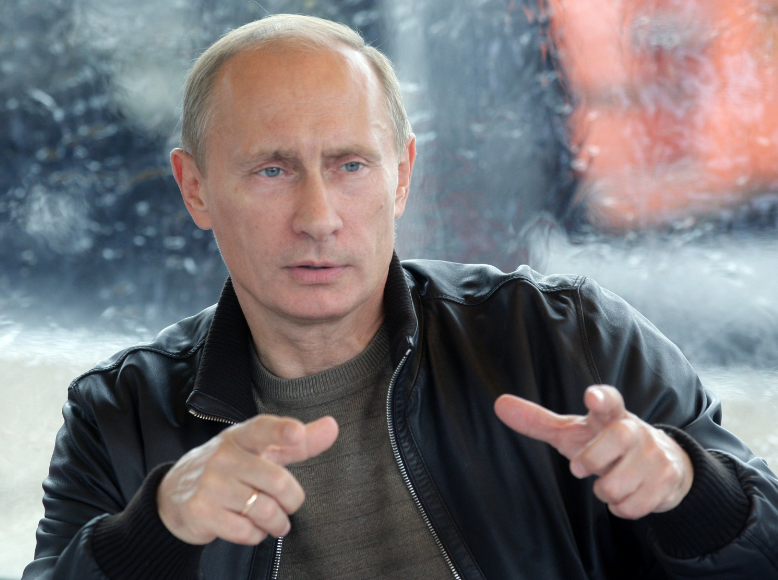
Russian President Vladimir Putin

Russian President Vladimir Putin

By Scott Taylor

The anti-Russian rhetoric and fear mongering in the west has reached fever pitch in the wake of the attempted assassination of former spy Sergei Skripal and his daughter Yulia.

British Prime Minister Theresa May expelled twenty-three Russian diplomats in retaliation for what she pronounced to be President Vladimir Putin’s “despicable acts”. Britain’s Foreign Secretary, Boris Johnson took things even further when he drew parallels between Putin’s present-day Russia and Adolf Hitler’s Nazi Germany in 1936.

Canada and fourteen other western countries followed the U.K.’s lead in expelling diplomats from their Russian embassies. The U.S. has booted out 60 Russians and Heather Nauert, a spokesperson with the State Department denounced Putin’s regime as having “tentacles… It’s a beast from the deep sea.”

In addition to the diplomatic response, NATO commanders are urging member states to bring more of their military units up to full combat capability. This is crazy stuff.

Nazi beasts committing despicable acts! Sound the alarm! Mobilize the militias!

Given the overwhelming combined military might of NATO’s 29 member states, the current panic is akin to an elephant being terrified of a mouse.

It also seems just a tad over the top that there is such an emotional outpouring of grief for Skripal. After all, the man was an evil Russian spy who sold out his country to become a British double agent. His duplicity was discovered in 2004, and he was convicted and sentenced to jail in Russia in 2006.

In 2010 Skripal was released to the U.K. as part of a prisoner-spy swap. Why Putin’s intelligence service would wait eight years to attempt to kill Skripal with a nerve agent remains a mystery.

However, as one who was weaned on the James Bond genre of spy movies, I would somehow suspect that the life expectancy of a traitorous agent would be shorter than that of someone who ripped off the Colombian drug cartel.

And Skripal is still alive. I hardly think the battle cry of NATO soldiers rushing into World War III would be “Remember Skripal!”

For western democracies who take such pride in our respect for the rule of law and the premise that an accused should remain presumed ‘innocent until proven guilty’ the rush to judgement in this instance is rather hypocritical.

Western media reports about serial killers and rapists are compelled to insert the word ‘allegedly’ to describe an accused’s criminal behaviour until such times as those allegations are ‘proven in a court of law.’

Yet in the Skripal case, as soon as it was pronounced – by British authorities that the nerve agent employed in the March 4 attempted assassination was ‘Novichok’, the case was essentially closed.

At the time of writing, there was still no conclusive theory as to how the allegedly Russian produced ‘Novichok’ was administered to the Skripals, but yet we are to believe that the Brits know with absolute certainty that it was Putin’s hit-men that did it.

As for Putin’s list of other “despicable acts” around the globe, perhaps Canada and the west should review our own resume before casting a barrage of stones. To wit, Russia has troops in Syria at the request of embattled President Bashar al-Assad. For the record, Assad’s regime is still officially recognized as the government of Syria.

The U.S. has troops in Syria, illegally assisting anti-Assad militia.

Putin has provided weapons and advisors to pro-Russian separatists in eastern Ukraine. Canada, the U.S. and other western countries have provided weapons and advisors to Ukraine as a counter to the pro-Russian separatists. If taking sides in another country’s civil war is despicable, then what is Canada doing there?

Putin annexed the Crimea after a virtually bloodless occupation and a referendum. Terrible.

In 1999, NATO bombed Serbia for 78 days causing the deaths of thousands of innocent Serbian civilians, and destroying billions of dollars worth of infrastructure.

NATO troops then occupied Kosovo and in February 2008, without any referendum, the U.S. redrew the map of Europe by recognizing Kosovo’s independence.

Throw into the mix the U.S. invasion of Afghanistan in 2001, the invasion of Iraq in 2003 and the Canadian led NATO air campaign to depose Libyan leader Moammar Gaddhafi in 2011. All three of those conflicts continue to rage in a storm of violent anarchy which has resulted in the death and displacement of millions of innocent civilians.

If Putin’s actions are ‘despicable’, how do we judge our own litany of recent failed military interventions? Good intentions gone bad?

ON TARGET: Mission To Mali: What’s Canada's Long Term Objective?

on target.jpg

By Scott Taylor

Last Monday the Liberal government announced that Canadian peacekeepers will be deployed to the West African nation of Mali. No exact deployment date was given but it is not expected that we will have actual boots on the ground until August.

The nature of Canada’s military commitment to this UN mission will be helicopter support.

While it was announced by Defence Minister Harjit Sajjan that this will consist of two Chinook heavy lift transport helicopters and four Griffon utility helicopters, Chief of Defence Staff, General Jonathan Vance later said the exact fleet mix has not yet been finalized.

What we do know is that there will be approximately 250 Canadian Armed Forces personnel deployed, and by golly they will be wearing the UN’s trademark blue helmets. We also know that they will be deployed initially for at least 12 months.

During the 2015 election campaign, the Trudeau Liberals pledged that if elected, they would return Canada to its former glory as a respected peacekeeping nation. In August 2016, both General Vance and MND Sajjan teased Canadians with the prospect of Canada embarking on a major peacekeeping adventure on the African continent.

We were told that this would involve 600 troops at a cost of $400 million per year, but we were not told exactly where they would be sent.

Mali was at the top of a short list of UN missions that included South Sudan, Republic of Congo and the Central African Republic.

At that time pundits argued that because Mali is considered to be the most dangerous UN operation with 162 peacekeepers killed since the mission began in 2013 – that the risk averse Liberals would opt out.

However, at the end of February 2018, it was reported that Canada’s military contribution to UN Peacekeeping missions worldwide had dropped to just 22 personnel – the lowest number since Canadian Prime Minister Lester B. Pearson invented the concept in 1956.

This complete digression from Trudeau’s promise to give the world more Canadian peacekeepers undoubtedly contributed to this recent commitment of helicopters to Mali.

It wont be 600 boots on the ground, it will be 250 boots in the air, which due to the nature of the Mali conflict, and the absence to date of anti-aircraft weapons in the arsenals of the various combatants, will greatly reduce the risk to our personnel.

The over eagerness of the usual cheerleaders to support a military mission – any mission – has led to yet another bizarre redefining of the word combat. Fearing that the Canadian public, still reeling from our 12 year, failed combat mission in Afghanistan would be reluctant to support another potential bloody failure in Mali, the pro war hawks are bending over backwards to downplay the potential risks.

To wit, my old friend Brigadier-General (retired) Matt Overton gave this quote to the Canadian Press: “For Canadians, if they see the helicopters flying and they’re returning fire or they’re suppressing a landing zone … so the Chinooks can get in, deliver their stuff and get out, they’re going to say that’s combat. But as a military person, I say: That is not engaging in combat, in that your primary purpose is to go out and actually deliver the violence to people. You are in support.”

That’s right folks, that famous battle scene of a helicopter assault in the Vietnam War film Apocalypse Now was actually just a routine support delivery. Nothing to see here. Move along.

Not that I expect this deployment to Mali to be anywhere near as dangerous as our failed mission to Afghanistan, or America’s defeat in Vietnam. The question still begs what does Canada and ultimately the UN hope to achieve with this mission?

The Dutch and the Germans who previously provided helicopter support for the UN troops in Mali were both keen to get Canada to take over that responsibility. Five years into this mission, obviously the Dutch and Germans don’t think they’ll be missing out on a victory parade anytime soon.

The semi-nomadic Tuareg separatists in Mali’s northern Sahara region have never accepted the authority of who attempted to rule them from the capital, Bamako, dating back to when France forcibly colonized the region at the turn of the 20th century.

France continues to deploy a large combat force to battle both Tuareg separatists and Islamic Jihadists, while the completely separate UN force attempts to keep a peace that doesn’t exist.

But hey, at least our soldiers will be wearing blue helmets again, just like Trudeau promised.

ON TARGET: Whacky Russian Assassins: Why All The Drama?

Screenshot 2018-03-19 09.52.08.png

By Scott Taylor

Last week Canada joined in the chorus of international countries demanding an explanation from Russia as to how weapons-grade nerve agent was used in an apparent assassination attempt in Salisbury, England.

The suspected target in this attack was former Russian spy turned British double agent Sergei Skripal. The ex-spy was found unconscious alongside his daughter Yulia on a park bench on Sunday March 4th.

A British policeman who found the pair and attempted to administer first-aid to the incapacitated Russians, also became seriously ill. Skripal and his daughter remain in serious condition in hospital, and British authorities have since concluded that the cause of their symptoms was a deadly nerve agent known as Novichok.

As this chemical weapon was developed by the former KGB during the Cold War it seems only logical that Vladimir Putin’s present day intelligence agency, the FSB would be the prime suspects in the attempted killing of Skripal.

That of course is the scenario put forward by British Prime Minister Theresa May, who is demanding answers from the Kremlin as to whether or not this was an ordered assassination. Joining in May’s quest, the U.S., France, Germany and Canada have all called for answers in what they claim to be a major threat to Western security.

To accept this theory, we also have to accept the fact that Putin’s FSB agents must be some of the dumbest spies in the business. Either that or they believe the James Bond genre of movies to be a non-fiction documentary series.

For starters, if they wanted Skripal dead, why go through all the trouble of employing a nerve agent. No one has yet put forward a theory as to how this Novichok was administered, but given that it affected Skripal’s daughter and the policeman as well, would indicate that it had a fairly wide range of toxicity.

British Investigators should therefore be scanning closed-circuit television footage for the would be assassin wearing a HAZMAT suit and gas mask.

Like all of those countless Hollywood Russian villains who manage to capture James Bond, none of them were ever content with simply shooting him. Instead they had to concoct some sort of elaborate slow death scheme that Bond inevitably thwarted with some new gizmo that he got from “Q”.

If Putin’s FSB agents wanted Skripal dead, given that they seemingly knew his exact whereabouts, why not simply shoot him, or stab him and fake a robbery? No, these FSB jokers had to use an unstable area weapon like a nerve agent - and one that is produced exclusively in Russia at that.

Even the dumbest of common criminals knows enough to wear gloves to avoid leaving fingerprints, but Russia’s top intelligence operatives are so clumsy that they left a clear trail of evidence right back to Putin’s desk in the Kremlin. Strange.  

Like the Bond villains, they also failed to kill their intended target.

Which brings us to the question of why would the FSB want to kill Skripal now? Skripal was arrested in Moscow back in 2004 when it was discovered he was a double agent working for Britain’s MI6.

Convicted of treason in 2006, he was later released to Britain in 2010 as part of a spy exchange between Russia and the U.K.

While it is possible that Putin still harbors a personal grudge against Skripol, why release him to the U.K. then wait eight years before attempting to assassinate him.

It should be pointed out that this botched killing comes just weeks before Russia’s presidential election. Perhaps Putin thought he’d best take care of loose ends such as Skripal on the off chance that he would lose at the ballot box on March 18th?

To accept the theory put forward by Theresa May, that Putin and Russia are the “likely” culprits behind the “plausible” assassination attempt on Skripal, means that we have to trust in the evidence presented by British and U.S. intelligence agencies.

These would be the same MI6 and CIA that told the world in 2003 that Saddam Hussein possessed weapons of mass destruction. That fabrication of evidence led to the invasion of Iraq and the resultant violent anarchy which continues to rage. That deliberate falsehood from our own allied intelligence agencies has indisputably claimed the lives of hundreds of thousands of innocent civilians.

One has to hope they will be a little more sure of their findings when they start accusing a nuclear armed superpower of aggression.

ON TARGET: No Denying Latvia’s Nazi Past

War time recruiting poster for the SS Latvian Legion

War time recruiting poster for the SS Latvian Legion

By Scott Taylor

For those Canadian soldiers currently based in Latvia, this coming March 16 should prove to be an interesting distraction. It is on this date the Latvians parade through the streets of Riga to commemorate their veterans of the Second World War.

So far, so good, as honouring fallen warriors is something that our Canadian soldiers can certainly relate to.

Unfortunately in this case, the March 16 parade through Riga is in celebration of the Waffen SS Latvian Legion. That’s right folks, this was a formation of the same notorious SS organization led by Heimrich Himmler, Adolf Hitler’s architect and chief executioner of the Holocaust.

The parades honouring Latvia’s fallen SS soldiers began in 1990 when this Baltic nation regained its independence from the Soviet Union.

During the war, the Latvian SS Legion had fought for Hitler against the Soviet Union. The date chosen for the commemoration is in recognition of a major battle fought on March 16, 1944 in which the two Latvian SS divisions – the 15th and 19th, fought together as a single entity. Sort of like a Latvian version of Canada’s World War I Vimy Ridge Battle legacy, except that they were fighting for Hitler, and they lost the war.

Since 1990, the commemorative parades gathered both popular and political support, and in 1998 the Latvian government declared March 16 to be an official day of Remembrance. Two years later however, with Latvia trying to gain membership in NATO and the EU, international pressure forced the Latvian Parliament to reverse their official recognition of this SS unit.

However, despite the controversy and condemnation from Jewish organizations such as the Simon Wiesenthal Center, the annual parades still take place in an unofficial capacity.

Apologists for the Latvian SS Legion point out that by the time this unit was formed in 1943, Latvia was considered to be Juden-Frei (free of Jews) by Hitler’s regime. Their argument is that the Latvian SS Legion therefore did not play a direct role in the Holocaust.

The flaw in that premise is that from the time the Germans entered Latvia in June 1941 until the Latvian SS Legion was established two years later, it was largely Latvian death squads that executed en masse the Jewish population.

The largest and most ruthless of these militias was the Arajs Kommando. It was this same Arajs Kommando that formed the nucleus of the Latvian SS Legion when it was formed by Himmler in 1943.

To follow the logic of the apologists, the Latvian SS Legion did not kill Jews, because its founding members – the Arajs Kommando had killed all the Jews before the Latvian SS Legion came into existence.

One of the most infamous leaders of the Arajs Kommando was a former Latvian aviation pioneer named Herberts Cukurs. He was a national hero for his piloting exploits and was considered to be a Latvian Charles Lindbergh.

Then the Germans drove the Soviets out of Latvia in 1941, and Cukurs turned his attention to the extermination of the Jews. According to Time Magazine, Cukurs was involved in a number of major atrocities including the burning of the Riga Synagogue which he had first packed with helpless Jewish victims, the mass drowning of 1,200 Jews in a lake, and a mass murder of over 10,000 Jews in a forest outside the Latvian capital on November 30, 1941.

Although Cukurs escaped to Brazil after Hitler’s defeat, Israeli Mossad agents executed him in 1965 in Uruguay.

Despite the evidence of his war crimes, there are those in Latvia today who want to return Cukurs’ legacy to that of a national aviation hero. In 2004 Cukurs supporters produced postal envelopes in his honour. Although these envelopes were condemned officially, and the General Prosecutors office of Latvia has twice rejected appeals for the exoneration of Cukurs, the fact is that Latvian nationalists want to re-write their Nazi past.

In fact just last week, Latvia’s National Alliance opposition party once again requested that March 16 be re-instated as an official day of Remembrance. “We shouldn’t be ashamed to honour Latvian freedom fighters” said National Alliance Party leader Raivis Dzintars. Actually, when those individuals fought under the Swastika banner of Hitler and Himmler, you probably should be ashamed.

Denial of any aspect of the Holocaust is still denial.

With Canadian soldiers currently deployed to Latvia to project Canadian values of freedom and democracy, we should be far more vocal in denouncing such blatant glorification of Latvia’s Nazi past.

We owe it to our WW2 veteran’s who fought against Hitler’s evil empire.

ON TARGET: Party Plane Antics Not A "Mission"

Dave “Tiger” Williams with what appears to be beads stuck up his nose

Dave “Tiger” Williams with what appears to be beads stuck up his nose

By Scott Taylor

Over the past couple of weeks news has continued to leak out of the Department of National Defence about a party aboard a military flight that spiralled horribly out of control. First it was the announcement of a sexual assault charge against former NHL hockey player Dave (Tiger) Williams, which led to a torrent of tales depicting drunken debauchery aboard an RCAF Airbus last December.

Two participants reputedly urinated themselves while a rock band played an impromptu concert in the aisles. Military eyewitnesses aboard the flight in question told media that some of the VIP civilian passengers had boarded the plane in a state of extreme intoxication; one individual bringing his own 40 ounce bottle of Johnny Walker Red Label Scotch.

Videos posted to Facebook show Toronto based rockers, the Carpet Frogs belting out songs through speakers set up inside the cabin of the plane while a dozen or so intoxicated onlookers dance clumsily to the beat.

Faced with this mountain of evidence, DND at first tried to downplay the ‘incident’ by reminding reporters that commercial airlines serve alcohol on long international flights. Of course everyone who has ever flown overseas knows that you cannot board a plane drunk, you cannot consume your own 40oz bottle of Scotch, and you cannot set up a guitar amp and strobe lights in the aisle of the plane.

By Friday February 23, Chief of Defence Staff General Jonathan Vance issued a statement regarding the incident, wherein he temporarily suspended these VIP morale boosting flights. He noted that in future, if resumed, such junkets would be booze free.

However, later that same day Vance tried to defend the party plane antics. He told reporters that such VIP trips were a boost to the morale of our brave frontline soldiers.

Addressing some of the specific antics of that incident, Vance claimed: “The band playing in the back of the plane, that’s some team building for people who have never met soldiers before and are going into maybe a dangerous place. It’s not Mardi Gras. It’s not a party. It’s a mission.” Wow.

Unfortunately none of the reporters in that particular scrum had the bottle to question Vance further on this issue.

So, in there interest of setting the record straight, allow me to punch a few holes in Vance’s assertion. First of all, on this particular flight the party bunch was flying to Athens, Greece, where they were to perform aboard the HMCS Charlottetown. They were not flying into a hot landing zone in Vietnam.

The second leg of the trip was to Riga, Latvia, which, although our troops are deployed there to prevent Russian aggression, has not heard a shot fired since World War II ended in 1945.

As for not previously having met soldiers, the Carpet Frogs have done at least three of these junkets before – two of them to Kandahar.

Tiger Williams and NHL Calgary Flames manager Brian Burke were aboard for their fourteenth such foray to raise morale.

It may not have been Mardi Gras, but Vance is way out of line trying to portray this as a ‘mission’. When troops fly in and out of actual combat missions aboard military aircraft they are not allowed to drink, let alone get drunk, urinate themselves and conduct rock concerts.

As for boosting morale, I’m sure that Canadian soldiers deployed are always happy to see visitors from home. However, given that the Carpet Frogs play cover songs from the 1960’s and 70’s one has to wonder how twenty-something year old sailors and soldiers even relate to them. These were the tunes that their grandparents listened to on vinyl records.

Tiger Williams last-played in the NHL in 1988, or in other words five years before the average year service member was even born.

If the Canadian Armed Forces really wants to boost morale, they will send over entertainers from the same generation as the frontline troops, not the old rockers and hockey players of the generals’ era.

For the record, Vice Chief of Defence Staff, Alain Parent and Canadian Forces Chief Warrant Officer Kevin West were both aboard the party plane, and neither stepped in to stop the shenanigans. That can’t be good for morale.

Party Plane Antics Are No Mystery: Senior Brass On Board At The Time Are Accountable – Case Closed.

Vice Chief Of Defence Staff Alain ParentPHOTO: JFC Naples

Vice Chief Of Defence Staff Alain Parent

PHOTO: JFC Naples

By Scott Taylor

For the past couple of weeks, there has been a steady stream of stories leaking out about a bizarre party flight aboard a Royal Canadian Air Force CC-150 Airbus.

The first hint of this came with the announcement late in the afternoon on Friday, February 9, that military police had laid charges of sexual assault and assault against former NHL hockey player Dave (aka Tiger) Williams.

The scant background information released at the time simply stated that Williams had been part of a troupe of VIPs partaking in a morale-boosting junket to visit a ship’s crew in Greece and the Canadian Army contingent in Latvia. So far, no biggie.

Then began a series of anonymous tips to the media from military personnel who were first-hand eyewitnesses to these events.

Turns out that Williams’ alleged actions were only one tiny aspect of an absolute gong show gone wild.

First it was revealed that, on the flight in question, many of the VIP passengers were inebriated before they even boarded the plane, with one passenger at least bringing aboard his own 40 oz. bottle of Johnny Walker Red Label Scotch.

Two of the partiers became so inebriated that they urinated themselves. Disgusted military stewards working the flight had to put the soiled seat cushions into plastic bags to be cleaned upon the CC-150 Airbus’ eventual return to CFB Trenton.

In response to the details being made public, DND tried to spin this as a possible policy oversight, but reminded the media that this type of flight is similar to commercial airlines serving alcohol on long flights. It was also acknowledged that there were only around 20 VIPs aboard the Airbus, plus flight crew, on a plane that can seat up to 194 passengers.

Further leaks revealed that, prior to the return flight, Williams’s accuser and three of her fellow military stewards were removed from the flight crew and flown home on a commercial flight. These last-minute one-way tickets cost Canadian taxpayers $6,500 each, for a whopping total of $26,000.

DND’s rationale for authorizing this expense was to separate Williams from his accuser, but no one could explain why it would not have been simpler — and cheaper — to simply fly Williams home on his own.

Questions asked about the identities of the other VIPs aboard were stonewalled by the DND spokesperson. However, this being the era of social media, it did not take long for a video taken during the flight to surface on Facebook.

Toronto businessman Rick Ekstein was part of that welfare-boosting trip and he posted his video “Rocking our way across the Atlantic” on his page.

And rocking they were! The footage shows the Airbus cabin rigged up with amplifiers in the aisle, with the rock band Carpet Frogs belting out a raucous version of the Doobie Brothers’ 1973 hit China Grove. About a dozen onlookers are drinking booze and bobbing to the beat while stage lights turn the cabin from blue to purple to green.

Once again, DND said they would look into possible policy oversights that might have violated air safety regulations.

Given that you cannot place so much as a handbag in the emergency exit row of a commercial flight, I’m going to guess that setting up guitar amps in the aisle is against a whole number of regulations.

Then, last Friday, Chief of Defence Staff Gen Jonathan Vance issued this statement: “The commander of the RCAF and I are deeply concerned and disappointed about what is said to have transpired aboard this service flight, and we will sponsor the necessary changes to prevent reoccurrence.”

The kicker to all of this is that Vice Chief of Defence Staff LGen Alain Parent was aboard the flight at the time of the party, as was Canadian Armed Forces Chief Warrant Officer Kevin West.

Given the booming rock music, the flashing lights and the stench of fresh urine, it would have been impossible for Parent and West to hear no evil, see no evil or smell no evil.

As a result of their wilful blindness to the events transpiring around them, a service woman was reportedly sexually assaulted.

Vance does not need an extensive investigation and a full review of RCAF policies to act upon his disappointment. He needs to hold senior leaders like Parent and West accountable. They were on the plane. They are responsible.

SAR Skills Built Through ‘Typical’ Training Day

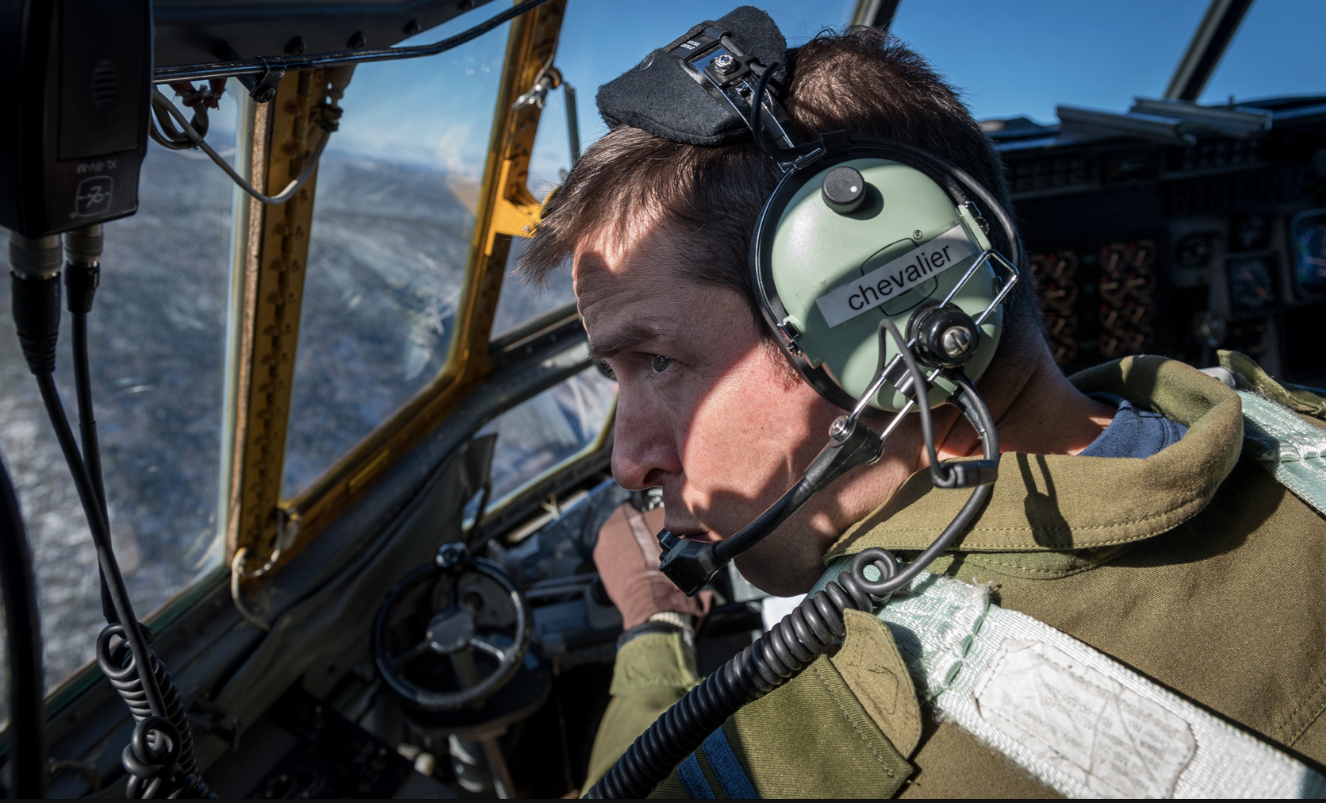
First Officer Captain Maxime Chevalier manoeuvres a search and rescue aircraft over the Cascapedia River Valley, in Québec. PHOTO: Corporal Neil Clarkson, GD05-2018-0060-020

First Officer Captain Maxime Chevalier manoeuvres a search and rescue aircraft over the Cascapedia River Valley, in Québec. PHOTO: Corporal Neil Clarkson, GD05-2018-0060-020

By Sara White

A search and rescue crew on board one of 14 Wing Greenwood, Nova Scotia’s CC-130 Hercules aircraft conducted a “typical” training day last month, leaving the airfield with a simple scenario that nevertheless covered some complex tasks.

First thing in the morning on January 22, 2018, 413 Transport and Rescue Squadron crew commander Captain Sebastien Roy gathered his day’s crew to determine their flight plan. The day’s goal: train the crew with a simulated search and finalize the scenario with some simulated equipment drops and search and rescue (SAR) technician parachute jumps.

“The Cascapedia River Valley, near Bonaventure in Quebec, is a great place for training, and the spot that we used for this scenario was challenging due to the fact that it is surrounded by mountains,” he said. “We can practise valley searches and simulate challenging scenarios.”

Off they went.

“Usually, on a real mission, we are tasked to search for something – aircraft, people, boats, etc. In this case, we planned on a valley search. When you find something or someone, you need to get in contact with them, so we open the aircraft’s ramp and drop a radio [to them]. From there, we can confirm if those people are in distress and go from there.”

In this scenario, the crew simulated casualties in need of medical assistance on the valley floor. They practised a supply drop of medical equipment, and follow-on SAR tech jumps. Within their trades, personnel have many different certifications they have to keep current. On training flights, they have the opportunity to check off some of them including safety- and equipment-related training or changes or upgrades to the technology they use.

“This is a typical SAR training day,” Captain Roy said, “[but any mission] changes day by day, depending on the weather and specific currencies requirements.”

ON TARGET: Is Canada’s Defence Minister Definitively Insane?

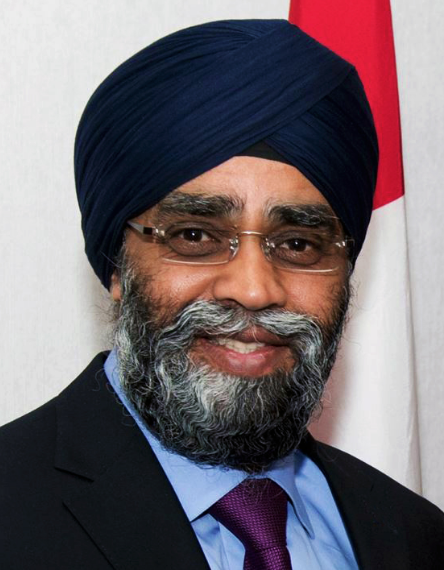
Minister of National Defence Harjit Sajjan

Minister of National Defence Harjit Sajjan

By Scott Taylor

Last Thursday Defence Minister Harjit Sajjan emerged from a NATO conference in Brussels and hinted that Canada would be willing to support the Alliance’s request for an expanded training role in Iraq. Sajjan could offer no specifics on how many Canadian soldiers would be involved or what their role would be, but somehow he remains confident that this time around the training of the Iraqi Security Forces will be successful.

What makes Sajjan’s broad comments laughable is that we still do not know which faction in this complex conflict our soldiers will be training. We presently have a few hundred elite commandos sitting idle in Iraq because their training missions in support of both Kurdish militia and Iraqi government troops were suspended after these two groups began fighting each other.

There is also a handful of Canadian combat engineers in Iraq conducting training in regards to the clearing of booby traps and unexploded munitions.

However, in a bizarre move last June, the Trudeau Liberals had promised to keep our military in Iraq until the summer of 2019. At the time this arbitrary mission extension was announced, Daesh (aka ISIS or ISIL) was already reduced to a handful of diehard zealots fighting in the rubble of Mosul.

As expected, the last of the Daesh evildoers were eliminated just a few weeks later and equally predictable was the fact that the diverse factions of the U.S.-led, anti-Daesh coalition began to fight among themselves.

Now NATO wants to bring in more elite trainers to train more young Iraqi men how to fire weapons and drive tanks. With Canada having pledged our military support for another 18 months at least, the decision for Sajjan to join this new training mission was a no-brainer. We are there anyway, doing nothing until the summer of 2019, so why not?

However, for Sajjan to think this is a successful strategy is sheer folly.

Albert Einstein’s definition of insanity is doing the same thing repeatedly and expecting a different result. This is exactly what the West continues to do in conflict after conflict, with the same failed result of increased violence and instability instead of the desired end state of a secure environment.

In Afghanistan in 2001, after the U.S.-led invasion toppled the Taliban, NATO members including Canada contributed troops to the International Security Assistance Force (ISAF). As the name implies ISAF was to assist the Afghans in achieving a secure environment.

The plan from the outset was for NATO to train and equip a self-sufficient Afghan Security Force. Seventeen years later, the alliance has trained hundreds of thousands of young Afghan males how to kill, and poured massive arsenals of weaponry in the name of security.

The result has been a steady increase in factional violence and a freefall descent into violent anarchy. The proposed solution by NATO generals? More training and more weapons for Afghans.

In 2003, following the U.S. invasion of Iraq, the decision was made by the administration of President George W. Bush to immediately disband all of Saddam’s security forces – army, police, border guards, the lot.

This resulted in months of absolute anarchy, looting and factional bloodletting. As the Iraqi insurgency grew around them, the Americans began recruiting, training and equipping a new Iraqi security force.

By the time President Barrack Obama withdrew U.S. troops from Iraq in 2011, the Americans had trained and equipped hundred of thousands of Iraqi soldiers.

However, when Daesh spilled into Iraq from Syria in the summer of 2014, this U.S.-trained force collapsed like a cheap suitcase. The huge, U.S.-supplied arsenal of modern weapons and armoured vehicles were abandoned to Daesh with hardly a shot fired.

Now that Daesh has finally been defeated in Iraq, NATO’s answer is to train more Iraqis how to kill and to bring in more weapons. Sajjan agrees to send Canadians and he assures reporters that this time it will work.

By Einstein’s reckoning, our defence minister is completely insane. And he is not alone.

ON TARGET: Canada In Iraq: What’s The Plan?

Destroyed city of Mosul

Destroyed city of Mosul

By Scott Taylor

Last week Conservative party defence critic James Bezan put forward a motion requesting that Defence Minister Harjit Sajjan appear before a House of Commons committee. It was Bezan’s hope that Sajjan could answer questions to Parliament — and by extension all Canadians — about the Canadian military’s current and future role in Iraq. Bezan also wants to know where Canada now stands on the provision of weapons to Kurdish militia in Northern Iraq.

The Liberals used their majority on the defence committee to scuttle Bezan’s request to grill Sajjan on this issue. Somewhat feebly, the Liberals then offered instead to throw Chief of Defence Staff Jonathan Vance into the hot seat to discuss Iraq.

However, as it is Vance’s responsibility to carry out government policy as instructed, it would be folly to expect him to speculate on the future of Canada’s role in Iraq. He will simply do what the Liberal government tells him to do.

At the moment, Sajjan’s elusiveness would appear to indicate that the Trudeau Liberals don’t have a clue about what to do next.

During the three-year-long fight to defeat Daesh (aka ISIS or ISIL), Canada’s elite special forces units trained Kurdish militia, and a Canadian field hospital was deployed near Erbil to essentially treat Kurdish fighters wounded in the battle against Daesh.

Seven months ago the U.S.-led coalition defeated the last of the Daesh extremists in the rubble that was once the city of Mosul. And that is when things went horribly, but predictably, wrong: The hodgepodge coalition forces began fighting among themselves.

The Kurdish fighters trained by Canadians now found themselves fighting against units loyal to the central Iraqi government in Baghdad, the same Iraqi government Canada’s foreign policy purports to support.

At the height of the offensive against Daesh in Mosul, Canada had announced that it would be arming the Kurdish militia with heavy weapons. Naturally enough, that did not sit well with the regime in Baghdad, which knew all too well that once Daesh was done and dusted, Kurds would start fighting government forces.

On behalf of all Canadians, Bezan wants Sajjan to tell us where these muddled plans are now.

After the Kurds began fighting Iraqi government troops and Shiite militia, it was announced that our Canadian special forces troops were suspending their role as direct mentors to the Kurdish fighters.

This means that Canada’s elite commandos are currently deployed in a violently disputed area with a suspended mission, essentially leaving them in limbo. Like Bezan, I think Sajjan has some serious explaining to do about what these Canadian soldiers will do next. For now, they sit.

In Canada’s heady rush to join the fight against Daesh evildoers back in 2014, somehow nobody took the time to fully analyze the complexity of the multi-factional, ongoing Iraqi conflict.

Now, there is also a question of responsibility for the future of Iraq. Canada was very much a part of the coalition to defeat Daesh, with our soldiers often far exceeding their mandated ‘advise and assist’ roles. There are numerous tales of Canadian snipers greasing Daesh fighters at extreme ranges, and Canadian fighters blowing up Daesh vehicles on the outskirts of Mosul.

However, in the aftermath of the coalition’s liberation of Mosul — Iraq’s second largest city and once home to more than 2 million inhabitants — remains an abandoned pile of rubble.

Seven months after the last of the Daesh diehards was killed, there are still an estimated 9,000 unburied bodies rotting beneath mounds of twisted metal and concrete.

Canada could not wait to be part of the fight, so should we not be just as keen to join in some sort of international reconstruction effort? It is hard to believe that, in this modern era, a major urban centre can be completely destroyed by the U.S.-led air armada assisted by international combat troops and then simply left in ruins.

If it was not the residents of Mosul — fewer than three per cent of Mosul’s displaced inhabitants have returned to the city since the fall of Daesh — then who exactly were Canadian soldiers supposed to be liberating?

Lots of questions for Sajjan indeed.

ON TARGET: Defence Dollars Spent In Latvia Better Spent At Home In Canada

 Canadian soldiers from India Company give a demonstration of the C-9 light machine gun to Julie Payette, Governor General of Canada during Her Excellency’s visit to the Canadian-led multinational NATO enhanced Forward Presence Battlegroup Latvia at…


Canadian soldiers from India Company give a demonstration of the C-9 light machine gun to Julie Payette, Governor General of Canada during Her Excellency’s visit to the Canadian-led multinational NATO enhanced Forward Presence Battlegroup Latvia at Camp Ādaži, Latvia on January 19, 2018. Photo: Sergeant Bernie Kuhn, Task Force Latvia

By Scott Taylor

It was with little fanfare and even less drama that the first Canadian contingent deployed to Latvia returned home to Edmonton last month. This 450 strong battle group based on the  first Battalion, Princess Patricia’s Light Infantry (PPCLI) have now been fully replaced by members of the New Brunswick based, Second Battalion, Royal Canadian Regiment (2RCR).

Canadian troops first deployed into Latvia over seven months ago as part of NATO’s Enhanced Forward Presence initiative which is theoretically aimed at deterring Russian military aggression in the Baltic States.

At the time it was announced, Canada’s participation in this show of strength was breathlessly touted by the usual pro-war tub thumpers, who are all too eager to revisit the good old days of the Cold War.

Some jingoistic pundits even referred to the Baltic States as “NATO’s northern flank” as if somehow World War Three had already begun.

The western media portrayed Russian President Vladimir Putin as a lunatic bent on world domination, and long planned, annual Russian military manoeuvres in western Russia and Belarus were portrayed as the harbingers of an imminent invasion.

Thus, the brave soldiers of the Princess Patricia’s could easily be forgiven if they were a little apprehensive about being deployed to the very border of Putin’s evil empire.

Seven uneventful months later and now these 450 soldiers have returned to their families, while the next rotation of elite Canadian combat soldiers  begin their own seven month extended separation from their loved ones.

Unlike the Cold War years when Canada permanently stationed a mechanized Brigade Group and three fighter squadrons at advance bases in Germany, the Latvia deployment is to be ‘rotational’.  This means that unlike the Cold War era where families were posted to Germany along with the military personnel, now Latvia deployed soldiers will be away from their spouses and kids for lengthy periods of time.

For the decade long commitment in Afghanistan, the normal length of deployment to Kandahar was six months, but since this was an actual shooting war troops remained focused on the task at hand while deployed in theatre.

With Latvia, there is not going to be any shooting war and the top NATO military commanders know this.

I say this with certainty because of the very composition of the forces which were deployed as part of the Enhanced Forward Presence. The Battle Group commanded by the Canadians and anchored by our nucleus of 450 infantry soldiers, is augmented by contingents from Spain, Italy, Poland, Slovenia and Albania bringing the total number to approximately 1200. Later this year, this will grow by another 200 international personnel when they are joined by units from Slovakia and the Czech Republic.

If there was any real threat of the Russian military juggernaut erupting over the Latvian border, no NATO commander in his right mind would want to be saddled with a polygot collection of penny packet national contingents. It makes no tactical sense.

What does make sense is from an economic perspective as all of the contributing countries are spending a portion of their own defence budgets to house and feed their troops in Latvia. Canada alone has budgeted $134 million annually for the Enhanced Forward Response.

The Latvian economy has been in a freefall since they joined the European Union in 2004, and it is estimated that there has been an exodus of more than 350,000 Latvians – economic refugees seeking employment - from a total population of just two million during that timeframe.

If the NATO alliance wants to shore up the economies of the struggling Baltic States, then we should do so in the form of an economic bailout and label it as such.

Instead we are committing resources from defence budgets to base these foreign troops in Latvia, Estonia and Lithuania to counter a non-existent threat from the Russian bogey-man.

As members of NATO, the three Baltic States are automatically guaranteed the Alliance’s collective defence of their sovereignty should they be attacked. In other words, there is no need for these 450 Canadian soldiers to spend extensive periods of time away from home – and that $134 million could be put to better use refurbishing bases or buying equipment here in Canada.   

ON TARGET: Child Rape By Afghan Security Forces Raises Question Of Canada’s Continued Funding

Afghan Security Force with pre-pubescent Afghan bacha boy

Afghan Security Force with pre-pubescent Afghan bacha boy

By Scott Taylor

Afghanistan was back in the news last weekend following a deadly suicide attack by Taliban extremists detonating an explosive-packed ambulance in the Embassy district of Kabul which killed 95 and wounded another 140 civilians.

This of course is only the latest such brazen attack in the Afghan capital in what has become an almost steady stream of unchecked violence.

What remains of the international community in Kabul lives behind massive concrete blast walls in an ever-more-fortified Green Zone. The only safe transit from the city centre to the airport is now by helicopter, as the Afghan National Security Forces can no longer protect the roads.

Afghan President Ashraf Ghani recently told the media that there are currently 21 terrorist organizations operating within his borders and that he is essentially “under siege.”

This hardly sounds like a success story given that the U.S. and international military intervention is now well into its seventeenth year.

That’s right folks, if you do the math, Afghanistan was far closer to a stable environment back in late 2001 when the Taliban were seemingly toppled and defeated.

However, in the violent chaos that has since ensued, the U.S. has spent over $1 trillion,seen 2,400 soldiers killed, another 10,000 wounded and that elusive dream of victory remains well out of any conceivable grasp.

American commanders now predict that with their new tactics and an additional 3,000 troops they can force the Taliban to the bargaining table within the next two years.

No mention was made of a timeline to pacify the other 20 terrorist organizations.

For the record, Canada spent a fortune in blood and treasure in Afghanistan before finally cutting her losses and withdrawing in the spring of 2014.

We saw 158 soldiers killed, 2,000 wounded or injured and an untold number of veterans suffering the unseen wounds of PTSD. In terms of money, it is estimated that once we factor in the long-term health care of our wounded veterans, Canada will have spent $20 billion on the failed, decade-long Afghanistan intervention.

Unknown to most Canadians is the fact that, since our withdrawal, Canada still contributes a whopping $150 million annually in support of the Afghan National Defence and Security Force (ANDSF). As such, the report issued last week by the U.S. office of the Special Inspector General for Afghan Reconstruction (SIGAR) should be of interest to all Canadian taxpayers.

This latest review released by SIGAR focused on the “U.S. Experience with Child Sexual Assault by the ANDSF.”

Apparently it was not until September 2015, following an exposé in the New York Times, that the Pentagon began taking seriously the allegations made by American soldiers that their Afghan counterparts were committing widespread child sexual assault.

Canadians may recall that our soldiers first reported such shocking behaviour to their chain of command back in 2006. The story then broke in the Toronto Star in 2008, prompting the Canadian military to convene a board of inquiry into the whole sordid affair.

It was not until April 2016, eight years later and conveniently two years after we had withdrawn from Afghanistan, that the military board of inquiry quietly concluded that, yes indeed, the Afghan military and police were in fact raping underage and prepubescent boys on a wholesale basis.

The U.S. Department of Defense, upon learning of these gross human rights violations via the New York Times, implemented what is called the Leahy Laws, wherein funds can be withheld from ANDSF units responsible for such child sexual assault.

The SIGAR report details that, in order to keep the ANDSF functioning, it is almost impossible to apply the Leahy Laws.

It was concluded that because Afghan police do not self-report the abuses they are committing and because senior level officers involved in child abuse have the money and power to force individuals to remain quiet about the rapes, “the full extent of child sexual assault committed by Afghan Security Forces may never be known.”

For our part, Canada just keeps paying to support the ANDSF and then we collectively wonder why America is not winning in Afghanistan.

ON TARGET: U.S. Is Out Of Control In Middle East

United States President Donald TrumpPhoto: Chip Somodevilla

United States President Donald Trump

Photo: Chip Somodevilla

By Scott Taylor

Last Wednesday, U.S. Secretary of State Rex Tillerson made the declaration that American troops will remain in Syria indefinitely. Tillerson’s remarks came on the heels of the recently announced defeat of Daesh (aka ISIS or ISIL) evildoers in both Iraq and Syria.

The reason given for U.S. soldiers remaining in Syria was not limited to the prevention of another Daesh movement; these troops are admittedly staying in order to counter the power of both Syrian President Bashar al-Assad and Iran. Of course, the buzzwords used by the U.S. State Department are that their combat soldiers will be used to bring “stability” and “security” to the region.

The sad fact is that no one even thought to question Tillerson as to just what the hell American soldiers are doing in Syria in the first place, and under what legal authority were they deployed?

There was never a declaration of war against Assad’s Syrian regime, even though from the outset of the uprising in the spring of 2011 the U.S. wholeheartedly sided with the anti-Assad rebels. In fact, the U.S. poured in weapons and advisors to assist the so-called ‘moderate’ Syrian rebels until it was revealed that they weren’t so moderate after all.

The U.S.-funded Syrian opposition leadership debated policies in Istanbul cafés while the actual Syrian rebels battled Assad’s loyalists in the country’s urban centres. It did not take long for these rebel groups’ true Islamic extremist nature to be revealed, and in 2014 they emerged as the Daesh scourge. As this Sunni Muslim faction poured out of Syrian bases and captured large swaths of central Iraq in the summer of 2014, the U.S. was compelled to rush military assistance back into Iraq to prop up the impotent regime in Baghdad.

Once they were back in the neighbourhood, the U.S. forces helping to battle Daesh in Iraq took the opportunity to take that fight across the Syrian border to battle Daesh there as well. Now, since Daesh was technically fighting Assad in Syria, any U.S. military operations against Daesh rebels would have indirectly assisted the embattled Syrian president. However, unlike the Russian and Iranian militaries that were invited into Syria by the recognized official government in Damascus, the U.S. simply authorized its troops to start killing people in a foreign civil war. All in the name of security and stability. And now they say they will stay in Syria indefinitely as they have learned their lesson of premature withdrawal from the fiasco that befell Iraq after the U.S. withdrew its combat forces in 2011.

For the record, the U.S. illegally invaded Iraq in 2003 on the false claim of self-defence from a fictional arsenal of weapons of mass destruction that Saddam Hussein never possessed. During the eight-year American occupation of Iraq, that country was plunged into an orgy of interfactional bloodletting that the American military proved powerless to curtail.

The Daesh onslaught in 2014 into Iraq’s Sunni Triangle was not an isolated operation, but simply a continuation of the perpetual cycle of violence that the U.S. started with their illegal invasion of Iraq in 2003.

Now their plan is to remain in northern Syria’s Kurdish separatist region, which has successfully freed itself from Assad’s authority. It is America’s stated intention to create a 30,000-strong unified Kurdish security force from the various splinter groups and factions that have been fighting against a variety of foes in the multifaceted Syrian civil war for the past seven years.

This sounds good in theory, but many of those Kurdish fighters have links to the Kurdistan Workers’ Party (PKK), the notorious terrorist organization that has been active for decades just across the Syrian-Turkish border. Naturally, Turkey has immediately decried the plan to create a Kurdish military force on its border while Turkish security forces are actively engaging PKK fighters in the eastern Kurdish-majority region of Turkey.

If that is Tillerson’s recipe for stability and security, I would hate to see what he could concoct if his objective was to sow chaos and reap violence.

ON TARGET: Sometimes Trump Is Right & The News Is Fake

United States President Donald Trump

United States President Donald Trump

By Scott Taylor

Whenever U.S. President Donald Trump hears facts and figures that he does not agree with, he simply dismisses them with his catch-all phrase “fake news.” This of course only serves to delight both the mainstream media and late night talk show hosts who have made a virtual industry out of harpooning Trump for his childlike capacity for self-delusion.

However, as much as we might want The Donald to be wrong about all things all the time, the truth is that Western media does pump out an incredible stream of fake news items in what used to be correctly labelled as propaganda.

In recent years we have seen a ferocious rekindling of the former Cold War, with Western media trying their level best to portray Russian President Vladimir Putin as an evil mastermind bent on nothing less than world domination.

It is for the very purpose of thwarting Russian aggression that we are told it is necessary for Canada to deploy 450 combat soldiers into Latvia.

Similarly, when we now deploy our Royal Canadian Navy frigates on routine missions alongside our NATO allies in the Mediterranean, we are doing so as part of the ongoing Operation Reassurance. In case any of you missed the obvious, that would be as in we are somehow reassuring Western Europe that we are containing Russian aggression.

Western leaders, military tub-thumpers and media cheerleaders have repeated the concept of Russian expansionism so often that it has now simply become an unquestioned fact.

The cornerstone of this argument stems from Russia’s 2014 annexation of the Crimea and their ongoing meddling in what remains essentially a civil war in Ukraine.

So if looked at in strict isolation, power-mad Putin gobbled up a strategic piece of geography on the Black Sea and he is supporting pro-Russian separatists in the breakaway Ukrainian territories along his own border. Sounds pretty evil.

Now, ask yourself what steps the U.S. would take if a similar situation involved them and one of their overseas bases?

The Crimea is the main naval base for Russia’s Black Sea fleet, and since the collapse of the Soviet Union in 1991, Russia had secured long-term leases for this territory from Ukraine.

Following the Western-supported overthrow of Ukraine President Viktor Yanukovych in February 2014, the Kremlin was taking no chances on a new Kiev regime revoking that lease, so they annexed it. However, they did conduct a referendum first and the latest polls show an 80 per cent approval rating among Crimea residents who still approve of Russia’s annexation.

As for interfering in the Ukraine civil war, if Putin is wrong for supporting the pro-Russian faction — and he is — then we in the West are equally at fault for pouring in military assistance to the current Kiev regime.

For the record, Ukraine President Petro Poroshenko’s current approval rating has been compared to milk because it presently sits at just 2 per cent. If the vast majority of Ukrainian citizens do not support Poroshenko’s corrupt cabal of comic-opera oligarchs, then why are Canada and the U.S. rushing to send them military aid?

One of the big announcements over the Christmas holidays was the fact that the U.S. will now start shipping sophisticated anti-tank weapons to prop up Poroshenko’s regime.

This news was of course applauded by the usual chorus of anti-Russian Ukrainian hawks. Their rationale for welcoming these anti-tank missiles was the rather startling claim that Russia currently has more tanks in eastern Ukraine than NATO has in all of Europe. This claim went unchallenged and thus became yet another fact to support Russian expansionism theories.

Unfortunately, as scary as this scenario sounds, it simply is not true. A little fact finding from public sources puts the number of NATO main battle tanks (MTBs) in Europe — not including any U.S. armoured vehicles — at well over 7,000. The highest estimate of tanks within the pro-Russian rebel-held territory in Ukraine is around 680, not all of which are considered serviceable.

So not only is it not true that Russia has more tanks on disputed territory than all of NATO in Europe, that false claim was exaggerated by a full tenfold. To give an even clearer perspective, the Ukraine military loyal to the Kiev regime has apparently 2,700 tanks — or roughly a four-to-one advantage over the pro-Russian rebels.

Trump is not completely wrong. Sometimes news is fake.

ON TARGET: Let's Not Jump On The Iran Bandwagon

Iran's supreme leader Ayatollah Ali Khamenei

Iran's supreme leader Ayatollah Ali Khamenei

By Scott Taylor

The only thing that is clear about the recent outbreak of civil unrest in Iran is that absolutely nothing is clear. The absence of foreign media outlets, the government crackdown on social media and in the case of Canada and numerous other western countries, the suspension of all diplomatic ties has made Iran a virtual black hole of information.

The dribs and drabs of news that was reported in the west were often contradictory and almost entirely skewed through the self-delusional prism wherein we see complex foreign political equations through our own value system.

Initial reports claimed that the anti-government protests taking place in a multitude of Iranian cities were in response to rising food prices and a stalled economy. However in all of the shaky video footage of these demonstrations, the agitators appeared to be young men hurling rocks at police vehicles. Typically one would expect anger over food costs to be projected by a much more family-centric demographic, and throwing objects at security forces is not a clever tactic when trying to make your point peacefully.

Then came the bombshell report that these angry mobs were in fact chanting “Death to Khamenei!”

As Ayatollah Sayyid Khamenei is the Supreme Leader of the religious theocracy that rules Iran, the immediate conclusion jumped to by U.S. President Donald was that this is the beginning of the long awaited freedom revolution in Iran.

As fast as his thumbs could bang out the tweets, Trump professed his “respect for the people of Iran as they try to take back their corrupt government” and he pledged the Iranian protestors “great support from the United States.”

Trump’s immediate and wholehearted support for the Iranian protesters illustrates the presumption that if the U.S. administration despises the regime in Tehran, then any Iranian opposed to the ruling theocracy must hate them for the same reasons, and are therefore entitled to our full and unquestioned support.

This begs the question, have we learned nothing from the recent fiascos in Libya and Syria wherein we were equally quick to jump to the same false conclusion?

One of the key things to remember here is that the slogan of these freedom loving Iranian demonstrators is “Death to Khamenei!” They are not asking for lower taxes, increased freedom or greater representation from elected officials, they want the current leader dead.

When the uprising began in Libya in the spring of 2011, Canada was one of the leading western nations encouraging the rebels to overthrow President Moammar Gadhaffi. While Canadian officials talked of ‘regime change’ the multi-factional Libyan rebel forces openly and bloodthirstily called for the death of the Libyan leader.

On October 20, 2011, with the assistance of the NATO air armada and Special Forces advisors, the Libyan rebels captured Gadhaffi alive outside of his last stronghold of Sirte. The mob then proceeded to beat Gadhaffi to death.

As history has unfolded, we now realize that in our eagerness to overthrow one Gadhaffi, we threw our support behind a hundred murderous scoundrels who have since plunged that once prosperous North African nation into a failed state awash in violent anarchy. One clue as to the true nature of the Libyan ‘freedom fighters’ should have been their unrepentant bloodlust.

In 2012, Canada was still backing the rebels in the Syrian uprising and vowing that embattled President Bashar al Assad ‘must go!’ By that point in the conflict it was already widely understood that the anti-Assad forces in Syria were Islamic extremists groups with links to al-Qaeda, and eventually Daesh (aka ISIS or ISIL).

They too were not calling for the simple ouster of Assad and the implementation of democratic reforms, they were instead calling for Assad’s death and promising to enforce Sharia law.

In Canada people frequently take to their streets to express their displeasure with the government of the day, but I have yet to ever see any demonstrators calling for the death of our Prime Minister. Even in the U.S. where politics have become extremely polarized and divisive, no one is calling for the death of Donald Trump.

If those disgruntled Iranians think the key to democratic reform is the murder of the incumbent leaders, then I suggest they are reading the wrong handbook.

ON TARGET: Daesh Fighters Are not All Terrorists

Daesh FightersCorbis/Medyan Dairieh

Daesh Fighters

Corbis/Medyan Dairieh

By Scott Taylor

Now that Daesh (aka ISIS or ISIL) forces have been all but completely defeated in Syria and Iraq, fears have risen in the West as to what will happen to all those foreign fighters who took up arms to assist the Daesh evildoers.

With their self-proclaimed caliphate having been pounded into a mound of rubble by the U.S.-led allied air force, it is wildly feared that the foreign Daesh volunteers will return to their native or adopted Western countries wherein they will continue to wage a deadly campaign of terrorism.

Canadian authorities estimate that there are as many as 250 individuals connected to Daesh who also have some form of official link to Canada. It is believed that, of that number, roughly 60 Daesh-affiliated individuals have already returned to Canadian soil over the past two years.

Fanning the flames of fear has been the Conservative Party with its claims that the Trudeau Liberals are soft on terrorists and, as a result, we are all in mortal danger. According to the Conservatives, dozens of Daesh already walk among us, hundreds more are poised to return to Canada, and all Justin Trudeau can do is make available counselling to reform these would-be evildoers.

At the root of their argument is Trudeau’s statement that “we have methods of de-emphasizing or de-programming people who want to do harm to our society.” Taken in isolation, Trudeau’s words do sound very naïve particularly when one is talking about former members of Daesh.

However, Trudeau also mentioned the more practical steps being taken by Canadian security forces regarding these individuals, which include increased surveillance, the issuing of peace bonds, and the revoking of passports.

These measures are still not harsh enough to placate the truly frightened tub-thumpers who herald British Secretary of Defence Gavin Williamson’s directive to “kill British ISIS fighters.” Without offering up any specific legal jurisdiction, which would authorize such extrajudicial executions, Williamson vowed to hunt down those Britons who left the UK to fight for Daesh.

Critics were quick to point out that Williamson’s tough guy comments are far easier said than done once you factor in the complex legal ramifications of such assassinations, but his rhetoric proved to be a widely popular sentiment in both the UK and Canada.

Part of this phenomenon can be attributed to the wildly successful PR machine of Daesh itself. In the early days of 2014, when Daesh first burst onto the scene in Syria and Iraq, its leaders were able to magnify the group’s evilness through widespread distributions of videos on the Internet. Mass beheadings, deaths by fire and threats to come and kill us in our beds, all professionally edited for maximum drama, turned the spectre of Daesh into something far larger than life. They became the epitome of terrorism, in that the infinitesimally tiny threat they posed to us in the West became an irrational source of fear. Daesh became the fictional bogeyman.

Western media played into Daesh’s hands by labelling everything they did as terrorism, which in turn made every member of Daesh a terrorist. The fact is that as Daesh fought to establish and then defend its self-proclaimed caliphate, its members fought as conventional military forces: they used conventional weapons such as small arms, military vehicles and artillery, and they fought from clearly identified defensive positions. They may have fought with fanatical resistance, but in terms of training and equipment, they were at best a third-rate guerrilla army.

Those Canadians and other Western volunteers who misguidedly chose to support Daesh’s skewered Islamic teachings would not have been trained to become some sort of super terrorists; they would have instead been given rudimentary training in basic infantry weapons and tactics.

Their crime is to have violated Canada’s 1937 Foreign Enlistment Act, which prohibits Canadian citizens from volunteering to fight in foreign wars against friendly nations.

To let our misplaced fear of Daesh cloud our judgment to the point that we would condone automatic death sentences for all these individuals only serves to illustrate just how effective the Daesh terrorism campaign has been.

ON TARGET: Canada's Defence Planning Is Adrift

Prime Minister Justin Trudeau with Canadian troops

Prime Minister Justin Trudeau with Canadian troops

By Scott Taylor

As 2017 comes to an end and we plunge forward into a brand new calendar year, it is a good time to take stock of just where Canada sits in terms of international military commitments.

From 2002 until 2014, the sole focus of the Canadian military was the mission in Afghanistan. That failed intervention ate up a fortune in terms of human and equipment resources, propping up a corrupt, despotic regime in Kabul. However, the very longevity of that campaign coupled with the fact that there was never any hope to achieve an actual ‘victory’ made things extremely simple for those planning our military operations.

We simply trained and equipped battle group after endless battle group to deploy into Kandahar to continue waging the counterinsurgency that never ends. Hell, we even built a full-scale mock Kandahar training area at CFB Wainwright, complete with actual Afghan actors, to prepare our soldiers prior to every deployment.

However, with the termination of the Afghan mission, that sense of focus has been lost.

The appearance of the Daesh (aka ISIS) scourge in Iraq in 2014 created a new bogeyman on the scene and Canadians were supportive of the Harper Conservative government’s decision to send in some fighter jets and a handful of special forces trainers to help battle the Islamic extremist evildoers.

That same year saw the onset of the political crisis in Ukraine, which resulted in Russian President Vladimir Putin’s annexation of the Crimea. The Harper government became one of the most strident anti-Russian voices among the NATO alliance and to demonstrate Canada’s resolve, a number of token military assets were committed to NATO’s collective Operation Reassurance in Eastern Europe.

When the Trudeau Liberals came to power in 2015, they pledged to get Canada out of shooting wars and to make Canadian peacekeeping great again.

That all sounded good, but it proved to be far easier said than done. Trudeau did finally withdraw Canada’s CF-18 fighter planes from the anti-Daesh mission in Iraq, but to appease our U.S. allies he also agreed to boost the number of Canadian Special Operations Forces trainers to 200. We also agreed to provide a 50-person field hospital to treat those wounded in the fight against Daesh.

This past June, Canada took the bizarre step of announcing a further two-year extension to our anti-Daesh commitment in Iraq. At the time of the extension announcement, Daesh diehards were fighting a last-stand battle in the city of Mosul, one of their final strongholds in Iraq.

By August, Mosul had been liberated, and the war in Iraq moved into a whole new phase. Those Kurdish fighters that our soldiers had been training to battle Daesh began fighting the Iraqi security forces that Canada’s foreign policy purports to support.

As a result, since late October Canada’s ‘advise and assist’ role has been suspended. That’s right, we currently have over 200 of the best Special Operations Forces soldiers in the world sitting idle on the edge of a civil war, without a clearly defined role, until the arbitrarily announced deadline for withdrawal of March 31, 2019.

We are also spending $134-million annually to maintain 450 Canadian soldiers in Latvia to deter a possible Russian invasion. While no one in their right mind actually believes Russia would invade the Baltic states, Article 5 of the NATO charter makes the entire deployment of Canadian troops a needless expense and a dangerous provocation. As full members of NATO, Latvia, Lithuania, and Estonia are guaranteed the collective defence of the NATO alliance regardless of whether we have soldiers on the ground or not.

As for the long-awaited Liberal promise to return to UN peacekeeping, this amounted to a lot of sizzle but no steak. The mid-November announcement of Canada’s new peacekeeping policy named no specific mission or troop numbers, simply a few planes here, a couple of helicopters there.

We also pledged to use our long-dormant peacekeeping expertise to train the militaries of other countries prior to deploying their soldiers into harm’s way, and we set up a $15-million trust fund to act as incentive for other countries to send their female peacekeepers into global hotspots.

Not exactly a classic case of leadership by example.

ON TARGET: Canada’s Warmongering In Ukraine Is Dangerous

Chrystia Freehand - Kiev’s Minister of Foreign Affairs in Ottawa

Chrystia Freehand - Kiev’s Minister of Foreign Affairs in Ottawa

By Scott Taylor

On December 13 Canada quietly undertook the decision to include Ukraine in our Automatic Firearms Country Control List.

With all the news cycles focussing on Donald Trump’s recognition of Jerusalem as Israel’s capital and the ongoing nuclear sabre-rattling between the U.S. and North Korea, this seemingly minor change in Canada’s legislation made barely a ripple on the domestic media front.

The few stories that did appear to have put a very positive spin on things with virtually no context as to what this policy revision will actually mean. In a nutshell, Canada is now authorizing the provision of lethal military aid to Ukraine. One CBC article heralded this as a good-for-business saga under the title “Canada arms makers get OK to sell to Ukraine.”

In Kiev, Ukraine President Petro Poroshenko hailed Canada’s decision and welcomed the promise of providing him with additional weaponry. What Poroshenko loves most about Canada’s assistance is the fact that we are giving him and the Kiev regime he represents unconditional support.

This is not the case with those spoilsport Americans who are dangling a whopping $500-million worth of weaponry under Poroshenko’s nose. For some crazy reason, the Pentagon wants to see progress made towards curbing the Ukrainian military’s rampant corruption before they simply hand over a massive arsenal of modern weaponry.

As for Canada’s European NATO allies, despite all of the anti-Russian hype and propaganda centred on the crisis in Ukraine, none of them are following our lead and pouring more weaponry into the region. This is easily understood as no matter where one stands on the issues, this conflict is in their backyard and it behooves no one to reignite what is presently a frozen civil war.

The spin that Canada has put on this provision of lethal aid is that we will be supporting Ukraine with “defensive weapons.” It’s time to call ‘bullshit’ on the term ‘defensive weapon.’ A machine gun is a machine gun and a rocket launcher is a rocket launcher. Period.

There are presently two self-proclaimed, pro-Russian breakaway republics in eastern Ukraine — Donetsk and Luhansk — that are held by the rebels. Foreign Affairs Minister Chrystia Freeland has made it abundantly clear that Canada regards these illegitimate rebel territories to be in violation of Ukrainian territorial sovereignty.

Therefore, should Poroshenko use the Canadian-provided “defensive weapons” to launch an offensive against Donetsk and Luhansk, he would still be ‘defending’ Ukrainian territory.

Freeland’s partisan fervour in support of Ukraine in this crisis should be tempered with the fact that Poroshenko and his Kiev cabal presently have just a two per cent popular approval rating. Factoring in a minimal margin of polling error, that amounts to about zero, yet Freeland is giving him a 100 per cent vote of confidence, and throwing in an arsenal of deadly weapons to help keep this corrupt oligarch in power.

Since the outset of the military clashes and unrest in Ukraine in 2014, Russian President Vladimir Putin has been labelled by the Western media as an evil provocateur, fighting a proxy war that victimizes Ukrainians. His alleged crimes are the provision of weaponry and instructors into eastern Ukraine to assist the rebel forces.

The question begs: If Putin is guilty of interfering in a foreign civil war, how can Canada not be just as guilty for doing exactly the same thing, albeit for the other side? Not that long ago we prided ourselves as being the world’s peacekeepers, and now we are actually in violation of the internationally brokered Minsk II treaty which prohibits the military escalation in the frozen Ukraine conflict.

Freeland is rushing in where even Donald Trump fears to tread. That is scary.