ON TARGET: Canada is at War??!! WTF??!!

By Scott Taylor

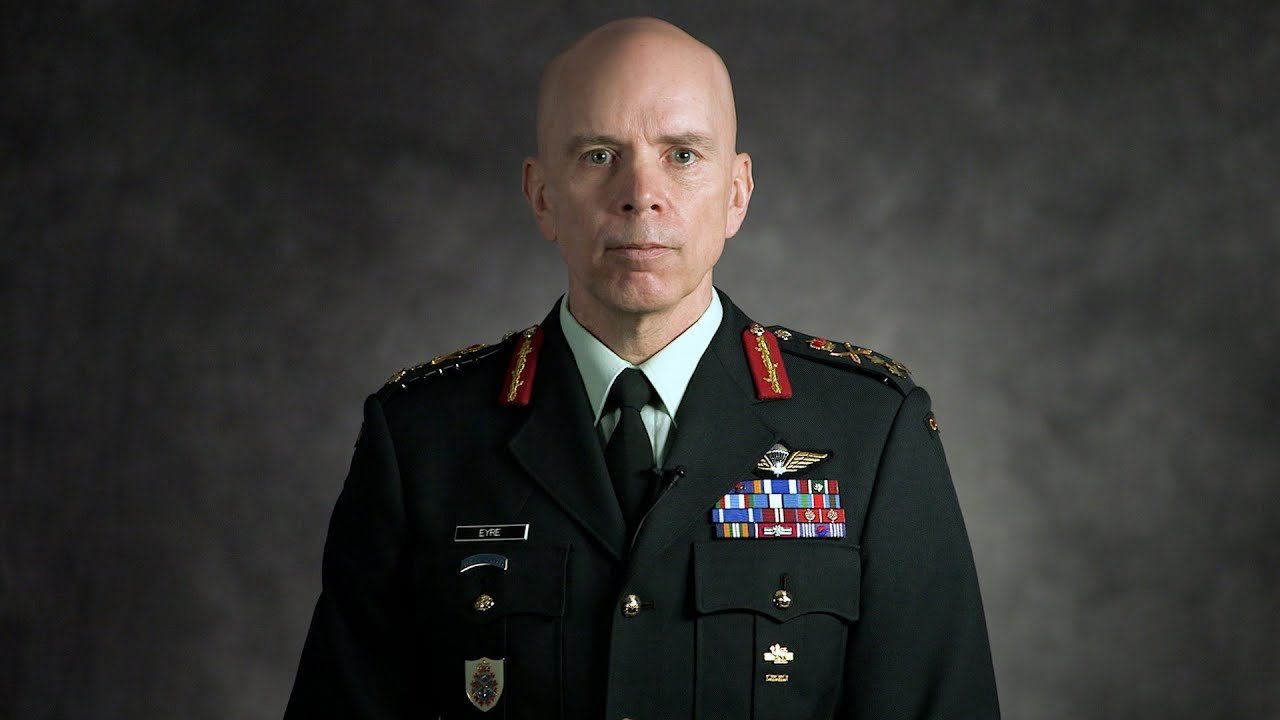
I must admit that when I retrieved my Ottawa Citizen from my front porch last Friday morning my heart literally skipped a beat when I read the headline “Russia and China at war with Canada, says General Wayne Eyre.”

For the past twenty months I have been closely following the conflict in Ukraine, and since the Hamas terror attack on Israel on October 7, I have also been monitoring the conflagration in the Middle East.

However, I had no idea that two major superpowers – Russia and China – were presently at war with Canada.

Yet in a document obtained by the Ottawa Citizen, Canada’s Chief of the Defence Staff claimed that such a state of war actually exists. “We must remember that Russia and China do not differentiate between peace and war,” wrote General Eyre in his introduction of a paper entitled the Pan-Domain Force Employment Concept. “The hostile intentions and actions of our adversaries show they consider themselves to be at war with the West: We must accept this reality and respond accordingly,” the concept document added.

First of all, I’m pretty certain that both Russia and China clearly differentiate between peace and war.

Russia has been bogged down in a bloody stalemate since they invaded Ukraine more than 600 days ago. The failure of the once vaunted Russian military machine to achieve a quick victory over Ukraine has no doubt given China second thoughts as to any military aggression towards a U.S.-backed Taiwan. However, if we are to take General Eyre’s assessment to heart and “accept this reality” that we are already at war with China and Russia, we must also take stock of Canada’s current state of military readiness. Sad to say folks but the situation is not good.

To begin with, according to General Eyre, the Canadian Armed Forces are presently 16,500 personnel short of an authorized combined regular and reserve strength of 115,000 service members. This personnel gap is only expected to grow in the months to come as the CAF continues to face an existential threat in the form of a combined recruiting and retention crisis.

Despite sweeping reforms to the regulations on dress and deportment – including the allowance of various hairstyles, beards, piercings and tattoos – recruiters are still failing to meet their quotas.

For many of those already in uniform, a recent study showed that personnel are increasingly leaving the ranks rather than move to another military base where their housing will be unaffordable.

As for the morale of our combat troops, this is being steadily eroded as the war in Ukraine continues to rage.

To date Canada has provided some $8.5 billion in financial and military aid to the Ukraine war effort.

Much of the military aid came from the existing arsenal of the Canadian Army.

In addition to 10 Leopard 2 main battle tanks, Canada has stripped its munitions stocks of anti-tank rockets and artillery shells to send them to the frontlines in Ukraine.

While Canada is heavily engaged in training Ukrainian recruits in the U.K our soldiers realize that the more kit weapons and ammo that we supply means the less likely that Canadian soldiers will be able to engage in a combat role themselves.

One of the aid packages Canada is providing to Ukraine is that of a sophisticated air defence system. When the $33 million purchase was announced by Defence Minister Bill Blair, critics were quick to point out that the Canadian forward based battle group in Latvia does not possess such an air defence capability. Even though their proximity to Russia puts them at risk of an airstrike.

As a result, there are now plans to hold a competition to acquire low level air defence missile systems for the Canadian military. But with the complexity of the Canadian procurement system that means it will be many months before such a capability can be fielded.

It would seem that only General Eyre understands that we are already at war with China and Russia. Given the sorry state of our military, we can only hope that the good general is wrong.

ON TARGET: Behaving Badly: A Synopsis of the Senior Level Misconduct in the CAF

By Scott Taylor

There have been a series of news stories lately pertaining to the string of senior level cases of alleged sexual misconduct that have hamstrung the Canadian military leadership for more than two years.

With all that is happening around the globe, not to mention the sheer volume of these overlapping scandals, it is easy to lose track of just what exactly has transpired. Here, as a matter of public courtesy is a brief summary of how this ongoing saga has unfolded to date.

Things kicked off in late January 2021 with just retired Chief of Defence Staff, General Jonathan Vance.

He had barely stepped aside when Global National News alleged he had had a 20-year extra marital affair with a subordinate, and that he had sent another subordinate an email invitation in 2012 to accompany him to a clothing optional beach. Vance was subsequently charged with a single count of obstruction, for asking the subordinate to lie about the affair. In March 2022 the former CDS plead guilty and was given a conditional discharge with 80 hours of community service and 12-months probation.

Just twenty-two days after the Vance story broke, it was announced that his successor, Admiral Art McDonald was stepping aside to allow a sexual misconduct claim against him to be investigated. The allegations against McDonald stemmed from a party aboard a ship back in 2010.

In the end the military investigators found insufficient evidence to lay a charge. McDonald claimed he had been exonerated, but the Trudeau government thought otherwise. McDonald’s twenty-two day stint as CDS remains the shortest tenure of a top commander in Canadian history.

While McDonald was still under investigation it was learned that air force Lt-Gen Chris Coates’ extra marital affair while at NORAD HQ precluded him from a post at NATO HQ. He retired early.

Then came the shocking allegation that Chief of Military Personnel (CMP) Vice Admiral Haydn Edmundson had committed sexual assault against a female shipmate in 1991.

Edmundson was subsequently charged with one count of indecent acts and one count of sexual assault. The trial was originally set for August 2023 but has been delayed. Edmundson remains awaiting trial. He has pleaded not guilty to the charges.

Next in the spotlight was Maj-Gen Dany Fortin. At the time of his suspension from duty, Fortin was the face of the federal government vaccine roll-out. The allegation against Fortin dated back to 1989 when he was a cadet at military college. Fortin was charged with one count of sexual assault.

He was recently acquitted of that charge by the Quebec Superior Court. He subsequently brought a lawsuit against 16 senior military and government officials for the manner in which he was publicly removed from his post. On Oct 12, it was announced that the government had settled out of court with Fortin for an undisclosed sum.

Then there was the case of Maj-Gen Pete Dawe being sent on paid leave. This was due to a public backlash over Dawe writing a character reference for an officer who was convicted of sexually assaulting a fellow officer’s wife. Dawe has been since quietly brought back on active duty.

Vice Chief of Defence Staff, Lt-Gen Mike Rouleau, took early retirement after it was learned he played a round of golf with General Vance while the former CDS was still under investigation.

Vice-Admiral Craig Baines also played in that same round of golf, but he made a public apology and agreed to counselling, thus retaining command of the Royal Canadian Navy. Baines has since retired.

The next two incidents came in rapid succession with Lt-Gen Trevor Cadieu and Lt-Gen Steve Whelan. Cadieu was set to take command of the Canadian Army and Whelan had briefly replaced the suspended Edmundson as CMP.

Both of their cases recently concluded with the military dropping the charges in Whelan’s court martial and a civilian judge staying the charges against Cadieu due to the length of time it took the prosecutors to bring their case to court.

Some might argue that the string of incidents involving nine senior commanders in less than six months resulted in few tangible outcomes in terms of formal punishment of those facing the accusations. However, given the actual impact of the results from the military ‘me-too’ moment, the institution itself has been changed for the foreseeable future.

ON TARGET: 'Sex Abuse' or 'Cultural Differences'?

By Scott Taylor

Last Thursday the Ottawa Citizen broke the story of a Canadian civilian worker who was sexually assaulted by an Albanian soldier on the NATO base in Latvia. What made the story exceptionally newsworthy was the fact that when the victim reported the assault, she was told by her employers that she should have realized she faced such dangers when accepting a job supporting Canada’s military mission in Latvia. 

I can understand that when a soldier voluntarily enlists, they realize they are entering a contract which entails unlimited liability in that they could be killed in the line of duty. However, I cannot fathom a civilian position with the Canadian Department of National Defence that comes with the inherent risk of sexual assault.

To recap events as they unfolded, Kristen Adams was employed by the Canadian Forces Morale and Welfare Services (CFMWS) to support Canada’s forward deployed battle group in Latvia. On December 3, 2022 she was working at the Commons canteen on Camp Adazi, which is open to all the NATO contingents stationed there. According to Adams, she greeted an Albanian soldier whom she knew and he proceeded to grab her left breast without her consent. Following this action, the Albanian reportedly commented to Adams “Oh, you are very strong.”

Shortly thereafter, Adams reported the incident to Canadian military police who promptly told her that under NATO rules, they had no jurisdiction to investigate. As a result, Latvian Military Police were brought in to examine the case.

After interviewing only Adams and the accused, on December 14th, 2022, the Latvians notified the Canadian Military Police that the investigation was ‘concluded’, without providing any further details. 

While it was outside their jurisdiction, the Canadian MP’s created a “shadow file” of Adams' case which did not dispute Adams' version of the events.

“On Dec 3, 2022, the victim was working as a civilian employee when a military member from another nation touched them inappropriately and without consent” the shadow file concluded.

No charges were laid against the Albanian and on February 3, 2023, CFMWS informed Adams that her contract was being terminated two months early “In order to ensure there is no further risk to [Adams] health.” 

The real kicker came three months later when Ben Ouellette, a Vice President of CFMWS wrote a letter to Adams. It read in part: “As you were made aware during pre-deployment training which occurred from 6 to 15 September 2022, there are risks involved in deploying to a theatre of operations where numerous countries work and live together and of the cultural differences that exist. In accepting to deploy, you [were] taking on a certain risk of working in this environment.”
My question for Vice President Ouellette would be, in what universe is it considered culturally acceptable to simply grab a woman’s breast? 

All the soldiers at Camp Adazi are members of NATO and therefore they are considered to be the enforcers of the ‘rules based international order.’

Adams told the Ottawa Citizen that she felt her case was swept under the rug to protect the Latvia mission.

If so, it would not be the first time the Canadian military kept mum about sexual impropriety to keep the Canadian public from questioning a foreign mission.

From 2002 until 2014 approximately 40,000 Canadian soldiers were deployed to fight the war in Afghanistan. During that time many Canadian soldiers bore witness to what is known as “Bacha bazi” which literally translates to “boy play”. 

This is a custom involving child sexual abuse by older men of young adolescent males or boys, called ‘dancing boys’. The practice involves sexual slavery and child prostitution. 

From 1996 until 2001, Bacha bazi  was banned by the Taliban under punishment of death.

However following the U.S. invasion and subsequent NATO occupation, the practice once again flourished. Many Afghan police officers and warlords allied with NATO against the Taliban were the primary perpetrators of this practice and as such many Canadian soldiers questioned their superiors as to why they were to tolerate such blatant pedophilia.

The official response was to simply note this was a ‘cultural difference’ and our troops, along with American and NATO forces were to simply turn a blind eye. 

Certainly if such news had been widespread at the time, many a Canadian might have questioned just what the hell we were doing in Afghanistan. 


ON TARGET: Canada's Defence Budget Boondoggle

By Scott Taylor

Last week the Department of National Defence was once again in the public spotlight. First it was the news that the Liberal government is trying to cut up to $1 billion from the defence budget as part of the government’s overall goal to trim federal spending.

Then, during an appearance before the House of Commons defence committee, Chief of Defence Staff General Wayne Eyre admitted that a cut of that magnitude would have an impact on operations. 

At the same time, he used the occasion to remind parliamentarians that the Canadian Armed forces have an authorized strength of 115,000 personnel and that the CAF currently has roughly 16,000 positions that are vacant.

For those doing the math this means that National Defence has already been saving more than the $1 billion the government is seeking in cuts. To wit: the current budget for National Defence is $26.5 billion with the majority of that money spent on personnel and benefits.

If one were to pay just the salaries of the 16,000 unfilled jobs at a median estimate of $50,000 this amounts to roughly $800,000,000. Throw in benefits, the cost of uniforms etc, and you are saving well over $1 billion already off the bottom line.

Interestingly, some pundits chose to link the threatened budget cut with Canada's recent pledge to work towards meeting the NATO proposed goal of spending two per cent of Gross Domestic Product on defence.

Canada currently spends roughly 1.3 per cent of GDP on National Defence.

Rather than simply parroting the "two per cent of GDP" message like many other defence analysts, I have long argued that a nation's defence commitment be measured as a tangible combat capability based on a percentage of population and regional circumstances.

Canada is blessed with sharing a single border with the world's most powerful super power. This means we have the luxury of choosing the conflicts to which we commit resources. 

The notion of simply spending an arbitrary amount as being reflective of a nation's commitment to defence was well illustrated in a recent column by the National Post's John Ivison. 

The target of his piece was the Canadian Surface Combatant program to build 15 new frigates to replace the Royal Canadian Navy's current 12 aging Halifax-class frigates. The gist of Ivison’s argument was that this massive program has been plodding along with a steady stream of delays and cost overruns, before the shipyard has even begun to cut steel. 

The title and subtitle of the article summed it up thus: "The uncontrolled military program plundering the public purse, desperate for adult attention: Canada's defence spending is an embarrassment, yet the massively expensive Canadian Surface Combatant program appears to have next to no cost controls."

To illustrate his point, Ivison compared a recent U.S. Navy frigate acquisition wherein they paid $1.66 billion per ship, to the now estimated price tag of $5.6 billion per ship, under the Canadian Surface Combatant program.

Once again we need to be clear that since no construction has started yet, that price tag is expected to climb even higher. 

Which brings us to the question of why those analysts pushing the two per cent of GDP message aren’t highlighting the problems with the CSC program.

For just the CSC project on its own, Canadian taxpayers are forking out 300 per cent more than the U.S. Navy to acquire the same level of combat capability. Spending ridiculous amounts of money in cost overruns for long delayed equipment purchases is certainly not what NATO had in mind with their target goal of two percent of GDP.

ON TARGET: Putting Canada's NAZI-Gate into Perspective

By Scott Taylor

The dust has yet to settle on Canada’s blunder of honouring a Second World War Ukrainian Nazi soldier with two standing ovations in the House of Commons.

Described by Australian media as a ‘Catastrophically Stupid” mistake, what made this incident worthy of international headlines was the fact that the salute to Yaroslav Hunka was made on the occasion of Ukraine President Volodymyr Zelenskyy’s official visit to Canada.

Zenlenskyy is Jewish and a number of his relatives were killed by Nazis during the Holocaust, and yet he dutifully rose to his feet for both standing ovations to thank Hunka “for his service.”

When recognizing Hunka as his special guest in the gallery, House Speaker Anthony Rota identified him as a Canadian veteran “who fought for Ukraine independence during WWII, against the Russians.”

To anyone with even a basic understanding of Second World War history, this should have set off alarm bells immediately. If Hunka was fighting against the Russians, that means he was fighting for Hitler’s Nazis.

Canada was allied with the Soviet Union during those dark days to liberate Europe from the Nazis. If some members of Parliament were indeed that ignorant of this chapter in our history, they can be forgiven for being unwittingly doped into applauding a man described by Rota as “a Ukrainian hero, a Canadian hero.”

To be fair, the mainstream media covering this event also collectively failed to grasp what it meant for Hunka to “fight against the Russians” and they reported the standing ovations to 98-year-old Hunka as a ‘moving moment.’

That bubble was burst shortly thereafter by Ivan Katchanovski, a Ukrainian-Canadian Professor of Political Science at the University of Ottawa.

Within hours Katchanovski was tweeting out photos and translated text that clearly identified Hunka as a member of the 14 SS Waffen-Grenadier (Galicia) Division. This was a volunteer SS unit stood up in 1943 with members taking an oath of allegiance to Adolf Hitler.

Once that shocking detail began to circulate, Members of Parliament could not distance themselves fast enough from the honour they had bestowed upon Hunka.

House Speaker Rota claimed to have not known of Hunka’s SS service, but the fact that the official recognition was bereft of any rank or unit mention suggests otherwise.

However, as the howls of indignation magnified, Rota took full responsibility for this colossal failure of judgement and he resigned as Speaker of the House.

Prime Minister Justin Trudeau dodged the issue for three days and then made a formal apology on behalf of all members of the House of Commons.

To date there has been no official apology to Ukraine President Zelenskyy, specifically and very few of the Members of Parliament in attendance at that event have personally apologized to their constituents for inadvertently paying respect to a Nazi.

Without a doubt, the true nature of Hunka’s war time service would not have come as a shock to all MP’s present for the ovations. In particular Deputy Prime Minister and Minister of Finance Chrystia Freeland is of Ukrainian descent and she has long prided herself on her detailed knowledge of Ukraine’s history.

Also present for the ovation was Canada’s Chief of Defence Staff, General Wayne Eyre.

As Canada’ top soldier, Eyre represents every serving member and veteran in the country. It is unthinkable that a career officer of Eyre’s rank would be so ignorant of military history as to not realize that Hunka must be a Nazi soldier. However, even if one gives Eyre the benefit of the doubt – perhaps he was distracted by an important text message when Rota read the citation – once the story broke it became incumbent upon the CDS to apologize for his misplaced tribute to a Waffen SS soldier.

Eyre recently did an interview with CBC wherein he reflected upon his experience as a young officer in Croatia. It was in reference to the 30-year anniversary of the Battle of the Medak Pocket.

Eyre was still emotional at having witnessed the ethnic cleansing committed by Croatian soldiers against Serbian civilians during that battle.

For him to rise to salute Hunka, whose SS formation committed similar slaughter in Poland, Slovakia and Slovenia, can be forgiven as an error.

However now that the truth is out, Eyre needs to retract his tribute publicly and officially.

ON TARGET: The CBC's Exclusive 'Non-Story' About an Encounter in the China Sea

By Scott Taylor

Last Thursday, the CBC National had an ‘exclusive’ lead story which was billed as a ‘tense encounter’ between a Royal Canadian Navy frigate and the Chinese Navy.

As a close follower of all thing’s Canadian military, I was naturally spellbound to discover the nature of this armed showdown in the East China Sea.

The news anchor assured viewers that this being a CBC exclusive, I could only get this story via Canada’s national state broadcaster.

The story starts on the flight deck of HMCS Ottawa wherein the reporter assures Canadians that the ‘moment of tension’ has not passed as two Chinese warships continue to ‘flank’ the Canadian vessel.

We are informed that the Chinese navy has grown increasingly assertive in recent months.

As the imagery cuts to grainy footage of a relatively distant Chinese naval vessel, the reporter tells us, “This is what China pushing back against other powers looks like.” Although the journalist torques the tale by claiming that such Chinese aggression runs the risk of collision, at no point does it appear that the Chinese vessels came anywhere near the convoy of allied warships.

That little detail was seemingly omitted from CBC’s ‘exclusive’ teaser which painted this ‘tense encounter’ as a Canada versus China standoff.

No, it turns out that the diminutive HMCS Ottawa was actually part of a joint U.S. Navy and Japanese Self-Defence Force flotilla that comprised everything from submarines to a massive U.S. amphibious ship.

There may have been two Chinese ships on the scene, but they were dwarfed in both size and numbers by the allied battle group.

Which brings us to the reporter’s breathless question to the captain of HMCS Ottawa wherein he asked the skipper why these Chinese warships would be present when the Canadian frigate had yet to enter the disputed Taiwan Strait.

To his credit, Commander Sam Patchell could not keep a straight face when he calmly replied “they are operating in their own waters, we are operating in open ocean.” Hatchell further explained “They’re as curious about our behavior as we are of their behavior.”

Undeterred by Patchell’s common sense reply, the reporter tried to further torque this non-story by claiming, “This is an example of China seeking control around its neighbours … sending what is now the world’s largest Navy further from its shores.”

First of all it needs to be remembered that this ‘tense encounter’ took place in the East China Sea. That is hardly to be considered far from China’s shores when their country is literally in the name of the waterway.

Secondly, the ridiculous notion that China’s navy is now ‘the largest in the world’ needs some clarification. While technically China may indeed possess the most number of ships painted in warship grey, this is no way reflects the relative ‘strength’ of that fleet.

In terms of sheer numbers, the USA ranks fourth in the world behind China, Russia and North Korea. However, no one disputes the fact that the U.S. Navy is leap years ahead of all three of those combined in terms of actual combat capability.

When one uses the number-of-hulls to assess the size of a country’s navy, an antiquated, 60 meter, Chinese Patrol Vessel counts the same as a 130,000 tonne U.S. Navy aircraft carrier.

This discrepancy was well illustrated in the CBC’s ‘exclusive’ coverage of the ‘tense encounter’ when it concluded with a shot of the distant Chinese warship photo-bombing a group photo of the U.S. led battle group.

The only ‘drama’ included in this CBC piece was old video footage from last June when a Chinese frigate crossed the path of a U.S. warship in the Taiwan Strait.

No doubt the CBC producers and the Public Affairs branch at the Department of National Defence hoped that by putting a camera crew from Canada’s state broadcaster abroad HMCS Ottawa they would indeed capture an actual ‘tense encounter.’

However given that the Chinese warships simply monitored the allied battle group in the East China Sea it is hard to define what transpired as an ‘encounter’ let along ‘tense.’

It may have been ‘exclusive’ but it just wasn’t a story.

ON TARGET: Inside the CFB Trenton fiasco

Colonel Leif Dahl is the commander of 8 Wing and CFB Trenton in Ontario. (Department of National Defence)

By Scott Taylor

There was a truly bizarre story out of Belleville, Ontario last week which involved the commander of the Canadian Forces Base Trenton, the largest operational military base in Canada.

Initial reports of the incident were often contradictory and clouded with the usual fog of social media commentary.

However, now that the dust has somewhat settled, I offer what I hope to be a concise summary of the sequence of events as they unfolded.

On Friday August 25th, Col. Leif Dahl the Commander of the RCAF’s 8 Wing and by extension the Commander of CFB Trenton was on leave and enjoying his summer vacation.

Col. Dahl was apparently boating on the Murray Canal, a narrow waterway that connects the Bay of Quinte to Presqu’ile Bay on Lake Ontario.

The channel is close to where Dahl resides in the city of Belleville.

A complaint was filed with the Ontario Provincial Police to the effect that Col. Dahl was allegedly observed shooting at wildlife from his boat. For those familiar with the Murray Canal, it is not surprising that the shooting would be reported to the police as this is not a remote stretch of woodland. It is a public waterway with residential properties lining the banks.

Furthermore, those that hunt will know that August is not duck season in Ontario and apparently the ducks which Col. Dahl was allegedly targeting are a protected species in this area.

When the O.P.P dutifully appeared on the scene, it seems to have donned on Col. Dahl that he may be in a bit of trouble as he was spotted allegedly disposing of a firearm in the Murray Canal.

The O.P.P dive team subsequently retrieved the weapon. On Monday August 28th, Col. Dahl was formally charged with the following; obstructing a peace officer, careless use of a firearm while hunting, hunting birds without a license, and unlawfully having a loaded firearm in a conveyance (his boat).

Two days later, the RCAF issued a statement which acknowledged Col. Dahl’s charges and announced that he had been relieved of command pending the results of the civilian court proceedings. In his statement announcing Col. Dahl’s suspension, Commander of 1 Canadian Air Division, Maj. Gen. Iain Huddleston stated, “It is my responsibility to ensure that the members of 8 wing have full confidence in their leadership and chain-of-command.”

However, the very next day, the OPP laid another set of charges against Col. Dahl.

After executing a search warrant of Col. Dahl’s Belleville residence and following the O.P.P dive team recovering a second firearm from the Murray Canal, Dahl now faces charges of; possession of a weapon for a dangerous purpose, careless storage of a firearm and, breach of firearms regulations – transporting a firearm or restricted weapon.

None of the charges against Col. Dahl have been proven in court. The officer is scheduled to appear in court in Belleville on Sept. 28.

For the men and women of 8 Wing, the charges against Dahl are the second time the trust in their leadership and chain-of-command have been challenged in recent memory..

In January 2010, the world was shocked when then 8 Wing commander Col. Russ Williams was charged and convicted on two counts of first-degree murder and rape along with 82 counts of break-and-enter.

The crimes committed by the cold-blooded psychopath Russ Williams are nowhere near the same ‘Homer-Simpson-esque’ semi-comical hi-jinks which Col. Dahl is alleged to have committed.

However if convicted it will be difficult for the RCAF senior leadership to re-instate Col. Dahl to any position of trust which is commensurate with his current rank.

Those who closely follow the history of the Canadian Armed Forces will note that this is not the first time a senior officer has faced hunting related charges.

Back in 1989 allegations arose that Brig.-Gen. Ian Douglas, the base commander of CFB Petawawa was using a military helicopter to hunt moose. The good Brigadier was eventually found guilty and given a light fine. His lack of sound judgement in this instance in no way hampered his career trajectory. In fact Douglas was subsequently named Canada’s military attaché to Washington D.C. to finish out his career.

Trust in the leadership and chain-of-command indeed.

ON TARGET: Yevgeny Progozhin: A Fallen Warlord?

By Scott Taylor

The startling news out of Russia last week was that a private jet carrying the notorious Oligarch-Warlord Yevgeny Prigozhin had plummeted from the sky just north of Moscow.

According to Russian state news, Progozhin’s name was on the passenger list of that flight along with seven top commanders of his Wagner Group mercenary force and three crew members. All are presumed dead.

Amateur video footage captured the stricken plane, minus one wing, plunging into the ground. Immediate speculation was that Progozhin’s plane had been downed by an anti-aircraft missile, but that theory was subsequently debunked by none other than the U.S. Central Intelligence Agency.

Analysts now believe that the private jet was downed by an internal explosion.

The one thing which virtually every western media outlet seems certain is that whatever happened to Progozhin, Russian President Vladimir Putin was directly responsible for his death.

Just two months ago Progozhin had leapt into the international spotlight when he staged a violent march on Moscow with a handful of his Wagner mercenaries.

Virtually unopposed by regular Russian troops, Progozhin’s Wagner renegades were halfway to Moscow when an unexpected deal was brokered by Belarus President Alexander Lukaschenko.

Under the terms of this deal Progozhin and the Wagner mercenaries would be granted a full pardon, so long as they agreed to be exiled to Belarus indefinitely.

Western pundits were shocked at Progozhin’s armed powerplay and even more stunned by Putin’s benevolent gesture of forgiveness to what he himself had described as an act of ‘treason’ against the motherland.

Even more surprising was that in the immediate aftermath of what western media described as an ‘attempted coup’ Progozhin openly flaunted the conditions of his so called ‘exile’ to Belarus.

During a recent summit of African nations, the notorious warlord was publicly seen in both St. Petersburg and Moscow. Just days before his apparent death, Progozhin released a video of himself somewhere in Africa encouraging volunteers to join his Wagner group. This could hardly be considered the actions of a man fearing Putin’s revenge for having challenged the Russian President’s authority.

Progozhin very much owes his career success to none other than Putin. From a humble upbringing, young Progozhin chose a life of crime that resulted in him serving a nine-year prison sentence in a Soviet penal colony.

Following his release, Progozhin entered the business world as a hot dog vendor. In the post-Soviet collapse, Progozhin saw an opportunity to cater to Russia’s newly minted billionaire oligarchs by opening several upscale restaurants in St. Petersburg.

He soon befriended ex KGB agent Vladimir Putin and the rest is history.

Often dubbed ‘Putin’s Chef’ Progozhin landed the catering contract for the Russian Armed Forces and said goodbye to his hot dog cart for good. 

In 2014, when Russia needed an arm’s length private military contractor to conduct covert operations in the Crimea and eastern Ukraine, Progozhin was the loyal ally to whom Putin turned.

The fledgling Wagner group flourished and expanded its operations from Ukraine into Libya, Syria, Mali, Sudan and Niger.

This arrangement proved mutually lucrative as the Wagner mercenaries received hefty paycheques and the Kremlin received profitable deals on oil and mineral resources from these African client states.

However, it was only during the recent Russian offensive to capture the Ukraine city of Bakhmut that Progozhin and his Wagner mercenaries really caught the attention of western media.

Although Progozhin had avoided his conscripted military service, given that he was in prison, the former hot dog vendor developed a tough guy warrior image for the benefit of his YouTube channel followers. As the Wagner group fought a bloody urban warfare struggle in Bakhmut, Progozhin became a very vocal critic of the senior Russian military leadership.

His ‘cannonball run’ demonstration last June was targeting Defence minister Sergey Shoiqu and Chief of Staff General Valery Gerasimov.

It is important to note that Progozhin was always extremely careful to avoid including his mentor Putin in his televised diatribes.

Many in Russia actually believe that Putin sanctioned Progozhin’s abortive armed protest in order to gauge the loyalty of the senior military leadership.

All of which brings us back to the question of what really happened to Progozhin? Why stage an elaborate execution involving a bomb aboard a private jet which could easily have resulted in additional civilian casualties. Would a man as cunning as Progozhin, if he truly thought he had run afoul of Putin, fly on the same plane with all of Wagner’s top officials?

Almost nothing in Russian politics is exactly as it seems, and this may be another case of ‘maskirovka’ – or deliberate deception.

With Progozhin pronounced dead, the hotdog vendor turned warlord can once again easily disappear from the international public spotlight.

In the meantime, his Wagner forces are publicly mourning the death of their charismatic leader, but no one is vowing to avenge his alleged murder. It is also true that the Wagner contracts in Africa remain a boom to Russia’ treasury and therefore it is unlikely that this private mercenary army will cease to exist.

ON TARGET: Russia and Ukraine Frozen In Conflict

By Scott Taylor

We are now well into the second year since Russia invaded Ukraine and it appears that a costly stalemate has resulted, with no short term end in sight.

In February 2022 Russian President Vladimir Putin shocked many military pundits – myself admittedly included – when he made good on his long standing threat to invade Ukraine.

It was believed by the Russian strategists that a formidable show of strength would collapse the Armed Forces of Ukraine’s will to resist.

After a victory parade through the streets of Kiev, Putin would install a pro-Russian regime to replace a deposed President Zelenskyy.

As with the David versus Goliath fable what looked to be a one-sided contest suddenly took an unexpected turn.

Wherein diminutive David used a slingshot to fell the giant, Ukraine used a barrage of NATO supplied anti-tank missiles to destroy Putin’s massed armoured columns.

To be fair, close observers of this conflict would not have been surprised at this embarrassing setback for the Russian military.

A fact that most western military analysts choose to omit from their commentaries is the fact that armed hostilities broke out in Ukraine in February 2014.

At that juncture, shortly after pro-western protesters had driven pro-Russian Ukrainian President Viktor Yanukovych from power following the Maidan riots, the ethnic Russian population of Donbass declared their own independence from Ukraine.

While Putin staged a referendum and annexed the Crimea, the two self--proclaimed independent Republics of Donetsk and Luhansk were not absorbed into Russia.

Both Donetsk and Luhansk formed their own militias with the covert assistance of the notorious Wagner private military company.

The Ukrainian Armed Forces of 2014 were disunified and demoralized by the dissolution of their state into two armed camps.

In the initial clashes against the Russian backed separatists forces in the Donbass, the Ukraine military fared poorly and they too turned to privately funded militias such as the notorious neo-Nazi Azov Battalion.

The fighting was intense, and while the Minsk peace accords were signed, first in September 2014 and a second Minsk II agreement in February 2015, combat on the demarcation line subsided but never ceased.

This frozen conflict between Ukrainian troops loyal to the pro-western administration in Kyiv and those Russian-Ukrainian separatists in the Donbass was the genesis for the Canadian government to commit to Operation UNIFIER in 2015.

This operation is ongoing to this day and involves hundreds of Canadian military trainers. This is part of the much larger NATO Operation REASSURANCE.

It is estimated that Canadian trainers had developed 30,000 Ukrainian recruits into first class combat soldiers by the time Russia invaded in February 2022.

With seven years of NATO training, the extensive provision of sophisticated NATO weaponry and the formal absorption of battle tested units like Azov, the Ukraine military was no longer the demoralized rabble they were back in 2014.

On the flip side, the Russian military relied on it’s own propaganda, amplified by the NATO fearmongers, to portray themselves as an invincible fighting force.

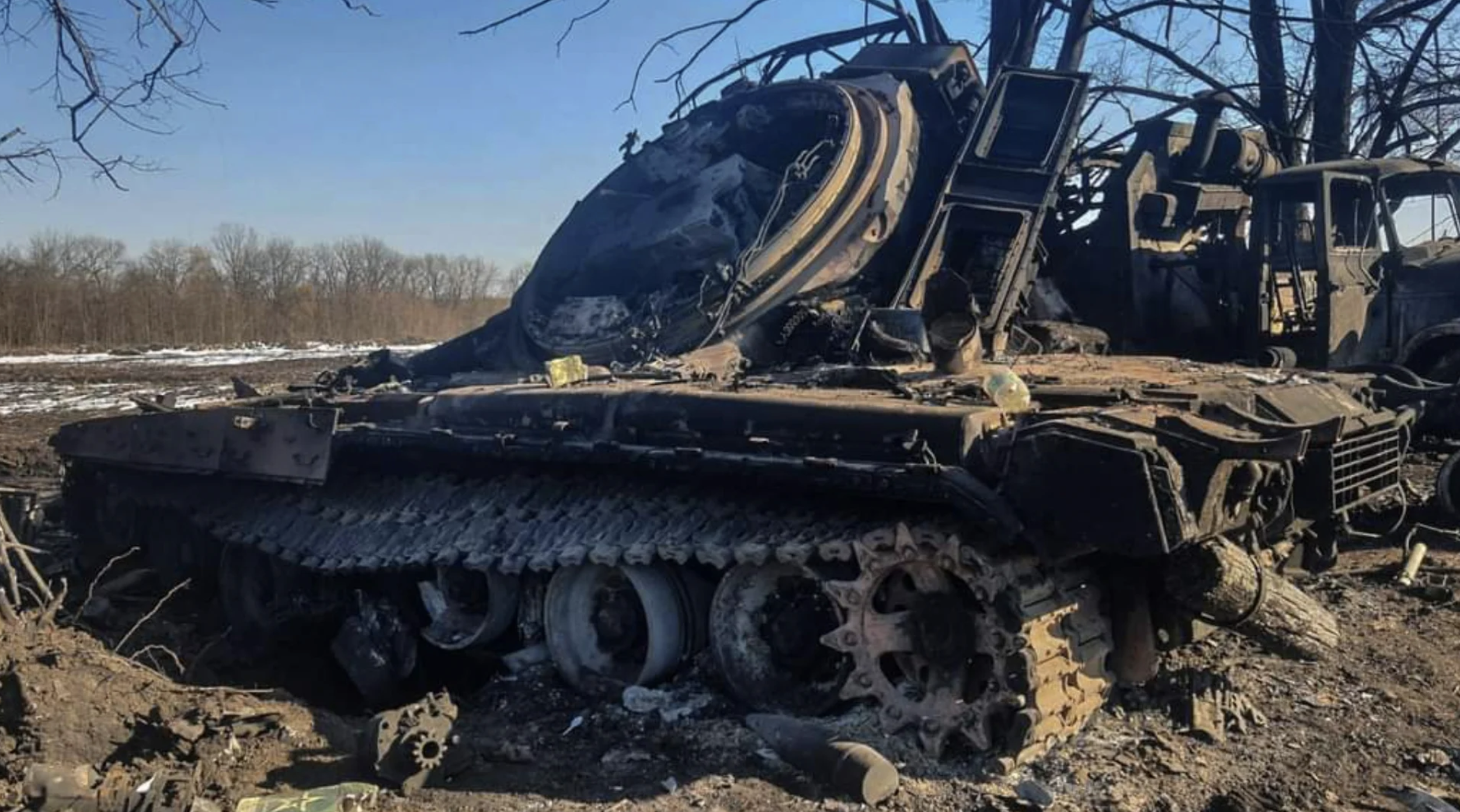
That discrepancy in expectations versus reality led to Russia’s initial assaults columns being destroyed. Thousands of shattered Russian tanks and armoured columns littered the routes of advance, providing stark evidence of the severity of Russia’s defeat.

Putin then settled for the much reduced objective of simply securing the Donbass. Reversing his earlier decision to keep the Republics of Donetsk and Luhansk as independent autonomous regions within a unified Ukraine, Putin formally incorporated both of these republics, plus the Ukrainian Oblasts of Kherson and Zaporzhiaca into the Russian Federation on September 30, 2022.

Shortly thereafter the Armed Forces of Ukraine launched a blitzkrieg counter-offensive that successfully recaptured vast swaths of Russian controlled territory.

The success of last fall’s offensive, along with a major increase in NATO’s provisions of additional modern armoured vehicles including 10 Canadian Leopard II tanks, had Western defence pundits eagerly anticipating major gains for Ukraine with their next big push.

This long awaited major Ukraine counter-attack began in early June, but after two months of bitter fighting and huge casualties, very little ground has been gained.

The reason for this is that the Russian military has learned from its painful lessons in the early clashes. With the winter months lull in fighting, the Russians were able to dig extensive fortifications and more importantly, lay a deeply layered series of minefields. Although casualties among Russians to date have been staggering, those who survived are now battle hardened veterans. They are no longer the parade square paper tigers that rolled across the Ukraine border in February 2022.

Unfortunately for all involved it appears that neither Russia nor the NATO supplied and trained Armed Forces of Ukraine have the capability to deliver a heavy enough knock-out blow that would end this war any time soon.

ON TARGET: Military Executives' Big Bonuses

By Scott Taylor

To even the most casual observer it is readily apparent that the Canadian military is in a woeful state. For months now it has been reported that the Canadian Armed Forces are in the midst of both a recruiting and retention crisis.

This double whammy has resulted in a shortfall of 16,500 personnel from an authorized Regular and Reserve Force strength of 105,000.

In terms of procurement there has been a steady drum beat of news reports detailing lengthy delays and massive cost overruns involving most, if not all, the major equipment purchase programs currently in progress.

Then there has been the relentless crap storm of sexual misconduct cases – many involving the most senior positions in the military.

If Canada’s Defence Department were a private sector company one would expect to see much of the senior leadership being escorted to the elevator with their personal belongings in a box.

Which is what made the recent headline in the Ottawa Citizen all the more shocking. It read “National Defence executives take in almost $3.5 million in bonuses.” According to documents released under the Access to Information law, some 252 executives at DND received a performance bonus between April 2021 and March 2022.

This equates to virtually every senior civil servant getting this extra boost to their pay package.

To put this in perspective, during the time frame that they earned these bonuses, the lowest-paid executives received salaries ranging from $103,000 to $131,000. More senior executives made between $195,000 to $230,000, while Deputy Minister level executives pulled in between $219,000 to a potential maximum of $371,000.

It should be also noted that not all bonuses are created equal, as one civil servant performed so well that they were rewarded with a staggering $101,000 bonus.

The documents outlining these bonuses were obtained originally by Ottawa-based lawyer, Colonel (ret’d) Michel Drapeau. He questioned the need for any such bonuses, given that these executives are already well remunerated and they receive additional benefits. In particular Drapeau took exception to the $101,000 bonus. “You have someone that was supposedly so good at their job that they were worth an extra $101,000?” Drapeau told the Citizen. “Let’s hear all about their deeds.”

While Drapeau may have made that quip somewhat facetiously, I would like to echo that sentiment.

These were taxpayers dollars, and given that the individual was rewarded with such a hefty sum, then their exploits also deserve to be heralded in public. If either the recipient or those who awarded this massive bonus wish to contact me, I will be happy to detail the rationale behind the reward.

On the uniformed side of the Defence Department, the manpower shortage has not been felt at the highest levels. At time of writing the CAF has a total of 138 Regular and Reserve General Officers and Flag Officers (GOFO’s).

With the current depleted forces numbering just 88,500 this adds up to a ratio of one general for every 635 servicemembers. This is without a doubt one of the most ridiculously over ranked militaries in the world.

Admittedly rank creep has kept pace with the changing face of warfare itself. A military’s effectiveness is no longer gauged by massed ranks of soldiers, but rather the employment of cutting edge technology. However, Canada still outpaces our allies in the ratio of generals to soldiers.

During World War 2, the United States military had 2000 Generals for a military force of 12 million personnel which amounts to a roughly one senior ranked officer for every 6,000 soldiers. That ratio currently stands at roughly one general level officer for every 1,400 servicemembers. Which is still more than double Canada’s ratio.

Back in 1996 when media reports of Canada’s bloated senior ranks embarrassed the Liberal government of the day, Defence minister David Collenette vowed to bring that ratio down to one general per thousand serving soldiers. There was to be no immediate purge, just a slow methodical reduction through attrition.

Twenty seven years later, it is clear that no such reduction took place. By that 1996 yardstick, Canada would have 105 General Officers if our ranks were fully manned, and just 89 at the current troop strength. Instead we have 138.

ON TARGET: Canada's Defence Spending Under Fire

By Scott Taylor

In last week’s major cabinet shuffle, Prime Minister Justin Trudeau puzzled many with his decision to move Minister Anita Anand out of the Defence portfolio.

Anand was viewed by many in the Defence community as an effective and efficient politician.

The man selected to replace Anand is former Toronto Police Chief Bill Blair who will be moving from his current post as Emergency Preparedness minister.

Avid political observers speculated that the appointment of Blair to Defence is an indication that the Trudeau Liberals intend to focus on domestic issues rather than foreign policy, in the run up to the next election.

The consensus is that Blair will be more of a caretaker than a crusader and defence will not be high on the government’s priority list.

The problem with that scenario is that the Canadian military is already in a crisis mode. The institution remains reeling from the string of sexual misconduct scandals which have led to calls for sweeping cultural reforms. Added to this, or perhaps as a result of the sexual misconduct revelations, the Canadian Armed Forces are presently facing a recruitment and retention crisis that has reached the tipping point.

With a current shortfall of 16,500 personnel out of a combined Regular and Reserve authorized strength of 105,000, the CAF will soon be unable to train the necessary replacements while still fulfilling our international commitments.

Coming into his new job, Blair will also be faced with warding off pressure from our NATO allies, the U.S. in particular, to spend more money on defence.

The magic number bandied about by the usual defence industry-funded military analysts is the NATO stated goal of two percent of Gross Domestic Product (GDP).

Canada currently spends just 1.3 percent of GDP on National Defence. That’s the supposed bad news. However, thanks to Canada’s relatively massive GDP that amounts to $36 billion in actual defence spending.

To meet that magical two percent of GDP NATO goal, Canada would need to spend an additional $20 billion on the military every year.

I think I can safely say that whether our Minister of Defence’s name is Bill Blair or Anita Anand, that is not going to happen.

In terms of real dollars spent, Canada ranks 6th out of the 31 member NATO alliance. Most Canadians would also be shocked to learn that we rank 14th in defence spending out of the 193 United Nations members. That’s well inside the top 10 percent of big defence spenders.

To illustrate the arbitrariness of the GDP percentage formula one need only examine the disparity between Canada and Greece.

With an expenditure of 3.87 percent of their GDP on defence one would think that Greece would be the darling of the alliance.

That is a higher percentage of GDP spent on defence than what the U.S. spends.

However, Greece’s GDP is one tenth that of Canada’s so in terms of actual dollars spent, Canada spends four times more than Greece.

Surprisingly, none of the two percent of GDP cheerleaders ever think to link defence spending to actual military capability. By this I mean that Canada could simply spend that extra $20 billion required to hit the two percent of GDP goal by giving serving members a massive pay raise.

If you paid each soldier an additional $400,000 a year that would spend that $20 billion and I daresay end the recruiting and retention crisis overnight.

Yet it would not add a lick to our existing defence capability.

Ditto for boosting spending on things like munitions. In theory, Canada could meet the two percent of GDP mark by simply purchasing huge quantities of munitions for soldiers to simply blast away on live fire ranges.

Which is why the NATO objective for member states should be rooted in the actual capability that countries bring to the alliance.

In theory this could be based on a per capita of population.

For instance, for every one million citizens, a NATO member would be required to maintain 1500 regular servicemembers, trained and equipped to an alliance standards.

Not every country in NATO is blessed with the same minimal national security threat levels as we are in Canada. Hence come countries, like Turkiye, by virtue of their geo-political circumstance would require a far different security footprint. Thus they would maintain far larger standing militaries than the NATO minimum.

The per capita yardstick would level the playing field in a manner that actual military contribution could be assessed on a practical basis.

Canada punched above its weight for over 10 years as part of the NATO-led mission in Afghanistan, and by maintaining a forward deployed battle group in Latvia to deter Russian aggression, we are delivering real capability to the NATO alliance.

That should count for more than meeting an arbitrary percentage of our GDP.

ON TARGET: A Canadian Foreign Legion...Eh?

Photo credit: Combat Camera

By Scott Taylor

The recent NATO Summit in Vilnius, Lithuania proved the genesis for a number of promises by the Trudeau Liberals to make significant increases to Canada’s military participation in the alliance. 


In a whirlwind photo-op, pit-stop to the forward deployed Canadian contingent in Latvia, Trudeau re-announced Canada’s plans to increase the size of that force to a full brigade.
While the other NATO allies that contribute to this multinational force in Latvia would also be increasing their contingents. For Canada this would mean expanding from 800 to 2200 troops deployed on a rotating, but continuous basis.


Trudeau also re-affirmed that Canada will continue to endeavour to raise defence spending to meet the NATO goal of 2% of Gross Domestic Product (GDP). At present Canada spends about 1.3% of GDP on defence.


Caught up in the NATO Summit spirit of pledging continued support for embattled Ukraine in their war against Russia, Trudeau also reiterated that the RCAF would be participating in the NATO program to train Ukrainian pilots to fly the F-16 fighter jets. 
Somehow this particular statement was simply parroted by Trudeau’s attendant media posse without anyone pointing out that our RCAF fighter pilots fly CF-18’s not F-16’s. Before Canadian pilots could train Ukrainians they would first need to learn to fly F-16’s themselves. If that is the case, then why not simply cut out the middle man – i.e. Canada – and teach the Ukrainian pilots directly? 


The last time I looked the RCAF were so woefully short of trained pilots that we were unable to participate in recent joint NATO international exercises. 


It is the chronic personnel shortage across the entire Canadian Armed Forces that will pose an almost insurmountable challenge for the Army to staff and maintain such a significant increase to the Battle Group in Latvia. 


Yes, the money spent to outfit this force with capabilities such as low level air defence, armed drones and anti-tank weapon systems will help push defence spending towards that arbitrary figure of 2% of GDP. 


However, the question begs as to where our understrength army units are going to find and train the pre-requisite number of personnel to keep that many soldiers forward deployed in Latvia.


The current tour length for troops based in Latvia is six months to one year. These postings are considered operational, so no spouses or dependants accompany the member.
That length of separation is a challenge for most couples and families and given the size of the army and the scale of the commitment, our soldiers will soon be in a constant cycle of preparing for Latvia, deploying to Latvia and returning from Latvia. 


There is an answer to this problem which might be considered extreme, but it is not without some successful precedents.


By this I mean the creation of a Canadian Foreign Legion. Based on the formula for the French and Spanish Foreign Legions, recruits would sign contracts for a three year tour of duty. At the successful completion of that contract they would be granted full citizenship.
This legion would be like the Spanish Legion in that recruits would need to be 18 years of age and not be older than 29 on the day they enlist. All recruits would be single and enrolled on a priority basis based upon physical fitness, mental aptitude, with previous military service being a bonus. 


Should a member of the Canadian Legion become injured or wounded prior to the three year commitment they would follow in the French example and automatically be granted full citizenship. The French call it “Francais par le sang verse’ or ‘French through spilled blood.” 


Recruits could be trained by Canadian officers and NCO’s at bases in Canada, but they would know in advance that their three years of service would be spent on overseas missions such as the brigade in Latvia or future UN peacekeeping operations. 
The question of retention for Legionnaires is a simple matter of withholding the bulk of their pay package. For instance, if the base pay rate was $60,000 then $40,000 would be held in trust until the contract is complete. 


At the end of the three year contract the legionnaire would be released as a full citizen with a starting nest egg of $120,000.


Both the French and Spanish foreign Legions have evolved into highly respected military formations which have earned their respective countries glory and respect on global battlefields. 


The original rationale for France and Spain to create such Legions was to avoid conscripting their own citizens to police the remnants of their far flung empires. 
In Canada’s case, it would be a means of bringing in a high level of immigrant to solve a manpower shortage within our military that has reached a critical tipping point.
It would be a win-win for Canada.  

ON TARGET: Biden's Clusterf**k in Ukraine

Photo: atlanticcouncil.org

By Scott Taylor

Last week’s NATO Summit in Vilnius, Lithuania was billed as the ‘most significant’ such summit since the end of the Cold War. It was certainly the largest such gathering with the NATO alliance membership standing at 31, with Sweden’s admission still pending.

It is worth remembering that during the Cold War there were just 16 NATO members aligned against the Warsaw Pact.

That communist alliance included the 15 Republics of the Soviet Union along with the seven satellite states of Albania, Bulgaria, Czechoslovakia, East Germany, Hungary, Poland and Romania.

In the 32 years since the Warsaw pact was dissolved and the Soviet Union broke apart, NATO has added seven former Warsaw Pact nations plus the three former Soviet Baltic Republics of Latvia, Lithuania and Estonia.

For those closely following the math, East Germany re-unified with NATO member West Germany, and the unified Republic of Czechoslovakia has since become the two separate NATO members of Czechia and Slovakia.

All of this clearly illustrates that the playing field has significantly shifted in the past three decades to the point that Russia stands alone against an alliance of 31, soon to be 32, NATO countries.

Perhaps even more revealing has been the poor performance of the once vaunted Russian military machine through the first 500 plus days of their invasion of Ukraine. No one ever expected Ukraine to withstand Putin’s initial onslaught, yet the combination of NATO supplied weapons, NATO supplied training and NATO supplied real-time intelligence has allowed Ukraine’s military to battle Russian forces to a standstill.

As Russian generals publicly berate their superiors at the Kremlin for failing to support the frontline troops, Ukraine is steadily making battlefield gains to reclaim captured territory in Eastern and Southern Ukraine.

At the NATO Summit, U.S. President Joe Biden confidently quipped to reporters that Putin has ‘lost the war’ in Ukraine.

This comes close on the heels of the same Biden administration explaining their rationale for supplying Ukraine with cluster munitions.

These controversial munitions are banned by the rules-based international order because of the threat they pose to innocent civilians. By their very nature cluster bombs break apart above the ground to scatter lethal bomblets over an area the size of a football field.

The problem is that not all of these bomblets detonate on impact. While the U.S. spokesperson claims there is just a 2.5 per cent failure rate, battlefield evidence suggests that number is far higher.

It is also not speculative to conclude that such unexploded ordnance poses a risk to innocent civilians for decades to come.

One need only visit those countries wherein the U.S. military has employed such munitions to see the legions of limbless survivors.

It was for that reason that Canada expanded the global landmine ban which we first spearheaded to also include cluster bombs.

For the record, the U.S. did not sign onto the landmine treaty and they certainly did not agree to ban cluster bombs.

To their credit, both Canada and the UK strongly voiced their opposition to this decision by the U.S. to provide Ukraine with cluster munitions.

In one of the most idiotic statements I’ve heard to date, NATO Secretary General Jen Stoltenberg justified the U.S. decision thus “The difference is that Russia is using cluster munitions to attack Ukraine, while Ukraine will be using cluster munitions to protect itself against an aggressor.”

This echoes that famous quote by a U.S. major during the Vietnam war when he told a reporter “it was necessary to destroy the village in order to save it.”

Another argument used to justify providing Ukraine with a banned weapon is that Russia has been using cluster bombs in the war. Again, whenever the Russians have done so, and it has been admittedly sparingly, the western pundits have been quick to cry “War crime!”

Alarmingly, the Russian Defence Ministry has vowed to increase their use of cluster munitions should Ukraine employ them.

This is a dangerous escalation with harmful implications for innocent Ukrainian civilians on both sides of the battle lines for decades to come.

Let us not forget that this current conflict is taking place entirely on Ukrainian soil.

The destruction caused by all of the munitions supplied to the Armed Forces of Ukraine have virtually all been expended on Ukrainian infrastructure. If Biden is correct and Putin has already lost the war, then why supply Ukraine with controversial banned weapons?

Ukrainian President Volodymyr Zelenskyy was present at the NATO Summit requesting accelerated membership into the alliance.

Given that such an admission of Ukraine would put NATO at war with Russian immediately, that was never going to happen.

Instead NATO placated Zelenskyy with the promise of additional weaponry to win a war in which Biden has already proclaimed him the victor.

It is too bad that the NATO leaders did not use this summit to discuss some sort of modern Marshall Plan to finance the eventual reconstruction of Ukraine. That would have been productive.

ON TARGET: Wagner Group Not the First Private Army

By Scott Taylor

With the recent crisis in Russia, wherein the private mercenary army called the Wagner Group mutinied and threatened to topple the regime of Vladimir Putin, casual observers were shocked at the concept of Russia employing a privately owned military force.


The usual suspects in the world of western military punditry were quick to hold up Wagner Group’s existence as further proof of Russian evilness and ineptitude. The sad truth is that privately owned mercenary armies have long been employed by global super powers to extend their martial authority without having to endanger the lives of their own citizenry. 


In fact, if one simply looks across the current battleline in Ukraine, it was a collection of privately owned militias that initially bore the brunt of the fighting against the Russian-backed separatists. 


In 2014, following the Maidan revolution which had forced the expulsion of elected President Viktor Yanukovych, the pro-Russian Ukrainian residents of the Donbas took up arms and proclaimed their own independence from the new administration in Kyiv. At that juncture, the existing Armed Forces of Ukraine were in disarray with many soldiers themselves having mixed loyalties based on the division within the country. 


Thus it fell to organizations like the Azov battalion to carry the fight against the pro-Russian separatists. The Azov battalion was privately funded and its ranks were filled with many international volunteers with links to neo-Nazi organizations. The unit's founder – Andriy Biletsky reportedly claimed it was his mission to “lead the white races of the world in the final crusade against Semite-led untermenschen.”


Despite the Nazi overtones, Azov proved to be an effective fighting force and they were soon incorporated into Ukraine’s official armed forces, albeit with a large degree of autonomy within that organization. 


Following their defiant defence of the steel plant in Mariupol against overwhelming Russian forces, the members of Azov were elevated to the level of heroes in the western media, and their previously reported neo-Nazi origins have been all but forgotten. 


Closer to home, the United States have made extensive use of private armies during their recent failed occupations of Iraq and Afghanistan. One of the largest of these is a group called Constellis which is better known by it’s original name Blackwater. 


Founded in December 1996 by former Navy Seal officer Erik Prince, Blackwater at it’s zenith employed over 10,000 mercenaries and carried out the heavy lifting in counter insurgency operations in both Iraq and Afghanistan.


From 2003 onwards they were directly employed by the U.S. Central Intelligence Agency to wage black ops on the enemies of the USA. 


As a private entity, Blackwater was not bound by the ‘rules based international order’ which constrains the conventional U.S. forces.


In 2007, Blackwater went a step too far over the line when their employees unleashed what became known as the Nisour Square Massacre. In that incident, Blackwater mercenaries killed 17 Iraqi civilians and injured another 20.


Four Blackwater employees were tried and convicted of the murders in a U.S. court but those convictions were pardoned on December 22, 2020 by outgoing U.S. President Donald Trump. 


During Canada’s participation in the failed occupation of Afghanistan, in addition to the regular force battle group deployed by the Canadian Armed Forces, the Canadian government also employed a number of privately owned militias. 
Many of these contracts were with local warlords-turned-democratically-elected officials.


The payments were essentially a form of ‘protection money’ to keep these fighters ostensibly on our side. 


These fighters were also able to operate outside the constraints of any ‘rules based international order’ and they often used that status to prey upon the local citizenry in the name of NATO. This of course only further defeated the purpose of Canada deploying troops to make a better, more secure life for the people of Afghanistan.


​​​​​​​Historically, the employment of mercenaries has rarely, if ever, resulted in a positive long-lasting result. 


When the U.S. colonies rose up in revolt in 1776, Britain opted to counter the military threat by deploying a large force of German mercenaries.
The bulk of this 30,000 strong force war supplied by the German state of Hesse-Kassel and they thus became known as the Hessians.


While they were excellent fighters they also earned a reputation for their ruthless conduct towards civilians whether they were loyalists to the British crown or supporters of independence. 


Having just celebrated the 4th of July with our American neighbours, we all know the Hessians may have won some battles, but they did not win the war. Ditto for Blackwater in Iraq and Afghanistan. 


The insurgents never defeated them in an actual military clash. They simply wore down the American will to maintain their illegal occupations.


It will be very interesting to observe what happens in the wake of the Wagner Group’s aborted mutiny. Perhaps they can take a leaf out of Blackwater’s playbook and simply change their name.

ON TARGET: Prigozhin's Cannon Ball Run on Moscow

By Scott Taylor

The war in Ukraine took a bizarre and alarming twist with the armed showdown between the Wagner Group mercenaries and Vladimir Putin’s regime. When the news first broke on Saturday June 24 that Wagner troops were driving on Moscow, western media outlets scrambled to make sense of the unfolding drama.

Thrust into the international spotlight was Wagner’s founder, the outspoken Yevgeny Prigozhin, who proclaimed his soldiers were targeting the Russian military’s senior leadership: namely Defence Minister Sergei Shoigu and top General Valery Gerasimov.

For those who closely follow global security issues, Prigozhin and his Wagner group are well known entities. However for casual observers the apparent open revolt by a private army inside Russia came as a bit of a shock.

Prigozhin began his career as a petty criminal and spent some time in jail. As a result he avoided conscripted service in Afghanistan during the Soviet occupation.

Prigozhin became a hot dog vendor before elevating himself into a proprietorship of several fine dining establishments in Saint Petersburg.

In this post-Soviet era Prigozhin hitched his wagon to a former KGB Chief turned politician named Vladimir Putin.

Soon nicknamed ‘Putin’s Chef’ Prigozhin expanded his enterprise with a catering contract to feed Russia’s massive military.

In 2014, Russia wanted to create a private military force that they could employ to do their bidding without formal involvement by the state.

Although he had no military experience, Prigozhin was a ruthless businessman and a loyal ally of Putin.

Thus, the Russian state funded and equipped what was called the Wagner Group.

It was Prigozhin’s employees who were described as “the little green men” when they entered and occupied the Crimea in 2014.

By employing Wagner mercenaries, Russia could dubiously claim that their military was not actively engaged in the pro-Russian separatist movement in the Donbas region of Ukraine.

We now know from public admissions by Putin, that Wagner was paid billions of dollars to wage Russia’s proxy wars around the globe.

Earlier this year a video surfaced showing Prigozhin recruiting volunteers at a Russian prison with the promise of a pardon for those who complete a six month tour of duty on the frontlines of Ukraine.

There is no doubt that many of those convicts failed to earn that pardon as the Wagner group suffered horrific casualties in the meat grinder battle for the city of Bakhmut.

In that months-long struggle, Prigozhin made a name for himself by publicly calling out the senior military leadership of Russia for failing to properly support his fighters.

In one graphic video rant a visibly enraged Prigozhin points at the dead bodies of scores of Wagner soldiers and shouts “Shoigu, Gerasimou, where the f*ck is our ammo.”

Many analysts were shocked at the amount of vocal independence that Prigozhin was allowed in totalitarian Russia. However, Prigozhin avoided singling out Putin for criticism, and kept his sights set on Russia’s inept military commanders.

That public spat had resulted in the decision by the generals to formally disband Wagner Group in Ukraine.

As of July 1 those mercenaries were to make a choice of either enlisting in the regular Russian Army, or simply heading home.

One has to imagine that Prigozhin saw this as a massive blow to his empire, and would go a long way to explain why he staged an armed protest with his drive on Moscow.

In the end, we are to believe that cooler heads prevailed.

Belarus President Victor Lukashenko is said to have negotiated a deal with Prigozhin whereby the mutiny leader and his rebel army will not face prosecution for their actions.

Prigozhin will be exiled to Belarus and Wagner soldiers can choose to follow him there, or take the original deal to enlist in the Russian military.

There is still the question of what will happen to Wagners’ other ongoing operations in Syria, Libya, Central African Republic, Mali and Sudan. It is believed that at its zenith, Wagner had some 50,000 mercenaries on the payroll worldwide.

Whatever happens it will not be a quick fix.

However, in the wake of Prigozhin’s ill-fated, cannon ball run on Moscow, western analysts are gleefully predicting this could be the beginning of the end for strongman Putin at Russia’s helm.

However, it does not take much imagination to ponder what would have happened if Prigozhin had succeeded in ousting Putin.

Putin may be a madman, but Prigozhin is a ruthless lunatic. He was never advocating for a peaceful resolution to the war in Ukraine. He simply wanted it waged with less regard for human suffering. He didn’t want an olive branch. He wanted more ammo.

We may think we want Putin ousted, but he remains the devil we know.

Prigozhin came within a hairs breath of obtaining Russia’s nuclear codes. Imagine that scenario.

ON TARGET: RCAF Chinook Tragedy Badly Mishandled

By Scott Taylor

In the early morning hours of Tuesday June 20 a Royal Canadian Air Force CH-147F Chinook helicopter from Garrison Petawawa crashed into the Ottawa River. The initial reports in the media stated that four crewmembers had been onboard the Chinook: Two were injured and two were missing. 

As per the RCAF official statements the military were working with civilian agencies to conduct a search-and-rescue operation. 

Obviously there was a communication breakdown at the uppermost levels as later that same day; Prime Minister Justin Trudeau contradicted the official military talking points. “I was happy to speak with Chief of the Defence Staff last night to express my condolences to the families and colleagues of the members who have been killed,” Trudeau said to shocked journalists who were still reporting this as an ongoing ‘rescue’ mission. 

While some critics took umbrage with Trudeau’s use of the word ‘happy’ to describe his expression of condolences, I will trust it was simply uttered in error. 

To keep apace with Trudeau’s revelation, the RCAF began reporting their operation as that of ‘search-and-recovery.’

On the morning of Wednesday June 21, the RCAF tweeted out what they titled ‘RCAF Incident Final Update, Petawawa ON.’ It stated “The two missing air crew members from the RCAF CH-147F Chinook that crashed in the Ottawa River on Tuesday June 20, were found last evening. Tragically neither member survived. The names of the deceased individuals are not being released at the request of the families.”

In response to journalists questions, the RCAF further explained that they were not going to reveal the specific trade qualifications of the deceased air crew members. 

Again, someone failed to ensure that Canada’s senior elected officials were singing from the same song sheet. Former Defence Minister Harjit Sajjan – currently the minister of International Development of Canada, retweeted the RCAF ‘Final Update’ and added “My heart goes out to the families and loved ones of the two pilots who lost their lives in this tragic helicopter crash. No words can describe a loss as tragic as this. Their service and sacrifice will always be remembered and honoured.”

Somebody in the DND comms office noticed Sajjan’s slip up as he hastily took down the tweet. 

However, keen-eyed defence reporter David Pugliese had already screen saved the tweets, and he re-posted them.

The initial decision to not release the names of the deceased was without precedent. These individuals were killed in the line of duty. While I understand this was at the request of the families, they were both killed in the service of Canada and should be honoured as such. It was subsequently announced that the two deceased were in fact Capt. David Domagala, and Capt. Marc Larouche

We know from media reports that the tight-knit Chinook helicopter community is mourning, as is the entire Garrison Petawawa. 

The Canadian Armed Forces is a tiny sub section of Canadian society: One in five service-members is married to a fellow service-member and one in three new recruits has either one or both parents in uniform. 

This recent tragic loss will reverberate throughout the entire defence community.

Perhaps more disturbing is the fact that the communication gaffs in this incident were eerily reminiscent of DND’s handling of the April 29, 2020 CH-148 Cyclone helicopter crash which claimed the lives of six service-members. Within hours of that crash in the Ionian Sea, Greek news outlets began reporting the downing of a Canadian Sea King helicopter. 

As this circulated on social media, Canadian newsrooms were sceptical that this might be Russian disinformation as Canada no longer flew Sea Kings. 

On April 30, 2020 more than 30 hours after the crash occurred the DND issued a formal statement that a CH-148 Cyclone helicopter had crashed: one member of the CAF had been killed and five others remained missing.

The official version was that the Cyclone had lost contact while returning to HMCS Fredericton. The scenario DND painted was that of a mysterious crash which had sparked an ongoing search-and-rescue mission by the entire NATO squadron. 

The following day on May 1, the DND reported that this was now a search-and-recovery mission with all the five ‘missing’ aircrew members presumed dead. 

It was at this juncture that CBC was tipped off to the fact that the Cyclone was conducting a low level pass right beside HMCS Fredericton when it nose dived and crashed into the waves.

To date no one has ever been able to explain how or why the initial reports claimed the ship had lost contact with the helicopter, and why for more than 48 hours, Canadians were filled with the false hope that the ‘missing’ would be found safe. 

I offer my condolences to the family friends and comrades of the two deceased aircrew and full and speedy recovery to the two injured survivors. 

ON TARGET: Is 'Total Victory' Possible for Ukraine?

By Scott Taylor

As the war in Ukraine enters its 17th month the misinformation and disinformation continues to emanate from both sides of the conflict.

Depending on which news outlet one follows, it would be possible to believe that the Armed Forces of Ukraine are destroying the Russian invaders with ease, armed, equipped and trained by NATO allies, including Canada. Conversely, the pro-Russian media sites portray the war as a Kremlin victory with the current Ukrainian counter offensive being bloodily repulsed at the hands of superior Russian forces.

It is a battle of information ‘absolutes’ wherein western media portray anything Ukrainian as infallible, and the invading Russian troops as being incompetent and incapable.

For instance, on June 6, when the Kakhovka dam was breached on the Dnipro river, there was never any doubt that the Russians were responsible.

Russian troops controlled the dam at the time of the explosion, case closed.

The resultant flood damage is estimated to have killed 10 civilians, injured 14 and washed away numerous settlements downriver.

Ukrainian politicians highlighted the fact that several tons of fuel oil had been spilled into the river during the flood, causing an ecological disaster.

In the immediate aftermath of the dam breach, western media turned to their usual military pundits to explain to viewers why Russia would have deliberately blown up the Kakhovka dam at this particular juncture.

There was no doubt about Russia’s culpability, or speculation that Ukraine might have triggered the blast.

The problem for the pundits was the fact that short of blundering incompetence or a tragic accident, it made no real sense for Russia to destroy the dam.

The best argument put forward was that it was to pre-empt and delay the long-awaited Ukrainian counter-offensive.

However, we are now learning from a study conducted by the Washington, D.C.-based Institute for the Study of War that it was Russian defensive positions on the east bank of the Dnipro river that suffered the most damage as a result of the flood. According to the ISW study, “flooding has deprived Russian forces of previously held positions in at least 12 settlements on the east (left) bank of the Dnipro River and has pushed Russian lines back as far as 10 kms in some areas.”

In terms of the Russian defensive positions the ISW reported, “The flooding has destroyed many Russian first line field fortifications that the Russians intended to use to defend against Ukrainian attacks.”

From the outset, Ukrainian officials noted that the flood had washed landmines downriver creating a dangerous hazard to relief workers. According to the ISW, most of those landmines were part of the defensive works constructed by the Russian army.

Also rarely mentioned in the western media coverage of the incident was the fact that the reservoir at the Kakhovka dam was used to feed the North Crimea Canal.

It is this man-made waterway that provides the main water source for the Russian-controlled Crimean Peninsula. In 2014, immediately following President Putin’s declared annexation of the Crimea, Ukrainian officials had blocked the water flow into the North Crimea canal.

This had resulted in a severe shortage of water for irrigation and agriculture across the Crimea.

One of those very few tangible victories achieved by Putin’s invaders to date was the re-opening of the North Crimea canal after they captured Kherson and the Kakhovka dam in February 2022.

The catch-all response to the conundrum of explaining why Russians would have blown the dam when they had so much to lose and virtually nothing to gain is for pundits to quip-well: ‘the Russians don’t care about their own people.’

On the battlefield, it is apparent that the Ukraine military has indeed begun their counter-offensive.

There is now almost no doubt among western military experts that with NATO equipment and training, Ukraine will defeat the Russian and pro-Russian forces.

Those who talk of ‘total victory’ meaning the removal of all Russian supporting elements from Ukrainian territory forget the fact that 17% of Ukraine’s population are ethnic Russians.

Out of a total population of 43 million, some seven million Ukrainians consider themselves to be ‘Russian.’

They may be supported by the Kremlin in this current conflict, but what is to be the fate of these Ukrainian citizens who also happen to be ethnic Russians?

Will the rules-based-international-order of NATO allies allow Ukrainian soldiers to ethnically ‘cleanse’ the eastern Donbass region of nearly seven million people?

The alternative would be for Ukraine’s military to forcibly ‘occupy’ the Donbass and Crimea and set the stage for a perpetual violent insurgency.

If indeed victory is now assured for Ukraine, perhaps it is time that we begin a debate on what a ‘just’ and ‘humane’ outcome would look like.

Given the amount of weaponry we are prepared to commit to this war, Canada should also take responsibility for the potential outcome.

ON TARGET: Why is the RCAF not Equipped to Fight Wildfires?

By Scott Taylor

As a resident of Canada’s capital, I can admit that the nationwide wildfire crisis suddenly became all too real last week.

A thick smoke haze engulfed Ottawa and much of southern Ontario for several days, prompting health advisories.

Pollution levels literally went off the charts with experts estimating that citizens were exposed to 100 to 200 times the normal range of pollutants.

The prevailing wind currents resulted in most of the eastern U.S. seaboard being blanketed with the same thick pall of smoke.

New York was the hardest hit city, and residents were quick to blame Canada by jokingly referring to the haze as the ‘Eh’pocalypse.

As an emergency stop-gap measure, firefighters have been brought in from France, South Africa and the USA to help provincial authorities to battle the still out of control wildfires.

There is no federal agency tasked with fighting these fires, but in some cases provincial governments have requested assistance from the Canadian Armed Forces.

This support will come mainly from the army in the form of actual firefighters on the ground, with the air force providing some emergency airlift of endangered citizens.

The reason for this is that in a country that boasts 362 million hectares of forest – the third largest in the world – our air force is not equipped for, nor tasked with fighting forest fires.

The even crazier part of this equation is that Canadian aerospace industries have historically produced one of the world’s most effective water bombers. Originally built by Canadair, the CL-415 was nicknamed the ‘Super Scooper’ when it first flew in 1993.

A twin-engine propeller plane, the CL-415 was custom designed to allow it to refill with water from lakes near the targeted forest fire, by skimming the surface. This allows the CL-415 far more time on station near the blaze rather than having to return to an actual airfield.

Following Canadair, Bombardier subsequently built the ‘415’ and then in turn it was De Haviland Canada that produced these water bombers.

In October 2016 the CL-415 programme was acquired by the Victoria, BC based Viking Air.

Their aim is to modernize the existing design into what will be renamed the DHC-515 Firefighter, which will be produced at a plant in Calgary.

Spread across Canada, there are approximately 64 of the CL-415 aircraft employed by private companies and provincial governments.

International users of this ‘Firefighter’ are almost all foreign air forces; Croatia, Greece, Indonesia, Morocco, Portugal and Spain just to name a few.

Which begs the question, why is the RCAF not responsible for fighting forest fires?

As we are currently witnessing, these wildfires pay no need to provincial boundaries.

Our forests are a valuable natural resource; worth I daresay, as much protection as our international borders.

We are barely into this year’s wildfire season and it is already one of the most destructive on record. The research indicates that things will only worsen with time. The changes in climate create warmer, drier conditions, increased drought and a longer wildfire season.

For much of North America, projections show that an annual average increase in temperature by 1 degree Celsius will result in an increase in the median burn area by as much as 600% in some forests.

If this is the new reality then Canada needs to act now.

If the threat was of a military nature we would have to find the will and the means to mobilize the necessary resources. Instead, Canada is battling the forces of nature.

However, this is also an opportunity for Canada to shift the focus of our military – particularly our air force – to protecting our resources and by extension Canadians health and welfare as well.

A huge investment in Canadian aerospace to build an iconic Canadian designed water bomber should be a popular one.

In re-rolling the RCAF to be the lead agency in combating wildfires, perhaps this would provide the genesis to create a true Air Reserve located at airfields all across the country.

Pilots and crews could be part-time reservists with legislation to protect their jobs when mobilized for active service.

Dropping loads of water on forest fires may not be as exciting as the prospect of engaging Russian fighter jets in a dog fight, but it would still be a hell of a lot more challenging than flying a cargo plane for a courier service.

It would also be great public relations for the Canadian military to have waterbombers bedecked in RCAF markings battling fires to save forests and remote communities.

As the fight against wildfires is seasonally hemispheric, if Canada was to possess such a potent firefighting resource as a 515 Firefighter equipped Air Wing of the RCAF, during our winter they could be deployed into the southern hemisphere.

Think of the international goodwill such support could earn for Canada- just as we are currently thankful to the French, South African and American firefighters here in Canada to help us get through the current crisis.

The threat of increased wildfires is real. The time to act is now.

ON TARGET: Time to Re-Think Entire Structure of Canada's Military

By Scott Taylor

The Canadian Armed Forces are presently facing a manpower crisis which threatens to hamstring the entire institution. 


Out of a combined Regular Force and Reserve strength of 105,000, the CAF are currently short some 16,500 personnel. 


The problem is twofold in that the military is challenged to recruit sufficient numbers, while at the same time the CAF is having difficulty in retaining those already in uniform. 


As the overall numbers dwindle, it becomes that much more difficult to maintain the staffing of foreign commitments, like Canada’s forward deployed Battle Group in Latvia and simultaneously finding the necessary trainers to create the next generation of soldiers, sailors and aircrew. 
Throw into this mix the constant interruption of training cycles to deploy military personnel to assist with climate change-related natural disasters such as floods and fires, and it becomes readily apparent that Canada’s military is very close to the tipping point. 


Thus far, the solutions proposed by the senior leadership of the CAF have been little more than cosmetic tinkering to existing policies. 


In order to attract more recruits the Canadian military have loosened restrictions on dress and deportment, radical hairstyles, facial hair, tattoos and piercings. They are now allowed without restrictions and while service-members still wear uniforms, they are no longer gender specific. 
It is also no longer necessary for recruits to be citizens of Canada. Applicants need only to have their permanent residency. As for retention, the military hopes to make alterations to the pay and benefits package as an incentive to keep trained personnel in uniform.


Vice Admiral Angus Topshee, Commander of the Royal Canadian Navy, has introduced the Naval Experience Program (NEP) which will allow recruits to join for a 12- month stint. 
After a short eight week Basic Military Training course, those personnel will be posted directly to CFB Halifax or CFB Esquimalt. They will not have any specific trade training so they will be considered ‘general duty’ sailors for the duration of their one year of service. 


Under the terms of the NEP, those sailors will serve on both coasts, earn $42,000, with free rations and quarters and enjoy three weeks of leave. 


Topshee ambitiously hopes that after experiencing the RCN’s culture and seeing the world from the deck of a warship, 80 per cent of these general duty sailors will elect to extend their career and sign up for a second tour. 


Such measures, even if successful, may be a case of ‘too little, too late’. 


Given the developments on the battlefield in the ongoing war in Ukraine, maybe it’s time that the CAF rethinks the structure of our military entirely. 


There is no question that the drone has emerged as the queen of the modern battlefield. 
Canada has correctly deemed it necessary to invest in a mixed future fleet of armed drones. However, the RCAF has warned that staffing  such a new capability will be challenging due to the current manpower shortage. 


As such it is being proposed that reservists be activated to operate this future fleet of drones. Which begs the question, why do skilled drone operators need to be uniformed members of the military? 


As warfare increasingly becomes a high-tech contest between machines, drone pilots or operators don’t need to learn how to march in formation, polish boots or be able to bench press their own body weight. They would not even have to learn field craft skills as, given the range of these new drones, they could be housed in comfortable lodgings well behind any front lines. 


There will always be a need for the traditional warrior but perhaps it is time to look at those non-combat support trades to determine whether their role necessitates that they undergo full military training and be subject to the military justice system. 


While Topshee’s NEP will put general duty, non-trade trained sailors aboard the RCN’s warships, maybe a parallel program could be implemented to hire specialized civilians to support the CAF without having to be in uniform.


I know this will sound like blasphemy to the traditionalists who insist on maintaining the status quo, but desperate times call for desperate measures.


As for the issue of the military being deployed to aid the civilian powers during natural disasters, one short term solution would be to expand and support the group called Team Rubicon.
Established in January 2010, this is an organization of CAF veterans which volunteers to assist in the aftermath of floods, fires and earthquakes both at home and abroad. 


Expanding Team Rubicon and adding resources to increase their capacity would allow the military community to still reap the goodwill generated through aiding fellow Canadians, without having to strain our already over-tasked serving troops. 

ON TARGET: Was Canada 'Born' On Vimy Ridge?

By Scott Taylor

When Global Affairs Canada unveiled their new passport design last week, it did not take the Colonel Blimp brigade long before they realized there is no longer an image of the Canadian National Vimy Memorial in France included within its pages. 

This omission set off howls of indignation from those who have long peddled the notion that the Battle of Vimy Ridge is where Canada was 'born' as a nation. 

The Royal Canadian Legion tabled a letter of protest, as did the Vimy Foundation, which as the name suggests, owes its very existence to the importance bestowed upon this First World War battle. 

To give them credit, the Vimy Foundation have been hugely successful in promoting the Vimy Ridge myth over the past two decades. 

For legions of young Canadian students, annual class pilgrimages to the Vimy Ridge Memorial have immortalized that monument into something of a Canadian Mecca. 

That said, I've never understood the logic behind isolating the Battle of Vimy Ridge as the moment in which Canada emerged as a truly independent country. 

The Vimy proponents argue that this was the first time all four Canadian divisions had fought together as a single army corps, and that they successfully captured a ridge which both the British and French armies had previously tried and failed to accomplish.

The fact is that, while unified, the Canadian Corps was commanded by British General Julian Byng. Furthermore the assault at Vimy Ridge was not a singular operation, but rather a diversionary attack meant to support a much larger French offensive along the Aisne River. 

From April 9 to April 12, 1917, the Canadian Corps sustained a staggering casualty toll of 3,598 dead and a further 7,004 wounded. 

While the Canadians did successfully capture the ridge, the victory was not a major breakthrough, as the German Sixth army simply retreated a few kilometers to the Oppy-Mericourt line and dug in again. 

The subsequent French offensive was a disastrous failure. The French losses were so staggering that the Army mutinied en masse, refusing any further attacks. 

If one remains wedded to the idea that Canada came of age in a First World War battle, a more suitable choice would be Hill 70. 

This was fought in August 1917, just four months after Vimy Ridge, but this time the Canadian Corps was commanded by Canada's own General Arthur Currie. 

The Canadians once again achieved their objective, but with fewer casualties than at Vimy. 

Some of the Vimy-as-birthplace-of-Canada supporters argue that Canada's effort there were symbolic of the overall wartime effort which led to a more independent Dominion in the post-war era. 

However, Canada's automatic heeding of Britain's call to arms in 1914 was a purely colonial response to what was in fact an imperial war. That we sacrificed so much to prop up and support British imperial objectives hardly signifies Canada's independence. 

For my money, Canada first cut the umbilical cord to Mother Britain during the Chanak crisis of September 1922. 

For those unfamiliar with this little known chapter of our history, this began with a resurgent Turkish national army emerging out of the ashes of the recently conquered Ottoman Empire. 

Under the generalship of Kemal Attaturk, the Turkish army was steadily forcing the Greek army out of Anatolia. 

The British were keen to enter the fray on the side of the Greeks. However, as the British people were war-weary after the First World War, UK Prime Minister David Lloyd George put the call out for the Commonwealth Dominions to commit troops to this venture. 

Canadian Prime Minister William Lyon Mackenzie King did not immediately conform to the British request and instead insisted that any decision on going to war would be made by parliament. 

In a telegram to then-Colonial Secretary Winston Churchill, King advised the British that unlike 1914, Canada's response was no longer to be considered 'automatic.' This resistance from King was soon echoed by all the other Dominion leaders within the Commonwealth. 

As a result, Britain had no choice but to conclude a separate agreement with Kemal Attaturk, which awarded all of Eastern Thrace to Turkey. The Greeks were forced to abandon the territory without a fight. However, more importantly, King's expression of independent action had a lasting impact on Canada's status. 

Historians credit Canada's response to the Chanak incident as the genesis for British Foreign Secretary Arthur Balfour's subsequent revision of the status of the Dominions within the Empire.

According to Balfour, from this point forward, the Dominions were to be "autonomous communities within the British Empire, equal in status and in no way subordinate one to another in any aspect of the domestic or internal affairs, though united by a common allegiance to the Crown, and freely associated as members of the British Commonwealth of Nations." 

Balfour's revised formula was enacted into law in 1931 through the Statute of Westminster. 

Fighting in an imperial war as a colony does not make you a nation. Saying 'no' to an imperial war is when we in fact came of age. 

But there are no monuments to the wars we didn't fight, so what image could be put in our passports to symbolize the 1922 Chanak Crisis?