UNITED NATIONS PEACEKEEPING: The need to prioritize Canada's military needs, at home and abroad

(Volume 23-12)

By the Honourable Daniel Lang, Chair Standing Senate Committee on National Security and Defence

The Standing Senate Committee on National Security and Defence tabled its report titled UN
Deployment: Prioritizing our Commitments at Home and Abroad
. Participating in peace-support operations is a laudable goal, however, we cannot ignore the fact that Canadian military resources are stretched thin.

Canada has commitments to NORAD and NATO, which are not being fully met. In fact, our defence spending is below one per cent, approximately $20 billion short of our two per cent commitment.

Despite talk of “re-engagement,” Canada has never stopped contributing to the United Nations. Over the course of this study we learned that Canadians provide approximately $1.5-billion to UN programs and agencies annually — including $324-million for peace-support operations. We have over 100 Canadians presently deployed on UN missions, as well as over 1,000 military personnel deployed on coalition / NATO missions in Iraq, Syria and Ukraine, and an additional 455 members of the military who will be deployed early next year to Latvia.

We noted that Canada has a proud tradition in which 120,000 Canadians have served on peacekeeping missions, though these missions have cost 122 Canadian lives.

UN peacekeeping missions have changed dramatically over time. Today’s missions are undertaken when there is often no peace to keep. They are more about the protection of civilians than they are about traditional peacekeeping, where parties agree to end hostilities and international observers monitor the “peace.” We must recognize that any deployment to a place like Mali, in Africa, will be dangerous and more of a counter-terrorism mission, rather than traditional peacekeeping.

The Committee believes that before the government increases our commitments to UN peace-support operations, they must ensure adequate funding is available to meet the current needs of our armed forces. Our first key recommendation calls on the government to table a “Statement of Justification” in both houses of Parliament outlining the specifics of any UN deployment including the size of the mission, its goals, the risks involved, the costs, rules of engagement and a fixed-term deployment plan so as to ensure bi-partisan and multi-partisan support through open parliamentary debate prior to confirmation and deployment of members of the Canadian Armed Forces.

This recommendation affirms in the words of House of Commons Speaker John Fraser, who ruled in 1989 that Canada is a parliamentary democracy, not “a so-called executive democracy nor a so-called administrative democracy.” While on deployment on a United Nations mission, the government must ensure there are clear rules of engagement so our soldiers can take action to defend themselves and/or civilians from harm or abuse. This is in response to the failures on previous UN missions. This must never happen again.

Additional recommendations note:

• Canada should move forward to expedite implementation of UN Resolution 1325 to encourage the inclusion of more women in all aspects of peace-support operations;

• recognizes the burden that a deployment to a francophone nation will have on Franco-Canadians, and calls for a strategy to better support those units and their families;

• if Canada were to become more involved in training, it would contribute to long-term capacity building for regional organizations and those developing countries that are deploying troops so they meet a basic performance standard. Hence our fourth recommendation focused in this area;

• we called on the government to ensure sufficient financial and support resources will be available for women and men who return from dangerous peace-support operations, especially those who develop post-traumatic stress disorders; and finally,

• we called for UN reforms to prosecute sexual exploitation and abuse which have occurred during UN peacekeeping missions.

To learn more about the report, visit www.sen.parl.gc.ca. 

STANDING TOGETHER: Families behind service and through rehabilitation

(Volume 23-12)

By Kari M. Pries

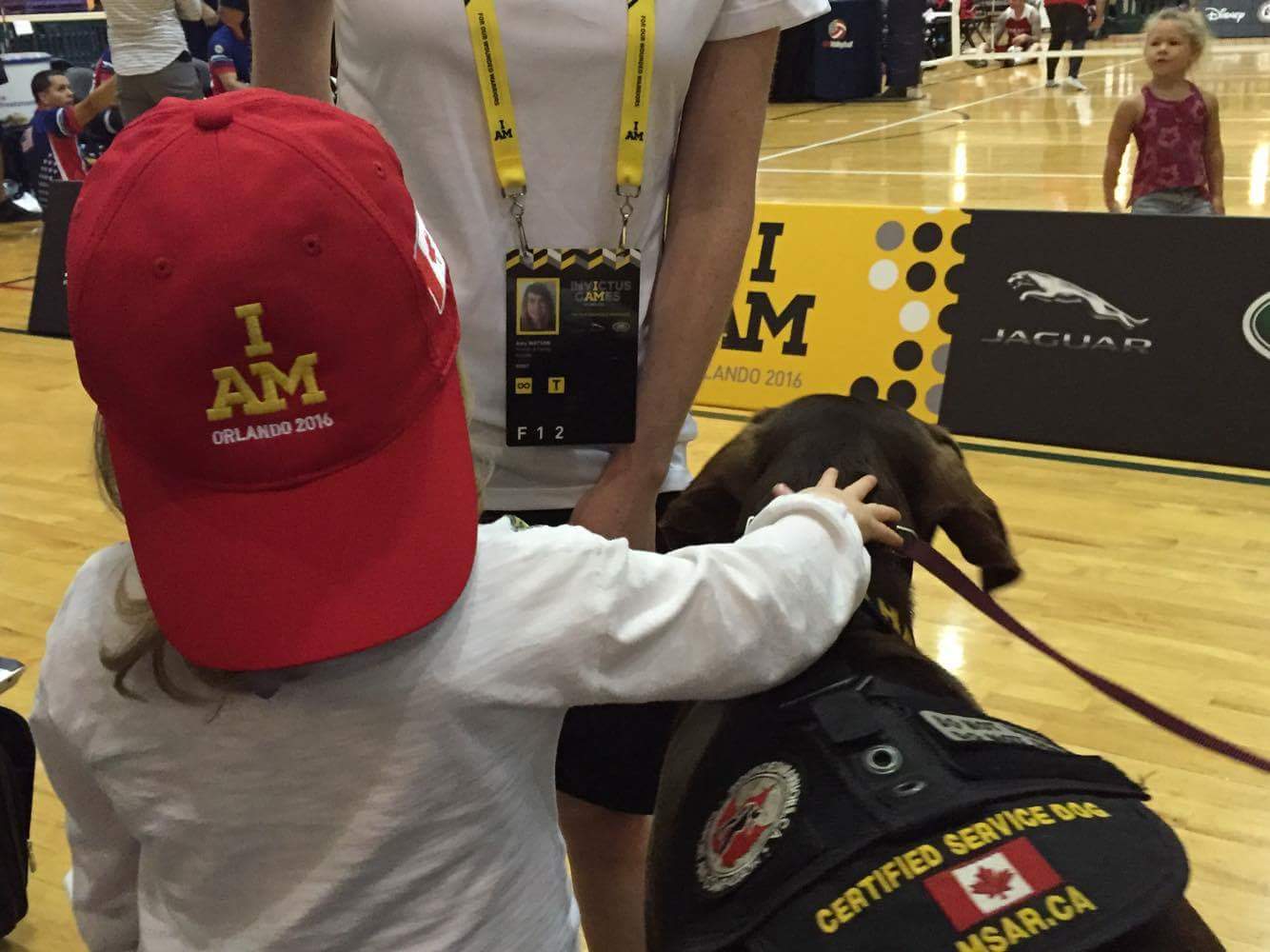
Zack held his daddy’s hand the whole plane ride home to Ottawa from the 2016 Invictus Games (IG16) in Orlando, Florida. All week he had seen injured soldiers at Disney World — people with legs missing, with glass eyes imprinted with patriotic symbols, with burn scars accompanied by dramatic tattoos on the swimming bodies of mothers and fathers alongside their shrieking, happy children at the hotel pool — and he had asked lots of questions. Who were they? What had happened? Where were they from?

The morning after his plane ride home with his dad, Zack took his mum aside and asked one more question: “Why do people like daddy have service dogs?” Zack’s mum, Marie-Andrée Malette, was used to answering questions as a registered nurse and advisory committee member for Veterans Affairs Canada (VAC) on the health care approaches needed in response to post-traumatic stress disorder (PTSD). She adapted the complex terminology of illness and injury to words her son might understand. “[Dogs] help them to be less scared. We don’t know why their bodies react like that, but we know it is because he has been at war.” Zack paused for a moment. “So, on the plane,” he said thoughtfully, “I was like a service human.”

Five Canadian Armed Forces members and 23 veterans made up Canada’s IG16 team in Orlando, Florida. Almost all were accompanied by family members or close friends who were hosted at Disney World and attended the events as honoured guests. They provided the ever-present cheering squad for Team Canada who represented their nation in sporting events from track and field to swimming and archery. A Canadian service dog even had a go in a special swim event.

Many people wonder why the Invictus Games, as an international sporting event for serving members and veterans, puts so much emphasis on competitors’ network of families and friends. Zack’s innocent observation explains the reason in a way that reaches to the heart. He was one of hundreds of children who attended IG16 in support of a loved adult — a mother, a father, an aunt, or an uncle — and learned along the way that there are many other children and many other families just like them who act as “service humans.”

As is so often observed by military family networks and resource centres, when a service member enlists, their families are thrown into a life they may not have chosen or of which they have little understanding. Effectively, they have been enlisted as well. And while the impacts of military service are studied and discussed widely — from physical and mental injury to lasting illnesses — there is much less focus on the friends and family networks that support those members, who make the sacrifices alongside them, and who live with the sometimes poorly understood impacts of a life of military service. Injury expands exponentially, leaving a community with the memories, reactions, and fallout as well as the struggle to offer the right support mechanisms to their loved ones.

Many may not realize for months or years what it is that they are dealing with. Jennifer Wyatt, the wife of one IG16 competitor, describes the feeling as “a frog in water that is coming to boiling point.” She continues, describing a decade of undiagnosed PTSD: “I always thought it was me. For him to start seeing someone, to put a label on ‘it’, really helped.”

For many families, attending IG16 was their first opportunity to witness loved ones challenge themselves in a new arena. The experience was as tantalizing as it was torturing. Sign-up was last minute, the training camps short. Competitors had personal hurdles to overcome and negative reactions and stressors to manage. But the message to competitors throughout training camps that “you are not alone” was generously extended to families who made personal connections with other families from around the world. There was also the support from Canadians across the country, poured out in what one family called “a genuinely humbling experience.”

IG17 brings the Games to Toronto, Canada, as the country celebrates its 150th anniversary of Confederation and the 100th anniversary of the Battle of Vimy Ridge. The Games provide another opportunity for remembrance, not only of battles past but community brought together and dreams of the kind of community to which Canadians aspire for our future.

The Hoogendoorn Family

Mark lost his leg in a 2010 incident in Afghanistan after three years of service. During his recovery, he met his wife Leisa in a pub. It was near Christmas and an early date was spent at the mall, shopping for Christmas presents. Standing in the Toys R Us checkout line, Mark tentatively mentioned that he had lost a leg in Afghanistan. “He seemed really nervous about it,” remarks Leisa, “but I was like, okay.” And that was that.

Soldier On has been great for Mark, allowing him to engage in new activities from snowboarding to mountain climbing to golf. “He’s able to get out and do stuff as a good break from work,” states Leisa. However, she had not been able to really see what that part of his life was like until the opportunity to participate in IG16 arose. “I think it’s a bigger deal for me,” she laughs. “Mark’s all nonchalant about it but for me, it’s awesome.” Not only did Leisa get to meet Mark’s Soldier On friends, about whom she had heard a lot, but she saw first-hand the importance of the Games themselves. “They bring more light to the issue [of ill and injured] and increase visibility for the adaptive lifestyle” that has been so important for Mark.

Their year-old son Atticus will be too young to remember the year his daddy competed at Disney World, but his father got to walk away proud of what he did, with his boy smiling away in the grandstands. “It is something for the future,” Leisa concluded.

The Wyatt Family

At the appointed time for the interview, Rachael, Jennifer and Sean Wyatt crowd into the camera field against a backdrop of colourful walls and cheerful sunshine. They exude familiar comfort if perhaps a slight bewilderment that they are so easily sharing their experiences of post-traumatic stress disorder (PTSD) via Skype. Missing is Rhiannon, the younger of the two girls. “She wanted to be here, but work calls,” noted mum Jennifer.

Family time has always been a series of wishes and gaps for the Wyatts since Sean, 29 years in the Navy, was often away on deployment and missed large chunks of his daughters’ lives. Jennifer explained she used all kinds of tricks to keep his presence with them, despite the frequent distance. Nonetheless, sailing took its toll with the result that it is often hard to share personal feelings and experiences as a family. Throughout Sean’s time in the Navy, Jennifer observed that “soldiers were so well protected but families were not, if that, protected at all.”

With the distance, families become used to glossing over the difficult bits. Communication becomes a challenge, even as work ends with retirement and the distances narrow. Sean acknowledged that he was good at hiding PTSD and later, at hiding his tattoo — the symbol of a semi-colon — and all it implies. “An invisible disability is tough,” explained daughter Rachael. She calls him frequently, usually when walking home, as they find it easier to talk on the phone.

IG16 came out of the blue for the family. Although it was a significant event for them to take a “real together” holiday, it was not something that Jennifer or the girls could let themselves anticipate with pleasure. Rhiannon did not even look at the possibility of where families would stay at Disney World because she didn’t want to get too excited.

But Sean managed to work through his fears. He returned to archery as a sport he had once loved but had abandoned for six yearsduring the depth of his PTSD. And so the family was ultimately able to make their way to Disney World to support him. Jennifer underlined what that meant to her: “It started in Orlando Airport and having people cheer at our arrival. The experience was so surreal and I cried. The first of several times.”

Jennifer and Rachael are enthusiastic about the potential for the Invictus Games in 2017 and what they can bring to Canada. “We are closer together because of the Games and we benefited from seeing other families [in Orlando] and sharing with them.” Jennifer is happy to promote the Games at school, where she works, and Sean came home from the Games with new projects in mind. He has challenged a neighbour who is also struggling with PTSD: “I went over to visit him and I said, ‘You are signing up [for IG17.]’”

The Wyatt family is usually quite private but the Games have allowed them space to try something new. Father Sean pushes forward to medalling in a sport he learned to love again while Jennifer, Rachael, and Rhiannon are happy to share their experiences with other families and the rest of Canadians. “If we can make people here feel as proud as we experienced when we were in the States …” Jennifer trails off. It will be a job well done.


The Guindon-Malette Family

Joel left the CAF in 2008 after several years serving in the military — police and close protection — and found the transition hard. He had been renowned for his skills but found that they did not translate well in the civilian world. His wife, Marie-Andrée, a registered nurse, saw the warning signs of PTSD but found that few programmes were available at the time to help manage a life with mental illness. “You shouldn’t need a medical degree to navigate the system,” she argued.

She found that occupational therapy for mental injuries was badly understood by VAC and it took all of her expertise as a health professional to navigate the system. Marie-Andrée was pro-active and pushed for further services through work on a VAC advisory committee to help them explore and fill the gaps in mental health services.

Thus, she knew what to expect when Joel received a call from IG16 team captain Bruno Guévremont asking him to sign up for archery on Team Canada. Joel had been a marksman and had previously won trophies in competition, but archery was something new: a challenge. Marie-Andrée described Joel’s experience with the first round of training as very hard, but it became easier as he got to know the team and they bonded over the capricious nature of PTSD.

“With every day, he became better at managing stress,” Marie-Andrée explains. “IG was a huge step in his therapy, in his progress.” Their two boys, too, were ecstatic to see their dad compete, to join him on the podium, and to see their father engaged in something that inspired him. Marie-Andrée reflects how it was so important, the personal and recovery progress. “And I was crying like a baby when he got his medal.”

IG has helped Joel push his limits, and his family along with him. These days, they focus on the positive things but there is still a long way to go. “Anxiety can still dictate our lives, but there is also a new way of looking at things.” Just as Joel received the message over and over that “you are not alone, not the only one struggling with sleep,” the message was equally for the families. Marie-Andrée reflects, “At some point, the tasks I have to do every day, I will be able to hand some of them over.”

The takeaway from IG for Marie-Andrée was overwhelmingly positive. “We can think of vets with positive thinking rather than seeing them [as portrayed in the media] as angry old vets concerned only with their pensions.” There is still a lot of veterans’ anger portrayed in the media, but the Invictus Games allows Canadians to see ill and injured soldiers in a new light. “And that,” she concludes, “is definitely a win.”


Invictus Games 2017

IG17 promises to elevate the visibility of wounded, ill and injured soldiers across Canada. Its inclusion of family, friends, and community as essential components to recovery will push Canadians to reconsider what it means to offer support. Invictus’ collaboration with the WE Movement, founded to motivate exceptional youth to make the world a better place, expands the reach of the Invictus message to Canada’s younger generation. Over the next year, this partnership will challenge our ambitious young people to do “more together than any one of us could do alone.” Especially as Canada celebrates its 150th birthday, these activities will dare our country to imagine big the community we strive to build. Hopefully, sparking meaningful conversations about what Canadians ask of our military families and the inspirational role they can play in Canada’s future.

Pushing The Boundaries: Supporting soldiers in recovery

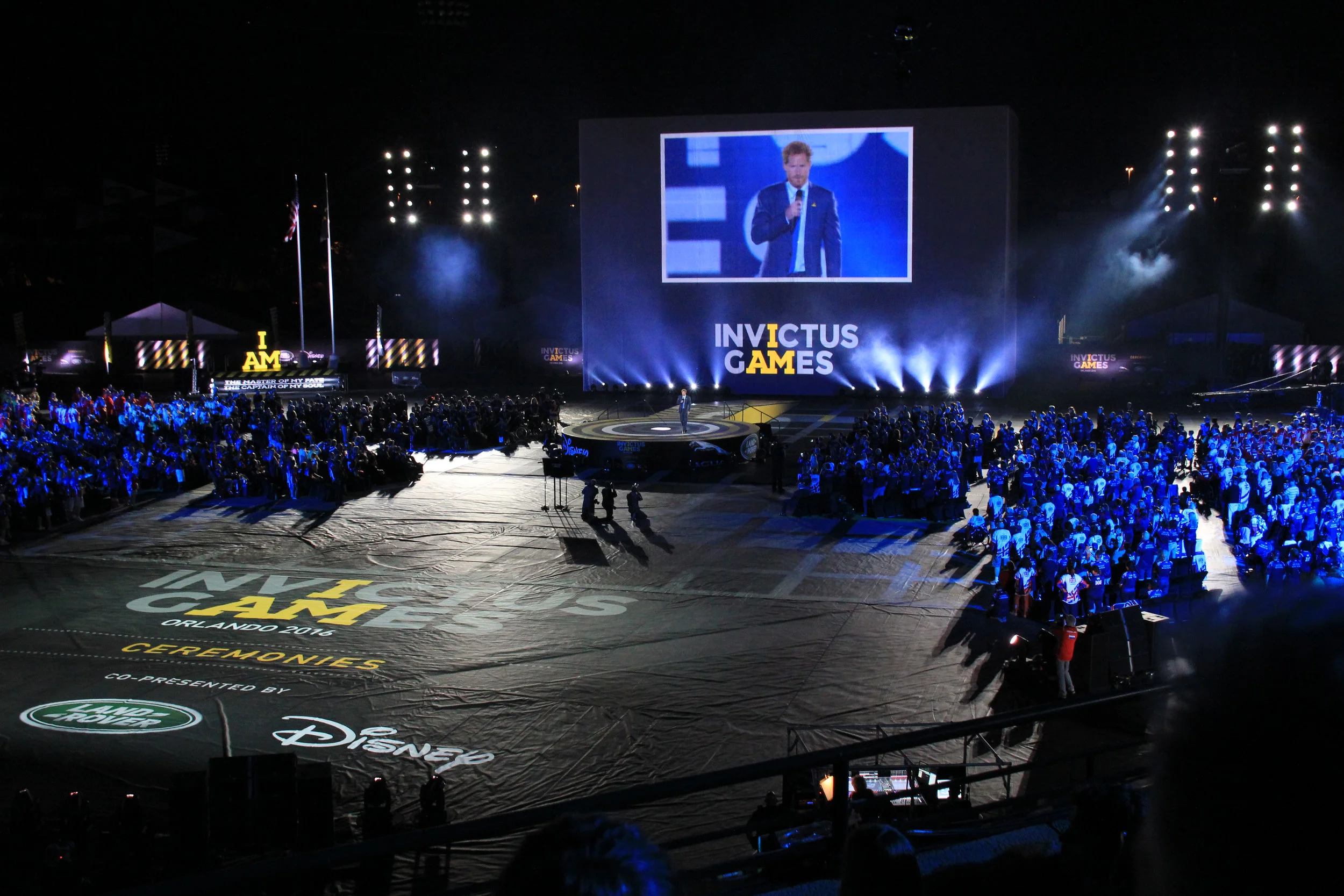
Invictus 2016 - Prince Harry opening ceremony.jpg

Text & photos by Kari M. Pries

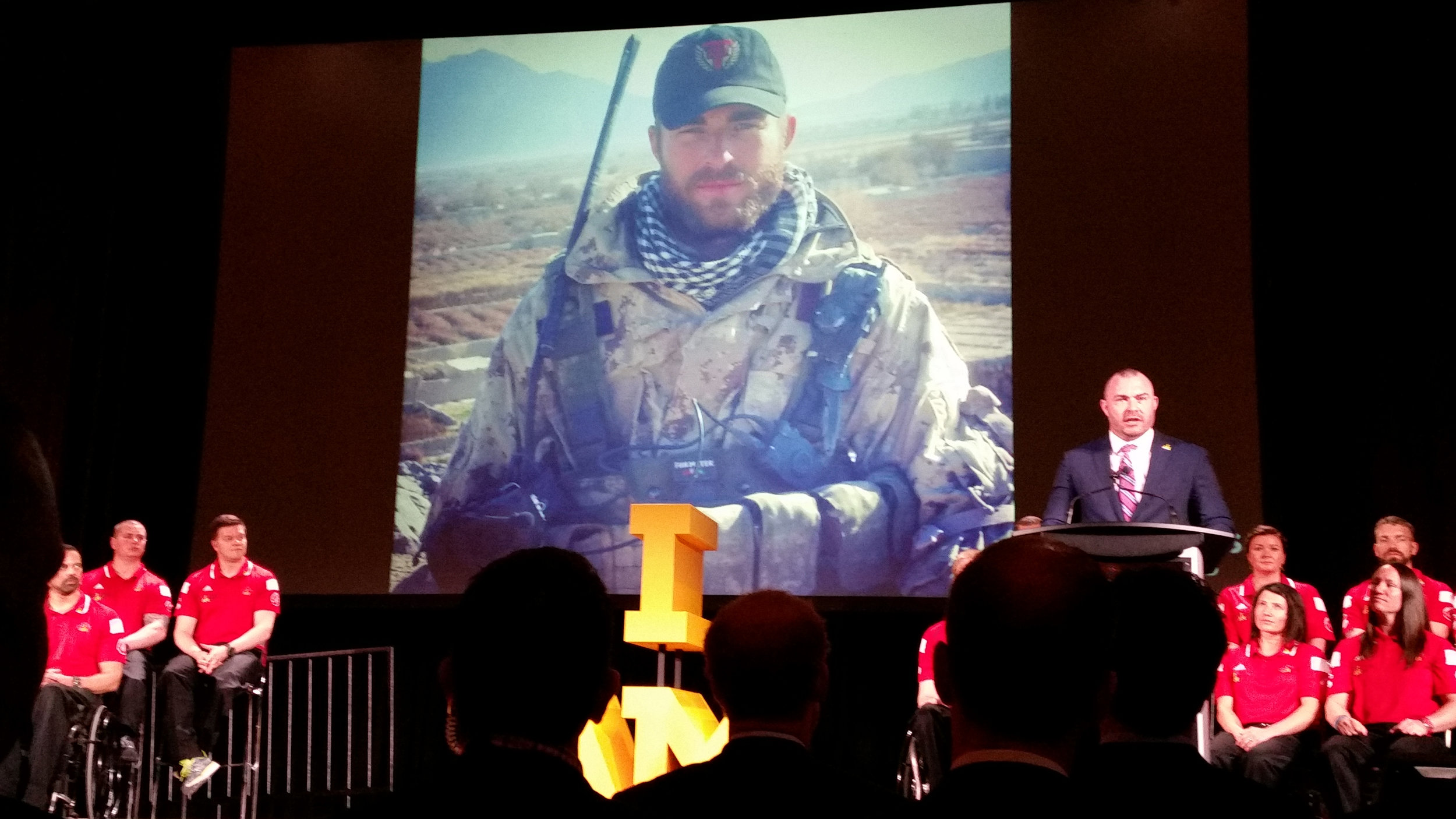
Amid the flashing lights and the roar of the city at Toronto’s Yonge-Dundas Square, CEO Michael Burns announced Team Canada’s co-captains for the 2017 Invictus Games. MCpl. (ret’d) Natacha Dupuis and Capt. Simon Mailloux will be guiding next year’s team of active and retired service member athletes in their training, supporting competitors in reaching their individual goals.

Toronto will be hosting the third rendition of the Invictus Games, founded by Prince Harry in 2014, receiving 500 competitors in 12 sports from 17 nations, along with their coaches and their families, from September 23 to 30, 2017. The announcement was part of an all-night interactive art installation, which saw members of the public build a 30-foot by 30-foot Invictus Games Lego-like structure along the backdrop of a 12-hour live mural painting by artist David Arrigo. The mural, titled From Darkness to Light, features key moments along the journey to recovery for both team captains.

“This city will become the focal point for hundreds of men and women who use the pull of Invictus glory to motivate their recovery from physical and mental injuries,” stated Prince Harry during his visit to Toronto earlier this year. One hundred Canadian active and retired service members will number among the 500 individual competitors who have overcome explosions, bullets, and terror — “injuries f**d up enough to be real” according to one — challenging themselves and each other to move forward, to overcome, and to reach new heights through rehabilitation. The Games also emphasize the contributions of friends and families as support networks in recovery — a completely unique perspective.

Toronto’s role as host city for the 2017 Invictus Games (IG17) was announced in a ballroom filled with VIPs in May of this year. Speaking about courage, Prime Minister Justin Trudeau looked directly to the small group of elderly citizens seated in the sixth row to his left. In wheelchairs or with canes and walkers propped within reach were these representatives of his grandfather’s generation — Second World War veterans who, Trudeau stated, had demonstrated a commitment to service and a dedication to serving for better: “a better world, better outcomes.”

IG17 CEO and Director Michael Burns tied today’s active service to the history of Canada’s commitment and sacrifice. In a Canadian tradition, as Burns highlighted, “We [Canadians] have a responsibility to care for [soldiers] when they get back.” The Games in Toronto will also fall during an auspicious time for Canada as it celebrates the 150th anniversary of Confederation and the 100th anniversary of the Battle of Vimy Ridge.

In Orlando, where the 2016 Invictus Games took place in May, competitors were joined by 15,000 supporters and spectators, among them not only Prince Harry but U.S. First Lady Michelle Obama, former U.S. President George W. Bush, and numerous artists from Morgan Freeman to singer and British Army veteran James Blunt. This was not your average military march. “[Soldiers] have shown us that in spite of the impossible, it [is] possible,” Jody Mitic, a veteran of Afghanistan, explained at the Toronto launch, choked with emotion. “[We] keep marching forward whether on two legs, one leg, or none at all and, as soldiers, we march together shoulder to shoulder.”

Aside from its fortunate royal founder, IG17 has a foundation in Canadian governmental and non-governmental charities. Running the games themselves is IG17 CEO Michael Burns, founder of national fundraising organisation True Patriot Love. Burns turned his sights from wealth management to veterans’ philanthropy after the Kingston funeral of a friend’s son who was killed in Afghanistan in 2007. He explained that the “emotional and moving experience” engendered “deep realisations that my generation was not doing enough or anything for military families.”

So Burns worked with former Chief of Defence Staff Gen. Rick Hillier on the Military Families Fund — an effort that was designed to bring immediate relief to ill and injured CAF members and their family, as well as raise awareness among Canadians of challenges that military families face. That effort for him evolved into True Patriot Love. When Burns heard that Prince Harry was hosting the inaugural Games in London, with its incredible experiences, support from the community to stage the Games, and broad public engagement, he had a moment of inspiration about what those Games could mean in a Canadian context.

Supporting the recovery of ill and injured serving members through sports was already something taken on by government programme Soldier On, founded in 2006 by Greg Lagacé. Then a Canadian Paralympic representative, he approached then Defence Minister Gordon O’Connor and Hillier with a plan for sport to facilitate long-term recovery among ill and injured service members. With Lagacé’s guidance and a team of devoted serving soldiers and public servants, chief among them Maj. Jay Feyko and PO1 Joe Kiraly, the organisation spread throughout the country to reach out to those who needed the boost even if they did not know it themselves.

For MCpl Mark Hoogendoorn, Soldier On introduced him to a lot of activities that he didn’t originally realise he could do after he lost his leg in an incident in Afghanistan in 2010. Ranging from snowboarding to glacial ice climbing, he tries to balance the temptation of new experiences with a return to his sapper career and his young family. Retired CPO2 Sean Wyatt noted that while he used to shoot regularly, his bows had hung on the wall for six years before a Soldier On contact tapped him on the shoulder. His participation started slowly after a PTSD diagnosis. First he picked up kayaking, which Wyatt explained was “an excellent experience that put me in contact with other people like me.” Joining Team Canada to compete in archery at the 2016 Invictus Games was a feat beyond anything he had attempted to date in his recovery, but one that was eminently rewarding.

Soldier On, with its established network of ill and injured participants, was thus a natural conduit to develop Team Canada for the Invictus Games, providing the trainers and sport professionals needed to build physical and mental capacity for competition in a large event. While emphasising that high-performance activities are only one component of their rehabilitation programme — a programme that has now expanded to include the 15,000 veterans covered under Veterans Affairs Canada — Lagacé argues that the Invictus Games gives programme participants a new goal, and an ultimate venue for recovering veterans.

The goal is not high performance so much as growing the capacity for perseverance. Several participants recalled that they were ready to give up after the first training camp in January 2016 but were able to push through with the support of their new teammates. Travel proved particularly stressful for two team members who got caught in a snowstorm at the Ottawa airport, severely testing their PTSD coping mechanisms, but also creating a bond between them. A spouse observed that it got easier for her husband once the team had connected and that they grew in confidence to share their stresses during the long months of individual training through a Facebook group linking participants from across the country.

Collaboration among team members is part of the healing process, according to IG16 team captain retired LS Bruneau Guévremont. Hoogendoorn concurs. “I could see how much it means to [my teammates],” he said. “It was good to get away [during training camps] to meet all the other injured guys. To get together with someone with a similar injury and compare notes.”

These exchanges can take place in smaller sporting activities and events like those Soldier On typically organises, and some have questioned whether a large-scale event like the Invictus Games are necessary, especially when they can prove a significant challenge or even a trigger to some with PTSD. Guévremont argued prior to the Games in Orlando that high-profile events are not only beneficial but essential. “We learn through challenges, experience and success. We need to learn to control our environment or [we will] let the injury control us.” But, most importantly for him, the Games give ill and injured the opportunity to “once again be part of a team” and to be “representing and serving again.”

Burns agrees. “Our engagement in Afghanistan has been ended for a decade but injury and mental health are lasting. The issues do not end with the war.” This is why, he argues, “The support and recognition [from regular Canadians] is as important now as it was during the height of the conflict.”

He has the research to back him up. According to polls commissioned before and after the Games in Orlando this year, 93 per cent of Canadians agree the country should support veterans who have been mentally or physically wounded in service while 75 per cent agree that initiatives like the Invictus Games have the power to transform how people think about mental illness.

In discussing plans for IG17, Lagacé notes that “IG will bring significant attention and awareness [among Canadians] to the requirements for comprehensive core programmes for ill and injured participants.” But he cautions that the media attention, the pressure, and the time, can be an additional challenge for individuals who go from struggling alone or with the support of family and friends to nation-wide attention. Visibility is not what most ill and injured are used to. “Most NCOs would not have previously interacted with VIPs, for example,” Lagacé notes. “But IG also allows them to see that Prince Harry is a human with a human story like theirs. That sharing their story can help others too.”

It can be really beneficial for some and have a ripple effect to reach others who haven’t yet made contact. “Paying it forward to a colleague,” Lagacé calls it. He points to the exponential increase in activity applications Soldier On has received since the IG17 launch as evidence that many were still unaware that there were programmes for them. Wyatt confirms this is the case and that IG made it natural “to go out and do things again, like a run to Canadian Tire” and, equally, to go check in on a neighbour who also needed support to change direction from a destructive path of unacknowledged PTSD. “It was a project I had in mind coming home from Invictus,” he confirmed. “I went to my neighbour [with PTSD] and I said, ‘You’re signing up!’”

Still, there are those who are not ready for the Games, its competition, its attention, and time commitment. For those, Soldier On is ready and waiting with more relaxed activities among a small group of comrades. Others cannot wait for the next Games to begin. And in between, a family member remarks: “We live an active normal life — [a] life that is our normal, not someone else’s normal.” Wyatt reflected on his experience competing in Orlando, concluding, “You know, if we freak out, others are going to be there. [They are] not going to judge you for it.” For Team Canada, at least, there is no façade between mates.

CALLING OUT THE GREAT VETERAN PRETENDER

By Sean Bruyea and Robert Smol

For the last 90 years Canadians have looked upon the Royal Canadian Legion as the living embodiment of Remembrance Day, keeping the memory of our veterans’ sacrifices alive. Likewise, successive governments have recognized the Legion as the primary institutional stakeholder when it comes to setting policy for veterans.

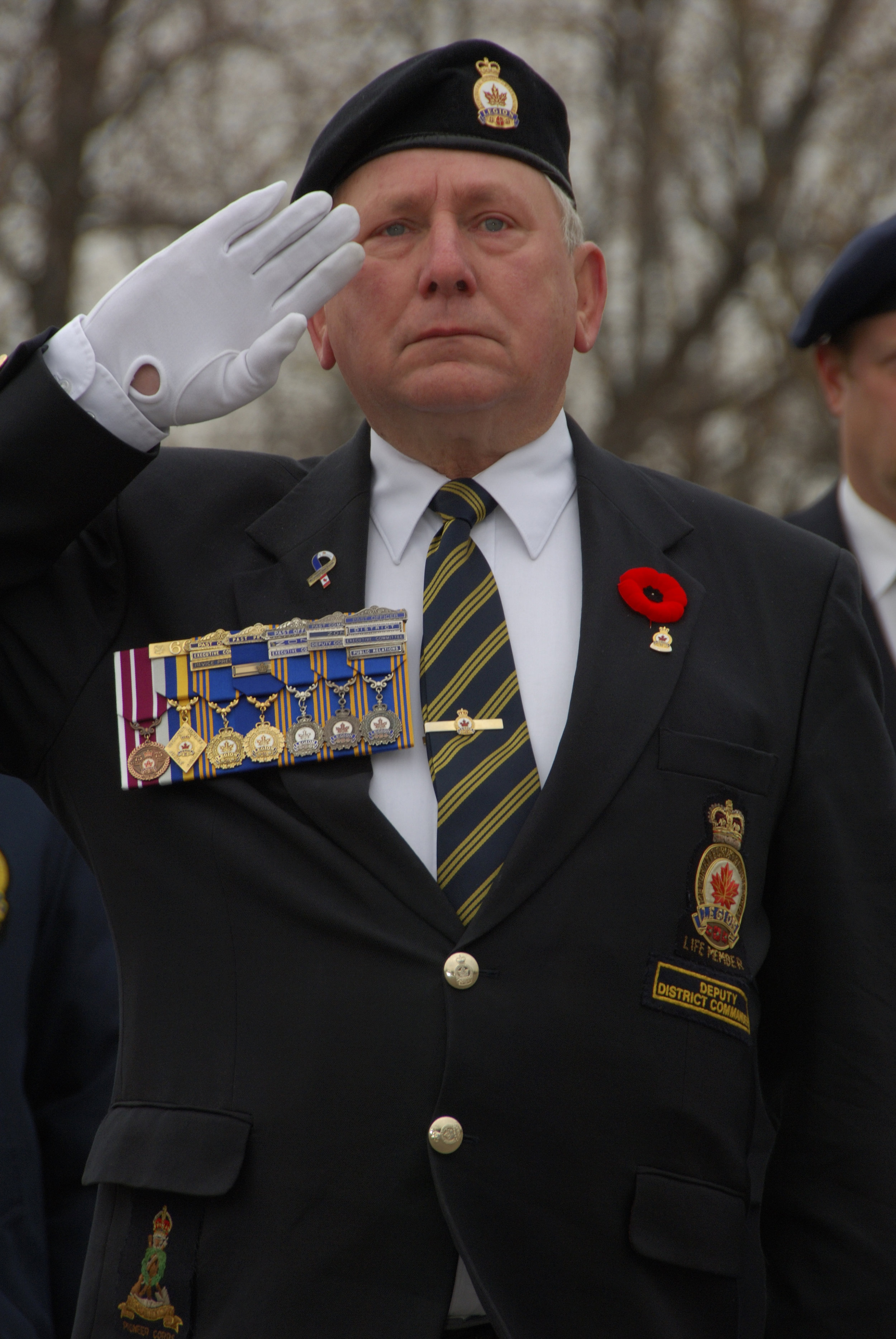
Today, however, this alleged veteran organization has devolved into an institutional lie. In spite of the deference it continues to receive, the Legion is now little more than a social club consisting primarily of civilian wannabe and “wish-I-had-been” soldiers imitating the façade of military life and sacrifice.

So it should not come as a surprise that, in recent battles with Ottawa over veteran benefits, the Legion either found itself lost in the fog or, worse, siding with government. Meanwhile, various municipal governments grant tax-free status to several Legion branches.

The Canadian public, which almost universally welcomes Legion uniforms at public events, needs to know the truth about what the Legion has become. More importantly, modern veterans like us owe it to the Legion’s battle-scarred founders to refocus the Legion back to its founding principles as an organization of veterans standing up for other veterans against government neglect and intransigence.

It never fails to shock uninformed members of the public just how unmilitary and veteran-less the Legion has become. At one time, approximately 50 per cent of Canada’s more than 1 million Second World War veterans belonged to the Legion. Currently, there are nearly 700,000 serving and retired Canadian Armed Forces personnel. As of October 1, 2015, the Legion had 265,000 members. Of those, more than 200,000 never served in the military! This is contrary to the Legion’s specious claim on its website that its membership “includes approximately 100,000 Veterans.”

The truth is, online documents show military veterans are lumped into a category of 64,000 “Ordinary” members. However, this category also includes militaries of allied forces and all NATO nations as well as war correspondents, YMCA, Knights of Columbus, firefighters and forestry services who served in wartime. Coast guard, provincial and city police services also qualify. Of the estimated maximum 35,000 to 50,000 military veterans in the Legion, more than half are likely WWII veterans. That leaves approximately 17,500 to 25,000 who might be post-Korean War veterans or less than four per cent of all CAF veterans and only 10 per cent of Legion membership. The bottom-line: the Legion apparently doesn’t care enough about veterans to know how many veterans are Legion members.

Look around. Any adult walking the street qualifies to be a uniformed, marching, medal-bearing, saluting, colour-carrying member of the Royal Canadian Legion. Legion membership is open to any “citizen of Canada, or a Commonwealth or Allied country” who is of “voting age” and “agrees to abide by the Royal Canadian Legion Constitution, rules and General By-Laws.”

The result: failing to understand the military culture and sacrifices is endemic in an organization which, with increasing illegitimacy, has a legal monopoly on all images of poppies related to remembrance and sacrifice. For all its grandiose rhetoric about being “Guardians of Remembrance,” the Legion’s overwhelming civilian membership does much to imitate, trivialize and therefore dishonour sacred symbols of military service.

Unlike any other Commonwealth nation, Canada’s Legion awards medals for administering the affairs of the Legion, including recreational activities for the elderly. Legion medals include a Meritorious Service Medal and a Palm Leaf. To an uninformed public, these Legion-exclusive “medals” can be easily mistaken for bona fide military service medals. And one can purchase only from the “Guardians of Remembrance” poppy earrings, umbrellas, tea towels, toques, mitts, and poppy puppies, giving the appearance more of a commercial monopoly than a sacred responsibility.

To add denial to dishonour, the Legion, in its last National Convention, voted not to allow its minority military veteran members to wear their specialist badges such as paratrooper wings and submariner badges. These distinctions are rightfully worn with pride to identify hard-earned specialized skills that often carried them through combat. Yet the same Legion delegates voted that all its members could wear a forget-me-not flower pin to commemorate the Battle of Beaumont-Hamel, although the tragically few Newfoundlanders who actually fought and survived that horrible First World War engagement have long since passed.


Community focus at the cost of veteran advocacy

Why did the Legion turn out this way? The Legion has admitted a prevalent “grumpiness” to potential new members. However, institutionalized age discrimination and the self-destructive veteran disease of one-upmanship are at the root of the problem. WWII and Korean War veterans during the 1950s through to the early 2000s saw CAF service as inferior. For much of this time, younger veterans could encounter a culture wherein the only true ‘veteran’ worthy of Legion support and recognition were those who served during ‘real’ wars, recognition restricted to two World Wars and, begrudgingly later, Korea. Conveniently ignored was the fact that many World War veterans never actually experienced combat.

As a result, younger ex-service men and women who may have endured full-blown combat operations in places such as Cyprus, the former Yugoslavia, Kuwait, and Afghanistan were not seen as bona fide veterans. No doubt history will record the 50 years following the Korean War as a lost opportunity for the Legion to help CAF veterans — the leading edge of whom are now well into their 80s.

Instead, the Legion opted to offset its declining and dying veteran membership with a new “community-based” focus. From a policy perspective, this meant shifting efforts to charitable work in support of local communities. Administratively, this meant opening its membership and, ultimately, its executive positions, including its Provincial and National Commands, to civilians.

This ageism and rampant superiority complex combined with the rapid devolution of the Legion into a civilian-led and -managed organization left little to no incentive for younger veterans, such as ourselves, to join. And frankly, whenever either of us are invited to a Legion function and can overlook the “grumpiness,” we see little shared experience and knowledge of the military that would make us feel like we belong.


Selling out Modern Veterans: Legion support for the New Veterans Charter

By far the single most tragic and costly end result of this military devolution of the Legion can be seen in its open support for controversial veterans’ benefits that were rammed through parliament in 2005 without a minute of debate or a committee of elected officials to study it. This legislation, commonly known as the New Veterans Charter, replaced lifelong tax-free monthly pensions for military injuries with highly inadequate one-time lump sum payments. It has been a lightning rod for veteran disaffection ever since.

Veterans still scratch their heads wondering why Legion National President Mary-Ann Burdett signed a blank cheque to government while proudly proclaiming to a Senate committee: “There should be no doubt whatsoever that the Royal Canadian Legion fully supports this initiative … we want this legislation.” Yet, astute concerns articulated by the Legion’s largest provincial command in Ontario just one year later were ignored in the national headquarters’ public declarations.

Why did all this happen? Only an organization acting as a true advocacy group for veterans would have the political chutzpah to sacrifice its popularity among politicians for doing what is right by its principles. In 2005, the Legion was no longer this form of organization.

In the meantime, organizations with a fraction of the membership (such as the rapidly growing Veterans Canada) are perceived as carrying equal or more clout in defending the rights of injured veterans to an often-insensitive federal bureaucracy.


What Needs to be Done?

If there is a glimmer of hope it would be that there is a groundswell of civilians and veterans in the organization demanding that the Legion make itself more responsive and accountable to the veteran community. In 2016 some brave and thoughtful members of Legion Branch 15 in Brampton, Ontario conducted an online survey where 96.6 per cent of the 1,606 respondents identified as veterans or serving members of the CAF. Of these, 75.8 per cent were not Legion members. An overwhelming majority of this group claimed the reasons why they will not join is that the Legion “is out of touch with the needs of today’s veterans” and “the Legion has too many non-vets in executive positions.”

Among the recommendations put forth by the respondents is elimination of the term “New Veteran” as it promotes segregation, elimination of Legion “medals” and the seemingly obvious, but sadly necessary, demand that the Legion not support “any legislative action that is harmful to veterans.” Not surprisingly, some in the national headquarters appear to have largely dismissed the survey, claiming it is unscientific.

To reverse this membership stampede out the door, the Legion has to regain trust with not just its own members but the wider veteran community. Openness and transparency is a beginning. Headquarters salaries are paid for by membership dues. For Legion branches struggling to make ends meet just to stop the roof from leaking and keep the lights on, subsidizing such exorbitant salaries with membership fees must be disheartening. There is no privacy law that prevents disclosing the salary ranges or the actual salaries of each position in the national headquarters. Likewise, such salaries need to be dramatically curtailed. It just doesn’t look good when the Legion depends upon the sweat of volunteers that are represented by a highly overcompensated national leadership.

In addition to opening its books, the Legion has to stand up to government far more aggressively when it comes to veterans’ benefits. It needs to aggressively focus on and incorporate its founding principles — namely, to “secure adequate pensions, allowances, grants and war gratuities for ex-servicemen, their dependents, and the widows, children and dependents of those who have served, and to labour for honourable provision being made for those who, in declining years, are unable to support themselves.”

No doubt this can only be realized if the Legion takes the government to task at every level and opportunity for its failed policies and neglect of veterans. Certainly a Royal Canadian Legion doing its job will no longer be so popular with politicians who will surely seek refuge from Legion members rather than frequent photo ops. Perhaps a veteran-focused Legion might even lose its tax-free status. But at least the Legion can then stand proud and say that it remained true to the memory of its battle-scarred founders.

TEACHING THE KOREAN WAR IN CHINA

BY Matt Moir

It’s a sunny April afternoon and I’m standing at the front of a Grade 10 Canadian history class in southeast Beijing.

My Chinese students, about twenty-five 16-year-olds, are sitting in their seats as I begin to introduce the broad outlines of the Korean War. In terms of detail, I don’t get very far — the troops tasked with defending Seoul from Pyongyang hadn’t even yet landed on the Korean Peninsula — before a hand belonging to a clever, serious boy with the English name Jason, raises.

He informs me that the Americans — and, presumably, their allies — didn’t in fact arrive in Asia to defend South Korea from North Korea, but to launch an aggressive war to subdue China. I ask Jason to expand on his ideas, and he says that the United Nations force, which included 26,000 Canadians, was eager to invade his country, occupy the very capital whose cityscape stretches out just beyond our large classroom windows, and dismantle communist China. Several students nod in agreement.

It goes without saying that Jason’s version of the Korean War is not reflected in Canadian history classes.

To be sure, no one should be naïve enough to think that nation-states, including Canada, don’t construct self-serving historical narratives, or that those narratives aren’t reflected in history classrooms. But most educators would, I think, agree that provincial curricula do an admirable job critically interrogating many historical injustices — the Chinese head tax, for example, or the internment of Japanese-Canadians.

That’s not to say there isn’t room for improvement. There is no shortage of disgrace in Canadian history, and it’s a fair point that curricula might be able to do a better job reflecting underrepresented voices and viewpoints.

But it’s hard to see where or how the Korean War fits into those types of debates. I’m not aware of any Canadian material anywhere that frames this country’s involvement in the Korean War as an act of imperialism, of villainy. Why would it exist? Canada’s Army, Navy and Air Force fought under the banner of the United Nations, with its almost definitional sense of legitimacy.

But plainly there are interpretations of UN-authorized campaigns that are very dissimilar to the average Canadian’s, and the Korean War is clearly one of them. Not everyone views it as an honorable fight; quite the opposite, in fact. The Chinese curriculum identifies the conflict as the very definition of imperialism, according to Chinese students and teachers, as well as East Asia academic experts.

Whether that particular interpretation is valid — its ultimate source is the Communist Party of China — is, of course, another matter.

The demand for a Western-style education in the Middle Kingdom has grown significantly over the past several years, closely paralleling the growth of China’s middle class. Currently, there are nearly 600 international schools in the country, and some analysts predict that number will shoot up to at least 1,000 over the next several years.

I teach at a large Beijing public high school with a small international program. That means that about 100 of the school’s 1,000 students spend half their day studying a Canadian curriculum, and the other half in the traditional Chinese system.

The program is small because it’s expensive; only families with significant means can afford to enroll their children. For those parents, though, the return on their investment is considerable. Graduates of the international program are awarded a Canadian high school diploma with all of the benefits that come with it, including the opportunity to gain direct entry into a Canadian university and, crucially, an exemption from gaokao, China’s infamous university entrance exams.

There are, unsurprisingly, substantial differences between the Canadian and traditional Chinese education philosophies. Each has its merits. The Chinese system relies heavily on note taking and repetition and, consequently, many Chinese students develop phenomenal memories and test-taking abilities. Canadian curricula, on the other hand, emphasize the importance of creativity and critical thinking skills.

In my experience, however, the most significant problem faced by international school teachers isn’t how lessons are delivered but the content of the lessons themselves.

Most foreigners in authoritarian China understand that it’s probably not a good idea to discuss the ‘Three T’s’: Tiananmen, Tibet and Taiwan. What are a little trickier to navigate, however, are issues that teachers might not know are controversial, or events teachers might not know are viewed very differently in China than in their own country.

I don’t think what I teach my students about the Korean War is particularly one-sided: the communist North Koreans, supported by the Soviet Union and China, wanted to control the entire Korean Peninsula, whereas the U.S.-backed South Koreans wanted the same. After the North invaded the South, the Americans and their Canadian, Australian and British allies came to help Seoul, and the Chinese stepped in to protect the North. A seesaw conflict ensued, and the two sides technically remain at war more than 60 years later.

The Chinese history curriculum’s coverage of the Korean War by no means resembles the North Korean brand of propaganda, cartoonish and vulgar. In fact, the Chinese curriculum reaches the same conclusion as Canadian curricula, it just takes a different path to get there. By that, I mean it recognizes the fighting’s oscillation, but it de-emphasizes the illegitimacy of the North Korean government, magnifies the authoritarianism of the South Korean government and casts the Chinese forces as the last line of defence against an enemy eager to dominate the Chinese mainland, according to the educators interviewed for this article.

There’s also more than a small dose of glory to the version of the Korean War’s history my students encountered in their Chinese history classes: the volunteer army — simple, committed revolutionaries — pushing back the world’s most fearsome fighting machine, pushing it back to the very edge of the Asian continent’s mainland.

I spoke to a Chinese history teacher about my students and their ideas on the Korean War. He told me that they must have been paying attention in their history classes because their beliefs — that South Korea and the U.S. instigated the war, that NATO was keen on invading China — mirror what he teaches his own students.

But he also said that all content in a Chinese classroom “must be taught with Marxism in mind.” He explained that most history teachers he knows don’t really believe much of what they learn in university nor what they end up teaching their own students. If they want a job, however, the party line must be towed.

Over the past several years, school boards from the U.S., to Israel, to Japan have been accused of using textbooks that whitewash inconvenient historical truths. Canada, too, hasn’t been spared controversy; Quebec’s Ministry of Education recently came under fire for a lack of cultural diversity in the province’s new history curriculum.

Debate among subject experts, parents, teachers and even students over curricula and textbooks is essential in creating a rigorous curriculum. Obviously, curricula and textbooks designed by bureaucrats in the employ of authoritarian China have a particularly robust illegitimacy.

Tao Zhang is a professor of culture and media at England’s Nottingham Trent University. He believes that history education in Chinese schools is a “huge problem” and that it stems from a political culture that is built on a foundation of anti-Western sentiment.

“It is immensely fascinating and frustrating to talk about the topic of school textbooks and education in China. Despite many changes, [like] big improvements in educational technology and the emergence of international schools and private educational institutions, the Chinese state education system suffers from continuing interference and manipulation by the propaganda and ideological apparatuses of the state,” says Zhang.

Propaganda plays a significant role in the way the Korean War is depicted in Chinese classrooms, according to China scholar Matthew Johnson, but so do academics with anti-Western views.

“There is a way in which the textbooks do reflect Chinese scholarship, which is to say at the level of scholarship, [the Korean War] is somewhat regarded as … American imperialism. In other words, the United States trying to impose through military means its political and economic will on East Asia,” says Johnson, a history professor at Grinnell College in Iowa, and an expert in East Asian history.

Chinese academic scholarship and high school curricula might have less overlap concerning the details of the Korean War; Johnson points to recent scholarship on prisoners and the elite politics of the war, noting that he’d “be surprised if those perspectives have made it into textbooks.” But scholars and textbook writers are in agreement when it comes to the broad strokes.

“History is seen as very important to maintaining national unity so it’s very important that there is a clear national perspective on historical events, and the framework for developing this perspective is mainly created by the propaganda department. To label it pejoratively by calling it propaganda isn’t necessarily my intention but I would point out the same authorities in China, who are responsible for everything from media control to the regulation of soap operas on television are … responsible for the regulation of textbook content.”

After completing several days’ worth of Korean War coverage, I pulled my student, Jason, aside for a conversation about what he was learning in my class.

He said he enjoyed taking the time to critically analyze historical events and being encouraged to develop personal opinions that might conflict with the dominant narrative.

In reference to the Korean War, he didn’t quite say that his mind had been changed, though he did mention our class studied aspects of the war he hadn’t been exposed to before. I got the impression he was ready to jettison some of the ideas he had learned in his Chinese history class.

But it’s impossible to say with any certainty. As I mentioned earlier, Jason is a clever student, and he knows who is marking his history exams.

SHARING A LEGACY: Future generations of amputees remember the sacrifices of veteran amputees

People often can’t help but smile when they see six-year-old Kamryn Bond lay a wreath with her friend, Shannon Krasowski, 40, at their local Remembrance Day ceremony. Although an unlikely pair, they are both amputees and are part of a legacy that goes back nearly 100 years.

Kamryn is a member, and Shannon a graduate, of The War Amps Child Amputee (CHAMP) Program. It was war amputee veterans returning from the First World War who created The War Amps in 1918, its Key Tag service in 1946, and later, the CHAMP Program. Since 1975, thousands of child amputees across Canada have received financial assistance for their artificial limbs through CHAMP and attended regional seminars where they learn about growing up as an amputee.

When Kamryn was 11 months old, both of her legs, right hand, and several fingers on her left hand, were amputated due to a respiratory illness. Shannon’s left leg was amputated when she was 13 years old due to bone cancer.

They met three years ago at their local Remembrance Day ceremony in Grande Prairie, Alberta. That year, Kamryn watched Shannon lay a wreath on behalf of The War Amps Operation Legacy, but ever since, it has been a tradition they share.

While growing up as a Champ, Shannon met many war amputee veterans and heard their first-hand accounts of the devastation of war. “They passed this legacy to us younger amputees and now it’s our turn to share their stories, so that we never forget their sacrifices,” she says.

Although Kamryn is still quite young, her mom, Dale, says it is important for her daughter to lay a wreath on Remembrance Day. “It builds the foundation for her to understand how much our war veterans gave up for our freedom.”

When Shannon was younger, she shared a close bond with one particular war amputee veteran. He gave her a lion statue because he said that she had the courage of a lion. Shannon says, “I have since passed this statue down to Kamryn to recognize her courage, and I hope that one day she will pass it down to another young amputee, who looks up to her.”

According to Shannon though, Kamryn is already a role model to many people. “Kamryn epitomizes what CHAMP is all about. She has such a great attitude and her positivity makes everyone smile. You can’t help but be in a great mood when you’re around her.”

Dale says that because Kamryn and Shannon are both amputees, they share a unique bond. “It’s important for Kamryn to have someone who understands what it’s like to be an amputee, especially as she gets older, because she will have questions that I won’t always know the answers to.”

Dale adds, “We will always be appreciative of the work of the war amputee veterans and the message they have left for young amputees like Kamryn to carry into the future. It is for this reason that she lays a wreath every year in their honour, and will do so for many years to come.”

Proud to Serve: A Wren speaks of her service in the second World War and making a difference

By the late Ann O'Brian (nee Plunkett)

It has been 50 years since I stood on this platform as head of Frances Ridley House. I can’t talk about all of the Second World War in just a few minutes, but I can talk of myself in the war. I am your token veteran.

I came to Havergal in September of 1939, the very month that war was declared. I was 14, full of excitement and patriotism; the whole country was instantly consumed by the war. The Great Depression was over so everybody could get a job.

By Christmas time of 1939, my father and three of my four brothers had gone overseas. British war guests began to arrive at Havergal, sent to the safety of Canada by their parents. They were wicked field hockey players.

At my house on that Christmas Eve, the doorbell rang. A telegram in wartime meant bad news. My mother opened it in terror; the president of Imperial Oil wished her a Merry Christmas in the absence of her son.

By the fourth year of the war my youngest brother had been shot down over Germany. His body washed up on the shores of the Zeider Sea. He was buried in Holland.

Another brother, a naval officer, had two ships sink from underneath him and then was bombed while in hospital. He was invalided out. Afterwards, on the streets of Toronto, he was often asked why he wasn’t in uniform. My eldest brother was wounded in Dieppe and taken prisoner.

When I was 18 I joined the Navy. I loved marching in the uniform. When the band played I could have marched all the way to Montreal. Once on parade my silk bloomers fell down. I simply stepped out of them and kept marching.

I was shipped to Quebec to HMCS St. Hyacinthe; it was the largest signals base in the British Empire. After six months of training I was a signaler, a wireless operator who could copy Morse code at over 30 wpm. We practiced eight hours a day.

The food was appalling and we slept 50 to a room in the barracks, but the good news was that there were thousands of sailors and, of course, they could dance. I got my dance training here at Havergal in the Assembly Hall at lunchtime.

Being a Wren was rather like being in school, with rules and regulations and officers telling you what to do. In naval terms, here is a sample: “Plunkett lay aft on the Quarterdeck.” That meant you had done something wrong and you were to be paraded before an officer or worse, before the captain of the base. I was paraded seven times.

Then the war really started. I was shipped to Vancouver Island, to HMCS Naden in Victoria. We began our secret work. No one knew what we did and we could not talk about it. We were copying Japanese radio signals transmitted in the Far East.

Our radio station was a wooden hut, in a field surrounded by barbed wire, deep in the country. We had Japanese typewriters, so we could not understand the signals. There were five radio stations on the West Coast between Alaska and California. We sent our messages to Washington by Teletype to be decoded. We worked watches at eight to four, four to twelve and twelve to eight; a week of each as I remember. I believe we were paid $30 per month, and supplied with our uniform and the ghastly food. We felt safe, cared for and vital to the war effort while in uniform.

Well, we know who won, so to end my story I came home, went to university, left to marry an airman who had jumped out of two Spitfires, and lived happily ever after.

May I leave you with a message? I believe that with privilege comes responsibility. Serve your country. There are a thousand ways to make a difference