Peacekeepers' Day

By Richard Lawrence

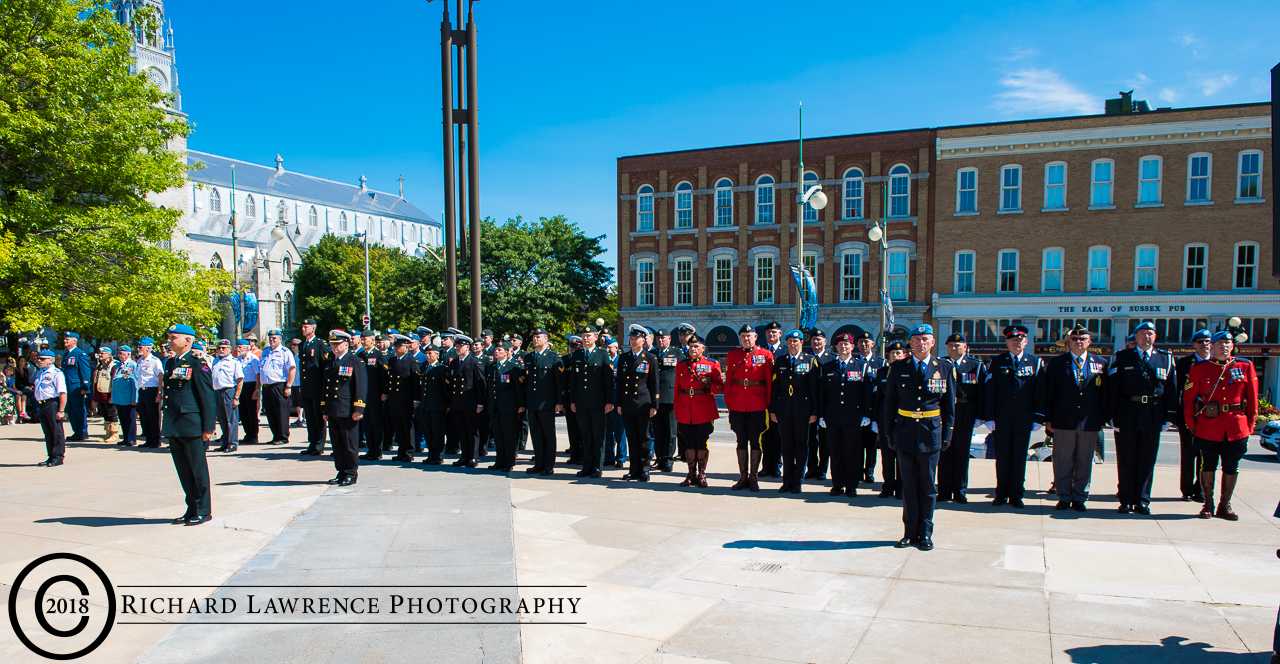
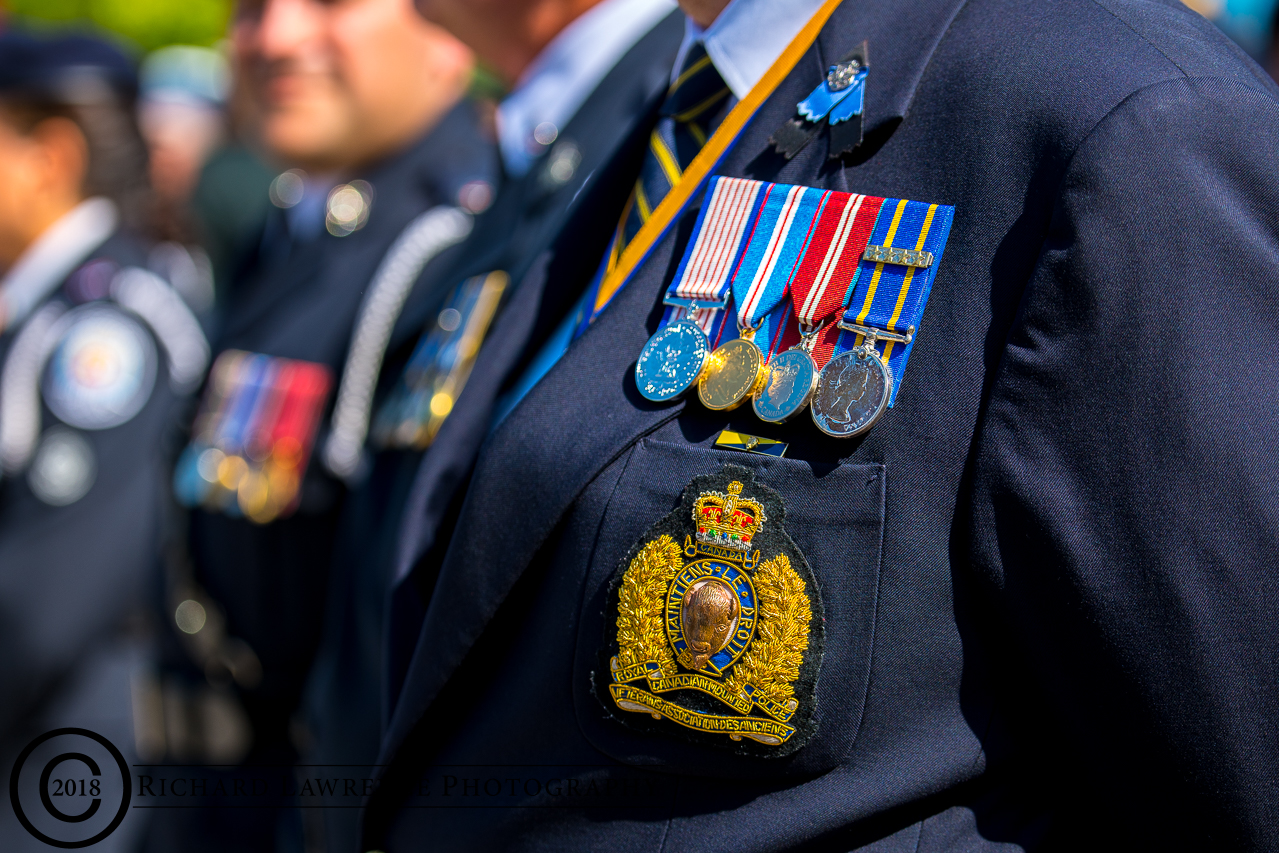
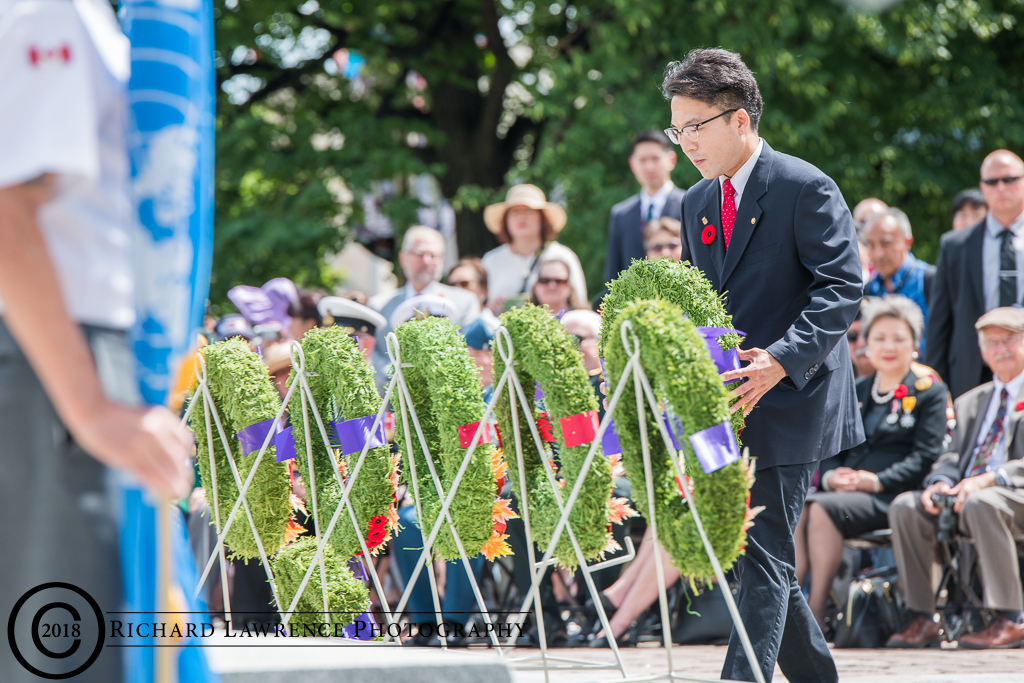
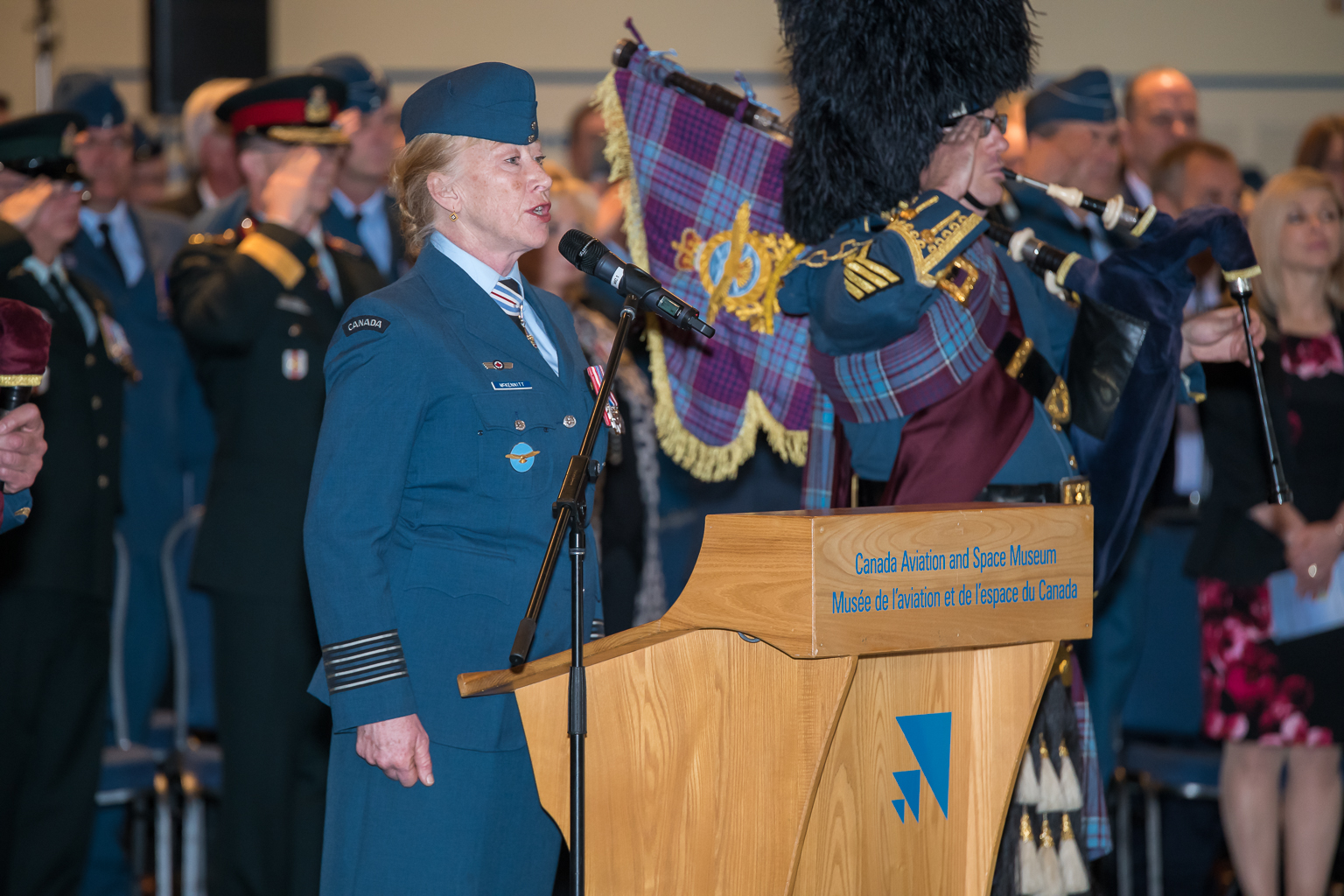
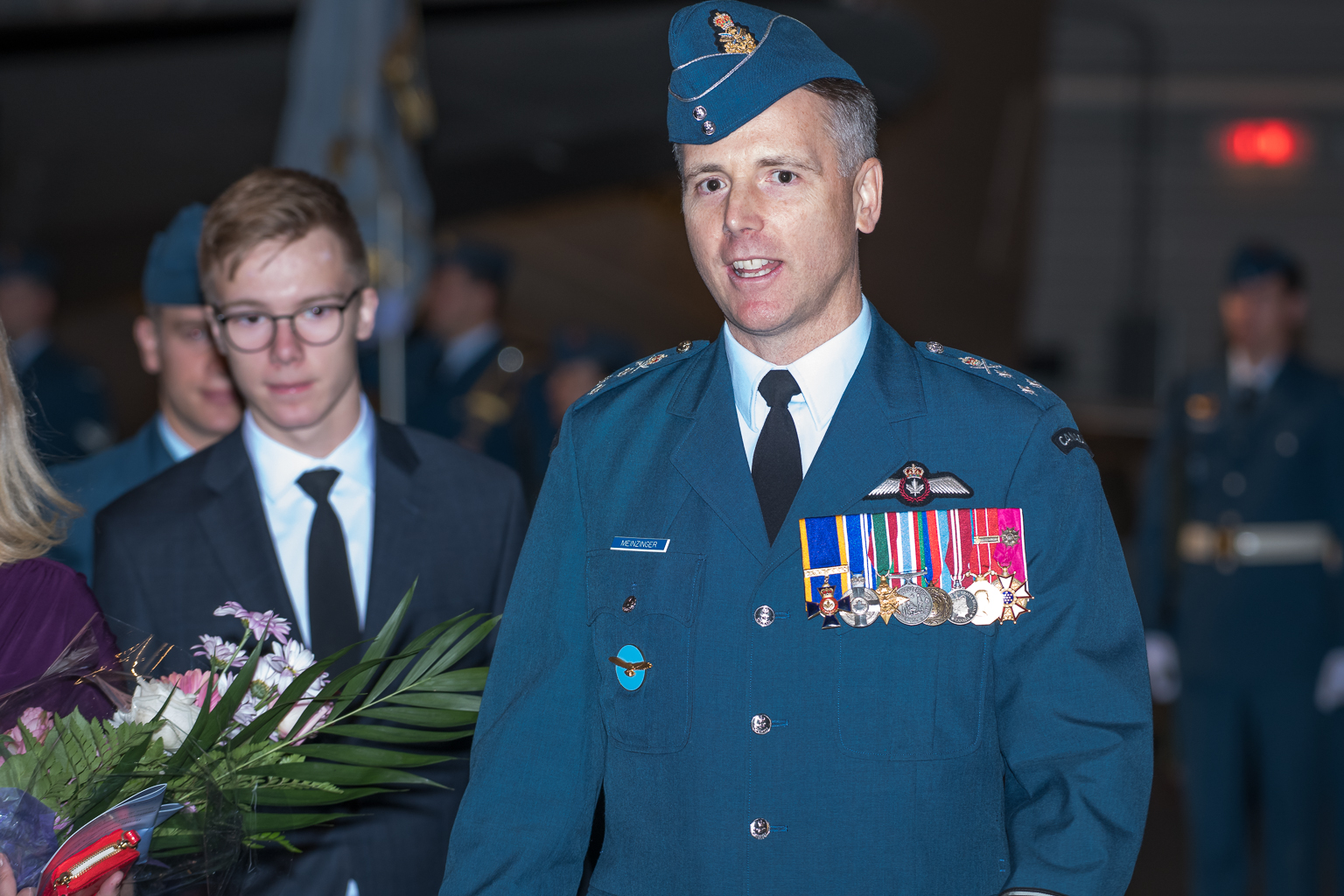
On the 9th of August, 1974, a Canadian Armed Forces “Buffalo” aircraft, while landing in Damascus, Syria, was shot down by a Syrian Air Defence missile killing all on board, including nine Canadian military on the United Nations Emergency Force in Egypt and Israel peacekeeping mission. This was the largest single loss of life for Canadian peacekeepers in history and it is this reason that the Sunday closest to the 9th of August was chosen for the annual National Peacekeepers Day Ceremony. The ceremony is organized by the Colonel John Gardham Ottawa Chapter of the Canadian Association of Veterans in United Nations Peacekeeping (CAVUNP) along with the RCMP, CFSU(O), the RCMP, and Veterans Affairs Canada (VAC). This year also commemorated the 70th anniversary of the start of the United Nations Truce Supervisory Organization, started in 1948,

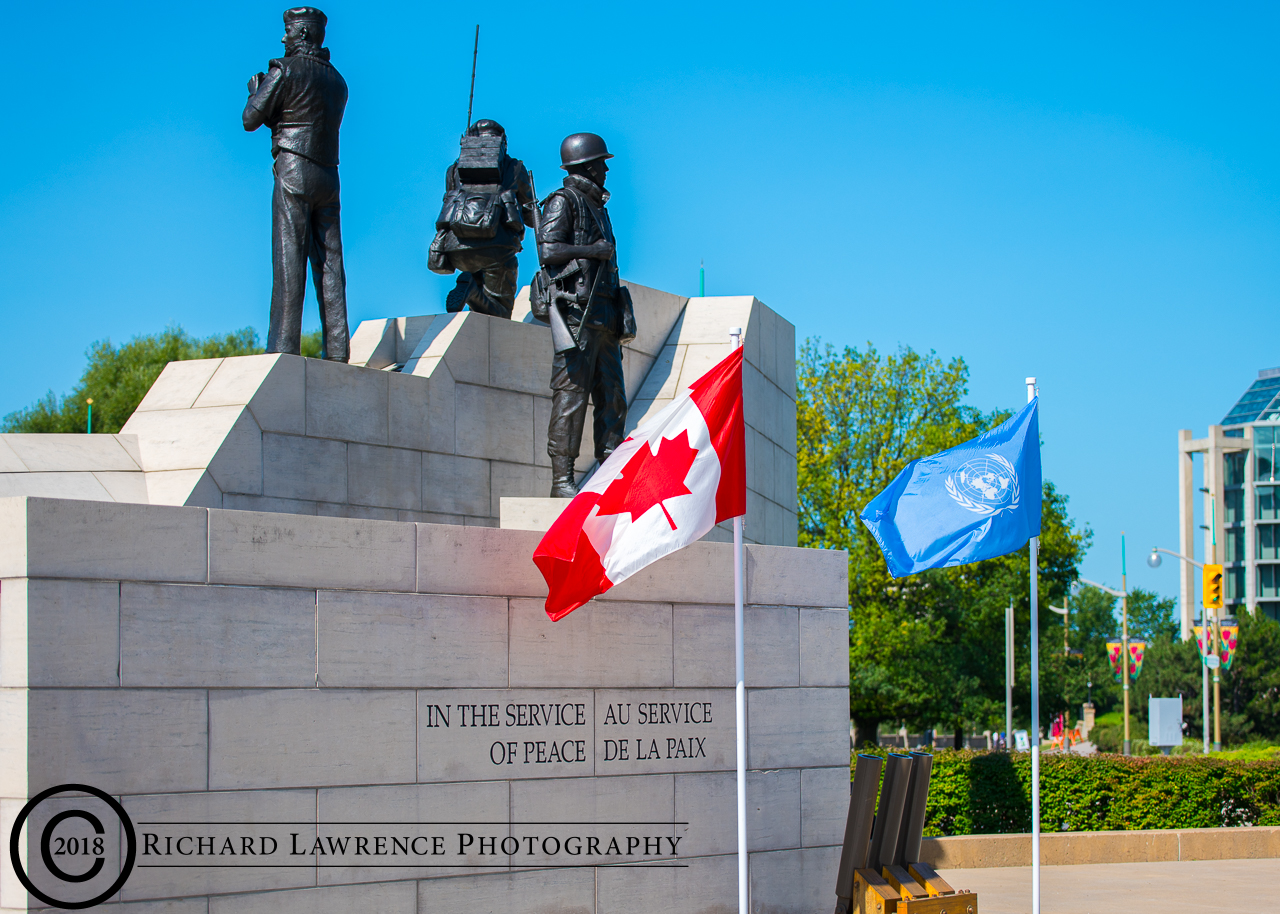
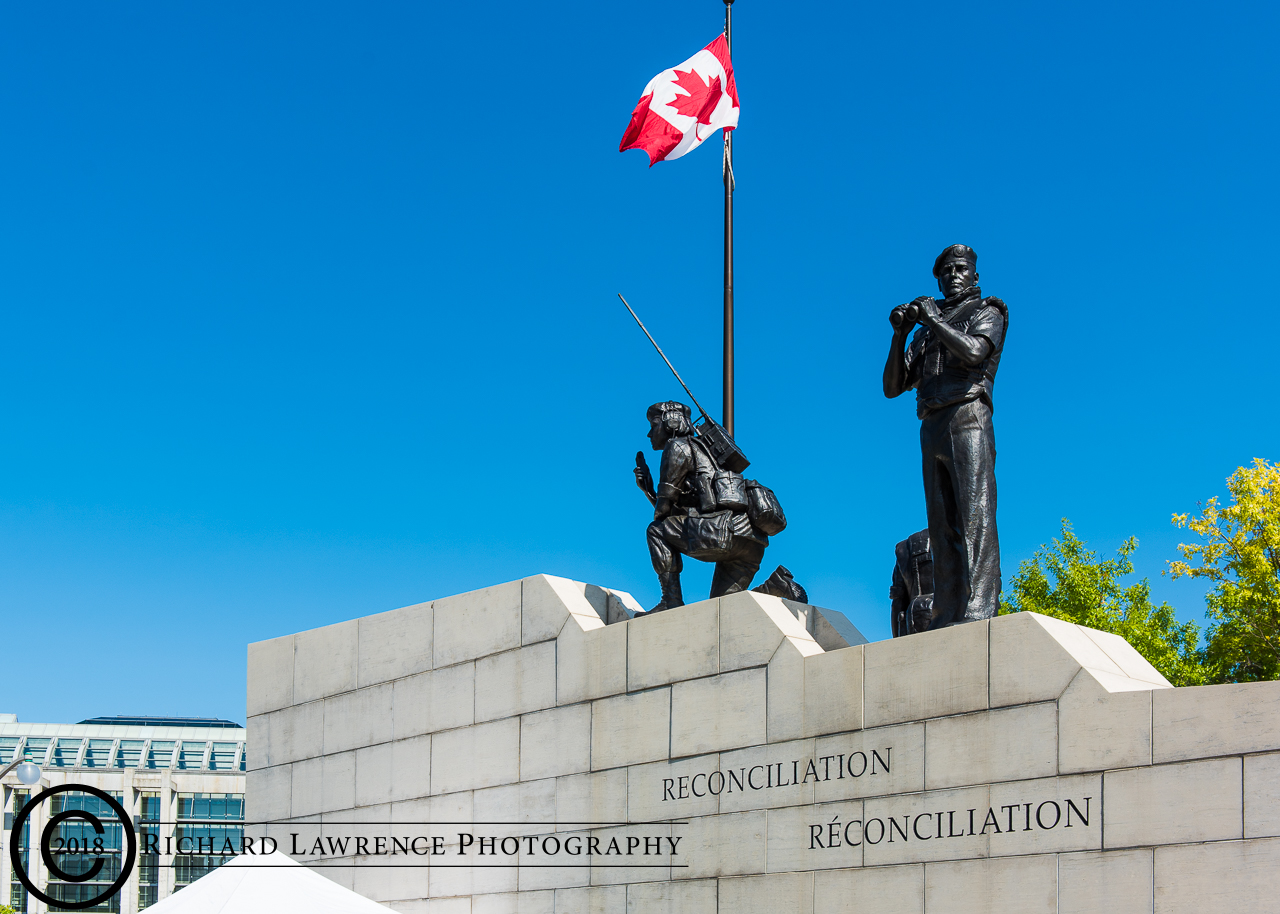
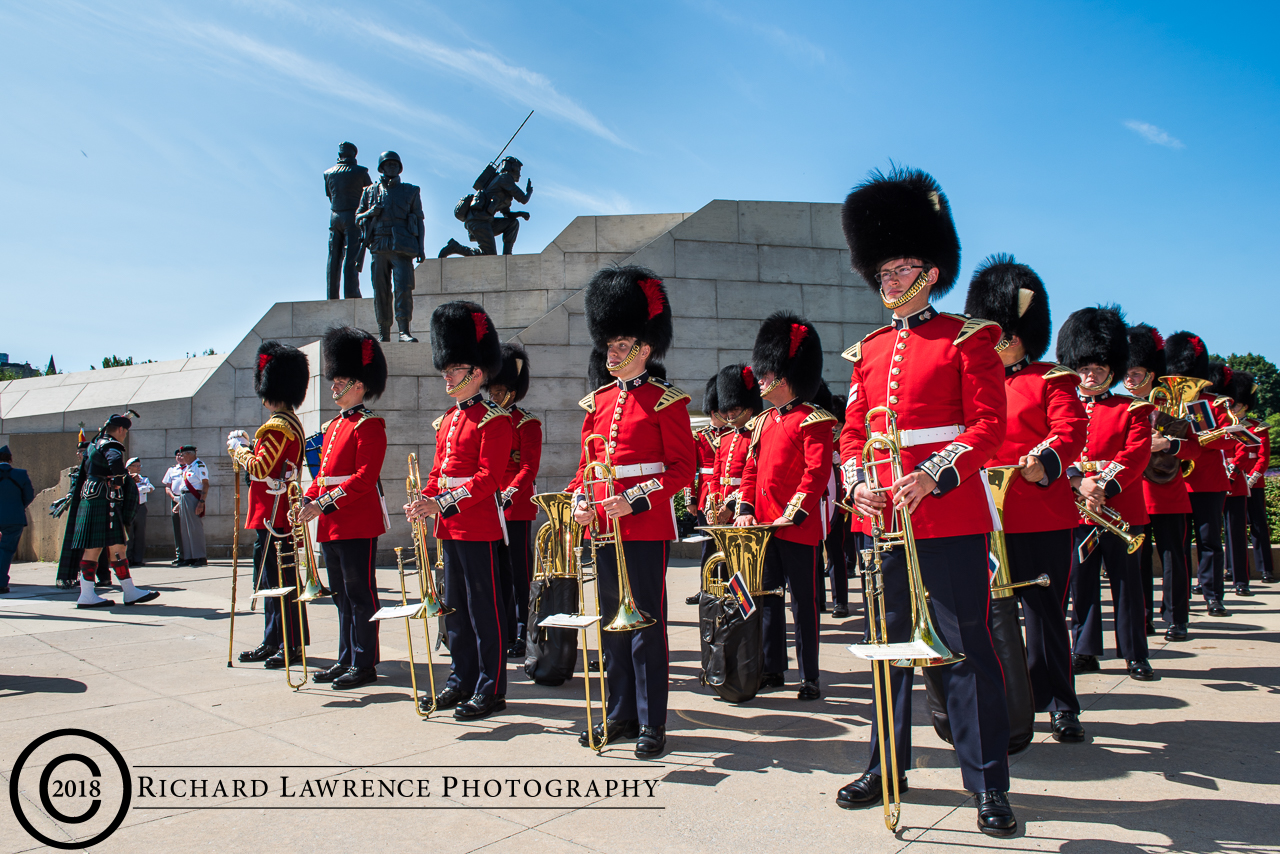
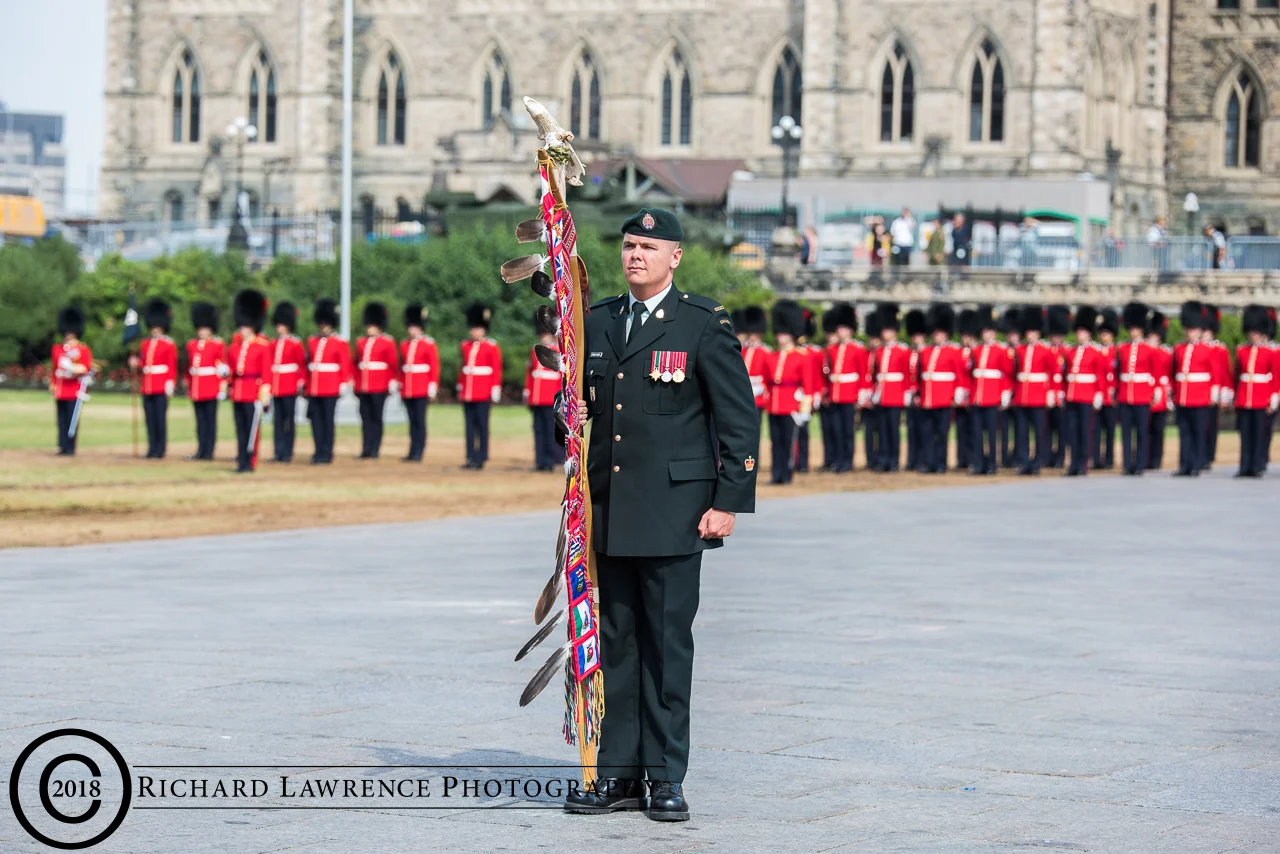
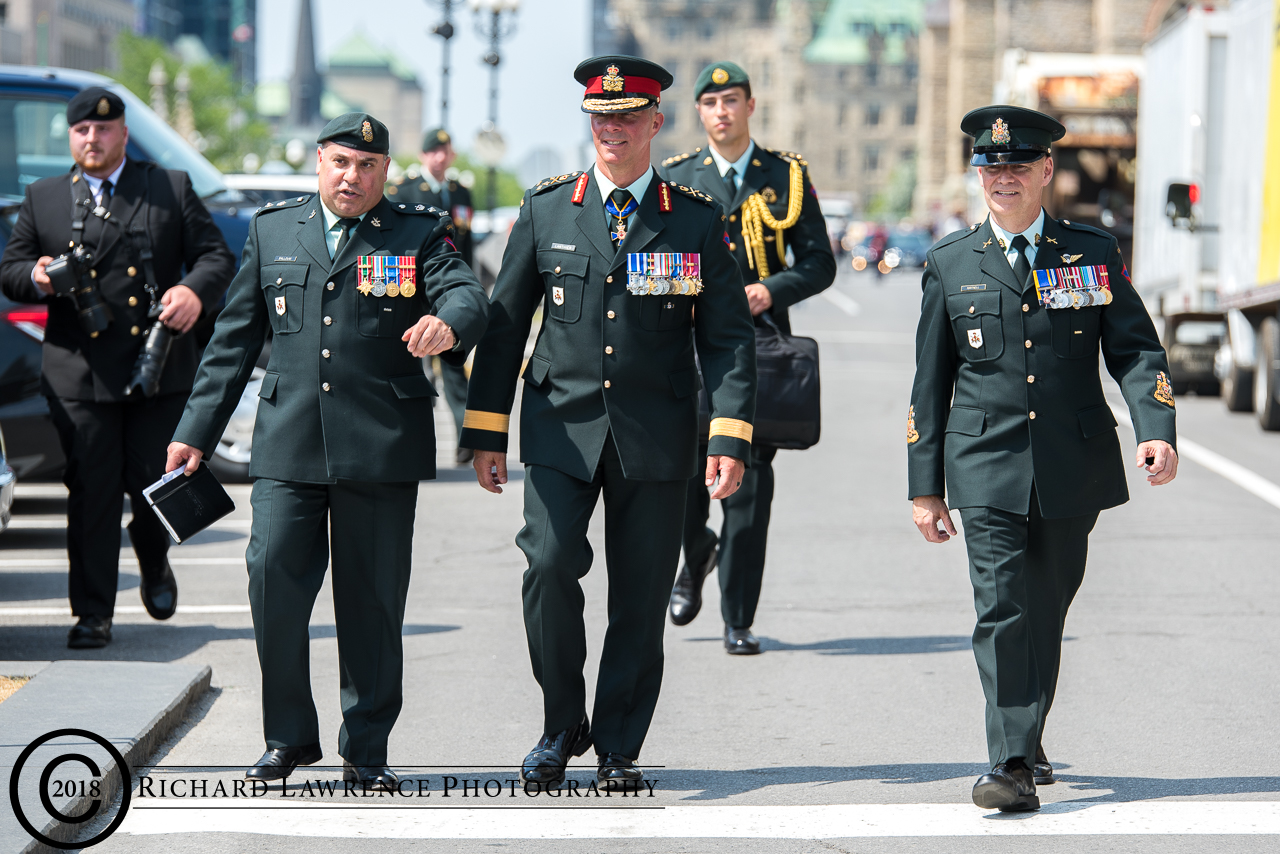
The ceremony was held at the Reconciliation Monument in Ottawa on Sunday the 12th August, 2018, under the heat and clear blue skies of Ottawa. And it was warm with a heatwave in progress and no shade for the troops on parade. The Ceremonial Guard, dressed in their scarlets and bearskin hats, had just come from the Changing of the Guard ceremony on Parliament Hill so had already stood in the heat for a bit before being bussed to this ceremony to do it again. Deputy Minister of Veterans Affairs Canada (DM/VAC), Walt Natynczuk, the reviewing officer, even made mention of it during his remarks and hoped that the battery operated cooling vests were working underneath their uniforms.

The first speaker was Mr. Wayne Mac Culloch, National President of the CAVNP, who noted that, “Ceremonies commemorating Peacekeepers Day are about recognition and commemoration of peacekeepers past, present, and yet to come and their families. Recognition and thanks to those who help make peacekeeping duty less arduous and remembrance of our fallen comrades who died in the service of peace.”.

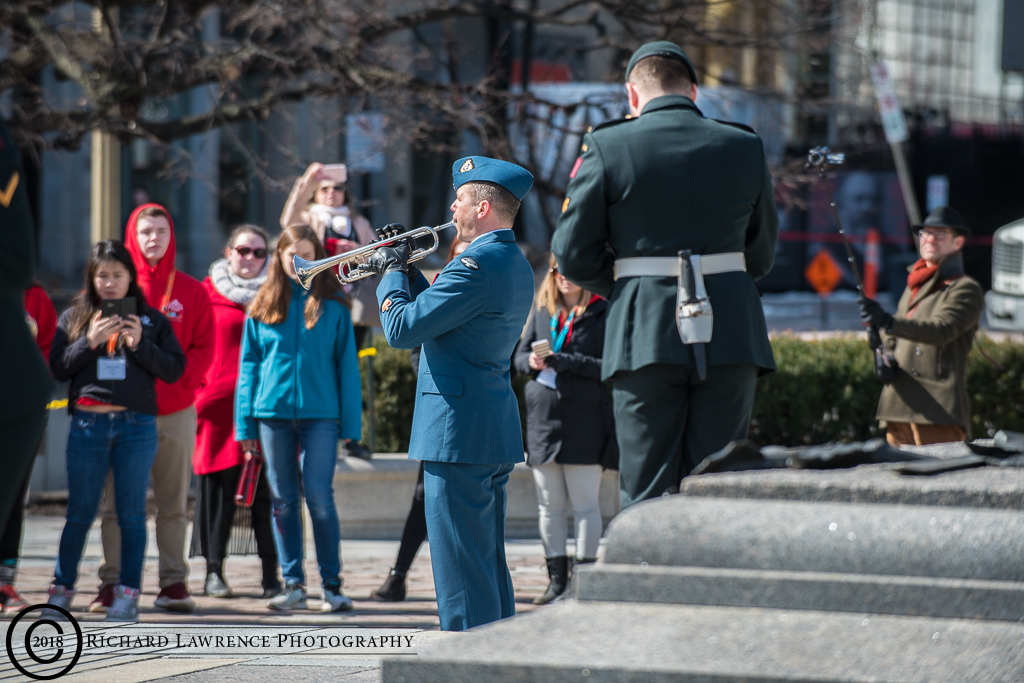
Following his remarks were the traditions of remembrance ceremonies with the last post, silence, rouse and lament then followed by the Act of Remembrance. The Commitment to Remember was spoken by air cadet Sgt. James Chettle in English and by army cadet Sgt. Claire Demers in French.

After the Prayer for the Peacekeepers, came the laying of flowers, which is different from most remembrance ceremonies because, instead of laying wreaths at the foot of the monument, bouquets of flowers are placed into the mouths cannon barrels, cut down and positioned for this purpose. This year the first flowers were placed by the Honourable Greg Fergus, MP Hull-Aylmer, and the DM/VAC Walt Natynczuk and the second set of flowers were placed by MGen. Alain Pelletier (Canadian Armed Forces) and RCMP Assistant Commissioner Paula Dionne. The third set was much more poignant in that they were placed by Mrs. Elizabeth Fournier-Law and her daughter Kathleen, who had lost their husband/father, Clive Law, suddenly last year. Clive had served as President of the John Gardham chapter of the CAVUNP and was also a driving force for the creation of a fourth figure to be placed on the Reconciliation Monument to represent police forces and first responders.

The Honourable Greg Fergus was first to address the parade where he noted that over 125,00 Canadians had participated in peacekeeping all over the world and included members from the Canadian Armed Forces, the RCMP, Police forces, both municipal and provincial, diplomats and civilians, of which over 130 had lost their lives. When DM/VAC Natynczuk took the podium, he promised to follow advice that he received in Cypress many years ago when addressing a medal ceremony during a hot day there – “keep it short!”. He spoke of the professionalism and dedication of all those who undertook peacekeeping duties and that “ we mourn the losses of our shipmates, squadron mates, battle buddies, and colleagues in operations … both the physical injuries and the invisible mental injuries our men and women endured. … and we gotta support those who are hunkered down somewhere to come forward

and get help and get treatment.”. He also noted that the Canadian contribution makes a difference due to the education, professionalism, training, and discipline of the people and that they “… represent the very best of Canadian values and ethics”. With that, he closed and the parade carried on to its conclusion and dismissal.

No-one fainted on parade because of the heat so it was a good day all around, although some of the Ceremonial Guard made note that their knees were a little stiff as they’d been standing still for so long.

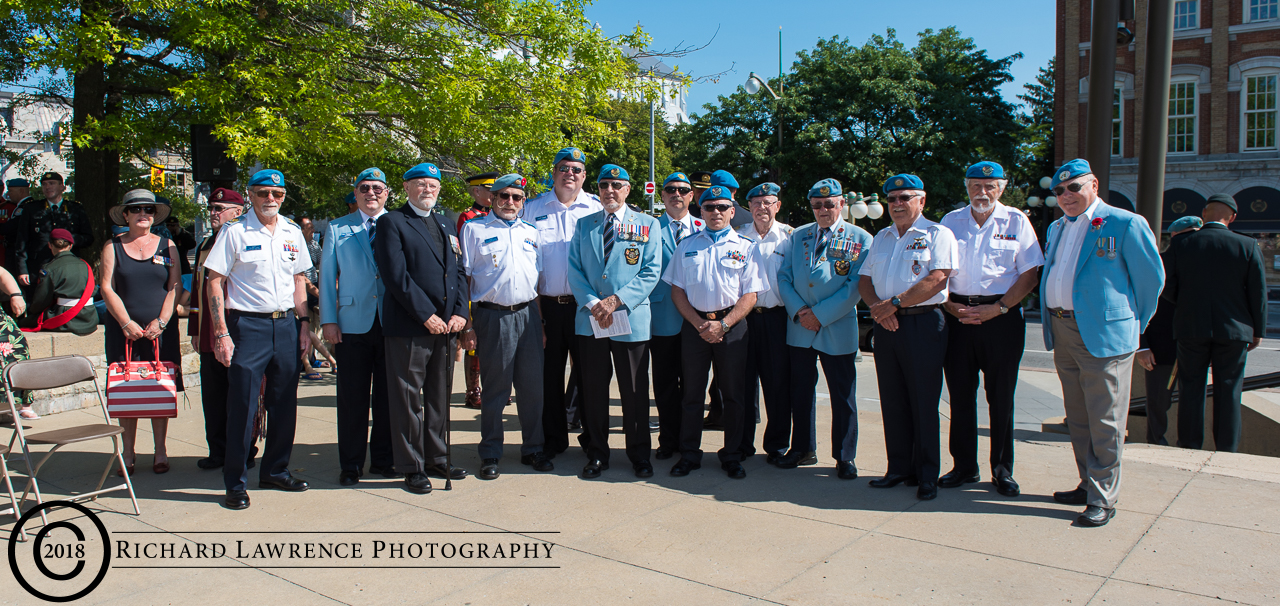
After the ceremony, there was much picture taking of UN Veterans and their families at the monument before adjourning across the street to the pub for after ceremony snacks and refreshments.

For more photos:

http://www.richardlawrencephotography.ca/rlpgalleries/2018/cavunp2018/index.html

Arizona Commemorative Air Force Museum B-25 "Maid in the Shade"

By Richard Lawrence

Once again the Commemorative Air Force is visiting the Ottawa area as the Arizona Airbase’s North American B-25J Mitchell bomber, “Maid in the Shade”, set down at the Gatineau Executive Airport and taxied over to the Vintage Wings of Canada ramp as part of the “Flying Legends Of Victory Air Show Tour”. This specific aircraft flew fifteen actual combat missions (13 x Italy, 2 x Yugoslavia) from Seraggia Airport on the island of Corsica in November and December 1944 as Battle 18 with the distinctive blue tail and blue ring cowls she now displays. She also participated in America’s first large-scale bombing offensive in the Philippines where “the Maid” is credited with eight ships sunk and five planes shot down. After she retired from the military in 1959 she was used as an aerial pest spray aircraft until 1980 when she arrived at the Arizona Airbase of the CAF (AZCAF) and was in restoration for almost 29 years until her first flight in May 2009.

The B-25 bomber, built by North American Aviation and named after Major General William “Billy” Mitchell, was one of the best known and versatile bombers of the second war. It was a heavily armed medium bomber which served in every theatre of war in roles from bombing, anti-shipping, to tactical ground support. It was an exceptionally sturdy aircraft that could withstand tremendous punishment. One B-25C (nicknamed "Patches “) of the 321st Bomb Group, had the aircraft's holes patched with the bright yellow zinc chromate primer. At the end of over 300 missions Patches had been belly-landed six times and had over 400 patched holes. The airframe was so distorted from damage that straight-and-level flight required 8° of left aileron trim and 6° of right rudder, causing the aircraft to "crab" sideways across the sky.

Of the nearly 10,000 B-25s produced, there were many variants with this “J” version having over 4,300 siblings. The “C” version (known as the Mitchell Mk II in the RCAF/RAF) would have been most familiar to Canadians, the “G” version had the nose plexiglass replaced with skin and two additional .50 calibre machines added PLUS a 75mm (3 inch) cannon, and the “J” version as a Strafer variant was outfitted with most of its 14 to 18 machine guns facing forward for strafing runs (8 machine guns in the nose position, 2 fixed on either side of the fuselage below the cockpit, and 2 in the dorsal turret). In short, there was no shortage of variations of this aircraft or job it couldn’t be thrown against.

One of the techniques for which the B-25 was known was “skip bombing”. This entailed the bomber to fly between 200-250 feet above ground at 200-250 mph and then drop a stick of two 1,000 pound or four 500 pound bombs that would then skip off the water (like skipping a stone) before hitting a ship and exploding (4-5 second delay fuses) or sinking below the ship and exploding next to her. Mast-height bombing was similar where the B-25 would come in at a slightly higher altitude and faster speed and then drop down to 10-15 feet about 600 yards back of the target. At about 300 yards, the bombs were released into the side of the ship.

The B-25 is most notably known as the bomber selected to make the first air raid against the Japanese home islands in April, 1942. For that raid 16 B-25B Mitchell bombers were stripped down of all unnecessary equipment, including most of the defensive machine guns and ammunition, and launched from the aircraft carrier USS Hornet (for which they weren’t designed) without a fighter escort. LCol. James Doolittle led the 80 man raid for the six hour, 800 mile flight after which they were to go to China to land, another 7 hours. However, one aircraft had issues in flight and diverted to Russia where they were interned and eventually escaped to get home. The 15 other aircraft successfully carried out the raid creating minor damage but a huge success as far as damaging the morale of the Japanese civilian population and boosting the morale of American Troops.

All 15 bombers made it to China where they had to crash land, bailout or ditch and all but two crews (10 airmen) made their way home. Not all crew members made it back with three KIA and eight taken as POWs (3 executed, 1 died). There were also reprisals against the Chinese who assisted the downed airmen with one city, Nancheng, burned to the ground for rendering assistance.

There is a Canadian connection to the B-25 as Canadian aircrew served on them when they served in RAF units which flew the B-25. The RCAF did fly them during WWII but Canadian usage was mostly after the war. The first B-25s for the RCAF were originally destined for the RAF but were diverted to the RCAF and redesignated using the Mark system. These included 1 x B-25B (Mitchell Mk I), 42 x B-25C (Mitchell Mk IIs), and 19 x B-25J-NC (Mitchell Mk IIIs).

No 13 (P) Squadron was formed at Rockliffe in May of 1944 where they operated Mitchell Mk IIs on high altitude aerial photography sorties and became No 413 (P) Squadron in April 1947, flying the Mitchell until October, 1948. In January, 1947, No 418 (Auxiliary) Squadron received its first Mitchell Mk IIs, operating a mix of Mk IIs and Mk IIIs until March, 1958. No 406 (Auxiliary) Squadron flew Mitchell Mk IIIs from April 1947 to June 1958 with No 12 Squadron of Air Transport Command flying Mitchell Mk IIIs from September 1956 to November 1960. No. 5 OTU (Operational Training Unit) at Boundary Bay, British Columbia and Abbotsford, British Columbia, operated the B-25D Mitchell in the training role together with B-24 Liberators for Heavy Conversion as part of the BCATP.

In 1951, the United States Air Force provided the RCAF with an additional 75 x Mitchell Mk IIIs (B-25J) so that second-line units could be equipped and to help alleviated shortages caused by attrition. In all, 164 B-25s served with seven RCAF squadrons in light bomber, navigation training, photo recon, and transport roles.

On a personal note, I had the good fortune to be selected to go for a ride in the “Maid” as part of a media flight and because I’m a veteran. My position was as the left hand waist gunner. From the pictures you can see that there were four of us in this space which normally accommodated two. As well, we had seats which the gunners would not have had, having instead to sit on their parachutes for the entire journey. After a flight briefing by AZCAF’s Ted Lloyd we got into the aircraft’s waist via a ladder just aft of the bomb bay and then wrestled into seats and seatbelts and waited … and sweated … and waited and sweated. It was a hot day with high humidity and there is no air movement in the waist until the engines start and the B-25 starts to taxi. As the engines turned over, we all put on ear protectors as the B-25 is noisy, so much so that just ear plugs are not deemed sufficient. The first smell is that of exhaust as we are seated just behind the engines but that clears soon enough as you start moving and you start to get some airflow into the cabin. The taxi out to take-off position is not much different than any other aircraft, other than it is 74 years old.

Once the take-off roll started, I was surprised by how much I was pushed into the back of my seat as I expected something gentler. After passing V1 and Vr speeds she jumped up in to the air and started a gentle climb for a couple of seconds and then did what felt like a 60 degree turn. Again, more abrupt than I would have expected. What I gathered from this little bit of experience is that this aircraft handles very nimbly and that the pilots have no compunction about throwing it around the sky.

A couple minutes into the flight, Ted gave us the OK to unbuckle and I was allowed to crawl from the waist position to the rear gunner position in the tail. And that’s the only way you can get there is on your belly. It’s a small little seat about 12-16 inches off the floor with the machine guns at knee level. Your head sticks up into a blister so you can see targets but your field of view is limited, especially if

you’re shorter than six feet. The others moved about standing at the waist gun positions tracking whatever they could see with the guns. A few minutes of this and all of a sudden, we’re bidden back to our seats by Ted as we’re starting to setup for landing. It’s surprising how fast a 25 minutes flight goes by.

I must say that the experience is not a lot different than flying in any other airplane EXCEPT that when you think of it in a historical perspective. You see how these young men, 18, 19, 20 years old with no worldly or life experiences yet, were crammed in together and sent up into the air to bomb another country – to execute government sanctioned killing. Imagine being airborne for hours, knowing that fighters were going to come at you for hours and that you only carried a limited supply of ammunition. Knowing that they could weave all over the sky at double your speed and that you were essentially a sitting target travelling straight and level. Knowing that anti-aircraft fire could bring you down in seconds. Put that together with an uncomfortable working environment, whether it be heat on the ground or cold in the air, and machine gun cartridges bouncing all over the aircraft’s inside as you blazed away hoping to hit a moving target and not even having enough room to fully traverse your gun without hitting your buddy on the opposite side. Take a look at the structure of the aircraft from inside and realize what a flimsy vehicle this is to do the job that it has been assigned. I can only commend the courage of any man who would go up and do this a second time. Most went up dozens of times without a second thought. Many didn’t return.

As a last historical note, I noticed that the bomb bay doors had a lot of graffiti on it and upon closer examination saw that it was inscriptions from men who had actually flown B-25s. It was pointed out to me that two of the signatures were of aircrew of the Doolittle mission, Ed Sayler (crew #15) and David Thatcher (crew #7). It’s worthwhile just to sit there a read the names for a minute or two.

I’d like to express my thanks to Corey Paul and her staff for their excellent service and response times in providing information to me and for thinking to include me in the media flight as a veteran. I’d also like to thank Ted Lloyd for getting me to the tail gunner position in flight, something I’m sure he didn’t have to do, and also thanks to Paul Hlavaty for letting me up into the cockpit once she was on the ground, again something he didn’t have to do. The Arizona Commemorative Air Force Museum (AZCAF), based in Mesa, Arizona, is one of 86 different airbases, wings, squadrons, and other unit types comprising the Commemorative Air Force organization that fly and house the largest collection of flying vintage aircraft in the world. The CAF is the nation's leading organization devoted to preserving American military aviation history through education, flying and exhibition.

For more photos: http://www.richardlawrencephotography.ca/rlpgalleries/2018/maid/index.html

Commemorative Air Force B-29 "FIFI"

By Richard Lawrence

Every weapons system is composed of three parts: the weapon, the delivery system, and the operator. For handguns the weapon is the bullet, the delivery mechanism is the gun itself, and the operator is the person who makes the decision to fire the bullet. During World War II (WWII) the most destructive weapon of the war was the atomic bomb. That was the weapon. The operator was the President of the United States and the delivery system was the Boeing B-29 Superfortress bomber. For the last week, one of only two remaining flying B-29 bombers was in town at the Gatineau Executive Airport and, with the assistance of Vintage Wings of Canada, was open to the public for viewing. For those with a little extra cash a half-hour flight could be purchased as well.

The B-29 is called “FIFI” and belongs to the Commemorative Air Force (CAF) from Texas and, as mentioned, is one of only two examples of this aircraft left flying in the world today. The B-29 was first flown in 1942, entered into service in 1944, and was retired in 1960. It was used in the Pacific theatre during WWII but also in Korea later. The B-29 project cost over $3 billion dollars and was the most expensive military project of the war, exceeding the cost of the atomic bomb by approximately $1.5 billion dollars. At the end, they had created a high-altitude bomber that was not very good at high-altitude bombing and was plagued by engine problems.

It could carry 20,000 pounds of bombs (at low altitude) or be modified to carry an atomic bomb (Silverplate variant), had a service altitude of 33,000 feet cruising at 190 knots (max speed 310 knots), for 3250 miles combat range or 5600 miles ferry range with a crew of 11. The B-29 was state of the art in its time and brought interesting innovations to the bomber world. Of those innovations, the most important are that it was pressurized, that it used analogue computers for firing computations, and had a remote controlled firing system controlling five turrets of dual .50 calibre browning machine guns.

During WWII bombers were unpressurized meaning that the crews were subject to the cold of high altitude and had to wear oxygen masks above 10,000 feet. This made flying uncomfortable and the risk of hypoxia high. Once the airframe was pressurized, the crew could work in a better environment and not have to wear oxygen masks. The only problem was how does one open a bomb bay for the bomb drop or use machine gun turrets, which are all open to the outside, and still maintain the pressurization?

The answer to the first issue, the bomb bays, was to divide the aircraft into compartments with the fore and aft bomb bays open to the air and the flight deck, rear aircraft, and tail gunner positions pressurized and separated from the bomb bays by pressure bulkheads. This maintained the integrity of the pressurized areas while allowing the bombs to be dropped from high altitude. The flight deck and aft pressurized compartments were linked together by a pressurized tube which spanned the gap of the bomb bays and through which aircrew would have to crawl if they needed to get to the other area. The tube is very small (rough guess about 24 inches wide) so you couldn’t be very big if you wanted to get through.

The second problem of the machine guns needing access to open air was solved by two systems: unmanned .50 calibre machine gun turrets and a computer controlled remote fire control system utilizing advance sighting systems and analogue computers. It worked by having low profile gun turrets, unpressurized and separated from the pressurized compartments, on the aircraft with gunner positions in the nose, tail, and three blisters in the centre fuselage at which gunners sat with gun sighting systems integrated with the computers. When the B-29 was attacked, the gunners would use the sighting systems to track their target aircraft and the computer would then figure out a firing solution compensating for airspeed, gravity, temperature, humidity, and distance to lead the target, automatically move the machine guns into position, and the gunner would fire. On top of this, the

control system allowed a gunner to relinquish control of his turret to another gunner so that the second gunner could bring more fire to bear on his targets allowing for idle guns to be more effective. For example, if the left side gunner had no targets but the right side gunner was heavily involved, left side could give right side control of his gun and right side would double his fire power. The computer would figure out the firing solution for both so bullets from both guns converged on the target. It was so effective that they stopped sending fighter escorts with the B-29s with one report from a mission over Kyushu, Japan, indicating that one crew had beat off 79 fighters and killed 7 of the enemy.

The Russians also had a B-29 variant, the Tupolev Tu-4. During WWII, some American pilots on missions against Japan had to make emergency landings in Russia and, although the aircrew got home (not easily) the airframes were never returned. The Russians took the airframes and reversed-engineered the aircraft to become the Tupolev Tu-4.

FIFI’s history, unfortunately, was not that glorious. She was built in 1945, served as an administrative aircraft for a while and was then put into desert storage. She was reactivated from 1953-1958 until she was again retired, this time being placed in the China Lake Naval Air Weapons Station, Calif., with 35 other B-29s. During her stay at China Lake, she was subjected to desert heat, sand, vandalism, and was used for gunnery practice. By accident, it was noted that there were B-29s on station and the Commemorative Air Force (then called the Confederate Air Force, or CAF), once notified, went into action. In March, 1971, they acquired the best airframe of the 36 and then spent nine weeks scavenging parts from the other 35 B-29s to make her airworthy enough to ferry the 1,250 miles, six-hour and 38-minutes flight to Texas. Once down in Texas with the CAF, she underwent extensive restoration for three years joining the CAF in 1974. She flew until 2006 when she was grounded for a three million dollar engine overhaul that lasted until 2010. She has been flying and touring since 2010.

During the tour of the airplane Stuart Watkins, of the B-29 aircrew, noted that the ailerons of the bomber were still made out of fabric even though the rest of the aircraft was metal. He also pointed out the flaps on this monster stretch over a third of the wing length, including the rear of the engine nacelle, and comprised over 20% of the wing surface. He stated that this allowed the B-29 to be landed at under 100 mph. When looking at the cockpit, he asked guests to look out the forward glass of the distinct B-29 nose. Then he asked people to think back to the Star Wars movies and envisage what it looked like when the Millennium Falcon jumped into hyperspace and asked them to compare the visual of the movie to looking out the B-29 nose. It is the same visual as the Star War movie makers used the B-29 nose structure for the concept of the hyperspace jump. As a last piece of information, Don Boccaccio, also with the FIFI team, mentioned that FIFI itself was not pressurized due to costs and weight, and while not a problem for most flights, crossing the Rockies or other high altitude flights were an issue and they had to be very careful.

So, like all veterans, the numbers of veteran military equipment is slowly disappearing. The Arizona Branch of the Commemorative Air Force will have a North American B-25 Mitchell bomber at Gatineau during the week of 5th – 8th August, 2018, with static display and flights for sale. The B-25 was an aircraft that was used by the RCAF so it’s a rare chance to see a part of history, to see a part of Canada’s history, and make a little of your own history.

For more photos go to: http://www.richardlawrencephotography.ca/rlpgalleries/2018/fifi/index.html

Fortissimo 2018

By Richard Lawrence

Fortissimo has completed another year of performances on Parliament Hill to the applause of thousands of each of the three shows from the 19th-21st July, 2018. Fortissimo is a free show of martial music, precision marching, and historical re-enactments sponsored by the Department of National Defence and highlights two military functions: the Retreat and the Tattoo.

The Retreat first occurred at sunset with the firing of evening guns telling the troops to move back into the fort and lock the gates before darkness descended. The Tattoo (possibly derived from the Dutch “die den tap toe” (turn off the taps)) followed at or near dusk when the pickets were set and rounds made to check the sentries. Bands beat drums as a warning for all to return and played popular music, and evening hymn and the national anthem. The drums were also a warning for tavern keepers to stop serving ale and for the soldiers to stop drinking and parade for final muster before returning to quarters.

Friday evening was warm, having been a 32-degree day and at show time (1900 hours) the crowd was bathed in blinding light from the northwest although half the front lawn of Parliament Hill was already in shadow. As the show went on, it got progressively darker until the whole show area was in shadow and the temperatures were quite moderate with a slight breeze. I would estimate a couple of thousand people in the audience, from those sitting on the bleachers to those who had brought chairs to sit by the barriers and those who stood behind them.

On Friday night, the newly minted Vice Chief of Defence Staff, LGen. Paul Wynnyk, started the show when he took to the podium to accept the salute. Once completed, the massed Pipes and Drums of the Canadian Armed Forces took to the field and the performance was on. This year music was provided by the Ceremonial Guard on Parliament Hill and the massed Pipes and Drums of the Canadian Armed Forces, with special performances by the US Army Old Guard Fife and Drums Corps (in period costume), Highland dancers, and the Royal Hamilton Light Infantry (Wentworth Regiment) re-enactors. During the playing of Tchaikovsky’s 1812 Overture, the Dominion Carilloneur, Dr. Andrea McCrady, contributed to the music and the 30th Field Regiment – Royal Canadian Artillery provided real cannon fire where it was required by the music.

The show concluded about 2030 hours with march-pasts and then everyone was free to leave or stay for the Sound and Light Show on Parliament Hill.

more photos: http://www.richardlawrencephotography.ca/rlpgalleries/2018/fortissimo/index.html

Canadian Army Change of Command Parade

By Richard Lawrence

On the front grounds of Parliament Hill, the regular Changing of the Guard ceremony was co-opted by the Canadian Army as they carried out their Change of Command (CoC) Ceremony which would see LGen. Paul Wynnyk step away from the position of Commander of the Canadian Army and LGen. Jean-Marc Lanthier take over command. The day, the 16th July, 2018, started warm and only got warmer as the ceremony started just before 1000 hrs on one of the hottest days of the year (32 degrees, 39 with humidity) and in full sun. But considering that the last Army CoC took place in the rain in this very same spot, perhaps it was an improvement.

Speakers included the Honourable Harjit Sajjan, Minister of National Defence, who reminisced about his time under the command of LGen. Wynnyk and how he gave him rein to learn. He also stated that he knows LGen. Lanthier will follow in the very same remarkable footsteps as LGen. Wynnyk during his tenure as Commander.

Gen. Vance, CDS, then led the reviewing party which consisted of himself, LGen. Wynnyk, LGen. Lanthier, Army CWO, CWO Alain Guimond (who is now moving the become CAF CWO), and incoming Army CWO, CWO Stuart Hartnell. After the review of the Governor-General’s Foot Guards and Band on parade, LGen. Wynnyk took the podium to address the crowd of a couple of thousand people. He lamented on a personal note that, “I cannot help but reflect that my very first job in the army was to deter against a threat that emanated from Moscow and my last job in the army was focused on preparing our soldiers, deploying in Ukraine and Latvia, to do the very same some three decades later.”. He also took the time to thank his wife to whom he had promised to retire after this posting of Commander of the Army. It was with her blessing that he will continue his career as Acting/Vice Chief of Defence Staff.

After this address, LGen. Wynnyk was presented with this car pennant, framed, by his driver, Cpl. Hayes. And then the big moment had arrived for the signing of the documents to effect the transfer of command. A table and chairs were brought out and the LGen. Wynnyk, Gen. Vance, and LGen. Lanthier quickly signed the papers followed by congratulatory handshakes all round.

Gen. Vance next took the podium and thanked LGen. Wynnyk for his tireless efforts on behalf of the Canadian Armed Forces, the Canadian People, and Indigenous Peoples, and also took the time to welcome LGen. Lanthier to the position as well as his family.

LGen. Lanthier, in his turn at the podium, made a promise to all that, “I will give you my best and my all, at all times, under all circumstances. I promise to put service before self as I lead the Canadian Army, an institution comprised of the best that Canada has to offer, so that the Canadian Army, as the Centre of Excellence for land operations, remains relevant to the Canadian Armed Forces joint team, our allies, and Canadians and continues to deliver excellence in all of its mandates.”.

Of particular interest during LGen. Lanthier’s address was a stirring in the parade ranks behind him as two of the Foot Guards fell prey to the sun. They were quickly assessed and moved off parade by attending medical staff without LGen. Lanthier missing a beat, probably because he was unaware of it as his back was to the entire situation.

Following the parade, LGen. Lanthier held a media scrum by the War of 1812 Monument on Parliament Hill. When asked about challenges in the job he replied, “ … the environment is always changing. We gotta be scalable, we gotta be agile … we need to understand better information operations … we’ve got to evolve all of this.”. When asked about extra troops being deployed to Latvia he mentioned that “ … concurrency of operations is critical so we are evolving the Canadian Armed Forces. … a complete review of what we need. We’re going to be growing starting next year – we’re going to grow by over 3500 regular force – a portion of that will come to the army. The same thing with the reserve. They’re going to be growing all the way to 30,000 troops…”.

And so now the Canadian Army is under new leadership with multiple deployments to eastern Europe, deployments to Africa, and increased participation in the United Nations and NATO to be tackled by the new guy. We can only wish him good luck.


For more photos: http://www.richardlawrencephotography.ca/rlpgalleries/2018/armycoc/index.html

Nijmegen Departure Parade

By Richard Lawrence

Today was the 21st time the Canadian Armed Forces (CAF) Nijmegen Task Force has held their official departure parade at the Canadian War Museum in Ottawa. The Nijmegen Marches consists of teams from over 50 countries totally over 51,000 personnel marching 160 km in four days through the Dutch countryside carrying rucksacks with a minimum of 10 kg of weight in remembrance of the losses over two world wars. Originally conceived as a method to increase long distance marching and weight-carrying capabilities for the Dutch infantry, it has turned into an international event drawing military participation worldwide.

The CAF has been participating in the Nijmegen Marches since 1952 and the marches themselves were started in 1916, although not in its current configuration. This year, the CAF contingent will consist of 14 teams from the Navy, Army, and Airforce as well as other branches of the CAF. There will also be representation embedded in the teams from the RCMP, the Kingdom of the Netherlands, Veterans Affairs, the Royal Canadian Legion, and others groups. Each team consists of 11 members as well as support staff.

There are several milestones to be considered in this year’s contingent. This will be the first year for participation from the Canadian Rangers, represented by the 2 Cdn Ranger Patrol Group of 2 Cdn Division – Quebec and the Judge Advocate General – Legal Branch has fielded a team. The Stormont, Dundas and Glengarry Highlanders are celebrating their 150th anniversary and the North American Aerospace Defence Command (NORAD) is entered. Let’s not forget that it is also the 100th anniversary of the end of the Great War (the proper name at the time was not World War I because we didn’t know we had to number them yet).

The reviewing officer was LGen. Charles Lamarre, Commander of Military Personnel Command, and the Contingent Commander is Col. Geoff Abthorpe, for the second year in a row (this is his fourth Nijmegen excursion). During his remarks to the troops, LGen. Lamarre honoured CWO Keith Jones who passed away suddenly in May, 2018, and who had served in the CAF for 40 years. CWO Jones had been the Cdn Contingent Nijmegen Task Force Regimental Sergeant Major since 2006 until his retirement and was an enthusiastic supporter of all things athletic. He was involved in many charitable organizations such as Soldier On and the 100 Km March. LGen. Lamarre imagined CWO Jones, “ … would be beaming with pride if he were here with us today. And he had that great moustache that’d be twitchin’ and there’d be a glint is his eye. And he’d be so honoured to see you off today.”

Mr. Henk van der Zwan, Ambassador of the Kingdom of the Netherlands, addressed the parade following LGen. Lamarre and said that, “ … cheering people along the way will guide you through the Dutch landscapes surrounding Nijmegen. You will notice that they cheer for all the marchers but the cheers are the loudest when they see the Canadian flag you carry. It is one of the ways we show that we have not forgotten and that we will never forget what Canada did for us.”

The Canadian troops will spend time at Vimy Ridge and Groesbeek Canadian War Cemetery where 2338 Canadian soldiers are buried. The will also visit St. Symphorien Cemetery where the first and last killed Commonwealth soldiers of the Great War are buried. The Nijmegen Marches take place during the 17th to 21st July, 2018.


For more photos go to: http://www.richardlawrencephotography.ca/rlpgalleries/2018/nijmegen/

65th Anniversary Of The Korean Armistice

By Richard Lawrence

With the U.S.A. and North Korea in the news the last few weeks, it is fitting to remember the Korean War and its outcome, which led to the current political positions of the Democratic People’s Republic of Korea (a.k.a. DPRK or North Korea) and the Republic of Korea (a.k.a. ROK or South Korea) and the division of the Korean Peninsula. On Sunday, 24th June 2018, remembrance ceremonies were hosted by the Embassy of the Republic of Korea at the Monument to the Canadian Fallen and the National War Memorial in Ottawa and after which they hosted a reception at the Chateau Laurier Hotel to honour those veterans who returned home and remember the sacrifice of those who didn’t.

The day started off with a smaller, intimate ceremony at the Monument to the Canadian Fallen where a contingent on Korean War Veterans gathered to honour their comrades with a wreath laying and the commitment to remember them. There were veterans from Ottawa, Montreal, Toronto, Hamilton, and as far away as British Columbia. Laying the wreath on behalf of Korea was Korean Rear-Admiral Kim, who had come all the way from Korea for this ceremony. Senator, the Honourable Yonah Martin laid the wreath on behalf of Canada. This was a small ceremony for the veterans only and was over in about 10 minutes after which everyone proceeded up to the National War Memorial (NWM) for the more formal ceremony.

The ceremony at the NWM followed the established program with the Act of Remembrance in English, French, and Korean, followed by the Commitment to Remember then prayers, the silence, and the laying of the wreaths. For Canada, the Honourable Seamus O’Regan, Minister of Veterans Affairs, laid the wreath while Minister In Kyu Park, and Colonel Yoon of the ROK responded for Korea. Wreaths followed for various Korean groups, Veterans Groups, and other countries that fought during the Korean War.

While the ceremony itself was programmed there was one event that wasn’t and, as it turns out, was truly symbolic and allegorical of the event. As recounted by Vice-CDS, Vice-Admiral Darren Hawco, at the reception, “We saw a violent wind knock over the Republic of Korea flag. And we saw a veteran go and pick up that flag. And then we saw a Canadian soldier take the flag and hold it up in support of that veteran.”. While we no longer use animal entrails to determine our futures one could interpret this to represent the invasion of South Korea (flag blown down) and the assistance rendered to them, first by our veterans and now by our current Armed Forces members.

At the following reception everyone was greeted by the Korean Embassy in the receiving line, some in national costume, which was very colourful. There was food and drink aplenty and remarks from Minister Park, Minister O’Regan, and Senator Martin. Minister Park noted “The Korean people are forever grateful to the people of Canada for their contributions and sacrifice during the Korean War.” And Minister O’Regan lauded Korea’s progress over the lasts 65 years as “… [Korea] has become one of the largest economies in the world, a country that is home to one of the strongest democracies in the world…”.

Following the remarks, Vice-Admiral Hawco toasted the veterans and Koreans with “To lasting peace on the Korean Peninsula”, which was responded to by Mr. Bill Black, President of the Korean Veterans Association (Ottawa) – Unit #7, “To the Republic of Korea”. After the toasts, children from the Korean

Language School in Ottawa, dressed in national costume, came forward and presented a gift of letters of appreciation to Mr. Black to be distributed to the veterans. Once completed, and photos taken, the steam tables were open for lunch.

For more photos go to:

http://www.richardlawrencephotography.ca/rlpgalleries/2018/korea65/index.html

Armour Exhibit

By Richard Lawrence

In medieval times, armour clad knights did battle atop steeds for the glory of their country, their lords, for their religion, and for themselves. But those days are over. Or are they? This is the question that the new exhibit, Armour, at the Canadian War Museum’s (CWM) McCrae Gallery from 15th June until 3rd September 2018, looks at.

Caroline Dromaguet, Acting-Director of the CWM, said that the exhibition is “… going beyond the idea of protection alone. It invites us to explore the many facets of body armour from the battlefields of old right up to high-tech cladding of Hollywood’s Iron Man…”

In conjunction with the Museo Stibbert of Florence, Italy, the CWM has created an exhibition of armour from medieval and Renaissance times through history into modern times and pop culture. The McCrae Gallery has been divided into four zones dealing with Battle, Sports, Status, and Pop Culture examining how armour and weaponry has affected society. The Battle Zone shows a myriad of full armour, swords, and weapons from the medieval era and explains how armour had to change as weapons became more lethal. The Sports Zone starts with the time where knights would fight and joust in tournaments complete with two complete ensembles of armour of knights on horse. It travels to modern times where today’s sports figures have replaced knights showing the goalie equipment of three time Olympic medalist Shannon Szabados, as well as a selection of football, hockey, and cycling helmets from the past made of flimsy leather to today’s cutting edge materials. The Status Zone shows how body armour evolved from protection to more ceremonial uses as firearms made armour obsolete. Some of the armour is inlaid with other precious metals while past pieces of armour (i.e. the gorget) evolved into other uses such as indications of rank. Lastly, the Pop Culture Zone shows replicas of the Iron Man and the Bullet Farmer (from Mad Max – Fury Road) in today’s re-imagined armour.

The Museo Stibbert was created by Frederick Stibbert, who lived during the second half of the 19th century in Florence. The collection of over 50,000 items was made possible by an inheritance from his grandfather who was Commander-in-Chief of the British East India Company’s private army. His collection contains a rich collection of European, Islamic and Japanese arms as well as paintings, sculptures, and furniture from between the 15th and 19th centuries, which he left to the Municipality of Florence on his death in 1906.

At the opening, addresses to the invited guests included Caroline Dromaguet, Fabrizio Nava, Minister Counsellor of the Embassy of Italy, Enrico Colle, Director of Museo Stibbert in Florence Italy, Mélanie Morin-Pelletier, and historian at the CWM. Several of the speakers talked to the importance of these cultural exchanges with Frabrizio Nava stating the importance of sharing cultural items between countries as “It is through culture that we generate the depth that enables us to sustain our friendship.”

It’s an interesting exhibit so take it in.


http://www.richardlawrencephotography.ca/2018/06/17/armour-exhibit/

RCAF Change Of Command Ceremony

By Richard Lawrence

It’s often said that when it rains, the army goes out and plays in it – the air force goes to the mess. And such was the case on the morning of 4th May, 2018, with overcast skies and forecasts with rain and 90 kph winds, when the RCAF moved its change of command ceremony from the rear parking area of the Canada Aviation and Space Museum inside the Museum itself. It was somehow fitting to have LGen. Mike Hood relinquish command of the RCAF to LGen. Al Meinzinger among the aviation history of Canada and the command elite of the Air Force. Special to the day were the Guard of Honour who had come in from 8 Wing in Trenton, which LGen Hood had commanded, and the Colour Party from 429 Squadron, the last squadron commanded by LGen Hood.

In his farewell address, LGen. Hood added some levity to the event as he got to the podium and then asked “Where’s my Aide de Camp? My speech? Where is it?”. He then paused dramatically before announcing that everything was good. Just a final gesture of humour.

In speaking of his time in command he noted the issues trying to drive through capital procurements for the air fleets, stating, “When we look at the big files of policy and acquisition …. I lament, not as commander of the air force, but as a Canadian, that we’re unable to come to positions when you’re going to have acquisitions that last six or seven governments. We certainly have to have a stronger vision and cooperation to get to a point where we're going to be able to deliver the tools the men and women of not only the air force but all of the armed forces need. …. It’s not happening fast enough.”

He also took the time to thank his family for their support and everyone who worked with him and for him, especially his staff who, “ … are fiercely loyal to the institution of the Royal Canadian Air Force “

After the signing of the transfer of command documents the CDS took the podium to address the assemblage. In saying farewell, Gen. Vance noted that LGen Hood had worked “ … for two fantastic CDSs [pause] … that’s not true. I worked for two fantastic CDSs. Mike, you work for a fantastic CDS. Al, the jury’s still out as to whether or not you work for a fantastic CDS but the CDS you work for thinks the world of you.”

Gen. Vance reflected on LGen. Hood’s time in command, specifically recalling discussions about the various air fleet replacements, “ … there were some challenging moments. Your advice to me was sound and clear and you did it exactly as you ought to have – ferocious advice delivered in private and honest execution delivered in public. You also, Mike, at every moment, offered a great sense of humour and the occasional fine scotch as we worked through some of the challenges.”

To incoming Commander, Al Meinzinger, he noted, “… when you darken my door at seven o’clock in the evening with something to say, it’s usually not a good thing. And you are one who is able to deliver challenging and important and difficult news with a plan to deal with it and you always do it with such optimism, with honesty, and integrity. You’re one of those people, Al, when you say it, it’s true. And that’s a good thing to be when you’re going to command the RCAF.”

Incoming Commander, LGen. Meinzinger, briefly went over some of his career history and thanked those who helped him get to this position, especially his family. But he also mentioned the abilities of those in the RCAF and their reputation on the world stage. “Our ability to deliver air power effects in an integrated manner with precision, agility, and professionalism is our true calling card. And I am immensely proud of what the credible members of the RCAF and their families do each and every day for Canadians. As your new Commander I intend to maintain our sterling reputation for delivering operational excellence at home and abroad – the true hallmark of who we are.’

With remarks concluded, the official party was marched off, the colours departed, and the parade was dismissed for the reception and press.


For more photos go to: http://www.richardlawrencephotography.ca/rlpgalleries/2018/rcafcoc/

ANZAC Day 2018

By Richard Lawrence

The 103rd remembrance of the Gallipoli campaign was marked at the Canadian War Museum as ANZAC Day was commemorated on the 25th April, 2018. There was a huge turnout, from the High Commissioners from Australia and New Zealand, the Ambassador of Turkey, delegations from several other countries (UK, France, India, Greece, etc.), and from several other veterans organizations and defence industries (Lockheed Martin, a sponsor). Canada’s military had a good turnout with music provided by the Governor-General’s Foot Guards and the Army Voices Choir, Gen. Jonathan Vance providing the Canadian Response to the ANZAC Day Address, and attendance by other senior military appointments such as VAdm Ron Lloyd, Commander of the RCN, and LGen. Mike Hood, Commander of the RCAF. Other countries were very well represented by defence attachés and senior officials.

LCol. Kurt Brown opened the ceremonies with an accounting of how the landing at Gallipoli unfolded followed by a prayer and the ANZAC Day Address by Her Excellency Ms. Natasha Smith, Australian High Commissioner. Gen. Vance provided the Canadian Response after which, following a reading of “In Flanders Fields”, His Excellency Selçuk Ünal, Ambassador to Turkey, read Mustafa Kemal Ataturk’s Memoriam. This was followed by hymns and readings and the final tribute, the laying of the wreaths. It should be noted that special mention was made of the Royal Newfoundland Regiment who provided rear guard cover when the allies eventually abandoned their positions and sailed home.

Following the laying of the wreaths, the sentries retired, and everyone adjourned up to the main foyer for “morning tea” hosted by the Australian and New Zealand High Commissioners.


For more photos go to: http://www.richardlawrencephotography.ca/rlpgalleries/2018/anzac/index.html

Battle for Vimy Ridge: Remembrance Forgotten

By Richard Lawrence 

The Battle for Vimy Ridge, arguably an event that helped define Canada as a nation, was fought one hundred and one years ago from April 9-12, 1917. It is commemorated with all the ceremony of any event that causes so much death and destruction (10, 600 plus casualties for Canadians). It was also the first indication of Canada being regarded as a nation and not just a junior member of the Commonwealth. It is worth commemoration. Or it was, until 2018.

In the past, there has always been a large remembrance ceremony held at the National War Memorial on the 9th of April. Last year, the 100th anniversary of the Battle, there was a vigil the evening before and a remembrance ceremony the following morning. The ceremonies were attended by thousands of people.

During the vigil in 2017 there were speeches and ceremony. Cadets were paraded out to stand vigil over the Tomb of the Unknown Soldier. There were veterans from every organization present, politicians galore, and children’s choirs. Then there was the ceremony of the Passing of the Torch, from the oldest veterans all the way up the line to the cadets and youth of Canada. In the morning, the cadets were relieved of duty and replaced by soldiers and a proper remembrance ceremony was held. This was again complete with contingents of veterans, Armed Forces, RCMP, politicians, and official delegations from many foreign governments. In all, the Vimy remembrance ceremonies are second only to the National Remembrance Day ceremonies on November 11. At least, they were. 

This year, there was no vigil at all. Nothing. In the morning there was a small ceremony that consisted of one member of government, MP Andrew Leslie, who laid a wreath for the Government. Also in attendance were two youth from the Encounters with Canada organization, delegations from the Vimy Foundation, a delegation representing the Portuguese Veterans of Ontario. No veterans were invited. There were no chairs, no speakers, and no choirs. Not even a microphone for someone to say a few words. The only soldiers on parade were four marched in to stand post at the Tomb of the Unknown Soldier. If not for the 120 youth bussed in from Encounters With Canada, it’s doubtful that any civilians would have been there at all. At least there was a bugler and piper so that the Last Post, Lament, and Rouse could be played. All in all, it was a quick ceremony.

Now that the 100th anniversary is past and there are no living WWI veterans, it seems that the government and Veterans Affairs is happy to sweep this event under the carpet. It makes one wonder what will happen to the remainder of the WWI remembrances once the 100th anniversary of the Great War passes into history, along with those who fought to make Canada the nation it is today.


For more photos go to: http://www.richardlawrencephotography.ca/rlpgalleries/2018/vimy101/index.html

CDAI Conference On Security And Defence

By Richard Lawrence

The Conference of Defence Associations (CDA) and CDA Institute (CDAI) promote research and informed public debate on national security and defence issues in support of credible government policies for Canada” (CDA statement) and hosted its annual Conference on Security and Defence at the Chateau Laurier Hotel on the 22nd/23rd February, 2018, with a theme of “Canadian Security and Defence in the New World (Dis)Order”. It was two days of opinion and research presentations on future challenges to the military, the changing world around us, speakers such as the Chief of Defence Staff, Gen. Jonathan Vance, and presentations from partner armed forces such as MGen Philippe Montocchio of France, and MGen Mitch Mitchell of the UK. Panelists covered topics of future defence challenges, the world disorder and the national capacity for defence with such noted panelists as Senator (Ret’d) Romeo Dallaire and LGen (USA Ret’d) Ben Hodges.

Suffice it to say that a blog post cannot do justice to any one topic covered by these august personages let alone two days of all-encompassing information so for a detailed account of what was covered one will have to wait for magazine articles to be published or more detailed reports to be submitted to websites. I can only briefly point out some of the highlights that resonated with me.

The first speaker was Mr. Darrell Bricker, of Ipsos Public Affairs, stating that he didn’t really have many opinions, as his job was to measure opinions and then collate that into data. He would, therefore, speak to public opinion and counter with demographic hard data to provide a data base to consider all the issues being considered here with a specific reference to fertility and aging, urbanization, and multi-culturalism within Canadian and global populations.

He started by showing birthrate data from the 1950s and comparing it to today and then projecting out to 2036 and the changes that we are seeing. The number to remember is that in order to have a stable replacement of population you need a birthrate of 2.1 children per family (stable replacement birthrate or SRB). In the 1950s Canada had a birthrate of 4 but today is down to 1.6 projecting to be 1.2 by 2036. In short, we’ve stopped having children. And this is not just a Canadian phenomenon but is worldwide with places like India and China (accounting for 40% of the world’s population) already below SRB. In the ten most populous countries in the developed world, the birthrate has dropped by 60% in 50 years.

At the same time, people are living longer and the gross population is getting older. In Canada in the 1920s the average lifespan was 57 years, increasing to 81 years today and projecting to 87 years by 2036. In China in the 1950s the average lifespan was 40 years but has doubled to 80 years today. The median age of a Canadian today is 41 years whereas in the 1970s it was 24 years, and the developed countries now have more people alive over 65 years than under 15 years. As noted by Mr. Bricker, “[we’re] bad at making new people but really good at keeping people around” which explains why we’ve got an increasing global population that is getting top heavy with the elderly but thinning with the young people needed to replace them. As this trend continues it should result in a slight increase in the current global population before it starts to decline (due to deaths of the elderly without replacement young), which is a contradiction of United Nations projections of an 11 billion person global population by the year 2100.

Why has this happened? It’s not the one child rule in China, which resulted in female infanticide, which now leaves China with a deficit of child-bearing females in the population. The entire planet has stopped having larger families. Mr. Bicker cited the one overwhelming reason that he feels has led to this decline has to do with the increasing educating of women. To explain, in the early decades, women had little choices in their lives and got married in there 20s and started having children. However, now women get educated, start a career path, and get married later. By getting married later and having careers they have less biological time in which to have children and they spend more time advancing their careers than staying home to raise children. The result is that women have more choices and chose to have careers and less children and this trend does not reverse – ever.

What is the impact of this? In China the elderly rely on younger people to look after them as they don’t have a national pension. People will get old before they get rich enough to support the older population. This is true in Canada and globally as well. In Canada by 2036 there will be two people working for every retired person resulting in a huge drain on their tax dollars in supporting the federal pensions. It also means less young people available for armed forces and less skillsets to draw on for the new technological battlefield.

Population urbanization is also an issue as we are right now seeing the single biggest transformation in history of where the world is living and it has nothing to do with the mass migrations from war-torn countries. Currently, only 3% of the world lives in a country where they were not born so this type of migration, while seemingly overwhelming on the news, is not a real issue in terms of global population. The real issue is the move of population from rural areas to cities. In 1960, 34% of the population lived in cities and it now over 50% projecting to be 67% by 2050. Eight-two percent of Canadians live in towns with over 1,000 people with 40% of Canadians living in four cities. Ninety percent of Canadians live within 100 miles of the USA border. We are a hugely urban population. What this means in terms of sovereignty and our “Great White North” is that we are protecting land on which no-one lives or has probably seen and that we won’t have the people or resources to defend it.

Along with this is that fact that our country is changing demographically from one that faced east towards the Atlantic to one that faces west and the Pacific Ocean. Atlantic Canada is old with more people dying and no immigrants moving there. Those immigrants that do move there generally have left within five years. The Maritimes have the oldest populations, lowest birthrates, and fewest immigrants.

The Canadian population is more and more facing eastward to the Pacific as that is where people our moving. In the 1970s immigrants came primarily from the USA and UK but, with 1% immigration (the highest in the world per capita), today they come almost exclusively from the Pacific. And not so much from China anymore (they’re running out of young people to send and their middle class is gaining wealth at home) but from the Philippines. So previous immigration patterns from India and China have changed Canada’s global outlook eastward and future patterns would suggest a solidification of that pattern. Canada also is looking to increase trade with many of the Pacific Rim countries so politically this move continues.

The location pattern of immigrants has changed as well as in our past many immigrants moved out west to homestead. Now, immigrants move to cities for jobs and to be with cultural clusters within those cities. This only exacerbates the decline in rural population and increase in urbanization. But multi-culturalism is something that Canada does well with Toronto being the most multi-cultural city in the world with 50% of the population born in another country (London – 40%, Ottawa – 18%).

Along with these changes in population comes a change in where they see issues of concern. Almost all Canadians now see domestic issues topping their priorities such as ethnic violence, heath epidemics, domestic terrorism, and hacking, but national defence is not an issue concerning people. The only real national defence concern is cyber security so that our infrastructure and financial institutions are secure.

So, do these changing birthrates and urbanization have an effect on security and defence? They do. Because we don’t have a credible national threat people recognize that economic power may be more important than military power and this is leading our government to join more trade agreements. We are certainly more focused on new trade deals with Pacific countries as we have existing deals in place with European allies. Our remote regions may no longer be able to be secured by people but more remote monitoring systems may have to be put in place. We are living longer and healthier and that is going to have to change who and how the military recruits, the workplaces, and retirement. It also seems that what the military is designed to do and is good at, defending territory, is not of real concern to the population and their concerns on terrorism and cyber-security is not something with which the military has fully come to grips.

The best tagline of the entire conference comes from Mr. Bricker as he noted that we won’t be able to rely on young people to fight our wars as we won’t have enough of them. He stated, “We’re setup for a geriatric peace. We’re too old to fight.”

Gen. Vance started the second day with his state-of-the-union address and captured the audience of approximately 450 attendees with his easy podium style peppered with small bits of humour for which he is known. As it was his first opportunity to address a peer audience since the new Canadian Defence Policy, “Strong, Secure, Engaged (SSE)”, was presented he stated that “the policy will give us the flexibility to anticipate, adapt, and act in response to current and emerging threats with a new set of capabilities and a force of 101,500 regular and reserve that will tackle those challenges.” He noted that the CAF will be manned to tackle up to nine concurrent international operations over and above domestic responsibilities as well as NATO and NORAD obligations which may require 7,000 troops at any one time, not including those required in North America, of which 4,000 will be capable of sustained operations and the remainder used for shorter operations. To put it in perspective Vance noted that currently Canada has 1800 troops deployed in 20 operations worldwide on any given day so this increase is vast.

Gen. Vance also covered where we are in various parts of the world such as Iraq and Daesh (it’s going to take time), a substantial return to Europe (NATO solidarity with Poland, Latvia, and Ukraine to send a message to Russia), and the possibility of future action in Africa.

At home he mentioned the successes of the CAF aiding civilian powers in helping with the Quebec floods and B.C. forest fires, search and rescue ops, and assistance to hurricane victims. He noted that new investments in equipment and infrastructure are necessary to carry out the new policy ($108 billion over 20 years) and procurement was underway for LAVs, combat vehicles (TAPVs), ships (Halifax class modernization), aircraft, and $250 million for the ISS (integrated soldier systems).

To do all this Canada will need more people and stated for the first time in a long time that the CAF is growing. But growing is not enough and that Canada needs the right kind of people and needs more diversity, including women, in that growth. Mentioning the Reserves, he stated historically the Reserves have augmented the Regular forces but now needs to become a larger Reserve force of part time soldiers who have 24/7 full-time capabilities to compliment the Regular force to carry out the increased numbers of deployments simultaneously and sustain them.

Lastly, Vance focused on personnel and their experiences from entry to exit into the CAF and admitted that more needs to be done. He spoke of soldiers who had suffered trauma (both physical and mental) possibly not being released so quickly as, although they may not be deployable at the moment, they are still employable. Personnel should be eligible for promotion while on parental leave or seeking medical treatment and soldiers on named operations overseas should be eligible for tax considerations without having to demonstrate a level of risk as before. There is a need to improve the relocation policies and benefits to align them with the current economic realities. In all, he envisions many changes to support CAF personnel.

Again, this does not even begin to cover to speakers mentioned above or even attempt to cover the scope of the conference. For that you must turn to other sources, such as the CDA and CDAI themselves.


For more photos go to: http://www.richardlawrencephotography.ca/clients/edec/cdai2018/

War Amps 100th Anniversary Commemorative Envelope Unveiling

By Richard Lawrence

The War Amps have had a long history of providing help to those in need and today Canada Post unveiled a 100th Anniversary of the War Amps Commemorative Envelope at the War Amps Headquarters in Ottawa. Speaking for the War Amps was Ms. Annelise Petlock, War Amps Advocacy Program Manager, and Ms. Aurélie Walsh, Director of Media Relations at Canada Post, represented Canada Post. Also on hand were Dante Fotia and Olivia Miller, child amputees representing the CHAMPS (Child Amputees) program as well as Mr. Charles Jefferson, a WWII veteran who has been associated with War Amps for 75 years, and Mr. David Saunders, COO of War Amps.

The War Amps was started in 1918 by amputee veterans from WWI. Formally granted a charter in 1920 as the “Amputations Association of the Great War”, it was led by Lt.-Col. Sidney Lambert, an Army padre who lost his leg on the battlefields. With the philosophy “amputees helping amputees”, and under the new name of “The War Amputations of Canada” (1939) they expanded their group and welcomed returning WWII veteran amputees, assisting them to adjust to the new realities of their lives. In 1946, the Key Tag Service was started to provide meaningful employment and the program continues to exist to this day having returned over 1.5 million lost keys to owners. In 1962, War Amps began expanding its scope to include civilian adults and children and by 1965, Mr. Cliff Chadderton, CEO of War Amps, transitioned the organization from a solely veteran oriented group into a charitable organization representing all amputees. Mr. Chadderton held the post of CEO for 44 years and is featured on the commemorative envelope, second picture from the left – bottom row) seated with a child amputee. The 1975 the Civilian Liaison Program evolved into CHAMPS where the experience and knowledge of the organization could be directed to encouraging positive attitudes and courage into child amputees.

The War Amps has fought many battles since then, some alone, some in concert with other advocacy groups. They have fought for “seriously disable veteran” legislation since 1975 with a breakthrough in 1995 of having this category of veteran included within veterans’ legislation, regulation, and policy. In 1998 the Canadian government paid a claim to surviving Hong Kong veterans and in 2011 these veterans also received apology from the Japanese government. In 2000, the Merchant Navy veterans were fully compensated for benefits they were denied from 1945-1992 and in 2002 a claim was started for Indigenous veterans to receive denied compensation. War Amps has played a significant part in all of these victories.

Still, more work needs to be done. Ms. Petlock noted that there are tremendous gaps in prosthetic funding and that artificial limbs are not adequately covered by provincial or private health care with some provinces not providing any coverage at all. In response, War Amps has launched a Crusade for Reform to improve the standard of funding for artificial limbs by educating government agencies and insurance companies. The goal is “to reform and improve the system so that amputees will receive the limbs they need for their independence, safety, and their security”.

Ms. Walsh spoke of how Canada Post acts as a storyteller and is so pleased to be associated with this organization that “works tirelessly for Canadian amputees across the country. The commemorative envelope tells the story of the organization’s 100 year history in delivery of [its] services”. The envelope shows pictures of the War Amps leaders as well as people that it serves, young and old, civilian and military, depicting the diversity of Canada.

The time had come to unveil the envelope so the two CHAMPs representatives, Olivia Miller and Dante Fotia, assisted Mr. Charles Jefferson in lifting the veil from the envelope for all to see. Mr. Jefferson joined the military in 1943 as a lieutenant in the Queen’s Own Rifles and, in March 1945, lost his leg to an explosion in the Rhine Valley. He has been associated with the War Amps since that time and has been a past President and Vice-President of the Ottawa Branch and visited civilian amputees in Ottawa hospitals to allay their fears arising from the loss of limbs.

Once the envelope was unveiled and the appropriate photos taken, what else – cake, capped off the celebration! Mr. Jefferson, with the help of Olivia and Dante, cut the cake, ending the press conference.


For more photos: http://www.richardlawrencephotography.ca/clients/edec/waramps100/index.html

Canadian Forces Artist Program

By Richard Lawrence

From February 2nd 2018, until April 2nd 2018, the Canadian War Museum (CWM) will be hosting an exhibition of war art created by the Canadian Forces Artists Program (CFAP) – Group 7.

The Directorate of History and Heritage of DND, which sits under the Commander Military Personnel Command and is commanded by LGen. Lemarre, is responsible for the CFAP Program. This program selects 5-10 artists from applicants (in this case approximately 50) to spend 7-10 days in the field with CAF troops to document the daily activities of the military.

The selection committee is represented by the National Gallery of Canada, the Canadian War Museum, an artists’ representative, the Canada Council, and the Legion Magazine. The purpose of CFAP is to “… encourage artists to learn more about our men and women in uniform and to create works of art that document and explore Canada’s military history and experience.” (Steve Quick, DG Canadian War Museum). DND is responsible for the logistics and authority to place the artists in the field whereas the CWM has the responsibility for conservation and display.

Canada has a long history of military art, which started in WWI with the first program followed by a second in WWII. From 1968-1985 a third program was instituted as the Canadian Armed Forces Civilian Artists Program and the current incarnation (fourth program) was started in 2001. This exhibition is the work of the seventh group to be selected of the fourth program that deployed with troops during 2014-2015 and started creating their works of art in 2015. Although they were “… in the field 7-10 days, [it] inspires them for years after.” stated Dr. John MacFarlane of the Directorate of History and Heritage.

The exhibit is a mixture of media ranging from sketches, paintings and installations with lightbox and video exhibits and two using cast glass, from artists Nancy Cole, Richard Johnson, Guy Lavigueur, Ivan Murphy, Kathryn Mussallem, Erin Riley, Mark Thompson, and Eric Walker.

As with any artwork, what grabs ones attention is completely subjective. For me, it was the sketches of Richard Johnson, a Scottish born visual artist who had previously been embedded with American and Canadian Forces in Afghanistan for the National Post and the Washington Post before travelling to Ukraine with CFAP in 2015. It was his pencil drawings of Operation UNIFIER where CAF soldiers carried out their mission of support by helping to train Ukrainian armed forces that drew me to his display area, and then the stories behind the drawings that he told me during our brief talk together that kept me there. One story told of two soldiers, soaked to the bone in the rain, being dressed down by a superior for their poor performance in an exercise and, when the drawing was first shown, that the superior recognized himself in the picture.

The story behind “The Wrecker” is of a difference of experience where the Ukrainian soldiers were confident that one of their BMPs (tracked soviet-style vehicle) had the capability to pull out another BMP should it get stuck and the Canadians thought not. To prove their point, the Ukrainians drove their BMP into the mud until it became stuck and then drove a second BMP in to pull it out. This resulted in two BMPs stuck in the mud. The Wrecker is in reference to the Canadian Heavy Logistics Vehicle, Wheeled (HLVW), configured with a towing cable, and the drawing shows two Canadian and two Ukrainian soldiers hauling on the tow cable to connect to the BMP to start the extrication process.

Mr. Johnson also alluded to some of the difficulties in his work outside of the conditions, weather, and location, the primary ones being gaining the trust of the troops and then becoming invisible to them as they lived their lives. The artist has to have the trust of the troops so he can become one of them, allowing them to relax in his presence, and then he has to become invisible so that he can do his job without the “observer effect” (the act of observation changes the behaviour of the subject being observed). Given the short period of 7-10 days in the field, this is particularly difficult.

Although I spent most of my time with Mr. Johnson, other works deserve a moment or two as well. The “Hard Rain” is a series of three rows of five bombs of cast glass that have a video loop going through them that changes the colours from white through aqua to blue. Another cast glass work is the “Book of War” which has a stationary picture of a CF-18 while the background zooms by and the colours change, all buried deep within a cast glass book. There are lightbox displays of images from Kuwait as well as a video display of the Canadian Patrol Frigates, paintings of training in CFB St. Jean, and some larger art installations.

All in all, I enjoyed the exhibit and would suggest that it would make a good way to spend some of your time at the Canadian War Museum.


For more photos go to: http://www.richardlawrencephotography.ca/2018/02/02/cf-artists-program-7/

Military Attaches Support Canadian Veterans: Ottawa Service Attache Association raises funds for Perley-Rideau Health Centre

By Richard Lawrence

 If you have “… no home to go to – come here. The staff spoil us. In fact, it’s a little embarrassing you know”. These are the opening remarks of Mr.Gerald Bowen, a resident at the Perley and Rideau Veterans’ Health Centre (the Perley), during the reception mounted by the Ottawa Service Attachés Association (OSAA) at the Perley last night. OSAA is an association of the Defence Attachés from around the world and posted to Ottawa and who have taken the Perley under their wing to raise money and to try and make life better for the veterans served by the Perley.

This year OSAA has worked 5 months to gather 43 sponsors, mostly defence contractors, who donated $33,549.43, money which, with the personal contributions from the Gala Thursday night, is enough to completely renovate the dining facilities at the Perley. This is the biggest fundraising event ever undertaken by OSAA and will continue under the auspices of Project Perley.

The reception was well attended by military, diplomatic envoys (Ambassador’s from Korea and Latvia at least), defence attachés, sponsors, veterans from the Perley, and many veterans’ family members. There were addresses to the reception from Col Thad Hunkins, Defence Attaché from the United States of America and representing OSAA, Mr. Akos Hoffer, CEO of the Perley, and Mr. Ron Buck, Chair of the Board of Directors. However, it was Mr. Bowen’s speech from his wheelchair that seemed to touch the crowd most. “We’re happy here because of you.” he stated. “I don’t think there would be any other place on this earth where we can be as well treated as we can here at the Perley. They’re so good to us”.

Before the big cheque was revealed, there was also a presentation to Ms. Louise Mercier for her fundraising efforts and assistance over the years. The Governor-General was unable to attend but sent a note to OSAA hoping their actions will “inspire others to do the same”. OSAA had this note framed along with the Angel Heart Award noting that Ms. Mercier was “a best friend to OSAA and Canada’s military”.

After this presentation, the cheque was unveiled for $33549.43 and the reception resumed.

Candlelight Tribute for Veterans

By RIchard Lawrence

 The Canadian War Museum once again hosted the Candlelight Tribute for Veterans on Monday night, 6th November, 2017, to a full house of veterans and families in the Lebreton Gallery. The Ottawa Police Chorus serenaded the crowd prior to the start of the ceremony and the entrance of the Official Party. The official party of the evening included of the Parliamentary Secretary for Veterans Affairs, the Honourable Sherry Romanado, the Mayor of Ottawa, His Worship Jim Watson, the Director General, Naval Force Development, RCN, Commodore Casper Donovan, and the President and CEO of the Canadian Museum of History and Canadian War Museum, Mr. Mark O’Neill.

The Ceremony started with the laying of wreaths followed by the youth of Canada, represented mostly by the Cadets, War Amps, and Scouts organizations, taking candles given by the seated veterans and placing them on the front stage in front of the wreaths previously laid. There were then brief addresses from Mr. O’Neill and Commodore Donovan followed by the Act of Remembrance, Commitment to Remember, the lament, silence and rouse. The remembrance portion of the program completed, the Mayor rose to award a street sign to the family of a veteran who will have a street in Ottawa named in his/her honour.

This year, the honour of having a street named after a veteran was bestowed upon the family of Leading Writer Stuart Alexander Kettles, an Ottawa born World War II veteran who passed away 20th May, 1966. Mr. Kettles was born in 1917 and joined the Royal Canadian Naval Reserve in 1941. He was posted to the H.M.C.S Athabaskan in 1942 until the Athabaskan was sunk on 30th April, 1944, after which he was taken as a prisoner of war (POW) to Germany for the next year. During his time as a POW he kept a diary detailing the daily life of those captured. After the war, Mr. Kettles continued to serve the community with the Ottawa Police Services from 1946 until 1966. The street, Stuart Kettles Street, is located in Bayward Ward.

Following the street name presentation the Mayor proclaimed 5-11 November as Veterans Week and exchanged the framed proclamation with a framed copy of the Veterans Week poster from the Parliamentary Secretary. Ms. Romanado then addressed the veterans before passing the stage to the Canterbury High School Chamber Choir and the Governor General’s Foot Guard Band to end the program.

20th Annual Senate Remembrance Ceremony

By Richard Lawrence

Senate Remembrance Ceremony 2017

On Friday, 3rd November, 2017, the Senate of Canada held its 20th Annual Ceremony of Remembrance in the Senate Chambers of the Parliament Buildings.  The official party consisted of the Speaker of the Senate, the Honourable George Furey, the Speaker of the House of Commons, the Honourable Geoff Regan, and the Parliamentary Secretary for Veterans Affairs, the Honourable Sherry Romanado, who stood in for the Minister of Veterans Affairs, the Honourable Seamus O’Regan, who was sidelined with a health issue that was “serious but not life threatening”.

While the speakers today largely focused on the Great War battle of Passchendaele, marking the 100th Anniversary of this battle and the Canadian losses from it, Speaker Furey also remarked that it was the 75th Anniversary of the Battle of Dieppe, one of the bloodiest battles in World War II for Canadians.  Speaker Regan took another direction and provided an eloquent history of the Memorial Chamber in the Peace Tower and how architect John A. Pearson visited the various battlefields in France and Britain to collect stone for its construction.  He noted that the main altar, the “heart of the chamber”, was a gift from Great Britain and that the cap badges of many Canadian regiments are carved into the stone walls of the chamber. 

Of particular interest was the fact that Pearson had originally intended to have all the names of the war dead engraved into the walls of the Chamber but that became impossible as the numbers of dead, over 66,000, continued to mount.  Instead it lead to the First World War Book of Remembrance, which sits upon the altar in the Chamber and to which six other Books of Remembrance of war dead, from the Nile to Korea to present day, sit on other altars, pages turned each day at 1100 hours.  As Speaker Regan noted, “it was not possible to return the remains of all the fallen for burial in Canada” but Pearson got his wish “… to provide Canadians with a way to honour those lost and a place on Canadian soil to mourn them.”.

Invictus Games departure

_RLP1785.jpg

By Richard Lawrence

A small crowd gathered at Ottawa’s VIA Rail Station this morning to wish athletes from Team Canada well for their upcoming competitions at the Invictus Games in Toronto.  Among those in attendance were Ottawa city councillor Jody Mitic, ex-serviceman and double leg amputee suffered during his last deployment in Afghanistan; Gen Walt Natynczyk, former Chief of Defence Staff now Deputy Minister of Veterans Affairs; MP Karen McCrimmon, who retired as a lieutenant-colonel after 31 years in the Royal Canadian Air Force; Minister of Transport Marc Garneau, who was a captain in the Royal Canadian Navy before being selected as astronaut; Ottawa-South MP John Fraser; and the host of the event, Yves Desjardins-Siciliano, President and CEO of VIA Rail and Honorary LCol of the Régiment de Maisonneuve.

In addressing the departing athletes, Desjardins-Siciliano noted he was “specifically inspired by the resilience, courage and determination that you have to represent Canada after [your military] service.  And, therefore, I hope you all realize how you continue to be an inspiration, [are] someone to look up to, heroes of Canada.”

Speaking to the group, Team Canada co-captain MCpl (ret’d) Natacha Dupuis reminded everyone that ”what we need to remember is within our recovery there is hard times, but together remember that there is hope. And when you get the strength to keep on going, there is light at the end of the tunnel.”

After the speeches, the athletes and invited guests enjoyed the pastries and coffee supplied by VIA Rail before the call to board the train for Toronto.


http://www.richardlawrencephotography.ca/clients/edec/invictus/

Battle Of Britain Parade

By Richard Lawrence

The day started off with a fog that only gave a few yards of vision but as the morning dawned, the sun burned off the moisture revealing a sunny and hot day for the 2017 Battle of Britain Ceremony held at the Vintage Wings of Canada (WVoC) hanger at the Gatineau Executive Airport.  This was the first year for the ceremony to be held at this venue, having been at the Canada Aviation and Space Museum for the past many years.  It is appropriate, however, to have it at VWoC as they have a stellar collection of flying WWII aircraft.

Among the distinguished guests were Ms. Tanya Sefolo, representing the High Commissioner of South Africa, Senator Joseph Day, Honourary Colonel of the Royal Canadian Air Force (RCAF) Loreena McKennitt, along with local members of Parliament and city councillors.  The dignitaries included the Commander of the RCN, VAdm Ron Lloyd, Acting VCDS LGen Parent, the British High Commissioner to Canada, Her Excellency Susan le Jeune d’Allegeershecque, and the Commander of the RCAF, LGen Michael Hood as the Reviewing Officer.

As mentioned earlier, it was a beautiful, sunny day, but also warm and it took its toll on the parade members.  Several of the airmen and cadets took a knee indicating that they didn’t feel well enough to continue so were helped off the parade to shade and water.  Other than that, the parade continued as most do with the lament, rouse, commitment to remember, and the laying of wreaths.  After the laying of wreaths, H.E. d’Allegeershecque addressed the parade remarking that:

It is often said that the UK stood alone during the summer of 1940.  But of course that isn’t true.  The United Kingdom stood with its friends and allies from 15 countries across the world who believed in the cause of freedom.  During this time we had no greater friend than Canada.”

She also mentioned Canada’s contribution, not only in manpower for the fighter squadrons, but for our training of aircrew and our manufacturing of war goods, so that “… the RAF … ended the battle stronger than it went into it”.

In his address, LGen Hood asked everyone to:

“…  remember all of our airmen and airwomen, past and present, who served Canada and Canadians, at home and around the world, in the cause of freedom and security.”.

After the march-off of veterans and troops, the Snowbirds, who had just completed a flypast, put on a show for the hundreds of people in attendance.


http://www.richardlawrencephotography.ca/rlpgalleries/2017/bob2017/index.html

10th Anniversary of the National Military Cemetery

By Richard Lawrence

Ten years ago, the Commonwealth War Graves Commission (CWGC), Veterans Affairs Canada (VAC), the Department of National Defence (DND), and Beechwood Cemetery came together to amalgamate the four veterans sections within Beechwood Cemetery — the Last Post Field of Honour (Section #19), Veterans and War Dead (Section #29, managed by CWGC), the Field of Honour (Section #27, managed by VAC), and the National Military Cemetery of the Canadian Forces (Section #103, managed by DND) — to create the National Military Cemetery. It is this amalgamation that was celebrated on September 13, 2017 at the Beechwood Cemetery’s Sacred Space.

The ceremony was divided into two parts: the first included addresses and a concert in the Sacred Space and the second a walking tour of the four sections with stops at notable graves along the way. BGen (ret’d) Gerald Peddle hosted the event. Among those addressing the small audience were LGen Charles Lamarre, Commander of Military Personnel Command, Member of Parliament for Ottawa-Vanier Mona Fortier, and BGen (ret’d) David Kettle, Secretary General of the Canadian Agency for the Commonwealth War Graves Commission. Following the addresses, a 40-minute concert of music and song from the wars and interwar years was given by Andrew Ager (pianist/composer), Joan Fearnley (soprano) and Ian MacPherson (tenor).

The tour portion of the event was a bit of a walk, but it was a beautiful day so no one really minded. In section 103 it was noted that it was opened 16 years ago and that the central monument was unveiled by Governor-General Adrienne Clarkson on June 28, 2001. The National Military Cemetery is open to any Canadian military personnel, either still in uniform or honourably released; this includes veterans of the World Wars, Korea and the Canadian Merchant Navy. Also found in Section 103 is the tri-service monument, which is inscribed with a poem on each of its three sides, one for each service.

Interestingly, there is no separate area for officers or generals as plots are assigned as they are needed and all headstones are the same except for crests and religious symbols. All the headstones also face east so they may be kissed by the first light of the day.

The Field of Honour (Section #27) is reserved for the graves of those who fell during 19th to 21st century conflicts; the land was purchased from the Crown in 1944 but is now overseen by VAC and CWGC. It contains over 2,400 graves and is designed to be a hollow square: a military formation in which four sides of a square are formed, guns facing outward, so that every soldier knows that his back is covered by a mate, and the general and colours are protected in the centre.

In the centre of this section stands the Cross of Sacrifice. It is one of 26 such crosses, designated in 1918 to stand in military cemeteries hosting 40 or more Canadian graves. In one corner stands a Sherman tank and in two other corners are cannons.

The other two sections, although small, did have notable people resting there. BGen Kettle did note that some of the headstones differed from others in that those killed in battle had their service emblem (i.e. fouled anchor, CAF Maple Leaf, etc.) as the top element of the headstone whereas those who died of natural causes had a religious symbol (i.e. cross, Star of David, etc.) as their top element.

Following the tour, and stops for BGen Cruikshank, Gen Foulkes, Gen Crerar, and Gen McNaughton, everyone went back to the main building for a look at the Hall of Colours and then on to the reception.


For more photos please go to: http://www.richardlawrencephotography.ca/clients/bw/10nmc/index.html