Imjin Hockey Classic 2019

1.jpg

By Richard Lawrence

To see all the images go to: https://www.richardlawrencephotography.ca/rlpgalleries/2019/imjin2019/

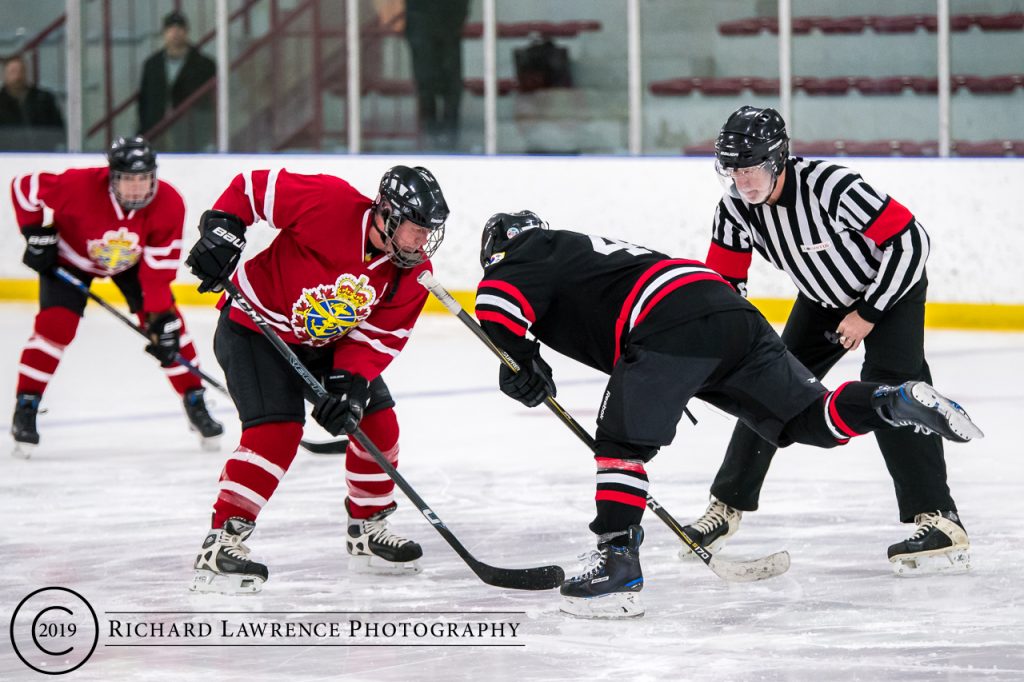
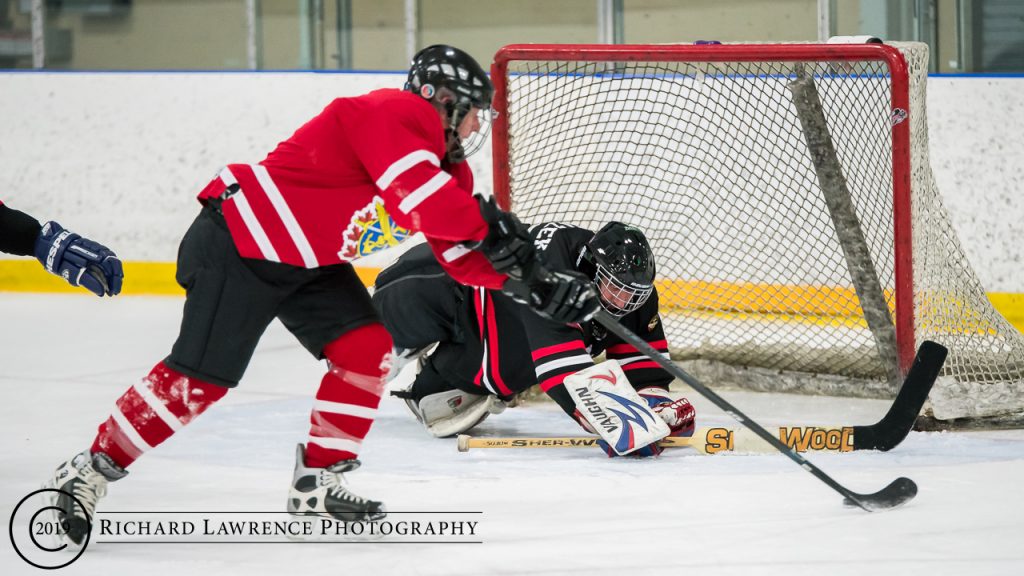
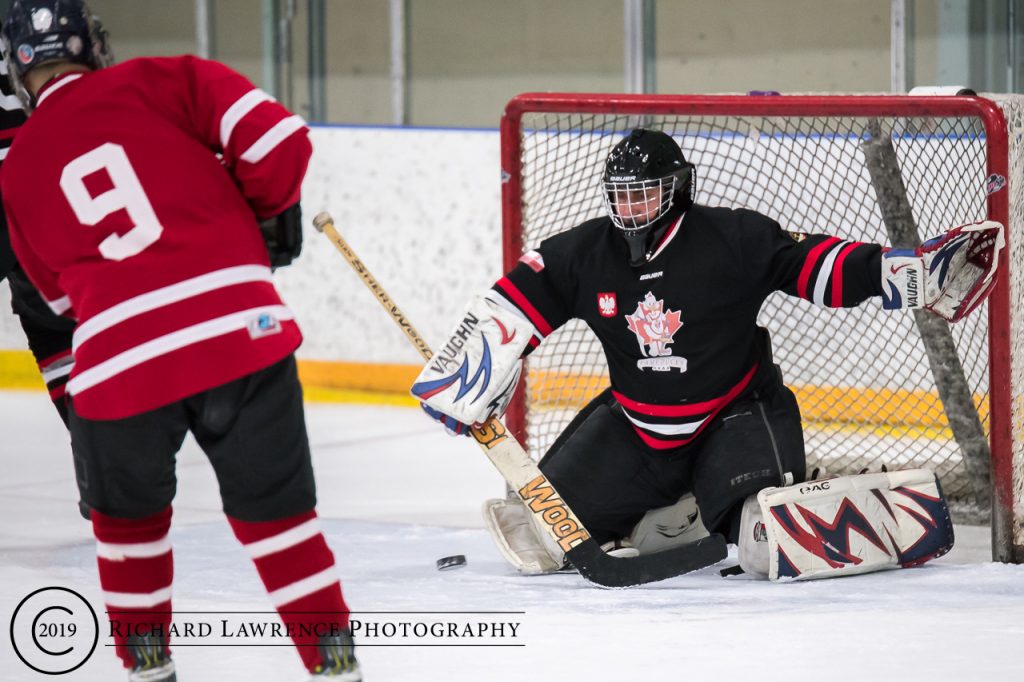
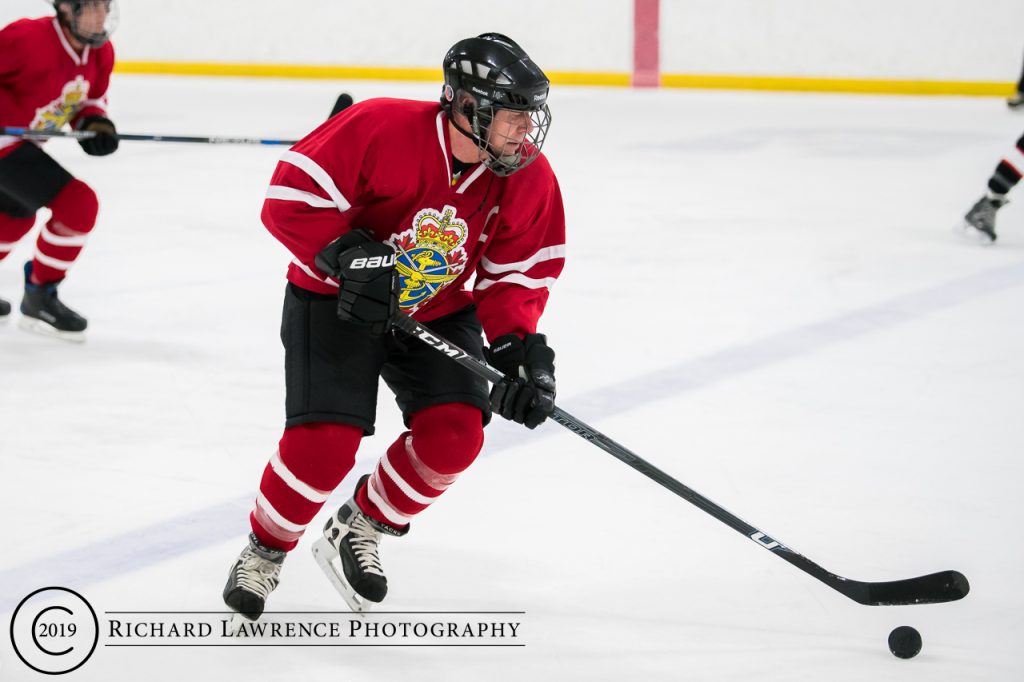
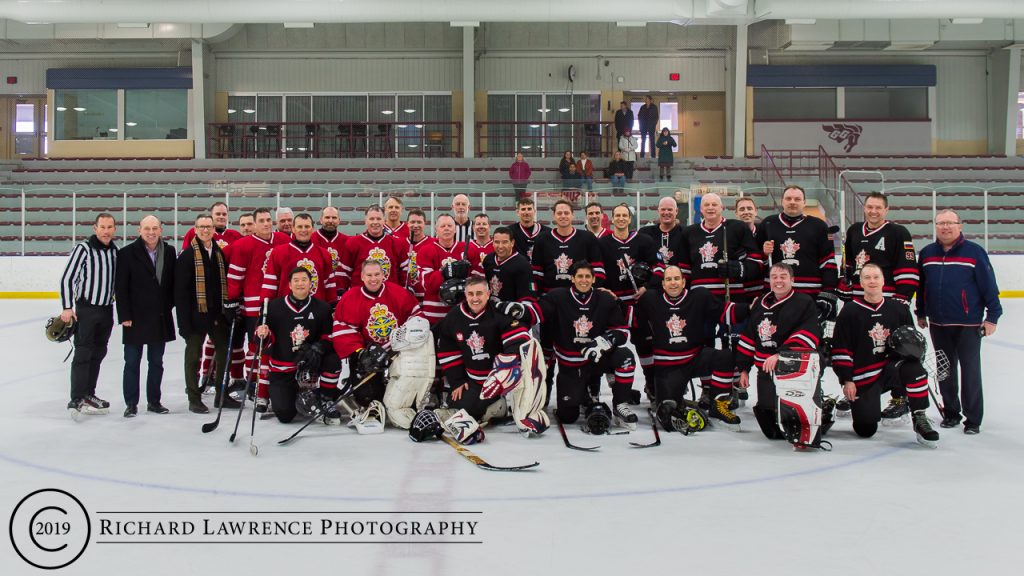
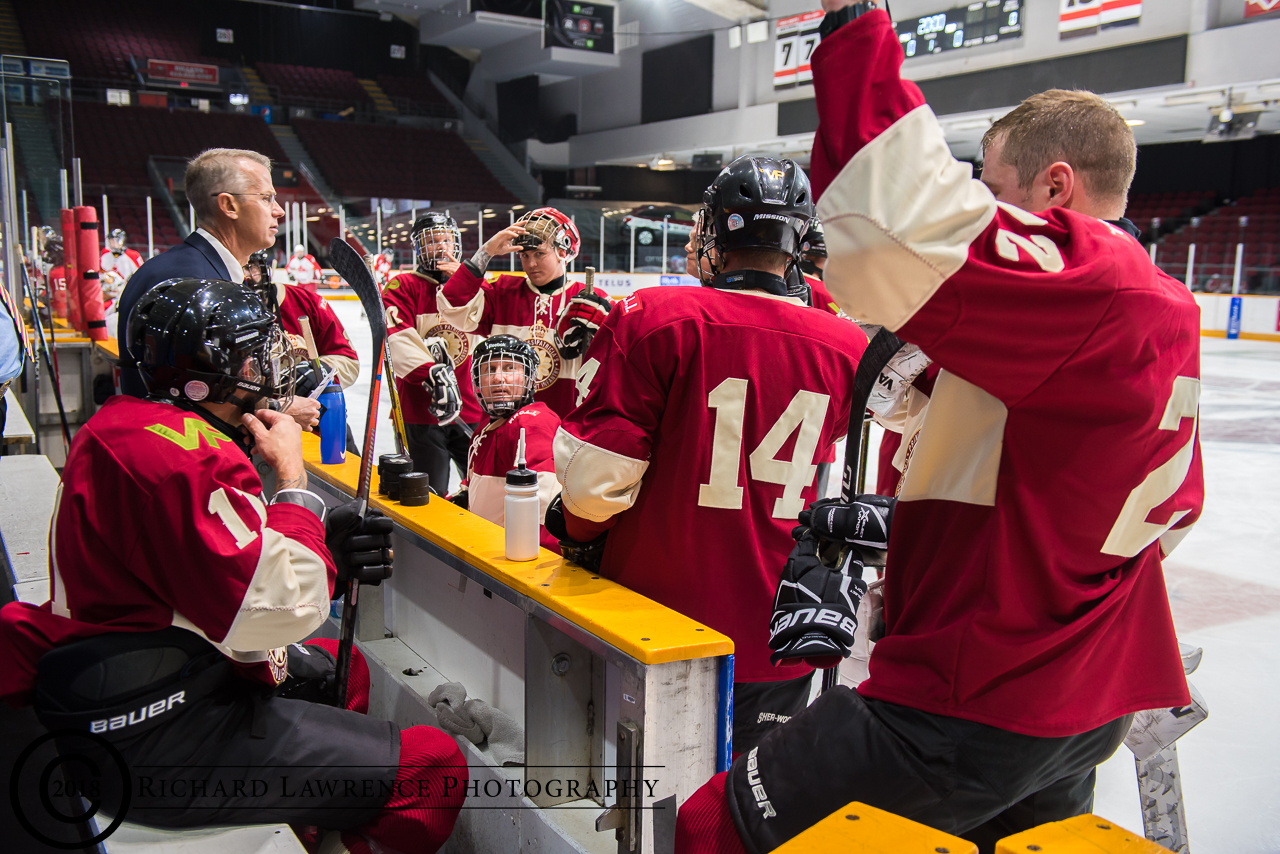
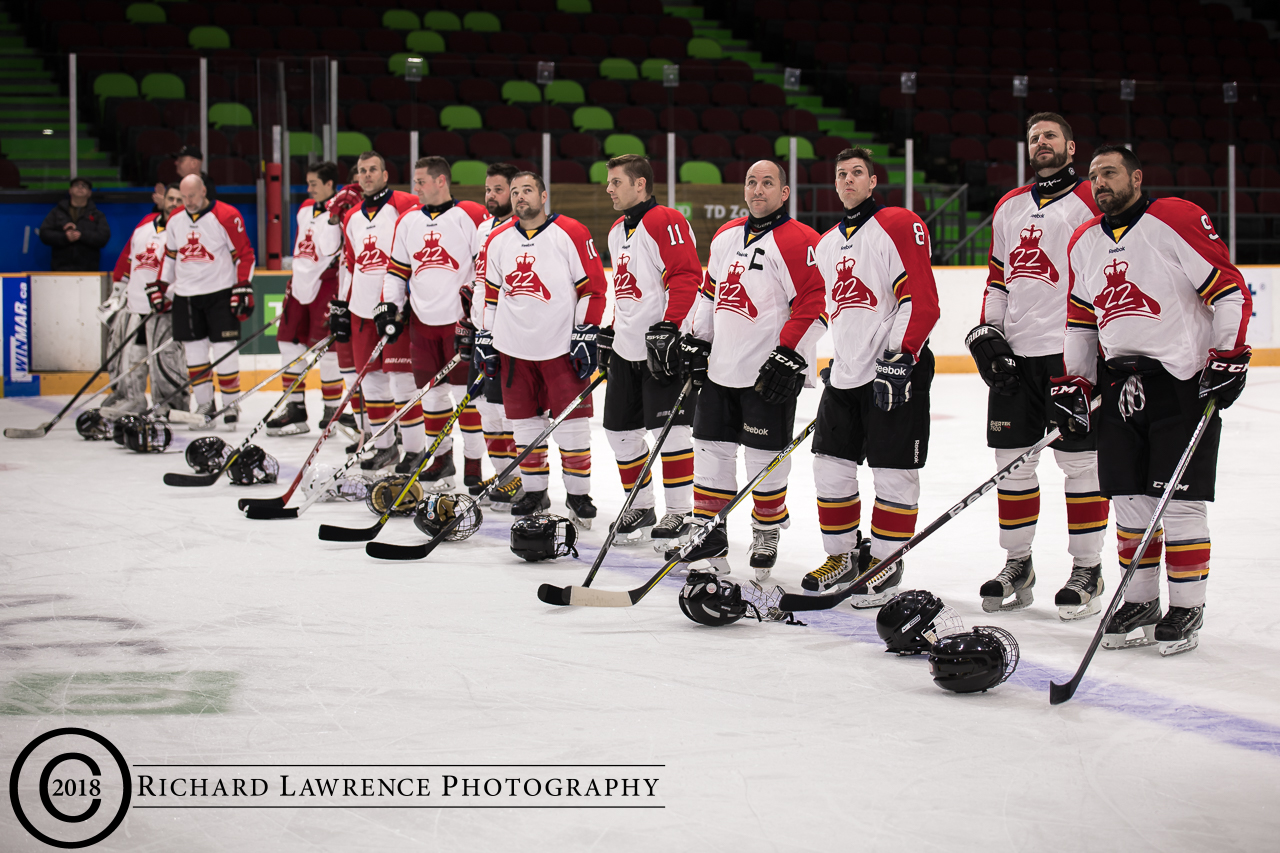
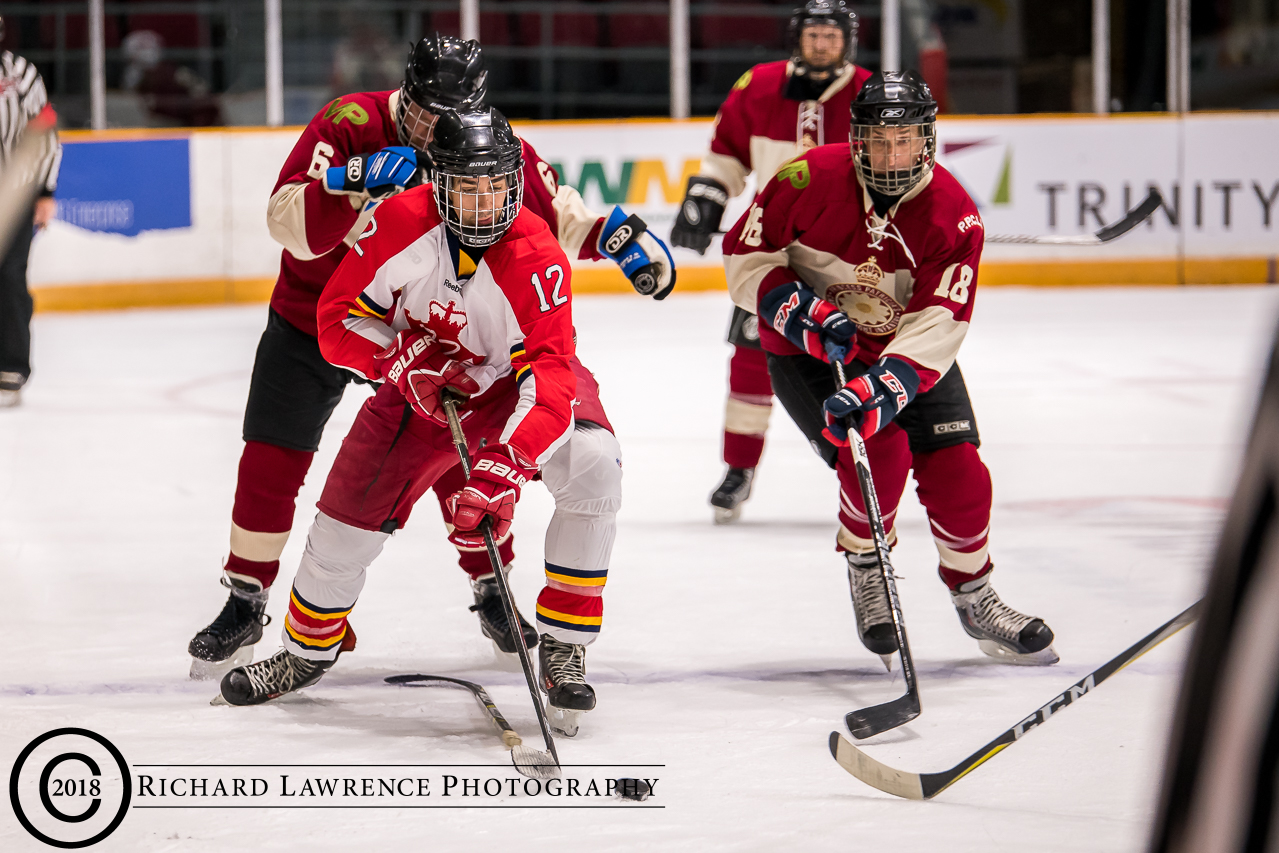
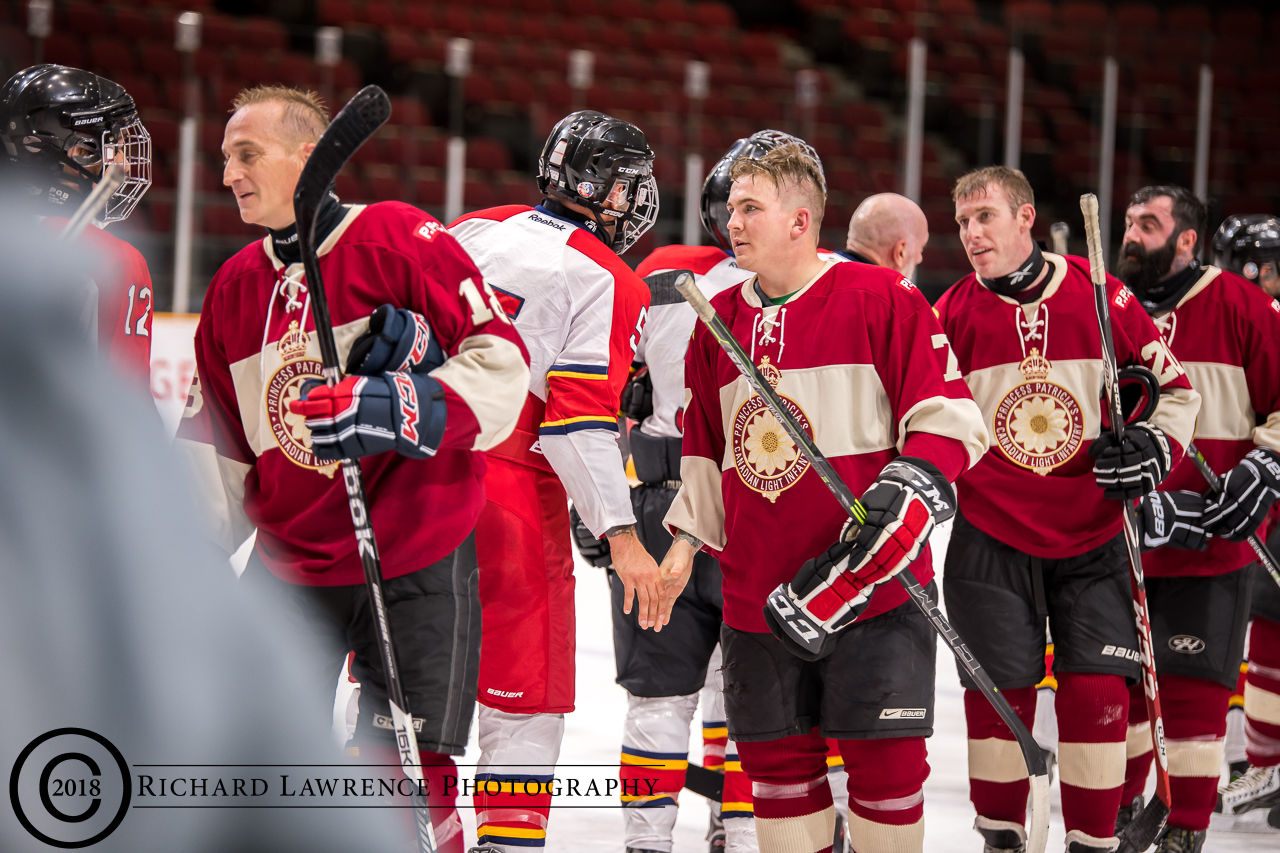
Once again the Princess Patricia’s Canadian Light Infantry (PPCLI) and the Royal 22nd Regiment (R22eR) put on their hockey armour to do battle in remembrance of hockey games played between the two regiments on the Imjin River in Korea in 1952/3.  The Imjin Hockey Classic has been played annually since 2013 and is usually a pretty close contest, this year being no exception as the game went into overtime before declaring a victor.

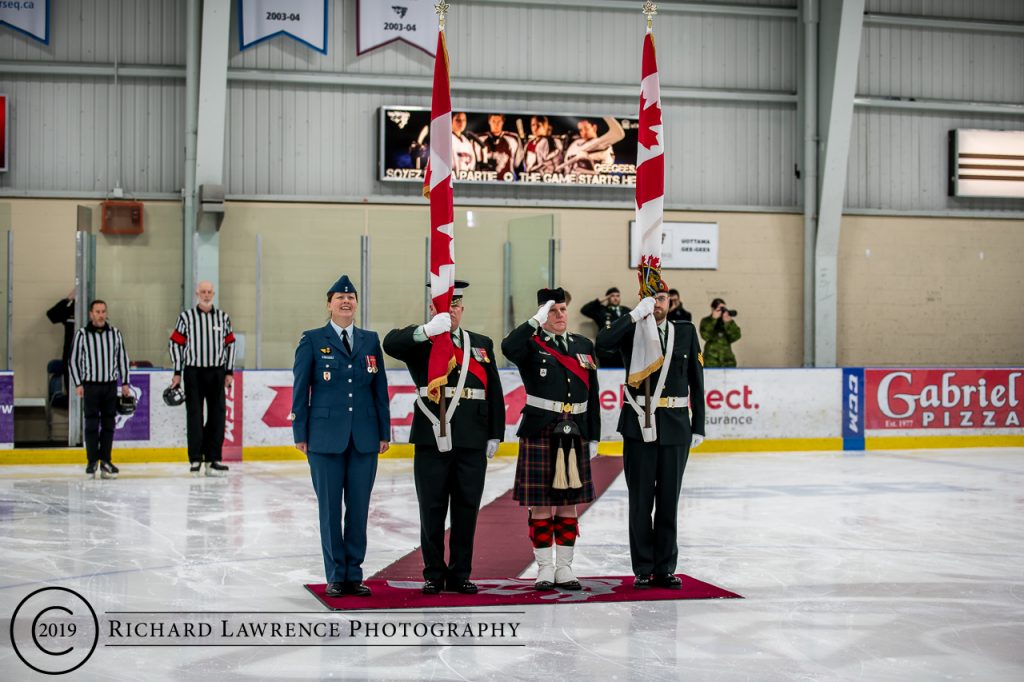
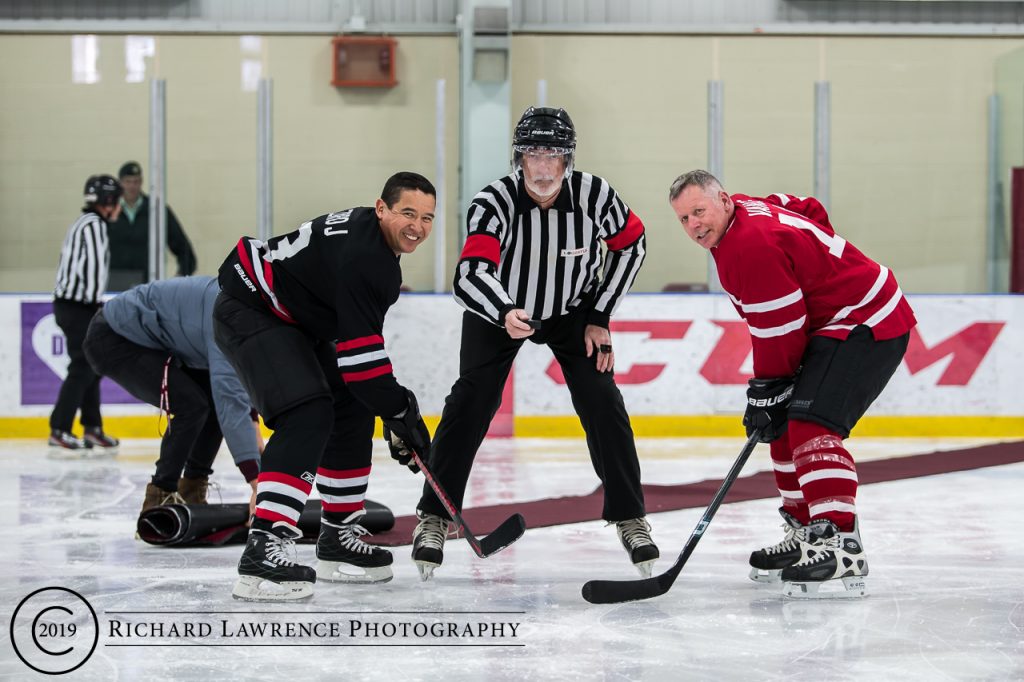
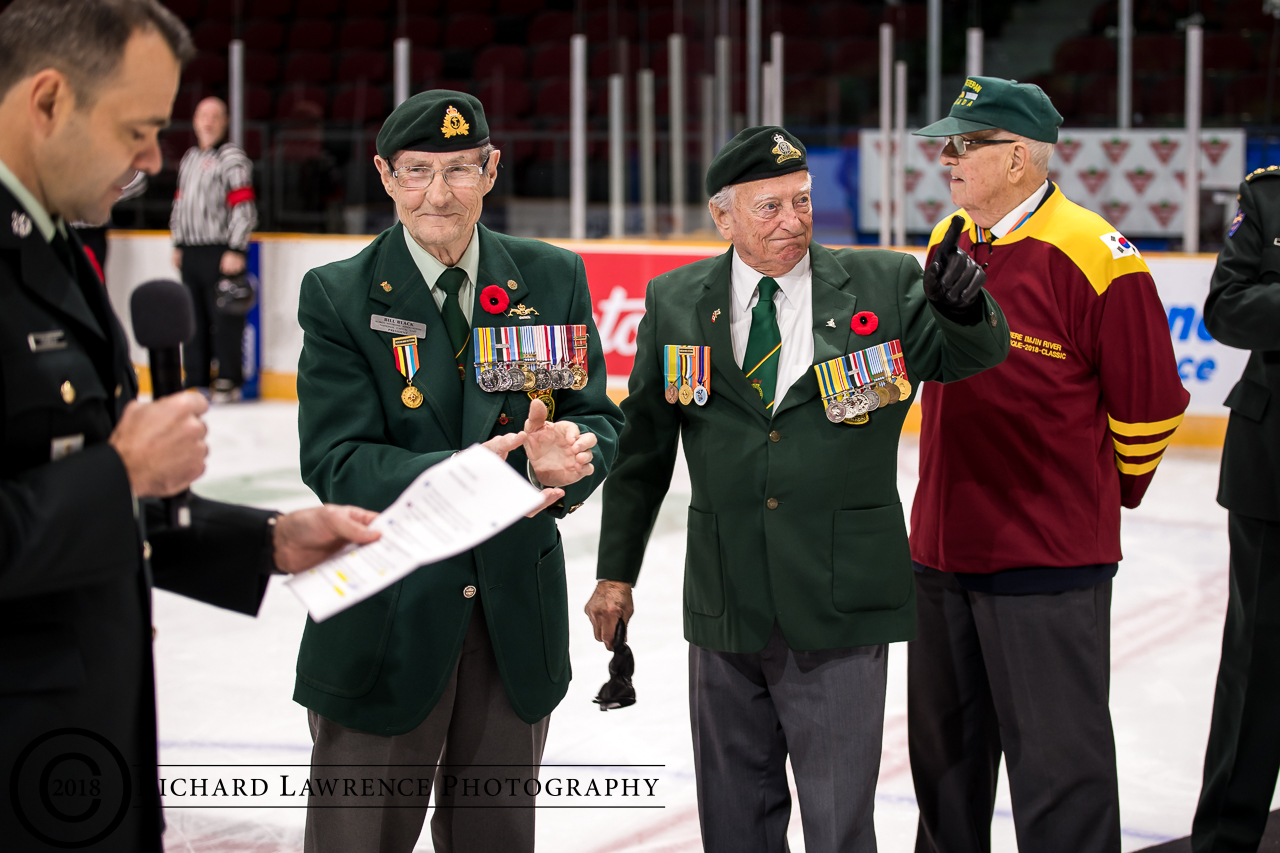
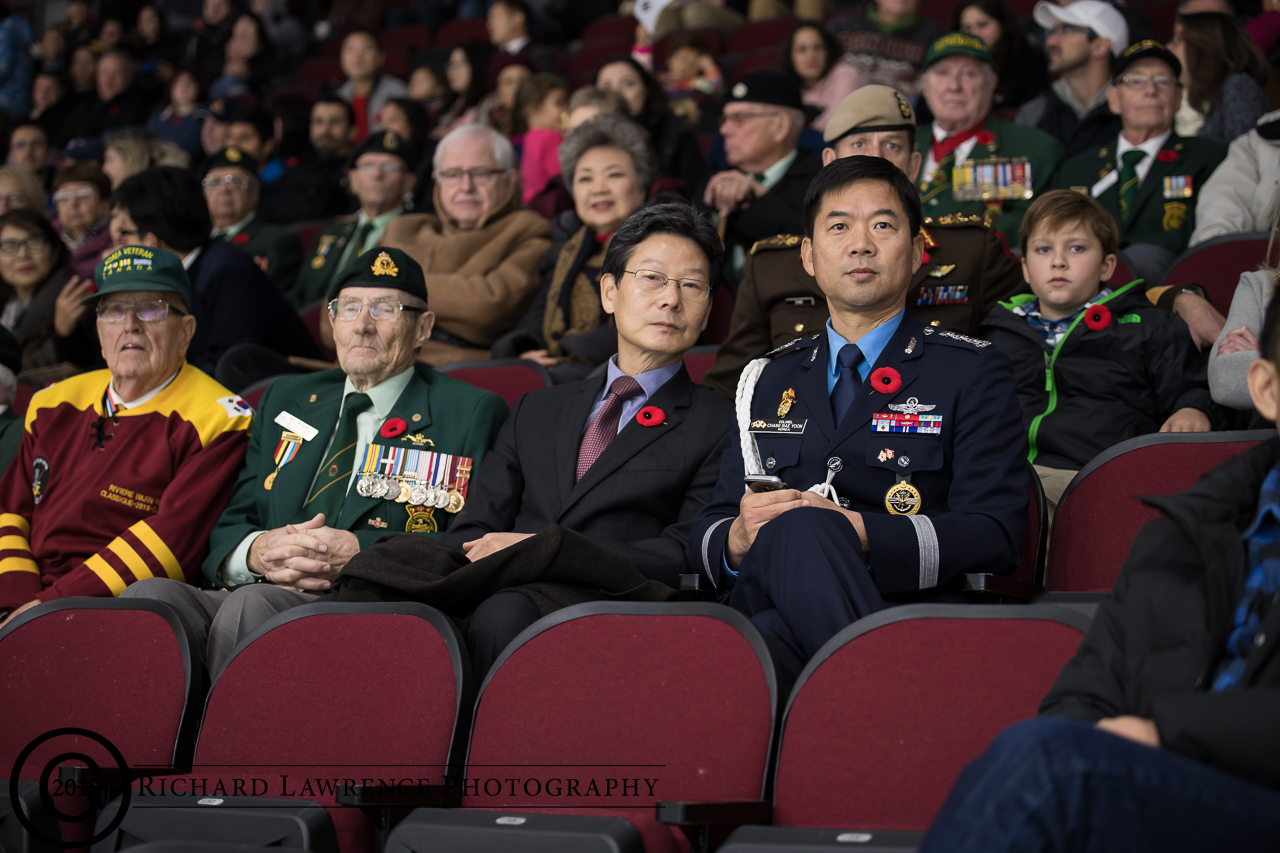
The game started with the ceremonial puck drop with the official party of the Ambassador of the Republic of Korea, His Excellency Maeng-ho Shin, Senator Yonah Martin, Commander of the Canadian Army, Lieutenant-General Wayne Eyre (originally PPCLI), and Korean Veterans Association (Chap. #7) member Bill Black.  Also on the red carpet was Mr. Claude Charland who played in the original game in 1952 in Korea.

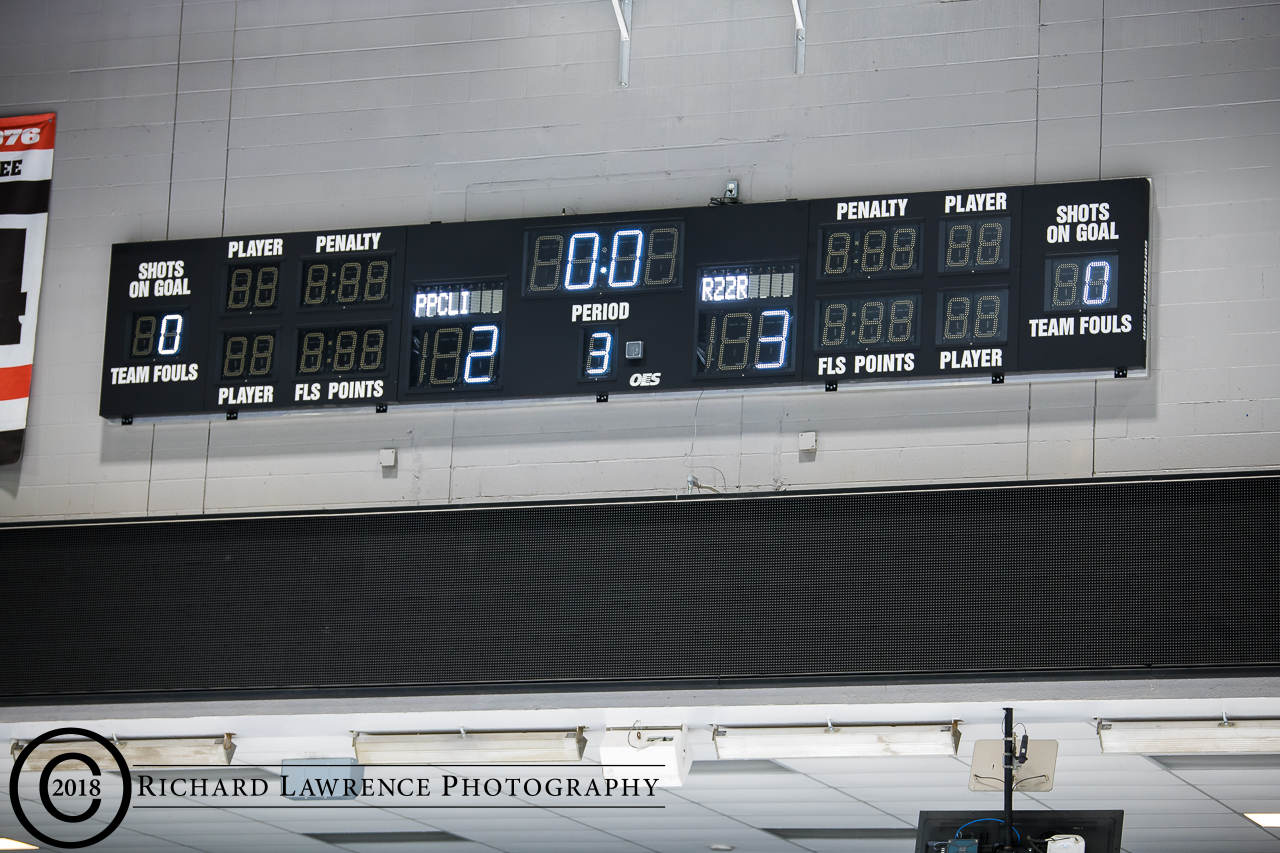
When the game started, it looked like the PPCLI was going to dominate the game as they scored at about the 18:52 mark (all times approximate) and again at the 7:30 mark and were clearly in control.  However, the R22eR finally decided to show up an evened the score at 4:15 and just as the buzzer went to end the first period in a 2-2 tie.  Into the second period they continued their momentum at 12:15 and 2:30 while the PPCLI only managed to score at 0:29 ending the second period down 3-4. The momentum swung in the third period back to the PPCLI as they potted one at 12:25 to even things up but the R22eR was not undaunted and scored at 4:05 to again take the lead.  In the closing minutes of the third, the PPCLI tied the game again at 2:11 and that’s how the regulation game ended, neither team taking a chance on pulling the goalie for the final minute.

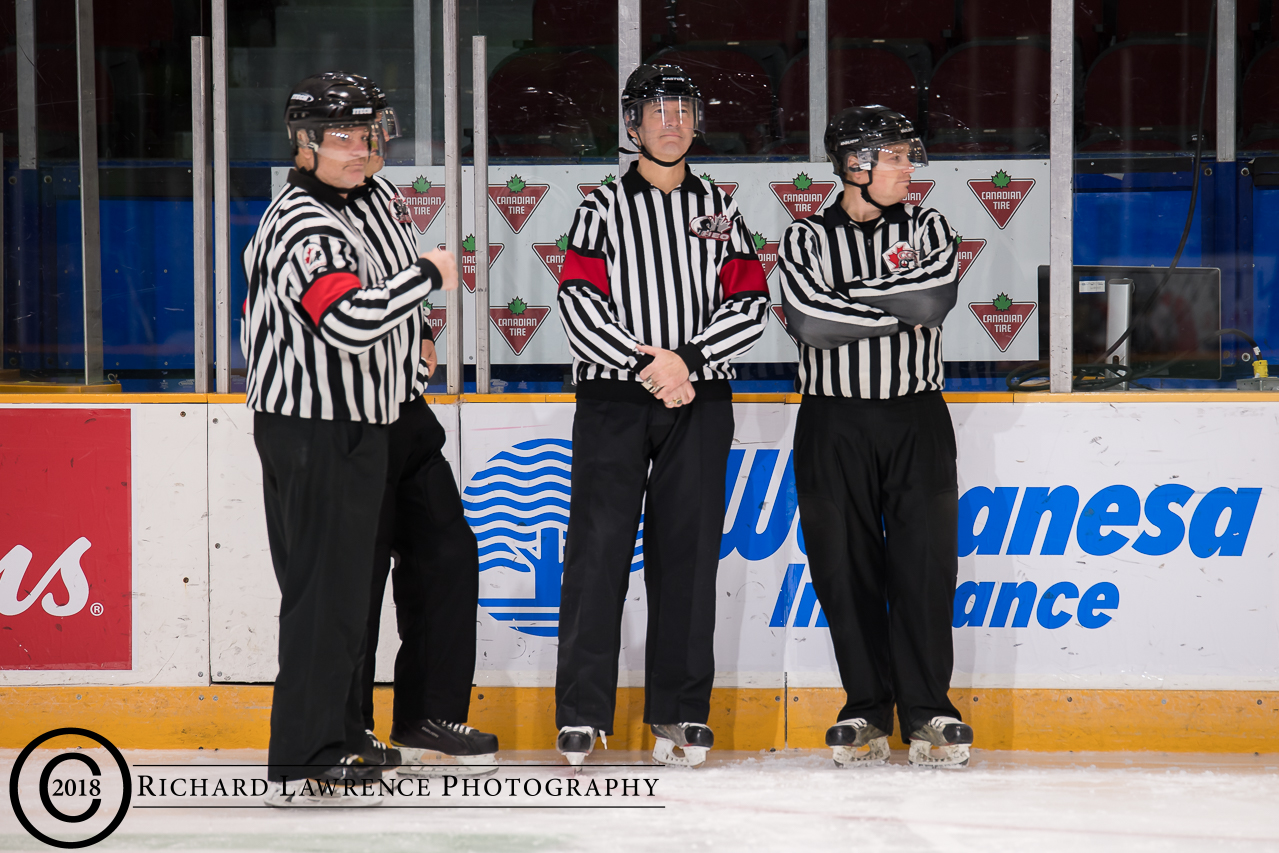
In the event of a tie, the teams play one five-minute overtime period and if tied after that, they go to a shoot-out.  Both teams came out fighting and the overtime period was fast with only three attackers on each side.  Back and forth it went, with pucks banging off the goalposts, and it looked like a shoot-out was inevitable when, with only 17 seconds left on the clock, the PPCLI got the winning goal.  It was a close fought match and the PPCLI were humble in their 6-5 victory and the R22eR gracious in defeat.

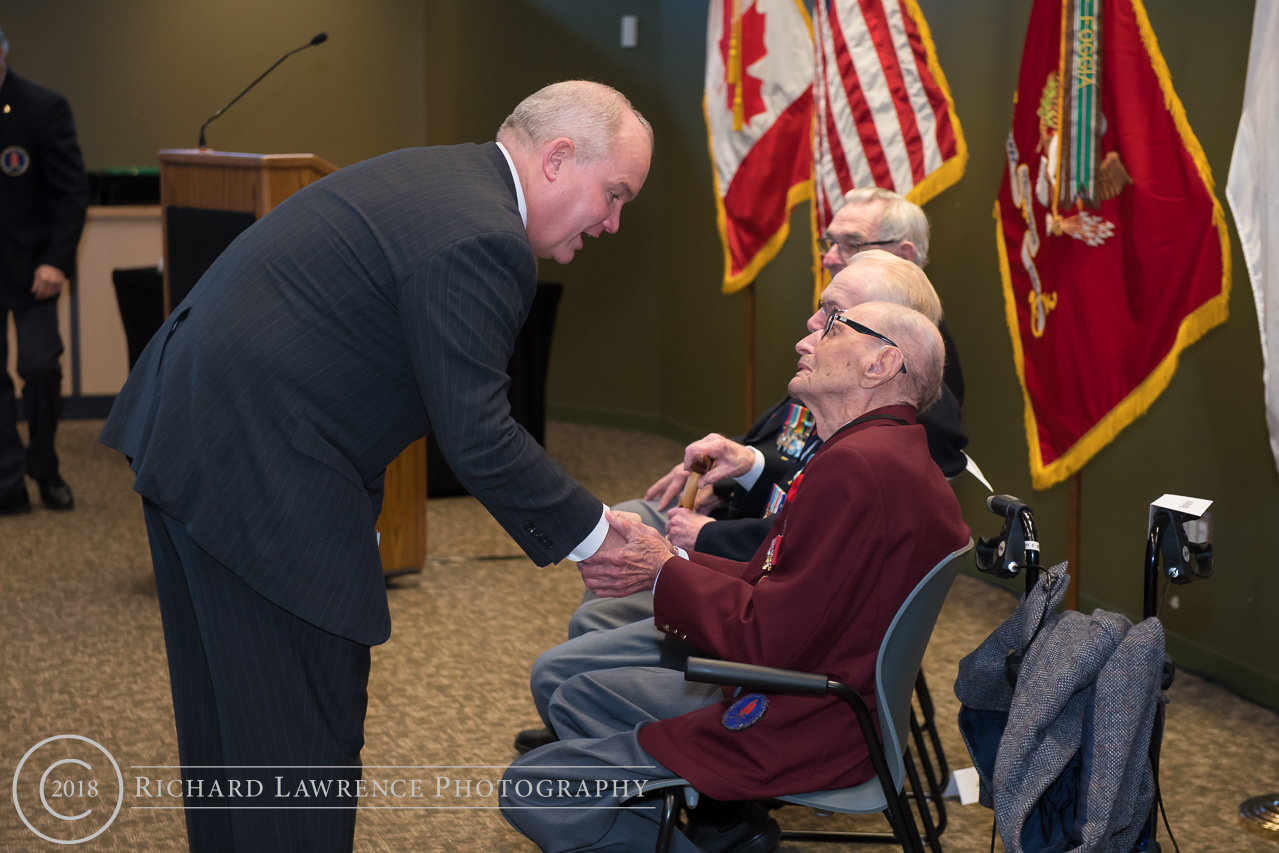
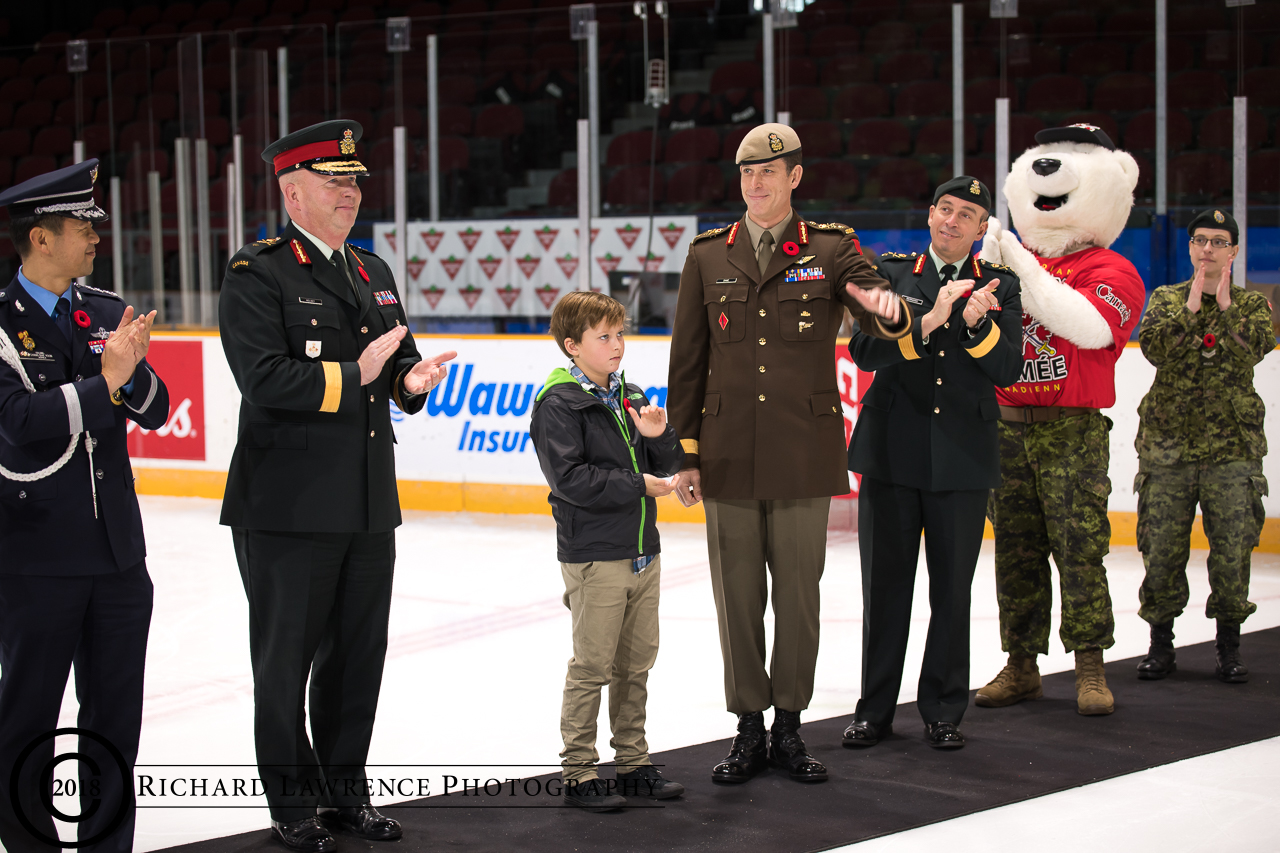
At the reception that followed, there was a small ceremony in which the Commander of the Canadian Army, LGen Eyre, was presented with a medal and citation for his contributions to security on the Korean Peninsula.  LGen Eyre was the first non-American to be Deputy Commander of the United Nations Command in South Korea prior to coming home as Commander Military Personnel Command and then on to Commander of the Canadian Army.  The “Order of National Security Merit – Guksun Medal” was awarded to LGen Eyre by Korean Lieutenant-General Choi, Byung-hyuk, Deputy Commander of South Korea-U.S. Combined Forces Command who had come all the way from Korea.

Further comments were provided by Ambassador Shin who noted that the hockey game was “most exciting and dynamic” and congratulated both teams on a well-played match. Senator Martin followed suit and also congratulated everyone and went over a brief history of meeting Claude Charland just prior to the first Imjin Hockey Classic in 2013.  LGen Eyre then took his turn and thanked Ambassador Shin and Senator Martin for their efforts in forging better Canada-Korea relations and then the veterans and LGen Choi.  When referring to why the tradition of the Imjin hockey game is important and the legacy that Canadians left in Korea he noted that this: 

“… speaks volumes about our legacy and what we want to remember … this is what success looks like [Korea today] … this is what right looks like.  This is the outcome that we want [when we go abroad]”. 

General Caron spoke on behalf of the R22eR and noted that this is the first time that the R22eR team members had played together and it was a testament to their abilities and drive that they performed so well and is indicative of the regiment itself.  The last speaker was Mr. Bill Black of the KVA who brought up all the Korean War veterans and took special note to introduce Mr. Joe Quinn who is 99 years old and still comes out to these events. KVA Chapter 7 used to have about 260 Korean veterans and is now down to 80 but he commended all those who still come out to events and to lay wreaths.  After three cheers in support of LGen Eyre and LGen Choi, everyone went back to the pizza, French fries, and chicken wings.


79th Battle of Britain Remembrance Ceremony

3.JPG

To see all the images, go to:

https://www.richardlawrencephotography.ca/rlpgalleries/2019/bob79/

 By Richard Lawrence

The Battle of Britain was one of the fiercest battles of World War II and raged on for three months during the summer of 1940 with the Allies, in the end, defeating the Nazi Luftwaffe and stopping the invasion of the British Isles. On 15th Sept, 2019 behind the Canadian Air and Space Museum, the 79th anniversary of this battle was remembered and celebrated.  The day started out sunny but by the time the ceremony started, had clouded over and cooled to a comfortable temperature – the sun only returning for the final minutes of the march off at the end.

This ceremony has a couple of events that separate it from the normal remembrance ceremonies starting with the singing of the national anthem by internationally acclaimed singer and Honourary Colonel of the RCAF, Loreena McKennitt.  There were also flypasts of vintage aircraft from Vintage Wings of Canada who supplied a Spitfire Mk XI, a P-40 Kittyhawk, a P-51 Mustang, a Harvard, a Fleet Finch, and a Cornell.  Music was supplied by the Central Band of the Canadian Forces and the RCAF Pipes and Drums. 

Again, it was a lovely fall day, albeit overcast, and cool enough that the troops on parade weren’t adversely affected as they have been in past years by the heat.  As well, because of past year’s heat, the cadets on parade stayed only long enough to be inspected by the reviewing officer, Commander of the RCAF, LGen. Meinzinger, after which they were marched off, only to rejoin the parade again for the march off.  During the review, LGen. Meinzinger made sure to visit the veterans from 410 RCAF Association (William Barker, VC) Wing to shake hands and thank them for their service.

There were only two speakers for the event, the first being the Polish Defence Attaché, Capt.(N). Krzysztof Ksiazek who spoke of the friendships between Canada and the Polish forces forged in Britain during the war.  He noted that Poland was the first nation to stand against the Nazis and when Poland fell, the remaining Polish forces moved to the United Kingdom, including 8,000 airmen who created two bomber squadrons and two fighter squadrons ( No. 302 and No. 303) under RCAF command.  No. 303 (Polish) Sqn was the most successful unit in the Battle of Britain claiming 126 German fighters in 42 days despite joining half-way through the battle.  By 1941 there were 13 Polish squadrons in the RCAF claiming 745 German aircraft and 342 gallantry awards but giving up over 1,900 aircrew killed and over 1,300 wounded. 

He also spoke of Canadian Group Captain John Kent who served with No. 303 (Polish) Sqn and was also known by the Poles as “Johnny Kentowski”.  John Kent had an illustrious career highlighted by an action on 1st November, 1940 when he found himself alone against 40 Messerschmidt Bf-109s.  During the action he downed two Germans aircraft and got hits on another while managing to extricate himself and get home.  On 24th December, 1940, he was awarded the Silver Cross of the Polish Virtuti Militari for achievements while with No. 303 (Polish) Sqn.  By June ’41 he had moved up to Wing Leader of the Polish Wing in charge of four squadrons in Norholt.  Despite flying with the Polish squadrons, Kent always maintained his Canadian identity with his personal marking on his Spitfire – a maple leaf with the Polish eagle on top.

Capt. (N) Ksiazek also mentioned the Canadian participation in the Polish Uprising in 1944 when 26 Canadian aircrew lost their lives flying in supplies to the resistance that tried to take Warsaw prior to the Soviet forces arriving.  He noted that every year, there is a ceremony to commemorate the uprising in Confederation Park, Ottawa, where there is a monument to those men.  After thanking everyone for listening, he then turned over the podium to the Commander of the RCAF, LGen. Meinzinger.

LGen. Meinzinger first thanked those in attendance for taking the time to remember and the veterans in who came out.  In speaking of the Battle, he noted that 100 Canadian pilots flew in the Battle and that 23 were killed.  They flew with RCAF squadrons in Bomber, Coastal, and Fighter Commands (including No. 202 (Cdn) squadron), and were also represented by No. 1 RCAF Fighter squadron.  He also noted that the last living Canadian Battle of Britain pilot (Squadron Leader John Steward Hart) had died in June at the age of 102 years having flown Spitfires in No. 602 Sqn.

In closing, he recognized the importance of these events to, “… bear witness, that we do remember, we do learn, and we will continue to carry the torch for future generations.”

Following the March Off, everyone adjourned to the Canada Aviation and Space Museum for refreshments.

F-35 Arrives in Ottawa

By Richard Lawrence

For all photos go to:

https://www.richardlawrencephotography.ca/rlpgalleries/2019/f35/index.html

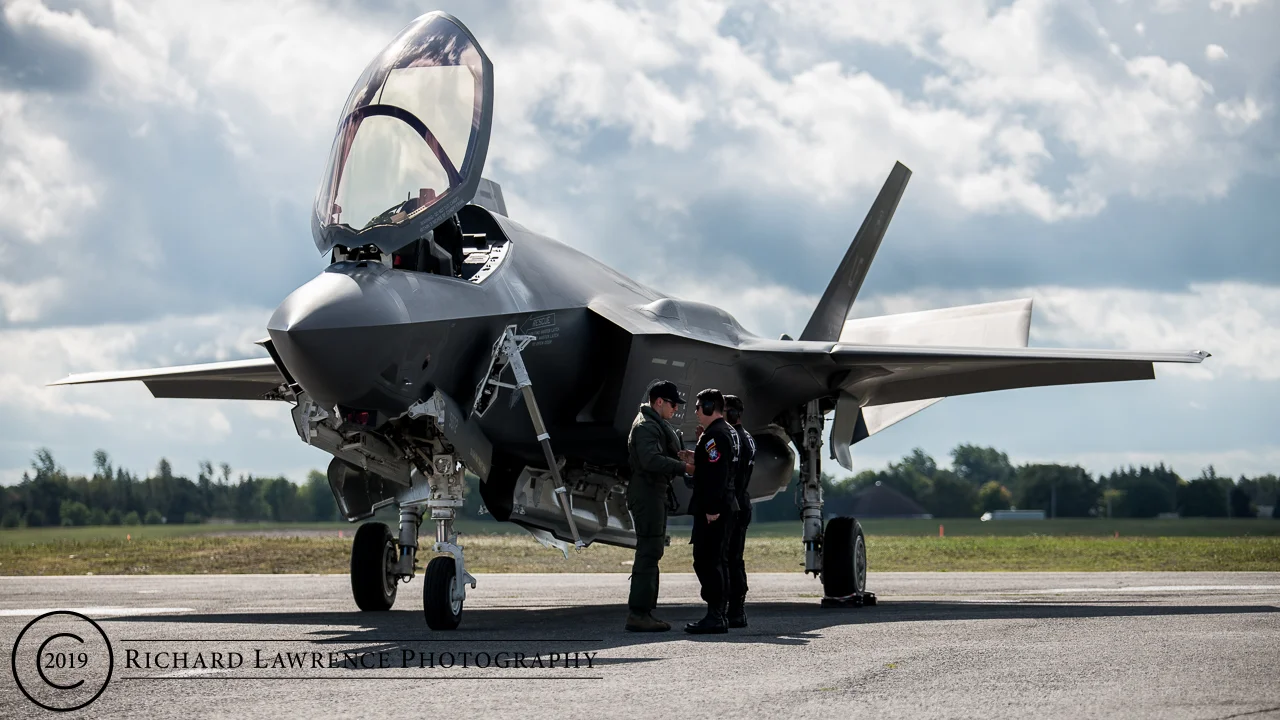
One of the contenders for the Future Fighter Capability Project (FFCP) dropped into Ottawa Airport as Lockheed Martin had two F-35As from the F-35A Demonstration Team drop in for a quick media brief in advance of its attendance at the 2019 Aero Gatineau-Ottawa Airshow.  The aircraft did not do any high speed passes or any aerobatics but simply came in and landed, taxied in, and then had Capt. Andrew ‘Dojo” Olson, the F-35 Demonstration Team Commander/Pilot for the 2019 Airshow Season, come and talk to the media.  Capt. Olson flew the F-15E Strike Eagle prior to his duties on the F-35 where he flew missions in Syria, Iraq, and Afghanistan prior coming aboard the F-35 three years ago.

When asked about the F-35 he said that compared to the F-15E, the F-35 is  “… an entire generation leap forward in technology.”  It’s the combination of stealth and sensor fusion that makes the aircraft so advanced enabling the pilot to see everything and yet not be seen by anybody giving him/her complete control of the battlespace.  The aircraft is covered in sensors looking outward at all times presenting the accumulated data to the pilot allowing him to make decisions not just for himself but for the entire four plane formation.  It can then take the data from all four aircraft to create information fusion and that information can be sent out making the F-35 the quarterback of the battlespace.   When asked if he trusted his life to the aircraft he said, “If I had to go into a serious conflict, this airplane for sure would be more lethal and survivable …”

13.jpg

He noted that there are eight partner nations involved in the F-35 development (Canada being one) and several other countries who are purchasing the jets (foreign military sales) and that makes for a “… more effective fighting force when you’re flying with your friends and … you all have the same airplane and you all speak the same language – that’s F-35.”

Capt. Olson summed up his opinion of the aircraft when he said, “You’re just King Kong out there.  You’re just untouchable.”

Canadian Army Change of Command Parade

11.jpg

By Richard Lawrence

To see all the pictures, go to:

https://www.richardlawrencephotography.ca/rlpgalleries/2019/army-coc/

The Canadian Army has a new commander and that is LGen. Wayne Eyre who officially took over the position on Tuesday, 20th August, 2019, at the Change of Command Parade held on Parliament Hill.  The event had all the usual pomp and ceremony one would expect from such a high level position and venue with the Ceremonial Guard on hand to be reviewed by CDS Jonathan Vance, outgoing Commander, LGen. Jean-Marc Lanthier, and the incoming Commander, LGen. Wayne Eyre.  There was a march past, speeches giving thanks to all, and the traditional presentation of the Commander’s Pennant to the outgoing Commander by his driver.  One change on this occasion is that in lieu of flowers presented to the wives, a donation was made to the Soldier On fund – not a bad change.  The day was warm and sunny, but not unbearably so, no-one collapsed on the field, and the event went off without a hitch.

This is the third Commander of the Army in the last 13 months, as LGen. Wynnyk held the position from 2016-2018 when he was replaced by LGen. Lanthier in July, 2018.  With the recent retirement of LGen. Wynnyk leaving the VCDS billet empty LGen. Lanthier has been moved up and LGen. Eyre has been tapped to take command of the Army.  LGen. Eyre has only been in his current position of Commander of Military Personnel Command for a couple of months so this move leaves that spot open which should be filled in a couple of days.  With any luck, all these moves will stick and provide some stability for the defence team.

LGen. Eyre comes to the job with a lot of qualifications. Born on a farm in Saskatchewan he joined the Army Cadets at age 12 and the army has been his home since.  A Royal Roads Military College and Royal Military College graduate, he started out with the PPCLI and has held command positions including 3rd Battalion PPCLI, 2 Canadian Mechanized Brigade Group, 3rd Canadian Division, Joint Task Force West, and Deputy Commanding General – Operations for the XVIII (U.S.) Airborne Corps.  Of outstanding note, he became the first non-American to serve as Deputy Commander of the United Nations Command in South Korea.  He has served operationally overseas in Cyprus, Croatia, Bosnia, Afghanistan and Korea, but also domestically in Manitoba (1997 floods), British Columbia (1998 forest fires), Ontario (2010 G8 Summit), Saskatchewan (2015 wildfires) and Alberta (Fort McMurray evacuation). 

Along the way he also managed to pick up some qualifications such as graduating the U.S. Army Special Forces Qualification Course, the U.S. Marine Corps Command and Staff College, the U.S. Marine Corps School of Advanced Warfighting, and the U.S. Army War College. Academically he has a Bachelor of Science degree and three Masters Degrees in Military Studies, Operational Studies, and Strategic Studies.

LGen. Eyre was accompanied to the ceremony by his wife Jennifer and has two children, Alexander and Breanna.


Re-Dedication of the Afghanistan Memorial

10.jpg

By Richard Lawrence

To see all the pictures, go to:

https://www.richardlawrencephotography.ca/rlpgalleries/2019/afghanmemorial/

Three months ago, the Canadian Armed Forces dedicated a memorial to those Canadian Forces members, civilians, and foreign combatants under Canadian command who died in Afghanistan from 2001 to 2014 (the Fallen).  To be absolutely correct, the Kandahar Airfield Cenotaph was placed in a building within the new NDHQ (Carling Campus) called the Afghanistan Memorial Hall and it’s important to know that these two things are separate entities that are now combined within a secure perimeter which is not generally open to the public.  The original dedication was a closed affair to which family members of the Fallen were not invited and a great hue and cry erupted because it was felt that the family members had been disrespected.  With hindsight aplenty, the CAF agreed that it had misstepped and on 17th August, 2019, rededicated the Afghanistan Memorial Hall with as much pomp and circumstance as could be mustered and included almost 700 family members of the Fallen.

The Cenotaph began life in 2003 at Camp Julian (Kabul, Afghanistan) when Capt. Sean McDowell conceived an idea to create a memorial to the first six Canadians killed.  On Remembrance Day, 2003, it was unveiled at the camp and it included a two-tonne boulder from the site where the jeep was hit by an improvised explosive device (IED) with two plaques attached (provided by Rod McLeod) and two marble plinths with an engraved inscription.  In November, 2005, Camp Julian was closed and the Cenotaph moved to Kandahar Airfield.

At Kandahar Airfield, the Cenotaph was redesigned to accommodate the growth of additional plaques.  The boulder was placed on a platform, and two wooden wings were added with the plinths replaced with marble walls containing the same inscription. In 2008 Canadian artist Sylvia Pecota donated a plaque of an angel caring for a wounded soldier which was placed on the boulder.  Over time, it continued to be added to with more wings and the addition of non-Canadians and civilians who lost their lives under Canadian command. After the last Remembrance Day in Kandahar (2011), the Cenotaph was painstakingly dismantled and returned to Canada where in May, 2014, it was put on display on Parliament Hill and then toured other Canadian cities and Washington, USA.  In May, 2019, with the Cenotaph installed in the Afghanistan Memorial Hall at NDHQ, a limited guest-list dedication was held which the CDS later viewed as an error in not making the event more public.  That led to this rededication of the Afghanistan Memorial Hall on 17th August, 2019, 

The day broke cloudy and humid and rain had fallen during the early morning but the forecast was that further rain would hold off until after noon.  Families, VIPs, guests, and military members strolled down the reflecting pond to the venue site and into their seats where, 30 minutes prior to the ceremony start, big LED screens on both sides of the Memorial Hall came to life with a slide show of the Fallen, accompanied with music from the Ceremonial Guard Band.  After the last of the Fallen was shown, the show continued calling attention to landmark moments in the Afghan campaign until it was time to start the ceremony with over 700 people in attendance – mostly family members of the Fallen.

The official party arrived with Governor-General, Julie Payette accompanied by the Chief of Defence Staff, General Jonathan Vance, and the Minister of National Defence, Harjit Sajjan.  The national anthems of Afghanistan, the United States of America, and Canada were played after which everyone was seated in anticipation of the first event of the program. To that end, Honourary Colonel Terry Kelly, singer/songwriter of “A Pittance of Time”, took to the podium where he sang “Portraits of Honour” to a crowd that was absolutely silent during the performance.  When finished, it was time for the remarks from the official party and representatives from Afghanistan and the USA with the Governor-General first to speak. 

H.E. Payette spent time speaking of seeing images of the Fallen being brought back from ramp ceremonies and down the Highway of Heroes, and of the people paying their respects along the highway, regardless of weather conditions.  She noted the sacrifices of the families, during deployment and during loss and recognized the struggles of those coming home, some with injuries seen and not seen.  Minister Sajjan amplified her remarks and recognized that the memorial is, “… a tangible reminder of your loved one’s service and sacrifice.”   

The First Secretary of the Islamic Republic of Afghanistan, Mr. Fahim Ebrat, thanked all the families for their sacrifices and remarked that the sacrifices had not been in vain as the people of Afghanistan now have access to education, healthcare, and other public services and “… women and girls have a restoration of rights and have political representation in the provincial consult and national parliament.”.  All this made possible by Canadian and U.S. forces. In concluding he said, “… their legacy is also indelibly etched in the living hearts of my people and is now forever part of our history.”

Mr. Richard Mills Jr., Deputy Chief of Mission, U.S. Embassy (Ottawa), reflected on the time of 9/11 and of the Canadians welcoming everyone caught in the air when the U.S. closed its airspace. He spoke of the partnerships between Canada and the U.S.  and then looked to the future of Afghanistan saying, “The United States will move forward seeking an honourable and enduring outcome to the war in Afghanistan that will be worthy of the tremendous sacrifices that the U.S. and Canadian Armed Forces have made.  … [to] ensure security for the Afghan people and their right to choose their country’s future.” 

The last speaker was General Jonathan Vance, who twice commanded the forces in Afghanistan and has firsthand knowledge of events and the Cenotaph in theatre.  He spoke of moments of reflection at the Cenotaph and when on his second tour, he purposely stopped in to remember Corporal Nick Bulger, who was the 121st Canadian killed when his jeep hit an IED in July, 2009.  General Vance was in that same convoy where along with the death of Cpl Bulger, five others were injured.  At this moment, General Vance had to stop and take a moment and when he started speaking again, it was obvious that emotion had overtaken him as his voice quivered a bit before completely regaining his composure.  In fact, there were a couple of occasions where the General just took a pause, showing that these remembrances had a strong effect on him.  On closing, he regretted the limitations of the first dedication and recognized the need to have the families involved.  “Today it’s about you, the families.  You are and always will be beloved to us in uniform.”

With remarks completed, the rededication took place inside the Memorial Hall followed by the Last Post, two minutes of silence, a flypast, finishing with the Lament and Reveille.  Wreaths were then laid against the wall of the Memorial Hall followed by the “Send Off” by Major-General Guy Chapdelaine, Chaplain General.  The Governor General was then taken into the Memorial Hall by General Vance where they looked at the plaques and memorial books and were then followed in by the families.  And, as if God was looking down and saw the ceremony completed, the skies opened up and the rain started to fall as people moved to the reception area. 

Some of the families then took the opportunity to speak with the media, although not many. Media had been asked to respect the solemnness of the occasion and not take images of the families in the Memorial Hall but once it cleared, a couple allowed themselves to be followed.

The final occasion of the day was when Lieutenant-General Jean-Marc Lanthier, Commander of the Canadian Army (until the 20th August) and Vice-Chief of Defence Staff, spoke to the media and took questions.  He had served twice in Afghanistan, where in 2009 he lost ten members in the first eight weeks. He was asked why the Memorial Hall is in this publically inaccessible area, to which he responded, 

“… the fact that here you’ve got the senior leadership of the Canadian Armed Forces, you’ve got almost ten thousand people that work on the campus and daily we’re reminded of the graveness of our decisions as senior leaders and members of the defence team.  This is why this is here …”. 

He also noted that the Kandahar Airfield Cenotaph, as originally conceived, was never meant to be a national monument.  “It is … a monument for the soldier and they’re now resting amongst their own.  That’s important for us.” 

Before leaving, he took the opportunity to remind everyone that there will be a national monument to the Afghanistan War placed across from the Canadian War Museum in the future and if anyone wants to see the Afghanistan Memorial Hall, all they have to do is make an appointment via the Afghanistan Memorial Hall web page, email, or call, and accommodations will be made and escorts provided. 

https://www.canada.ca/en/department-national-defence/services/bases-support-units/canadian-forces-support-unit-ottawa/afghanistan-memorial.html

UN Peacekeepers Day

By Richard Lawrence

To see all the pictures, go to: https://www.richardlawrencephotography.ca/rlpgalleries/2019/unday2019/
On the 9th August, 1974, a United Nations Buffalo aircraft flying over Egypt was shot out of the sky by a Syrian missile.  On that plane were nine Canadian Armed Forces personnel involved in a peace mission who were killed on what was supposed to be a routine resupply mission to the presence in the Golan Heights.  To this day, it is still the largest single loss of Canadian lives since Canada began participating in UN Peacekeeping missions in 1948.  That is why the closest Sunday to the 9th August is selected as United Nations Peacekeepers Day every year with this year’s remembrance ceremony being held at the Reconciliation Monument, Ottawa, on Sunday the 11th. 

This year’s ceremony saw participation by 450 Tactical Helicopter Squadron from Petawawa, just back from a peacekeeping mission in Mali, UN Peacekeeping veterans, and police representatives from the RCMP, OPP, Ottawa, and Toronto police forces.  The Official Party consisted of MGen. (ret’d) Clive Addy, MP (Ottawa-West – Nepean) Anita Vandenbeld, Commodore Rebecca Patterson (Director General Professional Military Conduct – Operation Honour), RCMP Superintendent Kevin Lamontagne, and Ms. Deborah Mac Culloch representing veterans and families. Music was supplied by the Governor General’s Foot Guard Band with piping from Mr. Eric Booth. 

The event started with the Master of Ceremonies, Ms. Suzanne Serrault, outlining several anniversaries to be commemorated at the day’s ceremony.  Specifically that this year is the 25th anniversary of Canada providing humanitarian relief to Rwandan refugees where over 400 Canadians served.  It was also the 20th anniversary of the UN Assistance Mission to East Timor and the 20th anniversary of the start of the UN mission in Kosovo in which almost 2,000 Canadians served, along with RCMP investigators, in three different operations to assist in the safe return of over one million refugees/internally displaced persons.  Lastly she noted the 30th anniversary of RCMP participation in “Peace and Civilization Operations” in which almost 4,000 police and worked in 33 countries.  Now, one can argue the success/failure of any or all UN operations and the politics involved, but this is not the day to do that.  It is the day to remember all those who served and continue to serve, under bad to horrific conditions, and especially those that did not return.

Mr. Wayne Mac Culloch, representing the President of the Canadian Association of Veterans in United Nations Peacekeeping (CAVUNP), was the first speaker of the morning where he reiterated why this date was chosen for remembrance and to thank not only the peacekeepers but their families who must endure long periods of absence with their spouses in harm’s way but who continue to support the member and the missions.  He was followed by the playing of the Last Post, a minutes silence, the Rouse and the Lament.  The Act of Remembrance was recited by Paul Greensides, Ray Paquette and Aurel Dubé and was followed by the Commitment to Remember by Cadet Sgt. Jeffery Lariviére and Cadet WO2 Madison Préfontaine.

For this ceremony, there is no laying of wreaths but instead three bouquets of flowers are placed into the barrels of three cannons, effectively turning the weapons into flower pots.  Ms. Vandenbeld, along with MGen. Addy, placed the flowers on behalf of the Government of Canada while Commodore Patterson, Superintendent Lamontagne, and CWO Guimond placed the flowers for the military and police organizations.  The last bouquet was placed by Mr. and Ms. Mac Culloch, representing the veterans and families. 

It was then Ms. Vandenbeld’s turn to address the assembly where she noted that 125,000 Canadians have served in UN peace support and that 123 have died in that service while “… putting yourselves in harm’s way to protect the world’s most vulnerable.”.  MGen. Addy followed with anecdotes of his terms as a peacekeeper where he “… saw how vile people can be to each other when on-one is looking at them” and noting some of the idiotic things that have happened to him, both at the command level and in the field.  He admitted that he didn’t always know what he was doing or what was going on but “… that he knew he was doing good.”.   

This pretty much ended the ceremony and the parade was dismissed but I think Ms. Vandenbeld put it best when she said, “Peacekeeping.  It’s what our country does.  It’s what we stand for.  It’s what other countries think of when they see our red maple leaf.” 

75th Anniversary of the 1944 Polish Uprising

3.jpg

By Richard Lawrence

To see all the pictures, go to: https://www.richardlawrencephotography.ca/rlpgalleries/2019/poland75/ 

On 1st August, 1944, the Polish resistance, along with the Polish Home Army (PHA), started what is known as the Warsaw Uprising (1944) to force the German Army out of Warsaw, Poland.  All that summer, the forces of the Soviet Union had been pushing westward and by end July were poised on the outskirts of Warsaw to clear them out.  The Germans were retreating and the Soviets were advancing and the time was ripe for the Polish people to make their contribution to the Allies in winning the war.  At 1700 hours largest act of resistance in the war began.

Now, some things should be put in context.  The first objective of the resistance/PHA was to expel the Germans from the city.  However, there was a second, political objective of installing a legitimate Polish government in power before the Soviet-backed Polish Committee of National Liberation could assume power and that is why it was important to launch the uprising prior to the Soviets actually getting into the city.  On the Soviet side, Stalin knew that he would have great troubles controlling the country after it was liberated so it was in his interests to see as much of the resistance/PHA destroyed before sending the Germans home.  Stalin said of the resistance that they were “…a handful of criminals” and “… enemies of the Soviet Union” and used this as justification for his inaction following the start of the Uprising.  While biding his time, he also decided that it was more advantages to occupy Eastern Europe than to thrust into Germany, so he left the Poles to fight and die. 

In effect, the Uprising started and the Poles, with little ammunition, food, or other supplies, were forcing the Germans back while capturing strategic infrastructure.  Then, they waited for assistance from the Soviets but none was forthcoming.  Soviet tanks were withdrawn, no supplies were offered, no air cover was provided, and radio pleas were ignored.  The Germans, in the meantime, managed to re-supply and reinforce and came back into the city with a vengeance, as destroying Warsaw had been one of Hitler’s objectives before the war and Himmler now saw the opportunity.  The fighting was brutal hand-to-hand, building-to-building, with the Poles losing irreplaceable soldiers and running out of food and ammunition while the Germans continued to reinforce.  Still nothing from the Soviets.

Churchill saw what was happening and pleaded with Stalin to allow the Allies to airlift in supplies but Stalin declined to allow the Allies access to airfields in Soviet held territory.  Churchill, undeterred, ordered the RAF to airlift supplies from bases in the UK and Italy and 223 low-level supply lifts were carried out during which the RAF lost 34 aircraft (the Warsaw Airlift).  From bases in Italy, the RAF left at night and flew over 1300 kilometers, to Poland where they had to do their drops during daylight and then fly home over German occupied territories, all without fighter escort.  The Germans knew they were coming and had fighters and AAA batteries lined up all the way.  There was also a night-fighter school along the incoming route that provided no end of problems.  In the end, the limited amount of supplies that got through, and the Soviet intransigence, spelled the end of the Uprising and a capitulation was signed on 2nd October, 1944. 

The Polish losses during the Uprising were large, in part because at the start the Germans decided not to take prisoners but to shoot anyone captured (until an agreement was reached to treat the Poles as combatants).  About 25% of the city was destroyed during the uprising with estimates of up to 16,000 resistance/PHA killed, 6,000 wounded, and 15,000 prisoners of war.  After the capitulation, the entire civilian population was expelled from the city with an estimated 90,000 sent to labour camps, 60,000 sent to death/concentration camps, and the rest relocated.  Once emptied, the Germans destroyed another 35% of the city which, with previous damage during the war, left Warsaw approximately 85% destroyed. 

Once Poland became independent again (1989), all of the lost Canadian airmen were located, except for one aircraft – a Halifax bomber.  In 2002 information led to its location near Tarnow, Poland, where it had been shot down on its way back to southern Italy after delivering its load of ammunition and arms.  It was crewed by four Canadians and two British airmen.

In Confederation Park, Ottawa, there is a large plaque, erected in 1964 by the Polish Home Army Ex-Servicemen's Association of Canada, dedicated to the memory of 26 Canadian airmen who flew with the Polish Home Army while flying support missions during World War II, including the Uprising. In 1993, when the airmen were posthumously awarded the Polish Home Army Cross, a bronze replica and a small plaque with inscription were added.  All this is preamble to the remembrance ceremony that was held on 1st August, 2019, in Confederation Park in front of this plaque, to commemorate the 75th Anniversary of the Warsaw Uprising. 

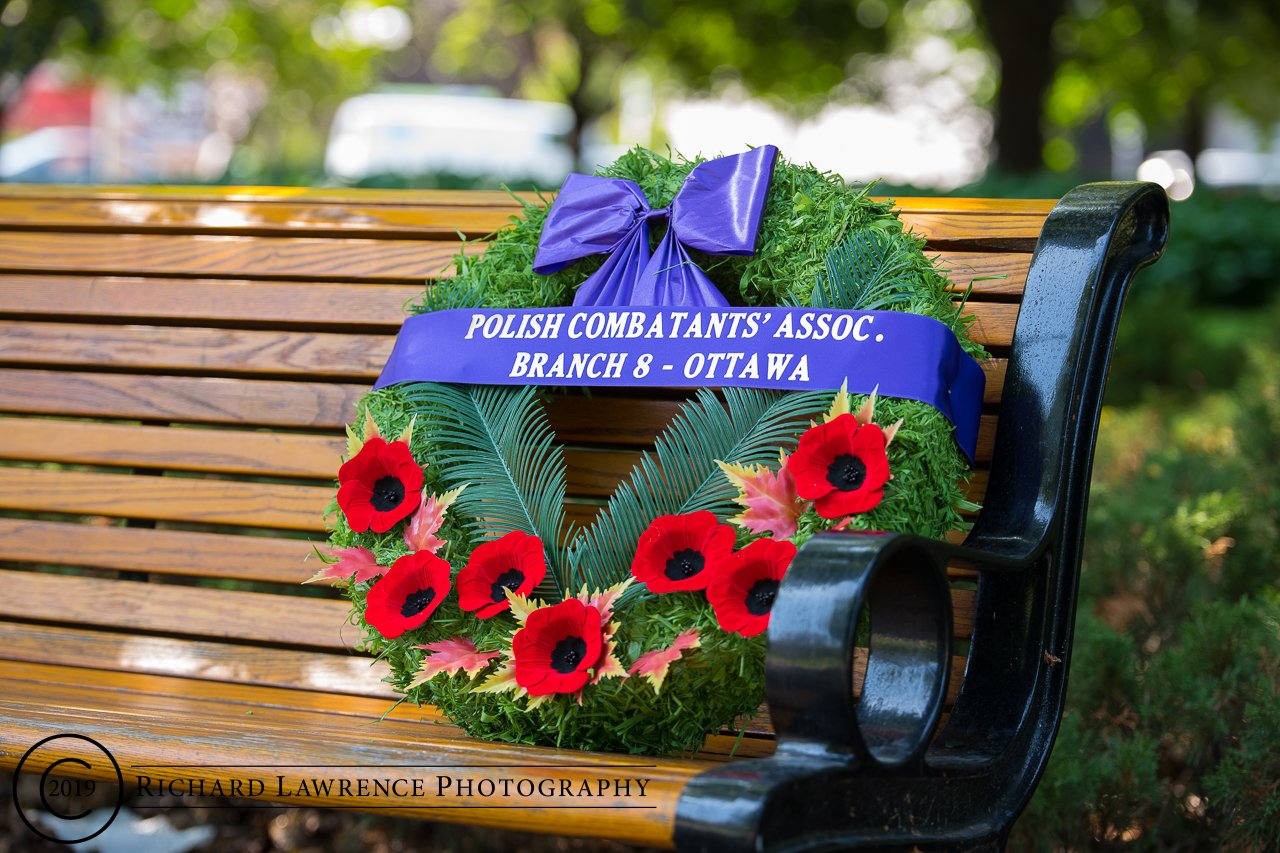
Attending was the Polish Ambassador of the Republic of Poland, H.E. Andrzej Kurnicki, his Defence Liaison Capt(N) Krzysztof Ksiazek, representatives from the Polish Boy Scouts and the Girl Guides, the Polish Combatants Association (Chapter 8-Ottawa), and most importantly, Ms. Ewa Konopacki.  Ms. Konopacki, a small, slight woman, fought with the Polish Home Army during the Uprising and is the recipient of Poland’s highest military decoration (Virtuti Militari) for “… heroism and courage in the face of the enemy at war” and may be the oldest surviving member of the conflict. The Ambassador, Ms. Konopacki, and Veterans Affairs laid wreaths in commemoration of both those lost in the Uprising and those Canadian airmen who risked so much to aid the Poles.   

CF Appreciation Night - Ottawa RedBlacks vs Calgary Stampeders

7.jpg

By Richard Lawrence

To see all the pictures, go to: https://www.richardlawrencephotography.ca/rlpgalleries/2019/cfappreciate/

The Calgary Stampeders were in town last night (25th July) to do battle against Ottawa’s RedBlacks in a Thursday night CFL contest, but more importantly, it was also the annual Canadian Forces Appreciation night which highlights the men and women of the Canadian Armed Forces.  It was a beautiful night, clear with only a few clouds, warm, but not unbearably so, with only light humidity.  The field of combat was set. 

As per normal, it started with the teams coming out and doing a few warmups and some stretching which got both the players and the crowd warmed up.  The RedBlacks’ Cheer and Dance Team took the field next and was warmly received for their opening routines. Make no mistake, this is not just a group of pretty girls (and guys) but hard core athletes in their own right who take to the skies in a number of gymnastic routines which, if they go wrong, can cause serious injury.  And finally, it was time to bring on the military, and this is where it was a bit of a letdown.

The Royal Canadian Dragoons were represented by a three man colour party that marched about 15 yards onto the field, counter-marched, and stopped facing the south stands.  With them came a member of the Central Band of the Canadian Armed Forces (CBCAF), WO Grenon, to sing the national anthem.  That’s it!  In my mind, there should have been a larger colour party, perhaps with sentries and other flags, and they should have marched all the way across the field, counter-marched, and stopped on center-field where they could have had part of a larger colour party facing both the north and south stands.  Perhaps a circle of sentries facing outwards with the colours in the center would have had more impact.  At that point, the singer could have come out with a contingent of the CBCAF who would have accompanied WO Grenon rather than having him sing to recorded music. 

And nothing says military power like a fly-by of two (I say again two) CH-146 Griffon helicopters, widely spaced and 1,000 feet up.  Woo woo. I understand that maybe it’s tough to always get a couple of CF-18s and local residents get upset by the noise, but they make a statement.  If I was using helicopters, then I’d like to have seen a tight formation of at least one Chinook with two Griffons in trail, have the Griffons peel off as they start over the field, and then have the Chinook let go with the anti-missile flares, all from a level of 500 feet.  That would get an ooh ahhh from the crowd.

At last it was time for the coin toss and the military’s representatives were the newly minted Commander of the Royal Canadian Navy, Vice-Admiral Art McDonald, and the Command Chief of the Royal Canadian Navy, CPO1 Dave Steeves. Both men waited patiently on the sidelines, talking to whomever was around them and were very friendly and I think excited to be representing the military at the game.  Out they went with the referees and players to center field where the VAdm tossed the coin which Calgary called correctly.  Once congratulations and good lucks were given to all, the coin party retired to the sidelines, with VAdm. McDonald joking with the referees all the way in.

The game started on time but it seemed that both teams had trouble getting going.  There were turnovers right from the outset as well as a higher than normal number of penalties.  In fact, it seemed that turnovers and penalties moved the ball more than the teams did.  The first quarter ended in a 6-6 tie with all scoring done by field goals. The second quarter was not much better and they went into half-time tied at 9-9.  There were some good runs and some good individual efforts, especially one by Ottawa #17, DeVonte Dedmon, who was tackled but kept his knees off the ground, balancing himself on his free arm while he regained his balance and took off again for a substantial gain. 

When half-time started, I waited for the Canadian Forces part of the programme but there was none.  In the past, there have been events where they would make teams of military members from both the north and south stands and then pit them against each other for the glory of their own side.  That way the civilians got to see the military in a very unmilitary setting.  This year, the only thing was the introduction of the aircrew from the fly-by who were from 430 Tactical Helicopter Squadron in Valcartier, Quebec.  That was it.

The third quarter turned out to be much the same as the first two with Calgary scoring another field goal to end the quarter at 12-9.  But finally in the fourth quarter, things turned around and Ottawa marched down the field to score a touchdown (Brad Sinopoli) at about the 13:23 mark to take the lead at 16-12.  Ottawa conceded a safety near the end of the game bring the score to 16-14 for Ottawa and there was more excitement as Calgary looked but missed to score a touchdown and they also missed a field goal.  However, as time was expiring, another field goal by Calgary ended it for Ottawa giving Calgary the 17-16 win.


103rd Nijmegen March Departure Parade

4.jpg

For more photos: https://www.richardlawrencephotography.ca/rlpgalleries/2019/nijmegen103/

By Richard Lawrence

On the 9th July, 2019, the Canadian contingent for the 2019 Nijmegen March held their departure parade at the Canadian War Museum. This is the 103rd Nijmegen March, in which Canada has participated since 1952 (67 years), where participants march in teams for a distance of 160 km over four days carrying a ruck sack of at least 10 kilograms. It covers much of the area liberated by the Allies, and more specifically Canada who lost 7,600 dead here, during WWII. Overall there will be more than 47,000 marchers from over 50 countries covering 70+ nationalities. This is the 75th anniversary of the liberation of the Netherlands and the 22nd year that the departure parade has been held at the Canadian War Museum. The Canadian team of 175 members in 14 teams of 11 will also pay respects by visiting Canadian war cemeteries at Groesbeek, Bergen-op-Zoom, and Vimy Ridge.

Speakers at this year’s parade included LGen. Lanthier, Commander of the Canadian Army, Ms. Frederieke Quispel, Deputy Head of Mission for the Embassy of the Kingdom of the Netherlands, Mr. Tom Irvine, President of the Royal Canadian Legion, and Dr. Peter MacLeod, Director of Research at the Canadian War Museum.  After the opening of the ceremony and inspection of the members present of the contingent, LGen Lanthier spoke of the honour of participating in this event and challenged all to “reflect on the great legacy that you now carry as members of this contingent.” 

Ms. Quispel, a historian, briefly covered the history of the area the marchers would see, noting that the first march in 1909 had 306 members (10 civilian, remainder military) but it wasn’t until 1925 that Nijmegen was chosen as the start/finish point for the march.  Nijmegen is possibly the oldest city in the Netherlands having officially obtained its Roman city rights in 100 A.D.  The area is also the scene of Operation Market Garden in September, 1944, when the Allies tried to secure the bridges over the Maas, Waal, and Rhine rivers, and almost succeeded. In recognition of this, on the last day of the march, military engineers will build a special pontoon bridge to take the participants over to the opposite side of the Maas, the home of the Black Watch during the winter of 1944/45. 

LCol Quirion, speaking as the contingent commander, noted that there were some anniversaries that made this year’s march special.  For example, the 30th Field Regiment of the RCA is celebrating 164 years in existence, The Royal Canadian Electrical and Mechanical Engineers are celebrating 75 years, and a combined team of 2nd Combat Engineer Regiment and 2nd Service Battalion celebrating their organizations’ parts in the NW Europe campaign.  He also noted that there were nine VIPs on this year’s team including representatives from the Dutch Embassy (Paula Martin),  two female RCMP officers (the first female officers to participate), Veterans Affairs, the Commissionaires, the Royal Canadian Legion, and three CAV members representing Soldier On. Lastly he announced that the fund raising effort of this year’s team has raised $26,000 for the Soldier On and Families First funds 

When Mr. Tom Irvine took the podium, he stopped to identify Mr. Lee Harrison, a participant representing the Royal Canadian Legion this year.  Mr. Harrison is a firefighter from Peterborough, a member of RCL Branch 52, and veteran of Bosnia and Afghanistan. 

He also mentioned that Canada has a historical connection to the Dutch royal family in that the Royal Family found sanctuary in Canada after the Nazis invaded the Netherlands.  A royal daughter, Princess Margriet was born in Ottawa, which is well known, but Mr. Irvine also noted that Princess Margriet’s son, Prince Floris, is the god-son of the Royal Canadian Legion and its honorary Vice-President.

Following the last of the speeches, wreaths were presented to LCol Quirion to be laid in the Canadian War Cemeteries in the Netherlands.  Ms. Quispel provided a wreath to be laid at Groesbeek Cemetery on behalf of the Embassy of the Kingdom of the Netherlands, Mr. Irvine provided a wreath to be laid at Groesbeek on behalf of the Royal Canadian Legion, and the last was provided by Dr. MacLeod and Mr. Hamilton to be laid at Vimy Ridge on behalf of the Canadian War Museum and Friends of the Canadian War Museum.

This ended the parade and the official party departed, followed by the contingent as they were dismissed and marched off.  But everyone soon reappeared to enjoy some time together as a luncheon was provided for the contingent, attendees, friends and family.

Highland Warriors Exhibit Opening

4.jpg

By Richard Lawrence

To see all the pictures, go to: https://www.richardlawrencephotography.ca/clients/cwm/highlander/

No-one can doubt the contributions made by the Scottish settlers who came to Canada when the country was just starting out.  One only has to look at the place names around the area such as Perth, Tay River, and others to see the foothold that Scottish culture has in Canada.  At every remembrance ceremony, there is a piper playing The Lament and who hasn’t seen a head table piped into a dinner.  And it is an interesting fact that the Canadian Armed Forces has more Highland Regiments than Britain.  This is the point of the new exhibit that has opened at the Canadian War Museum, Highland Warriors.

On 6th June, 2019, the Canadian War Museum (CWM) opened its new exhibit of the Highland Warrior and how that culture has permeated the world.  The opening ceremonies started with the skirl of the pipes as twelve pipers and five drummers of the Ceremonial Guard Pipes and Drums came down Commissionaires Way to Lebreton Gallery with the sound echoing off the concrete wall to fill the hall below. Once they were in formation and finished playing, Yasmine Mingay, Manager of Communications and Public Affairs at the CWM, took the time to acknowledge the presence of Mr. George Fouchard who was an RCE Mapper (cartographer) for the 1st Canadian Army for the Normandy campaign. This was of special importance as this day was also the commemoration of the 75th Anniversary of D-Day and the start of the Normandy campaign. 

First to the podium was the Honourable Kirsty Duncan, Minister of Science and Minister of Sports and Persons with Disabilities.  She noted that the Scots came to Canada and brought their culture with them and in doing so, helped to settle Canada.  They also formed regiments with her own family a part of the 48th Highlanders and she takes great pride in having danced for the regiment for more than twenty years.  To her, the regiments “… taught me the importance of history, of remembering, tradition, and what it means to serve”.  Speaking of her love of bagpipes, she noted that her father’s family comes from Aberdeen and were members of the Gordon Highlanders, but that it was her Polish-Ukrainian mother who played the pipes. 

Next up was Mr. Glenn Ogden, Acting Director – Exhibitions, Creative Development and Learning for the Canadian Museum of History.  He spoke of the remarkable legacy of the Scottish immigrants to Canada before speaking about the exhibit itself.  He told of the 200 plus artifacts from various private collections but also those from the Glasgow Museum and Highlander Museums in Scotland.  Everything from broadswords to the Victoria Cross awarded to a Canadian Piper during WWI (James Cleland Richardson, 72nd Seaforth Highlanders of Canada).  He then gave a brief overview of the extensive work of the exhibits curator, Mr. Alan Carswell, who has come all the way from Edinburgh, Scotland.

Mr. Carswell spoke of his time in the various Museums and collections that he has cared for and how esteemed the Scottish warriors and their traditions have become.  As an example, he brought up pipers playing The Lament at remembrance ceremonies and how it has become an accepted part of every remembrance ceremony in Canada, the United Kingdom, and throughout much of the world.  But mostly he spoke of the warriors as part of their community and the role they played within it.  He said, “the Highland Warrior … is a very old and long standing figure of respect within Gaelic culture and in the Highlands. … The warrior was a respected figure as the protector of the clan, the protector of the people.  So that tradition and that sense of honour transfers into military service very smoothly”.

He spoke of the peacetime drawdown of the regiments in Great Britain and with it the loss of some of the Highland Regiments.  On a happier note he spoke of the Royal Regiment of Scotland (formed in 2006) which, along with the Rifles, is the largest infantry regiment in the British Army.  The Royal Regiment is unique in that it is a merger of several Highland Regiments into one regiment of seven battalions.  One battalion is a merger of the Royal Scots and the King’s Own Scottish Borderers and the six other battalions are formed from the remaining single battalion regiments of the Scottish divisions.  While having only the one uniform for the regiment, each battalion retains their former titles and distinct hackles on their headdress.  The Pipes and Drums of each regiment also continue to wear the ceremonial tartans and uniforms of their former regiments.  After some re-organization in 2012, the Regiment consists of five regular and two reserve battalions.

The exhibit has many things to offer from weaponry to regalia and the history of it all.  There is some multimedia to watch and one can even pick up a sword or learn about kilts in the interactive area.  All this to show how much people are invested in the Scottish heritage and their regiments and the truths and myths of the Highland Warrior.  If you love all things Scottish, then the exhibit runs until 20th January, 2020.

D-Day Remembrance Ceremony

3.jpg

By Richard Lawrence

View photos here: https://www.richardlawrencephotography.ca/rlpgalleries/2019/dday75/

The 6th of June, 1944, or D-Day as it’s best known, was the culmination of years of planning, training, and stockpiling of supplies that allowed the Allied forces to regain a foothold on the European continent and open a second front to relieve the Russians, who had been fighting the Nazis since the summer of 1941.  It was a huge invasion, the largest amphibious assault in history, and the Canadians were given a sector of their own to control: Juno Beach. Approximately 14,000 Canadian troops hit Juno Beach that morning and by the end of the day, 340 were dead, 574 wounded, and 47 captured.  The RCN contributed 110 ships and 10,000 sailors and the RCAF had 15 fighter/fighter-bomber squadrons in the air to provide air cover and ground support.

It was good to see the Canadian government take the time to go to the Juno Beach in Normandy and commemorate and remember the sacrifices of the soldiers.  It was good to see some of the veterans who had actually fought in that battle go back. With the Prime Minister and senior ministers over in France, I feared that there would be little done to commemorate the battle in Ottawa, as has occurred with the Vimy Ridge remembrance.  However, I’m pleased to say that I was worried for naught as Veterans Affairs stepped up and did indeed hold a full blown remembrance ceremony at the National War Memorial.

The Honourable Andrew Leslie (MP Orleans) represented the government and laid a wreath with MP Karen McCrimmon, both who are ex-military.  MGen. Allain Pelletier represented the Canadian Armed Forces while the British High Commission had Brigadier Nicholas Orr (Defence Attaché) handle the wreath and Ministre Conseiller Jérȏme Bresson and Liaison Officer to the CAF, LCol. Guilhem de Tarlé laid the wreath on behalf of France.  

Of special interest to this ceremony was that there were actually five D-Day/Battle of Normandy veterans in attendance as Lucien Beauchamp and Jack Commerford (95 years old) handled the Act of Remembrance and Gerry Bowen laid a wreath on behalf of the veterans.  Also with the guests were Victor Norburn and Sam Jamieson who also participated in this battle in 1944.

The remarks presented by Mr. Leslie, Mr. Bresson, and Brig. Orr, all had a common theme which centered around how young these men were, the odds that they face and overcame, and the horrors which they saw and endured on the beaches.  None of the speakers forgot to mention how much we owed to these men, and their comrades who didn’t come home. 

One of the more poignant elements of the ceremony also provided a little comic relief and probably was missed by most present.  On the steps up to, and just below, the Tomb of the Unknown Soldier, were placed a pair of combat boots with a poppy affixed to the top.  In itself, it is a stark reminder of those who never came home.  However, when the photograph of these boots is examined, one the inside at the very top lip in black ink, is the boot’s owner’s name: Wynnyk As it turns out, this is an old pair of LGen Wynnyks boots that he turned in some time ago and they have resurfaced, unbeknownst to him, at this ceremony.

OSAA Lame Ducks vs DND GOFOs

By Richard Lawrence

The OSAA Lame Ducks took to the ice again this week against their Canadian Armed Forces foes, the General Officers and Flag Officers, or the GOFOs. It was a match that clearly showed the Canadian dominance of the game of hockey over the multi-national defence attachés posted to Ottawa, who, although showing improving skills in the game, were not a match on this day for the GOFOs, led by Chief of the Defence Staff, Gen Jonathan Vance, Commander of the Royal Canadian Air Force, Lt-Gen Al Meinzinger, Rear-Adm Scott Bishop, and Rear-Adm Couturier. The Ducks have some skills, especially in Col. Igor Starkov (Russian Federation) and Col. Chang Bae Yoon (Korea), and the effort put out by the others given their short time in Canada, learning to skate, and learning the game, is impressive.  Especially when you consider that one of the goalies is from Georgia, USA, doesn’t skate well, yet still volunteered to stand between the pipes and have pucks whipped at his head.

 The game started off with the colour party coming on to the ice and singing the national anthem followed by the ceremonial puck drop.  Referees Doug Thomas and Denis Rouleau then got things underway and it was clear that most of the action was going to take place in the Ducks end of the rink.  In the first period, the GOFOs took the lead with goals at 11:56 and 10:32 ending the first period ahead 2-0.  It was 12:34 into the second period when the Lame Ducks got their first mark but the GOFOs got their margin back at 9:10 and increased it at 0:42 to end the second period ahead 4-1.  The third period was more even as the Ducks scored at 12:08 and the GOFOs at 10:49 which ended the scoring for the game at 5-2 for the GOFOs.

As there was still time on the ice rental, it was decided to hold a shoot-out dual where every player on each team would get one chance to skate in on the opposing goalie to try and score.  Between the goalies and the attackers, the goalies came out on top, stopping almost all attempts to score.

At the following reception, the Most Valuable Players were named, with RAdm. Scott Bishop selected as GOFO MVP and Maj. Scott Bryan (USA) selected as the Lame Ducks MVP.  After that, it was pizza, wings, and beer. 

To see all the pictures, go to:

https://www.richardlawrencephotography.ca/clients/osaa/20190327/

Opening of Hill 70 Victoria Crosses Exhibit

By Richard Lawrence

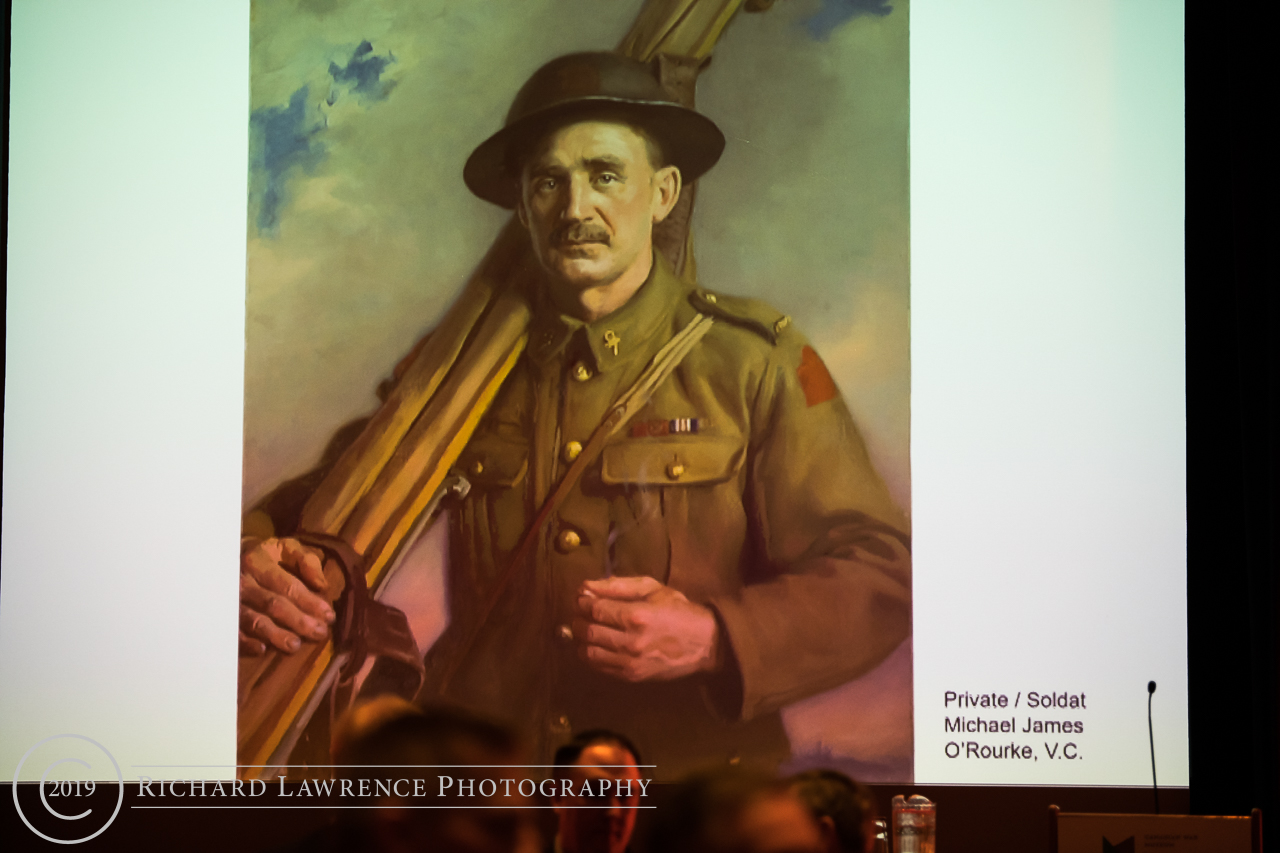
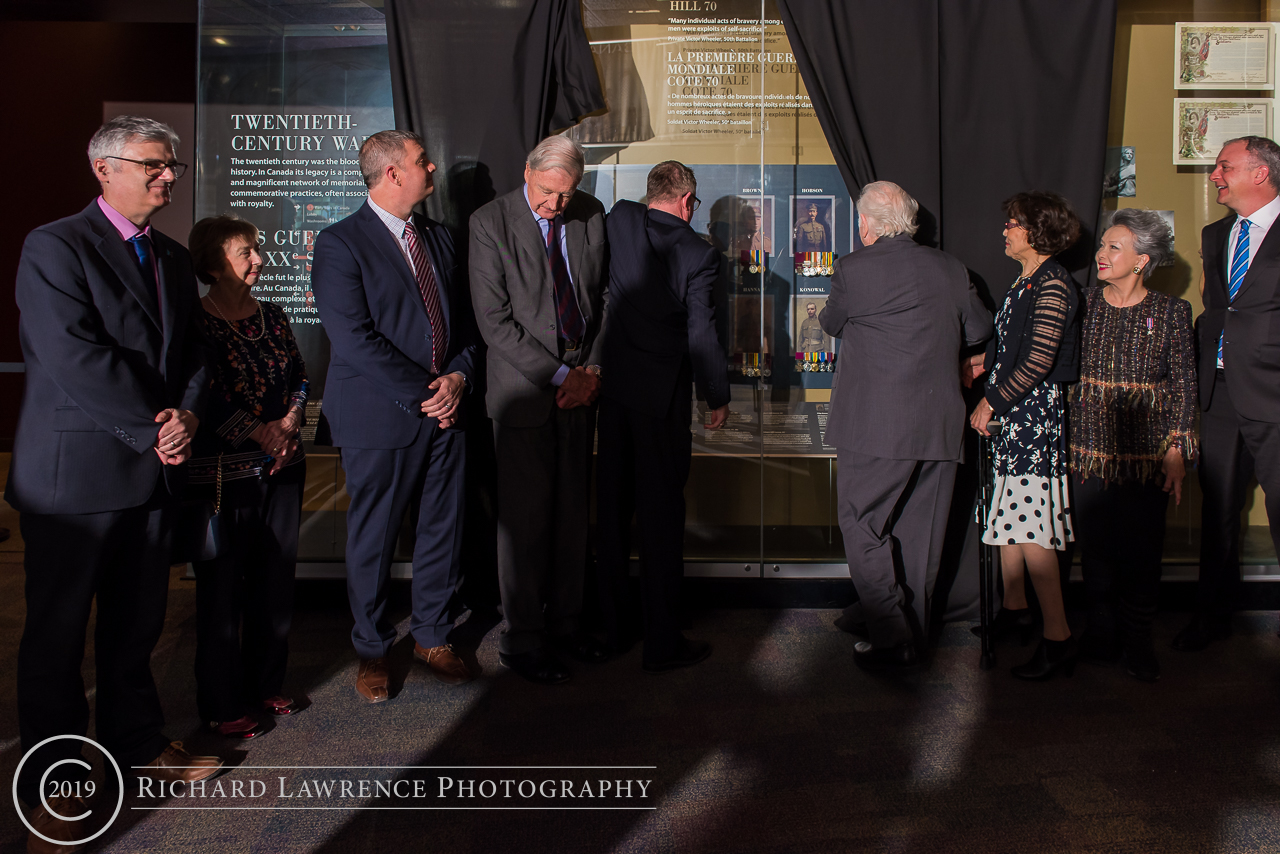
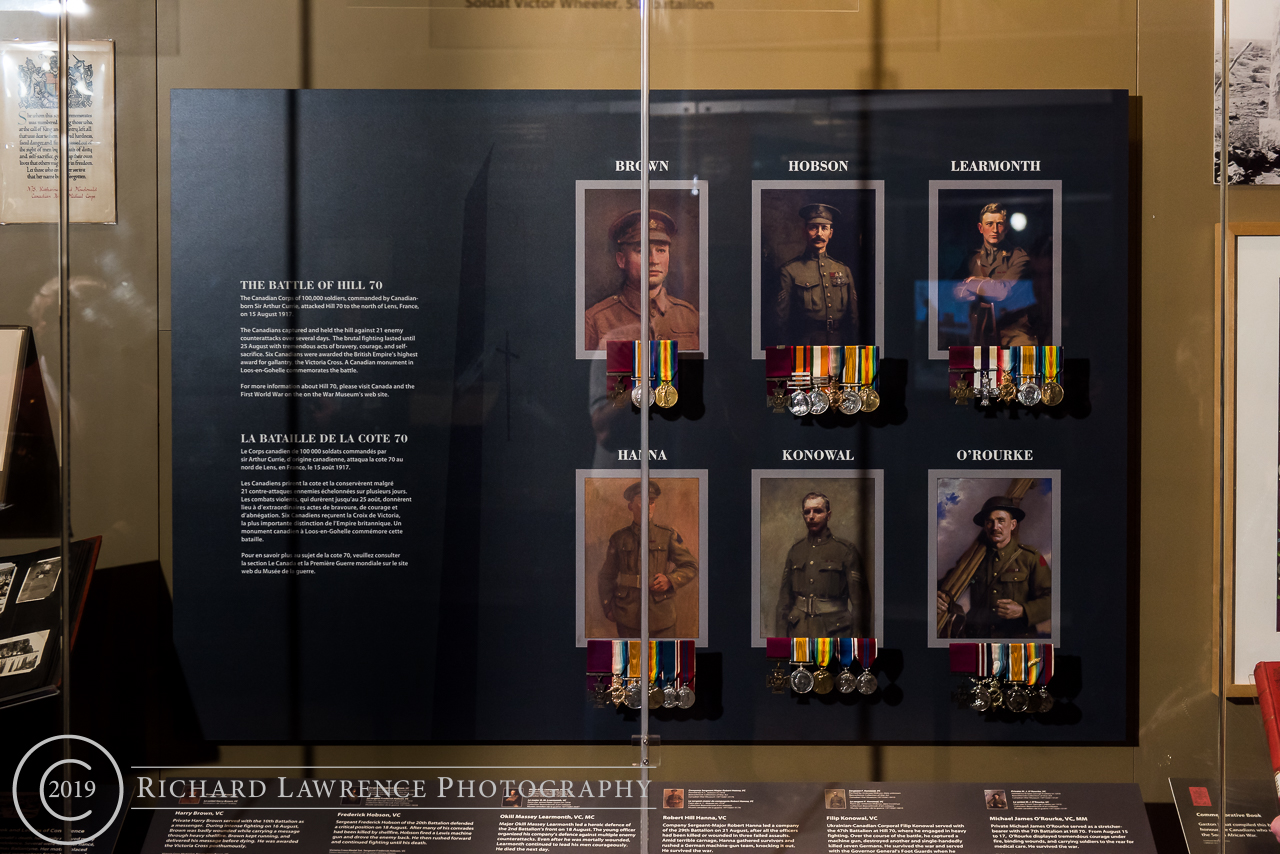
The Canadian War Museum has opened up a new exhibit in the Royal Canadian Legion Hall of Honour showcasing the six Victoria Crosses awarded to Canadian soldiers for the Battle of Hill 70 during World War I.  Hill 70 is often referred to as the “forgotten battle” as it falls between the major battles at Vimy Ridge and Passchendaele but it is every bit as important, arguably more so, than those battles. Notwithstanding, it was a battle fought by the Canadian Corps, this time led by a Canadian commander in Lieutenant-General Arthur Currie (unlike Vimy Ridge which had British commanders), with objectives selected by Canadian command (against the initial objectives selected by High Command).  Hill 70 was taken in hours on 15th August, 1917, and held against 21 German counter-attacks, providing the allies with the high ground in front of Lens, France, as well as providing a much needed diversion at Passchendaele causing the Germans to divert their troops from that battle.  Over the period of 15th -25th August, Canadian casualties ran to over 9,000 with almost 1,900 killed, while the Germans are estimated to have lost 25,000. 

During the battle, Canadian soldiers distinguished themselves and were awarded six Victoria Crosses. (NOTE: I use the term “awarded” rather than” won” as medals are not handed out for winning a contest but are awarded to people who have shown exceptional courage).  Those soldiers were: 

·       Private Harry Brown (Ontario)

·       Company Sergeant Major Robert Hanna (Ireland)

·       Sergeant Frederick Hobson (England)

·       Corporal Filip Konowal (Russian Empire, now Ukraine)

·       Major Okill Massey Learmonth (Quebec)

·       Private James Michael O’Rourke (Ireland)

The Museum already had four of these medal sets, the last acquired through the generosity of Mr. Cyril Woods and the Hill 70 Memorial Project with a fifth set on loan from the Governor General Foot Guards Regimental Museum (Learmonth) and O’Rourke’s on loan from the British Columbia Regiment (DCO) Museum Society. 

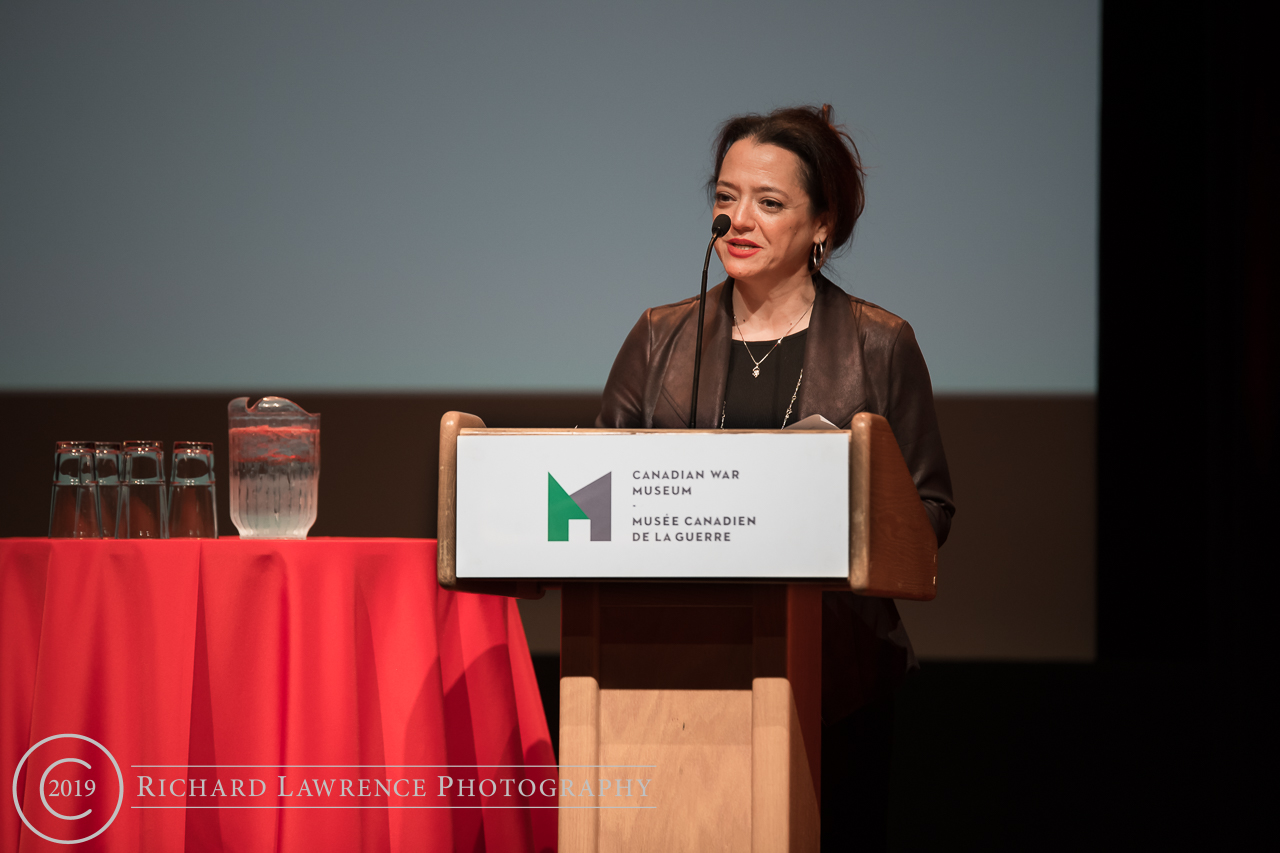
Speakers at the exhibit opening included Col. (ret’d) Mark Hutchings, chair of the Hill 70 Memorial Project, and His Grace, James Hamilton, 5th Duke of Abercorn, who had come all the way from Ireland for the opening because of a connection to his country of two of the VC recipients. One of the six was from Ontario, one from Quebec, and the four others were immigrants to Canada.

If at the Canadian War Museum, take a moment to browse through the RCL Hall of Honour and view the stories of these extraordinary men.

Other pictures of the exhibit opening are at:

https://www.richardlawrencephotography.ca/clients/cwm/hill70vc/

THE WOUNDED

By Richard Lawrence

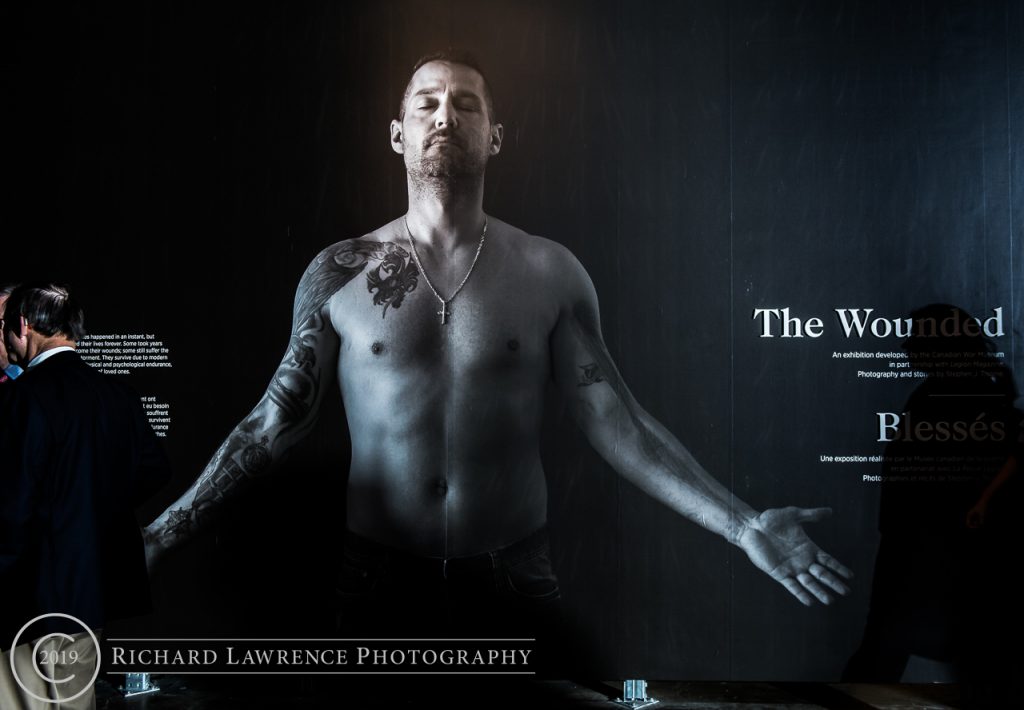
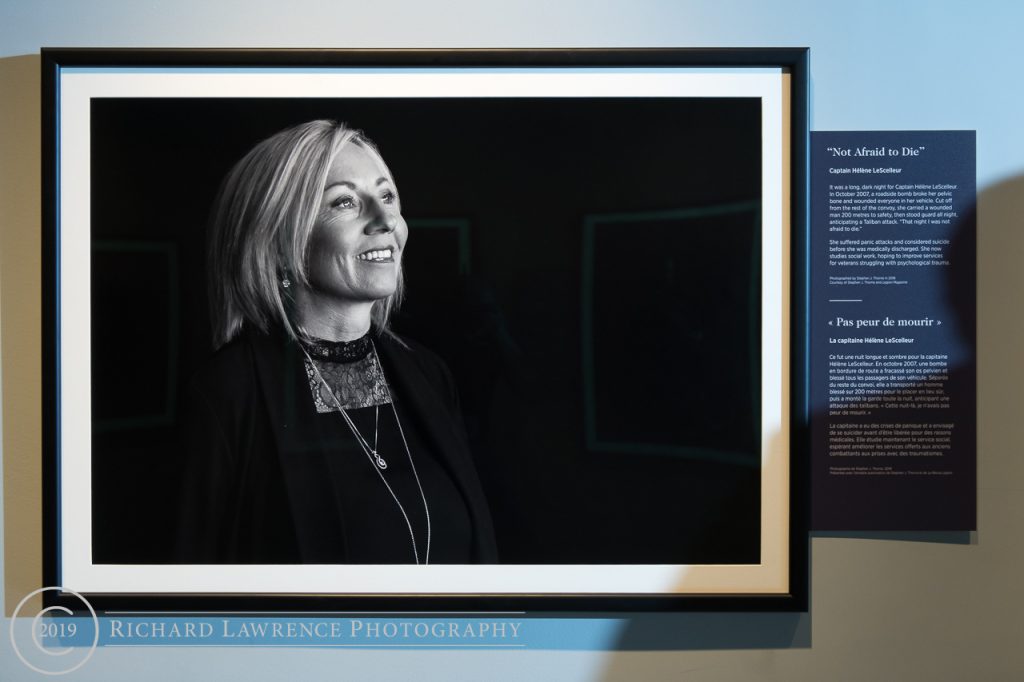
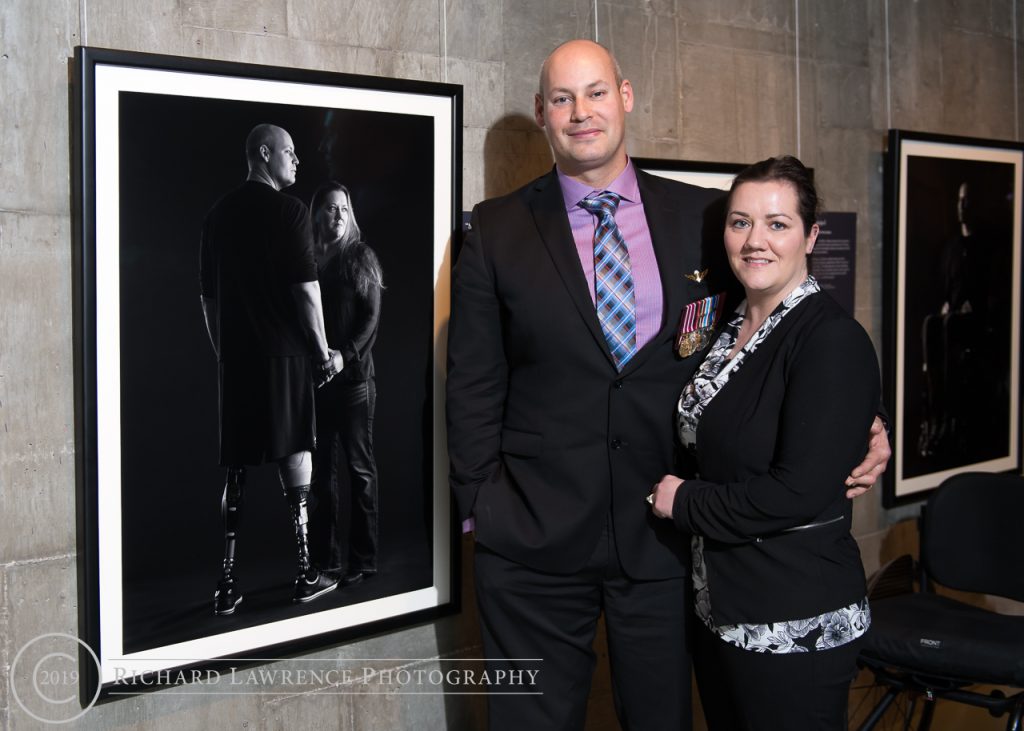
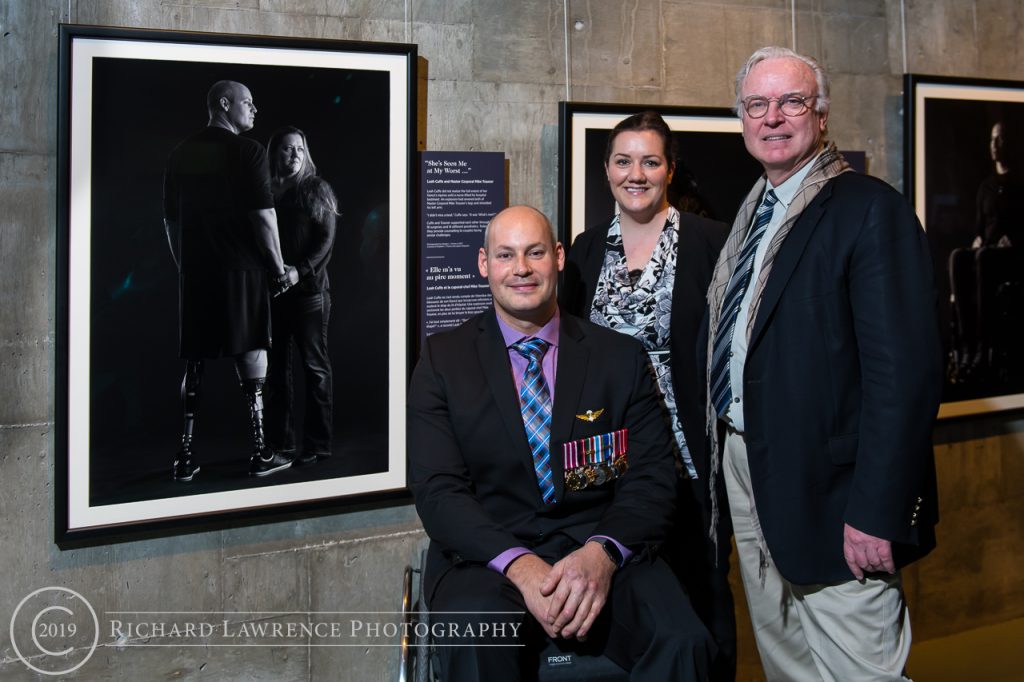
On February 14th the Canadian War Museum opened a new exhibit entitled “The Wounded” in which it displayed 18 black-and-white portraits of Canadian men and women who served and were wounded in Afghanistan, taken by photojournalist Stephen J. Thorne.  Sixteen of the portraits were originally featured in a series by Legion Magazine in 2017 while two are new.  This exhibit, which is presented in conjunction with Legion Magazine, illustrates stories of loss, but more importantly, the will and determination to stare adversity in the face and to rise above it. At the opening, 10 of the 18 soldiers portrayed were present in the audience and talked to the guests about their experiences before, during, and after their woundings. 

Mr. Thorne completed three assignments covering Canadians in Afghanistan from 2002 - 2004 and noticed that press coverage for the war dead was extensive but that the wounded were rarely mentioned.  And when they were, they were referred to as “injured” – a vague term at best.  In 2016 he decided to photograph and interview these dedicated, courageous soldiers.  They didn’t necessarily want the attention but co-operated and collaborated out of an ongoing sense of duty and public service. 

Mr. Thorne took this series of photographs using very low light, short lighting, and a lot of shadow, finally deciding to print them in black-and-white as he felt doing so made the images much stronger

for the viewer.  While Mr. Thorne’s work is exceptional in its posing, lighting, and presentation, the deeper story is of the subjects of the photographs.  Each one of these images tells of tragedy and show people overcoming adversity. And make no mistake, all of these stories affect not just the injured but those closest to them as well for while the world in turned upside down for the soldier, it is every bit the same for their partners.   

Particularly inspiring is the story of MCpl. Mike Trauner and his wife Leah Cuffe.  In December 2008 and IED detonated underneath Mike and took both legs and damaged his hands and arms.  The damage was so bad that he was not expected to live (in fact died once on the battlefield and once in surgery).  He was in Landstuhl, Germany, for 11 days and was then repatriated to the Civic Hospital where he continued to recover and then undertake rehab for the next 14 months.  He has been through 18 surgeries and 14 different prosthetics. 

Mike and Leah persevered and Mike decided that he was never going to wallow in pity.  He has been asked by many if he ever thought about “Why me?” and his response has always been, “Why not me?  If it hadn’t been me, then it would have been someone else so why dwell on it.”

Today he still moves around in a wheelchair but is able to use his prosthetic legs to walk as well.  He stated that he is able to move around for hours if he is in his sports gear but in a tie and jacket with dress shoes he tires much more quickly and standing becomes an issue.  I personally wouldn’t have thought that shoes would make a difference in how the prosthetic legs perform but he assured me that the dress shoes very much limit his ability to use the prosthetic legs.  When asked about pain, he stated that there is always pain, every day, every minute.  It’s all about managing the pain and moving forward.

As if getting to this point was not enough, Mike has become an international calibre athlete in rowing having won two golds in indoor rowing events in the 2017 Invictus Games.  Getting into this type of physical shape is demanding for normal people but even more so for someone so badly injured, not just in the legs, but the continuing injuries in his arms and hands.  Notwithstanding, after meeting Prince Harry and being challenged to compete, he knew he could do it.  And his physical prowess extends further than challenging other physically disabled athletes as he recounted in a story about when he decided to try distance rowing.

Mike decided to go to the Hudson Regatta (outside Montreal) never having rowed a distance race and decided to participate in an 18 km row.  Upon registration he found out that the 18 km was fully booked but there were still spots available for the 30 km race.  His thoughts were just to do a distance race so 30 km was just as good as 18 km to see if he could do distance.  He prepared himself and got into his boat without anyone noticing his condition and off he went.  Eventually, he crossed the finish line, so pleased with himself for completing such an exhausting course but was confused by the lack of competitors around him.  His first thought was that he was near the end of the field but, in fact, the opposite was true in that he had finished in second place against a field of 51 able-bodied (and I use this term both reservedly and sarcastically) men.  It was only upon docking and having his prosthetics brought to him that the onlookers realized what had happened and the physical accomplishment that Mike had achieved.

There are other stories as well such as Natacha Dupuis who was a co-captain of the Canadian contingent of the 2017 Invictus Games.  Unfortunately, these people will not be at the exhibit when you come through so the totality of their experience will not be able to be shared.  This exhibit, while simple in its presentation, shows the beauty of the photography of Mr. Thorne, as well as the inspiration of those pictured and runs until 15th June, 2019.

For more photos: http://www.richardlawrencephotography.ca/clients/cwm/wounded/

First Special Service Force Congressional Gold Medal Unveiling

By Richard Lawrence

“We honour all those who gave the supreme sacrifice, but we also honour those who, daring to die, survived.” 

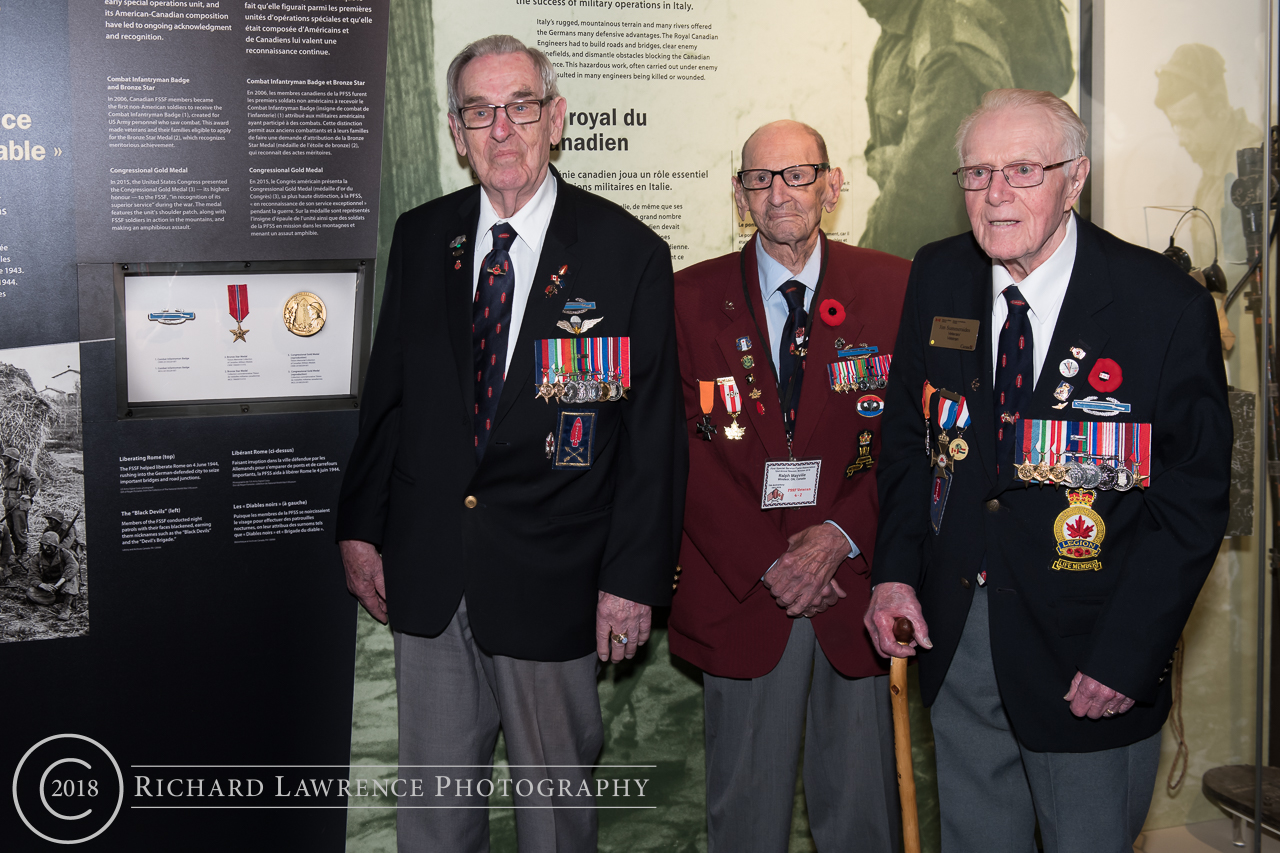
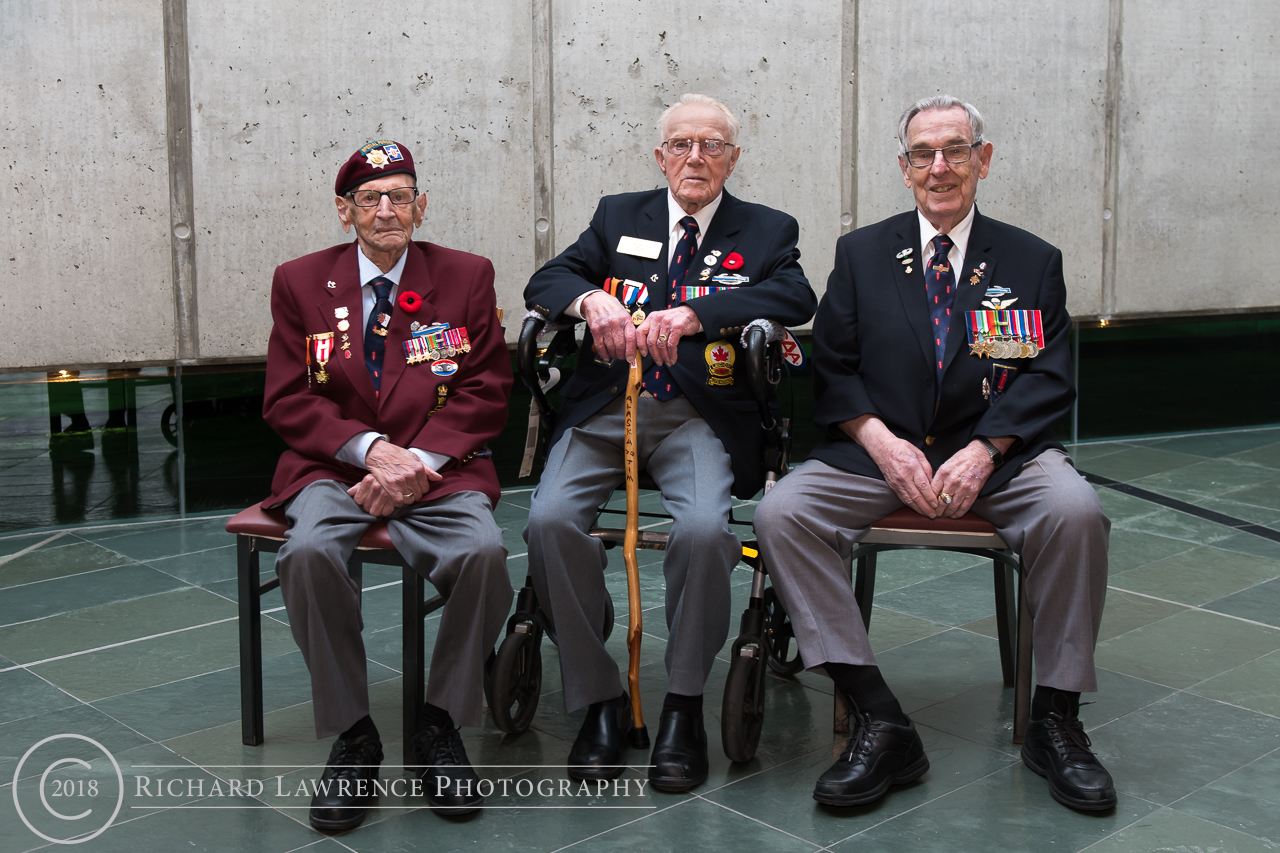
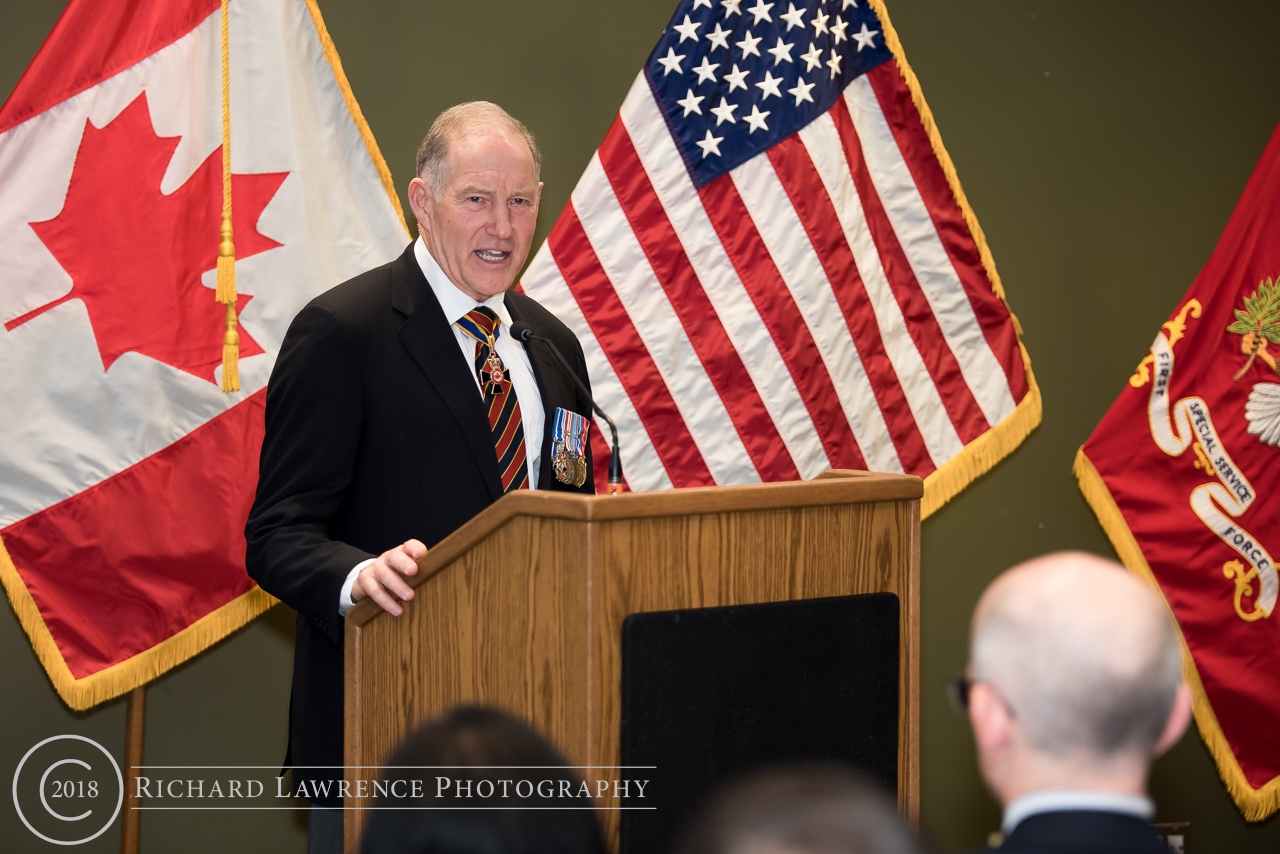
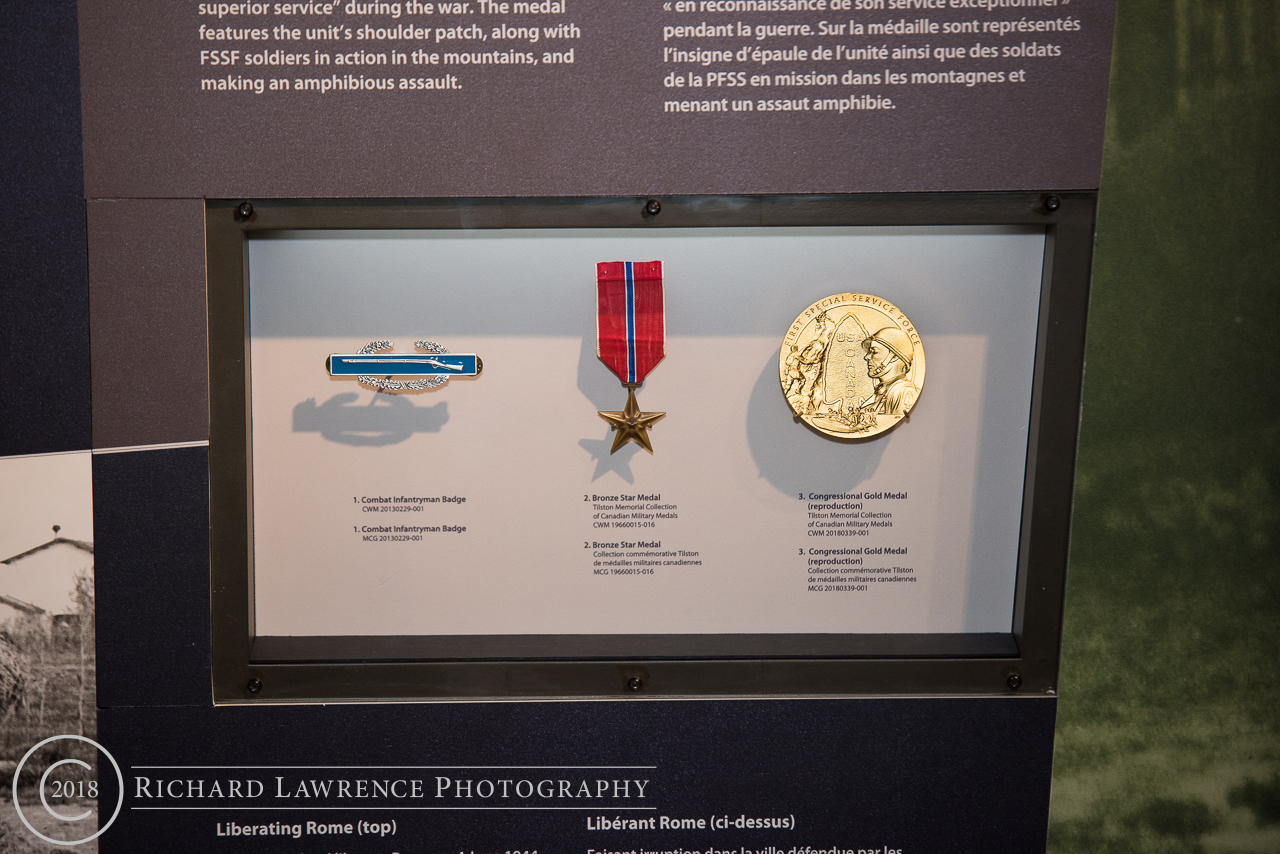
These were the parting words from Mr. Jack Callowhill, WWII veteran and member of the First Special Service Force (FSSF), at the Canadian War Museum on Wednesday, 22nd November, 2018, where the replica Congressional Gold Medal, awarded to the FSSF in 2015, was unveiled in a display to the Devil’s Brigade.  Speaking at the ceremony were Mr. Walt Natynczyk, Deputy-Minister of Veterans Affairs, Colonel Steve Hunter, Director of Special Operations for CanSOFCom, and a military member of US Special Forces attached to the US Embassy  and in attendance were three members of the original 1942 FSSF: Mr. Jack Callowhill (95), Mr. Jim Summersides (94), and Mr. Ralph Mayville (97).

The First Special Service Force, better known as the Devil’s Brigade because of the 1968 movie of the same name, was a unique organization pulled together from elite Canadian soldiers and American troops who volunteered to train for winter/mountain guerilla warfare behind enemy lines in Norway, specifically for Operation Plough.  The unit was activated on 9th July, 1942, as three small regiments and a service battalion with the second in command (LCol. McQueen), half the officers, and one-third of the men being Canadian, and eventually came under the command of the US Fifth Army.

 On the Canadian side, the Minister of National Defence, James Ralston, authorized 697 officers and men be trained under the guise of becoming the 1st Canadian Parachute Battalion as the FSSF was a secret at that time. In late 1943 Operation Plough was abandoned and the FSSF was sent to Italy in November where they would undertake their first operation with the attack on Monte La Difensa and Monte La Remetanea.  These two peaks were part of the Bernhardt Line, a bulge in the Gustav Line of German defenses which crossed Italy and had stymied the Allies.

Monte La Difensa was no easy assault as the Germans were positioned and dug in on the mountain top and commanded all approaches. After careful reconnaissance, it was decided that the only way to successfully attack the position was the scale the almost vertical face of the mountain and attack with surprise.  To that end, on 1st December, the 2nd Regiment was trucked to within six miles of the mountain where they disembarked and marched six more hours to the mountain base.  After one nights rest the 2nd Regiment of 600 men began the ascent at dusk as the mountain was barraged by artillery to give them some cover, albeit they were under fire as well.  By midnight they started the ascent of the final cliff of 1000 feet straight up, in the freezing rain, tied to each other.   Once on top, they positioned themselves for the final assault to start at 0600 hours but they were discovered earlier and the fight was on.  The attack was expected to last 4-5 days but within two hours, Monte La Difensa was secure in FSSF hands. 

This was not the end but only the start of the Italian Campaign for the FSSF.  Through the next year they fought 22 battles in Italy, France, Germany, and the Aleutians , never losing a battle or pulling back, once spending 99 days without relief on the Anzio Beachhead.  They compiled a 25:1 kill ratio and captured over 25,000 prisoners even though, at its very best, FSSF strength was less than 2,000. That kind of success does not come without its losses as the FSSF lost 576 killed with a casualty rate of 134% (many soldiers were wounded more than once accounting for the greater than 100% figure) in its two year history. The FSSF was disbanded on 5th December, 1944. 

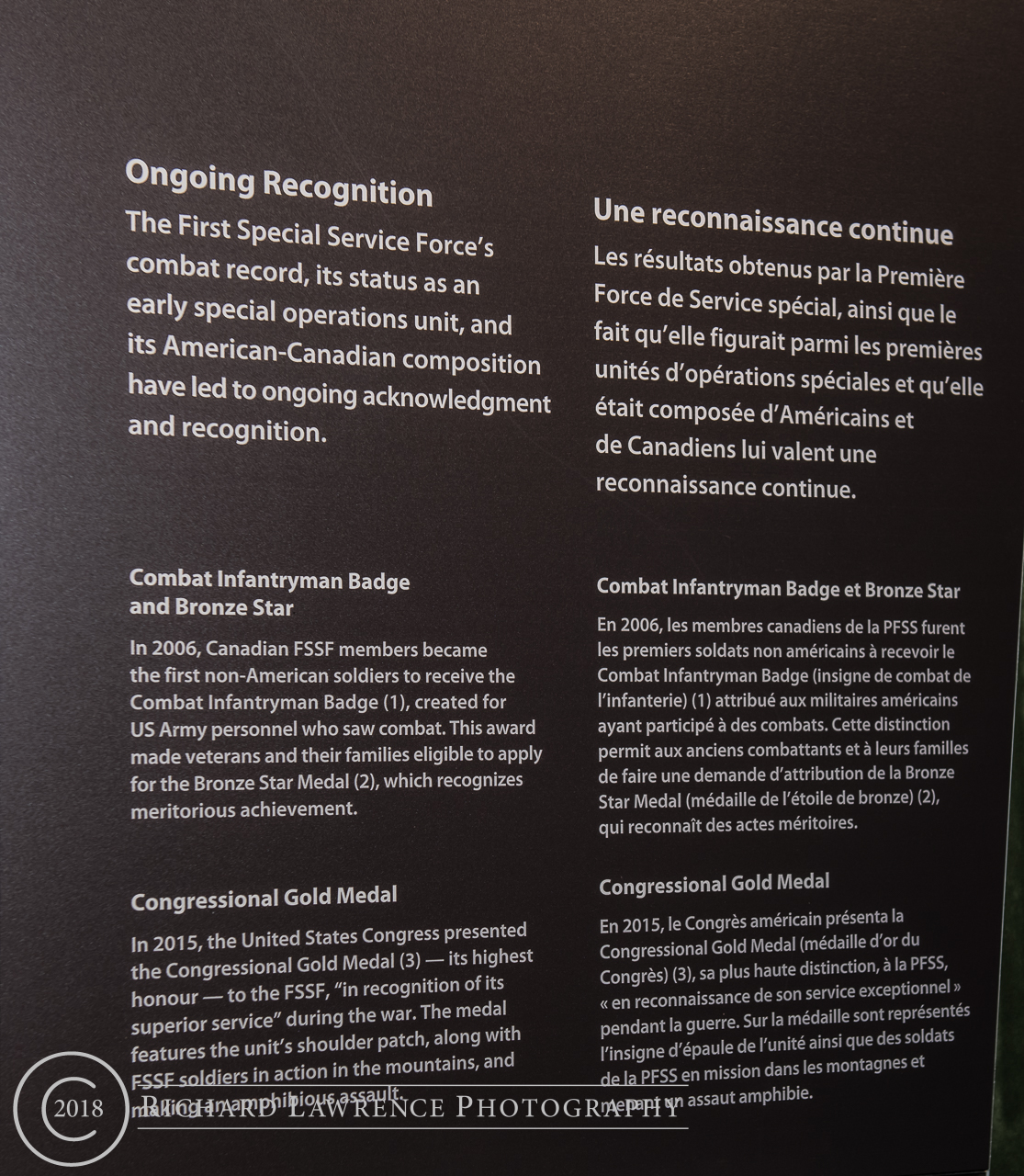
In 2015 the United States Congress passed a bill that conferred the Congressional Gold Medal, the highest award that can be given to civilians by Congress, to the First Special Service Force.  A single medal was awarded to the group and remains at Fort Bragg in the USA while bronze duplicates were allowed to be made for 16 surviving members of the Devil’s Brigade. Mr. Don Shelton, President of the First Special Service Force Association, donated a gold plated duplicate of the medal to the Canadian War Museum earlier this year.

As Col. Hunter, Director of Special Operations, noted, the FSSF was the foundation for contemporary special operations forces with the Canadian Special Operations Regiment (CSOR) tracing direct linage back as well as American special forces groups such as the Green Berets.  The US Special Forces representative noted that it normally takes decades for organizations to achieve such levels of competence and that the FSSF should “ … reach such a level of excellence in such a short time is nothing short of amazing.” 

The medal is on display in Gallery 3 (World War II) with the Devil’s Brigade display just after you pass under the Spitfire.


To see all the pictures go to:

http://www.richardlawrencephotography.ca/rlpgalleries/2018/fssf/

Kipnes Lantern and Edge of Peace

By RIchard Lawrence

Traditionally, remembrance ceremonies are traditional, predictable, and pretty much the same regardless of the group or organization putting it on.  This holds true from the small town ceremonies at the local cenotaph to the National Remembrance Ceremony held at the National War Museum in Ottawa.  This is why I was quite pleased to find two remembrances that have marched into the 21st century with the full use of multi-media: one from the Royal Canadian Legion and the other from Veterans Affairs Canada.

It is not a well-known fact that the Royal Canadian Legion (Legion) is the organization behind the National Remembrance Ceremony in Ottawa and not the government of Canada. It is steeped in tradition and reverence for those who sacrificed themselves for their country and it needs to be the pomp and ceremony that it is.  But this year, the Legion has added a new twist with a multi-media production hosted on the National Art Centre’s (NAC) Kipnes Lantern.

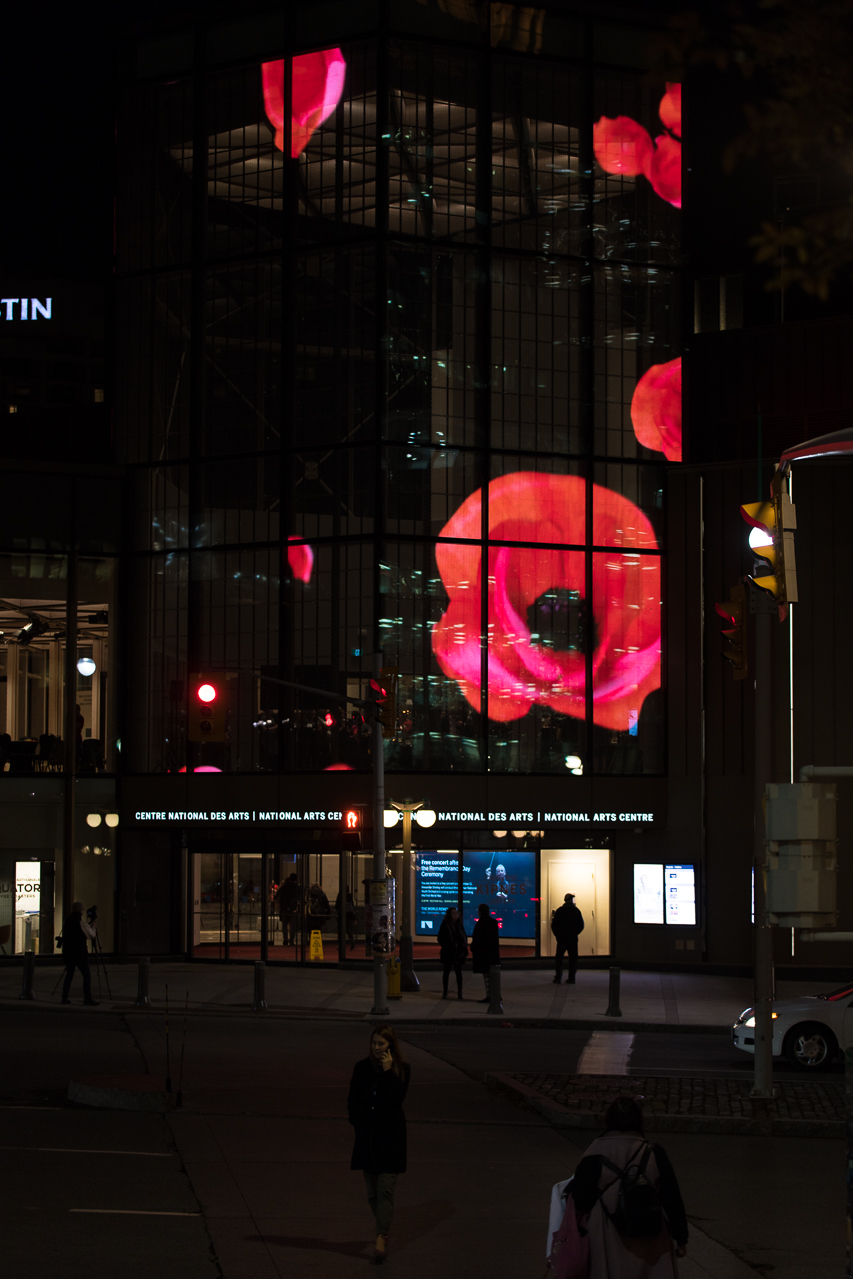
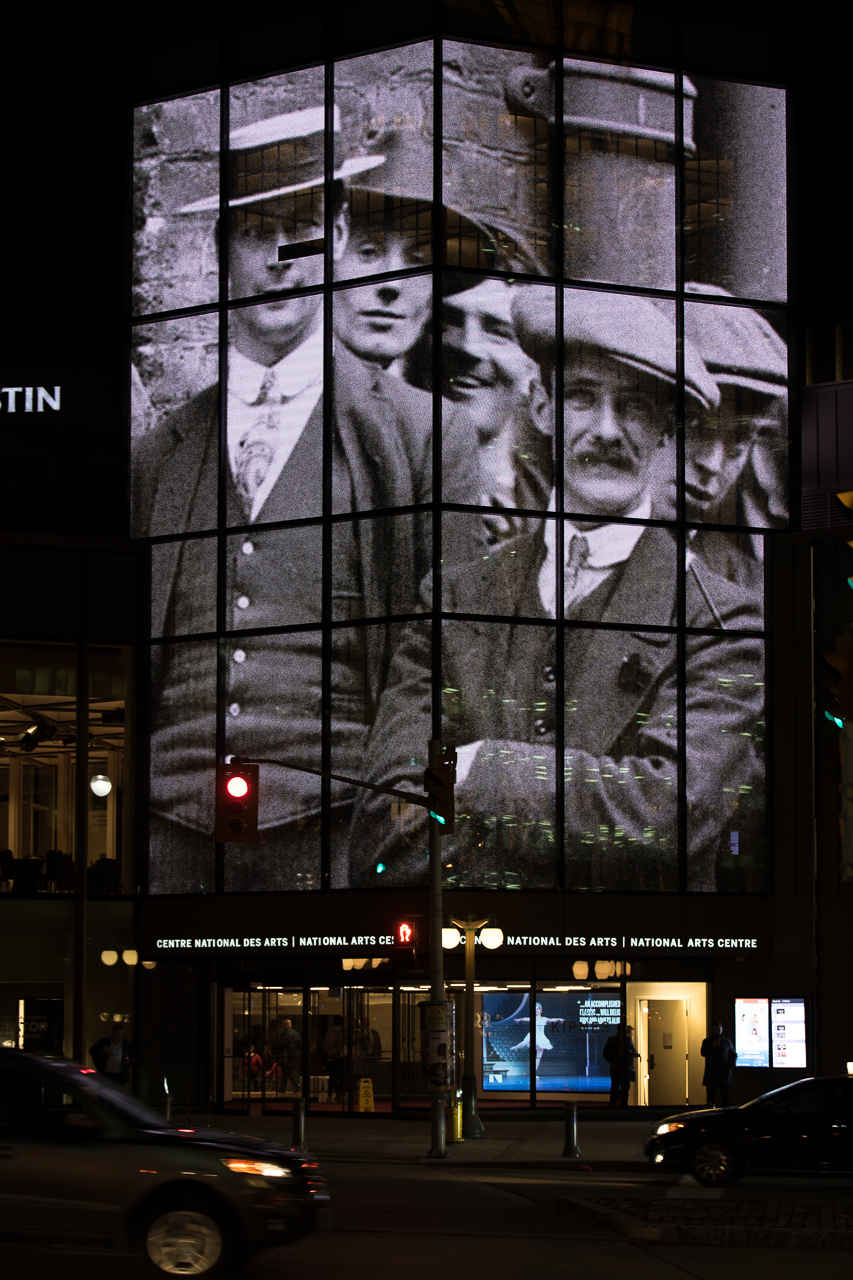
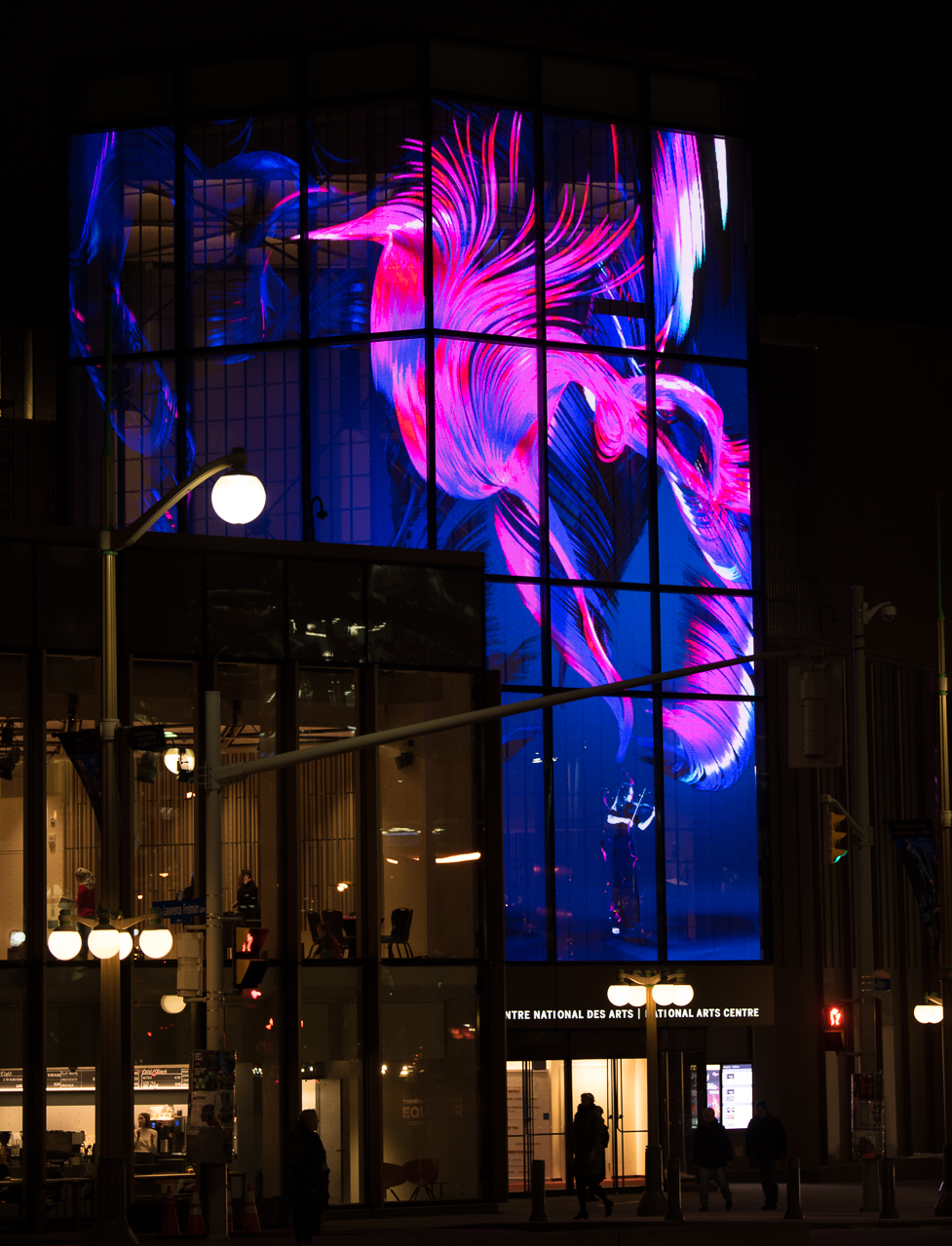
What is the Kipnes Lantern?  It’s the new all glass entranceway to the NAC that is listed as three stories tall but considering that each of those stories appears to almost double height, it actually towers about five stories into the night sky.  On four sides of this tower transparent LED panels have been installed which are practically invisible when it’s not in use.  When it is in use, it transforms the tower into a multi-sided, high-definition video wall and this is what the Legion has taken advantage of.   

Starting at 7 am on 11th November, the Kipness tower will light up and show images from WWI and then the famous “Poppy Drop” which is a cascade of poppies falling from sky to street.  Now, I’m sure this will be interesting during the day but I’d suggest going after sunset to really get a sense of what it is.  The Lantern is bright and colourful and showcases in a spectacular manner the images of soldiers and people left back home, surely visible for miles (albeit blocked by buildings downtown).  And there is some serenity in just watching the Poppy Drop portion of the production which will allow you to reflect on the day.  

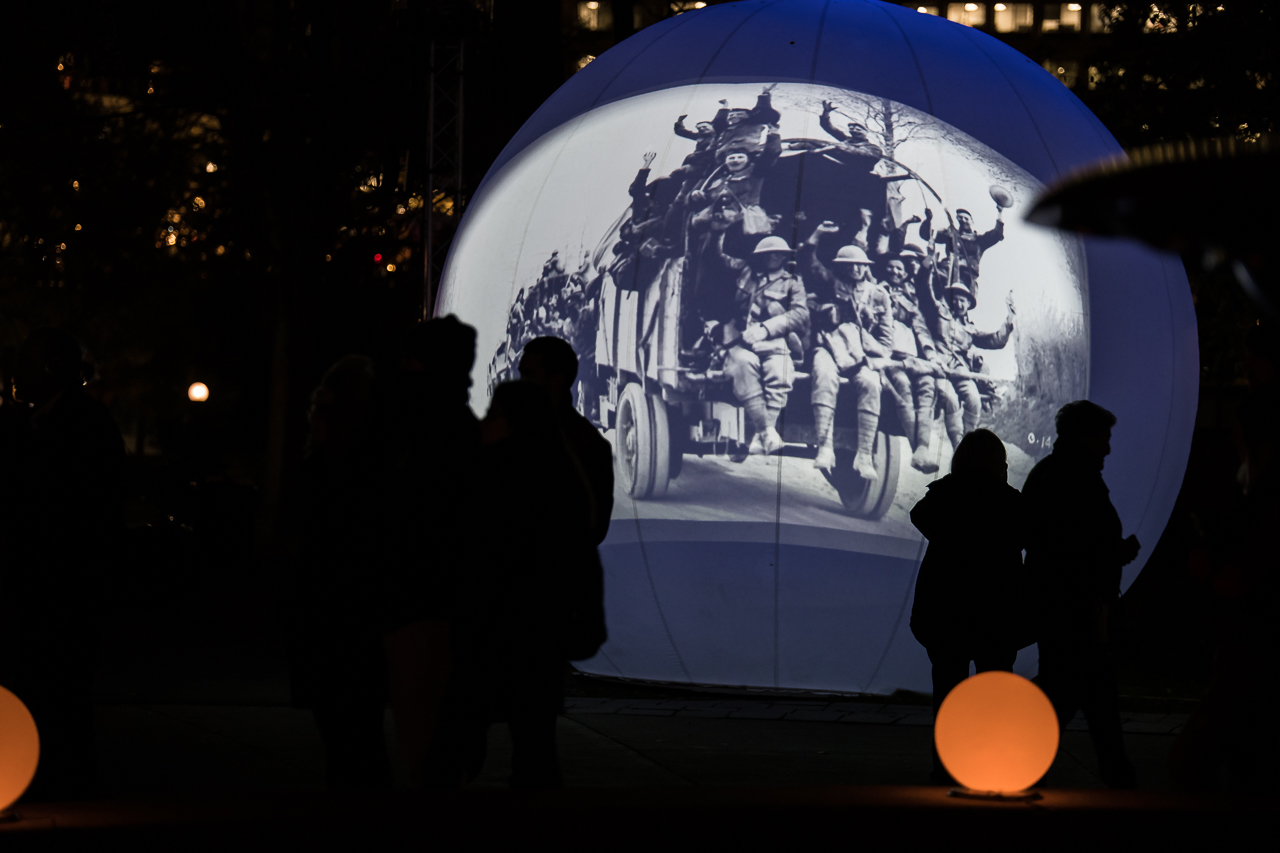
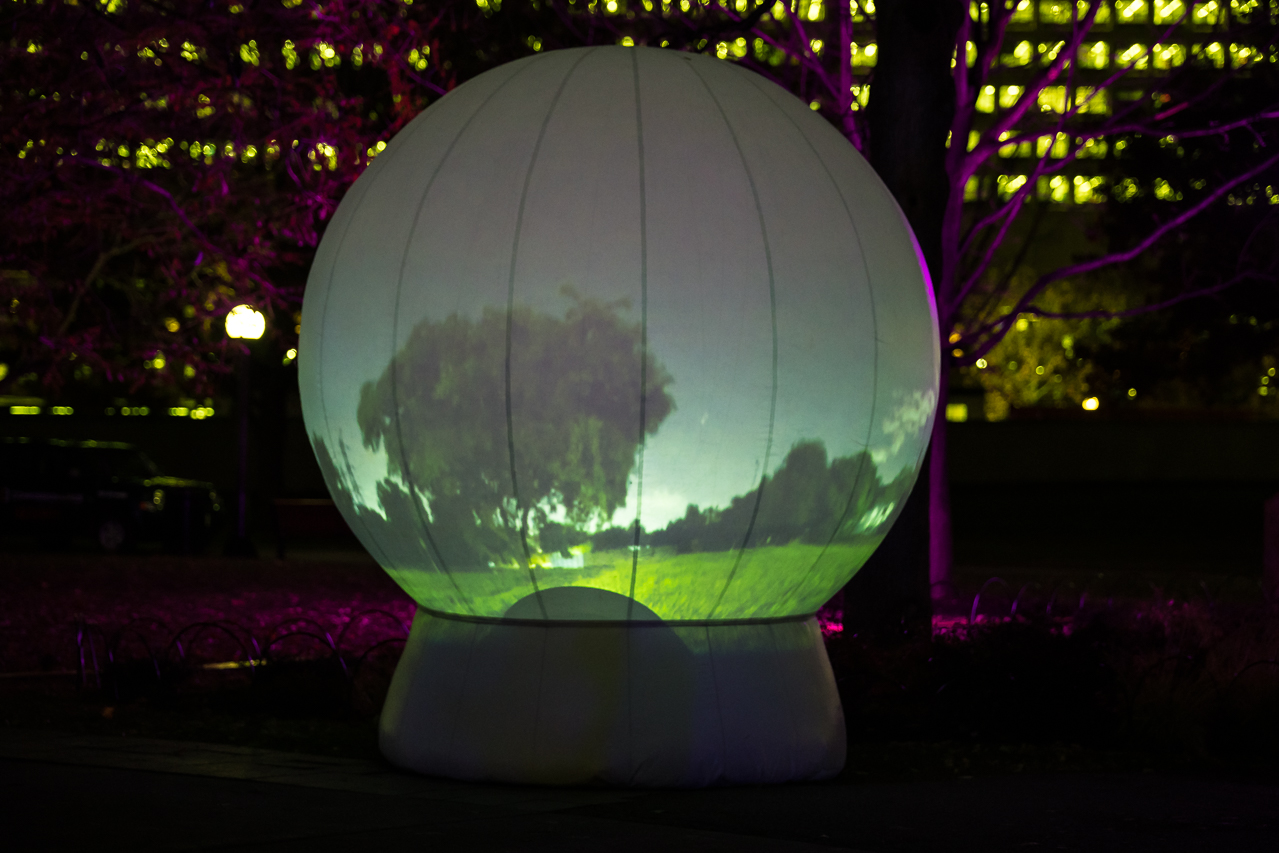
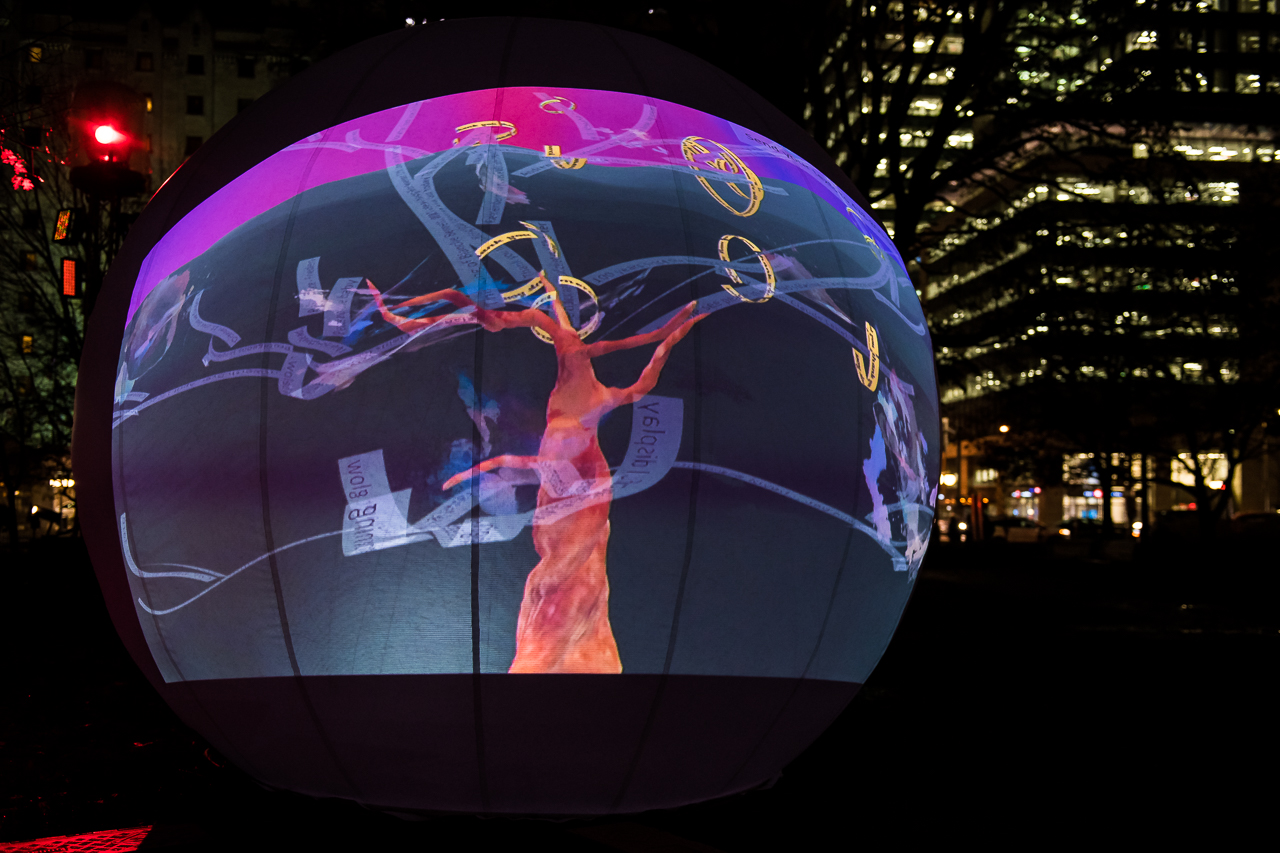
Not far away, in Confederation Park, Veterans Affairs has set up the “Moon Garden” which is a series of inflatable spheres showing a 14 minute multi-media production titled “the Edge of Peace”.  On the various spheres four WWI soldiers reflect on their service during the last 100 days of the war and a recently bereaved singer tries to find meaning and consolation by performing a new song.  There are also images from WWI projected onto the spheres and other bits of artwork.

As well, there is one sphere, the SpeakTree sphere, dedicated to showing messages from Canadians texted to a phone number and then redirected to this sphere in near-real time (all messages are vetted first).  The way this works is that a person texts a message to 438-800-0471 and then it appears on the sphere as branches on an ever growing 3D tree.

It’s good to see these organizations starting to think in the vernacular of youth and attempt to get the message out about Remembrance in a more modern manner, really attempting to engage a younger audience that historically are less interested in traditional remembrance ceremonies.  The Poppy Drop production from the Royal Canadian Legion starts at 7:00 am on the 11th November and will continue on a loop until midnight at the Kipnes Lantern entrance to the National Arts Centre on Elgin Street.  The Edge of Peace will continue to run daily in Confederation Park until the 11th November from about 4:30 pm to 10:30 pm.  They’re close together and neither runs very long so take them both in.


To see all the images, go to:

http://www.richardlawrencephotography.ca/rlpgalleries/2018/kipnes/

Candlelight Tribute

 By Richard Lawrence

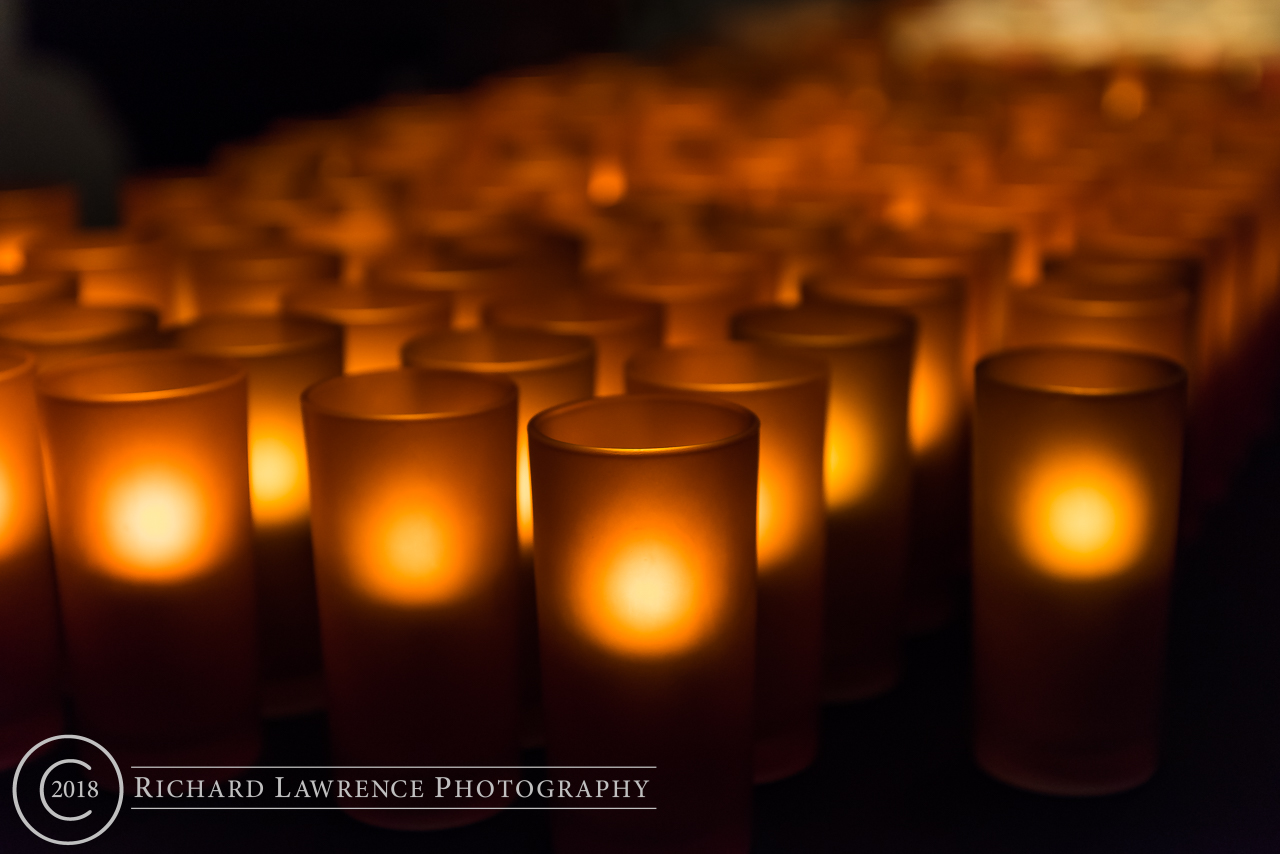
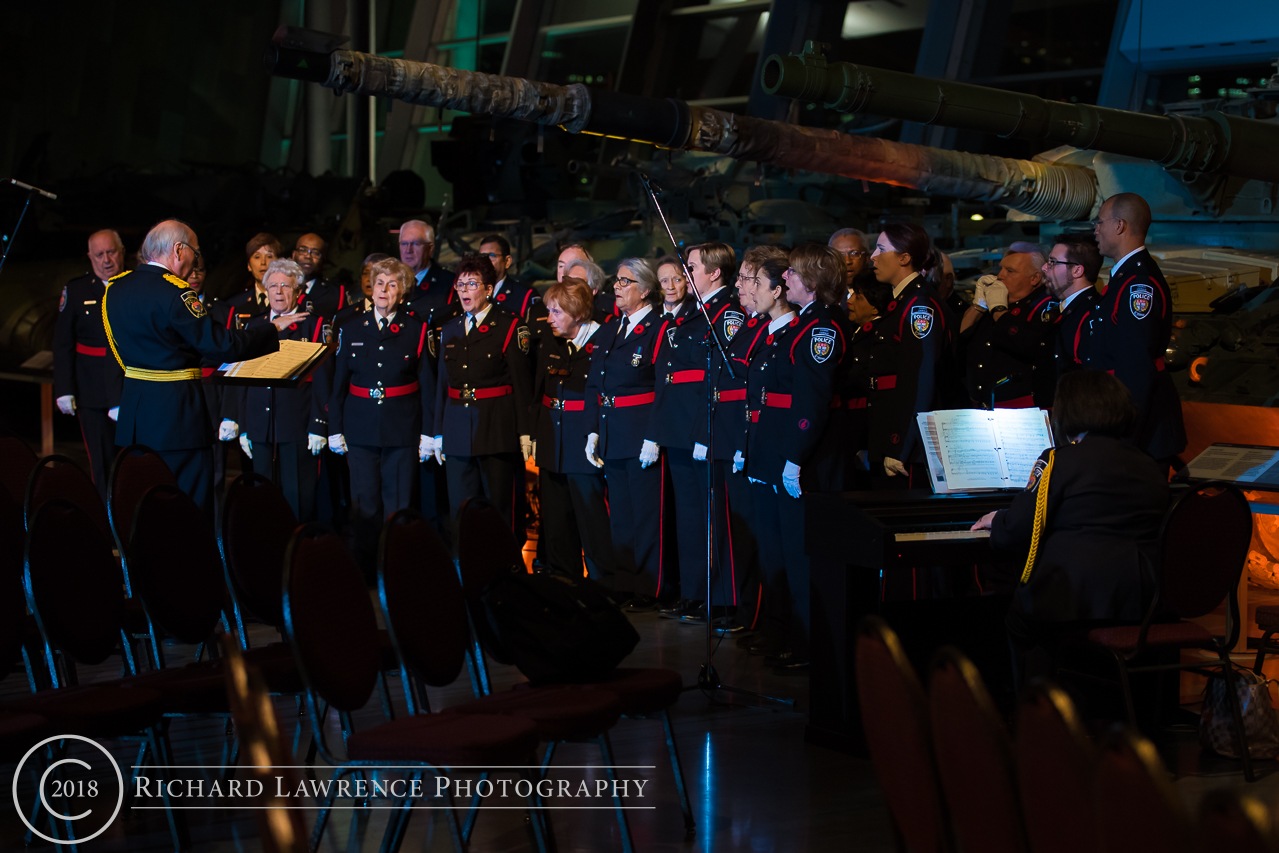
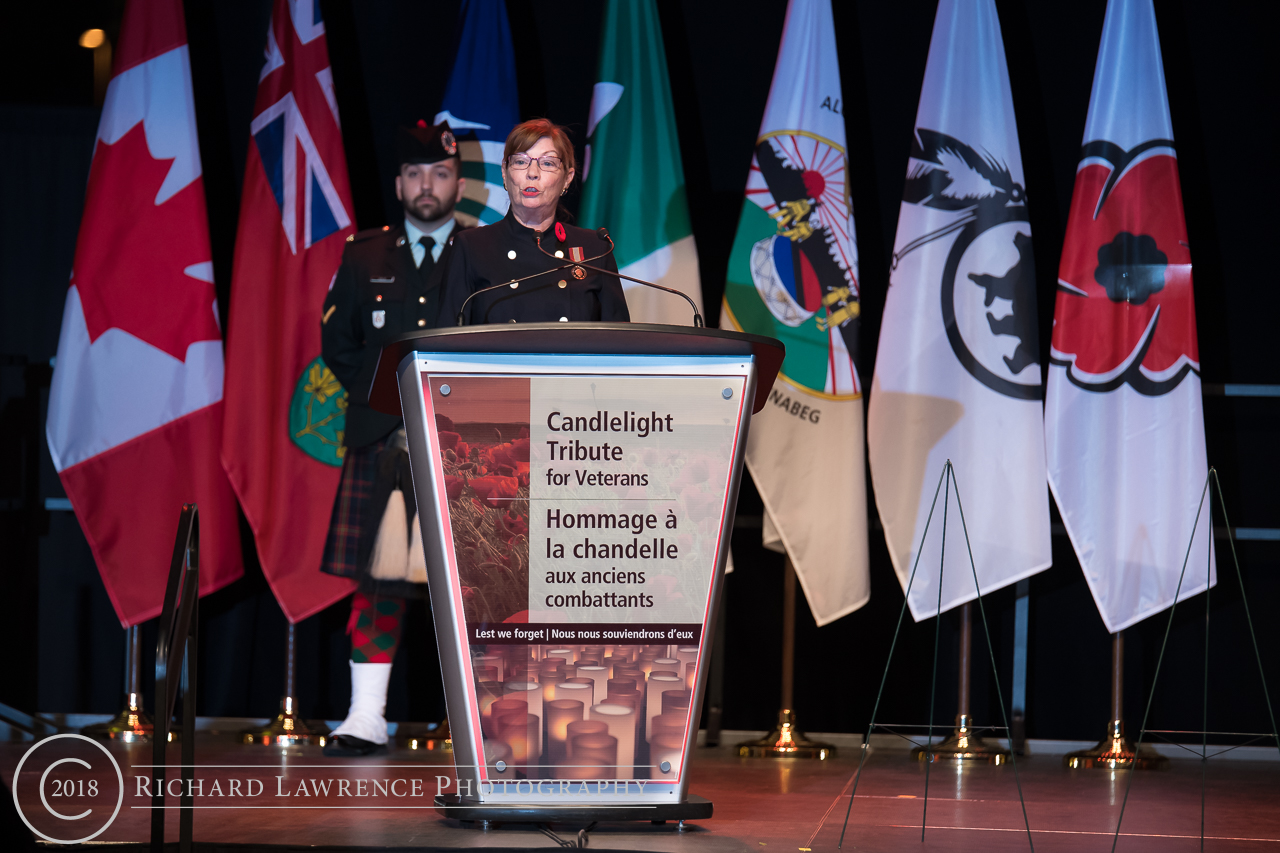
 The Candlelight Tribute for Veterans is a service marked by the passing of the torch from the veterans to the youth of Canada as a symbolic gesture and of the remembrance of the sacrifices of the elder generation for the younger. This is the 17th year for this event and was held at the Canadian War Museum on the evening of 5th November, 2018, to an almost packed Lebreton Gallery. The official party included the Honourable Seamus O’Regan, Minister of Veterans Affairs, His Worship Jim Watson, Mayor of Ottawa, Lieutenant-General Paul Wynnyk, Vice-Chief of the Defence Staff, Mr. Mark O’Neill, President and CEO of the Canadian War Museum, as well as representatives from the various cadet corps and the youth of Canada.

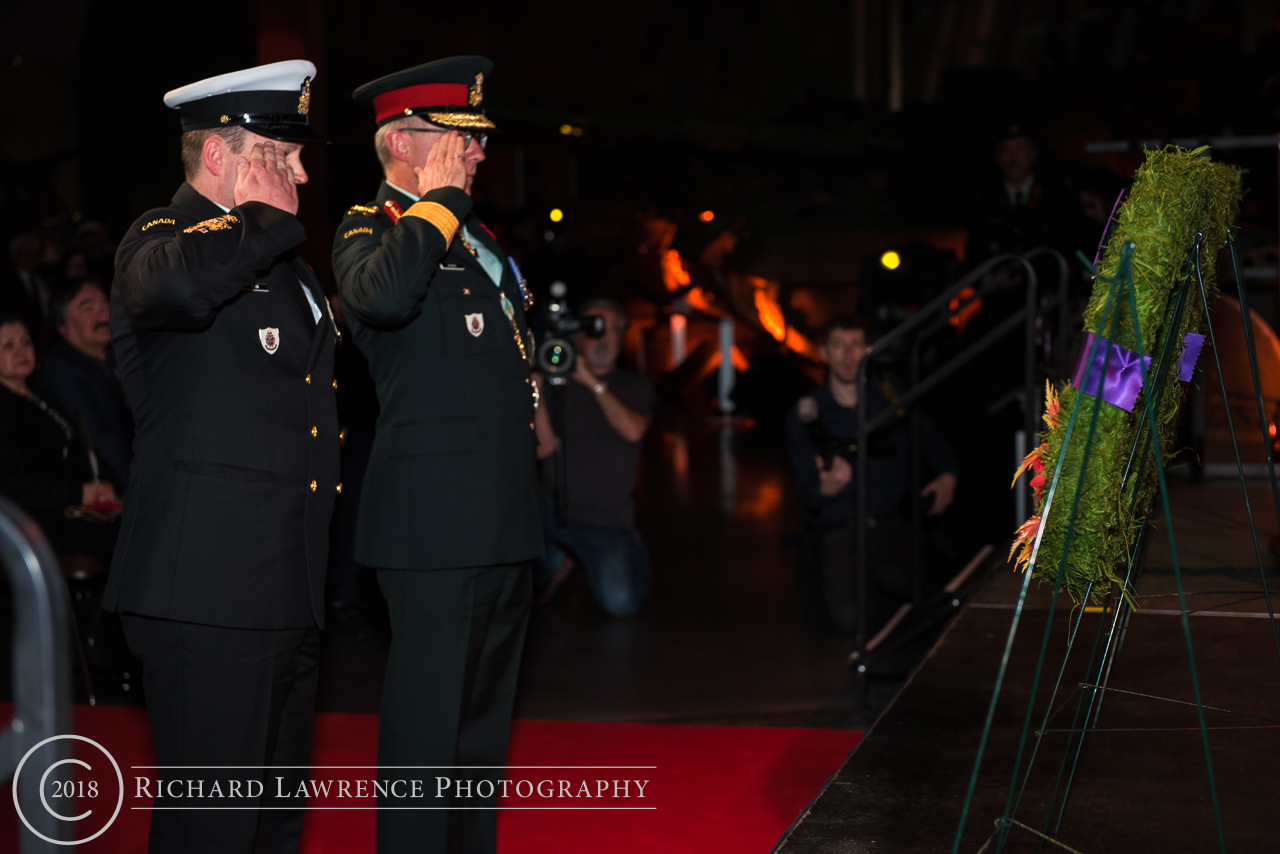
The ceremony started with an indigenous blessing from Elder Claudette Commanda after which the wreaths were laid by the official party. Following this the cadets and youth of Canada passed down between the rows of veterans who passed their candles to the cadets to be placed amongst the wreaths. Remarks were then made by Mr. O’Neill and LGen Wynnyk after which the Act of Remembrance was spoken by veterans and the reply given by the cadet representatives

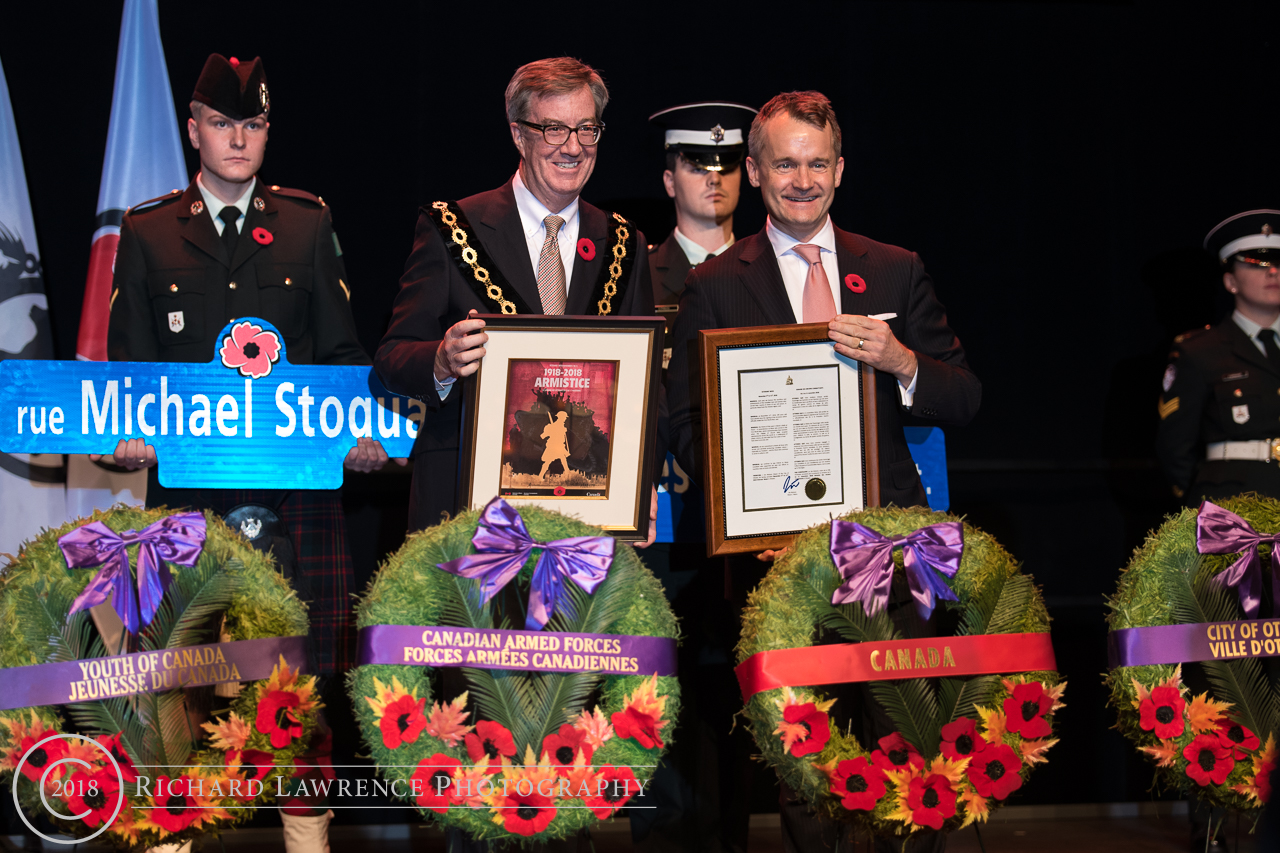
The one thing that sets this ceremony apart from all others is the City of Ottawa’s Veterans’ Commemorative Street Naming Program which serves to honour local Canadian veterans by naming streets in new developments after them. This program is run in co-operation with the City of Ottawa, the Royal Canadian Legion, Veterans Affairs, and developers within the city. The street signs bear the name of the person being honoured as well as a poppy.

This year Mayor Watson announced two local indigenous individuals, killed in WWI, who were so honoured this year: Private (Pvt) Michael Stoquo and Private Moses Tennisco, both of the Golden Lake Band, Algonquins of Pikwàkanagàn First Nation, Ontario. Pvt Stoquo joined the Canadian Expeditionary Force at the age of 22 and succumbed to his wounds on 15 April, 1917, in a hospital in Boulogne, France. Pvt Tennisco died in action on 27 June, 1917, and rests in the Brookwood Military Cemetery, Surrey, England. The streets bearing these two names will be in Wateridge Village on what used to be CFB Rockcliffe.

The honour of receiving the street signs, which usually goes to surviving family, was given to Chief Kirby Whiteduck, Chief of the Algonquins of Pikwàkanagàn. In his address he noted some the history of the Algonquins fighting for Canada, even though, he noted, in the War of 1812, they fought on the other side. In commenting on the recognition of indigenous soldiers, he said, “It’s very positive now that the Aboriginal and First Nations veterans are also being recognized for their contributions to what we have today and continue to have.”

Following the remarks of the Honourable Seamus O’Regan, and music from the Governor General’s Foot Guards Band, the ceremony concluded and guests were invited to a reception in the main hall of the Museum.

To see all the images, go to:

http://www.richardlawrencephotography.ca/rlpgalleries/2018/candlelight2018/

Imjin River Hockey Classic

 By Richard Lawrence

 Once again the Princess Patricia’s Canadian Light Infantry (PPCLI) suited up to play hockey against the Royal 22e Régiment (R22eR) in the annual Imjin Classic Hockey match. This match is sponsored by the Embassy of the Republic of Korea in Canada and commemorates the original Imjin Hockey game played on the Imjin River in Korea in 1952 by the R22eR and the PPCLI. This year the game took place on the 3rd November, 2018, at the TD Place arena, home of the Ottawa 67s hockey team, and turned out to be a classic battle. Both teams came ready to play and did not disappoint the crowd.

The skating was fast and the puck handling crisp as the teams traded ends for the first half of the first period. The stalemate was broken when the R22eR scored the first goal at 10:52 of the first but they didn’t hold the lead long as the PPCLI answered with a goal of their own at 8:08. The second period was just all out skating with both teams holding the other at bay. It wasn’t until 16:44 in the third period that the PPCLI pocketed their second goal and took the lead. Undeterred the R22eR came back at 7:22 to tie it up again and finally went ahead at 4:21 with their third goal. With a minute and a half to go, the PPCLI pulled their goalie to get the extra attacker but it was to no avail as time ran out giving the R22eR the match 3-2.

At the reception that followed, the Ambassador of the Republic of Korea to Canada, Shin Maeng-ho, stated that, “It is my sincere hope that the Imjin Hockey Classic will continue as an annual tradition. Each year we will come together like we did today not only to celebrate the strong alliance between Korea and Canada but also to remember the enduring legacy of the Korean veterans who brought freedom and democracy, and hockey, to the people of Korea.” He also added that, “It is my dream that in the near future the Korean Hockey team will become the 2nd best hockey team in the world.”

Other remarks were presented by Colonel Evraire on behalf of the R22eR and by Major-General Peter Dawe, Commander of the Canadian Special Operations Forces Command, on behalf of the PPCLI. The most interesting remarks were presented by Mr. Bill Black of the Korean Veterans Association, Chapter 7, who took the time to bring up three Korean veterans who actually played in the original hockey game on the Imjin River in Korea in 1952. Mr. Peter Dillon (taking a face-off) and Mr. Denis Moore were each given large pictures showing them playing hockey in Korea in 1952 and Mr. Claude Charland, although he played, managed to do so without getting a picture taken.

Further to that, Mr. Black introduced Mr. Delphis Cormier, at the time a Corporal in the R22eR platoon led by then Lieutenant Claude Charland. He recounted the story about how Lt. Charland’s platoon was returning from a patrol one night when they were ambushed by the Chinese and 17 year old Cpl. Cormier (he lied about his age to get in) saved the platoon and was awarded the Military Medal by Queen Elizabeth II in 1953 for his actions that night. Or as Mr. Black so eloquently put it, “He saved their asses!”.

With the official remarks concluded, the Korean War Veterans grouped together with members of both hockey teams from CF Recruit and Leadership School in St. Jean, Quebec, for pictures and then returned to the reception.

To see all the images, go to: http://www.richardlawrencephotography.ca/rlpgalleries/2018/imjin2018/

Senate Remembrance Ceremony

 By RIchard Lawrence

 Friday, 2nd November, marked the start of the Remembrance Week with the annual remembrance ceremony held in the Senate Chambers in the Parliament Buildings. This year’s theme is the 100th anniversary of the signing of the armistice ending the Great War and the last 100 days from 8th August to 11th November, 1918, where 30 Canadians and Newfoundlanders were awarded Victoria Crosses, accounting for nearly one third of all the Victoria Crosses awarded to Canadians in our entire military history.

This ceremony is attended by representatives of many of the veterans’ organizations, some members of both the Senate and House of Commons, selected individual veterans, senior military representatives, and many others involved with veterans affairs. Of note was Deputy Minister of Veterans Affairs, Mr. Walt Natynczuk, Mr. Thomas Irvine, Dominion President of the Royal Canadian Legion, Lieutenant-General Paul Wynnyk, Vice-Chief of Defence Staff of the Canadian Armed Forces along with representatives from veterans organizations, the Royal Military College, the RCMP, and other police forces. The official party was comprised of the Speaker of the Senate, the Honourable George Furey, the Deputy Speaker of the House of Commons, Mr. Bruce Stanton (MP Simcoe-North), the Minister of Veterans Affairs, The Honourable Seamus O’Regan, and the Chaplain-General of the Canadian Armed Forces, Brigadier-General Guy Chapdelaine.

All of the speakers carried a similar theme in that they emphasized the tremendous sacrifices during World War I with special prominence given to the last 100 days where Newfoundland soldiers and the Canadian Corps suffered over 45,000 killed and wounded and for which 30 Victoria Crosses were awarded. They also made mention of the 75th anniversary of the invasion of Sicily and the 300 kilometre march up Italy during which there were over 26,000 casualties, 6,000 fatal. As well, the audience was reminded of the 65th anniversary of the Korean Armistice, and the 10th anniversary of National Peacekeepers Day and the work done by the Armed Forces and Police Services in more modern conflicts and continuing peacekeeping missions.

They also reflected on the memorials right in the Center Block, starting with the Peace Tower, which is a monument to the soldiers of World War I and where construction was started even as the war raged on. Minister O’Regan stated that the Peace Tower Bells will ring 100 times at sunset on the 11th November to mark the 100th anniversary of the signing of the armistice.

Other reminders included the sacred memorial chapel and the Hall of Honour. Even in the Senate Chamber there are eight huge paintings, commissioned by Lord Beaverbrook and hanging high on the walls since 1921, depicting scenes from WWI showing the brutality, hardships, and the ravages of armed conflict. As noted by Speaker Furey, these memorials remind us that, “So many fought and so many died so that we could do this here in an open, free, and democratic society. Indeed the contributions of Canadians in uniform, not only to this nation’s defence, but to its foundation and identity cannot be overstated.”.

This will be the last ceremony held in the Senate Chambers in the Center Block of the Parliament Buildings as the chamber will be closed down for ten years as the Center Block undergoes renovations (maybe longer as it is a government project). The Senate will be moving to the newly renovated Government Conference Centre in the new year and hopefully this traditional kick-off to Remembrance Week will continue in the new venue.

To see all the images, go to:

http://www.richardlawrencephotography.ca/rlpgalleries/2018/senate/

Veteran Build Day - Habitat for Humanity

By Richard Lawrence

Everyone has heard of Habitat for Humanity (HfH) and at some level is aware of the good works they do in trying to provide home ownership for people by building homes through the use of volunteer labour, donated materials, their ReStore outlet, and financial donations. But one aspect that is not well known is that Canadian Armed Forces (CAF) members, both active and retired, participate in helping to build these homes and so much so that Habitat for Humanity acknowledges it with an annual Veteran Build Day (VBD). Today was the second annual Veteran Build Day in Ottawa with over a dozen active and retired CAF members participating at the Jean D’Arc Blvd., Orleans, location with the Habitat for Humanity Greater Ottawa (HfH-GO) organization. This site has four completed units with families already in them, four currently being built, and another eight on the drawing board when the current four are finished.

Now, one may ask how does one get a home from HfH? It’s not free and it’s not social housing so what is it? As Alexis Ashworth, CEO of HfH-GO, stated, “ [It’s a] bridge between social housing and market housing …”, where HfH helps people get that extra little step to home ownership. As explained by Gavin Liddy, a Director on the Board of HfH and also a CAF veteran in the artillery for 21 years, there is a specific audience that HfH is looking for to qualify for these homes which are people who have jobs, pay rent, and are financially making ends meet, but can’t get ahead enough to put together a down payment for a home or may not qualify for a conventional mortgage because the interest payments put it out of reach. Essentially they are looking for people with a solid financial foundation but still not able to get ahead.

As explained by Liddy, the HfH acts as a developer and builds the new home. They then take a qualifying family and provide an interest free mortgage where HfH becomes the mortgage holder and the family pays the mortgage. Every cent of the mortgage payment goes to the principle of the interest free loan which, without the extra cost of interest, makes the home affordable and builds equity quickly. The homes are sold at market value with the title going to the families as soon as they move in and the money that is paid back to HfH goes 100% back into the pot for the next build. As with any mortgage, once it’s paid off, the family owns the home outright.

Liddy also noted that it’s not just about owning a home. He said, “… [it’s] great for families as often they’re paying rent in areas that aren’t as nice to live in. It helps them develop a sense of community and become part of the community, it’s generally a safer environment for their kids, so it’s more than just an interest free mortgage, it’s also about making a transition to generally a better neighbourhood.”

To highlight the participation of veterans and CAF members in providing this housing was the purpose of today’s event. Several local politicians dropped by to offer thanks, including Orleans MP Andrew Leslie, who actually picked up some tools and helped out but had to leave before the photo-ops (I believe a vote was called in Parliament).

Newly elected city councillor and veteran Matthew Luloff stopped by to offer his support and congratulations noting that, “A lot of people think that Remembrance Day is the only time of year where we celebrate our veterans but our veterans are in our communities every single day making life better for people either through their service in the military or through this kind of volunteer work … I know that a lot of veterans, after their service, look for ways to serve their community.”.

Ottawa Mayor, Jim Watson, also toured the site and was here a year ago when the first four units opened. “One of the great things about HfH is that it really is a group of strangers that come together and in many instances they become friends … and come back year after year for different builds and they look forward to it.”, stated Watson.

Also noting the military participation was Darcy Elder, Director of Development for Wounded Warriors Canada, looking at a partnership with HfH-GO with the ultimate goal to “… hopefully identify a veteran family in that need and do a build for a veteran family”. This does not mean to actually fund the build but Wounded Warriors has many national/regional partners who could assist along with the HfH broad networks of resources. Wounded Warriors Canada is about delivering mental health programs for veterans, first responders, and their families across Canada as a national charity.

One would think that the waiting list for Habitat for Humanity built housing would be long but this is not the case, according HfH-GO CEO Alexis Ashworth. She feels that the program is not well known and that they may be targeting the wrong audience. They really want to target people who can pay rent with a solid financial foundation but still can’t see to accumulate a down payment or the interest puts the load out of reach. They are currently investigation new ways to make themselves visible to people they can help.

For more photos: http://www.richardlawrencephotography.ca/2018/11/01/veteran-build-day/