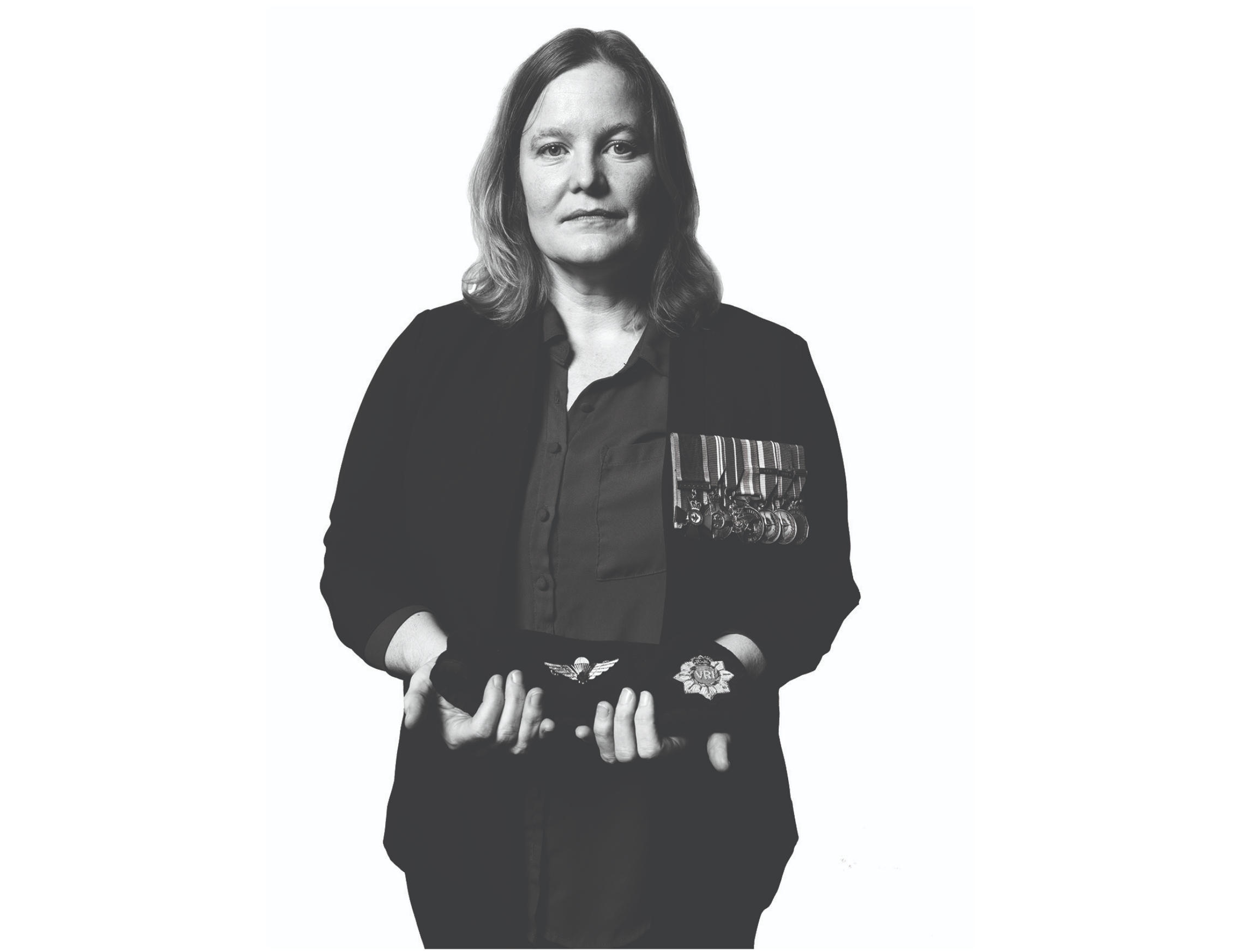
Chief Warrant Officer Sandra Bouchard, MMM, CD Military Police, Royal Canadian Air Force

As Chief Warrant Officer of the Strategic Joint Staff, Sandra Bouchard advises senior leadership and helps translate national strategic direction into executable military action across the Canadian Armed Forces. Representing the non-commissioned perspective at the strategic level, she ensures decisions remain grounded in operational reality and clearly understood by the members expected to carry them out. In this role, she provides senior leadership and coordination for joint military operations, helping bridge the gap between national intent and operational execution.

Her path into uniform began, as she jokes, with a desire “to shock my dad.” What started as rebellion quickly became purpose. Early in her career, Bouchard recognized the military as a proving ground where credibility is earned daily through competence, teamwork, and reliability. Entering without a fixed career plan, she adopted a deliberate approach: accept difficult postings, pursue demanding courses, and volunteer for responsibilities others avoided. Each step became less about advancement and more about building professional trust.

Beginning in 1996 as one of the few female combat engineers, she served in environments where women were still viewed as exceptions rather than peers. Rather than confronting assumptions directly, she focused on performance, quietly normalizing women’s presence through consistency and competence.

After remustering to the Military Police Branch in 2002, she progressed through increasingly complex leadership roles, including Regimental Sergeant-Major of the 3 Military Police Regiment, Unit Chief Warrant Officer of the Canadian Forces National Counter-Intelligence Unit. Across these appointments, she became known for explaining decisions rather than simply enforcing them, a distinction that strengthened trust across ranks and reinforced cohesion within high-performing teams. Her career continued to expand through operational deployments and senior headquarters appointments, contributing to greater integration of operational experience into institutional decision-making.

Her operational experience includes deployments to Afghanistan (2003, 2005) and Haiti (2010), where her leadership during the post-earthquake response earned a Vice Chief of the Defence Staff Commendation. Appointed a Member of the Order of Military Merit in 2024, she has also mentored multinational personnel through international Women, Peace and Security initiatives.

Bouchard acknowledges barriers exist but transforms them into momentum rather than allowing them to become obstacle. She believes diverse perspectives strengthen operational awareness by identifying risks earlier, improving conflict management, and reinforcing team cohesion. For her, resilience is not only endurance, but adaptability and professional credibility built over time.

Her advice to emerging leaders reflects that philosophy: do not wait for permission, commit to continuous learning, and focus on influencing the institution rather than simply adapting to it. Professional confidence, she emphasizes, is earned through preparation, integrity, and consistent performance.

In her current role, she prioritizes closing the gap between policy and practice, ensuring strategic concepts translate into practical solutions for those executing them. Trust, ethical leadership, and clarity of direction remain central to her approach. Looking ahead, she remains focused on strengthening institutional effectiveness by improving how decisions are communicated, understood, and implemented, believing the true measure of leadership is whether the system works better for those within it.

 Bouchard was nominated by Major-General Bob Ritchie.

Staff Sergeant (Retired) Jane Boissonneault, United Nations Peacekeeper and RCMP Member (Retired)

For Staff Sergeant Jane Boissonneault, the dream of becoming a Mountie began at the age of ten. What she could not have imagined was how that ambition would carry her far beyond Canada’s borders, placing her at the forefront of global stabilization efforts and gender-sensitive police reform.
Over a 33-year career, Boissonneault demonstrated how policing, diplomacy, and mentorship intersect, showing that women are essential contributors to international security and the protection of vulnerable populations.

A pioneer in the operational acceptance of RCMP women on United Nations (UN) missions — and later in the institutional recognition of women peacekeepers — she helped normalize women’s participation in peacekeeping operations. 

Her international service began in 2001 with the UN mission in East Timor (UNTAET). At a time when women remained a small proportion of uniformed personnel in overseas deployments, Boissonneault joined early deployments of women police officers in the post-conflict environment of Southeast Asia.
She established a Missing Persons Unit in the Ermera District and later led the National Vulnerable Persons Unit at UN Civilian Police Headquarters in Dili.

Her mentorship there had a lasting impact. She guided Maria, a graduate of the new East Timorese Police Service, through early challenges in a culture resistant to female authority. Years later, at a UN conference in Italy, Boissonneault learned Maria had risen to senior rank and credited that mentorship as pivotal to her career, reinforcing Boissonneault’s belief that representation reshapes policing culture worldwide.

In 2011, she again broke ground during the UN mission in the Democratic Republic of the Congo (MONUSCO). As Focal Point for Gender and Sexual Violence and Stabilization Coordinator for Security Sector Reform in North Kivu, she worked in zones emerging from militia control to restore governance structures and strengthen protections for all Congolese people, especially women, in conflict zones.

She was later seconded to UN Headquarters in New York as a Police Advisor to the Office of the Special Coordinator, where she helped advance the UN’s response to sexual exploitation and abuse — one of the most pressing accountability challenges in modern peacekeeping.

Domestically, Boissonneault’s RCMP career was equally varied. She served in Federal Commercial Crime in Saskatchewan, National Missing Children Operations, and in the role of Canada’s Missing Persons Clearinghouse Manager while chairing the National AMBER Alert Working Group. Her ability to move from complex fraud and anti-corruption investigations in Montreal to Aide-de-camp to the Yukon Commissioner reflected both versatility and trust in her leadership.

In 2025, she received the Canadian Peacekeeping Veterans Association’s Outstanding Service Award and was selected as Peacekeeper of the Year — marking a milestone in recognition for both RCMP members and women in peacekeeping roles. After retiring in February 2026, she hopes to continue contributing to peacekeeping legacy initiatives, including the PK75 Anthology Project.

Boissonneault views her gender as an operational advantage, enabling connection with people in crisis beyond traditional policing approaches. Her advice to young women remains simple: “Do it. You will never find a career more varied and rewarding.”

Boissonneault was nominated by Brigadier-General (Retired) Gregory B. Mitchell.