
By Tim Ryan
Canada’s purchase of a new fleet of submarines has become one of the most heated defence equipment competitions in the country’s history.
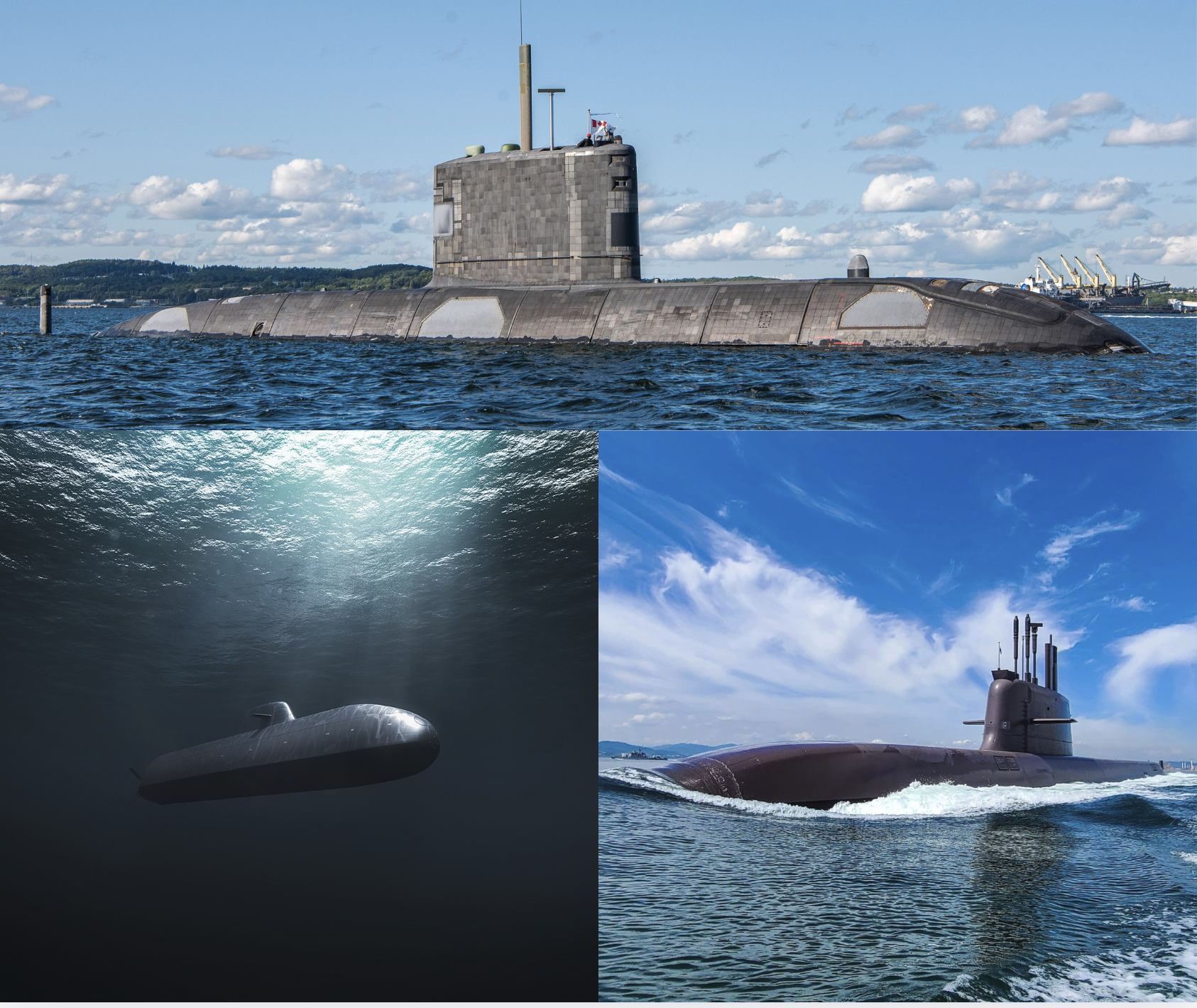
Prime Minister Mark Carney has approved the plan to buy up to 12 new submarines to replace the Royal Canadian Navy’s current aging fleet of Victoria-class boats.
In late August 2025, the Liberal government announced it had narrowed down its choices to two submarine builders: Germany’s ThyssenKrupp Marine Systems (TKMS) and the South Korean company Hanwha Ocean. Hanwha is offering Canada the KSS-III submarine and TKMS has proposed its Type 212CD submarine.
Carney wants to move quickly on the purchase of the new fleet. The schedule is to have a contract in place by the end of 2026. Royal Canadian Navy commander Vice Admiral Angus Topshee has said Carney wants to announce the winner of the competition as early as the summer.
The Ottawa Citizen newspaper has reported that when it comes to capabilities and weapons, either submarine can do the job for Canada. “Both of them fulfil the requirements, the very high requirements for the Canadian Navy,” Carney said in September.
So that means the main factor is deciding who wins the contract will come down to industrial benefits. What will the two companies offer Canada in return for being awarded a contract worth tens of billions?
Both companies have promised significant economic benefits for Canada, including alliances with Canadian-based defence firms. The German defence minister, Boris Pistorius, has suggested his country could buy Bombardier jets in the future for VIP transport, as well as other aircraft for airborne early warning planes. He has also suggested that Germany may purchase Canadian space systems. Other deals could be made on hydro and liquified natural gas.
Hanwha has announced various multiple strategic memorandums of understanding with Canadian companies.
https://ottawacitizen.com/public-service/defence-watch/south-korean-submarines-canada-hanwha
CTV news outlined in a report Feb. 8 some of the other proposals linked to Hanwha winning the bid. IG NEX1, which makes torpedoes for the KSS-III, offered to manufacture the weapons in Canada, CTV reported. The company has also discussed the possibility of producing its K-9 Howitzer armoured vehicles in Canada as part of the submarine deal, according to the network.
The Ottawa Citizen has reported that a purchase of the German-Norwegian submarine sends a signal by the Canadian government that it is further solidifying its long-standing alliance with European defence partners. The Germans have framed such a deal as strategic response to the Russians.
https://ottawacitizen.com/public-service/defence-watch/canada-submarines-south-korea-germany
The purchase of the South Korean subs would send the message that Canada is ready to become a significant player in the Asia-Pacific by forming an alliance with a major economic powerhouse in the region. Such a Canadian-South Korean deal is being framed as a strategic response to China’s growing presence in the region.
Here is the latest on the submarine front as far as the industrial benefits and alliances being proposed.
HANWHA
It’s been difficult to keep up with the flurry of announcements from Hanwha Ocean and related companies about its efforts to win the Canadian submarine contract.
Stephen Fuhr, Canada’s Secretary of State for Defence Procurement, toured Hanwha Ocean facilities in Geoje, South Korea on Feb. 2. Fuhr was accompanied by a delegation of representatives from more than 20 Canadian companies, including Algoma Steel, MDA Space, Telesat, Ontario Shipyards, Irving Shipbuilding, Seaspan Shipyards, Davie, Gastops, Hepburn, Boreal Energy, CAE, Babcock Canada and L3 Harris Canada.
During the visit, Fuhr and the Canadian delegation toured one of the largest shipbuilding facilities in the world, including the active and highly-automated production line for the KSS-III submarine. Fuhr also boarded and toured the completed and in-the-water KSS-III, which was launched for the Republic of Korea Navy in October 2025. This is the exact same submarine that Hanwha is proposing for the Canadian submarine program, company officials point out.
The Canadian delegation also visited the Republic of Korea Navy Submarine Force Command base. There they met with the Korean Navy’s Chief of Naval Operations and other senior submarine officers, and toured an in-service KSS-III submarine as well as the submarine training centre and maintenance, repair, and overhaul facility. It is here that Royal Canadian Navy sailors would train alongside the ROK Navy while Canada’s submarines are being constructed and where Canada’s submarines could receive maintenance and support while deployed in the Indo-Pacific region.
A recent analysis by KPMG forecast that Hanwha’s investments associated with the submarine bid would support more than 200,000 person-years of employment across Canada between 2026 and 2040, equating to average annual job creation of approximately 15,000 jobs.
A South Korean delegation also visited Canada in late January, meeting with a number of Canadian officials, including Prime Minister Carney. During that visit Hanwha announced a series of alliances with Canadian firms.
During that time, Algoma Steel announced it had teamed with Hanwha for the potential development of a steel beam mill in Sault Ste. Marie. Under the memorandum of understanding (MOU), Hanwha Ocean is to provide Algoma with an aggregate potential value of up to $345 million, comprising support for the development of a new structural steel beam mill in Canada, as well as anticipated purchases of steel products for use in Canadian-related submarine construction and associated maintenance, repair, and overhaul infrastructure.
That infrastructure is expected to be built in Nova Scotia and British Columbia where the submarine fleet would be supported throughout its lifecycle.
The beam mill investment, in particular, would give Algoma a new business opportunity beyond submarines, Hanwha officials point out. That would include supplying steel for infrastructure, housing, and road projects, and opening up new opportunities for Canadian workers in a market that has historically been dominated by imports, according to Hanwha.
In the area of space, Hanwha has signed a MOU with Telesat. The MOU follows the signing of a Letter of Intent between the Canadian government through the Canadian Commercial Corporation and the Government of Korea through the Defense Acquisition Program Administration to pursue a structured initiative on next-generation commercial Low earth Orbit (LEO) satellite communications and advanced maritime platforms.
Hanwha and Telesat will explore a range of cooperative programs, notably the Government of Korea’s LEO communications satellite constellation (K-LEO) and defence user terminals that are compatible with K-LEO and Telesat Lightspeed.
Additionally, the companies are cooperating on the Canadian Patrol Submarine Project, where Hanwha intends to include significant, multi-year Telesat Lightspeed services as a key strategic aspect of its bid.
Hanwha will also look to apply Telesat Lightspeed services to various platforms within its weapon systems as a means of exploring potential business collaboration opportunities throughout the global defence market.
“This collaboration brings together complementary resources and expertise to deliver next‑generation, sovereign LEO communications capabilities for Canada, South Korea, and our allied partners,” said Dan Goldberg, Telesat’s President and CEO.
Hanwha Ocean, Hanwha Systems, and Cohere have entered into an MoU to explore collaboration on advanced artificial intelligence technologies in support of the Canadian submarine project. The partnership focuses on the joint development of AI models—including large language and multimodal models—to enhance submarine operations and shipyard efficiency, leveraging Hanwha Ocean’s domain expertise, Hanwha Systems’ defence integration capabilities, and Cohere’s secure enterprise AI technologies.
The collaboration is intended as a cooperative framework to assess potential AI-enabled applications across submarine platforms and related industrial processes, reinforcing Hanwha’s broader cross-sector industrial cooperation strategy in Canada.
Hanwha Systems and PV Labs have also entered into a memorandum of understanding to jointly develop advanced capabilities for Electro-Optical Tactical Systems. Under the MoU, the two companies will collaborate to enhance EO/IR sensor capabilities for broader security applications. Hanwha Systems plans to support local development, system integration, and production activities in Canada, including technology transfer to PV Labs, a Canadian leader in stabilized electro-optical imaging systems.
The products will be jointly marketed for global export markets, according to the two companies.
Hanwha already has teaming agreements, MOUs and contracts in place with more than a dozen other Canadian companies, including Babcock Canada, Blackberry, CAE, and Curtiss-Wright Indal Technologies.
TKMS
TKMS started the year with the news that Norway recently had approved the procurement of two additional Type 212CD diesel-electric submarines for the Royal Norwegian Navy.
The decision increases the number of Type 212CD boats planned for the Royal Norwegian Navy from four to a total of six. The first two submarines for Norway are now being built at TKMS facilities. The first of the submarines is expected to be delivered to Norway in 2029.
“Norway is a coastal and maritime nation, and submarines are absolutely central to the defense of our country,” Norway’s Defense Minister Tore O. Sandvik said in a statement. “With six submarines, the armed forces will be able to operate more vessels in more locations at any given time. This will have a strong deterrent effect on any potential adversary.”
Sandvik also said the additional submarines will help strengthen NATO’s operations in the North Atlantic and northern regions.
On Jan. 20 the Reuters news service published an exclusive report revealing that TKMS was in talks with Norwegian and German companies to offer a multi-billion-dollar investment package to Canada as part of its efforts to beat Hanwha.
The talks go beyond submarines and cover possible investment commitments in rare earths, mining, artificial intelligence and battery production for the automotive sector, TKMS CEO Oliver Burkhard told Reuters.
TKMS is considered the world's largest maker of non-nuclear submarines and as Reuters pointed out its boats account for around 70 per cent of NATO’s conventional fleet.
Burkhard will come to Canada again in March for more discussions about the submarine plan. Germany’s defence and economic ministries are also part of the talks.
On Jan. 29, TKMS and Seaspan announced they had signed a teaming agreement to collaborate in support of the Canadian government’s objective to achieve a sovereign capability for the sustainment and through-life support of naval ships. The collaboration focused on the Canadian Patrol Submarine Project with potential further opportunities arising from TKMS’s international customers and programs, according to the companies.
Under the agreement, TKMS and Seaspan noted they intend to work together as an integrated team with Canada to develop and deliver capabilities for sustainment and lifecycle support of future submarine platforms in Canada.
Thomas Keupp, Chief Sales Officer at TKMS, pointed to Seaspan’s considerable experience in ship sustainment and its large industrial footprint in Canada. The agreement also contemplates opportunities for export support, noting TKMS’s broad international customer base.
John McCarthy, CEO of Seaspan Shipyards, said his company is the only shipyard in Canada with submarine maintenance expertise. “Seaspan is well-positioned to deliver on the decades-long sustainment of this new fleet and to contribute meaningfully to this country’s maritime defence industrial base,” he added.
On Feb. 4, TKMS and EllisDon announced they had signed a strategic teaming on the Canadian Patrol Submarine Project. The agreement focused on infrastructure co-operation with the intent to “jointly explore, develop, and implement cooperation for submarine maintenance, sustainment, and training facilities. “
“EllisDon is honoured to collaborate with TKMS on an initiative of such national significance,” said Chris Lane, Senior Vice President at EllisDon. “By contributing our expertise in adapting complex, mission-critical infrastructure to Canadian standards, we aim to help shape a sustainable, future-ready solution that delivers long-term value for Canada’s submarine program.
TKMS and Cohere, a key Canadian firm focused on AI, announced Feb. 13 that they had signed a teaming agreement to jointly explore the integration of advanced AI technologies into the Canadian Patrol Submarine Project.
Through the collaboration, the companies will assess opportunities to apply state-of-the-art language and data-driven models to support decision-support workflows, onboard information management, training environments, and secure naval interfaces. The initiative aligns with Canada’s future submarine requirements and modernization priorities.
Keupp, the Chief Sales Officer at TKMS, said Canada’s next-generation submarine project presents an opportunity to bring AI technology to enhance operational efficiency of future crews while maintaining the highest security and safety standards. The partnership will focus on research, prototyping, and evaluation activities. Both organisations emphasize that any AI-enabled capabilities will adhere to the strict security, compliance, and operational demands of the Royal Canadian Navy and the Government of Canada.
"Submarines are the ultimate high-stakes workplace. Through our partnership with TKMS, we’re embedding critical solutions that empower sailors to act decisively," said Dave Ferris, VP of Americas and Global Public Sector at Cohere. "Our technology will help the Canadian Patrol Submarine Project to meet stringent demands for precision, security, and streamlined operations, while reducing cognitive load."
The two companies pointed out that combining TKMS’s submarine engineering expertise with Cohere’s AI technology, the agreement would not only deliver next generation digital capabilities designed for the Royal Canadian Navy’s needs but it also reinforces TKMS’s commitment to bring Canadian companies into the its supply chain for the entire life cycle of the submarine program.
(With files from David Pugliese)
