
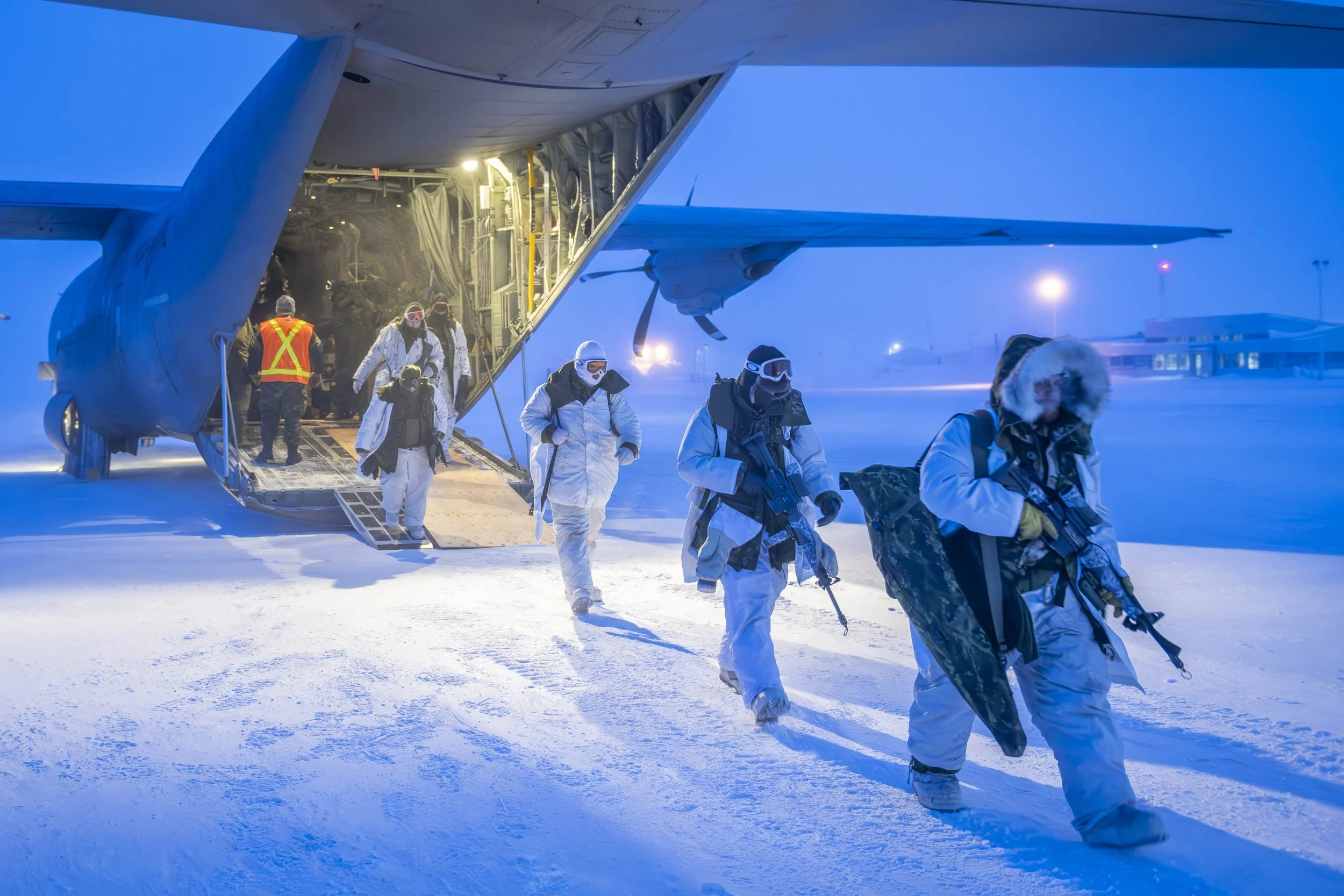
Canada’s push for a more significant presence in the Arctic is coming at a time when it faces pressure from various nations who are expanding their presence into the northern region. (Canadian Forces photo)
By Tim Ryan
Canada’s push for a more significant presence in the Arctic is coming at a time when it faces pressure from various nations who are expanding their presence into the northern region.
Russia and China are among those countries eying such an expansion in the resource rich territories. But Canada is also facing a dilemma in that its once close ally, the United States, has emerged as a potential new threat to Canadian sovereignty.
The Canadian Forces has a number of significant projects underway that will improve security efforts in the far north. Here is a rundown of those:
NORAD MODERNIZATION
The Canadian government will invest $40 billion on improving North American defence with a new array of high-tech systems and technologies.
The money will be spent over the next 20 years and will involve various sensors, fighter jets and support infrastructure.
Another pressing problem for both the U.S. and Canada that has not seen a lot of media attention is determining what to do about the North Warning System, which is estimated to be obsolete starting around 2025. The system’s radar sites were constructed between 1986 and 1992 and are mainly designed to track Russian bombers approaching North America.
The Liberal government has recognized it has to do something about what it calls the capability gaps in the North Warning System or NWS.
Canada is currently responsible for 40 per cent of the cost of the North Warning System, with the remaining 60 per cent falling to the Americans. Canada owns the sites and provides the site operations and maintenance while the U.S. owns the radars and communications equipment.
The federal government has also emphasized that the NORAD modernization will be done with a focus on co-operation with northern residents. The Canadian government has awarded a contract to Nasittuq Corporation, an Inuit owned company, for the operation and maintenance of the North Warning System. This new contract is for an initial period of seven years and is valued at $592 million. The contract also includes four two-year option periods for a total estimated value of $1.3 billion.
Under the contract, Nasittuq will be responsible for preventative and corrective maintenance for the NWS, and ensuring that NWS radar data is always available in support of NORAD and Canadian Armed Forces operations. This includes full logistics support, infrastructure and environmental stewardship, engineering and life cycle material management, and general program and project management.
As discussed, new fighter jets are also included in the overall NORAD modernization package. So far, 16 F-35s have been ordered but the Liberal government has still not determined what the makeup of the future fleet will be. Both F-35s and the Saab Gripen are being considered.
NORAD modernization also includes a new initiative called the Canada Fighter Infrastructure (DCFI) project. That will involve spending $7.3 billion on new infrastructure to support NORAD operations as well as the initial acquisition of F-35s by Canada. Those Lockheed Martin aircraft are expected to arrive starting in 2026 but would not be fully operational until three years later.
DCFI will improve Canada’s ability to project air power for defending North America with the upgrade of four Canadian Forces forward operating locations in the north. Those locations are at Inuvik, Yellowknife, Iqaluit and Goose Bay. Initial operating capability for those upgrades would be set for 2034 and full operational capability for 2039.
The DCFI project will also build and upgrade infrastructure required for the F-35 including airfields, electrical and IM/IT systems, hangarettes (small hangars), Quick Reaction Alert facilities, maintenance facilities, storage warehouses, accommodations, and training facilities to support operations, personnel, and logistics.
Almost 90 per cent of the budget will go towards the operational facilities: the already stated hangarettes; Quick Reaction Areas; maintenance infrastructure; warehousing; and weapon storage. The remaining budget will cover airfields, electrical and IM/IT upgrades as well as personnel and training facilities.
ARCTIC OVER THE HORIZON RADAR
Canada’s Over the Horizon system is seen by the federal government as a key component of its North American Aerospace Defence Command (NORAD) modernization plan and is expected to provide advanced early warning and enable faster detection of threats.
It could also be offered to the United States as a contribution to President Donald Trump’s proposed Golden Dome missile shield. The radar is supposed to detect incoming missiles over the Arctic. It could also track aircraft and surface ships.
Prime Minister Mark Carney announced on March 18, 2025 that Canada would purchase the new radar system from Australia, with the British firm BAE providing the technology.
DND originally estimated the cost of the over-the-horizon radar would be under $1 billion. In 2024, it estimated it could be as much as $3 billion. Carney’s announcement put the cost at $6 billion but there is no clear explanation for the significant increase in cost.
Over-the-horizon radar has the ability to conduct surveillance at far greater ranges than regular radar technology as it extends the distance of its capabilities by bouncing signals off the ionosphere, a layer of Earth’s atmosphere that reflects radio waves. It’s estimated that the minimum range for the radar will be 500 kilometres, while the maximum range could be more than 3,000 kilometres.
The radar will be located in Ontario near CFB Borden. But pushback to the radar site has been growing in the area, with “No DND Radar in Clearview” signs popping up along local roads. In addition, a local resident has started to gather signatures for a petition to be presented to the House of Commons in early 2026.
Area residents have questioned why the radar can’t be located at nearby Canadian Forces properties. CFB Borden, comprising around 8,500 hectares (21,000 acres), is about 30 kilometres away from the proposed radar location. The military also has another 8,000 hectares (20,000 acres) nearby at Meaford, a training centre.
Initial operating capability for the Arctic Over-the-Horizon radar will happen before 2030.
The radar would “provide long-range surveillance of northern approaches to the major population centers in North America by establishing a northward-aimed high frequency over-the-horizon radar system in southern Canada,” according to a April 7, 2022 briefing prepared for defence industry representatives.
The Canadian Armed Forces is looking at a Polar OTHR initiative as a second component of what it is calling a layered surveillance system. A third project, called Crossbow, is a complementary but classified network of sensors that will be distributed across northern Canada. Crossbow is expected to be operating by 2029-2030. Development of Crossbow is being done in conjunction with the U.S. military but the Department of National Defence declined to provide additional details because of the classified nature of the project.
NEW ARCTIC COMMUNICATIONS
The Canadian government took the first step in moving forward on military satellite communications by establishing a strategic partnership with Telesat Corporation and MDA Space. The Dec. 9, 2025 announcement is to develop and bolster the Canadian Forces’ military satellite communications (MILSATCOM) capabilities.
Government officials say the partnership is part of the Enhanced Satellite Communications Project – Polar (ESCP-P), one of the key procurements being led by the newly formed Defence Investment Agency. The project will provide reliable wideband and narrowband connectivity to support domestic and continental operations in the Arctic.
The Canadian government selected Telesat and MDA Space as strategic partners because of their combined expertise in secure satellite communications and space-based infrastructure. The Liberal government is pushing to establish the domestic space sectors as one of its key defence pillars for sovereignty, Arctic security and job creation.
“The Enhanced Satellite Communications Project – Polar will play a critical role in advancing the communications capabilities of the Royal Canadian Air Force and the broader Canadian Armed Forces,” said Lt.-Gen. Jamie Speiser-Blanchet, commander, Royal Canadian Air Force.
As a first step, Canada has awarded a $2.92-million contract to Telesat in conjunction with MDA Space to conduct engineering and options analysis work for ESCP-P.
The Canadian government says it is using “a strategic partner model” for the delivery of ESCP-P. The model, it claims, is an innovative approach to defence procurement that streamlines processes and accelerates timelines, while leveraging industry experience and expertise in the design, development and delivery of defence projects and programs.
DRONES
Canada has announced its plans to purchase a fleet of 11 MQ-9 Reaper drone from General Atomics Aeronautical Systems, Inc. in the U.S. The project will cost $2.49 billion.
The Royal Canadian Air Force had hoped that its new fleet of drones would be operating by 2025.
But plans for the Remotely Piloted Aircraft System (RPAS) project didn’t work out. That initial operational date will now take place between 2027 and 2030. Full operational capability will be reached by 2033, according to the Canadian government.
But why the delay in getting the drones operational?
“The Canadian RPAS configuration will require significant development work in order to address RCAF requirements which differ from our allies’ requirements,” explained Department of National Defence spokesperson Andrée-Anne Poulin in an emailed statement.
That extra development work needs to be done because of RCAF plans to use the Reapers in the far north. That will require the integration of new systems on the MQ-9.
“For example, the need to operate at high northern latitudes, including in the Arctic, requires the use of satellites and aircraft antennas and communication components not previously integrated on the MQ-9,” Poulin explained. “Similarly, additional testing and qualification work will be required to ensure the RPAS can be operated and maintained in Canadian climatic conditions”
In addition, Poulin said there is some developmental effort required to integrate the Canadian-made WESCAM MX-20 EO/IR sensor onto the platform.
This comes despite the fact that in March 2020 General Atomics Aeronautical Systems, Inc. and L3Harris Technologies announced they had successfully integrated the WESCAM MX-20 Electro-optical/Infrared (EO/IR) system onto the MQ-9B.
“We are aware that the MX-20 has been integrated onto other MQ-9B variants,” Poulin explained. “However, the overall Canadian RPAS configuration will be different than any previous MQ-9B variant, and as such, some development work will be required to ensure that the MX-20 is integrated to operate in conjunction with other new systems (e.g. that it can share information and cross-cue with the maritime surveillance radar), and that it will operate effectively for RCAF mission scenarios, including when operating in Canadian climatic conditions.”
NEW FLEETS OF ICEBREAKERS
In May 2021, Canada announced the construction of two new polar icebreakers under the National Shipbuilding Strategy at Seaspan's Vancouver Shipyards Co. Ltd. and Chantier Davie Canada Inc. Both polar icebreakers will have capacity and abilities beyond those of Canada's current largest icebreaker, the Canadian Coast Guard Ship Louis S. St-Laurent.
As well, Seaspan Shipyards is working on thee Canadian Coast Guard’s (CCG) Multi- Purpose Icebreakers (MPI) program.
The MPIs will be Polar Class 4 icebreakers. They will be designed with advanced capabilities, such as continuous icebreaking in heavy ice conditions. The ships will be able to carry out multiple missions, including maritime search and rescue, environmental response, and maintaining Canada’s marine navigation system of about 17,000 navigation aids. The first flight of MPIs will replace the existing High Endurance Multi-Tasked Vessels and Medium Endurance Multi-Tasked Vessels.
The Multi-Purpose Icebreakers will have a displacement of more than 8,500 tonnes; they will be 99.9 metres long and 20.3 metres wide, and able to accommodate up to 50 personnel. They will be able to break one metre of ice continuously. The Canadian Coast Guard will use the ships for year-round operations in Canada’s eastern and western seaboards, within Canada’s Exclusive Economic Zone (EEZ); year-round operations in the Gulf of St. Lawrence, the St. Lawrence River and the Great Lakes; and summer operations in the western and lower Arctic.
On Jan. 13, 2026 the Liberal government announced that Sydney, Nova Scotia is the preferred location to explore the creation of a maintenance port for the Canadian Coast Guard’s future polar icebreakers. This infrastructure will serve as a deep‑water port to support the unique operational and maintenance requirements of the Canadian Coast Guard’s largest and most capable Arctic-ready ships.
This preferred location follows a national assessment to determine the most suitable site based on the Canadian Coast Guard’s operational, geographic, and infrastructure needs, according to the federal government. Sydney, Nova Scotia has key advantages that support the long‑term operational needs of the fleet, providing one of the shortest routes to the Arctic from Eastern Canada, proximity to the Canadian Coast Guard Academy, and opportunities to strengthen collaboration with the Royal Canadian Navy.
The port will provide essential maintenance for the Canadian Coast Guard’s largest polar icebreakers, enabling year‑round Arctic operations and strengthening Canada’s sovereignty and security in the Arctic, federal officials say. This will allow personnel to continue delivering critical services, including icebreaking operations, environmental response, search and rescue, and Arctic science.
(With files from David Pugliese)
