
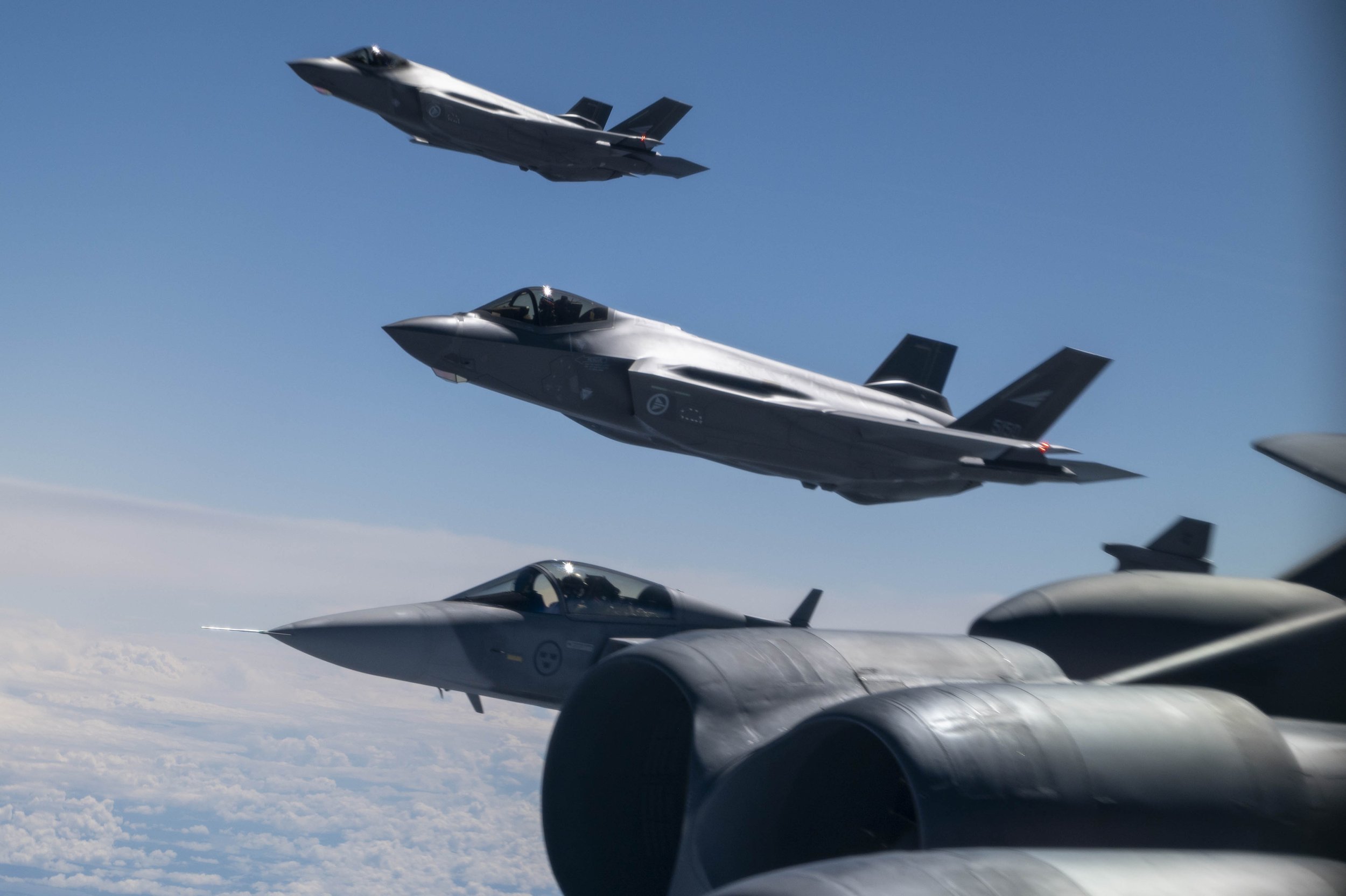
Will Canada go for a mixed fleet of F-35s from Lockheed Martin and Gripen fighter jets from Saab? (US DoD photo)
By Tim Ryan
There has been a lot of debate and speculation on Canada’s F-35 file but Prime Minister Mark Carney has still yet to make a decision on which way he will decide.
The main focus is on whether Canada will decide to go for a mixed fleet of F-35s from Lockheed Martin and Gripen fighter jets from Saab.
The Liberal government announced in January 2023 it was spending $19 billion to acquire 88 F-35s from the U.S. government. But Carney ordered a review of the F-35 purchase in mid-March. That review came in the wake of U.S. President Donald Trump calling for the annexation of Canada and threatening do destroy the Canadian economy.
At this point, the federal government is only committed to buy 16 F-35s — Carney will be making the final decision on whether to proceed with the additional purchase of another 72 of the stealth fighters, the Ottawa Citizen has pointed out.
https://ottawacitizen.com/public-service/defence-watch/us-ambassador-canada-f35-order
The newspaper has made the point that the RCAF leaders are highly supportive of the F-35 and the need for more integration into the U.S. military and its systems. Senior defence and RCAF personnel went to Lockheed Martin’s F-35 production facility in Texas on Feb. 2 for a ceremony for to mark the construction of Canada’s first F-35.
That closed event was attended by RCAF Lt.-Gen. Jamie Speiser-Blanchet, Crista-Lynn Ferguson, the director general of fighter capability and Col. Daniel Constable, director of fighter capability transition, confirmed DND spokesman Kened Sadiku.
Meanwhile, Saab has been going all in with its campaign to sell Canada a fleet of its Gripen E jets. Is it possible that Canada might make the move to the Gripen, with a split fleet of F-35s and the Swedish aircraft?
On Jan. 28, National Post reported the Liberal government was considering purchasing 40 F-35s in total and complementing those with the purchase of as many as 80 Gripens.
Saab Chief Executive Micael Johansson has told investors that Canada was recently looking at the option so it is “not to be too dependent on the US by having a dual fleet, both F-35 and the Gripens.”
“We are providing all [the] detailed information that they need to understand,” he added.
Saab is interested in sweetening the industrial benefits pot on any potential deal.
In addition, the CBC has reported March 4 that Saab has suggested partnering with the Canadian government and Canadian businesses to develop the next generation aircraft. "As we're looking ahead, we'd really like to work with countries and companies who are willing and interested and have the skill set," Peter Nilsson, head of future programs at Saab, said in an interview with Radio-Canada.
https://www.cbc.ca/news/politics/saab-canada-fighter-jets-9.7112654
The Department of National Defence told CBC that it is "exploring possible future options beyond the current fighter jets."
Saab recently upped the ante on the industrial benefits angle. It has proposed assembling Gripens in Canada, claiming that would create 6,000 new jobs over the course of 40 years. The proposed assembly facility could also work on the 150 Gripens that are to be built for Ukraine.
https://ottawacitizen.com/public-service/defence-watch/canada-fighter-jets-f-35-gripen
And in the newest development, Saab has offered to establish a secure, sovereign data centre in Montreal if Canada buys the Gripen. The centre would house critical fighter jet mission data and intelligence. CBC has reported that the company is framing this as a "unique advantage" – all part of Saab’s efforts to convince the Liberal government to limit the purchase of the F-35s, which have all of their data stored at a Lockheed Martin centre in Fort Worth, Texas.
F-35 supporters and Pete Hoekstra, the controversial U.S. ambassador to Canada, are firmly against any proposal in which Canada operates both the F-35 and the Gripen. They claim that Canada can’t afford to operate two different fleets of fighter planes.
That, however, isn’t true. In the past, the Royal Canadian Air Force has operated more than one fighter jet at a time. Supporters of the purchase of two different types of aircraft point out, that with Carney’s promise to massively boost the defence budget, the Canadian Forces will have the funding to run additional air fleets.
Gripen supporters have suggested the intense pushback against operating both Gripens and F-35s reflects concerns among the supporters of the U.S. plane that such an arrangement would reveal just how more cost-effective the Swedish aircraft is.
Saab has provided the Canadian government with specifics on how fast it could establish a Gripen production facility in the country and what the export potential would be for those fighter jets. At this point the Gripen is built in Sweden and Brazil. On March 25, 2026, Saab, Embraer and the Brazilian Air Force officially presented the first Gripen fighter aircraft produced in Brazil during a ceremony held at Embraer’s industrial complex in Gavião Peixoto, São Paulo State.
There has also been the suggestion that Gripens built in Canada could be exported to Ukraine. Sweden has signed a letter of intent with Ukraine that could mean an order of up to 150 aircraft.
Industrial benefits aside, the U.S. commander of NORAD added another wrinkle to the debate when he testified on March 19 that fifth-generation fighters such as the F-35 aren’t needed to defend North America. That undercuts the central claim by supporters of the aircraft that Canada requires such jets to protect the country.
https://ottawacitizen.com/public-service/defence-watch/norad-f-35-figher-jet-north-america
The Ottawa Citixen has reported that the Canadian Forces has emphasized that the F-35 is part of its plans to modernize the North American Aerospace Defence Command or NORAD. Chief of the Defence Staff Gen. Jennie Carignan, has also stated that the U.S.-built fighter jet is needed to defend the Arctic.
Royal Canadian Air Force commander Speiser-Blanchet has also stressed the need for such fifth-generation aircraft to protect Canada.
But U.S. Air Force General Gregory M. Guillot, who heads the joint U.S.-Canada NORAD, says such advanced jets aren’t needed by his organization. “Frankly we don’t need fifth (generation) to defend our borders,” Guillot told the U.S. Senate Armed Services Committee hearing on March 19.
He said fifth-generation jets, considered the most advanced type of aircraft, had a role to play in attacking overseas targets. “Those capabilities are better used overseas where their stealth, air to ground weapons and penetration capability are needed,” Guillot added.
As pointed out earlier, Carney’s review of the F-35 deal has angered the Trump administration. In a Jan. 26 interview on CBC, Pete Hoekstra, the U.S. ambassador to Canada, warned Canadians they could face dire consequences if the Carney government didn’t buy the F-35. He also stated that the joint U.S.-Canadian NORAD agreement would have to be changed if the F-35 deal didn't go through.
Hoekstra has pushed the idea that Gripens wouldn’t be as “interchangeable, interoperable” with U.S.-operated F-35s.
Bill Sweetman, a U.S. aviation writer and author of a book about the F-35, posted on X on Jan. 26 that Hoekstra was “babbling nonsense.”
“Canada has been flying different aircraft from the USAF in NORAD for 40+ years and controls its jets through Winnipeg, and the F-35’s stealth is irrelevant in NORAD because Russian bombers do not have air-to-air radar,” wrote Sweetman, author of Trillion Dollar Trainwreck: How the F-35 Hollowed Out the U.S. Air Force.
F-35s have flown with Gripens, which are used by NATO countries such as Sweden, Hungary and the Czech Republic.
Rasmus Jarlov, head of the Danish parliament’s defence committee, has voiced his concerns about that country’s decision to have the F-35 as its only operational fighter jet. Those concerns have only increased as the Trump administration recently threatened Denmark and talked about seizing control of Greenland from the NATO nation. In his interview with CBC, Jarlov had a message for Canada about the F-35: “Choose another fighter jet.”
“They’re in for repairs about half the time or even more,” Jarlov said. “The Americans have all the power of actually destroying our air force just by shutting down (parts) supplies.”
Jarlov, also pointed to Jan. 29 tweet by Trump where he threatened 50 per cent tariffs on all aircraft. “This is exactly why countries should not buy F35s. I am sorry we did. Get out of as much American as possible that this man can use to extort your country.”
Defence analyst Roland Paris also discussed on his X social media account the Jan. 29 Trump tweet. “A reminder of the risks of relying exclusively on the F35. Trump will use any available leverage to apply pressure, including on America’s closest allies,” Paris noted. De-risking is essential.”
Paris wrote that while it is true that in a few years time Trump will no longer be president, the bottom line is that Americans voted him in twice. “He has defined a type of politics that others will imitate. It would be foolish to assume that MAGA will disappear when he leaves the stage.”
(With files from the CBC and the Ottawa Citizen)
