RCAF Modernization Takes Flight

08_Feature.jpg

By David Pugliese

As the Royal Canadian Air Force prepares for the future several key equipment programs are taking precedent and moving towards being implemented.

The most high profile is the future fighter jet project which is valued at between $15 billion and $19 billion. The Canadian government received bids July 31 from all three suppliers that were eligible to participate. Those included the Swedish Government—SAAB AB with its partners Diehl Defence GmbH & Co. KG, MBDA UK Ltd., and RAFAEL Advanced Defence Systems Ltd; the U.S government with Lockheed Martin Corporation and its partner Pratt and Whitney; and the U.S. government with The Boeing Company, along with its partners Peraton Canada Corp., CAE Inc., L3 Technologies MAS Inc., GE Canada and Raytheon Canada Limited Services and Support Division.

Eighty-eight aircraft will be purchased to replace the current CF-18 fleet. The proposals will be evaluated on elements of capability (worth 60 per cent of the evaluation), cost (20 per cent of the evaluation) and economic benefits (20 per cent of the evaluation), according to Canadian government officials. 

During the evaluation process, a phased bid compliance process will be used to ensure that bidders have an opportunity to address non-compliance related to mandatory criteria in their proposals, Public Services and Procurement Canada
noted.

The initial evaluation of proposals is anticipated to be completed by spring 2021. The Canadian government will finalize terms with the preferred bidder prior to the contract award, which is anticipated in 2022. Delivery of the first aircraft is expected as early as 2025.

Saab is offering Canada its Gripen E fighter aircraft along with a comprehensive support and training package and an industrial and technological benefits program. Saab officials say they are committed to delivering an industrial program that has been designed to generate long-lasting, high-tech employment opportunities, and business opportunities across all regions of Canada. “Saab’s Gripen fighter is designed to operate in harsh environments and defeat the most advanced global threats,” explained Jonas Hjelm, Senior Vice President and head of Saab business area Aeronautics.

He noted that a unique element of the avionics design is that Gripen E’s system can be updated quickly, maintaining technological superiority against any adversary. “With Saab and Gripen, the Royal Canadian Air Force will have full control of its fighter system,” said Hjelm. “A guarantee to share key technology, in-country production, support and through-life enhancements will ensure that Canada’s sovereignty is enhanced for decades.”

Saab has formed the Gripen for Canada Team which consists of IMP Aerospace & Defence, CAE, Peraton Canada and GE Aviation.

Sweden and Brazil have already ordered Gripen E aircraft, with the first planes already delivered. Brazil has also ordered the dual-seat Gripen F and will be the sixth nation to operate Gripen, along with Sweden, the Czech Republic, Hungary, South Africa, and Thailand. Additionally, the UK Empire Test Pilots School uses Gripen for test pilot training, the company noted.

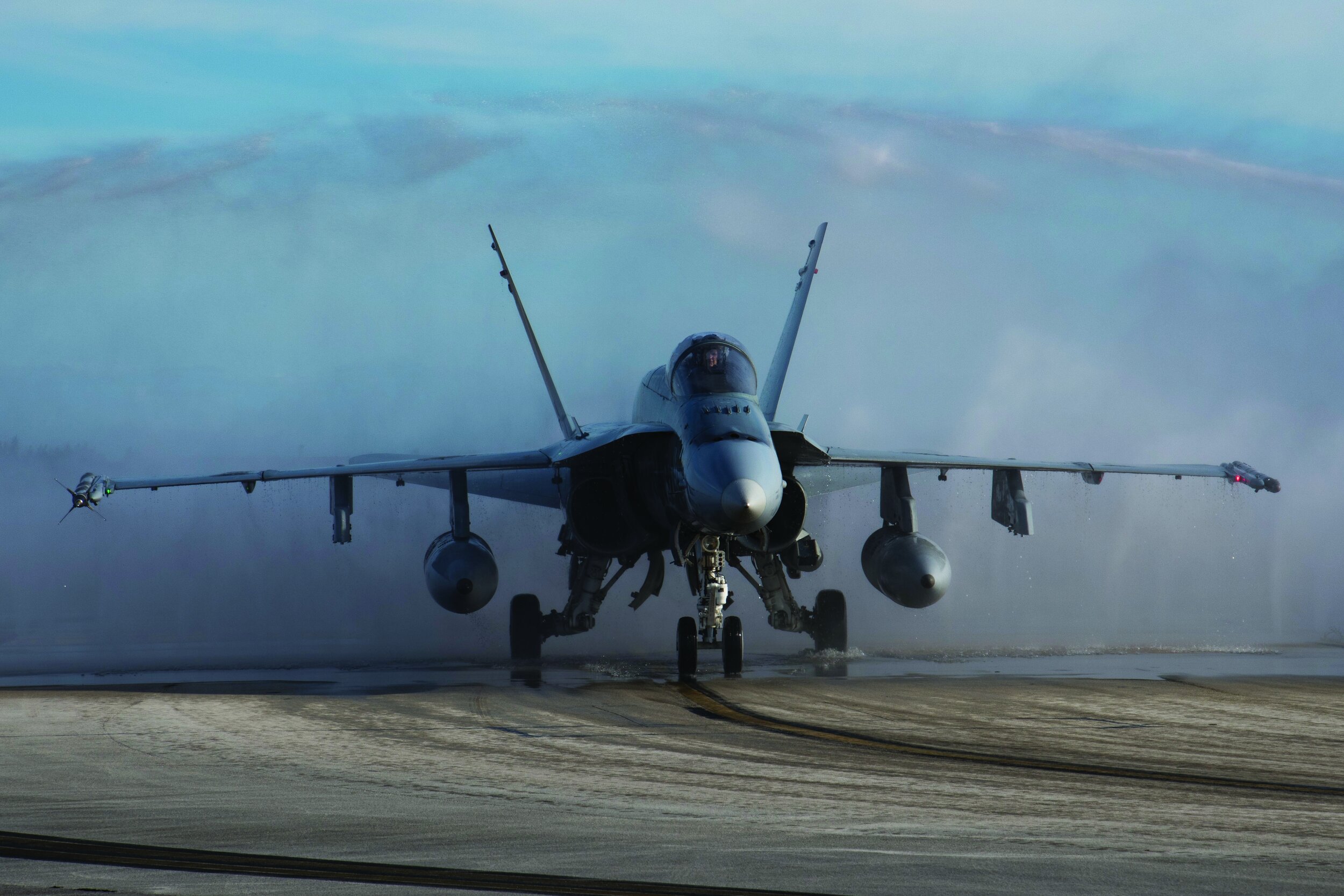
Boeing is offering the Block 111 Super Hornet. Boeing noted that the aircraft is compatible with existing CF-18 infrastructure and the current RCAF air refueling tankers, making transition to the aircraft less expensive and relatively easy. The firm has also highlighted that the Super Hornet production line is continuing well into the future, with the U.S. Navy confirmed it is purchasing 78 of the aircraft which are equipped with a new computer, sensors and data links to boost the amount of information that can be received or transmitted. The aircraft also has satellite communications, which is important for Arctic operations, Boeing noted. Some stealth aspects have also been added and Boeing says it has been able to increase the life of the aircraft from 6,000 flight hours to 10,000 flight hours.

It is also pitching the new Super Hornet as less costly to maintain. The aircraft costs about $18,000 U.S. an hour to operate compared to the F-35 which costs $35,000 U.S. Boeing has also highlighted its long-term commitment to Canada and its track record of meeting or exceeding industrial benefits obligations. Jim Barnes, Boeing’s director for Canada Fighter Sales, pointed out that the firm has had a partnership with Canada for more than 100 years. The response the company submitted to the future fighter program builds on that legacy and “allows us to continue to bring the best of Boeing to Canada and the best of Canada to Boeing,” he noted.

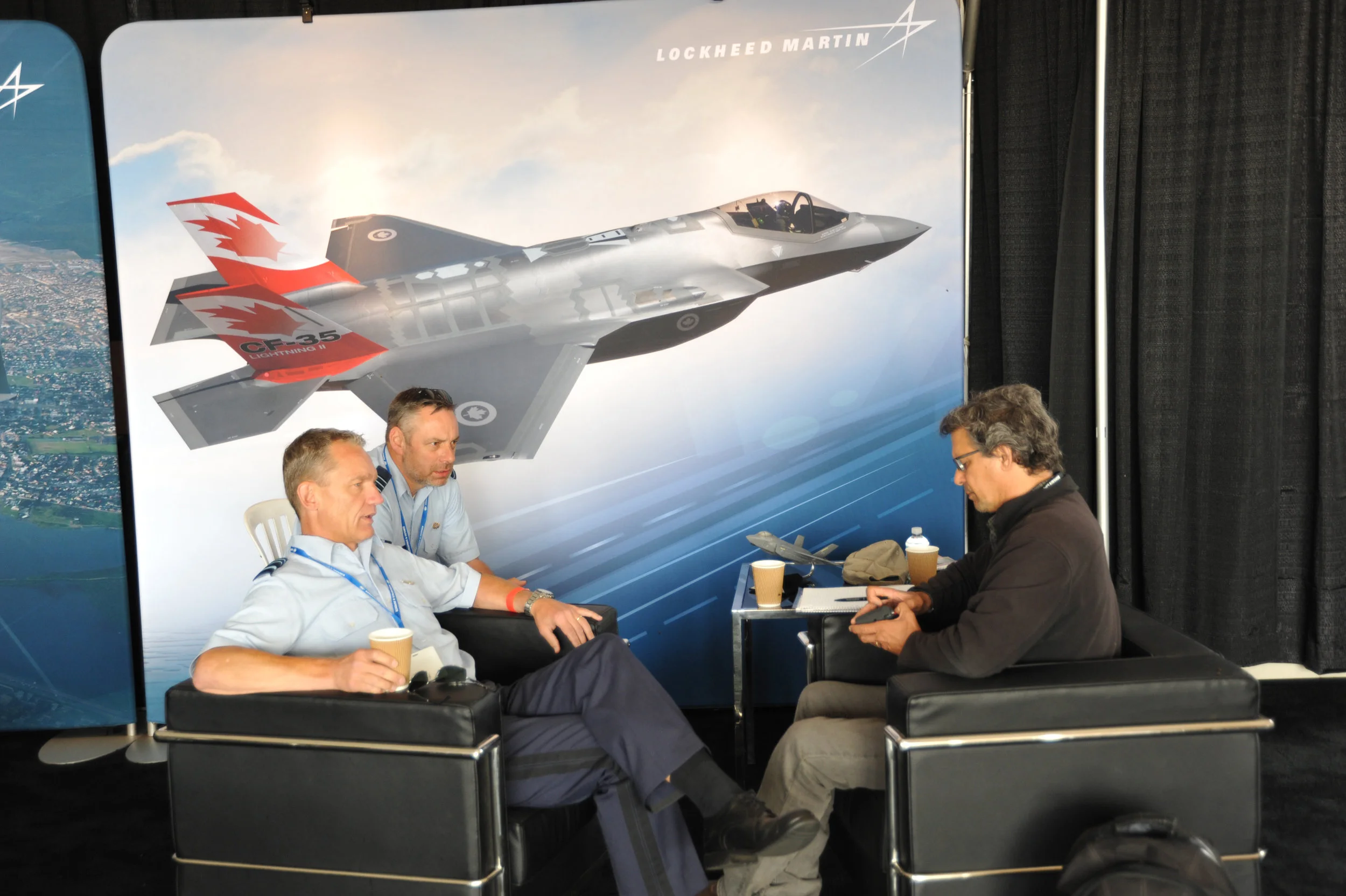
Lockheed Martin is highlighting the fifth generation fighter technology of the F-35, making it the only such aircraft in the Canadian competition. In addition the company is hoping in the coming years to drop the cost of operating the stealth fighter to around $25,000 U.S. an hour.

Lockheed, as well, is highlighting the program’s value to Canadian industry. An analysis commissioned by the company claims that 150,000 new jobs will be created over the life of the program if Canada purchases the F-35. More than 110 Canadian firms already have contracts to supply components to the F-35 program and that has generated around $2 billion in contracts. For instance Pratt & Whitney’s F135 engine is used in all three variants of the F-35. Curtis Wright builds rugged high performance processor modules and other computer components.

The downside of not selecting the F-35 could involve Canadian firms no longer building systems for the allied nations operating the aircraft. Lockheed Martin officials say if the F-35 is rejected by Canada then existing contracts would be honoured but that future contracts would likely be placed using industries in the nations that are buying the F-35.

The Canadian Armed Forces is already preparing for the new infrastructure needed for the next generation fighter jets. On Aug. 27 the federal government announced a $9.2-million contract to EllisDon Construction Services Inc., of Edmonton, Alta., for the design of a new fighter jet facility at 4 Wing Cold Lake, one of two main operating bases for Canada’s future fighter aircraft. A second facility and contract award is also planned for 3 Wing Bagotville in Quebec. Combined, the infrastructure will support the long-term maintenance and operation of the 88 new aircraft. The Cold Lake facility will host two tactical fighter squadrons and will cover approximately 19,300 square metres, providing space for daily operations, maintenance, administration, mission planning, and simulator training, according to the federal government. It will also house operational and support training squadrons and their training facilities. Construction is estimated to begin at both bases in summer 2022 and finish up by 2025. 

Both design contracts will also include options for the contractors to build the new facilities, and any additional infrastructure once the future fighter is selected, should Canada decide to exercise these follow-on options, the federal government noted.

Construction costs for the new fighter jet facilities are currently estimated at $272 million for Cold Lake and $250 million for Bagotville.

In the meantime, the RCAF will receive new weaponry for the CF-18 fleet as it prepares to continue operating those aircraft while it awaits the delivery of the future fighters and proceeds with the transition to that fleet. Raytheon Corporation, El Segundo, CA; General Dynamics Mission Systems, Marion, VA; The Boeing Company, St. Louis, MO; and Collins Aerospace, Cedar Rapids, IA will all be involved in providing the RCAF with new weapons and various other systems for the fleet in a deal worth more than $1 billion.

The U.S. State Department approved the sale for the 50 Sidewinder AIM-9X Block II Tactical missiles, radars and other various weapons. “This sale will provide Canada a 2-squadron bridge of enhanced F/A-18A aircraft to continue meeting NORAD and NATO commitments while it gradually introduces new advanced aircraft via the Future Fighter Capability Program between 2025 and 2035,” the Defense Security Cooperation Agency in the U.S. said.

Canada is acquiring 50 Sidewinder AIM-9X Block II Tactical missiles; 50 Sidewinder AIM-9X Block II Captive Air Training Missiles; 10 Sidewinder AIM-9X Block II Special Air Training Missiles; 10 Sidewinder AIM-9X Block II Tactical Guidance Units; 10 Sidewinder AIM-9X Block II CATM Guidance Units; 38 APG-79(V)4 Active Electronically Scanned Array (AESA) radar units; 38 APG-79(V)4 AESA Radar A1 kits; 20 Joint Standoff Weapon (JSOW) C, AGM-154C; and 46 F/A-18A Wide Band RADOMEs.

Also included are additional technical and logistics support for the AESA radar; upgrades to the Advanced Distributed Combat Training System (ADCTS) to ensure flight trainers remain current with the new technologies; software development to integrate the systems listed into the F/A-18A airframe as well as other equipment.

The RCAF expects some of the new weaponry will be of use on the future fighter aircraft as well.

Another focus for the RCAF is the eventual introduction of a remotely piloted aircraft system or RPAS. The RPAS project is a new name for what used to be called the Joint Unmanned Surveillance and Target Acquisition System or JUSTAS, which began in 2007.

An internal DND audit released in 2014 noted that the JUSTAS operational requirements lacked clarity and consistency to ensure that all of the Canadian military’s capability deficiencies would be addressed by the acquisition. 

But this time around the project has advanced significantly. The RPAS project entered the definition phase on April 5, 2019.  As a result of an Invitation to Qualify process, Public Services and Procurement Canada selected L3 Technologies MAS Inc.; and the United States Government and General Atomics Aeronautical Systems, Inc. as the two bidders for the project, said Department of National Defence spokeswoman Jessica Lamirande.

Under the ITQ process, L3 Technologies MAS Inc. proposed the Heron TP aircraft from IAI while the United States Government and General Atomics Aeronautical Systems, Inc. qualified with the MQ-9 aircraft, added Lamirande.

“The project team officially initiated engagement with qualified suppliers in July 2019 as part of the Refine & Review Requirements (RRR) phase,” she said. “As part of the RRR phase, the project team will continue to engage Qualified Suppliers and develop a Request For Proposal for release anticipated in Fiscal Year 20/21.”

Project approval to enter implementation phase is anticipated in Fiscal Year 22/23, Lamirande told Esprit de Corps.

The RPAS project will procure a fleet of armed, medium altitude, long endurance remotely piloted aircraft and related equipment capable of intelligence, surveillance and reconnaissance and precision strike in support of Canadian Armed Forces operations. The RPAS fleet will complement existing capabilities within the Canadian military, such as the CP-140 and the CF-18 fighter aircraft. 

“This capability will be integrated into a network of systems to enable near real-time flow of information essential to CAF operations, and to support domestic law enforcement and civilian authorities, Lamirande said. “Additionally, it will significantly expand Canada’s ability to contribute to joint intelligence, surveillance and reconnaissance operations with its allies.”

Team SkyGuardian consists of General Atomics (GA-ASI), CAE, L3 Harris and MDA. The team notes its multi-mission aircraft, the MQ-9B SkyGuardian and its nine hardpoints offer unmatched configurability to meet Canada’s mission requirements. MQ-9B SkyGuardian is the best solution to deliver multi-mission capability, a sustainable Arctic presence, interoperability with existing Royal Canadian Air Force assets and Five Eyes and NATO allies, all with low acquisition cost and sustainment, according to the team. GA-ASI has also noted it is involving Canadian industry in sustainment of the system and development of new capabilities for MQ-9B and other Predator series systems.

The second consortium, known as Team Artemis, is offering an enhanced Canadian version of IAI’s Heron TP platform. L3 Harris’ division in Mirabel, Que., has teamed with Israel Aerospace Industries to adapt the Heron TP for Canada’s specific requirements, the companies point out. The Artemis system uses the Canadian-made 1,200 shaft horsepower Pratt & Whitney Turbo-Prop PT6 engine, which allows the system to be capable of speeds, climb rates and altitudes that are unmatched in the medium altitude long endurance category, according to the team. The aircraft will be outfitted with an anti-icing system and capable of altitude greater than 45,000 feet. The aircraft will also be outfitted with the anti-jam GPS system provided by NovAtel of Calgary.

If Team Artemis wins the RPAS project the aircraft will be assembled by L3 Harris in Mirabel.

RCN Strategic Capability: Victoria-class Submarine Sustainment Top Priority for Royal Canadian Navy

08_Sub_HMCS Cornerbrook  USN photo.jpg

By David Pugliese

Canada’s Victoria-class submarines are seen as key elements to the Liberal government’s defence policy, Strong, Secure, Engaged.

With that in mind, one of the Royal Canadian Navy’s top priorities is a new sustainment plan for the four submarines.

Dubbed the Victoria-class In-Service Support Contract 2 or VISSC2 the project will address continued upkeep of the submarines into the mid-2030s. “VISSC2 is going to be a critical enabler” for the government defence policy, Capt.(N) Keith Coffen, Director Maritime Equipment Program Management – Submarines, told Esprit de Corps.

“Sustainment is a key industrial capability (and we) aim to grow and develop that capability in Canada,” he added.

Submarines are among the world’s most technically complex machines and they operate in an unforgiving environment, the RCN points out. The Victoria-class submarines operate in open-ocean and deep-sea environments where they experience pressure-induced stresses from changes in depth, extreme weather conditions, and the corrosive effects of seawater.

A strict in-service maintenance program is required to ensure the safety of the crew and mission success. It also helps develop and sustain a highly-skilled Canadian marine workforce with expertise in a specific domain, according to the Department of National Defence.

Upkeep of the Victoria-class boats is provided via a combination of Royal Canadian Navy and contracted maintenance resources. Coffen noted that DND’s fleet maintenance facilities in both Halifax, NS and Esquimalt, BC are involved in submarine sustainment.

But the main player is private industry.

A contract for maintenance support of the Victoria-class was originally awarded to Babcock Canada Inc. (formerly the Canadian Submarine Management Group Inc.) in 2008. This contract is currently approved for a total value of approximately $2.9 billion and a maximum duration of 15 years if all options are exercised.

“We’re partnered up with Babcock Canada to deliver deep maintenance for the class,” Coffen explained. “As well (the contract) delivers core support tasks to manage technical data, integrate new systems, to understand the state of each individual submarine at any given time and to understand the state of the supply chain.”

The Victoria-class In-Service Support Contract or VISSC is the largest naval in-service support contract in Canada and includes project management, refits and maintenance, capability upgrades, logistics, configuration/safety records and engineering support. The main contract covers core work and tasking with deep maintenance periods – termed Extended Docking Work Periods (EDWPs), included as required by the submarine operating schedules.

The work is done in Victoria (Esquimalt), BC.

In May 2018 the Department of National Defence extended the existing submarine support contract with Babcock. That extension is out to June 2021 and will see a team of more than 400 Babcock engineers, project managers and specialist support staff continue to support all four submarines in refit and in-service, the firm noted.

Babcock Canada is recognized as a leading naval in -service support specialist with the ability to leverage international best practices from a wide range of similar navies and vessels around the world.

Since its inception in 2008 Babcock Canada has continued to grow and has now established facilities in Victoria, Halifax, and Ottawa, the company added.

Prior to the end of this current Victoria-class In-Service Support Contract, the Canadian government has been holding meetings with industry on the development of a request for proposal for the follow-on contract – VISSC2 - to ensure a smooth transition between maintenance contracts. 

VISSC2 will address continued upkeep of the submarines into the mid-2030s, while a new capital initiative – the Victoria Class Modernization – will ensure that the Victoria-class submarines remain operationally relevant to the end of their intended service lives, according to the RCN.

The decision to modernize and operate the four submarines until the mid-2030s was contained in the Liberal government’s 2017 defence policy.

Invitations to Qualify for the future VISSC2 contract were issued by the Canadian government in August 2019 and December 2019. Pre-qualified bidders, including Babcock, will be invited to participate in the development of the future contract.

That involves a study by the RCN to examine how to improve sustainment of the Victoria-class submarines. Industry will contribute their ideas and those will be written into a request for proposals for VISSC2, said Coffen.

“It will take a while to get through the study,” he explained. “We’ve initiated a process called the Sustainment Business Case Analysis which looks at all of our new sustainment activities.”

Performance, flexibility, value for money and economic benefits are being examined. “That process is underway now,” Coffen said.

Areas where sustainment for the Victoria-class can be further improved will be examined and those will be written into the request for proposals. The RCN is interested in improving its schedule for deep maintenance activities and coming up with a plan where it can stick to that schedule.

The present intention is to award VISSC2 through a competitive process and to ensure a smooth transition between maintenance contracts.

Coffen declined to get into milestones for the process, noting that the original VISSC can be extended to 2023 if necessary.

But previously Department of National Defence officials stated that it was hoped the request for proposals would be issued by the end of the year and a contract awarded before mid-2022. Industry representatives have been told that bid evaluations would take place between July 2021 and September 2021 and the contract awarded in May 2022.

But that was before the COVID-19 pandemic so it is difficult to say whether the federal government and the DND will stick to that schedule.

The current annual recurring maintenance cost for the four Victoria-class submarines, including expenditures under the original VISSC, is in the range of $300 million to $350 million per year.  The final value for the VISSC2 contract will depend on the number of years the contract is active and the scope of work, added DND spokeswoman Jessica Lamirande.

The company winning the VISSC2 will be required to have an office in Ottawa and facilities on the east and west coast. All intensive third-line maintenance periods will take place at the Esquimalt Graving Dockyard in Victoria, BC.

The evaluation criteria for the winning bid will focus on demonstrated submarine sustainment and maintenance experience, access to an available and skilled workforce, ability to meet the criteria to become a tenant of the government owned submarine repair facilities at Esquimalt Graving Dock and capability to support industrial benefits and value proposition initiatives.

The industrial and technological benefits and value proposition set up requires companies awarded defence procurement contracts to undertake business activity in Canada equal to the value of the contracts. Key industrial capabilities including critical industrial services as defined by the Canadian government. Those include marine ship-borne mission systems, sonar and acoustic systems, munitions, electro-optical support, training and simulation, armour, shipbuilding, design and engineering services and aerospace systems.

Babcock has pointed out that since the inception of the original VISSC, the company has contributed over $1.8 billion to the Canadian economy and has developed a domestic supply chain network that is now an integral part of Canada’s strategic submarine sustainment capability. The vast majority of Babcock’s Canadian submarine expertise is domestically based, the firm added. It now has over 330 suppliers from coast to coast, annually sustaining over 2,000 Canadian jobs.

The sustainment plan for VISSC2 calls for two submarines at high readiness, one available as required and one in Extended Docking Work Period or EDWP. First and second line maintenance will be done primarily in-house. Third line maintenance will rest with industry.

The Royal Canadian Navy wants a 9 plus 3 Victoria-class operating cycle. The submarines would be involved in operations for a nine-year period, followed by a EDWP of three years.

Increasing cost of Canadian Surface Combatant project to be examined

12_Feature_Ship.jpg

By David Pugliese

As the Canadian Surface Combatant project moves slowly forward more questions are starting to be asked about its ballooning cost and why other nations seem to be acquiring frigates at a much lower acquisition price.

In August the House of Commons Government Operations Committee voted to request the Parliamentary Budget Officer examine the estimated $60 billion project cost of the Canadian Surface Combatant.

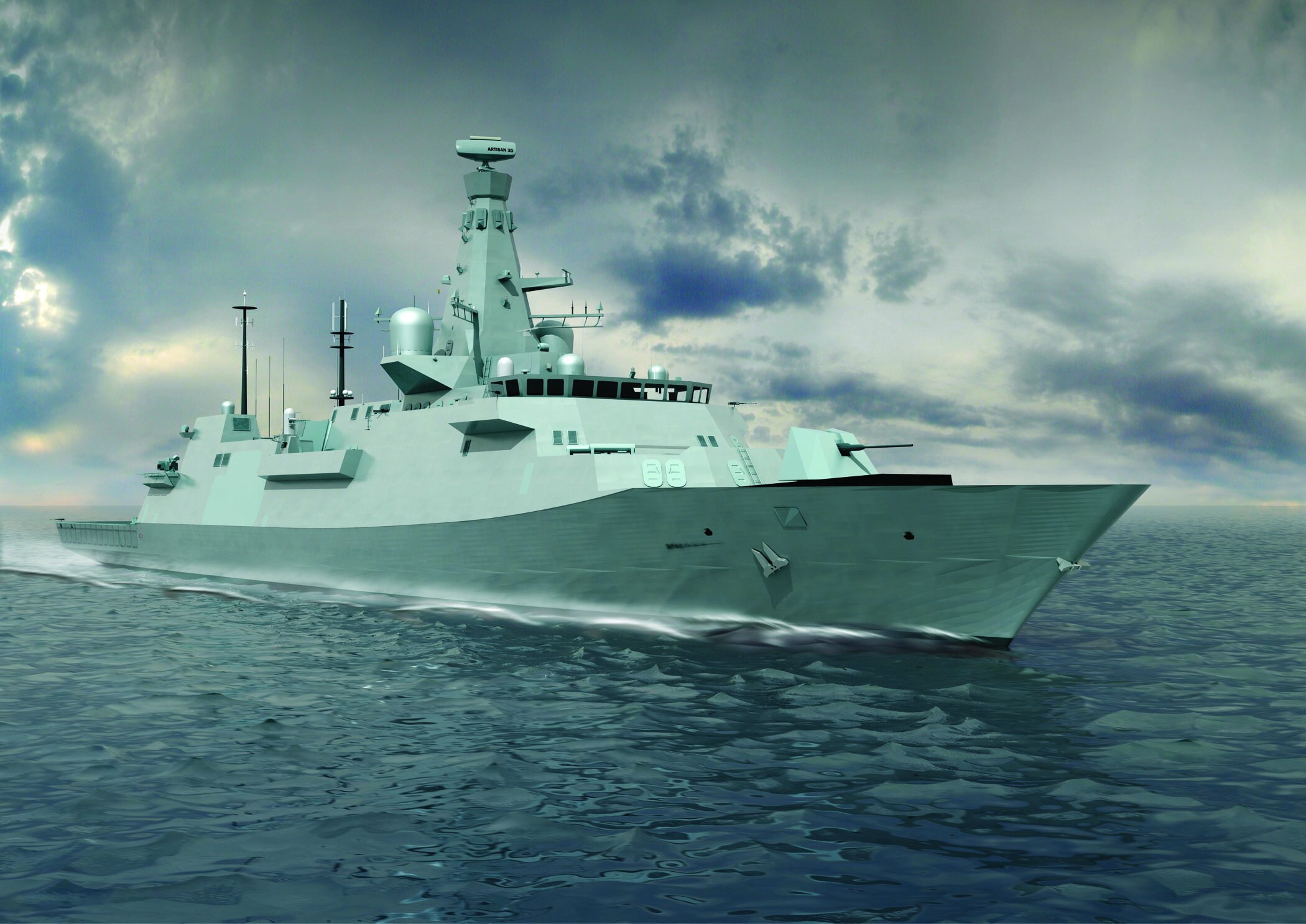
That project proposes the acquisition of 15 Type 26 frigates, the largest single government purchase in Canadian history. Last year the Liberal government signed a deal that would start the process for the acquisition of the initial vessel in a Canadianized version. Lockheed Martin offered Canada the Type 26 warship designed by BAE in the United Kingdom as its bid for the Canadian Surface Combatant (CSC) project. Irving is the prime contractor and the vessels will be built at its shipyard in Halifax, Nova Scotia.

Construction of the first Canadian Type 26 isn’t expected to begin until the early 2020s. The ships would replace the Halifax-class frigates.

The Government Operations Committee requested that Parliamentary Budget Officer Yves Giroux not only examine the cost of the Canadian Surface Combatant project but in addition take a look at the cost of two other types of warships, the FREMM and the Type 31.

Babcock is to build five Type 31s for the Royal Navy in the United Kingdom.

The average cost of those ships are to be less than $500 million each.

Jeremy Quin, the UK’s Minister of Defence Procurement, said steel will be cut for the Type 31 next year, with the first ship in the water by 2023. The Royal Navy will operate Type 26 ships as well as Type 31s.

The FREMM is the other type of warship the Government Operations Committee is interested in having the PBO examine. The FREMM is a multi-purpose frigate designed by Naval Group and Fincantieri for the French and Italian navies. The frigates are also used by Egypt and Morocco.

But in a significant development the FREMM designed has now been selected by the U.S. Navy, which expects to order 10 such warships.

What has caught the interest of some on the Government Operations Committee is the cost the U.S. is paying for its new frigates. The U.S. will spend $1.2 billion ($1.6 billion Canadian) for the first ship. That price includes both the design work to enable the vessel to carry U.S.-specific equipment, as well as to prepare a domestic shipyard to build the vessel. 

After that the price per ship isn’t expected to be no more than $1.3 billion (Canadian) each, according to James Geurts, the Assistant Secretary of the U.S. Navy for Research, Development and Acquisition.

Canada is expected to pay $36 billion for 15 Canadian Surface Combatants, or around $2.4 billion per ship. (The rest of the CSC project – an estimated $24 billion – is for some training, contingency costs, and shore infrastructure and project management costs at the DND).

Parliamentarians are interested in understanding why the U.S. cost per warship is much lower than what Canada expects to pay.

In December 2017 the French and Italian governments already proposed a plan in which Canada could build the FREMM frigate at Irving in Halifax. Those governments offered to guarantee the cost of the 15 ships at a fixed $30 billion but that was rejected by the Canadian government.

Sloane Mask, spokeswoman for the Parliamentary Budget Office, said the analysis requested by the Government Operations Committee will be ready by Oct. 22. “The analytical work is currently underway,” she added.

The Canadian Surface Combatant program has seen steadily increasing costs over the years. In 2008 the then-Conservative government estimated the project would cost roughly $26 billion. But in 2015, Vice-Admiral Mark Norman, then commander of the navy, voiced concern that taxpayers may not have been given all the information about the program, publicly predicting the cost for the warships alone would approach $30 billion.

“Approximately one-half of the CSC build cost is comprised of labour in the (Irving’s) Halifax yard and materials,” according to federal government documents obtained through the Access the Information law.

Some Canadian parliamentarians are privately worried that the CSC project cost will continue rising to $70 billion or $80 billion by the time the program is finished. They have suggested that since a contract has yet to be signed committing Canada to anything more than one ship, the government could withdraw from the Type 26 deal and go for a less expensive alternative.

The entry of the BAE Type 26 warship in the Canadian competition was controversial from the start and sparked complaints the procurement process was skewed to favour that vessel. Previously the Liberal government had said only mature existing designs or designs of ships already in service with other navies would be accepted, on the grounds they could be built faster and would be less risky. Unproven designs can face challenges as problems are found once the vessel is in the water and operating.

But the criteria was changed and the government and Irving accepted the BAE design, though at the time it existed only on the drawing board. Construction began on the first Type 26 frigate in the summer of 2017 for Britain’s Royal Navy but the vessel has yet to be finished.

ANALYSIS: Is It Time To Open Canadian Military Small Arms Contracts To Competition?

: It’s been nine years since the Canadian Forces plan to acquire new handguns to replace the Browning Hi-Power (shown here being used in Afghanistan) was derailed. Some inside the Canadian military blame the Small Arms Strategic Source program for t…

: It’s been nine years since the Canadian Forces plan to acquire new handguns to replace the Browning Hi-Power (shown here being used in Afghanistan) was derailed. Some inside the Canadian military blame the Small Arms Strategic Source program for the ongoing failure to provide pistols to CAF personnel. (Canadian Forces photo)

By David Pugliese

In a flurry of sole-source contracts over the last several months the Canadian military has embarked on a series of purchases of small arms from Colt Canada.

Colt is the country’s Small Arms Strategic Source and Centre of Excellence and the sole source deals maintain the 100-member workforce at the company’s facilities in Kitchener, Ontario.

But questions have been raised in industry circles and in the Canadian Armed Forces on whether having such a strategic small arms capability makes sense for the military and for taxpayers.

 Stéfanie Hamel, a spokeswoman for Public Services and Procurement Canada, told Esprit de Corps that the federal government’s program has allowed the production of quality firearms by Colt for decades. “DND successfully procured multiple small arm fleets through Colt Canada over the years and has the capacity to sustain those fleets during the entire life cycles, including access to sustainment programs, parts, and technical expertise,” Hamel explained. “This stable Canadian small arms manufacturing and maintenance capacity is considered key for the constant readiness of the CAF for domestic and international operations.”

But critics correctly point out that having Colt assume such a role has been costly to taxpayers and has created excessive delays over the years in getting pistols, rifles and machine-guns into the hands of Canadian Armed Forces personnel.

Those who argue against the small arms strategic source concept point out that the days of viewing firearms as a strategic source is no longer valid in a world awash in small arms and companies eager to provide quality weapons at reasonable prices.

Colt produced firearms are seen as quality products by the federal government but that comes with a steep price. In late January Defence Minister Harjit Sajjan announced that the government was purchasing more than 3,600 new C6AI FLEX General Purpose Machine Guns from the company. The $96 million order was a follow-on deal to the 2017 contract for 1,148 of the same machine guns. Some spare parts are included along with cleaning kits and carrying slings in the purchase.

Critics point out that the design of the gun is pretty much the same a previous C6s (based on the FN MAG) but there have been cosmetic changes such as the installation of a top rail and the replacement of the wooden butt stock with a polymer one.

What is different is the cost. The cost of each gun works out to around $27,000, at least twice the amount that other militaries are spending.

In February and April the federal government quietly awarded two other contracts to Colt to produce a semi-automatic rifle in 7.62 calibre to be used by sniper teams as an auxiliary weapon.

The process to acquire what is being called the C20 has been interesting. The acquisition will cost taxpayers $8.5 million for 272 rifles and spare parts.

The federal government initially awarded a $2 million contact to Colt Canada in Kitchener on February 28 to establish a production line to see if it could produce the C20 weapon. That contract also included an initial delivery of 10 of the C20 rifles. That early production run was to ensure Colt had the technical proficiency to deliver the new weapon, according to the Department of National Defence.

The federal government then awarded a $6.5 million contract to Colt Canada on April 17 to produce 262 additional C20 rifles, associated equipment and spare parts.

Canadian Rangers use their new rifles provided by Colt Canada but based on a rifle produced by Sako of Finland. Questions have been raised whether it makes financial sense to spend up to $4,000 for a bolt-action rifle. (Canadian Forces photo)

Canadian Rangers use their new rifles provided by Colt Canada but based on a rifle produced by Sako of Finland. Questions have been raised whether it makes financial sense to spend up to $4,000 for a
bolt-action rifle. (Canadian Forces photo)

The awarding of the contracts were not announced by the DND. The department says it does not have details on the per unit cost of the rifles. But officials acknowledge that taxpayers are paying a premium to have the guns manufactured in Canada under what is called the Munitions Supply Program (that includes the stipulation that Colt is the small arms strategic source). Critics point out that each rifle is costing taxpayers more than $24,000 each.

Probably the most glaring examples of the problems associated with having a small arms strategic source are the lengthy acquisition programs for the Canadian Ranger rifle and the still delayed project to buy new handguns to replace the military’s Browning Hi-Power pistols.

In 2011, the Canadian Armed Forces announced its plan to buy the new pistols and Ranger rifles and then went looking for prices from industry. Approximately 10,000 handguns were to be bought with deliveries to start in the fall of 2015. 

Ten thousand Ranger rifles would also be acquired, with deliveries to start in 2014. 

Foreign firms would bid their weapons for the contracts but in both cases the guns would be built by Colt Canada.

The main problem, according to industry representatives, was the stipulation that the firms provide a Technical Data Package – essentially proprietary information about the firearms – to the Canadian government, with the understanding that would be passed to Colt Canada. Using that information Colt, in turn, would build the guns in Kitchener.

The companies, including some who saw Colt as a competitor, essentially balked at that plan, leaving Canada with no one interested in its competition.

Industry representatives told Esprit de Corps that since the numbers of pistols Canada was buying were relatively small, companies were not inclined to turn over their technical data to Colt. Similar comments were received from the manufacturers of bolt action long guns who might have competed their weapons in the competition to acquire new Ranger rifles.

Colt officials pointed out at the time that the concerns expressed by the firms were unfounded as Colt Canada successfully maintained foreign-made machineguns purchased by the Canadian Forces (C-6s and C-9s) without any major concerns expressed by manufacturers.

Even still, just months later, the Canadian government retreated on its small arms purchases, cancelling its 2011 request to the companies for information about prices and availability. The programs went into limbo as the government tried to figure out what to do.

Besides concerns about Colt as a potential competitor, various small arms companies pointed out the other difficulty with the acquisitions. The numbers of weapons being purchased by Canada were so small that it simply made more sense to place a direct order through the Canadian distributors for those guns. (In some cases, handgun orders to police forces in large U.S. metropolitan centres dwarfed what the Canadian military wanted.) It didn’t make economic sense to have Colt manufacture the guns in Canada or even to have parts shipped to Colt so the guns could be assembled in Canada, industry representatives argued.

In 2016 the Canadian Forces outlined to defence industry representatives – once again – how the replacement for the Browning Hi-Powers would move forward. Industry officials were told then that between 15,000 and 25,000 handguns were needed, with the Canadian military estimating the project would cost around $50 million. Deliveries of the new General Service Pistol would start in 2022-2023.

But sources inside National Defence headquarters in Ottawa say the stumbling block to moving forward continues to be the insistence by DND bureaucrats to have the guns built in Kitchener by Colt Canada.

The Ranger Rifle program did move forward, albeit slowly. The Tikka T3 by Sako of Finland was selected. Colt assembled the rifles but the first weapons didn’t get into the hands of the Rangers until 2018. The Canadian Forces put the price tag for each bolt action rifle at about $4,000. As one small arms industry official pointed out: “That’s pretty expensive for a bolt action rifle which is used mainly for hunting seals.”

Ironically, Sako now markets the same rifle in Canada as the Tika T3x Arctic but the cost to the public is only $2,800. Those specific rifles are made in Finland and were available to the Canadian public even before the Rangers started receiving their weapons.

Ultimately, buying small arms “off the shelf” can be done and something the Canadian Armed Forces has admitted can be accomplished.

The DND and Procurement Canada plan to hold a competition among small arms firms to provide the CAF with 229 C21 rifles. The C21 will be a bolt action medium-range sniper rifle. 

So why didn’t Colt receive that contract? “A Munition Supply Program Business Case Analysis was conducted and it was determined that it would be more cost effective to compete the procurement of the C21 as opposed to have Colt Canada perform the work,” the DND noted. “Creating a new production line at Colt Canada was estimated to be more expensive than leveraging existing production lines currently manufacturing modern multi-calibre sniper rifles through a competitive procurement process.”

There was no explanation, however, why it made economic sense to hold a competition for 229 C21 rifles but it didn’t make financial sense to hold a similar competition for the purchase of 272 C20 rifles, the deal handed to Colt on a sole-source basis.

What will the future hold for the Canadian small arms market? 

The federal government is obviously committed to Colt as the Centre of Small Arms Excellence. “With Colt Canada as the strategic source of supply and centre of excellence for small arms, the Government of Canada has the ability to produce small arms domestically, ensuring the development of a viable and internationally competitive industry that gives Canada long-term industrial and economic benefits,” explained Hamel, the spokeswoman for Public Services and Procurement Canada. But she added: “The government can compete small arms procurements when it is determined to be better value for Canada.”

That statement may hold out hope for Canadian Armed Forces personnel who have been waiting a decade for a new handgun. 

It will now be up to defence firms to lobby the Liberal government MPs to allow for an open competition, taking into account the savings to taxpayers and the speedy acquisition for new handguns for the troops. And it will be up to the politicians to follow through on what is best for Canadian Armed Forces personnel.

Canadian Army Looking For New Tactical Assault Vest – Bids Expected This Fall

08_Feature_TAC VEST.jpg

By David Pugliese

The Canadian Army is looking for a new tactical assault vest/load carriage system as it strives to improve the gear its soldiers are issued. 

A Request for Proposals is expected to be issued to industry sometime in the fall, Army officials told Esprit de Corps.

The current tactical assault vest was originally designed based on the Canadian Armed Forces’ experiences in the Balkans in the 1990s. That design assumed soldiers would carry minimal equipment in a standardized fashion but it is common knowledge that the current vest is not well liked by troops, who – in response - often purchase their own such kit.

Lt.-Col. Ray Corby, who served as Director of Soldier Systems for the Canadian Army’s Directorate of Land Requirements before leaving the post in July, readily acknowledged the current vest is no longer sufficient to meet soldiers’ needs. In fact, surveys conducted by Defence Research and Develop Canada show that the tactical vest is at the top of the list of equipment that soldiers would like to see replaced, Army officials point out. Most soldiers cite the lack of modularity with the current vest as the main cause of their complaints.

The Requests for Proposals for the new load carriage system will be specifically written in a way to encourage creativity on behalf of industry, according to Canadian Army officials. The bid package will outline what soldiers need to do, what they carry and where they operate, as well as provide industry with flexibility to determine how those roles can be accomplished by a new system. Delivery of the new equipment is expected to begin in 2022.

Corby noted that small amounts of equipment could be purchased at first, with modifications made later. “We want to prove that we as an Army can quickly and efficiently trial and select equipment so that going forward we can capitalize on industry’s advances,” he explained. “We are not looking for a 20 to 30-year solution. We want a bit of the best every five years or so for those who need to retain the advantage on the battlefield.”

Selection trials of new load carriage systems are currently scheduled for next summer, which will see industry prototypes evaluated by a cross-section of soldiers from a range of Canadian Army trades. The goal is a modular system that will give soldiers more flexibility to configure their equipment according to occupation and body type, Army officials say. Besides modularity, the other major factor to consider is that of “burden management”, a reference to the weight of all the combined equipment a soldier needs to carry. Too much weight has the unintended effect of slowing soldiers down.

The Canadian Army, however, has yet to announce the results of its testing of a new camoflague pattern. In September 2019, trials began of a new prototype disruptive pattern involving troops with 2nd Canadian Mechanized Brigade Group in Petawawa, with the soldiers mostly belonging to the 3rd Battalion, Royal Canadian Regiment. The majority of soldiers wore a pattern called “Prototype “J.”

The trial lasted approximately six months and ended in February 2020 and produced a wealth of useful data, according to the Canadian Army. In addition, members of the Battalion continue to wear Prototype J.

The troops involved in the Prototype J camouflage tests were issued with uniforms, a soft field cap, helmet covers and fragmentation vest covers.

Some of the tests used uninhabited aerial vehicles to determine the extent the new pattern can be seen from such drones.

The Army has stated that a final decision on the new camouflage is expected no later than 2022. A full roll out of a new camouflage uniform would take place in 2027.

SITUATION REPORT: Canadian Army Commander Lt.-Gen. Wayne Eyre Shares His Vision Of The Future Army

Feature_Wayne Eyre main.jpeg

Interview by David Pugliese

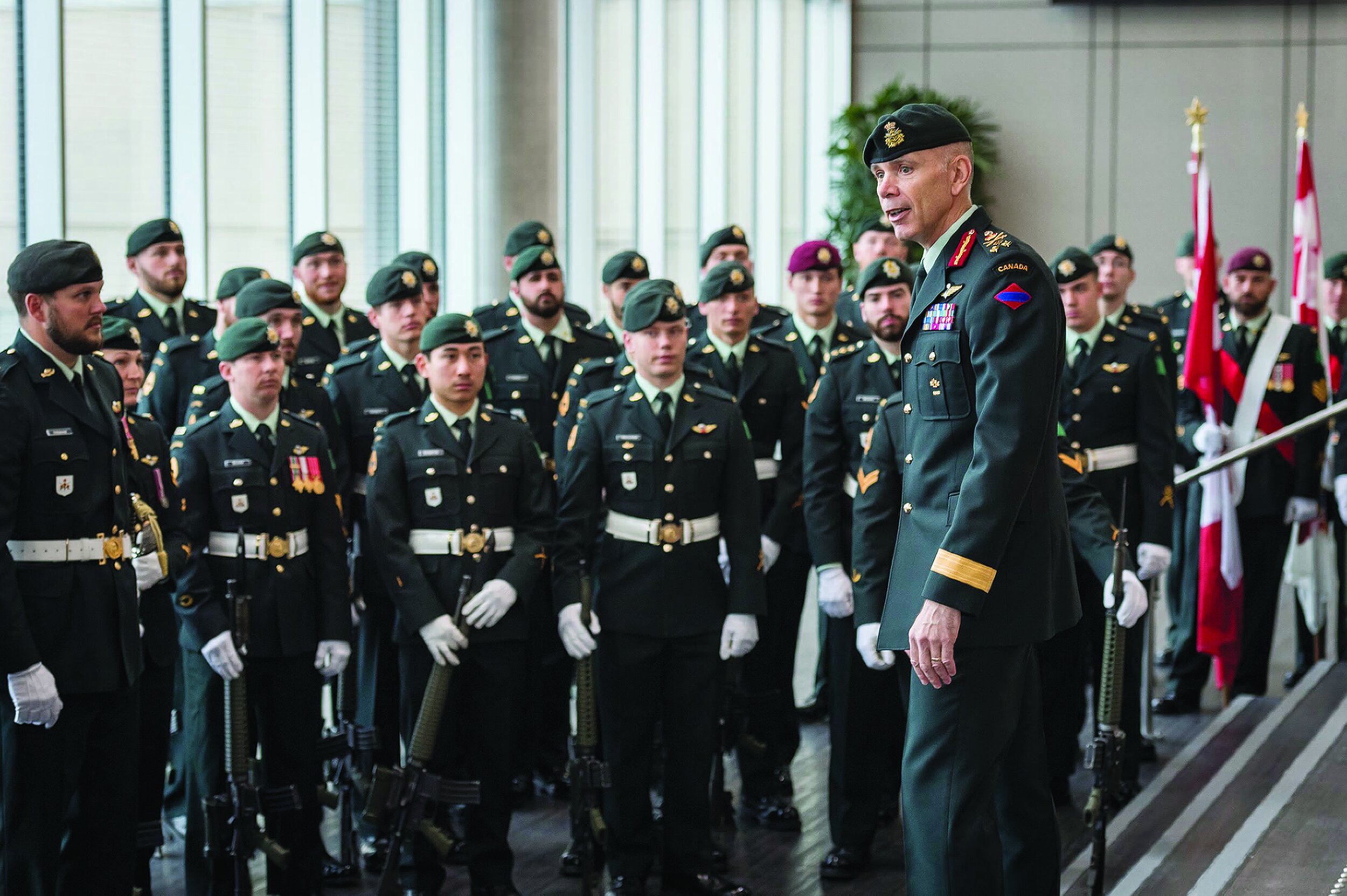
Earlier this year Esprit de Corps magazine interviewed Canadian Army commander Lt.-Gen. Wayne Eyre about his views on the state of the land force, its procurement needs and where he sees the service moving in the future.
Eyre assumed the position of Commander of the Canadian Army in August 2019. He has served in a variety of command and staff appointments including command of 3rd Battalion Princess Patricia’s Canadian Light Infantry, 2 Canadian Mechanized Brigade Group, 3rd Canadian Division and Joint Task Force West, Deputy Commanding General – Operations for XVIII (US) Airborne Corps, and as Commander Military Personnel Command. He was also the first non-American Deputy Commander of United Nations Command, the multinational force supporting the Republic of Korea since 1950. The Canadian Army is the largest element of the Canadian Armed Forces, consisting of 23,000 full-time soldiers in the Regular Force; 19,000 part-time soldiers in the Reserve Force; 5,300 Canadian Rangers who serve in sparsely settled northern, coastal and isolated areas of Canada; and 3,300 civilian employees who support the Army.
The following interview has been edited for length:

Esprit de Corps: What direction do you plan for the Canadian Army in the future?
Eyre: The world is going to be a dangerous place so the demands being placed on the Army aren’t going to go down. If anything it will increase. I think we have a confluence of stressors happening on the global stage. You have the resurgence of great power competition. That’s always dangerous. You’ve got global climate change as well as an acceleration in technological change. You’ve got changes in demographics and the rise of populism. So all of these are creating stressors in the security environment. We can’t really forecast what the future is going to bring other than it will be pretty dangerous and uncertain. But I don’t see the role of land power diminishing. That’s the philosophy I’ve been sharing. It’s really underpinning where I want to take the Army. I’m calling it the Army modernization strategy.
I want to carry on with a number of initiatives my predecessors put in place, really integrate them, tie them together and provide some priority. Right now one of our biggest limiting factors is one of resources and the most important one is people who can execute the change. That is where the prioritization comes in.
Esprit de Corps: What areas will be prioritized?
Eyre: In our modernization we’re going to look at a number of things. We’re going to look at readiness. So how do we get forces ready for operations? How do we increase the overall availability of forces? How do we train our forces? How do we bring in modern training techniques that really reflect some of the cutting edge learning procedures and systems out there?
The second piece is the Reserves. We are going to continue to strengthen the Army Reserves, continue to reinforce them and make sure they will be really able to provide operational capability to the Army as a whole?
The other areas are people, targeted investments, and concepts and capabilities. So do we need to take a look at how we’re selecting people for different positions?
The targeted investment piece examines what capital investments should we put our efforts into. Concepts and capabilities is to look at the question of how we fight in this new environment. How does the Army maneuver in the space of just below the level of violent conflict? We also need to take a look at our force structure to make sure we have that right. Then we will look at what capabilities we need to flesh out in terms of being able to operate in areas like the Arctic because I believe that is going to be of increasing importance for the Army.
Esprit de Corps: What’s your current assessment of the Army’s capabilities for the Arctic?
Eyre: We have five challenges in this area. How do we get ourselves up there? How do we sustain ourselves? How do we move when we are there? How do we survive? And the final challenge is how do we fight? So where are we in all of this? Well, we have a ways to go. We’re not going to be able to get up there by ourselves so we need to work with the Air Force on that. In terms of tactical mobility we’re working on that. One of the equipment projects we have on the books is our Domestic Arctic Mobility Enhancement program, which is really a Bv-206 replacement. The survive piece concerns me. It’s really about the longer term survive and sustain up there. Our infrastructure density in the Arctic is very very low. What happens if we have to respond to something that is in between infrastructure nodes? These are the nuts we need to crack. The basic soldier skills are relatively easy. That’s stuff we have continued to focus on and at the soldier level I think we’re okay. It’s the higher-level concepts that support everything around that which need a lot of work.
Esprit de Corps: Are there technologies that you are focused on or where you want industry to focus on to better support the Army?
Eyre: We want to harvest ideas from industry. For instance, how would be get a land force up to an area that has no infrastructure? This is maybe where we refocus our parachute capability, much as it was the same as in the 1950s and 1960s. So our ability to rapidly get boots on the ground in the Arctic could be by parachute. So these are the types of ideas we are exploring.
Esprit de Corps: Are there particular areas of interest when it comes to procurement for the Army?
Eyre: As part of the modernization strategy I want to lay out project by project and by priority. We are going to be a LAV-based Army for the next two decades. So the question now is how do we protect these LAVs? My top priority is our C4ISR (Command, Control, Communications, Computers Intelligence, Surveillance and Reconnaissance) projects. How do we ensure they can take advantage of the huge amount of data that is out there and connect them to be able to operate in this modern environment.
The second priority I would say would be ground-based air defence. We see the evolving threat from drones, from rockets, and other forms of indirect fire. We have to be able to protect ourselves. We need to look at Joint Fires Modernization. That’s somewhat tied to the C4ISR piece so we have to look at how we tap into the joint fires available, not only from the Air Force but from our coalition allies. We need to ensure we are interoperable and able to access the range of capabilities that are available.
Another priority is figuring out how we sustain ourselves. So this is where trucks come in, and projects such as the Logistics Vehicle Modernization, as well as some of combat support capabilities such as modernizing our bridge and gap capability. There’s probably another 15 or so projects that would be just below this list I just gave you.
Esprit de Corps: Many of these projects are farther out in terms of when they are expected to materialize. Can you advance some of these procurement programs?
Eyre: We are pushing these ones as fast as we can and as fast as the investment portfolio allows for. These ones definitely have my attention.
Esprit de Corps: Have you made any decisions on the requirements for ground-based air defence? For instance, will the system be outfitted on a LAV chassis?
Eyre: We haven’t got that far into it. We know there will be a number of components that will be key, particularly the fire direction centre that can tap into all of the different sensors out there. That would gather information from not just our own sensors but joint and allied ones as well. Such a centre would also tap into other shooters. Conceivably one of our radars could pick up a target and that information goes through the fire direction centre and is connected to a navy asset which then fires a navy missile. That’s where we really want to go. We want to have the brains of this piece right. That’s where the C4ISR piece comes in. The network that will be so
important.
Esprit de Corps: Can you provide examples of where you want to go with C4ISR?
Eyre: Interoperability is a huge piece. So as part of the Australia-Canada-Britain-US-New Zealand (alliance), we have some pretty intense Army interoperability forums where we sit down a number of times each year and talk about the specifications needed to drive the technical interoperability. So we are talking about the ability to put a battalion in each other’s brigades, a brigade in each other’s divisions and seamlessly share data back and forth. That is what we’re aiming for. Our projects will have a huge part of that. The other challenge with the C4ISR piece is changing the way we procure. So the spiral procurement – fielding a little bit of the capability at a time because technology is advancing so fast. We need to be agile to get these capabilities in the hands of our soldiers so what we’re fielding is not absolute.
Esprit de Corps: But won’t you end up with an Army equipped with a variety of various systems doing the same role?
Eyre: I told my staff I am fine with an asymmetric Army that is constantly fielding updated versions of equipment so we can keep that technological edge. If we fail, we fail and we revert back to the old systems. We have to take some risk because our potential adversaries are doing it. They are rapidly fielding new technologies. What we need to have is a culture of continuous change. We introduce new capabilities and learn very rapidly how to incorporate them and employ them.
Esprit de Corps: Most big organizations have an aversion to risk. Won’t the challenge be that others might not feel the same way about accepting risk?
Eyre: But if we don’t we’ll be irrelevant. We’re not the only ones wrestling with this. Every military in the west is facing this challenge.
Esprit de Corps: What is your assessment of the current status of the Army procurement system?
Eyre: I take a look at the projects currently in the pipe and I think back to times in the 1990s. Some of my predecessors would be somewhat jealous to see the number of projects now coming through the system. That being said, no Army in history has ever had all the equipment and all of the capabilities that it wanted, or in some cases, needed. But relative to certain periods of our history I think we’re doing fairly well. Could we do better? Absolutely.
Esprit de Corps: I’m always puzzled when I see defence analysts claiming the Army is in dire straits when it now operates a wide range of modern equipment, including some of the most modern Leopard tanks, the new TAPVs and recently delivered upgraded LAVs. The Army, when it comes to equipment, seems to be in pretty good condition.
Eyre: Yes, but you could probably notice the Canadian proclivity to look at our navels and beat ourselves up.

Interview by David Pugliese
Part 2 of the interview with Lt.-Gen. Wayne Eyre will
appear in next month’s issue of Esprit de Corps.

Major Shift In National Shipbuilding Strategy As Third Yard To Be Selected

12_Feature_Icebreaker.jpg

By David Pugliese

The Federal Government’s decision to add a third shipyard to the nation’s shipbuilding program and shift construction of the Polar-class icebreaker to that facility is a major shift in policy.

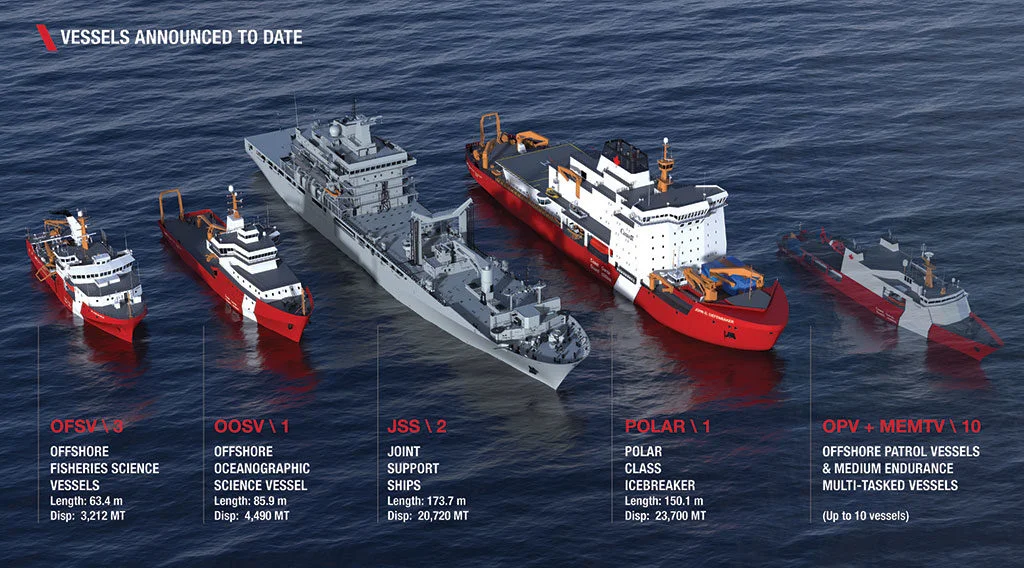
Seaspan was originally named to build the icebreaker – the CCGS John G. Diefenbaker – for the Canadian Coast Guard but the start date for construction of that vessel has been continually delayed.

But in the latest development, Fisheries Minister Jonathan Wilkinson’s office announced that Seaspan will no longer build the icebreaker. Instead it will build 16 new multipurpose vessels for the Canadian Coast Guard.

No decision has been made on who will construct the Polar-class icebreaker.

But the decision to remove construction of the icebreaker from Seaspan comes shortly after Prime Minister Justin Trudeau announced that the federal government will select a third shipyard to also build federal vessels. That shipyard would be in addition to Irving and Seaspan who are constructing vessels for the federal fleet.

Chantier Davie, the largest yard in the country, has stated it will pursue that third shipyard designation, prompting suggestions that it is a strong contender.

The government has stated it will move forward with a competitive process to select the third shipyard in the coming months. But Trudeau also hinted that Davie could become that third shipyard. “We recognize that it’s an opportunity for Davie to apply to become that third shipbuilding facility because there will be a tremendous amount of work in the coming years for workers in our shipbuilding industry right across the country from coast, to coast, to coast,” Trudeau said at a news conference in May.

Davie spokesman Frederik Boisvert also noted that the yard is the only one in Canada that has the capacity and ability to deliver the new icebreaker.

That Polar-class icebreaker would replace the aging CCGS Louis S. St-Laurent, which is currently at Davie in drydock as the firm works on a life extension for the vessel.

Seaspan is still trying to determine various details with the federal government on both the multipurpose vessels and the situation with the Polar-class icebreaker. The government has stated that the 16 Multi-Purpose Vessels will support a variety of missions, including light icebreaking, environmental response, and offshore search and rescue. It will also proceed through a competitive process with the design of the new class.

“We are in the process of seeking clarification from the Government of Canada regarding any decisions that have been made to alter the scope of Seaspan’s work under the NSS (National Shipbuilding Strategy),” Seaspan communications advisor James Mitchell told Esprit de Corps.

Davie has been lobbying the federal government for years to be let into the national shipbuilding plan. It has already received work to provide interim icebreakers.

On December 14, 2018, the Canadian Coast Guard accepted the first of three interim icebreakers being converted by Chantier Davie as part of a $610-million contract awarded in August 2018. The three icebreakers were acquired to supplement the Coast Guard’s existing fleet during vessel life extension and repair periods, providing continuous on-water capability during scheduled maintenance periods, the government has noted.

The Liberal government’s decision to change the National Shipbuilding Strategy to include a third yard – presumably Davie – comes as a federal election looms. A third yard to build the Polar-class icebreaker would not only provide the Canadian Coast Guard with such a vessel on a much faster basis but could also earn the Liberals votes in Quebec.

If the Conservatives form the next government will they follow through with the plan for a third shipyard? The Conservatives have indeed voiced concern about the delays related to the Polar-class icebreaker. In fact, Conservative MP Todd Doherty, has warned that the icebreaker wouldn’t be delivered until 2030.

A Conservative government could be hard pressed to jettison the plan for a third shipyard to build the Polar-class icebreaker.

DOWN TO THE SEA IN SHIPS: Heady Days For Canadian Naval Procurement

08_RCN-MV-Asterix.jpg

(Volume 25 Issue 3)

By David Pugliese

There’s a good chance that this year’s CANSEC will be easily dominated by companies hoping to sell naval defence products to Canada.

With the federal government’s shipbuilding program in full swing – and a number of related major projects waiting in the wings – potential suppliers for the Royal Canadian Navy can use CANSEC 2018 as the premier vehicle to highlight their systems.

The defence and security trade show will be held this year on May 30-31 at its usual location at the EY Centre, near Ottawa’s international airport.

The future prize of Canada’s naval defence procurement is unquestionably the Canadian Surface Combatant (CSC), a $60 billion project estimated to provide years of work for as many as 80 domestic companies and whichever consortium is selected as the winning team.

Many of those firms will be highlighting their potential role in CSC at CANSEC 2018.

Three bids have been submitted to the Canadian government and Irving Shipbuilding for the CSC program.

rving will soon be launching the first Arctic Offshore Patrol Ship. (Photo courtesy Irving)

rving will soon be launching the first Arctic Offshore Patrol Ship. (Photo courtesy Irving)

Among the formal bids is the one from Lockheed Martin Canada, who will be the prime on the team that includes BAE Systems, CAE, L3 Technologies, MDA, and Ultra Electronics.

The team is offering the BAE Type 26 warship for the Canadian program.

The proposal includes Lockheed Martin Canada’s combat management system, CMS 330, which is currently on board the modernized Halifax-class frigates. A scaled down version of the system will be used on the Royal Canadian Navy’s new Arctic Offshore Patrol Ship fleet.

At its CANSEC 2018 booth, Lockheed plans to have a large-scale model of the Type 26 on display, company officials say. The firm sees the Type 26 as very low risk and is adaptable to accept various systems including the CMS 330.

Lockheed’s CSC team will also be emphasized at the trade show. CAE is involved in training, MDA has engineering and manufacturing capability, Ultra provides underwater warfare systems and L3 has a range of defence and electronic products.

In addition, Canadian companies such as W.R. Davis Engineering in Ottawa, Rolls-Royce in Peterborough and L3 MAPPS in Montreal have already begun work on delivering high-technology systems for the UK’s Type 26.

Alion Science and Technology, along with its subsidiary Alion Canada, submitted their proposal based on the Dutch De Zeven Provinciën Air Defence and Command (LCF) frigate. That frigate is a proven NATO vessel built by Damen Schelde Naval Shipbuilding.

Underlying the Alion offering is its focus on affordability, risk reduction and Canadian content, grounded in nearly 50 years of experience designing and producing combatants.

Alion’s combat system solution to be highlighted at CANSEC 2018, is based on the world-class capabilities of ATLAS-Elektronik and Hensoldt Sensors. ATLAS brings a renowned open architecture Combat Management System that readily accepts new and evolving technologies, officials with the team point out. Hensoldt’s capability and experience in developing and fielding state-of-the art radars was central to meeting the unique Canadian requirements with a fielded, non-developmental radar. Other key suppliers for the team include L3 Technologies Canada, Raytheon Canada Limited, DRS Technologies Canada Limited (DRS TCL) and Rheinmetall Canada Inc.

ATLAS- Elektronik Canada of Victoria, BC is also promoting its SeaSpider system, which can be offered to the RCN as an Anti-Torpedo-Torpedo. The company points out that SeaSpider is the world’s first dedicated Anti-Torpedo-Torpedo (ATT) and is capable of being used to counter threats against submarines or ships. It can operate in both deep and shallow water; the company also points out that the weapon system is deliberately designed to be affordable for navies in procurement and operation.

Navantia of Spain is leading a team that includes Saab Australia and CEA Technologies. Its proposal is based on the F-105 frigate design, a ship in service with the Spanish navy.

Saab, which would provide the combat management system, has support on the CSC program from Lockheed Martin (Moorestown, New Jersey), General Dynamic Mission Systems - Canada, DRS Technologies Limited Canada, OSI Maritime Service and Rheinmetall Canada, according to Navantia.

Fincantieri of Italy and Naval Group of France offered Canada the consortium’s FREMM frigate design. But the firms did not submit a bid to Irving via the CSC procurement process. Instead the companies made their proposal direct to the Canadian government, noting that they could save significant amounts of money because their ship is in production and the production costs are well established. That proposal was rejected by the Liberal government.

Naval Group (formerly DCNS) nonetheless continues to maintain a significant presence in Canada.

Davie Shipbuilding and its affiliate Federal Fleet Services have had a run of successful ventures to highlight at CANSEC 2018.

Their Project Resolve, the program to provide an interim refueling and supply vessel for the Royal Canadian Navy, rolled out without any hitches.

Canadian sailors have trained on the Motor Vessel (MV) Asterix and a crew provided by Federal Fleet Services will operate the 26,000-tonne Asterix. Navy personnel will be on board to handle maritime operations such as refueling warships at sea.

Raytheon Canada Limited is overhauling and providing in-service support for the Phalanx Close-In Weapon Systems operated by the Royal Canadian Navy. Raytheon has promoted its Phalanx system and its capabilities over the years at CANSEC. (DND photo)

Raytheon Canada Limited is overhauling and providing in-service support for the Phalanx Close-In Weapon Systems operated by the Royal Canadian Navy. Raytheon has promoted its Phalanx system and its capabilities over the years at CANSEC. (DND photo)

By the time CANSEC 2018 has started the Asterix will already be accompanying Canadian warships on international operations, with preparations for addition missions such as the U.S.-led Rim of the Pacific exercise scheduled to start in July.

As of press time, the companies are also in negotiations with the federal government about a plan to convert several former oil industry vessels into icebreakers for the Canadian Coast Guard.

Under the proposal the icebreakers, originally built for Shell and other companies for use in Arctic operations, would be brought to Davie shipyards for upgrades to allow them to be used by the Coast Guard.

MV Aiviq, Polar-class icebreaker, was originally built in the US and the other three, built in Norway, are considered medium icebreakers.

If the deal goes through expect it to be a highlight at CANSEC 2018.

Irving will soon be unveiling the first Arctic Offshore Patrol Ship (AOPS), an opportunity for some CANSEC exhibitors to point out their achievements on the project. GE’s Marine Solutions business in Peterborough, Ont. has a multi-year contract with Irving to provide electrical power, propulsion systems, installation and commissioning services for the AOPS. GE’s power and propulsion systems will position the new vessels amongst the highest performance in their class worldwide, company officials point out. 

CANSEC exhibitor Seaspan Shipyards is riding high on its successful launch of the first large vessel to be designed and built under the Canadian government’s National Shipbuilding Strategy. OFSV1 is the first of three Offshore Fisheries Science Vessels (OFSV) to be built by Seaspan. OFSV1 is a 63-metre Canadian Coast Guard fisheries research vessel. The ship will be used to gain a better understanding of the health of fish stocks and their ocean environment. OFSV1 is the first of three OFSV ships built by Seaspan, with considerable progress made on the remaining two ships.  Seaspan, of course, is well known in the Canadian defence industry as it has been selected to build the Joint Supply Ships for the RCN and a new Polar-class icebreaker for the Canadian Coast Guard.

Rheinmetall Canada is known for its land-based defence systems, particularly its fully digital and stabilized remotely controlled weapon stations. But it also has a footprint in the naval realm. The Nanuk weapon station produced for the Canadian Army’s LAV-111s has been navalized for the RCN. One prototype has been installed and tested successfully on board HMCS Goose Bay.

CANSEC exhibitor MBDA has and continues to promote its Aster missile system as an air defence option for the CSC.
If selected the firm has noted it would offer a manufacturing and production facility in Canada. Aster 15 is a short to medium range missile and Aster 30 is a short to long range, so the company has various options for the RCN. In addition, MBDA offers CAMM-ER (Common Anti-air Modular Missile Extended Range).

Other firms in Canada’s defence industry have recent successful export deals to highlight. NovAtel of Calgary has had success with its unique technology on the international naval market. It recently announced that its GPS Anti-Jam Technology or GAJT has been selected for the United Kingdom’s Type 26 frigates to meet a requirement as part of a protected navigation system. GAJT protects GPS-based navigation and precise timing receivers from intentional jamming and accidental interference, ensuring that the satellite signals necessary to compute position and time are always available. It is a commercial off-the-shelf product, and comes in versions suitable for land, sea, fixed installations and smaller platforms such as unmanned aerial vehicles (UAVs).

Rolls-Royce Canada also has its latest win on the international stage to highlight at CANSEC.  It has won a contract with BAE Systems for its mission bay handling technology for the UK Royal Navy’s Type 26 frigates. The contract covers the first three ships - the first of which is currently under construction at the BAE Systems Glasgow shipyard, Scotland, according to Rolls-Royce Canada.

Equipment designed for the Royal Canadian Navy has also sparked export orders. Leonardo DRS, Inc. has highlighted that its Canadian subsidiary, DRS Technologies Canada, Ltd., has been awarded a contract by the U.S. Navy to provide four additional Integrated Voice Communications Systems (IVCS) for their Aegis cruisers and destroyers. The award is part of the U.S. Navy’s larger IVCS contract.

The IVCS, also known as the Shipboard Integrated Communications System, or SHINCOM, on board various RCN vessels.

CANSEC exhibitor Raytheon Canada Limited has a new contract to highlight at the trade show. Raytheon Canada is overhauling and providing in-service support for the Phalanx Close-In Weapon Systems operated by the Royal Canadian Navy.   

Raytheon produces Phalanx, a rapid-fire, computer-controlled radar and 20mm gun system that automatically acquires, tracks and destroys enemy threats that have penetrated other ship defense systems. More than 890 systems have been built for navies around the world.

“The Phalanx CIWS is an integral element of the Canadian Navy’s defence,” Terry Manion, RCL vice-president and general manager, said in a statement. “This contract supports modernization work that will keep these systems ready and relevant well into the future.”

Under the $330 million contract by Public Services and Procurement Canada, RCL, working with Raytheon Intelligence, Information and Services, will provide maintenance, fleet technical support, repair and overhaul services on the Phalanx mounts which will ensure the systems are ready to address current and emerging threats.

Work under the contract, valid until late 2037, was announced in late January by Defence Minister Harjit Sajjan. It will be conducted in Raytheon Canada Limited›s Calgary facilities.

The contract will update all 21 Phalanx CIWS and provide engineering services, project management, support and disposal services, as well as the procurement of spares and test equipment.

Pension For Life?

An injured soldier is rushed off the battlefield and onto a CH-146 Griffon helicopter following a firefight in a mock Afghan village during Exercise MAPLE GUARDIAN at CFB Wainright in 2008. Unfortunately, this scenario played out all too often on th…

An injured soldier is rushed off the battlefield and onto a CH-146 Griffon helicopter following a firefight in a mock Afghan village during Exercise MAPLE GUARDIAN at CFB Wainright in 2008. Unfortunately, this scenario played out all too often on the real battlefield of Afghanistan. (Cpl Jasper Schwartz, Army News Montreal)

(Volume 25-01)

By Sean Bruyea & Robert Smol

Everything Veterans Wanted to Know About the Liberals’ Pension for Life Plan …
And Should Not Be Afraid to Ask

Changes to the Pension Act resulting from the New Veterans Charter led to a demand for a new benefits plan for injured soldiers. Will the Liberals’ proposed Pension for Life plan bring about the desired reforms needed?


If there is any praise worthy of the Trudeau Liberals, it would be their ever so sharp appreciation and application of political spin, evasion and deception. No doubt should this government’s anaemic feint at implementing life-long pension actually come into effect in 2019 (an election year), they will claim that they had fulfilled their sacred obligation to Canada’s disabled veterans.

But the reality is that this revised pension scheme is a pale reflection and a clear reduction when compared to the lifelong monthly pension Justin Trudeau personally promised. Monetarily, it does not go anywhere near corresponding pension amounts given to those who, ironically, were lucky enough to “take a bullet for Canada” before 2006.

Prime Minister Justin Trudeau speaks with Canadian Armed Forces members participating in Operation LENTUS in Lamèque, New Brunswick on February 3,  2017. As with most election promises, keeping them once in power is always difficult to do. (wo …

Prime Minister Justin Trudeau speaks with Canadian Armed Forces members participating in Operation LENTUS in Lamèque, New Brunswick on February 3,  2017. As with most election promises, keeping them once in power is always difficult to do. (wo jerry kean, dnd)

As with any “new and improved” marketing campaign, this alleged attempt at bringing back disability pensions for veterans must be aggressively scrutinized, not just for the actual content of the pension plan but also for the manner and circumstances in which it was presented.

Indeed, the manner, time and location of the Liberals’ new pension announcement says much about how the government itself feels about what they are doing to today’s disabled veterans. When the Liberals promised to bring back lifelong pensions, it was done very publicly at the height of the 2015 election.

Disconcertingly, the announcement of the much-anticipated return of these pensions in late December 2017 was made neither in a public venue nor even a Veterans Affairs facility but in a high security, claustrophobic basement room in National Defence Headquarters. Injured military, veterans and family members were not welcome. Nor could Parliament ask questions on the proposals since the Liberals waited until the House rose, making the announcement only days before Christmas. Government clearly was not proud of these proposed programs knowing full well how vulnerable the plan is to scrutiny and criticism.

Before we look at the announced details of the plan, let’s take a look at how military members and veterans are compensated for their injuries.

When Canadian Armed Forces (CAF) members suffer a service-related disability, government has the legal obligation to compensate for both pain and suffering through tax-free amounts as well as taxable compensation for lost income. But let’s be frank, this is no magnanimous gesture of appreciation to our military veterans. Indeed, this legal obligation is no different than court awards or most provincial workplace insurance programs. Simply put, military veterans were historically the first employment group in Canada to be compensated for lifelong injuries.

In September 2010, then MND Peter MacKay and then MVA Jean-Pierre Blackburn announced that the Government of Canada would allocate $52.5 million over five years in additional support to establish a legacy of care for seriously injured Canadian Force…

In September 2010, then MND Peter MacKay and then MVA Jean-Pierre Blackburn announced that the Government of Canada would allocate $52.5 million over five years in additional support to establish a legacy of care for seriously injured Canadian Forces personnel and their families. However, the legislative amendments to deal with shortcomings identified in the New Veterans Charter have yet to be fully ratified. (dnd)

The creation of the 1919 Pension Act after the Great War is widely seen as the origin of this way of recognizing wartime sacrifice on behalf of Canada. In fact, lifelong recognition of pain and suffering as well as compensating for lost income dates back to the War of 1812, when the first comprehensive plan for disabled Canadian veterans was implemented in 1816 and 1817. Government provided lifelong pensions with additional amounts for spouses and children as well as assistance in re-establishing the individual, such as land and farm supplies.

Re-establishment and retraining support was expanded to all returning Second World War and Korean War veterans, whether injured or not. However, CAF veterans after this period did not fare so well. Beyond the oft-ridiculed Second Career Assistance Network (SCAN) seminars, releasing members received absolutely no assistance. Only recently have they started receiving some limited help beyond SCAN. The injured did not receive universal rehabilitation and retraining assistance until the CAF made the Service Income Security Insurance Plans (SISIP) for lost income and rehabilitation mandatory in 1982.

At least all injured CAF members and veterans, under the Pension Act, were eligible for lifelong monthly payments plus amounts for spouses and children.

However, back in 2005, it was the Liberal government under Paul Martin that introduced the legislation eliminating lifelong pensions. At the time, this plan had the full support of the Conservatives, the Bloc Québécois, as well as the NDP. This so-called “New Veterans Charter” replaced the lifelong disability pension with a one-time lump sum payment as part of a hodgepodge repackaging of already existing programs. Persistent complaints under the Harper Conservatives and calls to change these programs were met with bureaucratic stonewalling and political insouciance.

The latest programs announced by the Liberals are to take effect in April 2019 and will bring some changes that can be divided under pain and suffering as well as income loss. Veterans, undergoing retraining or if unable to fully return to work due to their lifelong injury, will continue to receive an income loss paying 90 per cent of their military salary until age 65. They also will continue to receive retraining if able to work.

There is nothing new here. However, positive announcements include raising the minimum income loss to just over $48,000 annually, allowing veterans to receive employment income up to $20,000 annually without penalty, and collecting up to 70 per cent of their military salary, “less offsets,” after age 65.

The positive news ends there. Unlike court awards and most workplace insurance schemes, the new Liberal program for lost income will not fully recognize lost career progression but provides a token one per cent annual increase per year for every year less than 20 years that the veteran served in the military. Considering that current Deputy Minister of Veterans Affairs Walter Natynczyk and Veterans Ombudsman Guy Parent have approximately 40 and 50 years respectively of career progression while collecting full military pensions and top public service salaries without “offsets,” disabled veterans are being grossly short-changed on this one.

Under the category of pain and suffering, an existing taxable allowance for those with severe injuries will be replaced with a lower-paying non-taxable allowance of up to $1,500 monthly. A currently available taxable supplement of $1,100 monthly will be eliminated with no replacement.

Furthermore, under the same category of non-taxable benefits for pain and suffering, injured veterans will have a choice between a lump-sum payment of up to $360,000 and a monthly “Pension for Life” up to a maximum of $1,150 to compensate for their injuries. There are no additional amounts for spouses or children. The average “Pension for Life” likely will be around $200 per month. For the 60,000 veteran recipients still receiving the Pension Act, they are paid an average of $680 per month plus amounts for spouses and children.

For a government aggressively branding itself as gender equal, it is ludicrous that female veterans will receive less each month in pain and suffering payments than males because “sex is a factor of life expectancy.” Imagine corporate Canada or the civil service under our current prime minister paying their female employees less with the justification they will live longer in the job than their male counterparts. If there were to be any discrepancy based on gender, women should be paid more given the hyper-macho culture of harassment and abuse they have long endured.

As for family members, frustratingly, they can only collect income benefits if the disabled veteran dies as a result of the military injury. Lifelong suffering benefits will be paid out only if there is “any residual amount” to be paid to the deceased veteran. Years of sacrifice caring for a veteran living with severe psychological suffering or multiple amputations mean nothing if the veteran dies of a heart attack or car accident. No such restriction exists for the recipients who got coverage under the old Pension Act. Survivor benefits are paid throughout their remaining life at their full, not “residual” amounts.

Certainly veterans will be severely anxious and perplexed by the complexity of the new program and its murky criteria to qualify. But military veterans, and indeed all Canadians, should be beyond furious at the fact that civilian government employees disabled in a flying accident and all RCMP members can continue to apply for the lifelong Pension Act programs, but we veterans, for whom the program was specifically designed in 1919, cannot?

Why the discrimination in favour of other government employees and against those who volunteer to wear the military uniform? This is the question our veteran community needs to ask again and again at every campaign rally and at every town hall between now and the next election.

Indeed, comparisons between Pension Act recipients and this new program is where veterans will likely condemn this new program, and any political party that supports it. If the program is so much better than the Pension Act, why are Pension Act veterans denied access to the new program?

Predictably, government is clearly hoping that the “soldier on” “carry on” “yes Sir” conformity and deference to authority we may have learned in the Forces will somehow manifest itself again in our post-service life. As bureaucrats and politicians bide their time while older generations of veterans die off, is it their intention we lose touch with the better benefits that our fathers’ and grandfathers’ generations received in decades past? Callously, government is counting on their endless rhetoric and accolades to avoid providing the same level of support to differing groups of veterans based upon arbitrary application and release dates.

Many questions will gnaw at the honour and dignity of Canada’s proud veterans. Guy Parent has repeatedly voiced his own empty rhetoric for “one veteran, one standard,” which is also a key commitment in the Liberal mandate letters. The ombudsman’s silence on this new program is not merely deafening, it demonstrates his fear to bite the enriched hands that feed him.

“I won’t go back to the Pension Act of 1919,” said Veterans Affairs Minister Seamus O’Regan in a recent interview with CBC. “It did not meet the needs of our veterans.”

Really?! Of course, like any disability compensation program, there were those who did not get quite what they thought they deserved from the old Pension Act. But the reality is that, before 2006, there was nothing even remotely resembling the widespread anger, desperation, and sense of betrayal seen among disabled veterans in the last decade.

Our men and women in uniform fulfill their debt to serve and sacrifice at a moment’s notice. How can governments perennially string along vulnerable disabled veterans and their families? Politicians of all stripes dance around repaying that debt until the next election campaign begins, claiming there’s not enough money in the federal till. They wait until the public outcry has become unbearable, and then make only token gestures even when tragic veteran suicides blanket the news.

Meanwhile, Canadians know our veterans, disabled or not, should and must not wait until politicians and bureaucrats exhaust their bag of excuses to honour lifelong sacrifice with equitable and dignified lifelong compensation.

FIGHTER JETS COMING: CF-18 Replacement Project Takes Off

Royal Canadian Air Force CF-18 fighter jets taxi on the runway in Kuwait during Operation IMPACT on November 13, 2014. The start of the competition to replace the current fleet of 76 modernized fighter aircraft has officially begun, although a decis…

Royal Canadian Air Force CF-18 fighter jets taxi on the runway in Kuwait during Operation IMPACT on November 13, 2014. The start of the competition to replace the current fleet of 76 modernized fighter aircraft has officially begun, although a decision on the winning bid will not be announced until at least 2019. (Canadian Forces Combat Camera, DND)

(Volume 25-1)

By David Pugliese

The competition to supply Canada with a new fighter jet is officially on.

Liberal ministers announced the start of the competition on December 12, 2017 and plans are moving forward on the process.

The Liberal government has committed to buying 88 aircraft.

Senior government officials said the finalized solicitation documents will be released beginning in spring 2019 and that these will result in the selection of a permanent replacement fighter aircraft fleet by 2022. The first plane would arrive in 2025.

The new fleet will be continuing in service beyond 2060.

So how will the process unfold?

The Canadian government held what it called a Future Fighter Industry Day on January 22 in Ottawa.

The objective of the event was to present foreign governments and industry with the information required for them to make an informed decision about whether they will participate in the procurement. In addition, the event provided an opportunity for Canadian industry to network with foreign governments and fighter aircraft manufacturers.

The industry day went for four hours and involved 200 participants from foreign governments as well as Canadian and foreign industry, Troy Crosby, Director General, Defence Major Projects Sector for Public Services and Procurement Canada, told Esprit de Corps. “Our objective, and I think it was fairly successful based on the feedback we got, was to ensure the potential suppliers have the information they need,” he said. That information, Crosby noted, will allow participants to “understand what it is this procurement is out to achieve.”

Canada will establish a list of suppliers as a first step in this procurement. The list will be comprised of foreign governments and fighter aircraft manufacturers that have demonstrated their ability to meet Canada’s needs, according to the federal government. Responses from those who want to be on the suppliers’ list have to be submitted by February 9.

Once the list is formalized, only suppliers on the list will be invited to “subsequent engagement activities and to submit proposals for this procurement,” the Canadian government has noted.

Proposals will be rigorously assessed on elements of cost, technical requirements and economic benefits.

At the same time, the ministers also announced a change to the standard procurement process. The new provision appears aimed directly at Boeing, which complained to the Trump administration that its Quebec-based competitor Bombardier was receiving unfair government subsidies on the production of its C-Series civilian passenger aircraft. The U.S. ruled in favour of Boeing, resulting in Bombardier facing duties of almost 300 per cent on sales of its C-Series planes in America.

The Liberal government retaliated against Boeing’s complaint by cancelling plans to buy 18 of the company’s Super Hornet fighter jets at a cost of around $6 billion.

And as part of the competition for the new fighter jets, Canada will assess a company’s “economic behaviour” in previous years — a provision that effectively serves notice to Boeing that it will be at a disadvantage in competing for the new program as long as the U.S. duties against Bombardier stand.

The provision was immediately dubbed by the news media as the “Boeing clause.”

Navdeep Bains, the Minister of Innovation, Science and Economic Development, said at the news conference to announce the competition that any company is welcome in the process. But the new policy is designed to protect the Canadian economy and key sectors such as aerospace, he added. “If they (a company) cause economic harm they will be at a distinct disadvantage,” Bains said.

Bains and Defence Minister Harjit Sajjan said Canada was looking for a “trusted partner” to provide it with new fighter jets. In the ongoing battle with Boeing, cabinet ministers continued to state that Boeing was no longer a trusted partner.

But procurement minister Carla Qualtrough left the door open for Boeing to change its stance. She said that the evaluation of bids will be done in several years and the provision will be enforced based on a company’s situation at that time. That allows Boeing a chance to drop its complaint against Bombardier, government officials privately noted.

But is the so-called Boeing clause even legal? Public Services and Procurement Canada received a legal analysis about this potentially controversial policy and Qualtrough indicated she was confident the clause could stand any test. Although she said that there are no guarantees Canada would not be sued, Qualtrough added, “We are confident this policy is appropriate.”

The policy would be applied to all future procurements, she added.

What was missing from the news conference was an explanation and proposed criteria on how the federal government would determine whether a company has harmed Canada’s economy.

Boeing officials have repeatedly pointed out that the company is a trusted partner to Canada as it employs thousands of people in the country and has been a presence in the domestic aerospace market for decades. Boeing would also be able to point to its operations in Canada and how it has successfully met all offset requirements from previous defence contracts.

So, which firms are expected to be interested in the new fighter procurement? The list is the same as it has been for the last ten years, when the Conservative government looked at replacing the CF-188 Hornet fleet. The potential contenders include:

LOCKHEED MARTIN F-35

Lockheed Martin has in the past not only highlighted the advanced fifth generation capabilities and stealth technology of its F-35 but it has been promoting the fact that the aircraft is now operational. It expects the cost to come down as more aircraft are produced for Canada’s allies. In addition, Canadian industrial participation in the F-35 program has reached $1 billion (..) as more than 110 Canadian firms have landed contracts related to the aircraft program. That will be key for Lockheed Martin to highlight to Canadian government officials.

Interoperability with Canada’s allies is also a key factor since many will be operating the F-35 far into the future.

To address concerns about the plane’s ability to operate in the Arctic, Lockheed Martin officials point out that F-35 customers – the U.S., Denmark and Norway – will all be using the aircraft in Arctic operations.

BOEING SUPER HORNET

Boeing officials have pointed out their aircraft is combat proven, less expensive than the F-35 and will be operating for more than another 20 years. They have also highlighted the fact that its two engines provide added safety for Arctic flights.

The jet has its landing gear designed to take the pounding of short landings on aircraft carriers, a design that works nicely with the forward operating locations in Canada’s Arctic, company officials have noted in the past.

Another feature is that the Super Hornet can act as a refueller for other Super Hornets, extending its range significantly.

With the so-called “Boeing clause” as part of the selection criteria expect the company to highlight the work Canadian firms do on a variety of its aircraft. In all, some 2,000 Canadians are employed by Boeing.

In addition, since the RCAF already operates the CF-18 Hornet, there should be a smooth training transition for the Super Hornet. The aircraft can also make use of Canada’s existing infrastructure.

SAAB GRIPEN

Saab’s Gripen is known for its reasonable acquisition price tag and its low maintenance costs.

The aircraft has a proven track record in a cold weather environment and is compatible with weapon systems used by Canada.

In addition, the aircraft is designed to take off from short runways and can be outfitted with Link 16 for communications with NATO and U.S. allies.

In the past, Saab has indicated its willingness to assemble aircraft in Canada if that is something Canada’s government is interested in having done. In its recent deal with Brazil, Saab showed a flexibility to work with domestic firms. Brazil’s government selected the Gripen NG over the Dassault Rafale and Boeing Super Hornet.

EUROFIGHTER TYPHOON

The consortium promoting the Eurofighter Typhoon has pointed out that the aircraft is less expensive than the F-35. Any purchase by Canada could also include technology sharing and final assembly in Canada. The combat-tested aircraft is also compatible with U.S.-made weapons that are used by Canada.

The Typhoon has both the speed and the range for Canada, Eurofighter test pilot Christian Worning has told Canadian parliamentarians.

The Eurofighter consortium can also promote the fact that the aircraft has two engines, providing it with added safety while flying on Arctic operations.

DASSAULT RAFALE

Dassault, as part of its previous sales pitch to Canada, promised to transfer fighter jet technology/intellectual property to Canada. The aircraft has two engines and has been combat tested in Libya and Mali. Dassault has noted that the aircraft — or parts of it — could also be assembled in Canada.

NSS Report Card

With the Resolve-class MV Asterix preparing to enter service in 2018 followed by the first arctic offshore patrol vessel (AOPV) —HMCS Harry DeWolf — a new dawn is about to break on the Royal Canadian Navy. (Corporal J.W.S. Houck, Formation Imaging S…

With the Resolve-class MV Asterix preparing to enter service in 2018 followed by the first arctic offshore patrol vessel (AOPV) —
HMCS Harry DeWolf — a new dawn is about to break on the Royal Canadian Navy. (Corporal J.W.S. Houck, Formation Imaging Services)

(Volume 24-11)

By David Pugliese

After years of delays there is now some solid movement on the National Shipbuilding Procurement Strategy (NSPS).

The initiative, now referred to by the federal government as the National Shipbuilding Strategy or NSS, is the largest maritime building program since the Second World War and represents a massive amount of work for potentially large numbers of Canadian companies.

Irving Shipbuilding has been selected by the government to construct 21 combat vessels under the NSS, while Seaspan will build the non-combat vessel work package of 7 vessels in total.

The first-ever large vessel designed and built under the NSS — one of the Canadian Coast Guard’s Offshore Fisheries Science Vessels (OFSVs) — is expected to be launched in December by Seaspan’s Vancouver Shipyard. That ship is the Sir John Franklin.

An event to celebrate the launch will be held December 8, noted Tim Page, vice president of government relations for Seaspan Shipyards. A second as-yet-unnamed OFSV will be launched in April 2018 and the final one in November of that same year.

The Canadian Surface Combatant (CSC) project, also part of NSS, is moving forward, although arguably slower than first expected.

Under the National Shipbuilding Strategy, Seaspan Shipyards will build up to 17 ships for the CCG and RCN. This package of non-combat ships includes the three Offshore Fisheries Science Vessels that are currently under construction at the company’s …

Under the National Shipbuilding Strategy, Seaspan Shipyards will build up to 17 ships for the CCG and RCN. This package of non-combat ships includes the three Offshore Fisheries Science Vessels that are currently under construction at the company’s Vancouver Shipyards. (seaspan)

Bids for the ships, which will be eventually constructed at Irving Shipbuilding Inc. in Halifax, were submitted on November 30. The CSC is the largest, most complex procurement undertaken by the government, according to Public Services and Procurement Canada.

Bidding and construction have been delayed a number of times so far. At one point, construction of the vessels was supposed to start in 2018 but that milestone now seems to be a distant thought.

The ships being built will form the backbone of the Royal Canadian Navy. Fifteen are to be constructed.

Lisa Campbell, Assistant Deputy Minister for Defence and Marine Procurement at Public Services and Procurement Canada, said bids will be evaluated in early 2018 and the winner is to be determined later that year. Construction of vessels is expected to begin in the early 2020s, she added.

The cost of the program is almost $62-billion, according to a study released in June by the Parliamentary Budget Officer.

There is also work being done on the Joint Support Ship or JSS, another vessel to be built under NSS.

Seaspan is buying long-lead items for JSS as it prepares for the construction of the vessels. “We’re using a supply base that is as Canadian as it can be so the ship can be efficiently maintained over its lifecycle,” said Brian Carter, president of Seaspan Shipyards. “As we buy new pieces of equipment those are reflected in the design and detail. That is a large part of the effort.”

Canada selected the German Navy’s Berlin-class design for the JSS fleet.

Carter noted there are currently 1,200 employees at Vancouver Shipyards, where the non-combat vessels are being constructed. But he said that number would increase by another 300 once construction of the JSS fleet is underway.

In the meantime, there are about 200 Seaspan staff dedicated to the JSS program at this point.

The Department of National Defence has noted there has been a slight slippage in the delivery of the ships. In the 2014–2015 Departmental Performance Report, the target date for first delivery of the Joint Support Ships was in the last quarter of 2020.

As a result of challenges associated with completing the detailed design and organizing the entire supply chain, the JSS first delivery date slipped by a number of months to early 2021, DND has pointed out.

At the same time, the union representing workers at the Seaspan Shipyards is warning that some of those employees could be facing layoffs because of downtime in the federal government’s shipbuilding program.

There is expected to be a gap between the end of construction of the third and fourth federal government vessels.

Seaspan’s Page said the company is trying to drum up new work from the federal government and other commercial sources to deal with the gap.

“We do anticipate a production gap and while clearly not welcome, swings in a shipyard’s workforce is not unusual around the world,” Page explained. “We’re doing everything we can to mitigate that gap through work that we’re competitively and aggressively competing for in both the commercial and the government environments.”

At Irving, besides dealing with the bids on the Canadian Surface Combatant project, the company is preparing the first Arctic Offshore Patrol Ship (AOPS) for launch. That is expected to come sometime in 2018.

In mid-October the MV Asterix, a containership that was converted into an auxiliary oiler replenishment (AOR) ship by Davie Shipbuilding — was launched. The vessel, which will be leased by the Royal Canadian Navy, began its sea trials on November 16…

In mid-October the MV Asterix, a containership that was converted into an auxiliary oiler replenishment (AOR) ship by Davie Shipbuilding — was launched. The vessel, which will be leased by the Royal Canadian Navy, began its sea trials on November 16, 2017. Overseen by Lloyds Register, the trials will test the ship’s safety, quality, systems and functionality against the high military standards and specifications it was built to. (davie)

But Irving has also been dealing with growing anger in some quarters over its use of foreign workers on the NSS.

In February, news reports detailed how the union representing shipyard workers was upset that Irving was hiring outside of Canada for various positions. There was recruitment in Poland as well as a subcontract Irving had with the Spanish firm Gabadi LC, which involved Spanish carpenters being brought in to work on the AOPS in Halifax.

Irving responded that specific shipbuilding expertise did not exist in Canada and, under special circumstances, skilled workers had to be sought internationally. Union officials responded that they found it difficult to believe that no one in Canada could fill the needed positions on AOPS.

On October 20 the Halifax Chronicle Herald published a new article about union complaints that 27 ironworkers had been hired from Lithuania and Romania for NSS. Unifor Marine Workers Federation Local 1, which represents employees at the company’s Halifax shipyards, told the newspaper that Irving had not provided proper justification for the hiring of the foreign workers.

The issue is a thorny one since one of the main goals of the NSS is the creation of long-term shipbuilding jobs in Canada.

On the sidelines of the NSS, but very much having an effect on the strategy, is the interim auxiliary oiler replenishment (AOR) ship that has been built by Davie shipyards for the Royal Canadian Navy. MV Asterix was unveiled on July 20 and will soon be ready for RCN operations.

The $670-million project will provide the RCN for the first time since 2015 with its own capability to refuel and resupply its warships at sea. Since the retirement of its own aging resupply vessels (HMC Ships Protecteur and Preserver), Canada has leased the services of Chilean and Spanish navy supply ships at various times.

MV Asterix, known as a Resolve-class naval support ship, will be the largest naval platform in service with the RCN for the foreseeable future and will provide a wide range of functions from at-sea replenishment of fuels and cargo to aviation support, fleet medical support, and humanitarian and disaster relief, Davie officials point out. The project involved the conversion of a modern, European-built containership into an auxiliary oiler replenishment ship, a process that was accomplished in about 18 months.

The ship is expected to be deployed as early as the spring of 2018 to support RCN missions in the Pacific Ocean. In a November 4 editorial, the National Post newspaper called the project “a military procurement triumph.”

In 2011, when Irving and Seaspan were selected under the shipbuilding strategy to construct new federal government fleets, Davie was in financial trouble. But the firm is now back on its feet and wants a share of the action in federal shipbuilding.

Davie is looking for additional similar work and has proposed to convert another commercial ship as an RCN supply vessel, as well as provide an icebreaker and a humanitarian support ship. Such initiatives are seen by federal bureaucrats as a threat to NSS, but Davie argues that isn’t the case. In addition, the federal government has put out requests for information about smaller icebreakers. Davie has those vessels already to go, according to a Davie representative.

The company also has political support from some federal Quebec MPs and the Quebec government. On November 8, members of the National Assembly of Quebec unanimously passed a motion calling on the Trudeau government to amend what it was calling the faltering National Shipbuilding Strategy to include Quebec. Such a move would save 1,200 middle-class shipbuilding jobs, according to the politicians.

Not surprisingly, officials at Davie greeted the support with thanks. “The federal government is going to invest almost $100-billion over the next 20 to 30 years on its fleet renewal,” Alex Vicefield, chairman of Davie Shipbuilding, explained in a statement. “Quebec represents 50 per cent of Canada’s shipbuilding capacity and 23 per cent of Canada’s tax base, yet it is receiving less than one per cent of federal spending on shipbuilding.”

Vicefield said Quebec is at risk of losing a significant number of middle-class jobs due to what he called “bureaucratic intransigence and roadblocks within a broken procurement system, despite the clear and obvious need for Canada to urgently renew the entirety of its fleet.”

He noted that the federal government has acknowledged that its ship fleet is rusting out faster than it can be replaced. Davie argued that the National Shipbuilding Strategy is costing taxpayers too much and is slow to produce vessels.

Vicefield argues the shipbuilding strategy only covers a certain number and types of ships that would be built by Irving and Seaspan. But there are many more vessels that need to be constructed and that Davie should be given a chance to bid on those, company officials argue.

Sources close to Davie say the Quebec government and unions are trying to mobilize Quebec Liberal MPs to put pressure on their government to change the shipbuilding strategy.

But whether the Liberal government alters NSS to deal with concerns from Quebec and Davie remains to be seen.

TRAINING FOR THE FUTURE RCAF

One of Leonardo’s newest pilot trainer, the M-345, is being marketed to Canada and other Allied nations as a replacement aircraft for primary flight training. Italy is expected to purchase 45 M-345s to use in both a training role and for Frecce Tric…

One of Leonardo’s newest pilot trainer, the M-345, is being marketed to Canada and other Allied nations as a replacement aircraft for primary flight training. Italy is expected to purchase 45 M-345s to use in both a training role and for Frecce Tricolori, Italy’s aerobatic team. Could it also be a replacement for the Snowbirds’ CT-114 Tutor? (Leonardo)

(Volume 24-10)

By David Pugliese

It has become the modern trend to increase the cost effectiveness of aircrew training through simulation — and the outsourcing of training flights to private contractors. David Pugliese examines what is in store for the next generation of RCAF pilots.


The Royal Canadian Air Force’s future air training needs promises billions of dollars of work for aerospace firms. RCAF leaders have pointed to the need to acquire everything from new simulators to new aircraft for pilot training.

The RCAF future simulation strategy has outlined the need to purchase simulators for the service’s CC-177 Globemaster III and CC-150 Polaris transport aircraft and CH-149 search and rescue helicopters. Those acquisitions would eliminate the need for the service to send personnel overseas for such pilot training, according to RCAF officers.

The full cost of implementing the simulation strategy is estimated at $544-million, with the potential for $2-billion in savings over the coming years.

In 2015, Canada’s military also started work on a multibillion-dollar program designed to train its future pilots.

Industry representatives have been asked for feedback on the Future Pilot Training (FPT) project, expected to be worth at least $4-billion. The project will be put in place over the next five years and is expected to cover a 20-year period.

In the meantime, the Canadian government has extended CAE’s existing contract for the NATO Flying Training in Canada Program through at least 2023 while the RCAF sorts out its training needs.

Military officers eventually hope to combine two existing programs, including the NATO Flying Training in Canada Program, which deals with advanced and lead-in fighter training. Besides training RCAF pilots, the program is open to other NATO and allied nations. Past participants have included aviators from Denmark, the United Kingdom, Singapore, Italy, Hungary, Austria, Saudi Arabia and the United Arab Emirates.

In 2027, a program dubbed Contracted Flying Training and Support, which will provide the Canadian Forces with primary flight training and specialized helicopter and multi-engine, fixed-wing pilot training, also will be brought under the FPT umbrella. Numerous firms are expected to be interested in the potential work.

For instance, Leonardo has already started marketing the Aermacchi M-345 jet as a solution for the whole range of the RCAF’s training needs. The Italian Air Force has already ordered a first batch of five M-345 aircraft, which Leonardo describes as having costs comparable to those of a high-power turboprop aircraft but with a higher performance level. The first delivery of the planes for the Italian Air Force is expected by 2019.

The engine is a turbofan Williams FJ44-4M-34 for military and aerobatic use, according to the company. The cockpit is equipped with HOTAS (hands on throttle-and-stick) commands, digital displays with three-colour touch screen MFD (multi-function display) and a head-up display (HUD), which in the rear seat is replaced by a display repeater of images of the front HUD.

Life cycle cost reduction is driven by long fatigue life and two-level maintenance, Leonardo added.

Italy is expected to purchase 45 M-345s to replace the Aermacchi MB-339. The aircraft would be used in both a training role and for Frecce Tricolori, Italy’s aerobatic team.

The M-345 training system Leonardo is marketing includes a complete ground-based training system comprised of e-learning and computer-based training components as well as an operational flight trainer, with a 180° wide-screen display and a life-like…

The M-345 training system Leonardo is marketing includes a complete ground-based training system comprised of e-learning and computer-based training components as well as an operational flight trainer, with a 180° wide-screen display and a life-like cockpit where the student pilots can use the same controls they will find on the actual aircraft. (leonardo)

That last role could set the aircraft up as a potential replacement for the Snowbirds’ CT-114 Tutor aircraft.

While the purchase of new training aircraft for the RCAF might still be some ways off, the awarding of another training contract is expected shortly.

The winner of the $1.5-billion Contracted Airborne Training (CATS) contract was supposed to be selected in December 2016, but it has been delayed somewhat by shortages of procurement specialists in the federal government.

Discovery Air Defence from Montreal has been providing such services for the Canadian military since 2005. It has also expanded in operations internationally and was recently hired to provide similar services to Germany.

Discovery Air is up against CAE, which has allied itself with Draken, a U.S. firm.

Public Services and Procurement Canada official Nicholas Boucher said the plan is to still award the contract sometime in the “fall of 2017” although no specific date has been provided.

The existing bids, however, are valid until October 31, 2017. As of press time, Boucher told Esprit de Corps that “a bid validity extension has not been requested,” meaning that it is expected a winner will have been selected by the end of October.

CATS will provide aircraft to the Canadian Forces to simulate hostile threats for ground and naval forces as well as fighter pilots. The winning firm also provides aircraft to tow targets and carry electronic warfare systems for various training scenarios, according to the information supplied by Public Services and Procurement Canada.

CATS will run over an initial 10-year period, followed by the option to continue for another five years. The winning bidder is required not only to provide planes and pilots but also maintenance crews and engineering support. The Canadian government estimates that aircraft operated by the winning bidder will have to fly between 2,500 and 3,500 hours a year.

The majority of services will be provided in Victoria, B.C.; Cold Lake, Alberta; Bagotville, Quebec; and Halifax, Nova Scotia. Other training flights could take place outside Canada, including in the U.S. and Mexico.

Discovery Air has taken its skills developed on the Canadian program and is now applying them to other programs in foreign countries.

It has teamed with Leonardo and Inzpire Ltd. to develop and deliver what the firms are calling a customer-centred, low-risk, live air training solution for the UK Ministry of Defence’s Air Support to Defence Operational Training (ASDOT) Program. The companies will combine their capabilities, expertise and experience in live air aggressor training, air warfare training, electronic warfare, and airborne systems integration to deliver a highly capable and scalable solution to support ASDOT’s live fly tactical training needs through the mid-2030s, the firms noted in a statement. This support would be for RAF Typhoon and F-35 Lightning II aircraft.

Discovery Air had an earlier alliance with Inzpire but it has been expanded to include Leonardo, the firms noted in a September 12 announcement.

With extensive experience in working with the RAF on their Typhoon and Tornado aircraft, providing advanced technology, training, services and support, Discovery Air noted that Leonardo is well placed to understand the end user requirements for ASDOT and offer the best mix of simulation, networked and integrated training capabilities to train British combat jet pilots in the most effective and efficient way possible.

INTERIM FIGHTER JETS: The Battle Heats Up

In November 2016, Defence Minister Harjit Sajjan announced that his government was going to “enter into discussions immediately with Boeing on the acquisition of 18 Super Hornets (pictured top left) to address the [CF-18] capability gap.” In June 20…

In November 2016, Defence Minister Harjit Sajjan announced that his government was going to “enter into discussions immediately with Boeing on the acquisition of 18 Super Hornets (pictured top left) to address the [CF-18] capability gap.” In June 2017, following Boeing’s lawsuit against Bombardier, Defence Minister Harjit Sajjan said the government was “looking at many different options” for finding 18 fighter jets as a stop-gap solution to Canada’s aging CF-18 fleet. Thus, the door could once again opened for Lockheed Martin’s F-35 Lighting II aircraft

(Volume 24-09)

By David Pugliese

Canada’s quest for a fighter jet has taken a number of twists and turns. First the Conservative government wanted to buy 65 F-35s. Then the Liberal government announced that they would purchase 18 Super Hornets as an interim fighter. Now that deal could be in jeopardy. David Pugliese has the latest on Canada’s fighter jet plans.


These days, the Liberal government’s plan to buy interim fighter jets for the Royal Canadian Air Force is as clear as mud.

But one thing is certain: the proposed purchase of 18 Super Hornets has turned into a dispute crossing international borders and involving the heads of state of three countries.

The process had been smoothly proceeding, with the expected purchase of 18 Boeing Super Hornets to be wrapped up by the end of 2017 or early 2018. The deal would be handled through the U.S. Department of Defense’s Foreign Military Sales (FMS) program, with Boeing providing new fighter jets to fill the capability gap the Liberal government said the RCAF was facing in the near future.

But that multi-billion-dollar plan was thrown into limbo after Boeing filed a trade complaint in the U.S. against Bombardier of Quebec. Bombardier has denied any wrongdoing. The complaint alleges that the Canadian and Quebec governments heavily subsidize Bombardier, which in turn allows it to sell its C-Series civilian passenger aircraft in the U.S. at below-market prices. Boeing convinced the U.S. Commerce Department and International Trade Commission to launch an investigation into Bombardier.

Defence Minister Harjit Sajjan used his keynote speech on the first day of CANSEC 2017 to denounce Boeing for prompting a U.S. government trade investigation into Canada’s largest aerospace firm, Bombardier. (Richard lawrence)

Defence Minister Harjit Sajjan used his keynote speech on the first day of CANSEC 2017 to denounce Boeing for prompting a U.S. government trade investigation into Canada’s largest aerospace firm, Bombardier. (Richard lawrence)

The Liberal government then broke off direct discussions with Boeing on the Super Hornet. In an unprecedented move, various Liberal cabinet ministers voiced their public dismay with Boeing, labelling the aerospace firm as untrustworthy.  The Liberals continue talks with the U.S. government on the acquisition of the jets, but will not proceed with a purchase as long as the trade dispute is still open against Bombardier.

Two rulings on the dispute are expected, one on September 25 and the other in early October. If those rulings go in favour of Boeing, then the Super Hornet deal may be off the table once and for all.

The Liberal government has asked Boeing to withdraw its complaint.

Boeing has refused.

Boeing representatives have pointed out in the past that the issue with Bombardier is a separate one on the commercial front and should not be linked to its defence capabilities and offerings to Canada.

They have also noted that Boeing has had a long history in Canada and contributes around $3-billion U.S. annually to the country’s economy through direct employment at its Winnipeg plant and other facilities, as well as purchase of equipment and services from Canadian firms. In total, Boeing supports more than 17,000 jobs across Canada.

Marc Allen, Boeing’s president of international business, says the company is committed to long-term growth in Canada and wants to expand its presence. “We’re Canada’s largest aerospace prime,” he told Esprit de Corps. “We’re growing in Canada faster than the rest of Canadian aerospace industry.”

So, was it worth it for Boeing to have made the complaint and are there concerns it will jeopardize future defence work in Canada?

Royal Australian Air Force (RAAF) F/A-18A Hornets bank away. Canadian officials visited the RAAF in August 2017 to review the possibility of purchasing their used F-18s. (australian department of defence)

Royal Australian Air Force (RAAF) F/A-18A Hornets bank away. Canadian officials visited the RAAF in August 2017 to review the possibility of purchasing their used F-18s. (australian department of defence)

Allen says that the industry has to be governed by a clear set of rules that all companies follow. “We faced a tough decision as a company,” he acknowledged. “We recognized we just couldn’t stand by. It’s very important to us that the industry as a whole get to a place where there are clear rules that everyone plays by.”

The Liberal government’s anger doesn’t appear to be lessening against Boeing. The level of the seriousness the government assigns to the dispute prompted Prime Minister Justin Trudeau on September 5 to phone Eric Greitens, the governor of Missouri, to reiterate his disappointment with Boeing and point out the number of Missouri jobs that depend on the manufacturing of Super Hornets that Canada could purchase.

Boeing builds Super Hornets at its plant in St. Louis, Missouri. It is believed that Trudeau is hoping the phone call would prompt Greitens to put pressure on Boeing.

“Canada is reviewing current military procurement that relates to Boeing, as Boeing is pursuing unfair and aggressive trade action against the Canadian aerospace sector. Meanwhile, Boeing receives billions in support from U.S. federal, state and municipal governments,” Trudeau’s office stated.

The issue is also being felt overseas. UK Prime Minister Theresa May phoned U.S. President Donald Trump to ask him to get involved in settling the dispute. Her government is worried Boeing’s actions could result in job losses at the Bombardier plant in Northern Ireland. “Our priority is to encourage Boeing to drop its case and seek a negotiated settlement with Bombardier,” the UK Department for Business said in statement. “This is a commercial matter but the UK government is working tirelessly to safeguard Bombardier’s operations and its highly skilled workers in Belfast.”

Defence Minister Harjit Sajjan continues to insist that the capability gap, supposed to be filled by the purchase of Boeing Super Hornets as an interim fighter, will still be dealt with.

During his August 11 appearance at a defence and aerospace conference in Abbotsford, B.C., Sajjan stated the Liberal government has “many other options, so that we can fill this capability gap.”

He, however, didn’t get into details.

But it has emerged that Canadian officials were in Australia in August to examine the potential for purchasing used F-18s. “In light of Australia recently notifying all allies about their intent to dispose of their F-18 fleet, Canada visited them to inquire about the state of their equipment and spare parts,” said Department of National Defence spokesman Daniel Le Bouthillier. “Although it is too early to provide detailed information about other options, we continue to work to ensure the Royal Canadian Air Force receives the critical equipment it needs, as soon as possible.”

Sajjan, however, recently told aerospace executives that he is not keen on the purchase of second-hand fighters. “I’d prefer to buy brand new versus used, but we are currently in the process, and we’ll make a decision to making sure that our members in the Canadian Armed Forces have the right tools necessary,” he said in Abbotsford, BC.

Meanwhile, Lockheed Martin is using the opportunity to offer Canada the F-35 as the interim fighter jet.

Jack Crisler, vice president of F-35 business development, told Esprit de Corps that the offer of the F-35 as an interim fighter jet was made June 2. Canada could acquire the jets for $80-million U.S. to $85-million U.S. each, he noted. “We left it up to them to determine,” Crisler said when asked how many jets Lockheed Martin offered to Canada.

Esprit de Corps writer David Pugliese interviews the head of the Dutch air force, LGen Dennis Luyt, about the progress on the Netherlands’ purchase of the F-35 as well as aircrew training on the new fighter. The Netherlands purchased an initial orde…

Esprit de Corps writer David Pugliese interviews the head of the Dutch air force, LGen Dennis Luyt, about the progress on the Netherlands’ purchase of the F-35 as well as aircrew training on the new fighter. The Netherlands purchased an initial order of eight F-35As as the replacement for its F-16 fighter jets, with delivery due in 2018. (mark pugliese)

Lockheed has long contended the F-35 is more cost effective and more advanced than the Super Hornet.

Crisler said the delivery of the F-35s would match the proposed delivery timetable that the Canadian government has planned for the Super Hornets if they are acquired.

Lockheed Martin says its F-35 fighter aircraft fleet recently exceeded 100,000 flight hours while the F-35 Integrated Test Force teams are completing the remaining requirements in the program’s system development and demonstration phase.

Charles Bouchard, chief executive of Lockheed Martin Canada, noted that the Danish government conducted a study into various fighter jet options. “Their conclusion was that the F-35 was cheaper” than other aircraft. “The aircraft is clearly working,” he added.

Matthew Luloff, a spokesman with Defence Minister Harjit Sajjan’s office, acknowledged the Lockheed Martin offer. “We have not yet made a decision,” he added in an email. “Discussions must demonstrate that the interim fleet is appropriately capable and can be obtained at a cost, schedule, and economic value that are acceptable to Canadians.”

Lockheed Martin’s efforts were aided in mid-August when the F-35 made an appearance at the international air show in Abbotsford.

The air show featured an F-35 from the Royal Netherlands Air Force on static display, while a USAF F-35 flew in the “Heritage Flight” performance.

In the meantime, Dutch air force officers are updating their Canadian counterparts about their progress on the acquisition of F-35 fighter jets.

LGen Dennis Luyt, the head of the Royal Netherlands Air Force, said his organization has been providing updates to Canada on its F-35 purchase and aircrew training. “They are very interested in our experiences,” Luyt told Esprit de Corps in an interview at the Abbotsford air show.  “We’re on track,” he added. “It’s looking very promising.”

The Netherlands is purchasing the F-35A as the replacement for its F-16 fighter jets. The Dutch parliament approved an initial order of eight aircraft in March 2015.

The first aircraft are to be delivered in 2019 and Dutch pilots and maintenance crews are currently undergoing training in the U.S. The Netherlands will purchase up to 37 F-35s.

Luyt said if Canada does eventually buy the F-35, that acquisition would further strengthen the user group of nations operating the plane. Having allied air forces capable of being interoperable with each other is important, he added. “If we operate the same platform, it’s obviously a big thing,” Luyt explained.

Luyt said one of the other main attractions of the F-35 is that it will be constantly upgraded. “It will be state of the art for decades,” he added.

Meanwhile, the high stakes campaign for and against the Super Hornet as an interim fighter jet continued to play out through the month of September.

A day after Prime Minister Trudeau’s office released details of his phone call with Missouri’s governor, executives from Canadian-based defence and aerospace firms released details of their letter sent to Trudeau and Liberal ministers.

The executives suggested Trudeau back off his resistance to the Super Hornet purchase. “Prime Minister, we ask for your co-operation as we work with Boeing to keep our collective growth and innovation story unfolding here in Canada,” the letter noted. “Our partnership is deep and enduring, but it needs your engagement.”

Various executives from companies such as Héroux-Devtek, L-3 MAS, CAE and GE Canada signed the letter. “There is a bright opportunity in front of us that can be harvested, in a successful and mutually beneficial win for Canada, our Canadian companies, and Boeing,” added the letter.

News coverage of the letter, however, forced CAE to issue a clarification that it wasn’t attacking Bombardier, a firm that it has a long-standing partnership with. In addition, CAE provides training systems for the C Series. “CAE signed a letter as part of the Boeing Canadian Industry Team for the Canada Interim Fighter Capability Project (IFCP) Super Hornet program,” the firm noted. “The intention of the letter was to talk about the economic benefits to Canada of this potential program.”

“We are not in a position to tell Canada what platform to buy, but to simply champion our Canadian capabilities on procurements,” it added.

In addition, on September 12 the U.S. State Department for the first time outlined the extent of the proposed deal. The estimated cost of the Super Hornet package is $5.23-billion U.S., according to the notice issued by the State Department. The notice of a potential sale is required by U.S. law and does not mean the sale has been concluded, the statement added.

The price tag goes well beyond the aircraft themselves, which are estimated to cost around $77-million U.S. each. It includes advanced targeting systems, almost 170 missiles, spare parts and initial training and some maintenance.

In response to the U.S. State Department notice, Boeing released a statement that, “We are encouraged by the U.S. Government’s support for this important capability in the defense of North America.”

Cimetières Sans Frontière: The Untold Stories Soldiers’ Graves Tell

To be sacrificed on the altar of love is one thing. To be sacrificed by sheer stupidity — and a relentlessly advancing technology — is another. If nothing else, the War Which Did Not End All Wars left at least one major legacy: cemeteries throughout…

To be sacrificed on the altar of love is one thing. To be sacrificed by sheer stupidity — and a relentlessly advancing technology — is another. If nothing else, the War Which Did Not End All Wars left at least one major legacy: cemeteries throughout the “civilized” world, which tell many tales. The same world that came up with conventions that governed the rules of civilized warfare outlined in The Hague Conventions of 1899 and 1907.

(Volume 21-10)

By Ted Dentay

Military cemeteries, not often the subject of dinner or social conversation, become most sanguine on November 11. Politely, and with the hushed overtones that accompany lip service … lips perhaps dabbed in advance with fine linen napkins … the realities of politics, religion, cultural philosophies, sacrifice, and suffering, usually lost in casual repartee, are well reflected throughout the cemeteries of World War One if one has the eyes, intellectual wit, or desire to see.

How this war even influenced English-language cultural vernacular is a classic, albeit largely unknown, story. For example, the British expressions of “plonk” and “bully beef” came from the rations of the 1914–1918 period. French troops got generous rations of wine called Pinard along with ratatouille, a disgusting vegetable soup. For some reason, Commonwealth troops adopted the name plonk for cheap red wine and it is a word that exists to this day … a century later. French troops also received iron rations in the form of tins of boeuf bouillé (boiled beef). Commonwealth troops, never adroit with ‘foreign’ languages, couldn’t pronounce the words so they reduced it to bully beef.

The Jeffery Armoured Car may have looked threatening during World War One, but it had its fair share of faults. Although equipped with four-wheel drive, the solid, narrow tires didn’t provide a lot of traction in rough or muddy terrain. As for firep…

The Jeffery Armoured Car may have looked threatening during World War One, but it had its fair share of faults. Although equipped with four-wheel drive, the solid, narrow tires didn’t provide a lot of traction in rough or muddy terrain. As for firepower, it was armed with only one machine gun, operated under less then ideal conditions with very limited situational awareness. Nevertheless, these early versions of armoured cars proved their worth, performing everything from yeoman’s work to dangerous recovery missions. (toronto city archives)

Physically, one can find forensic evidence of the nearby battles that, even today, can tell many tales. Oddly enough, a single small arms cartridge can provide limitless tales of the politics and sciences of the time.Most 1914–1918 period military cemeteries are tended by respective combatant nations such as France, Belgium, the Commonwealth, and the United States. In many cases, they are in close proximity to where the soldiers fell, attested to by the remains of materiel and unexploded ordnance that lay just beneath the cratered surface of the soil.

Vimy Ridge, with its stunning monument, is perhaps the best known of all Canadian cemeteries. But Canadian war history is also graven into much smaller stones and with much less fanfare. For example, at the Tyne Cot Cemetery — the largest Commonwealth War Graves Commission cemetery and located adjacent to Passchendaele Ridge — two interesting reflections on the war lie close to one another, each with a vastly different history.

In one place lies Corporal J.T. Johnson, Regimental Number 794, age 23, who served with the Eaton Motor Machine Gun Battery and who died on October 30, 1917. His unit, part of the Canadian Machine Gun Corps, was likely deployed with one of the T. Eaton Company’s (a now-defunct department store chain, headquartered out of Toronto) 15 privately purchased Jeffery armoured cars.

In an ostensibly patriotic gesture, Sir John Eaton provided $100,000 — a huge sum in July 1915 — for 15 of the very first purpose-built armoured vehicles ever used in warfare. Ultimately, with Canadian government contributions, 25 of these armoured cars were bought from the Thomas B. Jeffery Co. of Kenosha, Wisconsin.

Cpl Johnson’s family home was located at 233 Ashdale Ave., a semi-detached house in what has become Toronto’s “The Beach” neighbourhood. His very low serial number means that he must have been first in the recruitment line on the day war was declared. Today, there is no evidence of the commemorative bronze plaque that once fronted the homes of war dead after 1918.

Russian POW graves are carefully tended by their German overseers, and strike a contrast between the plain German war graves. By the end of WWI, POWs in Germany totalled in the millions. The closest grave marker is for Iwan Kowalenka, a Russian sold…

Russian POW graves are carefully tended by their German overseers, and strike a contrast between the plain German war graves. By the end of WWI, POWs in Germany totalled in the millions. The closest grave marker is for Iwan Kowalenka, a Russian soldier, who died fighting for France (“mort pour la patrie”) in 1914–1918.

A few rows away from Cpl Johnson lies Dominick Naplova, a Canadian Pioneer and Czech national who served with the Canadian Expeditionary Force. His story is also fascinating.

As a teenager, Naplova wanted to join the fight but was turned away from every door he knocked on. Ultimately, he sailed for the U.S. hoping to get into the fray via that route. Because the U.S. did not enter the war until 1917 he was forced, once again, to search elsewhere. Thus he came to Canada, became quickly naturalized, joined up and was duly sent overseas. He was one of the last casualties before the capture of Passchendaele.

Ironically the U.S., which had declared war on Germany on April 4, 1917, then declared war against Austria-Hungary on December 7 of that same year. Ironically again, this is the first of two important December 7 milestones in American history, the latter being the 1941 attack on Pearl Harbor. Private Naplova could have fought with American troops but for his timing.

That Germany was defeated is reflected today by the somewhat cavalier fashion in which remains of their soldiers are buried. This only becomes apparent when you run across a cemetery containing hundreds of crosses or memorial stones to find it actually contains thousands of war dead. That’s when you notice that each marker has up to eight names engraved on it in some cemeteries — four to each side — while virtually all other combatants’ war dead are individually buried, even those whose names were never linked to the interred remains.

German cemeteries speak volumes on their culture and philosophies by what is said on their monuments. They are also illustrative of both the realities of the time and of today, both by what is said and left unsaid.

What is said expresses the endless poignancy of war from their perspective. What is left unsaid are changes that took place in the post–1918 years.

German markers throughout the Western Front often have sayings (translated from German):

I had a friend/comrade. A better one you would never find.

Whosoever meets the Holy Ghost/Spirit becomes one of God’s children.

So thereafter remains belief, hope, and love. [Of] These three love is the greatest under you.

Love is stronger than death.

Here rests our hero.


What is left unsaid? Lots. The singular gravesites of impressed labourers, such as Russian POWs, buried next to their overseers, yet today tended and planted with ivy, flowers, and with much greater care than those of the plainly manicured, undecorated lawns of the massed German graves.

Not all German war dead cemeteries are well tended. It was a bizarre moment when, in mid-August 2014, there was a high-level meeting between German and French political leaders at the peak of the Hartmannswillerkopf battlefield. Yet, barely three kilometres away downslope lies the cemetery at Eherenfriedhof, hidden in the now-regenerated Vosges forest.

Political matters are also an understated part of German war cemeteries. If only “they” — the Jews who fell for the Fatherland — had known what was going to happen.

The “Ehrenfriedhof”: It was estimated that 30,000 French soldiers died fighting the Germans on Hartmannswillerkopf’s 3,100-foot slopes, which offered a strategic vantagepoint of the Rhine and of the mountain ranges of the Harz and Black Forest. Near…

The “Ehrenfriedhof”: It was estimated that 30,000 French soldiers died fighting the Germans on Hartmannswillerkopf’s 3,100-foot slopes, which offered a strategic vantagepoint of the Rhine and of the mountain ranges of the Harz and Black Forest. Near the cemetery, located north of Vieil Armand, is a small monument that commemorates Halifax bomber MZ-807. The aircraft, which had just completed a bombing run with its seven-member crew, was hit by German flak and attempted an emergency landing in December 1944. Only one survived.

Their headstones, tablets actually, are oddly out of order within the otherwise perfectly serried ranks of steel German crosses, eight names to a cross. When viewing the sites, one can also appreciate their relatively few numbers and what a sacrifice it ultimately was for them. Germany also suffered the loss of the “cream” of their generation, if noble titles are any indication. Just south of Guise, France, one monument is dedicated to eight officers, among them four barons. The translated inscription reads: “

In the slaughter/battle of Colonfay, [these men have] fallen or died from their wounds.”

Sometimes very discreet changes have been made to German war dead monuments. One example is the monument to the cavalry battle for Halen, Belgium, known as the Battle of the Silver Helmets. Now located in the middle of a farm field, the monument used to say, “Hier ruhen gefallene Deutsche soldaten” (Here rest fallen German soldiers). However, after the remains of the soldiers were moved elsewhere, “ruhen” (rest) was chiselled out and replaced with “ruhten” (rested).

Discretion was not in the French mind when the memorial to Caporal Jules André Peugeot was erected in Joncherey, France. Peugeot was the first, official soldier to be killed in action (KIA) of World War One. This bold and brash memorial was demolished by the Germans early in World War Two, and later rebuilt by the French.

By contrast, the first German KIA of World War One, Lt. Albert Mayer, killed in the same engagement as Peugeot some 30 hours before the official declaration of war was made, occupies a tiny plot in an out-of-the-way German war cemetery near the town of Illfurth, France.

French cemeteries tell an interesting political tale. French colonial troops, usually from Morocco, Algeria, Senegal, and other African countries, are honoured with tablet headstones engraved in Arabic. Non-French nationals who fell in combat are marked as having died for the country (mort pour la patrie) while French nationals are marked to have died for France (mort pour la France).

Despite their late entry into World War One and their relative inexperience in a war of this scale, American troops acquitted themselves well. American cemeteries equally represent their own casualties and are beautifully maintained in their memory.

Echoes of ‘what was’ can be inferred from some Commonwealth cemeteries’ gravestones. For example, there’s the stone for Private Peter Pitchfork of the Northumberland Fusiliers, who died at the age of 22 in 1916. You could easily imagine the classic regimental sergeant-major, moustache bristling, spittle flying, giving a dressing down of Private Pitchfork on parade before disembarkation and inches from his perplexed face:

“PRIVATE BLOODY PITCHFORK???!!!! What kind of git, idiot parents would name you PETER-BLOODY-PITCHFORK, Private? God strike me dead if I shouldn’t just put you out of your misery meself! Save the damned Boche the effort! Twat name!“

Today it takes quite the leap of imagination to picture what was happening exactly 100 years ago … to the hour and day. The scenes are so bucolic. The mine crater of St. Eloi, just south of Ypres, is a case in point.

On private property but accessible to the public, the famous crater is now a pond surrounded by manicured lawns while, over the hedge to the south, fields of Brussels sprouts grow as far as the eye can see. A century ago, it was part of the Battle of Messines, when 19 of 21 explosive charges deeply buried beneath German lines were detonated at the same time on June 7, 1917. One of the largest was at St. Eloi: 96,000 pounds of ammonal, the most powerful explosive then known, made a crater measuring 176 feet in diameter.

At 0310 hrs the British Second Army under General Sir Herbert Plumer started an attack that resulted in the capture of the whole of the Messines Ridge on the south side of the Ypres Salient. In the days leading up to Zero Hour, 100,000 men of the Second Army were lying in position waiting to attack. A loud bang was followed seven seconds later by a continuous series of huge explosions that tore at the German front line. The explosions were so destructive that British soldiers some 400 meters away were rocked off their feet.

Nine divisions of British infantry advanced through the clouds of smoke and dust and within minutes, the whole of the German front line was in British hands. Three hours later, the whole of the Messines Ridge was taken. No official figures were ever released regarding German casualties, but 7,354 prisoners were taken and a reported 10,000 went missing; over 6,000 were known dead. British casualties numbered 16,000, of which about 30 per cent were killed.

But those echoes have died. World War One is no longer within living memory. All we have now are what remain of an incredibly stupid episode in human history — The War That Did Not End All Wars, despite expressions to the contrary. The cemeteries say it in spades; the relics support it in spades.

The voiceless have a final voice. We will remember the friends we never made and raise a toast to absent friends …

INTERIM AOR: Plugging The Navy's Capability Gap

The Resolve-class MV Asterix was official unveiled on July 20, 2017 at the Chantier Davie shipyard. Once the auxiliary oiler replenishment ship enters service with the Royal Canadian Navy at the end of 2017, she will be the country's largest naval p…

The Resolve-class MV Asterix was official unveiled on July 20, 2017 at the Chantier Davie shipyard. Once the auxiliary oiler replenishment ship enters service with the Royal Canadian Navy at the end of 2017, she will be the country's largest naval platform for the foreseeable future. (Chantier Davie)

(Volume 24-08)

By David Pugliese

Quebec-based Chantier Davie is providing a unique solution to the Royal Canadian Navy in the form of a converted civilian vessel and a leasing agreement. The result will allow the RCN to replenish its ships at sea as early as next year.


With the unveiling of the MV Asterix, the Royal Canadian Navy has ended its supply ship capability gap it has faced for several years.

Thousands were on hand at the Chantier Davie shipyard in Lévis, Quebec to watch Canadian naval history in the making with the unveiling on July 20 of the Resolve-class Asterix — it is the first time a commercial vessel has been converted to conduct …

Thousands were on hand at the Chantier Davie shipyard in Lévis, Quebec to watch Canadian naval history in the making with the unveiling on July 20 of the Resolve-class Asterix — it is the first time a commercial vessel has been converted to conduct refuelling and resupply operations for the Canadian Armed Forces. Among those in attendance were RAdm Gilles Couturier, Steven Blaney, Spencer Fraser, Pauline Théberge, Alex Vicefield, Jacques Létourneau, Jean D’Amour, Gilles Lehouillier, Jean-Yves Duclos, and VAdm Ron Lloyd. (chantier davie)

The Asterix was unveiled on July 20 at the Chantier Davie Canada yards in Lévis, Quebec in front of RCN and Canadian Armed Forces senior leaders as well as federal, provincial and municipal politicians.

Speakers at the event included Jean-Yves Duclos, Minister of Families, Children and Social Development; Vice-Admiral Ron Lloyd, Commander of the Royal Canadian Navy; Jean D’Amour, Québec’s Minister of Maritime Affairs; Gilles Lehouillier, Mayor of Lévis; Jacques Létourneau, President, Confédération des syndicats nationaux; and Alex Vicefield, Chairman of Davie.

Davie’s 1,369 staff, together with over 900 Canadian suppliers, spent just under two years on this Resolve-class naval support ship that will enter into service with the Royal Canadian Navy by the end of 2017, Davie officials noted.

The $670-million project will provide the RCN with its own capability to refuel and resupply its warships for the first time since 2015 (both HMCS Preserver and Protecteur performed their final sea-going services in 2014). Since the retirement of its own aging resupply vessels, Canada has leased the services of Chilean and Spanish navy supply ships at various times.

The Resolve-class naval support ship will be the largest naval platform in service with the RCN for the foreseeable future and will provide a wide range of functions from at-sea replenishment of fuels and cargo to aviation support, fleet medical support as well as humanitarian and disaster relief, Davie officials pointed out.

The project involved the conversion of a modern, European-built containership into an auxiliary oiler replenishment (AOR) ship. The concept of converting a containership into a naval fleet auxiliary ship is not a new one, Davie officials point out. It has been performed on several occasions over the past decades for both the Royal Navy and United States Navy. But it is the first time that a commercial vessel has been converted to conduct refuelling and resupply operations for the Canadian Armed Forces, noted defence analyst Martin Shadwick, who teaches at York University in Toronto.

“We’re extraordinarily proud that we’re delivering the next naval support ship for Canada,” Spencer Fraser, chief executive officer of Federal Fleet Services, said in an interview. “It’s a cost-effective initiative. We’re delivering a capability at a quarter of the price.”

Federal Fleet Services, a sister company of Chantier Davie Canada, is overseeing the provision of the ship to the RCN. The vessel was designed by NavTech, a leading Canadian naval architecture firm, and Rolls Royce Marine.

Under a lease agreement, Federal Fleet Services will provide the ship and a civilian crew to operate the vessel. Royal Canadian Navy personnel would be on board to handle communications and the actual transfer of supplies and fuel to warships. The lease would run for five years, with an option after that to extend it on a yearly basis for a total of another five years. The Government of Canada also has an option to buy the vessel at the end of the 10 years.

The price tag includes the conversion of Asterix, the lease of its services to the Royal Canadian Navy for five years, maintenance and the salaries of a civilian crew to operate the vessel.

The fully integrated state-of-the-art bridge of the MV Asterix will be captained by a civilian crew provided by Federal Fleet Services for the duration of the lease agreement. Royal Canadian Naval personnel will handle communications and the actual …

The fully integrated state-of-the-art bridge of the MV Asterix will be captained by a civilian crew provided by Federal Fleet Services for the duration of the lease agreement. Royal Canadian Naval personnel will handle communications and the actual transfer of supplies and fuel to warships. (chantier davie)

Asterix will be able to carry two Royal Canadian Air Force CH-148 Cyclone maritime helicopters and also have medical facilities on board. In addition, it has space for light armoured vehicles and other equipment.

“The success and affordability of this first ship is proof of what Canada’s largest, longest established and highest capacity shipbuilder is capable,” Davie Chairman Alex Vicefield said in a statement.

Davie officials point out that the program involves three levels of innovation for Canada. Firstly, instead of building a ship from new, a modern containership was converted into a state-of-the-art naval support ship. Secondly, the ship has been privately financed by Davie and leased to Canada — this means a fixed, transparent cost to the Canadian taxpayer, the company noted. Thirdly, as highlighted previously, Federal Fleet Services will operate the ship with a mixed crew of merchant seafarers and Royal Canadian Navy personnel.

Vice Admiral Ron Lloyd, head of the RCN, said in an earlier interview with Esprit de Corps that the service is looking at stationing Asterix on the West Coast. The vessel is expected to accompany Canadian warships next year on RIMPAC 2017, one of the major exercises involving the Canadian military and its allies in the Pacific Ocean.

Currently, the Canadian government is only committed to the one interim supply ship, but Federal Fleet Services is prepared to provide a second on short notice if needed.

In May, the Senate’s defence committee recommended the federal government not only buy Asterix but order a second vessel of the same type by 2018.

“This will provide Canada with four supply ships, two AORs by 2018 (one on each coast) and another two, when the Joint Supply Ships are delivered by Seaspan,” the Senate report noted. “These four ships also possess a modest secondary capacity to support forces ashore and can therefore significantly enhance the Navy’s ability to respond to humanitarian emergencies. By basing these four ships, two on each coast, the government will be able to significantly bolster the government’s desire to contribute to peace support and humanitarian operations.”

It is unclear at this point, however, about whether the acquisition of a second Resolve-class is being considered.

RAdm Gilles Couturier views the personnel quarters while touring the MV Asterix after the official unveiling ceremonies were completed on July 20. The ship has the capacity to house 150 regular personnel, in addition to emergency accommodation for u…

RAdm Gilles Couturier views the personnel quarters while touring the MV Asterix after the official unveiling ceremonies were completed on July 20. The ship has the capacity to house 150 regular personnel, in addition to emergency accommodation for up to 350 people. (chantier davie)

Department of National Defence spokeswoman Ashley Lemire has noted that besides providing resupply at sea, the Asterix would allow the Navy’s personnel to maintain their skills in key areas until the Joint Support Ships arrive.

Fraser has indicated the Resolve-class project has attracted the interest of foreign navies. As the vessel starts operating by the end of this year that international interest will likely increase.

DISASTER RELIEF: The Way Ahead

The German Federal Agency for Technical Relief (Technisches Hilfswerk, or THW) is an operational volunteer-based  civil protection organization that operates under the Ministry of the Interior. According to THW, the use of modern equipment and well-…

The German Federal Agency for Technical Relief (Technisches Hilfswerk, or THW) is an operational volunteer-based civil protection organization that operates under the Ministry of the Interior. According to THW, the use of modern equipment and well-trained specialists in a number of sectors — from supporting the fire brigade (pictured, working on a high-intensity fire) and flood relief to urban search and rescue — account for the agency’s high efficiency. (THW)

(Volume 24-7)

By Eva Cohen

In this second of a two-part feature on disaster relief, author Eva Cohen discusses the urgent need for second responders in dealing with civil protection and disasters. In preparing for the worst, Canada’s emergency preparedness system should provide communities with a more efficient way of responding to and recovering from calamity.


Assistance in domestic disasters is one of the tasks of the Canadian Armed Forces. But as the military’s main focus is on warfare, its equipment and expertise in disaster relief operations cannot be nearly as effective as a civil protection organization that specializes in all-hazards technical disaster relief, such as Germany’s Federal Agency for Technical Relief (THW).

Germany, like Canada, is a federation where the German states and cities — like our provinces and municipalities — have jurisdiction in emergency management. Yet, through the THW, a federal operational agency, Germany ensures that states and communities all over the country are supported with local capacity, logistics, coordination, structure and oversight before an emergency situation escalates into a disaster or catastrophe. In Canada, this structure would also help to ensure other volunteer groups like our Canadian Red Cross, the Canadian Ski Patrol, St. John Ambulance, Ground Search and Rescue, etc., could be used to their full potential and be more effectively integrated into the overall relief effort.

 THW volunteers erect a flood wall to protect the city of Cologne from flooding along the Rhine. These protective walls are made of aluminium lamellae and can be quickly built when flooding is expected. They provide another more modern option t…

 THW volunteers erect a flood wall to protect the city of Cologne from flooding along the Rhine. These protective walls are made of aluminium lamellae and can be quickly built when flooding is expected. They provide another more modern option to traditional sandbags.

As much as we need to focus on mitigating the effects of disasters, we also need to acknowledge that we cannot prevent disasters or catastrophes from happening. We need to be able to adequately respond to and recover, and as Canadians we all need to have a role in this!

Right now, our system reduces the role of the federal government largely to costly after-the-fact damage repair with little improvement for future crises. In Germany, taxpayers’ money is invested in sustainable capacity, guaranteeing preparedness for all kinds of scenarios that the average person would rather not think about. For example, the majority of people imagine an earthquake to be a terrible rumbling and shaking, but believe that many of the newest buildings will withstand tremors due to better building codes. What we don’t think about is that, even though a lot of buildings might not collapse, they could still be considered unsafe for months or even years. In addition, many roads and bridges could be destroyed or rendered unsafe and power could be cut off; and there could be food shortages, no drinking water, no sewage disposal, and thousands of people needing shelter for a long period of time. And the situation would be incomparably worse in the middle of a harsh Canadian winter.

A potential cyber attack also seems a bit abstract for most people, yet the consequences of an attack on our critical infrastructure could quickly translate into a devastating large-scale catastrophe. For some of us, these thoughts seem so terrifying — or intangible — that ignoring them is often the easiest solution.

Governments though cannot afford this complacency. Above all, the safety, protection, survival and recovery of Canadians facing major disasters is their paramount responsibility. Yet, expensive long-term projects to strengthen safety and security are not always politically attractive.

In Germany’s case, federal, state and municipal governments do have an operational capability at hand 24/7 to meet worst-case scenarios. Large-scale disasters fortunately do not happen on a regular basis, but the THW still conducts tens of thousands of domestic operations annually, assisting with all kinds of damage to infrastructure or other hazardous situations. Some recent examples are:

In June, over 700 THW volunteers from 25 detachments assisted the Berlin fire department in providing illumination, building sandbag walls, pumping out basements and providing electricity to mitigate flooding in the German capital caused by heavy rains.

Some 60 THW volunteers helped to clean up a beach in Hamburg after masses of unidentified, possibly toxic, white particles appeared on the shore.

After a terrible bus crash that resulted in 18 deaths, 20 THW members diverted traffic and salvaged the wreckage of the burnt-out vehicle.

Members of 4th Artillery Regiment (General Support) knock on a window during their door-to-door check to ensure residents are safe during Operation LENTUS 17-01 — the CAF’s response to the ice storm that affected some 200,000 homes in the Acadian Pe…

Members of 4th Artillery Regiment (General Support) knock on a window during their door-to-door check to ensure residents are safe during Operation LENTUS 17-01 — the CAF’s response to the ice storm that affected some 200,000 homes in the Acadian Peninsula of New Brunswick in January 2017. Following the April flooding in Kashechewan, Ontario and the May flooding in Quebec and Newfoundland, the CAF is now undertaking its fifth mission against natural disasters in 2017 with the committing of resources to assist in fighting the B.C. wildfires emergency. (wo jerry kean, 5 cdn div public affairs, dnd)

About 100 THW volunteers assisted in the July 1 funeral procession for former Chancellor Helmut Kohl by directing the crowds, erecting a media platform and a temporary dock for the ship that carried Mr. Kohl’s casket.

In June, some 1,200 THW volunteers secured this year’s German section of the Tour de France, directing spectators and ensuring emergency routes for paramedics were planned, prepared and kept open.

These activities could of course be done by others, but they demonstrate one reason why the THW concept has been so successful for over half a century. Preparedness means to be ready when the call comes. THW volunteers routinely practise their technical skills — all needed in worst-case scenarios — to prevent or fight flooding, provide power supply, deal with hazardous material, carry out debris clearance, control traffic, provide logistics in large crowd situations, and even deal with dead bodies.

Rather than merely relying on the Canadian Armed Forces as our only technical backup for first responders, we need to give communities the means to help themselves. Civil protection cannot just be a government responsibility. But governments must play a key role in initiating, funding, organizing and setting standards to achieve this capability. A national operational federal agency for civil protection would give citizens the choice of becoming trained and certified expert volunteer members of their local detachment, to help raise funds to support them, or as business owners, to donate money and resources and/or to allow employees time off for training courses and volunteering at operations in support of first responders.

Canadian “seasons” are spring-flooding, summer-storms and wildfires, fall-flash floods and winter-ice storms. That our reactive system is outdated and no longer adequate is very obvious when we observe how we currently deal with emergency situations. The federal government assures us that they are “monitoring” the situation, like with the current wildfires in BC, and days after thousands of people are evacuated, the situation is out of control and a state of emergency is declared, we start to “quickly” deploy the CAF, our asset of last resort.

In Canada, it would be much easier than we might think to establish a proactive civil protection agency. On the national level, we need to discuss the structure and tasks of such a second response capability. To be able to quickly draw resources together in large-scale emergencies, we need to agree on standards for training curricula and equipment. Provincial offices would determine location and number of local detachments, and ensure regional and provincial coordination. As the agency is based on unpaid volunteers, funding is not spent on wages but on a lasting and sustainable infrastructure that could be used for generations to come.

At the local detachment level, it would be a family-friendly organization offering an attractive range of skills in the field of technical disaster relief. On weekends or in the evenings, the basic training curriculum would prepare volunteers on how to operate in a hazardous environment and, once certified, to focus on one or more of a wide variety of specialized skills. Among them: logistic support, communication, debris clearance, water purification, power supply, high capacity pumping, bridge repair, and many more. Very often, volunteers bring knowledge and skills from their work life into the organization and naturally fill positions they are already experienced in. The key to success, however, is for these volunteers to consistently train their skills in an operational setting and in joint exercises with other available assets, like first responders and non-governmental organizations (NGOs).

This also helps to identify local vulnerabilities and creates close personal and professional relationships. Larger exercises, at the regional and provincial levels, would further strengthen cooperation and ensure common standards are maintained.

An important part of the organization would be its youth element. Like the highly successful THW youth component, it would be a vehicle for recruiting, fostering a family spirit and building long-term commitment in the next generation of skilled second responders. For the youth groups, these regional or provincial gatherings are organized as competitions, where the different local groups test and strengthen their hands-on skills in an entertaining camp setting. International exchange programs add exciting and unforgettable experience within the network of civil protection.

A Canadian civil protection agency could also have an active international role. Armed forces are not always welcome in disaster-stricken countries. Experience has shown that very often a civilian agency is more agile, certainly less expensive and, most importantly, can stay longer and transform disaster assistance into efficient humanitarian aid. It also allows government to keep control over how its aid is used and delivered. As many countries have their own local urban search and rescue capacity, the most valuable international assistance is infrastructure repair and assisting in the recovery phase of disasters.

Experience gained and lessons learned in active international operations, as well as in joint international exercises, would also be of tremendous value for operations in Canada.

We have not yet recovered from this year’s spring flooding in Quebec and Ontario, and now we’re battling wildfires in B.C. But we can’t allow these ongoing crises to distract us from the pressing need to transform our inadequate reactive system into a state of proactive preparedness.

Canada urgently needs to fill the dangerous gap between our first responders and the agents of last resort, the Canadian Armed Forces. A Canadian civil protection agency is the way forward. And as others have shown, it is clearly achievable!  

CSC: Forging Ahead

Royal Canadian Navy Halifax-class frigate HMCS Vancouver steams in close formation as one of 40 ships and submarines representing 13 international partner nations during Rim of the Pacific 2016. The RCN’s Canadian surface combatant fleet is meant to…

Royal Canadian Navy Halifax-class frigate HMCS Vancouver steams in close formation as one of 40 ships and submarines representing 13 international partner nations during Rim of the Pacific 2016. The RCN’s Canadian surface combatant fleet is meant to replace the capabilities found in both its frigates and retired destroyers. (Mass Communication Specialist 1st Class Ace Rheaume, U.S. Navy)

(Volume 24-7)

By David Pugliese

The Canadian Surface Combatant (CSC) program has emerged as this country’s largest single military procurement since the Second World War, now dwarfing the planned acquisition of new fighter jets.

It has been more than a decade since the Royal Canadian Navy identified the need to acquire what it hoped would be a common fleet to replace its Halifax-class frigates and Iroquois-class destroyers.

The CSC will consist of two variants. The first of these will be the Area Air Defence and Task Group Command and Control variant to replace the Iroquois-class. The second will be a General Purpose CSC variant designed to replace the Halifax-class frigates. Irving Shipbuilding Inc. of Halifax, Nova Scotia has already been designated by the Canadian government as the prime contractor.

The program has sailed, at times, into troubled waters, with delays and concerns raised by various companies.

So what are the latest developments?

Minister of National Defence Harjit Sajjan visited HMCS Scotian — which celebrated its 70th year of service to the RCN and the Halifax region this past April — on June 12, 2017 to talk about the government’s new “Defence Policy: Strong, Secure, Enga…

Minister of National Defence Harjit Sajjan visited HMCS Scotian — which celebrated its 70th year of service to the RCN and the Halifax region this past April — on June 12, 2017 to talk about the government’s new “Defence Policy: Strong, Secure, Engaged.” Sajjan was adamant that this new policy would fully fund “the Royal Canadian Navy’s full complement of 15 Canadian Surface Combatant ships necessary to replace the existing frigates and retired destroyers.” (leading seaman dan bard, dnd)

First off, the Liberal government has actually made a commitment to a specific number of ships and has released what is seen to be a more accurate costing figure of the entire program.

The previous Conservative government had assigned a $26-billion budget that would build of up to 15 CSC vessels. By 2015, then Defence Minister Jason Kenney was backtracking from that promise.

“We’re not going to write a blank cheque on this program,” Kenney told reporters in October 2015. “Based on the expert advice that we received from the Royal Canadian Navy after exhaustive analysis by the Department of Public Works, following the most exhaustive and transparent major procurement process in Canadian government history, we believe it’s possible with a $26-billion budget to build between 11 and 15 surface combatants.”

Defence Policy: Strong, Secure, Engaged, the Liberal government’s defence strategy released on June 7, has solidified the commitment to 15 vessels. The budget has been increased to $60-billion to reflect actual costs, according to the Liberals. “This plan fully funds, for the first time, the Royal Canadian Navy’s full complement of 15 Canadian Surface Combatant ships necessary to replace the existing frigates and retired destroyers,” according to Defence Minister Harjit Sajjan. “Fifteen. Not ‘up to’ 15 and not 12. And definitely not six, which is the number the previous government’s plan would have paid for, as the Parliamentary Budget Officer reported.”

The next step is the submission of bids. The Liberal government announced October 27, 2016 that Irving Shipbuilding had issued a request for proposals to companies on the design of the new warships. Firms are required to provide those bids, which must not only include the design but details of teaming arrangements with Canadian firms.

Originally, the submission of bids had been set for April 27, 2017. That was pushed back to June 22. There are now further delays and the bids will be required to be submitted “no sooner than mid-August,” according to Public Services and Procurement Canada.

HMCS Athabaskan sailing towards the Scapa Flows off Scotland in 2009. Sailing into the sunset, Athabaskan, Canada’s last serving destroyer, was paid off in Halifax on March 10, 2017. Built in the early 1970s, the RCN had four Iroquois-class destroye…

HMCS Athabaskan sailing towards the Scapa Flows off Scotland in 2009. Sailing into the sunset, Athabaskan, Canada’s last serving destroyer, was paid off in Halifax on March 10, 2017. Built in the early 1970s, the RCN had four Iroquois-class destroyers in service at one time. Now, the RCN must wait a decade for the CSC, the fleet’s replacement, to enter service. (cpl chris ringius, formation imaging service)

The department insists that the program is in order and all questions from companies about the bidding process have been answered. Those pre-qualified bidders are now working with an amended request for proposals.

Irving Shipbuilding president Kevin McCoy says the firm is ramping up to work on the CSC. He noted that Irving’s workforce is currently around 1,800, but by 2020 that is expected to grow to 2,400.

McCoy acknowledged the CSC program is the most complex procurement Canada has ever undertaken. But he is confident a contract announcement will be made in the spring of 2018.

Steel will be cut between mid-2021 and early 2022, he added.

Although some firms have raised concerns about the issue of intellectual property of the vessel design and systems, McCoy does not see that as an issue that can’t be dealt with. Companies who are bidding on the CSC program worry about turning over their sensitive intellectual property (IP) to a rival shipyard like Irving.

Intellectual property negotiations are a challenge, McCoy conceded, but Irving won’t be able to take proprietary intellectual data and then turn around, for instance, and sell such designs or systems to other nations. “I don’t view the IP as a stumbling block,” McCoy added.

Still, with up to $60-billion in contracts on the line it’s not unusual that there are other concerns associated with the Canadian Surface Combatant project. Prime contractor Irving, public service unions as well as defence firms have all raised issues.

Irving had identified several areas including the effect of inflation, the potential gap in work and the in-service support contract for CSC. “It is imperative that we work at a steady pace and minimize delays,” McCoy has warned. “Starting in fall 2019, production work on AOPS (Arctic Offshore Patrol Ships) starts to wind down. If we don’t put our skilled shipbuilders to work on CSC we face significant layoffs. If there is a production gap between the two shipbuilding programs, the cost to reconstitute this workforce and their experience will be borne by the CSC program.”

McCoy also warned that “the impact of inflation is very real on a shipbuilding program such as CSC. With shipbuilding inflation running 3-5 per cent annually, on a 15-ship program you lose the buying power equivalent of 45-75 per cent of one ship for every year of delay. Delays have a serious impact on a program such as CSC.”

(Jean-Denis Fréchette, the Parliamentary Budget Officer (PBO), has also raised such concerns. In late May, the PBO also estimated the cost due to inflation for delaying the awarding of the contract after 2018. “We estimate that for each year of delay, the program would cost about $3-billion more,” Fréchette noted in the study.)

In addition, Irving Shipbuilding has emphasized its belief that the long-term in-service support (ISS) contract for the CSC fleet should be in the hands of the shipyard that constructed the vessels. It only makes sense since Irving would have intricate knowledge of the warships, the firm argues.

But various unions representing federal employees involved in ship maintenance are starting to warn about the increasing role private firms are playing in what used to be largely a federal government responsibility. They have already complained to the Liberal government about the ISS package for AOPS/Joint Support Ships that will be awarded to industry. It is expected they will ramp up for a campaign to prevent a similar deal with industry for CSC.

Then there are the concerns from industry itself on how the CSC acquisition is structured.

First there were complaints that the 12 pre-approved companies were not being given enough time to prepare their bids. There were warnings from firms that the limited six-month window to prepare bids didn’t allow time to adequately team up with Canadian suppliers.

At first, Procurement Minister Judy Foote dismissed such concerns. But when a third of pre-approved bidders requested a delay in the bidding process, the federal government and Irving eventually acted. The bid period has been extended a number of times. In addition, some companies have also warned the Canadian government about the alleged flaws in the CSC procurement process.

Fincantieri, the Italian shipbuilder, had told Foote in October 2016 that the project was so poorly structured it had doubts whether it could bid unless significant changes were made.

Fincantieri sent Foote a detailed outline of why the acquisition process was in trouble, warning that “Canada is exposed to unnecessary cost uncertainty.”

The Naval Ensign on the back of a rigid hull inflatable boat flies as HMCS Toronto leaves her namesake port during Canada 150 celebrations. Until the CSC’s arrival, the RCN’s 12 Halifax-class vessels will be serving as the backbone of the Navy. As s…

The Naval Ensign on the back of a rigid hull inflatable boat flies as HMCS Toronto leaves her namesake port during Canada 150 celebrations. Until the CSC’s arrival, the RCN’s 12 Halifax-class vessels will be serving as the backbone of the Navy. As such, the fleet has undergone a modernization of its combat systems and a mid-life refit to ensure the frigates remain effective throughout their service life. (cpl kenneth galbraith, dnd)

In its letter to Foote, Fincantieri pointed out that the current structure of the procurement limited the role of the warship designers to simply providing engineering and design services to Irving, which will then build the vessels.

In return for that small role, the companies were being asked to provide valuable intellectual property to their designs, access to their established supply chains, and transfer technology to Irving and Canada.

In addition, the warship designers had to provide a warranty on the integration of technology into their designs, even though they were not responsible for buying that equipment.

The project as it is structured now leaves little incentive for warship designers and builders such as Fincantieri, which has designed and constructed ships for the navies of Italy, the United Arab Emirates, India, Iraq, Malta and Malaysia.

“If the current proposed procurement approach is retained, then it will be very difficult for Fincantieri to obtain approval to bid from its board,” the company warned Foote.

The company instead proposed to Foote that a fixed-price competition be held, with the wining shipyard building the first three warships, complete with Canadian systems, and deliver those to Irving. The ships would then be run through evaluations and, after any technical issues were worked out, Irving would begin to build the remaining 12 vessels.

That way work on the new ships could get underway faster, the vessels will be fully tested, and the risk to the Canadian taxpayer significantly reduced. The “winning team can be held accountable for the overall performance of the finished ship,” Fincantieri added.

“Companies are also given incentive to make long-term investment in Canada because they can expect to get a fair return from the greater value of their work responsibility,” Foote was told.

The minister responded by suggesting Fincantieri approach Irving with their concerns.

However, the Italian firm’s proposals were not adopted.

Lucas Maglieri, a consultant for Fincantieri, has pointed that the company “remains interested in doing business in Canada and in the CSC project — we continue to assess our options for the Canadian marketplace.”

Fincantieri, however, is not alone in its concerns.

In June the CBC, citing industry responses to Irving about the CSC program, noted one of the bidders told the shipbuilder that the project faces a “very high risk of failure” unless the requirements were rewritten. The unidentified firm warned the plan was more complex than initially advertised by the federal government and that no pre-qualified bidder had an off-the-shelf design which could be modified to meet all of the Canadian requirements, the CBC reported.

“Not only will we not be in a position to make a proposal, which we believe will best meet Canada’s objectives, but we have reason to believe that most, if not all, other pre-qualified bidders with an existing ship design will be in a similar situation,” the firm noted in its comments to Irving. “In such an event, a failure to respond positively to our enquiries might put the (request for proposal) process at a very high risk of failure, either because an insufficient number of bids are received or because the bids which are received do not meet Canada’s value for money objectives.”

Irving responded that it would look into the issues that were raised but no changes to the request for proposals would be made.

Whether that is the right call will be seen in the coming years as the CSC moves forward.

What is the future of Ballistic Missile Defence?

This interview was first published by the NATO Association of Canada. http://natoassociation.ca/interview-with-gen-patrick-oreilly-what-is-the-future-of-ballistic-missile-defense/


Interview with Lt. Gen. Patrick O'Reilly


"Touraj Riazi, the Program Editor for the NATO’s Arc of Crisis section at the NATO Association of Canada, had the great privilege of interviewing former director of the Missile Defense Agency Lt. General (Ret’d) Patrick O’Reilly. Gen. O’Reilly enjoyed a lengthy and distinguished career in the Army where he occupied a variety of positions including Program Manager for the Directed Energy Programs, Patriot Missile PAC 3, THAAD, and the Ground based Midcourse Defense Program. Gen. O’Reilly culminated his career with being appointed Director of the MDA from 2008-2012.” 


Could you talk a little about the future of BMDS, specifically about the integration of solid state lasers (SSL) with unmanned aerial vehicles (UAV)?


We invested a lot in the terrestrial and sea based BMD systems. However, the opportunities of using UAV’s as BMD platforms is what missile defense needs to leverage for the future.

 UAVs are flying higher and longer with larger payloads. This progress in aviation technology offers an exciting opportunity for missile defence. Not only from putting sensors up there, not only adding nodes to communication but UAVs also reduce the reliance on space based assets.  And, space based assets- putting things up in space to do missile defence functions- are obviously the most expensive alternative.

If you look at future technology, orbiting systems that predictably circumnavigate the earth become more, and more, vulnerable over time as other countries develop anti-satellite technologies with greater and greater ranges. Space systems are by their nature expensive and the sensors on board that need to be very accurate.  I’m not saying don’t do it, but it’s the most expensive option.

I think we are approaching an era of leveraging the latest advancement in aviation which is UAVs. UAVs can fly predictable patterns or can fly using artificial intelligence.  Thus, if you lose communications with them they are still preprogrammed to do what they are supposed to do.

Most of BMDS components are dormant 99.9 % of their operating lives, so you could integrate BMDS functions with other functions that UAVs could do for the military, to support all the other military functions that UAVs do. So UAVs are very nice platforms for combining missile defense with other functions.

At the same time, we have learned from our experience with lasers that Solid-State Lasers (SSLs) are becoming more powerful and compact. And what is really important, is that the higher you fly, and UAVs give you that opportunity, the thinner the earth’s atmosphere is and less complex beam propagation systems are required. 

You know, when we build ABL [Airborne Laser system] a large part of the investment and development of the laser system on that 747 was in the optical system. And that was an optical system designed to very precisely track and compensate for the earth’s atmosphere at the altitudes it flew. But, if you fly at much higher altitudes, then you do not have as much of the atmosphere to deal with and you can use much smaller beam pointing and atmospheric compensations systems.

So the concept of ABL was developed in the 90’s and it’s predecessors were developed in the 70’s and 80’s. Since then, UAVs have been developed to fly extremely high for long periods of time.

Now that we have high altitude UAVs, on-board laser beams can propagate farther and with less power required to propagate through a thin atmosphere.  A vulnerability of a long range offensive missile is that if it’s going to be effective, it needs to fly accurately.  However, the tolerances for an offensive missile are not as strict as a defensive missile, which has to hit an object the size of a warhead. If you’re trying to hit a power plant or a military base, you have a much bigger target and the missile doesn’t have to be as precise, but you still need to fly with some level of precision.

If you’re trying to destroy a missile with a laser, which we have done, a lot of power is needed to destroy the missile. However, if you are trying to disrupt, interfere, or harass, a missile so that the offence knows it does not have the same confidence that the missile is going to strike the target they are shooting at, then you can use much lower power lasers.

When you add all that up we are approaching a point today where we are looking at the releases of the amount of power that you read in the press releases for the SSL and their size.

Equally important as the development of solid state lasers is the advancement in energy storage in the automotive and the solar industries. They have invested billions of dollars in research in power storage and conditioning. The progress in those enabling capabilities allow one to conclude that technology is very close to allowing the integration of high-power SSL’s with UAVs.

I have no knowledge of any specific SSL or UAV program, but just by looking at the status of technologies attractive for integrating BMDS packages on UAVs, it is easy to conclude that they would provide very cost-effective anti-missile technology. Additionally, you don’t have geopolitical issues if you are only deploying UAVs to patrol the earth’s oceans and costal areas where if you previously had to deploy ships, or if you had to deploy ground based BMDS, and negotiate treaties with countries, it becomes very expensive.

This goes back to some of my earlier comments about how do you calculate the cost of a missile defense system, and I think UAVs and modern technologies- not only of lasers, but energy storage work that’s going on from the commercial side- have taken us to a point where it’s extremely attractive to pursue the integration of UAV and BMDS technologies.


You spoke of diminishing the reliance on space based technologies and radars like the STSS I assume. Is that just a function of developing technologies in both aircraft and lasers or was reducing reliance on space a specific driver of those developments?


I’m un aware that it was a driver. It’s more of an emerging opportunity. When you look over the past 20 years at missile defense technologies, and the architecture, UAVs never played a prominent role. During my service in government we had a tendency to attribute our military technical progress with what we chose to invest in. That is a very narrow view. We have to open our aperture of consideration to technologies that somebody else developed for other purposes.

They constantly use the term dual purpose, but a lot of times that dual purpose was not readily recognized. And, frankly, the investments on the commercial side today are so much higher in technology than what the Pentagon does on the R&D side. If you’re going to have the most cost effective BMDS possible, you really need to be investing as large an effort into harvesting technologies that were developed by somebody else for other commercial purposes because they really have eclipsed the work that DOD would have done.

 Industrial lasers are driving the SSL development, it’s not defense. It’s the solar, the automotive industry, that’s developing power storage, light weight, extremely high power density, and equally important power conditioning - which means you can precisely manage the on-board power and the software processors to enable the next generation of BMD. Obviously the commercial processor industry is investing by many orders of magnitude more than DOD (Department of Defense) in new R&D.

So I don’t think the current focus on UAVs was intentionally done to reduce the reliance on space. I think it was more of we stumbled into it and realized we are under-investing in UAV applications.  So, the decisions that have to be made are really about budget balance. How much are you going to invest in ground based,  sea-based, space-basedand aviation based lasers and sensors. It has to be a balance. But, the area that I think has had the least amount of investment in over the past decade, compared to its technical progress, is UAVs.


What are your views on mobile laser platforms, in sea or space, and do you think it would be preferable to have space based, ground based, or air to air power supplying units?


Space launch capabilities are continually being developed and the cost continues to come down. Even at their most optimistic cost, its an order of magnitude more expensive to put power systems in space instead of on aviation platforms.  Likewise, aviation platforms are much more expensive than ground-based. So I think the real consideration goes back to basic science and it’s the advantages of operating in the earth’s high atmosphere.

If you’re operating a laser on the ground, you unfortunately do need a tremendous amount of power. I see lasers being deployed on ships today and that makes perfect sense because you have a big ship engine, with a lot of power, to power the laser. However, the beam propagation distances are not that great because the laser has to burn through the earth’s dense low atmosphere.

Thick atmospheres also scatters a laser beam, so you need to incorporate adaptive optics, and all the tricks that we have learned over the years, so that the beam is perfectly focused at the intended point, in the path of the beam over a great distance. The use of adaptive optical to accomplish that requirement are well known and unclassified.

Just look at what astronomy has gone through in the past decades. The idea of forming beams at a great distance is basic physics. The nice thing about UAVs are, if you can get them high enough, they have the advantages of operating in a thin atmosphere, but they don’t have the expense or vulnerability of operating in space. That vulnerability is not just a threat having a new weapon that could shoot down our satellites with lasers and things. I’m referring to the vulnerability that was just demonstrated a decade ago when the Chinese shot down their own satellite and caused it to orbit large debris fields.

The moving “Gravity” that was built around that debris pattern is a real threat to all objects in space. So, I’m not saying UAVs are a replacement for space based components, I’m just saying that these advantages justify a lot investment, and this has to be taken into the calculus of determining how much is invested in different BMD platforms.


Are you in favor of having a UAV powered by artificial light as opposed to a solar powered UAV, given the differences in proven capability today, especially their sustainability and altitude requirements?


The number one focus from the technology point of view, is power density storage. How much power can you store in a small device?

The investments that Tesla has made have really been advantageous. They not only showed you could have an ability to store power that is orders of magnitude greater than it was in previous decades; but, also when they’re mass produced, you have great reliability and cost reduction. So dense power storage has become a real catalyst in opening up high powered systems to be placed on UAVs because they’re small.

Now the next question is, how do you provide that power to the storage device? You can either charge it up on the ground or you have the alternative, where advancements have been made in solar lined aircraft where all the space on the wings is exposed to the sun. Then the question becomes what is that rate of power charging and how much time do you have in order to sufficiently reach a charge? I don’t know the answers to that. But I do know we are making great progress.

What also needs to be taken into account is what is the total amount of charge / power you need, which directly relates to how many times you can shoot your laser. And if you want to be able to shoot your laser 40 or 50 times then you calculate the amount of power you need but are you going to do it all at once or can you trickle charge slowly? It doesn’t make sense to me why you would not send up UAVs that are fully charged, but then the question is can they recharge themselves.

This is where I think we are with cutting edge technology today on the commercial side. I’m not cognizant of all of the military projects that are going on but I do believe that it appears reasonable that this area is where you want to be investing. To get as much of a benefit as you can from the commercial investments and breakthroughs that have been made in power storage.

I do want to emphasize though, that I was not stating you would send up an aircraft that has no charge with it. What I’m saying is, you would fully charge those batteries and the size of those batteries would be driven by how many times you expect to shoot your laser before needing to recharge. And I don’t know the answers to that, but again, where we are venturing into this conversation is the great opportunity there is for these types of technologies to be applied today without significant development. It’s just harvesting and leveraging what has been done in industry, as long as you can convince industry to participate.


Can you explain what potential utilities of such a program would be, short of its conceived end? So assuming you don’t fully arrive at a stage where you could fully integrate UAV’s and SSL, do you think there is a benefit, in terms of communications or surveillance, in having a high altitude aircraft that is pretty much sedentary due to power requirements?


Well it is more of a platform that could perform any of the missile defense functions. You could also place command and control on board these UAVs.

And, as I said before, any BMDS is dormant for large periods of time. So the smartest application would be to integrate various missile defense functions, including C3, sensors and other functions that the military would need.  For example, you could put a system that might be there for sea navigation purposes, atmospheric sensing, or other communications that have functions other than just purely missile defense.

I think that as missile defense continues to grow, one way of reducing the cost of missile defense is to integrate it with other military functions so that you’re not building single dedicated systems that only performs a missile defense function.

GAINING INTELLIGENCE: An Interview With CFINTCOM's Rear-Admiral Scott Bishop

Rear-Admiral Scott Bishop addresses members of the Canadian Forces Intelligence Group. Serving his country since 1983, Bishop was appointed Commander of the Canadian Forces Intelligence Command and Chief of Defence Intelligence in June of 2016. Prio…

Rear-Admiral Scott Bishop addresses members of the Canadian Forces Intelligence Group. Serving his country since 1983, Bishop was appointed Commander of the Canadian Forces Intelligence Command and Chief of Defence Intelligence in June of 2016. Prior to taking the helm of CFINTCOM, he commanded both the Pacific and Atlantic fleets. (dnd) 

(Volume 24-06)

By Micaal Ahmed

On June 7, 2017 the Government of Canada released the result of its Defence Policy Review, which had a significant focus on the defence intelligence community across the Department of National Defence and the Canadian Armed Forces. To shed more light on the intelligence section of the CAF, Esprit de Corps’ Micaal Ahmed met with Rear Admiral Scott Bishop, Commander of the Canadian Forces Intelligence Command and Chief of Defence Intelligence, for a one-on-one interview.


Esprit de Corps: What led to the transition from the Chief of Defence Intelligence organization to the Canadian Forces Intelligence Command?

RAdm Bishop: Intelligence, obviously, has been a part of military operations since the military started. Intelligence is critical to conducting operations. And intelligence has always been the future of National Defence Headquarters. But, prior to CF Intelligence Command standing up, it was treated like a staff function — at the strategic level. We were working for the chief of defence staff, deputy minister and the minister of National Defence. It was treated like a staff [position]. And there was a recognition that, given the growing importance of intelligence to the operations that we’re doing, that intelligence would be better served by making it an actual Level I command. This gives Intelligence Command the authority to manage its own resources, and be a distinct entity on par with other commands across the Canadian Forces — Army, Navy, Air Force, Canadian Joint Operations Command (CJOC), [Canadian] Special Operations Forces Command (CANSOFCOM) and Military Personnel Command, and now we’ve got CF Intelligence Command.


Esprit de Corps: How would you describe the role of the Canadian Forces Intelligence Command?

RAdm Bishop: We have a lot people across the forces working in intelligence, so it’s not just the folks in CF Intelligence Command. Each one of the services — Army, Navy and Air Force — has an entity in their organization focused on intelligence. Joint Operations Command and Special Operations Forces Command also have an integral intelligence function. In CF Intelligence Command, we’re at the strategic level. So, we’re providing some support to Canadian Forces operations — working with CJOC and Special Forces Command — but we’re also servicing the decision-making needs of the chief of defence staff, the minister and the deputy minister.


Esprit de Corps: How is the group organized?

CFINTCOM provides credible, timely and integrated defence intelligence capabilities, products and services to support Canada’s national security objectives. Using satellite technologies, the Map and Charting Establishment, one of CFINTCOM’s five gro…

CFINTCOM provides credible, timely and integrated defence intelligence capabilities, products and services to support Canada’s national security objectives. Using satellite technologies, the Map and Charting Establishment, one of CFINTCOM’s five groups, provides timely and accurate mapping and charting support to DND, CAF and other government departments. (cpl francis gingras, dnd)

RAdm Bishop: It’s a military-civilian command. So, right now, it’s about 35 per cent civilian, 65 per cent military. We’re all working together on the intelligence problem. We have most of our civilians doing analysis work — taking various bits of intelligence that has been collected, fusing it together and providing information to decision-makers. On the military side, the majority of our folks are working in the Canadian Forces Intelligence Group, which is essentially providing those intelligence products that the analysts are using: imagery, mapping and charting, meteorology, human intelligence.


Esprit de Corps: What resources does the group possess in terms of offices and staff to carry out its mandate?

RAdm Bishop: In CF Intelligence Command it’s about a thousand people, working not just in National Defence Headquarters, but we have other people in buildings around Ottawa. We have people in Kingston — we have a couple of units there — and we have folks across Canada in small units. And we have a budget of a little over $80-million for running our normal business through the year. So it’s a pretty sizeable group, but compared to the other commands, it’s pretty small. [If] we compare ourselves to the Army, the Air Force, or Military Personnel Command, Intelligence Command is pretty small. Of all the Level I commands, as we call them, CF Intelligence Command is the smallest.


Esprit de Corps: What about the relationship with the Communications Security Establishment (CSE) and Canadian Security Intelligence Service (CSIS)?

RAdm Bishop: We do a lot of cooperation with our partners in Canada, in terms of talking to each other about what we’re doing. Obviously, each one of those intelligence enterprises in Canada has its own mandate, and those mandates are highly respected. The one thing I would state: While interacting with our other partners in the Canadian government like CSIS or Communications Security Establishment or the Intelligence Assessment Secretary at the Privy Council Office, we don’t have the mandate to collect [intelligence] against Canadians. We’re strictly focused on defence intelligence issues, generally in support of operations, or looking at the defence landscape and providing assessments to decision-makers about how we see the world.


Esprit de Corps: Thank you Rear Admiral Bishop. Before concluding the interview, we have a few “rapid fire” questions.

What was your first pet?  A dog. I had a golden retriever, and my wife had a black lab when we met.

What was your first car?  Chevy Impala, which consumed more oil than gas.

What was your nickname growing up?  Bill, like Billy Bishop.

What is your favourite sport?  Ice hockey for sure

What is your favourite team?  Montreal Canadiens

Do you prefer reading books or watching movies?  I prefer books. I seldom watch movies.

What was your first job?  Working at McDonald’s when I was 14. I got to work in the first McDonald’s in Canada.

What is your favourite book? Guns, Germs and Steel [by Jared Diamond].

What is your favourite TV show?  I have a lot which my wife considers to be in poor taste. I like comedy shows, some of the animated ones I watch a lot.

Disaster Relief

Tactical Armoured Patrol Vehicles patrol flooded streets in Saint-Barthélemy, Québec during Operation LENTUS, May 12, 2017. But is door-to-door searching of neighbourhoods the best use of the military during flooding? Author Eva Cohen believes using…

Tactical Armoured Patrol Vehicles patrol flooded streets in Saint-Barthélemy, Québec during Operation LENTUS, May 12, 2017. But is door-to-door searching of neighbourhoods the best use of the military during flooding? Author Eva Cohen believes using the Canadian Armed Forces for these types of events is not the most efficient or cost-effective use of the military and its resources.
(Sgt Marc-André Gaudreault, Valcartier Imaging Services)

(Volume 24-06)

Eva Cohen 

What we need is a real alternative for “too little, too late!”

In this first of a two-part feature on disaster relief, author Eva Cohen explains why Canada should change the way it deals with impending natural disasters and rely on the military only as a last resort.

Large-scale emergency events are increasing in frequency and cost. Yet, the 2017 spring flooding in Eastern Ontario and Quebec was just the latest example of how we tend to be complacent until something bad happens. Then we are surprised and shocked, which creates chaos in what should be a well-prepared and planned exercise where procedures kick in automatically.

During these events, we rise to the occasion and try to deal with the situation. Everybody gives their absolute best, and more. The various levels of government repeat endlessly that they are there to help and support, and they make every asset available in trying their best to cope with the emergency. But inevitably, first response capabilities (fire, police, emergency medical services) and other available resources become overwhelmed. Canadians react; many as ‘spontaneous volunteers.’ As Canadians, it is our nature to offer a helping hand.

We are all doing our very best … but too often we are forced to ask ourselves why our best doesn’t seem to be good enough.

Everybody knows that most natural disasters are not preventable and no government or politician is to blame for them. Yet, when questions are directed at the federal minister of Public Safety and provincial, territorial and local authorities, there is certainly a lot of blame thrown around, coupled with questions and bickering around costs. The stock answer from government is: Everything is being done the way it should be; this is how the system is meant to work.

 Author Eva Cohen (right) walks through a flooded neighbourhood in County Renfrew, west of Ottawa, in May 2017. A volunteer expert in urban search and rescue with the German Federal Agency for Technical Relief (THW), Cohen believes Canada shoul…

 Author Eva Cohen (right) walks through a flooded neighbourhood in County Renfrew, west of Ottawa, in May 2017. A volunteer expert in urban search and rescue with the German Federal Agency for Technical Relief (THW), Cohen believes Canada should have a volunteer-based emergency preparedness organization to proactively respond when a natural disaster looms.

And THAT is exactly what our problem is. Our system is responsive and reactive … and in urgent need of a shift to proactive modern preparedness, mitigation, response and recovery.


From reactive to proactive

Our current system divides us into two camps: those affected by the disaster and those whom we hold responsible for dealing with it. This can result in a bitter chasm between the two, full of recriminations at a time when everyone involved should be working hand-in-hand. If we think about it, we must realize that it is not possible for Canada to keep us safe … we have to keep Canada safe. We all have a role to play, and it is essential that we have a system in place that invites us and allows us to play a meaningful and active part.

In trying to figure out what real “resilience” looks like and how we can achieve a “whole of society approach,” we should not reinvent the wheel. Many of our friends and allies, especially those with a higher population density than ours, have practiced effective disaster relief for many years. There are valuable lessons to be learned from international best practices.

Let us first look at our own experience. During the recent flooding, Minister of Public Safety and Emergency Preparedness Ralph Goodale’s answer was: “The federal government supports the efforts of the provinces, and now that they have asked for federal assistance, we will deploy the Canadian Armed Forces. They are experts in what they do; they have structure, coordination, logistics.”

He is absolutely right. What is needed in an emergency situation is structure, coordination, capacity and expertise, but to be effective and efficient it has to be in place locally before the disaster occurs.

Currently, our system requires that an emergency worsens to the point that local resources are overwhelmed and then, after the damage is done and mitigation efforts come too late, we bring in our asset of last resort, the military, and trust that they will somehow rescue the situation.

It seems unfair that when the Canadian Armed Forces arrive to show federal support and to boost morale, they are criticized for being “too little, too late!” Sadly, there is often some truth in these complaints. In addition, as in the recent floods, one cannot but wonder if using expensive armoured vehicles to go from house to house to check on residents after an entire neighbourhood is inundated is really the best use of taxpayer money.

There is the common misperception that in peacetime our soldiers are not very busy and, as they are being paid anyway, we should make use of them and their equipment. This is far from reality. As well, in most cases the Canadian Armed Forces is not a local asset. Members of the CAF do not deploy when their added benefit is needed most — to identify vulnerabilities before a disaster strikes and to help mitigate its effects with quick and efficient expertise as well as specialty equipment. The earlier you want the CAF to deploy, the more the mission will cost. And provinces, territories and municipalities themselves could be liable for these expenses. As a result, the armed forces are always our asset of last resort and they often arrive too late to mitigate the worst of the disaster. And after a disaster, they are not legally able, nor are they generally available, to assist in the long, and often painful, recovery efforts.


Mitigating emergency situations

Soldiers of the Canadian Army help to fill sandbags during Operation LENTUS, the CAF’s response to forest fires, floods, and natural disasters in Canada. On May 12, 2017, the CAF’s emergency response to support the Province of Quebec reached peak st…

Soldiers of the Canadian Army help to fill sandbags during Operation LENTUS, the CAF’s response to forest fires, floods, and natural disasters in Canada. On May 12, 2017, the CAF’s emergency response to support the Province of Quebec reached peak strength with approximately 2,600 personnel from the Army, RCAF and RCN. (cpl djalma vuong-de ramos)

So we tend to ignore our vulnerabilities until something nasty happens. Then we realize that we are unprepared and that we lack local capacity to mitigate the impact of any emergency situation (earthquake, storms, wildfires, power outages, etc.). For example, in the case of a flood, instead of building solid sandbag dikes and deploying high-capacity pumps at strategic locations, we watch whole neighbourhoods flood and see people build sandbag walls around individual homes. Unfortunately, lack of know-how often means that this protection is not being properly built and residents, and the volunteers who help them, often see their hard labour done in vain.

Once the worst of the disaster is over, because we don’t have a local, trained infrastructure repair capacity to help with the recovery phase, we have to rely on community volunteers to help clean up the mess and start the long process of recovery. Municipalities are reluctant to decide on their spending as they are unsure if and how much funding will be available. In this phase, as in the actual response phase, ad hoc volunteers are the only surge capacity available and municipalities have no choice but to make best use of them despite their lack of training and experience, and despite serious insurance and liability challenges.

There will always be a role for the Canadian Armed Forces. But their numbers are limited and emergency response is not their primary focus. If we picture some serious non-peacetime scenarios, it becomes more obvious why it truly should only be our asset of last resort.


Investing in emergency preparedness

What is needed is a system that allows the federal government to best support the provinces and municipalities in their efforts to create and maintain local capacity, logistics, coordination, structure and oversight before an emergency situation escalates into a disaster or catastrophe. Rather than spending taxpayers’ money solely on costly after-the-fact damage repair, it should be invested in a sustainable capacity guaranteeing foresight and future preparedness.

The most cost-effective way to do this would also close the disconnect between citizens and the government. The German Federal Agency for Technical Relief (THW), widely recognized as international best practice, confirms that under a federal system similar to ours, a national operational government organization should be based on local citizen volunteers that are trained, certified and equipped to be reliable technical experts in civil protection. Furthermore, this type of federal system creates a functional whole-of-society approach.

Under this system, the government shows leadership and foresight, while the private sector makes use of its corporate social responsibility and supports the employees in their efforts to volunteer. In return, it gains tremendously from the expertise the volunteer experts bring back into the private sector in regards to preparedness and business continuity planning. Citizens make the effort affordable by volunteering to do their share as part of the team. Through an active youth component, volunteers often start as teenagers and remain part of the organization long after they retire from their professional lives.

This kind of technical civil protection agency offers a fascinating escape from the routine of everyday life. The interesting training covers a long list of skills and tasks: logistics, communication, command and control, illumination, bridge building, water purification and drinking water supply, debris clearance, urban search and rescue, wildfire fighting, combating oil pollution, emergency power supply, infrastructure repair, water rescue … just to name a few.

A Canadian version of this operational model would create a structure and standards that guarantee regional, provincial and national scalability as well as making best use of all of our already existing capabilities. It would fill the identified gap of a technical, local SECOND response and infrastructure repair asset, and like Germany’s THW, it could also become a Canadian civilian disaster relief and humanitarian aid organization for international deployment.

As part of an international network (including at the youth level) of such civil protection organizations, and volunteer experts would come together regularly for joint training and sharing of best practices and lessons learned, thereby increasing the value for all.

Now that Canada is back, we want to be part of this!


Next month: A look at how a civil protection organization would work in Canada and internationally to help in times of crises.