
Press Release
As Canada sharpens its focus on defence industrial capability and long-term operational sovereignty, the partnerships advanced at Hanwha Ocean’s CPSP Partners Day in Montreal point to a broader shift underway—one that positions the Canadian Patrol Submarine Project (CPSP) not simply as a procurement, but as a platform for building enduring industrial capability in Canada.
At the center of this shift is a growing recognition that future submarine capability will depend not only on the acquisition of platforms, but on Canada’s ability to produce, integrate, sustain, and upgrade them in-country over the long term. The agreements brought forward in Montreal reflect a deliberate effort to localize critical elements of that capability across advanced manufacturing, key systems and components, engineering and testing infrastructure, digital engineering and lifecycle management, and long-term in-service support (ISS), strengthening in-country capability, supply chain resilience, and industrial participation in line with the priorities of Canada’s Defence Industrial Strategy (DIS).
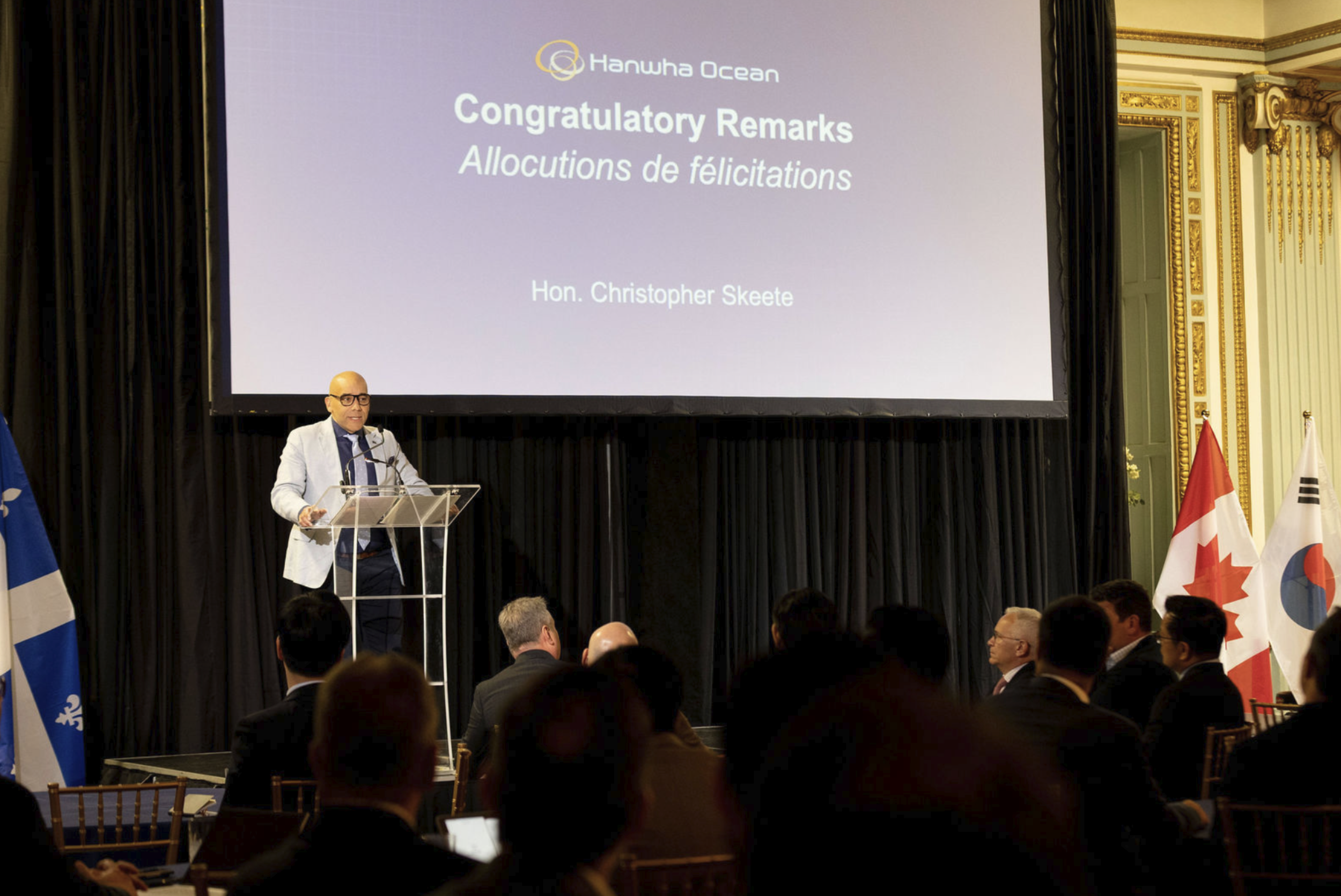
Held at Le Windsor Ballroom, CPSP Partners Day brought together organizations from across Canada’s defence, aerospace, advanced manufacturing, and research sectors, with participation from government, industry, and academia. The event was attended by Christopher Skeete, Québec’s Minister of International Relations and La Francophonie; Kim Lim, Ambassador of the Republic of Korea to Canada; Hubert Bolduc, President of Investissement Québec International; and Claude Pinard, Chair of the Executive Committee of the City of Montreal. Within that setting, Hanwha Ocean advanced a series of Memoranda of Understanding (MOUs) and Teaming Agreements (TAs), providing a clearer picture of the industrial architecture being assembled around CPSP.
The agreements announced span key elements of submarine capability, digital engineering, and supply chain development:
Hanwha Ocean – Velan (MOU)
Advancing in-country sourcing and industrial cooperation for critical submarine valve systems, reinforcing Canadian production of high-spec naval componentsHanwha Ocean – LIG Defense & Aerospace – AtkinsRéalis (Teaming Agreement)
Collaborating on the development of sovereign defence infrastructure in Canada, including acoustic testing facilities to support submarine systems, sustainment, and industrial participationHanwha Ocean – Dassault Systèmes Canada (Teaming Agreement)
Supporting the development of in-country capabilities in submarine design, engineering, and product lifecycle management (PLM), including digital engineering environmentsHanwha Ocean – Kolon Spaceworks – Spartec Composites (Teaming Agreement)
Establishing a localized composite supply chain and advancing technical collaboration to support submarine composite structures and advanced materials manufacturing in CanadaHanwha Ocean – Thordon Bearings (MOU)
Advancing collaboration on marine bearing and propulsion system components, supporting in-country capability development for critical submarine subsystems and lifecycle sustainment
Together, these partnerships reflect a coordinated effort to establish a Canadian-based industrial ecosystem spanning advanced manufacturing, digital engineering, systems integration, and long-term sustainment.
Among the agreements, the collaboration with Kolon Spaceworks, Spartec Composites, and Thordon Bearings points to the early formation of a Canadian-based supply chain for advanced materials, while the MOU with Velan underscores the importance of securing domestic capability in mission-critical components that underpin both safety and long-term sustainment.
Beyond components, the partnership with LIG Defense & Aerospace and AtkinsRéalis signals a broader shift toward integrating engineering, infrastructure, and system-level capability from the outset. The development of acoustic testing facilities and weapon-related infrastructure provides a pathway toward establishing sovereign in-service support (ISS) capability in Canada, reinforcing long-term operational readiness and industrial resilience.
The collaboration with Dassault Systèmes Canada further highlights the role of digital capability as a differentiator. By advancing in-country capabilities in design, simulation, and product lifecycle management, the partnership enables Canada not only to maintain submarine platforms, but also to participate in their continuous evolution and modernization.
What is taking shape through the Montreal partnerships is not a series of agreements, but the outline of a Canadian industrial ecosystem built to sustain capability over the long term.
Building on earlier engagements in Ottawa, Calgary, and Toronto, this latest phase of collaboration further aligns international capability with Canada’s industrial priorities, particularly across Québec’s engineering, aerospace, and advanced manufacturing sectors.
