
By Newell Durnbrooke
In November, 2011 the Canadian government held a large-scale parade on Parliament Hill to commemorate the leading role played by Canada’s military in the “victory over Libya.”
The Canadian Forces spectacle included a parade of troops and a fly-past of RCAF aircraft overhead. The fly-past, alone, cost taxpayers $850,000.
The victory parade was to honour those in Canada who took part in the overthrow of Libyan dictator Muammar Qadhafi. Then Prime Minister Stephen Harper declared at the time, “History shows us this; that freedom seldom flowers in undisturbed ground. Our job in Libya has been done, and done well.”
Canadians soon forgot about the Libyan mission. In the aftermath of the war, Libya descended into chaos and the turmoil in that country disappeared from the news.
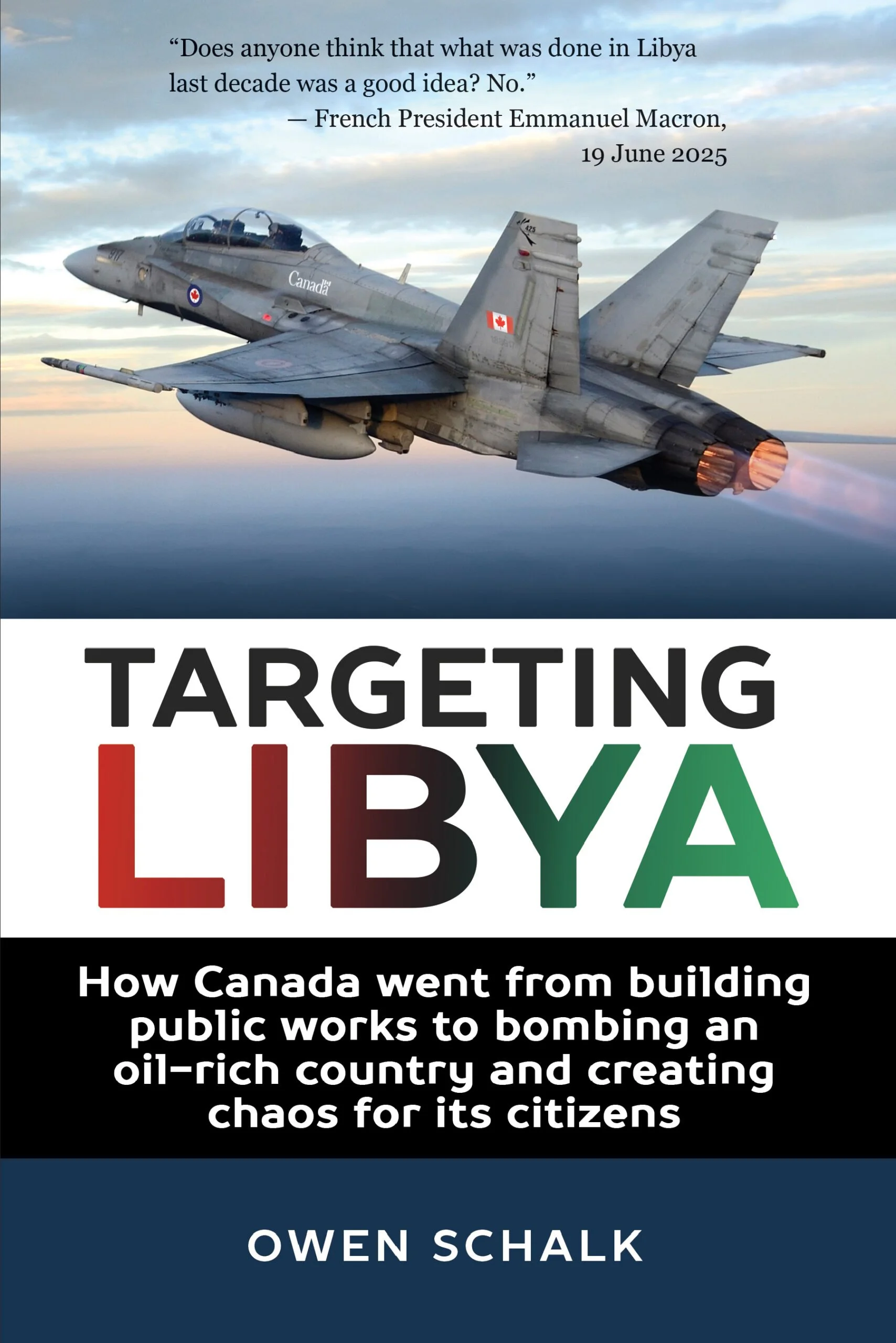
But a new book by investigative journalist Owen Schalk aims to change all that. In Targeting Libya, Schalk examines how Canadian business and government actors influenced Libya’s fate, from the rise and fall of Muammar Qadhafi to the country’s ongoing instability in the present day.
Schalk’s book is an excellent dive into an epic story of dubious foreign affairs entanglements and questionable military actions. He covers the whole gamut of the Libya debacle, from the beginnings of Canadian business and government dealings in Libya, curiously timed visits by federal cabinet ministers, Canadian military participation in the 2011 NATO-led bombing of the country, CSIS collaboration with Libyan intelligence agencies and the SNC-Lavalin corruption scandal that plagued the Justin Trudeau government. Then of course there is the blow by blow details of the criminal conviction of senior executives for bribery in the Canadian courts.
Schalk has pointed out that in 2007, Libya had an annual per capita income of more than $6000 USD, which made Libya the richest African nation by a significant margin. Healthcare and education were free and universal, while hunger and food insecurity had been erased, he has written. According to UN data, Libyan life expectancy was nearly 72 years – three years higher than the average in Arab countries, and almost 18 years higher than the average in sub-Saharan Africa, Schalk has noted.
But Canadian and NATO intervention in Libya wiped all that out. Today close to one million Libyans require humanitarian assistance. Agricultural production has plummeted. Libya is a failed state.
Today, Canada’s role in destroying Libya remains largely forgotten by journalists and politicians. It remains so much so that on Oct. 27, 2025 a Senate Committee on National Security heard testimony from former Harper cabinet minister Chris Alexander that “in Libya, Saddam went.”
Not one senator had the knowledge or understanding that Libya was never ruled by Saddam Hussein. Not one senator challenged Alexander’s failure to understand even the basics about the Libya mission – that it was Muammar Qadhafi who was removed from power.
Owen Schalk’s Targeting Libya is an in-depth chronicle on the Libyan debacle that will be welcomed by readers interested in foreign affairs. And maybe someone should buy a copy for Chris Alexander so he can be brought up to speed about what really happened under the government he served in.
