
By Scott Taylor
Last Wednesday it was reported in the Ottawa Citizen that the Canadian Armed Forces plan to spend $18 billion to acquire new fleets of military helicopters.
The good news for aviation buffs is that this current plan envisions a mixed fleet of four distinctly different types of helicopters to support the Canadian Army.
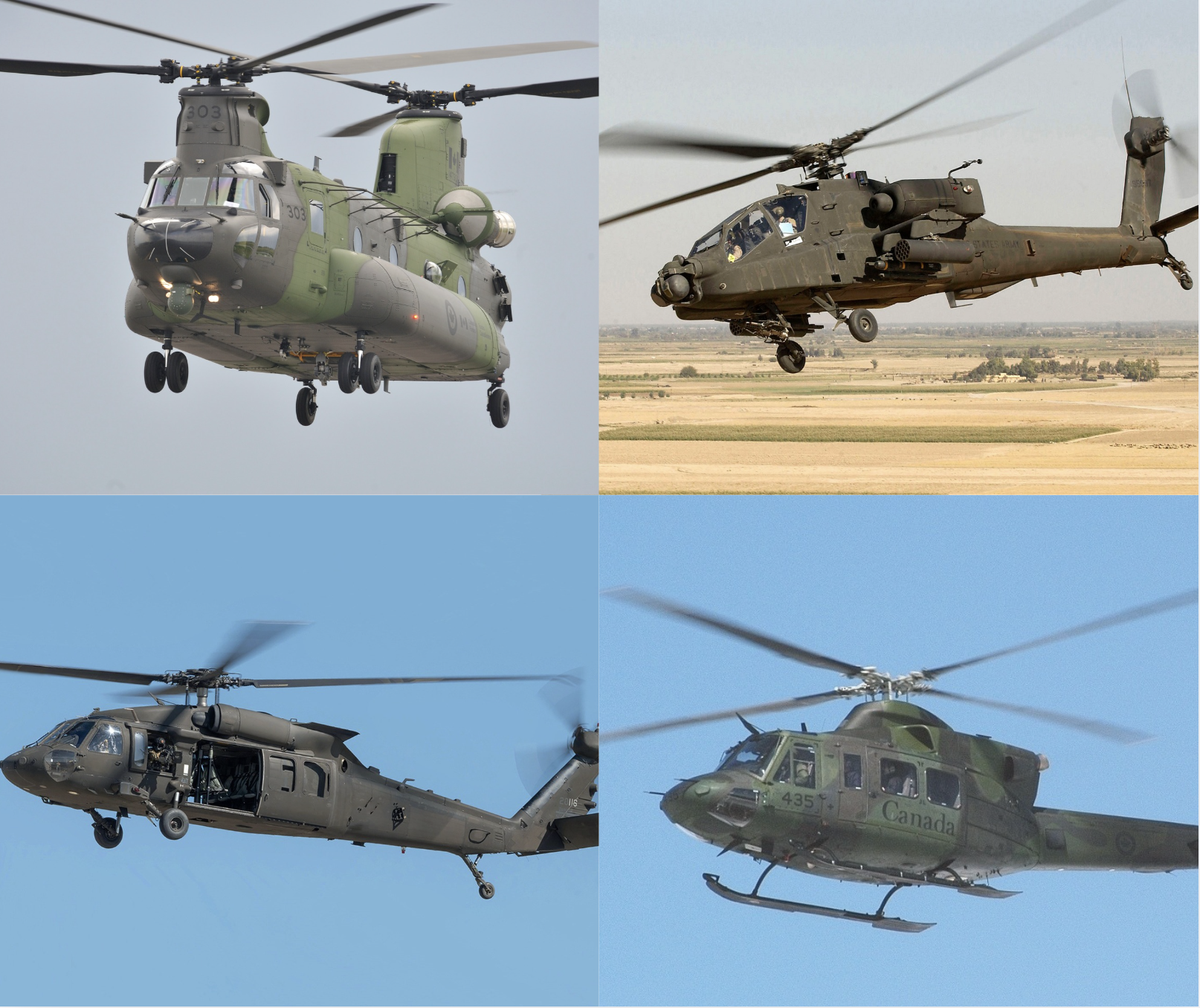
The new fleets will include Special Operations, Attack, Reconnaissance and medium lift helicopters, all in addition to the RCAF's relatively new fleet of 14 CH-147F Chinook Heavy lift transport choppers. Having five separate helicopter fleets to perform five separate tactical roles will be a major boost to the efficiency of the RCAF in support of the Army.
Those old enough to remember, prior to 1992 Canada operated three separate helicopter fleets to tactically support soldiers on the battlefield. There was 8 CH-147C model Chinook heavy lift transports, 74 CH-136 Kiowa reconnaissance light helicopters, and 50 CH-135 Twin Huey utility helicopters. As all three helicopter fleets were advancing in age, and with the Soviet Union's collapse signalling the end of the Cold War, a political decision was taken to replace all three types with a single rotary aircraft. Canada gave the 8 Chinooks to the Netherlands rather than invest in extending their service lives. The reason given at the time was that heavy transport helicopters had no future on the modern battlefield.
But I digress.
Marcel Masse, the Progressive Conservative Defence Minister of the day, decided that 100 Bell CH-146 Griffon utility helicopters would replace both the Twin Hueys and the fleet of reconnaissance Kiowa's. It was a simple coincidence that Bell Helicopter Canada's plant was located in Minister Masse's riding of Mirabel. But again I digress.
During the 2002 - 2014 counter insurgency operations in Afghanistan, it became readily apparent that the roads were the battleground and the solution was to resupply outposts with heavy lift helicopters. Embarrassingly, on several occasions, Canadian soldiers had to hitch a lift from their Dutch allies flying the very Chinooks which Canada had given away a decade earlier.
In 2008 the RCAF purchased 6 very well used Chinook D models from the USAF for approximately $300 million.
Tactically, the vulnerable Chinooks should operate in conjunction with protective helicopter gunships. However as Canada possessed only one other type of helicopter, the CH-146 Griffons were modified in theatre to become quasi-gunships.
Canada did acquire 15 brand new Boeing Chinook CH-147F models at a cost of $1.5 billion, however they were not delivered until 2014 just as Canada ended its commitment in Afghanistan.
Subsequent military budget cuts by the Harper Conservative government ensured that if there ever was a plan to add helicopter gunships to the RCAF inventory to complement the Chinooks, it was quietly shelved.
So now we are being told that the RCAF will see a return to a 'balanced fleet concept' for the Army's rotary aircraft.
However, as with most major military procurements do not expect delivery any time soon. According to the Ottawa Citizen the first of the new helicopters will be to support Canadian Special Operations Forces Command. The first of these rotary aircraft are not expected to be delivered until 2033.
The Attack, Reconnaissance, and Medium Lift fleets are to be entering operations around 2038.
Other than a whopping budget of $18 billion, there were no specifics as to the number of each different new helicopter fleet.
Until then the aging trusty CH-146 Griffons will continue to fill in the multi-roles required outside of the heavy lift provided by the Chinooks. For the record, of the original 100 Griffons purchased, only 82 remain in service. The wear and tear of combat missions in Afghanistan took a tough toll.
