ON TARGET: Freedom Fighter & Terrorist All In One

Jalaluddin Haqqani

Jalaluddin Haqqani

By Scott Taylor

On Tuesday, September 4, it was reported that Jalaluddin Haqqani had died in Afghanistan. His claim to fame was the founding of a militant network that is considered to be the most effective fighting element of the Taliban. Believed to be in his early 70’s, Haqqani’s passing will in no way affect the combat capability of his network, as he relinquished command of his fanatical fighters to his son Sirajuddin a decade ago.

The western media coverage of Haqqani’s death serves as a perfect example of just how delusional we are when it comes to judging how we are perceived by others, and in turn how we perceive them, when perspectives change.

As the old saying goes, one man’s freedom fighter is another man’s terrorist – in Haqqani’s case, the man was both.

When the Soviet Union invaded Afghanistan in 1979, it did so at the request of the Afghan communist regime of President Mohammad Najibullah. The Soviets conscripted, trained and equipped hundreds of thousands of Afghan troops to support them in quelling an insurgency led by Islamic extremists.

A young Jalaluddin Haqqani was one of those Mujahadeen fighters and he earned a reputation for his fierce engagement of Soviet and Afghan security forces. The evil communists wanted to educate the Afghan population – including the women - build roads, hospitals etc, and Haqqani and the Islamic extremists were fighting to the death to make sure that did not happen.

Through Pakistan, the U.S. covertly armed and equipped these Afghan mujahedeen with sophisticated weaponry such as the Stinger ground-to-air anti-aircraft missiles. The U.S. even facilitated the deployment of Islamic extremist foreign fighters into Afghanistan, the most notorious of them being Saudi Arabian Osama bin Laden.

As they were both fighting together in the same Jihad – Holy War, to oust the evil communists, Haqqani and bin Laden became friends.

This was the height of the Cold War and in America’s eyes, anyone inflicting damage on the Soviet Union was to be heralded as a friend. In1988, Hollywood gave us the blockbuster Rambo III in which the hero deploys to Kandahar to help locals kill evil Soviets.

The final credits in that film dedicate the movie to “The Brave Mujahadeen of Afghanistan”.

President Ronald Reagan singled out Haqqani for personal praise as a ‘freedom fighter’ and U.S. Congressman Charlie Wilson, the single most influential American securing aid and weapons for the Afghan mujahedeen, called Haqqani “goodness personified”.

Then came the terrorist attack on September 11, 2001.

In response to that attack against Americans by bin Laden’s al-Qaeda network, the U.S. invaded Afghanistan. The Americans were not invited in by the Taliban regime. The Taliban were instead to be toppled instead for having provided bin Laden with a safe haven. Fair enough.

Then the parameters shifted and the U.S. decided to lead an international effort to ‘rebuild’ Afghanistan into country that it never was.

The west installed a puppet regime under President Hamid Karzai which included a number of former anti-Taliban warlords.

Under the guise of propping up this corrupt cabal, the U.S. mirrored the Soviets by recruiting, training and equipping hundreds of thousands of Afghan soldiers to help them battle a stubborn insurgency waged by those Islamic extremists still loyal to the ousted Taliban.

Haqqani and his network were the most effective unit battling the U.S. led coalition that included, of course, thousands of our very own Canadian troops.

In 2012, Haqqani was considered to be ‘public enemy number one’ and his Taliban-allied unit was responsible for killing the most NATO soldiers.

We knew from the get –go that the Karzai government was the most corrupt on the planet, but we also felt that our intentions were rooted in good. We wanted to educate the Afghan population – including women - build roads, hospitals etc.

When Haqqani fought the Soviets to prevent such progress, we hailed him as a hero; when he fought us to prevent the exact same development, we labelled him a terrorist.

Haqqani fought his entire life for freedom from foreign occupiers. He didn’t change sides, we did. We became the occupiers.

ON TARGET: Canada Remains Clueless In Iraq

kw04-2016-0040-004.jpg

By Scott Taylor

Last week, the Department of National Defence conducted a round of media interviews to introduce Major-General Dany Fortin as the new commander of a Canadian led training mission in Iraq. It was announced on July 11 following the NATO Leaders’ Summit that Canada would provide headquarters personnel, four Griffon helicopters and up to 250 soldiers to form the nucleus of a NATO training base near Baghdad.

This new contingent is in addition to the approximately 200 Special Forces operatives and four Griffon helicopters that are already deployed to Iraq. The original role for our special forces in Iraq was to train the Kurdish militia to combat Daesh (aka ISI or ISIL). However, once the last Daesh stronghold of Mosul was recaptured by the alliance last October, the Canadian trained Kurds embarrassingly began battling the Iraqi National Army.

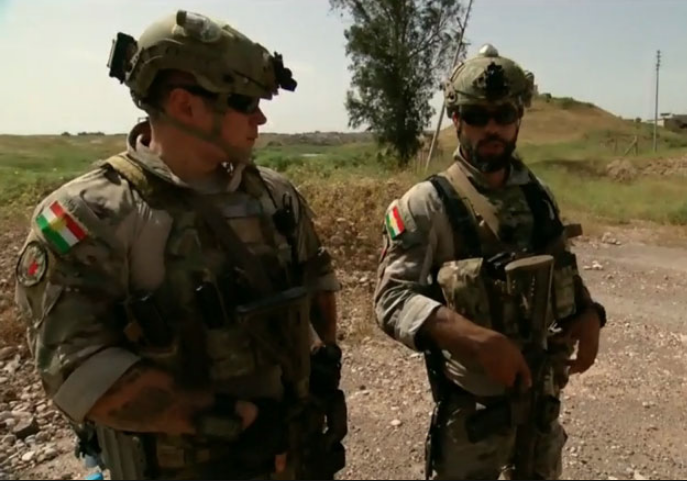
The Kurds had always been honest about their intention of fighting for an independent Kurdistan. They wore the flag of Kurdistan on their uniforms and duped the Canadian trainers into wearing them on their uniforms too.

The Canadian military leadership was so naïve, that they allowed our soldiers to wear the symbol of Kurdistan, an unrecognized state within a federal Iraq. For the record, Global Affairs Canada has always maintained its full support for a unified Iraq under a central government in Baghdad. Oops.

Now we have Major-General Fortin displaying a similar degree of willful blindness or just plain ignorance as he prepares to assume his new role in Iraq.

In response to reporters questions Fortin expressed his confidence that somehow he and his NATO colleagues would be able to weed out any Iraqi war criminals, or factional zealots. “I think we have a pretty good vetting process in place to screen out those potential instructors to ensure we have quality people, that they – the Iraqi government feel confident with.” Fortin told the CBC’s Murray Brewster.

Since the U.S. invasion in 2003, Iraq has been awash in a complex, multi-factional civil war and insurgency. The U.S. spent more than a decade pouring billions of dollars into arming and training hundreds of thousands of Iraqi Security Forces.

In the summer of 2014 this American built force collapsed like a cheap suitcase under a gorrila’s foot the minute the Deash evildoers swarmed in from Syria.

A similar collapse of fighting-will happened in the fall of 2004 when Iraqi insurgents took control of the city of Mosul for more than three days. The U.S. paid and equipped Iraqis simply deserted their posts and handed their weapons and vehicles over to the insurgents.

In 2006, al-Qaeda extremists had seized control of Iraq’s Sunni triangle, with popular support from the marginalized Sunni Arab leaders. The so-called surge strategy employed by the Americans to oust the al-Qaeda extremists from the Sunni triangle involved cash payments and arms being given to the local tribal leaders.

With the U.S. promise that the payments and improved status would continue, the Sunni moderates forced the al-Qaeda from their midst.

Following the U.S. departure from Iraq in 2011, Shiite President Nouri al-Maliki ignored his U.S. advisors and stopped payments to the Sunni tribes. Hence, once again feeling shunned, the Sunni tribes welcomed the Daesh extremists when they arrived in 2014.

This past May, Iraq held a new round of parliamentary elections, wherein Muqtada al-Sadr’s party won the majority of the seats. Muqtada is not only a Shiite cleric; he is also a fanatical warlord.

In April 2004 he ordered his military to attack U.S. troops and for a long period of time he was considered to be America’s number one enemy. He posted billboards to taunt the U.S. soldiers featuring his image and the words – in English – “All men belong to me.” This guy is a raving nutter.

Now he is to be Iraq’s new leader, and a Canadian led NATO mission will be training troops to prop up his regime.

But don’t worry folks; Major-General Fortin is confident that this time around he will be able to tell the good guys from the bad guys in Iraq.

Note to Fortin, I cannot wish you success in your mission because you are embarked on a fool’s errand: Training more Iraqi’s to kill in the name of a corrupt regime is insane.

However, I will hope and pray for the safe return of all Canadians from this dangerous venture, one which we should never have agreed to become involved with in the first place.

ON TARGET: Fear not: Daesh is not a Threat to Canada

Screenshot 2018-08-27 10.45.35.png

By Scott Taylor

Last week there was a media flurry in Canada over a new audiotape allegedly released by the sinister evildoer, Abu Bakr al-Baghdadi, the leader of the Islamic extremist group known as Daesh (aka ISIS or ISIL).

The only reason al-Baghdadi’s comments garnered any attention in Canada was that in his latest diatribe he once again includes Canada by name in his list of potential targets.

For the fear mongers among us, this is the stuff of their wildest dreams. The Daesh leader personally calling on his ‘striking lions’ to “carry out the kind of strikes that terrorize the hearts and minds and sends the brains flying”. In particular, al-Baghdadi reminded his suicidal followers to “not ignore running over people on the roads”.

This would be scary stuff if indeed al-Baghdadi had some sort of legion of sleepers waiting to rise up and strike us down following his latest ‘call to arms’.

The fact is that no one can confirm if al-Baghdadi is even still alive. He was last seen at a public event in the Iraqi city of Mosul in 2014. That was when Daesh was at its evil-doing zenith. They had captured a vast swath of Syria and Iraq and al-Baghdadi proclaimed his conquered territory to be the new caliphate.

His fanatical followers made graphic videos of Daesh beheading prisoners, setting captives on fire and driving accused heretics en masse off of tall buildings.

That was then, but a lot has changed over the past four years. Attacked relentlessly by an improbable alliance that included the U.S., Iran, Iraqi Shiite militia, Syrian forces allied to President Bashar al-Assad, Russia, Kurdish separatists and even Canada – Daesh was systematically destroyed on the battlefield.

As the end drew near, many of al-Baghdadi’s supporters began to have their doubts. It was reported that in the besieged city of Mosul, Daesh enforced loyalty by lopping off the ears of those they suspected of possible desertion.

Now that the caliphate is no more, many of those foreign volunteers who fought for Daesh and then surrendered to the allies, now want to return home. This destruction of his forces and subsequent fizzling out of his fighters’ loyalty is hardly an inspiration for these so called ‘striking lions’ to kill us here in Canada.

The fact is that despite Daesh claiming responsibility for attacks in Canada, there have not been any attacks to date.

The closest association to such incidents can be at best described as having been ‘Daesh inspired’. These both occurred in 2014. The first was on October 20 when Martin Couture-Rouleau used his vehicle to kill Warrant Officer Patrice Vincent and to injure a second soldier. Two days later, Michael Zehaf-Bibeau shot and killed Corporal Nathan Cirillo as he stood guard at the Tomb of the Unknown Soldier. Bibeau then went on a one-man shooting spree on Parliament Hill. Both Bibeau and Couture-Rouleau were killed by security personnel. Neither of these men were actual Daesh followers, and Bibeau had a history of mental health issues and drug addiction.

More recently, Daesh claimed that the July 22 attack on Danforth Avenue was perpetrated by one of their striking lions. However, while he managed to kill two victims and wound thirteen more before being killed himself, Faisal Hussain was apparently a lapsed Muslim who did not attend prayers, let alone exhibit a tendency to Daesh-style extremism.

As for “running over people on the roads” as al-Baghdadi has urged his followers to do, one immediately thinks of that tragic van attack in Toronto last April. Ten victims were killed and sixteen injured when Alek Minassian drove a rented minivan down a crowded Yonge street in the middle of the afternoon.

Minassian was not heeding al-Baghdadi’s orders, as he is not a Muslim, he is an Armenian Orthodox Christian. His suspected motive for the attack was to start the ‘incel revolution’. The ‘incels’ are apparently those who are involuntarily celibate.

Of course nobody took Minassian’s ‘incel revolution’ to be any thing more than the ravings of a lunatic.

We should put al-Baghdadi’s warnings in the same category. Followers of Islam are not coming to get us, but there are individual whack jobs of all faiths and persuasion who can and will commit random acts of violence.

ON TARGET: Deployments Don’t Result In Public Recognition For Canadian Military

CORPORAL JEAN-ROCH CHABOT/CANADIAN ARMED FORCES

CORPORAL JEAN-ROCH CHABOT/CANADIAN ARMED FORCES

By Scott Taylor

The results of a recent survey show that the Canadian military has a serious image problem in that the majority of the population are unaware that they even exist. According to the findings of an extensive poll conducted by the Earnscliffe Strategy Group, fewer than 26 percent of Canadians felt that they had some awareness of what the Canadian Armed Forces had been doing in the previous year, while only 42 percent considered themselves to be “somewhat familiar” with Canada’s recent military activity.

An astounding 58% admitted to having little to zero knowledge of what our troops are doing around the globe, or on domestic operations. The level of ignorance was particularly high among the younger generations.

For those in uniform, these stats must come as quite a shock as just twelve short years ago the Canadian soldier was named “newsmaker of the year” by Canadian Press as the result of the almost continuous mainstream media coverage of Canada’s military intervention in Afghanistan.

Of course the Colonel Blimps, tub-thumpers and rabid warmongers out there, still lament the fact that Canada ‘cut and ran’ from the doomed NATO campaign in Afghanistan back in 2014. However, all of the recent news out of that failed state would indicate that the U.S. led forces are no closer to a victory parade a full four years after we cut our losses.

That said, the dearth of media coverage for our troops must not be blamed on a shortage of deployments. In fact, we have so many current operations that it is difficult to even keep track without a scorecard.

To wit, we already have a total of eight helicopters and 250 personnel deployed to assist the UN peacekeeping mission in Mali. The initial commitment is for twelve months, but no one in their right mind thinks that the deeply rooted conflict issues of Mali will be resolved within that limited timeframe. At present, Mali is considered the most dangerous of all UN peacekeeping missions.

Then we have our battle group, which has been based in Latvia since the summer of 2017. Originally 450 strong, that number has recently been bumped up to 540 personnel, and the commitment extended until 2023.

Ostensibly this forward presence of our combat troops - in conjunction with a number of NATO allies - is to keep Russia from invading the Baltic states of Lithuania, Estonia and Latvia.

However, as all three of those nations are full-fledged members of the NATO alliance, and as article five of the NATO Charter assures members of a collective defence, there is no actual need for us to provide a ‘tripwire’ deterrent in Latvia. The Latvia commitment is simply adding stress through extended separation to the families of 540 soldiers – not to mention the $400 million incremental deployment cost per year that could be put to better use improving domestic infrastructure on Canadian bases.

Then there is Iraq. It was announced in July that Canada would be sending 250 personnel and four helicopters to assist in a NATO training mission, which will begin this fall and last an initial twelve months. This force will be in addition to the approximately 120 Special Forces soldiers and four helicopters already deployed to Iraq.

No one can quite explain what these elite solders are still doing in Iraq since they were originally sent in to train Kurds to fight Daesh (aka ISIS or ISIL). Once Daesh was defeated last October, the Canadian trained Kurds began fighting Iraq’s security forces. Somewhat embarrassingly, it is a unified Iraq – not an independent Kurdistan, which Canada officially supports. As for us helping to train more young Iraqis to kill, do not expect that to secure peace in Iraq by 2019.

We also have 200 trainers in Ukraine, the frigate HMCS Ville de Quebec deployed with the NATO squadron and we are sending five CF-18 fighter jets and 150 personnel to Romania as part of our overall effort to keep the big bad Russian genie in the bottle.

All told, that is a lot of forward deployed troops for the majority of the Canadian public not to be aware of. But as they say in the media business “If it bleeds, it leads” and it was the 158 dead and over 2000 wounded in Afghanistan that made our military the top topic at the water cooler.

I, for one, hope that the present trend of obscurity continues, and our soldiers remain safe.

ON TARGET: Let’s Cut Out The Hypocrisy Over Saudi Arabia And Cancel The Armoured Vehicle Deal

2018-05-22T19-04-11.7Z--1280x720.jpg

By Scott Taylor

There was a very disturbing news story last week about a Saudi Arabian airstrike that killed 50 civilians and injured a further 77. What was particularly upsetting about this incident was that the primary target had been a school bus and the majority of the victims were young children. The graphic photographs that appeared in media reports showed bloodied and bewildered innocent youngsters.

I have no doubt that the current diplomatic spat between Canada and Saudi Arabia helped to propel this story into the headlines of national Canadian newspapers as opposed to it being yet another global tragedy buried in the back of the World Section.

However, the killing of innocent Yemeni children in an errant airstrike is certainly a clear illustration of the hypocrisy of the Kingdom of Saudi Arabia. The initial spat with Canada began over a couple of careless tweets wherein Global Affairs Canada admonished Saudi Arabian officials for having arrested some human rights activists and then demanded the “immediate release” of these same Saudi activists.

The Saudis launched a twitter counter-attack, criticizing Canada for our “overt and blatant interference in the internal affairs of the Kingdom of Saudi Arabia”. Then the Saudis went completely bonkers – ordering Canada’s Ambassador out of Riyadh, recalling their Ambassador to Ottawa, ordering the immediate repatriation of some 16,000 Saudi nationals, currently enrolled in Canadian universities, suspending flights to Canada by their state airline and cancelling any new trade initiatives.

Then we were presented with this grim reminder in the form of Yemeni children blasted apart by a Saudi bomb, that Saudi Arabia has no qualms about overtly and blatantly interfering in the internal affairs of foreign sovereign states.

Since March 25, 2015, the Royal Saudi Arabian air force has been waging a relentless bombing campaign in neighbouring Yemen. This air campaign is being conducted with the full support of the U.S. intelligence apparatus and a number of allied Gulf Arab States. The official line is that they are bombing the Houthi rebels in support of Yemen’s President Abdrabbuh Mansur Hadi.

The truth is that the Houthi rebels under the leadership of Sayyid Abdul-Malik Badreddin al-Houthi and allied with supporters of a former Yemeni President Ali Abdullah Saleh, defeated President Hadi’s forces in March 2015.

It was immediately after Hadi fled into exile that the Saudi air force began bombing the Houthis. In other words they are not rebels any more if they are victors.

The perpetuation of the civil war in Yemen by Saudi forces has killed an estimated 5,200 innocent civilians to date, with another 50,000 having died of starvation. It is estimated that since March 2015, over 3.1 million Yemenis have been displaced by the ongoing conflict.

Unlike a couple of impolite tweets, Saudi Arabia’s blatant and overt interference in Yemen has had a very deadly impact.

Then there was the March 2011 uprising in Bahrain by the Shiite majority, challenging the reign of the Sunni Royal family. While the U.S. was eagerly fanning the flames of the so-called Arab spring in Tunisia, Egypt, Syria and Libya, the Americans did not want the apple cart to be upset in Bahrain.

As a result, Saudi military forces were brought in to disperse in the Shiite demonstrators and to shore up the Bahraini monarch. Coincidentally, the U.S. 5th fleet has long been based in Bahrain, from which it can strategically dominate the Persian Gulf. But I digress.

Getting back to the Canada-Saudi dispute, one of the things Canadian pundits are feverishly speculating about is whether or not the Saudis will punish Canada further by cancelling their current purchase of an armoured vehicle fleet from General Dynamics Land Systems of London, Ontario.

The deal is reportedly worth a whopping $15 billion and creates over 7,000 high-tech jobs in southern Ontario. That deal was brokered by the Harper conservatives in 2015, and ratified by Trudeau’s liberals after they were elected in October 2015. In other words, the armoured vehicle deal was signed well after Saudi Arabia began its overt and blatant interference in Yemen.

Instead of waiting for the Saudis to drop the other shoe, we should correct our pervious hypocrisy and cancel this deal ourselves. It is embarrassing to watch Chrystia Freeland preach about defending human rights, while she simultaneously fears the cancellation of a contract to supply a repressive regime with the combat capability to commit further repression.

Cancel the Saudi deal, bite the bullet and contract General Dynamics to build a Light Armoured Vehicle fleet for the Canadian militia instead. We would keep our integrity, boost our reserve forces’ capability, save high-tech jobs, and we would please Donald Trump by increasing our defence budget.

ON TARGET: Protectors Of Canada Deserve Our Respect

photo from: http://www.vintagewings.ca/VintageNews/Stories/tabid/116/articleType/ArticleView/articleId/369/Weve-Got-You-Covered.aspx

photo from: http://www.vintagewings.ca/VintageNews/Stories/tabid/116/articleType/ArticleView/articleId/369/Weve-Got-You-Covered.aspx

By Scott Taylor

There is currently a debate raging throughout the British Columbia military community as to whether or not retired members of the RCMP should be entitled to special veteran vehicle licence plates.

The Royal Canadian Legion grants provincial governments the authority to use their trademark poppy symbol on licence plates to signify the driver is a veteran. By the Legion’s definition of what constitutes a ‘veteran’ that status includes those who were members of the RCMP.

Former Mounties in Ontario, Quebec, Newfoundland and Nova Scotia qualify for the poppy adorned licence plates and British Colombia is currently running a public consultation on the issue. Somewhat surprisingly, the move to include the RCMP has blown up into a storm of anger amongst some military veterans groups who are vehemently opposed to the idea.

Some angry vets have threatened to turn in their own veteran licence plates rather than share the honor with the RCMP, while others have taken to social media urging a countrywide boycott of the Legion.

There is no tangible benefit to these plates other than the fact that a few communities allow free parking for the drivers on Remembrance Day. However it is a token symbol of respect for those who have served to protect Canada and Canadians.

The fact is that all military service is not created equal. For instance a part-time reservist might have completed a couple of tours in Afghanistan and been engaged in several combat firefights, whereas a 38 year regular force veteran, depending on their trade qualifications might have never deployed outside of Canada. Who decides which of the two provided a greater service to our country?

Over the past three decades, RCMP officers have been deployed on numerous UN peacekeeping missions, facing the same dangers as our troops. In the field there is always a mutual respect between soldiers and their RCMP counterparts, which is why I find it strange that some military veterans are so enraged by the licence plate issue.

Both the military and the RCMP protect the interests of Canada at home and abroad, so why not honour them both equally?

In more practical terms, we should use this opportunity to placate U.S. President Donald Trump by restructuring our national security resources. The Donald has chastised NATO in general and Canada in particular for not spending 2% of the GDP on defence. Canada currently spends approximately 1.2% of our GDP, with plans to grow that budget slowly over the next decade.

At present, we only include the money spent on the Canadian Armed Forces in our annual defence budget. With a little more creativity and imagination we should rebrand the RCMP as a national gendarmerie. The origin and traditions of the force are that of a paramilitary unit, and their current role has them in the frontline in the domestic war on terrorism.

Moving the RCMP’s $2.3 billion budget and 22,500 personnel into the ‘defence’ category would give us a substantial boost.

While we are at it, why not throw in the Canada Border Services Agency as well? They too are a vital part of Canada’s protective umbrella with a $1.2 billion budget and over 10,200 personnel in uniform.

Then there is of course the Canadian Coast Guard. This is traditionally a civilian organization in Canada, but in the U.S. it is considered to be the fourth service branch after the Navy, Army and Air force. With an operating fleet of 119 vessels, 22 helicopters and over 5,000 personnel, the Coast Guard would be another sizable boost in our ‘defence’ contribution.

Technically, the Coast Guard’s annual budget is only around $285 million, but that does not include equipment acquisitions, because unlike the defence department they do not have a separate procurement budget.

At present Seaspan shipyards in Vancouver has an order list of up to 15 new vessels for the Coast Guard ranging from offshore patrol vessels to a Polar Class Icebreaker.

Throw these shipbuilding costs into the defence budget, tally up municipal expenditures on specialized police tactical squads, and for good measure add long term health care costs for our injured veterans, and lo and behold, we are well above the Donald’s 2% goal. Without spending an additional nickel.

As for the licence plate debate, let’s rename it the ‘Protector’s of Canada plate’ and include all retired military, police, firefighters and paramedics to own one. They all deserve our respect.

ON TARGET: AFGHANISTAN: Canada's Role In Failed Mission Must Be Fully Investigated

Screenshot 2018-07-30 10.19.10.png

By Scott Taylor

On Saturday, July 21, Afghan official media was reporting that Vice President Abdul Rashid Dostum would be welcomed back to Afghanistan with a ceremony at the Kabul airport.

The official line was that Dostum had spent the pervious fourteen months in Turkey due to a medical condition, and he has now recovered enough to return to his Vice Presidential duties.

Glossed over in that narrative was the fact that Dostum left Afghanistan into exile after the Governor of Jowzjan Province - Ahmad Ishchi accused the Vice President and his bodyguards of sexual assault.

Until now, Dostum had repeatedly been denied re-entry into the country and nobody can fully account for the sudden about face by President Ashraf Ghani, who told the media that Dostum would now be “warmly welcomed”.

As it turned out, Second Vice President Mohammad Sarwar Danish was on hand to greet Dostum at the Kabul airport. However, the warm welcome turned deadly when a Daesh jihadist detonated a huge suicide bomb.

Fourteen civilian and military personnel were killed and another 50 plus were wounded. Like a cat with nine lives Dostum, the notorious former Uzbek warlord - the intended target of the blast, survived unscathed.

I first met Dostum in 2007 along with my colleague David Pugliese from the Ottawa Citizen. We had driven across the Hindu Kush Mountains to reach him at his northern Afghanistan stronghold in the ethnic Uzbek province of Sheberghan.

Dostum was to us the very embodiment of the complex and constantly changing political landscape of that war torn country. When the Soviet Union occupied Afghanistan, Dostum served in the Afghan army in support of the communist regime. After the Soviets withdrew in 1989, Dostum eventually turned on communist President Mohammad Najibullah and became a warlord.

Unlike many of the other Mujahideen warlords who enforced a strict code of Sharia Law, Dostum liked his booze and cigars, and in his fiefdom women were encouraged to get an education.

On the battlefield, Dostum and his Uzbeks were considered among the most ruthless. At the time of 9-11, Dostum was part of the Northern Alliance and he was battling the Taliban.

His boss, the charismatic ‘Lion of Panjshir’ Ahmad Shah Massoud had been assassinated the day before 9-11 by al-Qaeda operatives. Dostum was proud to boast that he had called U.S. Secretary of Defense Donald Rumsfeld to pledge allegiance to the U.S. on behalf of the Northern Alliance.

That support is portrayed in the Hollywood movie Twelve Strong, wherein a horse-riding Dostum helps a squad of U.S. Special Forces eliminate a huge horde of Talban.

Not depicted in that film was the subsequent mass executions that led many to characterize Dostum as a war criminal. It is estimated that up to 2,000 Taliban fighters were locked in sea containers and left to simply expire: Death by sea container Dostum style.

None of this prevented Dostum from legitimately getting himself elected to public office.

In fact he was also suspended from his post as Deputy Defence Minister in 2008 for allegedly kidnapping and sodomizing a prominent Turkmen leader named Akbhar Bey. In 2010 we interviewed Akbhar Bey about the alleged rape. He described Dostum as the “most vicious man in the whole world” and bemoaned the fact that even he, as a top political figure could be raped by Dostum and there was no justice.

In 2014, Dostum, the accused serial sodomizer and accused war criminal was sworn in as Afghanistan’s First Vice President. Such is the absolute dysfunction of the regime which the U.S. has installed in Kabul.

In 2007, after my first meeting with Dostum, upon my return to Kabul I spoke with Canadian Ambassador to Afghanistan Chris Alexander. Alexander was furious that I would be giving coverage to Dostum as, to paraphrase the Ambassador, he was yesterday’s bagel in a new modern democracy.

The fact that Canada’s - admittedly young, inexperienced, and too eager by half - Ambassador could have been so far off the mark should be cause for serious concern.

Dostum is still vey much a major player on the Afghan stage. The warlords remain in power, and they remain untouchable. This level of ignorance and naïveté on the part of Alexander, and others in both the Defence department and Foreign Affairs is the reason that Canada should follow the UK’s lead and commit to conducting a full-scale parliamentary investigation into the massive blunders that were made in assessing the Afghanistan quagmire.

For the 158 soldiers killed, over 2,000 physically wounded, and the untold numbers suffering from the invisible wounds of PTSD, we owe it to their sacrifice to ensure no such preventable mistake happens again in the future.

ON TARGET: What Moral High Ground?

Trump and Putin

Trump and Putin

By Scott Taylor

When U.S. President Donald Trump met with Vladimir Putin in Helsinki on July 16, the critics were quick to pounce.  The general consensus from western pundits and politicians alike was that the Donald had been too soft on Putin. This sentiment is rooted in the notion that the U.S., and by extension the other western countries - including Canada -somehow have the moral authority to chastise Putin for his actions, because we are after all, the ‘good guys’.

Prime Minister Justin Trudeau took a particularly harsh anti-Russia stance following the Helsinki meeting of the two Presidents: “Whether it’s their illegal annexation of Crimea, their incursion into the Donbass in Ukraine and the fact that we’re glad to have 200 Canadian soldiers there helping to train Ukrainian armies. Whether it’s interference in Syria and the support for the murderous Assad regime, whether it’s what they were responsible for in the chemical weapons attack in Salisbury on UK soil against British nationals. Canada has always been clear.” Trudeau told reporters.

Those are strong words, but let us take a little closer look in the rearview mirror. In 1999 Canada was very much a part of NATO’s 78-day bombing campaign against Serbia and one of the first countries to recognize Kosovo’s unilateral declaration of independence from Serbia in 2008.  So, apparently Canada has no issue with the use of military force to redraw the map of Europe, as long as it’s us who are doing it.

For the record, Kosovo is now a failed state with the lowest GDP and the highest crime rate in Europe, with the Serbian minority population still living in protected enclaves.

As for interfering in the Ukraine’s civil war, how can Trudeau condemn Putin for assisting and supporting ethic Russian-Ukrainian rebels in the eastern enclave, and simultaneously be proud of the fact that we have Canadian solders, thousands of kilometers from our borders assisting and supporting troops of an non-NATO country in the same conflict?

Russia may be in Syria to support the “murderous” regime of Bashar al- Assad, but they are fighting the far more murderous Daesh (aka ISIS or ISIL) and al-Nusra (aka al-Qaeda). Those would be the same terribly murderous Daesh and al-Nusra that our Canadian special forces were sent to battle in Iraq, which would make us allies in a common cause.

For Trudeau to describe the incidents in Salisbury as a Russian State chemical attack is a hyperbole at it’s level best. The intended March 4th assassination targets - Sergei and Julia Skripal - are still alive and we are now to believe that the Russian intelligence agents were so incompetent and carless that they left the excess deadly nerve agent Novichok lying in a public park in an old perfume bottle.

Four months later a local drug addict is alleged to have found the bottle and sprayed what she thought was perfume on her wrists. If human nature still applies to a drug addled brain, her next step would have been to inhale the fumes in the expectation of a perfumy reward to her olfactory glands. Somehow she managed to walk herself to the hospital after inhaling a full on dose of Novichok, which is said to be 10 times more deadly than the notorious VX gas.

She died 7 days later, while her 45-year-old partner and fellow drug addict Charlie Rowley who was also exposed to the Novichok perfume has since recovered. There remains no proof of Russian State involvement other than the initial unsupported claim by UK Prime Minister Theresa May.

On the wider subject of Trump and the west holding the moral high ground one need only to revisit the U.S. led ill-fated allied military misadventures of the past seventeen years.

In 2001, in the wake of 9-ll, the U.S. invaded Afghanistan in order to apprehend Osama bin Laden. It was also seen as convenient opportunity to rid Afghanistan of the Taliban regime. Fast-forward to the present, and Afghanistan remains a failed state engulfed in violent anarchy. Tens of thousands of innocent civilians have died in that interim.

In 2003, the U.S. lied to the world about Sadden Hussein possessing weapons of mass destruction as an excuse in to invade Iraq. Since that juncture, Iraq has been and remains awash in inter-factional bloodletting. More than a million innocent victims have perished in that ongoing conflict.

In 2011 the Canadian led NATO force was authorized by the UN to impose a no-fly zone in the skies above war-torn Libya. From the outset that limited mandate was expanded to a full out aerial bombardment against embattled President Muammar Gadhafi.

After Gadhafi was brutally murdered by the rebels in October 2011, the west left a power vacuum that resulted in the current failed sate awash with violent anarchy. Thousands of innocents have been killed as a result of NATO’s intervention.

It would be one hell of a stretch to blame Putin for these three monumental cock-ups. None of which appears to be extinguishable within the foreseeable future.

ON TARGET: Back To Iraq: Mission Impossible

Screenshot 2018-07-16 10.33.48.png

By Scott Taylor

Last Wednesday on the eve of the NATO leaders’ summit in Brussels, Prime Minister Justin Trudeau announced to reporters that Canada will assume command of a mission to train Iraqi military personnel. This is to involve approximately 250 Canadian soldiers and include an air detachment of 4 Griffon utility helicopters.

Since 2014, Canada has had military trainers in Iraq and we presently have 4 Griffon helicopters operating in that war torn country. However, those Special Forces trainers had their mission suspended after Daesh (aka ISIS or ISIL) were defeated in their final urban stronghold of Mosul last July.

 At that juncture the Kurdish fighters, which the Canadians were assisting, began battling Iraqi army troops in a bid to establish their long sought sovereign state of Kurdistan

As Global Affairs Canada officially supports a unified Iraq under a Baghdad controlled regime, our military trainers found themselves on the wrong side of the battle lines, so they did an about face.

The similarity in the force size, the training mandate and the fact that a defence official mistakenly reported that the announced Griffon helicopters were in fact those already on the ground, led some to conclude this was something of a smoke screen.

It was even speculated that this was not an increased commitment at all, but a simple reallocation of already deployed resources, now dressed up as a new NATO undertaking to appease U.S President Donald Trump.

The Donald of course used the NATO leaders’ summit as his bully pit to browbeat all of those NATO allies - including Canada - who are shirking their responsibility by not spending up to two percent of their national GDP on defense.

If Trudeau thought he could apple polish his way into Trump’s good books by first announcing a three year extension to our ongoing deployment to Latvia, followed immediately by this announcement about Iraq, then Justin obviously never read the Art of the Deal.

Trump is still insisting Canada and other NATO shirkers meet his two percent benchmark, sooner rather than later. So much for the attempted smokescreen.

 Now that the dust has settled, DND has confirmed that the training mission in Iraq – which is set to begin this fall- is in fact a real increase of 250 personnel and the 4 Griffons will be in addition to the four already in theatre. 

In support of Trudeau’s announcement, Foreign Affairs Minister Chrystia Freeland told reporters that supporting democracy in Iraq is a “great thing” and she claimed that training foreign troops is something Canadian soldiers do particularly well.

Both of these statements are completely out of whack. The great U.S engineered democracy experiment is well into its sixteenth year in Iraq and to date it has been a complete failure.

The series of ‘elected’ regimes that have governed from Baghdad have not only been amongst the most corrupt in the world, they have also served only to widen the factional divides, resulting in continued violence.

Following the parliamentary elections this past May, Shiite cleric and warlord Muqtada al-Sadr is poised to become Iraq’s next political leader. His Sadrist Party won 54 seats.

However, in 2004 he was regarded by the U.S. to be public enemy number one. Now, he is being praised for the simple fact that he is opposed to Iran’s influence in Iraq.  A little side note on al-Sadr’s mental stability, in 2004 while his militia battled U.S. troops, he put up billboards taunting the Americans with the phrase in English “All men belong to me”.

Supporting this guy is not supporting democracy and should not be described as a ‘great thing’.

As for our soldiers training foreign combatants, let me state from the outset that in my opinion Canadian soldiers are the best in the world. That said, training recruits that do not share our language, culture or religion is difficult in the extreme.

We trained, tens of thousands of Afghans during our twelve-year commitment and the Americans have trained hundreds of thousands of Iraqis over the past fifteen years. Despite all this training, both the Afghan and Iraqi security forces remain a dismal, dispirited rabble compared to their far more fanatical countrymen who comprise the insurgents.

Our soldiers can teach these recruits, drill and weapons handling, but there is no way we can make them willing to die for the corrupt regimes that are currently in place.

The big question still begs, does anyone in their right mind think that the solution to Iraq’s violent anarchy will be one year of a Canadian commanded mission training more of Iraq’s young men how to kill?

ON TARGET: Where's The Proof?

Screenshot 2018-07-09 09.31.31.png

Scott Taylor

On Saturday 30 June, in the sleepy little town of Amesbury, England, a middle aged couple – Dawn Sturgess, 44 and Charlie Rowley, 45 were found in medical distress.  At first, British authorities believed their condition to be the result of either a heroin or crack cocaine overdose, as both individuals are known to be “recreational drug users”.

Three days later it was announced that Sturgess and Rowley were in fact stricken by the exposure to the nerve agent Novichok. This of course is the same Novichok poison that was allegedly used in the attempted murder of former Russian double agent Sergei Skripal and his daughter Julia back on 4 March.

Since Amesbury is just 11 kilometers away from Salisbury, where the Skripals were attacked, the official conclusions was that the two cases must be linked. That sounds logical enough.

Therefore it makes sense that the British government would blame the same alleged culprit. Home Secretary Sajid Javid rose in Parliament to demand, “that the Russian State come forward and explain what has gone on.” For good measure, Javid added that “ it is completely unacceptable for our people to be either deliberate or accidental targets, or for our streets, our parks and towns to be dumping grounds for poison.”

It is not exactly in the same league as Winston Churchill’s rousing 1940 “we will fight them on the beaches” speech, but Javid would have us believe that the UK is under a direct chemical attack by the Russians.

The question begs not only where is the proof, but also what is Russia’s motive? To date, the UK authorities have not identified a single suspect involved in the Skripal attack, and have yet to even identify how and where the Skripals were exposed to this “deadly, military grade nerve agent”. Theories range from liquid applied to their door handle, vapor through their car vents and the substance being planted into Julia’s suitcase.

So far no one has even speculated as to how the recreational drug users Sturggess and Rowley were exposed, other than it is somehow collateral contamination from the Skripal attack.

It was a bit of a stretch to understand why Russian secret service agents would plot such an elaborate assassination of Skripal. Yes, he was discovered to be a double agent working for Britain’s MI6 back in 2004. He was convicted in 2006 and spent four years in jail. In 2010 he was released to the UK as part of a spy swap deal.

Any secrets Skripal has acquired as a traitor to Moscow would have been fourteen years out of date, and he has been left alone for eight years since the Kremlin felt it safe to release him. So why kill him? And why use a “deadly, military grade nerve agent”, rather than simply shooting him in a fake robbery?

I do not think any one will be able to come up with a plausible motive as to why Russian agents would return to a place near the scene of a crime to risk attacking a couple of recreational drug users in the middle of the World Cup, which as Sectary Javid pointed out means “ the eyes of world are currently on Russia”.

We were told to believe that the Russian Sate was implicated in the Skripal attack by UK Prime Minister Theresa May because there was simply no other possible theory. Canada and 26 other countries took May at her word and dutifully expelled a total of 151 Russian diplomats from embassies around the world.

Then on 31 May we had a truly bizarre case of the Ukrainian intelligence service faking the death of Russian journalist Arkady Babchenko . Since Babchenko was a rabid critic of the Putin regime, the blame was immediately placed on the shoulders of Putin’s murderous henchmen.

Britain’s ever comical Foreign Secretary Boris Johnson tweeted out a demand for Putin to be brought to justice. When Babchenko held a press conference two days after his “death” to announce he was still alive, his convoluted explanation was that Putin would have killed him if he did not fake his death.

 In addition to the Babchenko case proving Ukraine intelligence has a clear motive to discredit Russia with a fake assassination, they are also a former Soviet Republic meaning they would also possess the Novichok agent.

Speaking of which, despite all of the emotive descriptions of Novichok as a “deadly, military grade nerve agent,” it has proven to be rather unreliable. To date, of the five people allegedly exposed to it — the Skripals, Sturgess, Rowley and police Detective Sergeant Nick Bailey — only Dawn Sturgess has died while the other 4 have all recovered.

By comparison, it is expected that over 4000 recreational drug users will die this year in the UK as a result of the burgeoning opioid crisis. Blame that on Putin. 

ON TARGET: Rise Of The Far Right In Ukraine

President Petro Poroshenko

President Petro Poroshenko

By Scott Taylor

On July 11, Prime Minister Justin Trudeau will head to the NATO Summit in Brussels and apparently his single point of concern for his fellow leaders will be that of continued support for Ukraine. There is nothing new in this approach as Canada has long been on the ‘Russia bad, Ukraine good’ oversimplified foreign policy bandwagon for some time now.

What is new, and worth noting is that even some of the most strident voices who have been chorusing that same sentiment are now starting to admit some reservations about the rise of neo-Nazism in Ukraine.

In the past, anyone who even mentioned the participation of far right extremists in Ukraine’s 2014 political revolution, were denounced by NATO cheerleaders as propagators of Russian ‘fake news’.

The Atlantic Council by its very definition and mission statement is NATO’s standard-bearer and pitbull protector all rolled into one. That’s why a June 20 editorial published by the Atlantic Council was so noteworthy. Entitled “Ukraine’s Got a Real Problem with Far Right Violence”, the subject was so far off previous scripts that the editor added the subhead “(and no, RT [Russia Today] Didn’t Write this Headline”.

The article details how neo-Nazi group C-14 is receiving tax funds from the Ministry of Youth and Sports to run a children’s camp. It also catalogues a litany of attacks by the neo-Nazi Azov battalion and the Right sector extremists. Their victims have been Roma, anti-Fascist demonstrators, LGTBQ2 events and even environmental activists. According to the Atlantic Council “In only a few of these cases did police do anything to prevent the attacks and in some they even arrested peaceful demonstrators rather than the actual perpetrators.”

The situation was assessed by Amnesty International as that of “Ukraine sinking into a chaos of uncontrolled violence posed by radical groups and their total impunity. Practically no one in the country can feel safe under these conditions.”

While this level of admission on the part of the Atlantic Council is a departure from the norm, the fact is that these same neo-Nazi groups were very much at the forefront of the Euromaidan protests. Anyone watching those riots unfold in the streets of Kiev back in 2014 would have seen the Right sector thugs battling police with bats, chains, Molotov cocktails and even guns.

I recall watching one particularly violent encounter when neo-Nazis were using a fire hose to flail the ranks of police officers. The heavy brass nozzle made for an incredibly lethal weapon when used in such a brutal fashion.

One of the most blood-thirsty of the Right sector leaders was a career mercenary named Oleksander Muzychko aka Sashko Bilyi. his battle cry was a vow to fight “communists, Jews, and Russians for as long as blood flows in [his] veins.”

Of course mainstream western media and the Atlantic Council did not highlight the contributions made by Sashko Bilyi and the Right sector in the overthrow of pro-Russian President Viktor Yanukovych.

They would rather have us believe that all came about with a peace-loving crowd of candle lighting demonstrators. You know, the same ones who marched arm in arm through the streets of Kiev with Canada’s then Foreign Affairs Minister John Baird prior to the ouster of Yanukovych.

As with most private militia groups during times of civil unrest, once established, they are difficult to disarm.

The Atlantic Council is suggesting immediate action in Ukraine, urging President Petro Poroshenko to implement a zero tolerance policy on unsanctioned vigilantism. To illustrate just how deeply rooted this problem is, they also suggest Poroshenko should remove Sergei Korotkykh from his post due to his far right alliances. Korotkykh just happens to be the head of Ukraine’s National Police head of security for sites of strategic importance.

Trudeau’s message at the NATO Summit needs to reflect the reality of Ukraine’s growing trend of far right violence. It is time for plain talk and bad manners with Poroshenko: “Get rid of your Nazis.”

ON TARGET: CANADA: Peacekeeper To Warmonger

By Scott Taylor

There was a report out last week that the Canadian government is considering shipping a supply of weapons to Ukraine. This particular cache of pistols, machine guns, carbines and 60mm mortars was originally intended to equip Kurdish fighters in northern Iraq. That plan was hatched while Canadian Special Forces personnel were acting as trainers and mentors to the Kurdish militia in the allied effort to combat Daesh (aka ISIS) in Iraq.

Before we could get the weapons into the hands of the Kurds, Daesh was defeated and it suddenly became clear that the Kurds were likely to turn those guns against the security forces of the Iraqi central government.

 Since it is this regime in Baghdad whom Canada officially purports to support, giving weaponry to Kurdish separatists would run completely counter to our stated goal of a unified, post-Daesh Iraq. So the weapons sit.

Now Conservative opposition M.P. James Bezan is lobbying to get these same weapons into the hands of the Ukrainian military. Paving the way for this, last year, Foreign Affairs Minister Chrystia Freeland put Ukraine on the ‘Automatic Firearms Country Control List’, which allows Canadian manufacturers to sell a wide range of deadly weaponry to the Ukrainian military.

While this posturing is portrayed as evidence of Canada’s resolve to contain Russian President Vladimir Putin, the truth is that the provision of such a relatively small amount of Canadian weapons to Ukraine makes no sense in terms of military logistics.

As a former Soviet Republic, Ukraine’s Army is equipped with the Kalashnikov family of small arms. To ship them 500 Canadian made carbines would be problematic in the extreme when it comes to ammunition supply (NATO standard rounds are not compatible with former Soviet style assault rifles) and even basic maintenance due to a lack of spare parts and lack of trained armourers. It should be noted that this would have been the same story had we given them to the Kurds, as Iraqi security forces are also primarily equipped with Kalashnikovs.

In Afghanistan, Canada did equip a battalion of Afghan security forces with Canadian made C-8 carbines. Rather than being pleased with these sophisticated assault weapons, the Afghan recruits were extremely disappointed in the fact that they could no longer sell their ammunition to the Taliban as the carbines were incompatible.

Selling ammo to the insurgents was simply considered to be part of their pay package on the part of Afghan soldiers. But I digress.

Stepping back from the minutiae associated with military supply systems, the bigger question begs, when did it become Canadian policy to ship weapons into war zones to equip proxy forces? Does anyone in their right mind think that the solution to the ongoing violent anarchy in Iraq would be to ship in 500 weapons to equip one of the multitude of warring factions?

Hell, we knew so little about the geopolitical situation on the ground in Iraq that we authorized our Canadian military trainers to wear the flag of Kurdish separatists, while officially supporting the central government!

As for Ukraine, I do not think that anyone has said that this bitter civil war would benefit from having better weapons. Ukraine is in fact the 11th largest weapons exporter in the world, and that is after taking care of the domestic weapon demands generated by the war.

Canada prides itself on a history of peacekeeping, and in the past we deployed our troops into hostile battlefields with a mandate to demilitarize the disputed territory.

In the former Yugoslavia from 1992-95, our contingents in Croatia and Bosnia launched dangerous and daring raids to seize weapons caches from belligerents on both sides of the ceasefire lines.

In September 2001, Canadian troops were deployed into Macedonia on a mission dubbed Essential Harvest, to disarm Albanian separatists following the signing of the Ohrid Agreement peace plan.

Now Canada has a ready stash of deadly weapons that we seemingly can’t wait to add to some already lit conflagration.

Regrettably, we preach peacekeeping while practicing the exact opposite.

ON TARGET: Embarrassing Shortfall Nothing New For Canadian Military

The Canadian Army is chronically short of rucksacks and sleeping bags

The Canadian Army is chronically short of rucksacks and sleeping bags

By Scott Taylor

In the past few weeks, one of the media stories buzzing about in Canadian defence circles is the official plea put out for soldiers to turn in their spare gear. It turns out that the Canadian Army has a chronic shortage of rucksacks and sleeping bags.

Any soldier who has more than one of these items is being asked to voluntarily hand it back to the supply depot in order that it can be reissued to new recruits. Similarly, personnel who possesses this gear, but who are not currently in a job wherein field deployments are imminent, are also being asked to return these items.

Naturally enough, the opposition Conservative party used this equipment shortfall to bash the Trudeau Liberals for failing to provide the essentials to Canada’s “brave men and women” in uniform.

What makes the sleeping bag shortage even more embarrassing and the Conservative Party’s comments totally ironic, is that just four years ago the Harper government gave 795 sleeping bags to the Ukrainian armed forces.

At the time, the nearly $5 million in non-lethal military aid we gave to Ukraine – including the sleeping bags – was declared to be ‘surplus’ material. This was news to any close followers of the Canadian Military who were of course surprised to learn that our troops had a ‘surplus’ supply of anything.

Turns out that we didn’t, and in the subsequent four years the supply systems failed to adjust for the current shortfall of sleeping bags.

As embarrassing as this may seem, for those of us who keep close tabs on military affairs, shortages of essential equipment are really nothing new.

Back in 2002, Canada’s first battle group deployed into Afghanistan in dark green forest camouflage uniforms. The rest of the NATO alliance all had desert camouflage, as it better suits Afghanistan’s dust bowl environment.

The fact that the Canadian military did not have desert camouflage uniforms in stock made no sense as in the previous decade our troops had been deployed on three separate missions to desert theatres; Persian Gulf, Somalia and Eritrea.

Rather than simply admit the forest green uniforms were an embarrassing lapse in our supply system, the official apologists claimed that it was Canada’s intention to have our soldiers ‘stand out’ from the NATO crowd. Obviously the political spin-doctors were not clear on the concept behind military camouflage.

Things were even worse back in the mid 1990’s when the Canadian Army had about 4,500 troops committed to operational peacekeeping missions in all corners of the world. We had three separate forces in the Balkans, one in Cyprus, and in Cambodia and briefly a battle group in Somalia.

The tempo put a tremendous strain on the supply system and there was an acute shortage of combat uniforms. In order to equip the battle groups training to deploy overseas, at one point the military had to take out ads in the base newspapers asking soldiers to turn in any spare uniforms they had in their closets. The uniforms already issued were worn until they were completely threadbare.

On a more dangerous note, in 1992, when Canada first deployed troops into the war torn republics of the former Yugoslavia, there was often no peace to keep. With bullets and shells still flying, body armour and helmets were an essential piece of equipment for our soldiers.

The problem was that at that juncture, Canada simply did not have enough helmets or flak jackets to equip all soldiers. When there was a rotation among the battle groups, on occasion incoming soldiers would literally take these items from the soldier they were replacing as they stepped off the plane.

The frontline shortages of vital equipment was explained away by Ottawa bureaucrats as being a result of the rapid downsizing of the Canadian Armed Forces – from 90,000 personnel to 65,000 – at the end of the Cold War. We were to believe that a military theoretically equipped to wage World War Three in 1990, was too short of helmets, uniforms and flak vests to outfit a few hundred peacekeepers just two years later.

Now, it is rucksacks and sleeping bags. Embarrassing, yes. But nothing new.

ON TARGET: Canada’s Burgeoning Bungle In Baghdad

Screenshot 2018-06-11 10.02.47.png

By Scott Taylor

Last Thursday, Canada’s Chief of Defence Staff, Gen. Jonathan Vance, told reporters that there had a been a major shift in terms of our military commitment in Iraq. At an undisclosed point in time, our Special Forces operatives stopped training Kurdish Peshmerga militia and began assisting Iraqi government troops. As Vance put it, “We have changed … partners.”

Given that our soldiers — up to 200 of them — are deployed in what remains a very volatile, complex conflict zone, one might have thought that such a major operational shift might have warranted a full press briefing as opposed to some off-the-cuff responses to reporters’ questions.

Switching sides in a burgeoning foreign civil war is a pretty big deal.

To recap for those who may have lost track of the bouncing ball, Canada first sent our elite Special Forces operatives into northern Iraq in 2014. At that juncture, Daesh (a.k.a. ISIS or ISIL) had captured a huge swath of central Iraq known as the Sunni Triangle, the Iraqi government forces had dissolved, and the Baghdad regime had called on the U.S. and Iran to help bail them out.

In the north, the Kurdish militia were battling Daesh and also seeking to establish their own independent state. To defend Baghdad from the Daesh Sunni Muslim extremists, Prime Minister Haider al-Abadi mobilized the Shiite militia, many of them being Shiite extremists, and bolstered them with Iranian military advisors. Such was the hodgepodge of disparate groups opposing Daesh in a loose alliance that Canada found itself on the same team as Iran, Russia, Syrian President Bashar al–Assad and the terrorist group Hezbollah.

Canada’s official policy from Global Affairs Canada was that we supported a future unified Iraq under a single central government in Baghdad.

On the ground, however, our Special Forces guys got a little caught up in the moment and someone at National Defence Headquarters foolishly authorized our soldiers to put flags of Kurdistan on their Canadian combat uniforms.

Now there is no question that the Kurdish trainees were ever deceitful in any way. They have always stated that they were fighting for Kurdistan, they flew the flag of Kurdistan and they, of course, wore the bright red, white and green with yellow sunburst flag of Kurdistan on their own uniforms.

Canadian military officials explained that by wearing the Kurdistan flag on their Canadian uniforms they were better able to bond with Kurdish trainees. The problem was that Kurdistan does not exist as a recognized state, and as a symbol of a separatist faction those flags ran completely counter to Canada’s foreign policy toward a unified Iraq.

In January 2017, at the height of the battle to crush Daesh, Canada pledged to send $9.5 million worth of weapons to the Kurds. That was when Baghdad officials said “not so fast,” as they fully understood that once Daesh was eliminated, those weapons in Kurdish hands would be turned on Iraqi government forces.

In the end, the weapons were never delivered and, after a referendum last September, Kurdish leader Masood Barzani made a declaration of independence for Kurdistan.

There were brief clashes with Iraqi government troops, who successfully recaptured the vital, oil-rich city of Kirkuk, and Barzani was forced to rescind and resign.

Meanwhile, Canadian troops had quietly removed the flag of Kurdistan from their uniforms, and now we learn from Gen. Vance that we are training troops loyal to the government in Baghdad.

Following the parliamentary elections in Iraq held last month, once the dust has settled and a coalition is cobbled together, that new Iraqi government will be headed by none other than Shiite cleric and former warlord Muqtada al-Sadr.

In 2004, al-Sadr unleashed his militia against the U.S. occupiers and was considered to be public enemy number one by American troops.

To taunt the U.S. soldiers, al-Sadr put up billboards with his image on them, and in English the phrase “All men belong to me.”

Now, Canadian soldiers are employed training troops who will be loyal to this guy?

It is high time to get Canada out of Iraq before our good intentions do any more harm to the region.

We cannot focus solely on the bad guys we are fighting against. We need to fully assess the bad guys we are fighting for as well.

ON TARGET: Ukrainian Intelligence’s Deliberate “Fake News”

Arkady Babchenko faked his own death

Arkady Babchenko faked his own death

By Scott Taylor

On Tuesday 29 May, Ukrainian officials announced that Arkady Babchenko had been shot and killed in his apartment. Dramatic photos were released showing Babchenko’s body lying in a pool of blood. His distraught wife was inconsolable.

Babchenko is a Russian Journalist who had been vehemently critical of the Kremlin, and of President Vladimir Putin in particular. Naturally enough all fingers pointed the blame at Putin.

An eyewitness described the suspect to a Police sketch artist and the likeness was matched to an alleged Russian Secret Service assassin who had recently entered Kyiv.

Boris Johnson, Britain’s Foreign Minister tweeted out “Appalled to see another vocal Russian Journalist, Arkady Babchenko, murdered. My thoughts are with his wife and young daughter. We must defend freedom of speech and it is vital that those responsible are now held to account.”

Tributes to Babchenko poured in from around the world and his career was eulogized in the media by his shaken colleagues. First Putin and his henchmen were alleged to have attempted to kill former double agent Sergei Skripal and his daughter Yulia in the United Kingdom, and now we have a Journalist gunned down by a Putin hitman in Kyiv. Crazy stuff.

Then came the even crazier part. On Thursday 31 May, a very much alive Babchenko hosted a press conference to explain that the whole fake death thing was an elaborate hoax perpetrated by the Ukrainian security service.

The bizarre explanation as to why Babchenko fooled even his own wife with his staged assassination was that it was necessary in order for Ukrainian intelligence to thwart a real assassination attempt ordered by that evil bastard Putin.

Apparently Babchenko and company poked some holes in a t-shirt to resemble bullet hole and then poured pig’s blood over the ‘corpse’.

A paramedic team, who were in on the scam, whisked Babchenko first to a hospital and then to a morgue. He then spent two days watching himself being lionized in the media while his distraught wife mourned his loss. 

No doubt he was elated at the fact that Putin was fingered as his killer, and dupes like Boris Johnson so eagerly took the phony bait and immediately weighed in on bringing Putin to justice.

Now we know that Putin not only didn’t order the killing, but that the crime never happened. More astoundingly, Babchenko, himself a Jounalist, does not seem to understand that he was a willing party to creating ‘fake news’.

His claim that he only agreed to this ridiculous scheme out of fear for his life from the alleged ‘real threat’ still makes no sense. No Ukrainian official has yet been able to explain how faking Babchenko’s death could possibly save him from future attacks – especially when 48 hours later, he tells the world he’s alive.

The Kyiv court did order a suspect, Borys Herman, detained for two months for his connection to the alleged plot to kill Babchenko. For his part, Herman, a weapons manufacturer, claims that there was never any intent to kill Babchenko, and he was always acting in the interest of Ukraine.

What is not ‘fake’ is the fact that for two days, the world believed that Babchenko was dead, and that Putin was responsible. Hopefully this will be the case of Ukraine fooling us once – shame on them, and in future media will be far less willing to accept such fabrications at face value, lest the shame be on them.

For the record, the case against Russia being behind the Skripal attack is hinged on U.K Prime Minister Theresa May’s claim that no one else had a motive. It would seem clear now that Ukrainian intelligence will go so far as to pretend to kill a Journalist in order to demonize Russia.

Oh, and as a former Soviet Union Republic, Ukraine would have also had access to the nerve agent ‘Novichok’ the poison allegedly used on the Skripals. Just saying.  

ON TARGET: Afghanistan: Who's To Blame

Ramp ceremony Kandahar

Ramp ceremony Kandahar

By Scott Taylor

A new book was recently released entitled Operation Medusa: The Furious Battle That Saved Afghanistan from the Taliban. The author of this book is Major-General (ret’d) David Fraser who was the Canadian commander at the time of this battle back in September 2006.

In the interest of full disclosure, I know Fraser from the social circuit, and I have not yet had the opportunity to read his book. However, I have followed with great interest the media coverage and analysis of Operation Medusa.

The most misleading element of Fraser’s book is the title itself, which implies that somehow this one conventional clash with the Taliban twelve years ago saved Afghanistan. All that was accomplished by NATO’s victory in that clash was for the Taliban to realize they were not capable of defeating the massively superior firepower of NATO in open battle.

There was no lull in the fighting after Medusa, the Taliban simply changed their tactics back to hit-and-run guerilla strikes.

Eleven years later, most NATO countries – including Canada, have withdrawn their troops from the conflict and the Taliban are at their strongest level since the U.S. pronounced them defeated back in 2002.

To claim that Medusa was a turning point in a war where the fortunes did not actually turn would be akin to writing a book entitled Dieppe’s Successful Defence: The Battle that Saved Hitler’s Third Reich.

Just last week the U.S. Special Inspector General for Afghanistan Reconstruction (SIGAR) released a report outlining how America’s sixteen-year effort to stabilize Afghanistan had ‘mostly failed’. T4he problem was not in the volume of money spent, it was the fact that billions of dollars were spent creating widespread corruption rather than generating government capacity or tangible infrastructure.

One key SIGAR observation was that “The effort to legitimize the government was undermined when the very Afghans brought in to lead the efforts themselves became sources of instability as repellant (if not more repellant than) the Taliban.”

This theme of NATO supporting such dubious and corrupt Afghan allies is also referenced in Fraser’s new book. Fraser singles out the former governor of Kandahar, Asadullah Khalid as a particularly distrusted individual.

It was Fraser’s belief that at the time of the Medusa battle, Khalid was attempting to spy on the senior Canadian officers. “Khalid was trying to get us to hire his own police for our security, thereby putting his henchmen where they could watch us and report. He could then pass on our plans to the Taliban.” Fraser wrote.

While it is disturbing to think that an Afghan ally would be considered a Taliban spy while Canadian troops are engaged in a battle against the Taliban on behalf of that same governor – it is even more disturbing to know that Fraser, and other senior Canadian officials said nothing of this at the time.

In fact, as one who reported extensively on the Afghan conflict, I can state that these same officers vehemently defended these same Afghan allies to any journalist who would listen at the time.

None of them ever admitted that the regime of Hamid Karzai, which our soldiers were propping up in power, was the most corrupt cabal on the planet. With our own soldiers tasked with training the Afghan security forces, no one ever admitted that they were in fact a demoralized, ill disciplined, incompetent pack of rogues who used their weapons and authority to rob the helpless Afghan citizenry.

Fraser’s admission that he and the others were well aware of the shortcomings  - yet these facts were deliberately kept from the public domain, serves to illustrate why Canada needs a full parliamentary inquiry into that failed mission.

We lost 159 soldiers killed, over 2,000 physically wounded and countless more suffering the invisible wounds of PTSD. It is estimated that once the long term care of our wounded is factored into the equation, Afghanistan will have cost over $20 billion.

If Fraser knew in 2006 that we were polishing a turd in the form of Karzai’s government, why did we continue to commit such vast resources to the task for an additional eight years?

Our veteran’s deserve to know the truth, the whole truth, and nothing but the truth.

ON TARGET: Trump's Two-Percent Non-Sense

President Donald trumpJUSTIN SULLIVAN/GETTY

President Donald trump

JUSTIN SULLIVAN/GETTY

By Scott Taylor

U.S. President Donald Trump has once again served notice that he will be pressuring NATO members not currently spending two-percent of their GDP on defence to start ponying up the difference. That list includes Canada and nineteen other countries in the 28 Nation Alliance.

Trump praised Greece, Latvia, Poland, Estonia, Lithuania, Romania and the U.K. for meeting or exceeding the two-percent of GDP benchmark. “They paid. They were on time. They paid the number that they were supposed to be paying” Trump said.

As for the 20 NATO members not spending the two percent, Trump warned: “Well, they’ll be dealt with.” As is his custom, the bombastic Trump did not disclose just how he plans to deal with Canada and the other alleged shirkers.

Still, the Donald’s spontaneous quip was enough to send the Canadian defence community into a flap. Canada currently spends around $20.6 billion (U.S.) per year on defence, and this amounts to slightly more than 1% of our GDP.

To comply with Trump’s desire, we would need to find another $20 billion (CND) annually out of the Federal budget. While most analysts realize this would be an unreasonable and unnecessary expenditure of tax dollars, there are a few hawks who still champion the arbitrary “two percent” spending limit. To them, Trump’s chastising comments and unveiled threats are music to their ears.

Saner voices, both in the former Conservative and current Liberal government have opined that NATO members should be judged by what they contribute to the alliance’s collective defence, rather than solely on the percentage of GDP which they spend.

The case in point would be best illustrated by the fact that the majority of those countries meeting the ‘two percent’ goal – Estonia, Latvia, Lithuania, Greece and Romania – all have comparatively tiny GDP’s. Latvia’s total annual defence budget is just $677 million (U.S.), while Canada’s incremental cost to maintain just a 450 soldier-strong combat battle group in that Baltic State costs Canada over $300 million.

In terms of actual dollars spent, and the real combat capability which that purchases, one need only look at the stark differences between Canada and Turkey. Both countries spend approximately $20 billion (U.S.) on defence, but in Turkey’s case this amounts to just under the magical two percent mark. For those dollars, Turkey is able to muster 510,000 regular service members plus an additional 531,000 reservists for a total of 1,041,000 personnel in uniform.

Canada boasts a mere 65,000 regular troops and 35,000 reservists for slightly less than 100,000 in total.

The Turkish order of battle includes 1,500 Main Battle Tanks, while the Canadian Army possesses fewer than 100.

In the air, Turkey maintains over 300 fighter jets compared to Canada’s aging fleet of just 76 CF-18 fighters. At sea, the Turkish navy has 16 frigates, 10 corvettes, 12 submarines, 18 fast attack craft, 16 patrol boats, 11 minesweepers, 33 amphibious warships, 2 refuel-resupply ships and one troopship. By contrast the RCN has 12 frigates, 12 maritime coastal defence vessels, four submarines and a leased resupply ship.

In other words, dollars spent does not translate directly into combat capability.

An even better example of this would be Saudi Arabia. With an annual defence budget of $76 billion (U.S.) Saudi Arabia is the third largest spender on defence behind the U.S. $677 billion (U.S.), and China $150 billion (U.S.).

In terms of defence spending per capita, Saudi Arabia is number one in the world. Despite this massive outlay of cash, no one considers Saudi Arabia to be even a regional military powerhouse.

Since April 2015, Saudi Arabia has been involved in a military intervention in neighbouring Yemen. This civil-war ravaged, impoverished nation spends only an estimated 3 billion (U.S.) per year on defence, yet somehow continues to resist the far wealthier Saudi military.

Canada has the best soldiers in the world, and we are blessed with the fact that we have only one land border, and that being shared with the United States of America.

We do not need to spend an arbitrary percentage of our GDP to prove our commitment to NATO. The blood and gold we expended in Afghanistan should have more than proven our resolve. More importantly, we certainly do not need to spend another $20 billion just for the sake of spending $20 billion, to meet Donald Trump’s quota.

ON TARGET: Canada's Mission To Mali

Screenshot 2018-05-14 13.14.43.png

By Scott Taylor

It was announced on March 19 that Canada would be sending military resources to support the ongoing United Nations peacekeeping mission in war torn Mali. While the exact composition of Canada’s contribution to Mali has yet to be finalized, it is expected to include two heavy lift Chinook transport helicopters, four Griffon utility helicopters and up to 250 personnel.

The primary role for this contingent will be to provide helicopter logistic support for the 13,289 UN peacekeepers from 20 countries, who are currently deployed to what is billed as the UN’s “most dangerous mission”.

To date, since it’s inception in April 2013 there have a total of 145 UN peacekeepers killed in Mali, but many of those deaths were as a result of accidents or illness rather than targeted attacks by insurgents.

To be clear, Mali will have its dangers but this mission is not anywhere near as dangerous as Afghanistan. Still, whenever the Canadian government commits to sending our troops into harm’s way, we should have a clear understanding of how any potential sacrifice by our soldiers will be offset by a direct benefit to Canada’s interest.

In other words, when a Commanding officer has to potentially write that letter to a grieving family, they can say with conviction “rest assured that your son/daughter did not die in vain”.

So far, the stated objective for Canada’s initial twelve-month commitment to Mali is that our service members will be providing support to the ongoing international peace effort underway in Mali.

That is certainly not much of a battle cry. It is also not exactly a plan filled with any optimism for a victory, as no one from the Trudeau government has dared to even explain what a Canadian ‘victory’ will look like in Mali.

The most recent eruption of violence occurred in 2012, but the international community – including Canada, have been pumping aid money into this impoverished West African nation for more than 5 decades. To date an estimated $80 billion (USD) of international aid has been pumped into Mali. Canada also sent military trainers to assist the Malian security forces back in 2011. It was in fact some of these Canadian trained Malian paratroopers who failed to prevent the March 2012 coup d’état staged by commander Amadou Sanogo. But I digress.

At the root of the problem is the fact that Mali was never a natural nation, but rather a product of the colonial era wherein European powers staked out claims on the African continent.

Geographically, Mali resembles an hourglass with the top half being part of the vast Sahara desert, with the bottom section carved out of the tropical sub Saharan territory of West Africa.

The fiercely independent Tuareg semi-nomads who live in the Sahara region have virtually nothing in common with those Malians from the south.

In January 2012, Tuareg separatists, heavily armed from the unsecured arsenals of ousted Libyan leader Muammar Gadhafi and allied with al-Qaeda of the Islamic Magrheb (AQIM) extremists easily defeated Malian security forces in Northern Mali.

They proclaimed an independent caliphate, and this demoralizing setback led Sanogo and his troops to seize power in Bamako the capital.

The Tuareg – AQIM success also led the new Malian regime to request international military assistance in the form of French troops.

For our part, in early 2013 Canada helped support the French military deployment though the provision of our C-17 strategic airlift planes. It only took the French army a few short weeks to recapture the territory of the caliphate, but since that time, both Tuareg separatists and Islamic extremists continue to offer defiant resistance to both French troops and the UN peacekeeping force.

It is also worth mentioning that neighbouring Libya, which has remained a failed state plagued by violent anarchy since NATO helped depose Gadhafi in October 2011, still offers an unchecked conduit of illegal arms and ammunition for the Malian insurgents.

Canada is going to commit to furnishing a military contingent for at least 12 months, to a mission that is already six years in progress with no feasible plan on the table to resolve the age-old problems that so clearly divide Mali.

There is also of course no mention of a plan to fix Libya, despite the fact that Canada took great pride in the fact that we had a lead role in the military operation to topple Gadhafi. As long as Libya remains destabilized any peacekeeping effort in Mali is akin to bailing out a sink with the tap still running.

I sincerely hope that Canada can conclude this Mali mission without a single casualty because I honestly do not know how one could justify the sacrifice of any of our soldiers in pursuit of fruitless perpetuation rather than a victorious conclusion.

If we are in it, it should be to win it. Otherwise it is just senseless political posturing to curry favour at the UN.

ON TARGET: Celebrating Nazis Is Wrong. Period.

Ukrainian SS Division Galizien In WWIIPinterest

Ukrainian SS Division Galizien In WWII

Pinterest

By Scott Taylor

On Sunday, April 29, in the western Ukraine city of Lviv hundreds of demonstrators marched through the streets chanting anti-Semitic Nazi slogans while repeatedly thrusting their right arms forward in the straight arm Nazi salute. The purpose of the parade was to commemorate the 75th anniversary of the creation of the 14th Waffen SS Division ‘Galician’. This unit was comprised of Ukrainian volunteers, many of them from Lviv who served as members of Adolf Hitler’s SS killing machine under the direct control of Heinrich Himmler.

Naturally enough, the Lviv parade honoring SS troopers drew the condemnation of the international Jewish community. Eduard Dolinsky, director of the Ukrainian Jewish Committee told the Times of Israel that this Nazi parade was “a scandalous event that should not be allowed to happen in Ukraine in which murderers of Jews and others are glorified.”

Andrew Srulevitch, director of European Affairs at the Anti-Defamation league wrote on Twitter, “Ukrainian leaders need to condemn such marches, where Ukrainian extremists celebrate Ukrainian Nazi SS divisions (1st Galician), giving Nazi salutes in uniform in the middle of a major Ukrainian city.”

The bizarre and unsettling tribute parade to Nazi killers also drew stern rebuke from none other than the U.S. Congress. A recent letter signed by 57 Congressmen strongly condemned Ukrainian legislation, which they claimed “glorifies Nazi collaborators.”

Of course in Canada there was no news of this incident and certainly no official condemnation. That is because such behaviour runs counter to the current official narrative of ‘Russia bad, Ukraine good’. One British media report went so far as to claim that the Ukrainian Nazi supporters in the Lviv parade were ‘playing into the hands of the Russian propagandists”. So marching around in a Nazi uniform spewing anti-Semitic slogans is only a bad thing if the Russians can use it as a weapon in the so-called information war?

Have we lost so much perspective already that everything is viewed through the prism of vulnerability to Russian meddling? Glorifying Nazis is bad, period.

For Canada’s part, Foreign Affairs Minister Chrystia Freeland has been on the opposite tack from Israel and the U.S. when it comes to relations with Ukraine. Instead of condemning the Ukrainian leadership for what the U.S. Congressmen’s letter described as the “rise of this hateful [Nazi] ideology”, Freeland has instead been cozying up to her counterpart from Ukraine.

On Sunday, April 22, on the eve of the G7 Summit in Toronto, Freeland hosted a brunch in her private home. In attendance that day were all the Foreign Ministers from the G7 countries, with a plus one in the form of Pavlo Klimkin, Foreign Minister of Ukraine. No, Ukraine is definitely not a member of the G7, but Freeland wanted Klimkin front and center to make sure he put the ongoing crisis in Ukraine at the top of the G7 Summit agenda.

That’s all well and good, as a lit powder keg such as Ukraine in the middle of Europe, polarized between NATO and nuclear-armed Russia is certainly a global concern. Freeland has also never denied the fact that she is proud of her Ukrainian-Canadian roots.

In addition to giving Klimkin an inside edge at the G7 meeting, Canada has been at the forefront of providing support – both military and monetary to the Ukraine regime that seized power in Kiev in 2013.

That should give us a lot of clout when it comes to chastising Ukraine for allowing such blatant glorification of Nazism.

It is not an issue of allowing freedom of speech in a democratic society; the very basis of Nazi ideology is rooted in hate.

Freeland would be doing Ukraine a huge favor should she join in condemnation of Nazi glorification with a little tough love; end the Nazi parades or Canada turns off the aid money tap and brings home our military advisors.

This same message should be delivered to the Latvian leaders in Riga. If they insist on staging a Nazi parade every year on March 19 to honour the SS Latvian Legion, then our military commitment to that country will be terminated.

We are in the driver’s seat here, and we say our military is protecting Canadian values. In that case we need to tell our allies in Ukraine and Latvia that glorifying the perpetrators of the Holocaust is not a Canadian value.

ON TARGET: Not All Terrorists Are Terrorists

Screenshot 2018-04-30 09.07.13.png
Screenshot 2018-04-30 09.06.12.png
1.jpg

By Scott Taylor

On Monday, April 23rd, a rental van was deliberately driven down a pedestrian sidewalk in Toronto, mowing down a total of 24 victims. Ten of those bystanders were killed. Of the 14 injured, many were left in critical condition. When the van came to a halt, Police Constable Ken Lam bravely confronted the suspect who had exited his vehicle. Witnesses took videos of the dramatic takedown and arrest of the suspect, wherein a composed Lam refused to be drawn into discharging his firearm. This, despite the fact that the attacker claimed he was armed, pretended to pull out a pistol (his cell phone) and asked Lam to shoot him.

Despite all this abundant imagery of what transpired before, during, and after the deadly van attack, media reports have been very careful to insert the word ‘allegedly’ when detailing the actions of ‘accused’ killer Alek Minassian. This is how the media are supposed to report crimes in a society that prides itself on upholding the rule of law, whereby an accused is presumed innocent until proven guilty in a court of law.

Contrast this treatment of a suspect who attacked Canadians here on our own soil, with the alleged Russian spy poisoning case in the UK. British authorities still have no plausible theory as to how nerve agent Novichok was administered to former double agent Sergei Skripal and his daughter Yulia. No suspect has been arrested, yet Russian President Vladimir Putin was pronounced guilty. Canada joined 28 countries in accepting the British accusation carte blanche, and expelling a total of 150 Russian diplomats in order to punish Putin’s regime.

Then there is the curious reluctance to label Minassian’s rampage of death in Toronto as a “terrorist attack.” Very shortly after his arrest, authorities were quick to declare that Minassian’s attack was not part of any wider threat to national security. Thus the headlines described the ‘incident’ as ‘horrific’ and ‘tragic.’ This was despite the fact that Minassian used the exact same modus operandi as the perpetrators of the April 2017 attack in Stockholm, Sweden, the June 2017 attack in London, England, the August 2017 attack in Barcelona, Spain, and the April 2018 attack in Muenster, Germany. In all of those cases, civilian vehicles were used as weapons, and in every case the media reported them to be actors of terrorism.

On October 20th, 2014, in Saint-Jean-sur-Richelieu, Martin Couture-Rouleau drove his car into two Canadian soldiers, killing Warrant Officer Patrice Vincent and injuring his unidentified comrade.

The Quebec police officers who gave chase to Couture-Rouleau did not have the same courageous restraint as Constable Lam. The suspect was shot and killed after he rolled his car during a high-speed chase. Given Couture-Rouleau’s past association with Islamic extremist groups, his attack was declared an act of terrorism.

Ditto for the case of 27-yr-old Ayanle Hassan Ali. On March 14th, 2016, a mentally distraught Ali entered a Canadian Forces recruiting center in Toronto. He managed to stab one soldier in the forearm with his knife, before being overpowered by other military personnel. He said at the scene, “Allah told me to come here to kill people.” That reference to Islamic extremism resulted in Ali being slapped with nine counts of terrorism related charges.

In June 2017, a similarly distraught 32-yr-old Rehab Dughmosh went bonkers in a Canadian Tire store in Toronto. According to witnesses, Dughmosh threatened customers with a golf club and a knife. Once she was subdued, Dughmosh claimed to be devoted to the Daesh (aka ISIS) evildoers. “I am pledged to the leader of the believers, Abu Bakr al-Baghdadi,” she proclaimed in a courtroom, referencing the founder of Daesh. That pronouncement led to a total of 14 terrorism charges laid on her, for an attack that resulted in only one store employee receiving a slight injury.

On the flip side of this we have the unrepentant Islamophobe Alexandre Bissonnette, who went on a shooting spree at a Quebec Mosque in January 2017. Bissonnette killed six and wounded five when he launched his deadly fusillade during a prayer session. He pled guilty to six charges of first-degree murder, but he was never charged with committing an act of terrorism.

One can bet that if Minassian had yelled “Allahu Akbar” during his rampage of vehicular manslaughter, it would have instantly been labeled terrorism and the word “allegedly” would not have been used.