ON TARGET: Don Cherry saga Divides Canadian Military Community

1.jpg

By Scott Taylor

There is no question that hockey commentator Don Cherry’s controversial remarks and subsequent firing proved polemic well beyond the normal reach of the Hockey Night in Canada audience. But the Cherry saga was perhaps at its most divisive among the very veterans’ community, which the aging sportscaster was purporting to defend.

The reason for this is that for decades now Cherry has been seen as the country’s biggest booster of the Canadian Armed Forces. He would use his weekly pulpit on Coach’s Corner to heap praise on Canadian troops and during the Afghanistan conflict he made it a point to recognize and mourn every soldier killed on duty.

Cherry also made numerous trips to visit Canadian troops in the field, often giving up his Christmas holiday to serve soldiers their festive turkey.

The night that Cherry made his off-colour remarks he was wearing a Royal Canadian Legion blazer and the regimental tie of the Princess Patricia’s Canadian Light Infantry.

It is therefore no wonder that many Canadians – including a large majority of my own extended family – believed that Cherry is himself a veteran. The truth is Cherry never served in uniform, but his dedication and support for the military is clearly evident.

That said, his remarks were both racist and divisive. So that I cannot be accused of taking things out of context, lets review his bumbling statement in its entirety.

“You people love – they come here, whatever it is, you love our way of life, you love our milk and honey, at least you could pay a few bucks for a poppy or something like that. These guys pay for your way of life that you enjoy in Canada, these guys paid the biggest price,” said Cherry.

The Cherry apologists would have people believe that there was a single slip-up wherein Grapes used the term “you people” instead of what he now claims should have been ‘everybody.’

That is clearly not the case and it is undeniable that Cherry was singling out immigrants in his rant.

On the topic of Canadians wearing poppies to display repect for our men and women in uniform, I would whole-heartedly agree with Cherry that every Canadian should participate. However it would defeat the purpose if Canadians were forced to wear one – or as Cherry would have it – shamed into wearing one.

The very freedom that was earned by those soldiers who paid the ultimate sacrifice means Canadians have the option to wear a poppy.

That so many Canadians of all stripes are opting out of wearing these symbols of Remembrance means that we are failing to educate people as to what these poppies represent – and why we wear them every November.

During the decade long conflict in Afghanistan, the steady flow of flag draped coffins put a new look on Remembrance Ceremonies. People were engaged with out troops’ deployment in Kandahar to such a degree that the ‘Canadian Soldier’ was named Newsmaker of the year in 2006.

On 22 October, 2014, Corporal Nathan Cirillo was gunned down by a terrorist at the tomb of the unknown soldier in Ottawa, our soldiers’ sacrifice was brought all too close to home.

That year’s Remembrance Day ceremony at the National War Memorial attracted the biggest crowd in history.

However it is obvious that Canadians have short memories when it comes to our military. A poll conducted in 2018 showed that the majority of Canadians had no understanding of what role the Canadian Armed Forces preform.

If we do not know our present, let alone our history, then pinning a little red flower to our lapel for a few days each year is pointless. I agree with Cherry’s sentiment that everyone should wear a poppy, but only if they actually understand what it means.

As for Rogers firing Cherry over this latest outburst, it seems a little hypocritical to be upset by this given that the 85 year old should have been retired twenty years ago. Remember, this is the guy that once thought it was ‘sissy’ for Swedes to wear helmets in the NHL.

ON TARGET: Canadian Soldiers Play Hockey While Iraq Burns?

Photo: AFP / AHMAD AL-RUBAYE

Photo: AFP / AHMAD AL-RUBAYE

CAF/Facebook

CAF/Facebook

By Scott Taylor

Last Thursday there was news out of Iraq that security forces had killed four protestors and wounded 35 in violent clashes just outside the Green Zone in Baghdad. This incident barely made a ripple in the Canadian media as it was simply the latest in a steady stream of violent clashes in a country that has been awash in inter-sectarian violence since the U.S. invasion back in 2003.

This most recent wave of unrest began with public protests against government corruption, unemployment and the inability of the current regime to provide basic services and utilities.

The protestors were unarmed but that did not deter the Iraqi security forces from using lethal force against the demonstrators. To date more than 260 Iraqi civilians have been killed in the one-sided clashes, which have also resulted in thousands of these protestors being injured.

Canada currently has two separate military missions deployed to Iraq totaling a maximum of 850 personnel. One of these missions is a contingent of Special Forces trainers who have the vague mandate of aiding and assisting Iraqi forces in the aftermath of the defeat of Daesh (aka ISIS or ISIL).

The second much more clearly defined role is that of lead nation in the NATO training mission.

Based in Camp Taji just outside Baghdad, these 250 Canadian soldiers are directly involved in training the security forces of the Iraqi regime. That would be the same Iraqi military personnel that have been mowing down unarmed protestors in the streets of Baghdad and Basra.

Although the Canadian media has largely ignored the violence in Iraq, you would think that at least such incidents would be a major concern for the Canadian soldiers on the ground there. Not only is it happening in their own backyard, it is potentially being perpetrated by their very own recruits. Sadly these concerns don’t seem to have registered.

On Oct. 19 the Canadian Armed Forces Operations posted an update on Facebook that read “Ball Hockey Night in Iraq!” alongside a photo of Canadian soldiers in sports gear playing hockey in an air conditioned gym. The full text reads (and I quote verbatim lest I be accused by some Captain Canada wannabees of disseminating ‘fake news’) “CAF members on OP IMPACT host a weekly ‘Ball Hockey Night’ and face off with coalition partners at Camp Taji, Iraq. Included are players from Sweden, United States, Germany and Poland. Sports play a prominent role in promoting fitness and good health within the military community. It also contributes to improved leadership skills, teamwork, loyalty and commitment.”

All this talk of good health and camaraderie but not a single reference to either Iraqis or what the hell is raging outside the heavily protected walls of the NATO compound.

 It would seem that we have learned nothing from our twelve year fiasco in Afghanistan. For the first nine years of that commitment Canada sent soldiers to battle insurgents and to prop up the most corrupt regime on the planet.

For the final three years in Afghanistan we trained Afghan security forces to prop up that same corrupt cabal in Kabul.

For some reason the Canadian military convinced itself that they were ‘particularly good’ at training the Afghan recruits. The truth is that the Afghan security forces trained by Canadians were just as woefully inept and unmotivated as those trained by our NATO allies.

Now we find our soldiers training young Iraqi males to prop up a regime that is hated by the general public for its corruption. Like Camp Taji, Canadians also set up ball hockey tournaments at the airfield in Kandahar. Hockey is something Canadian soldiers do ‘particularly well’. Our track record at propping up hated regimes is not so stellar.

We should get the hell out of Iraq now, because Canada had no stake in this conflict in the first place.

ON TARGET: Trump way off the mark on the death of al Baghdadi

Gage Skidmore/Flickr

Gage Skidmore/Flickr

By Scott Taylor

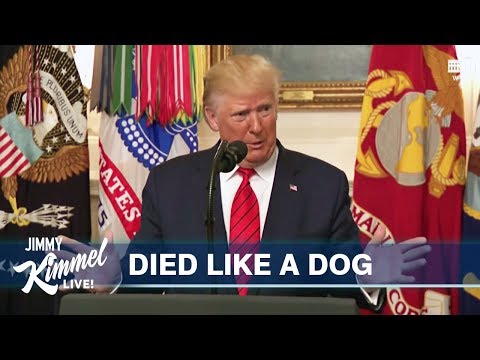
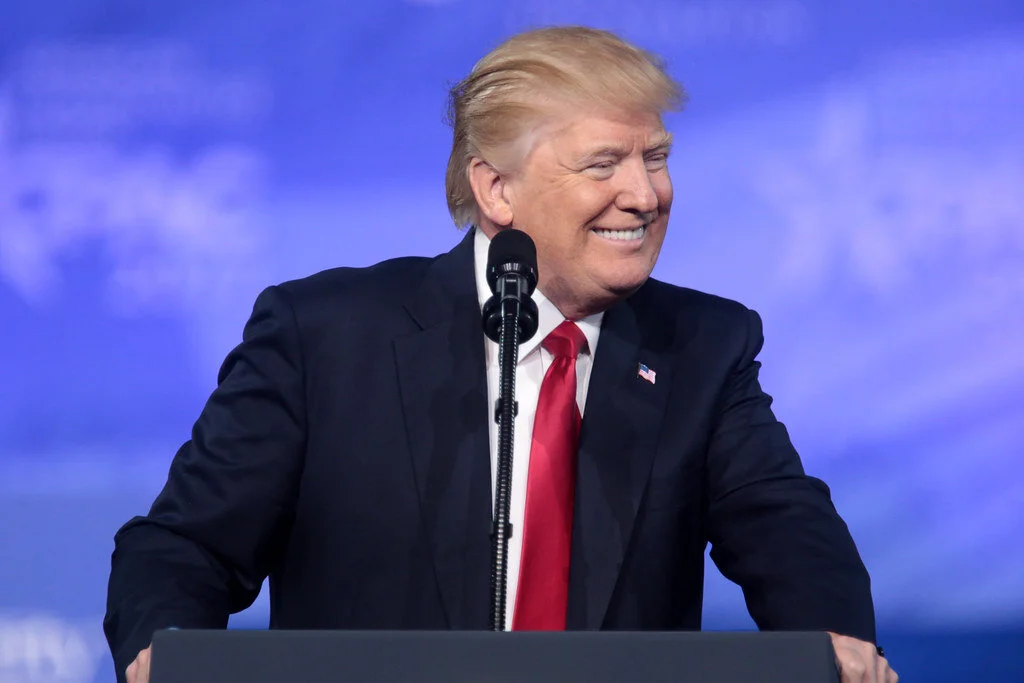
There is a very funny video circulating throughout the world on social media, in which U.S. President Barack Obama’s composure is contrasted with Donald Trump’s bombast. The clip originally aired on the late night show Jimmy Kimmel Live and it is introduced as a mash-up – alternating sound bites of Obama announcing to the world that Osama bin laden had been killed by U.S. forces, and Trump making a similar pronouncement regarding the death of Daesh (aka ISIS) leader Abu Bakr al-Baghdadi.

While the Kimmel crew edited the mash-up to produce maximum hilarity, the fact is that the difference in these two Presidents’ demeanor is startling. Obama appears solemn and his direct delivery of the unembellished news of bin Laden’s execution at the hands of a U.S. Seal team carries a sense of gravitas.

Trump on the other hand comes across as a gloating buffoon.

Often using the collective ‘we’ Trump made it sound like he was actually involved in the raid. In attempting to give praise to the initiative shown by the U.S. special forces operatives, Trump comes across as both comical and childish, “Even not going through the front door” Trump described the details of the raid, adding “If you’re a normal person you say ‘knock knock’ may I come in?”

This is not exactly the sort of juvenile joke one would expect from the Commander-in-Chief of the world’s largest and most sophisticated military force.

Trump also revealed the fact that the U.S. commandos had used dogs to chase al-Baghdadi into a dead end tunnel, following which Trump gleefully reported “al-Baghdadi died like a dog”.

However, contrary to Trump’s attempts to portray Baghdadi’s final moments being the cowardly act of ‘whimpering in the dirt’ the Daesh leader apparently detonated a suicide vest which killed himself and two of his children.

Why Trump felt it was necessary to relay this detail to the American public only further serves to illustrate that the U.S. President has no understanding of the Islamic Jihadist mindset.

In life, al-Baghdadi encouraged his followers to seek martyrdom in order to defend his self-proclaimed caliphate. Detonating a suicide vest while engaged in a firefight with U.S. forces will be considered a death in battle by al-Baghdadi’s followers. He has now become a martyr in their eyes. He in the end practiced what he preached.

Although Trump also announced that the same raid had killed not only al-Baghdadi but also his second in command, it would seem that Daesh did not remain leaderless for long.

By November 1st, less than six days after al-Baghdadi’s death, the Daesh spokesperson had already announced their new leader to be a chap named Abu Ibrahim al Hashimi al-Qurashi.

During his Sunday October 27th, 48 minute press briefing on al-Baghdadi’s death, Trump repeatedly stressed just what a bad guy the Daesh leader had been.

The main theme of Trump’s victory rant was that al-Baghdadi was a bigger terrorist than bin Laden. To make his point that al-Baghdadi was “the worst ever” evildoer on the planet, Trump stated “Osama bin Laden was very big but Osama bin Laden became big with the World Trade Center. [al-Baghdadi] is a man who built a whole, as he would like to call it, “a country” a caliphate, and he was trying to do it again.”

Somehow in Trump’s mind, his administration’s execution of al-Baghdadi trumps (pun intended) the Obama administration’s capture and killing of bin Laden.

The truth is that neither of these highly publicized U.S. assassinations have done anything to eliminate the threat of Islamic Jihadists.

Neither bin Laden nor al-Baghdadi were leaders in the conventional sense that they actually commanded their fighters on a tactical level. Both men at the time of their executions were living as hunted fugitives.

They had long since lost direct operational contact with their followers. They were instead symbolic figureheads – both of whom have now been martyred by the U.S. military.

That does not make the world a safe place – no matter what the Donald would have you believe.

ON TARGET: Report: Russia did not divide Canadian Electorate

1.jpg

By Scott Taylor

On Oct. 23, with the dust still settling in the wake of the federal election results, it was quietly announced by the Privy Council Office that there had been no attempted foreign inference in Canada’s democratic process.

While it was reported by several national media outlets, if you blinked you likely missed this particular news item.

That no foreign malign actor even bothered to attempt to further divide Canadians during the 40-day election campaign flies in the face of all the fear mongering reports leading up this year’s exercising of our democratic rights.

Last January, the threat was supposedly so real that Canada set up extensive counter-measures in an effort to limit the potential fallout from a coordinated campaign from foreign malign actors abusing social media platforms to spread hate.

In addition to making public appeals for the monitors of popular social media platforms to tighten up their own regulatory processes, the Liberal government also established a tiger team of five senior bureaucrats called the Critical Election Indecent Public Protocol.

This panel was headed by none other than the Chief Clerk of the Privy Council and included the federal national security advisor, the deputy minister of Justice, the deputy minister of Public Safety and the deputy minister of Global Affairs Canada.

To support this collection of bureaucratic heavyweights, the government also established a special task force featuring the combined resources of Canadian Security Intelligence Services (CSIS), the Royal Canadian Mounted Police (RCMP), Communications Security Establishment (CSE) and Global Affairs very own intelligence branch.

In other words ‘all the kings horses and all the kings men’ were mobilized to protect Canadians.

Despite this mighty defence system, being in place last April Global Affairs minister Chrystia Freeland told reporters that she was “very concerned that Russia is meddling” in Canada’s election. She claimed at that juncture that there had “already been efforts by malign actors to disrupt our democracy.”

That same month Facebook took the decision to ban a couple of malign actors from using their social media site. However both Faith Goldy and the Sons of Odin – the two users banned – are very much homegrown Canadian purveyors of divisive hate.

By September when the official writ was dropped, we had another warning of Russian meddling, this time from a report tabled by the U.S. based Jamestown Foundation think tank. They warned us that Russia would use the election process in Canada to advance Putin’s growing interest in the Artic.

Well, for whatever reason, we are now being told by our extensive security apparatus that the feared interference never materialized. The foreign malign actors did not disrupt, or attempt to disrupt our democracy.

Which means that all the division and hate, which emerged during the election, is on us as Canadians.

In the final days of the campaign, the Globe and Mail broke the story that the Conservative Part of Canada allegedly hired Warren Kinsella to smear Maxime Bernier’s People’s Party of Canada. This is the sort of dirty tricks political tactic we would have believed to be beneath Canada’s lofty democratic process. Turns out we’re apparently not above stooping that low.

Post election, we had the shocking incident wherein the campaign office of Liberal Cabinet Minister Catherine McKenna was vandalized. Red paint was used to convey a vulgarity that does not deserve repeating. That display of hate was not some malign foreign actor tooling about with a keyboard on the dark web. No, it was a real person with an unhinged view of what free speech entails. Trust me, hate speech is not free speech.

However, far more alarming than a bigot with a paint can, was the post election rhetoric uttered by none other than Jason Kenney the premier of Alberta. With Trudeau’s Liberal’s failing to win a seat in Alberta, Kenney has already issued the veiled threat that without some form of reconciliation there will be long term damage to Canada’s national unity. In other words he is threatening to literally divide our nation.

So while the government tiger team of security experts may have indeed saved Canadians from those malign foreign actors, the question now begs who will save us from ourselves?

ON TARGET: Foreign Policy a no-show in Election

Screenshot from the debate

Screenshot from the debate

By Scott Taylor

Right down to the wire in the 2019 federal election, no political leader offered up a vision on Canada’s role on the world stage. At no point in the campaign did any party issue specific statements regarding their position on defence or foreign affairs issues.

In his successful run in 2015, Prime Minister Justin Trudeau had vowed not to purchase the controversial Lockheed Martin F-35 Joint Strike Fighter, while also promising to get the Canadian military back into the business of conducting U.N peacekeeping missions.

This time around, with the F-35 currently leading the pack of potential bidders to replace the RCAF’s aging fleet of CF-18 fighter jets and the Liberal’s one-and-done diminutive peacekeeping effort in Mali concluded, Trudeau barely even mentioned the military. Ditto for Conservative leader Andrew Scheer and the NDP’s Jagmeet Singh, neither of whom put forward any concrete discussion on the future of Canadian military.

Despite the virtual silence and utter lack of debate, the current instability and shifting circumstances on the world stage means that Canada will have no option but to make some serious alterations to our present course on the foreign affairs file.

The recent Turkey-U.S. deal that forced the Syrian Kurds back under the authority of President Bashar al-Assad demonstrated exactly who the big boys are at the Middle East decision-making table.

Canada is not even at the adjoining kids table, which is why we need to re-think the current commitment of military personnel to Iraq.

Although it has been almost ignored by the western media in recent weeks, the streets of Baghdad have been awash in violent demonstrations.

Unlike the Chinese police in Hong Kong who have been singularly restrained in their use of lethal force against demonstrators, the Iraqi security forces wasted little time before firing live ammunition into the rioters on the streets of Baghdad.

Over a 100 people have been killed and more than a thousand injured to date and there is no sign of the unrest in Iraq being resolved anytime soon.

Canada presently has a lead role in the NATO effort to train the Iraqi military.

That might have seemed a noble use of Canadian military personnel when the common threat was the Daesh (aka ISIS) evildoers. However, now that the Iraqi security force is being used to shoot and kill those protesting the corruption of the current regime, it becomes tougher to justify Canada’s continued participation.

Likewise Canada’s second, separate commitment of special forces advisors to Iraq is no longer serving a clear purpose. Canada does not have the necessary foreign intelligence capability to allow us to assess the complex and constantly shifting threats in this sector.

Our special forces are the best in the world, in my opinion, but without independent intelligence they are operating as highly trained professional mercenaries in the service of U.S. interests.

As we saw with the recent Trump abandonment of the Kurds in Syria U.S. interests in the region may not always reflect Canadian values.

In short, Canada should get out of Iraq militarily because we should never have been deployed there in the first place.

In 2011, Canada led the international chorus encouraging the Syrian uprising and chanting, “Assad must go!” Well, now it seems that Assad is back and he’s here to stay.

That same year Canada did more than shout encouragement to the Libyan rebels as the Canadian military led the international bombing campaign to oust President Moammar Gadhafi.

The problem with that little exercise was that in place of one big warlord, Libya was instead over-run with a thousand little violent warlords. That poor country remains awash in violent anarchy thanks in large part to Canada coordinating the NATO air campaign.

Closer to home, Canada also took a lead role in trying to effect regime change in Venezuela. Canada chaired the fourteen-nation Lima Group who not only denounced incumbent President Nicolas Maduro, but they also recognized a chap named Juan Guaido as the Lima choice as replacement President.

Back on 10 April, Guaido boldly proclaimed he had the support of Venezuela’s security force but subsequent events have proven that boast to have been premature.

Not only does Maduro remain in control, but also last week Venezuela was named as a member of the U.N committee on Human Rights.

Given Canada’s track record of late, it was probably a blessing that foreign policy never entered the current election debate.

ON TARGET: USA Has a History of Selling out the Kurds

Gage Skidmore/Flickr

By Scott Taylor

In the wake of Turkey’s recent military offensive against the Kurdish forces in northern Syria we have seen a very complex regional conflict dumbed down to the simple equation of – “Trump bad.” It was of course in the immediate aftermath of President Trump announcing the withdrawal of U.S. forces from the region, that Turkey’s President Recep Erdoğan launched his cross border attack.

The over simplistic and emotional response from U.S. politicians and pundits was that the Kurdish forces had assisted American troops in defeating Daesh (aka ISIS or ISIL) and now it seems that for strategic expediency, Trump is abandoning these loyal allies to the mercy of the evil Turks.

On the surface it appears to be an open and shut case of simple betrayal on the part of the Donald.

However let’s start adding some context and modern history to the equation in order to cloud the issue a little. First of all, there is no legal premise for U.S. forces to be in Syria in the first place. They were not invited into the fight against Daesh by embattled Syrian President Bashar al-Assad. The U.S. were invited back into Iraq by the Baghdad regime in 2014 to fight off the Daesh scourge and the Pentagon simply chose to ignore the border with Syria.

While the Americans may have aligned themselves with Kurdish fighters, the list of coalition partners fighting against Daesh also included the Russian military, Iran’s Revolutionary Guard, Iraqi Shiite militia, Hezbollah and forces loyal to Assad. I don’t think anyone would shed crocodile tears for any of these erstwhile anti-Daesh allies should Trump turn his back on them.

For the record, while the Syrian Kurdish forces fought against Daesh they also were upfront and honest about the fact they were ultimately fighting to establish an independent Kurdish state.

It has been this dream of an independent Kurdistan that has allowed outside players such as the U.S. to exploit the Kurds to their own advantage for decades. Large Kurdish minorities exist in Syria, Iraq, Iran, Armenia & Turkey. Any creation of an independent Kurdistan would only inflame the existing separatist Kurdish movements in these neighboring countries.

Throughout all the discussions of long term regional solutions I have yet to hear anyone discuss a proposal to redraw the map of the middle east in order to carve out a Kurdistan.

It is the official position of Global Affairs Canada that we recognize the existing borders of Iraq and Syria under the centralized governments of Baghdad and Damascus respectively. This is what made it so bizarre when the Canadian military senior leadership in 2014 authorized Canadian Special Forces trainers to wear the flag of Kurdistan on their uniform while working with Kurdish fighters in Northern Iraq.

When this policy was questioned in the Canadian media, the military petulantly stuck to their guns and continued the practice of our soldiers wearing the flag of an unrecognized breakaway territory. The Pentagon had a quiet word with our brass and the flags were subsequently removed.

Now that Trump has abandoned the Syrian Kurds, such an example of Canada’s naiveté in affairs of the middle east seems even more embarrassing in retrospect.

For their part the Turks claim they are battling Kurdish terrorists in Syria in order to create a 30km safe zone. The plan is to then resettle a large portion of the 3 million Syrian refugees presently housed in camps on Turkish soil.

It is also true that not all Kurds can be considered equal. The Peoples Worker Party (PKK) has been waging a bloody insurgency in eastern Turkey for more than three decades. Over 40,000 people have been killed in those clashes, and more importantly the U.S., NATO, the E.U. and Canada all officially recognize the PKK to be a terrorist organization. Ditto for the notorious al-Qaeda Kurdish battalions in northern Iraq.

Western media almost never mentions the Turkish speaking Turkmen minority in northern Syria and Iraq as that would only further complicate an already confusing equation.

Turkey is also a NATO ally, and at the end of the day that fact alone would appear to trump any sentimental notion of a Kurdish state.

Former U.S. Secretary of State Henry Kissinger summed it up best back in 1975. He had just sold out the Iraq Kurds to Saddam Hussein with the signing of the Algiers agreement and Kissinger retorted “covert operations should not be confused with missionary work.”

That sounds like something Trump would tweet.

ON TARGET: No Real Election Divide between Liberals & Conservatives on Defence Issues

Screenshot 2019-10-07 11.33.27.png

By Scott Taylor

We are now past the midway point of this year's 40 day federal election campaign. If the polls are to be trusted, Trudeau's Liberals are locked in a dead heat with the Andrew Scheer Conservatives. The public furor over Trudeau's Black face - Brown face shenanigans has seemly blown over without seriously tipping the voter balance in favour of the Conservatives. That could in part be explained by the fact that most of the electorate still recall that just four short years ago the Conservatives were proposing a snitch line for Canadians to report 'barbaric cultural practices' practiced by their immigrant neighbors.

That racist policy was admittedly one of the reasons that the Harper government was chased from power in 2015. Yet despite that election defeat, the snitch line legacy is far from history. One of the key architects and proponents of the snitch line, Chris Alexander, is running under the Scheer Conservative banner in an attempt to win back the seat he lost in the Ajax - Pickering riding last time around. This means the individual voter has to choose between Trudeau's youthful racist actions and a Conservative party that preaches racist and divisive policies..

Similarly, there is little difference between the two major parties when it comes to their policies in defence.

In his successful bid to get elected in 2015 Trudeau had made two promises regarding the military. The first was that as Prime Minister he would make Canadian Peacekeeping great again.

The sum total of action on promise was a single one year commitment of helicopter support and 250 personnel to the United Nations mission in Mali. That mission has since concluded and with only a handful of Canadian service members assigned to far flung U.N missions, it is safe to say that Canada is out of the peacekeeping game once again. There is presently no talk about peacekeeping on the election campaign trail as it would seem that politicians have realized that Canadians don't really care about our nations commitment to the U.N.

The second thing that the 2015 Liberal party promised to do if elected, was to not buy the controversial F-35 Joint Strike Fighter Jets to replace the RCAF's aging fleet of fighter aircraft.

During their four years in power, the Liberals first announced they would sole source purchase 17 new Super Hornets from Boeing to fill a short term capability gap. That deal was scrubbed when Boeing entered into a trade dispute with Bombardier, leading the Liberal party to denounce Boeing as an untrustworthy partner. Instead of Super Hornets Canada has purchased 18 legacy Hornets - of the same vintage as Canada's aging fighter fleet, to fill in the announced 'capability gap'.

The problem with this solution is that a recent Auditor General's report noted that the RCAF does not have enough pilots and ground crew to operate the planes now in service - yet the braintrust decided the answer to this dilemma was to buy more old used planes. But I digress. There is presently a competition to find a fighter jet replacement, and despite what Trudeau told voters in 2015, the F-35 is considered to be the front runner to win. In fact, Airbus withdrew from competing their Eurofighter citing the fact that the request for proposal was all but tailored to the F-35 option. 

If Conservatives are elected it is expected they will terminate the competition and simply purchase the F-35. You can also bet that Scheer will not be keen to boost our military commitment to the United Nations.

As for Canada's other current international deployments, these were all initiated under the Harper Conservatives and extended and expanded by the Liberals. Regardless of who gets into power on 21 October, expect that we will continue to support the forward deployment in Latvia, the training mission in Ukraine and the two separate contingents we have in Iraq.

As for how these two parties match up when it comes to policies on the care and welfare of our veterans, that is the grist for another column.

ON TARGET: Now that's foreign interference on steroids

29496564944_a9faceb1c2_b.jpg

By Scott Taylor

Now that we are in the midst of our federal election, Canadians are constantly reminded by our security agencies that foreign “malign actors” are hard at work interfering with our democratic process. It is repeated so often and so emphatically that it must be true.

I am not sure exactly what divisive issues the Chinese and the Russians are concocting on the dark web, but they certainly have not impacted the Canadian electorate’s sensibilities to the same degree as Justin Trudeau’s unexpected blackface scandal. No one has questioned the authenticity of old images depicting Canada’s prime minister sporting blackface; he has admitted to the offensive behaviour and apologized for his actions.

So, no claims of “fake news.” As for the origin of the initial images becoming public, they were first published in a foreign-owned magazine — but I don’t think anyone will accuse Time magazine of trying to interfere in Canada’s democratic process.

This brings us to President Donald Trump’s latest boondoggle south of the border. The Donald is now facing an impeachment inquiry following a whistleblower’s complaint alleging the president had attempted “to solicit interference” from Ukraine in advance of the 2020 elections in the U.S.

The background to this saga began with a July 25 phone call between Trump and the newly elected president of Ukraine, Volodymyr Zelensky.

In the normal course of events, this would have been nothing more than a courtesy congratulatory call, but Trump is not your normal politician.

As it was not supposed to be a sensitive or classified call between world leaders, White House staffers listened in and transcribed the conversation. Someone was troubled enough by Trump’s comments to file a whistleblower complaint to the inspector general.

Once that action was made public, the White House released a partial transcript of the phone call. Hence, we now have a fairly clear picture of what transpired.

Trump first pressured Zelensky into investigating potential 2020 election rival Joe Biden. At present, Biden is leading the pack of Democratic candidates seeking to run against Trump for the presidency next November.

Trump asserted that when Biden was serving as vice president, he had attempted to block a corruption probe by Ukrainian authorities into a company whose board of directors included his son, Hunter Biden. Trump urged Zelensky to pursue this investigation.

To put a little pressure on the Ukrainian president, Trump reminded Zelensky that the United States “has been very, very good for Ukraine. I wouldn’t say that it is reciprocal, necessarily, because things are happening that are not good. But the United States has been very, very good to Ukraine.”

There can be little doubt that at the time of that phone call, Zelensky was all too aware of the fact that Trump had used his presidential authority to put on hold hundreds of millions of dollars worth of military hardware earmarked for Ukraine.

So after reminding Zelensky just how “very, very good” the U.S. has been to Ukraine, Trump revisited this request that Zelensky investigate his Biden allegations. Imitative of the legendary Hollywood character Don Corleone, aka the Godfather, Trump tells Zelensky he would consider this probe into his rival to be a “favour.”

Unfortunately for Trump, after the story of the whistleblower complaint broke last week, the former Ukrainian prosecutor general who first investigated Hunter Biden’s company claimed there is no dirt to be dug. “From the perspective of Ukrainian legislation, (Hunter Biden) did not violate anything,” Yuri Lutsenko told the Washington Post.

So while Trump appears to have failed in his attempt to “solicit interference,” the transcript of that conversation has certainly revealed the true character of the U.S. president.

Reminding a head of state just how beholden the Ukraine is to the U.S., freezing vital military aid, and then advising Zelensky how to use his own legislative apparatus in order to benefit Trump personally? Now that’s foreign interference on steroids.

ON TARGET: Saudi Arabia Spends a Fortune On Defence and Still Cannot Defend itself

By Scott Taylor

On September 14, there was a series of missile and drone attacks that struck Saudi Arabian oil processing facilities near the city of Abqaiq. The result of the impact by an estimated 17 warheads was to cut Saudi oil production in half, taking nearly 5 million barrels a day off the world market. This of course caused speculators to drive up the price of oil, and within hours this was reflected in a spike in prices at gas pumps across Canada.

The Houthi led government forces in Yemen claimed responsibility for the strike, yet Saudi Arabia insists that Iran was the culprit. Iran has categorically denied responsibility for the attacks.

For those not closely following the bouncing ball of Middle East events, here is a summary leading up to this current crisis.

In 2015, the Shiite Muslim Houthi minority in Yemen, with Iranian backing, overthrew the Sunni Muslim Yemeni government, led by President Abdrabbuh Mansur Hadi. His military force defeated, Hadi fled into exile.

Almost immediately, Saudi Arabia led a military coalition into Yemen in an effort to restore Hadi and his Sunni supporters. This conflict is seen as yet another in a series of proxy wars throughout the Middle East between Saudi Arabia and Iran.

In the wake of this latest strike at Saudi oil production, U.S. Secretary of State Mike Pompeo has reaffirmed the position that America is firmly backing Saudi Arabia and that all possible means of military retaliation against Iran are on the table.

Initial reports talked of the U.S. military potentially targeting Iran’s oil refinery at Abadan, which is one of the world’s largest, or the Khark Island crude oil export facility, or both.

I may be missing something here but unless the objective is to drive oil prices back above USD $100 per barrel, how could taking even more oil off the world market benefit the global situation?

The real puzzle is why would it fall to the U.S.A to do Saudi Arabia’s military bidding when it comes to a stand off with Iran?

For those not familiar with the statistics it may come as a bit of a shock to know that Saudi Arabia is the third largest defence-spending nation in the world behind only the U.S.A and China. As a percentage of its Gross Domestic Product, Saudi Arabia leads the world at a whopping 12.5% of GDP on defence.

For the record, Canada currently spends just 1.2% of GDP on defence with both the NATO Secretary General and Donald Trump urging us to raise that amount to at least 2% of GDP.

The actual dollar figure spent on defence by Saudi Arabia is USD $67 billion annually, which is more than three times the estimated USD $19 billion spent by rival Iran. For an even more ridiculous comparison, poor old Yemen spends just USD $1.4 billion per year on the military – fifty times less than what the Saudis spend and yet the Saudi military has been unable to subdue the Yemeni Houthis in more than four years of intense fighting.

One of the first questions that needs to be asked is why, with so much spent on defence, was Saudi Arabia unable to protect such a strategic asset as the massive oil processing plants at Abqaiq? The Yemen rebels have been launching pinprick drone missile attacks on targets inside Saudi Arabia for some time now – although nothing on the scale and scope of the September 14 attacks.

Sophisticated air defence systems are capable of dealing with most modern drone threats, and from the enormity of their defence  budget, Saudi Arabia could certainly afford the best such systems in the world.

The other glaring conundrum is why the U.S. would feel the need to commit its own military resources to retaliation against Iran. Surely with all the deadly hardware the U.S. has sold to Saudi Arabia over the decades they should be capable of taking care of their own regional squabbles.

For Canada’s part, the Harper government broke off all diplomatic relations with Iran in 2012 and Liberal Foreign Affairs Minister Chrystia Freeland froze out the Saudis in the summer of 2018 as a result of the Kingdom’s widespread domestic abuse of human rights.

Canada has no dog in this fight but everyone on the planet will have a stake in the outcome.

Stay tuned.

ON TARGET: Trump Calls Off Peace Talks: Unwinnable War In Afghanistan Continues For USA

By Scott Taylor

In the days leading up to the anniversary of 9/11, U.S. President Donald Trump sent out a bizarre tweet claiming that he had just called off a secret summit at Camp David. According to Trump, senior leaders of the Taliban along with President Ashraf Ghani and Afghan Chief Executive Officer Abdullah Abdullah were about to jointly announce the signing of a peace deal.

This would have fulfilled one of Trump’s key election campaign promises to bring an end to America’s longest running war. Trump also made a lot of noise at the time about how he was going to win the war in Afghanistan, because despite his absolute absence of any military experience, he is somehow a self-proclaimed master strategist.

Now Trump claims that on the eve of him making what would have been a landmark announcement, he called off the Camp David meeting and shut down the peace talks completely. “They are dead.” Trump tweeted, referring to the status of peace negotiations with the Taliban.

Trump’s claim that senior Taliban leaders were to be on hand, on American soil to announce the deal was somewhat startling. However, the fact that the U.S. has been holding peace talks with the Taliban was not news. For the past 18 months, U.S. negotiators led by former Ambassador Zalmay Khalizad have been taking place in Doha, Qatar.

The fact that these discussions were taking place without any inclusion of representation from the impotent tag team of Ghani and Abdullah is certainly telling. By excluding the corrupt cabal, which the U.S. has installed in Kabul and propped up for the past 18 years means that the U.S. senior leadership has given up on the Ghani- Abdullah regime.

The real power struggle in Afghanistan has always been between the U.S. and the Taliban since America initially invaded in 2001. Despite all the rhetoric and effort put into arming and training the Afghan security forces to be self-sufficient – and this includes more than a decade long Canadian military contribution to the cause – the fact is that Afghan security forces remain all but useless.

The training and weaponry are not the problem, what they lack is the motivation to fight. While the Afghan soldiers wish to live in order to cash their U.S. provided paycheques, the Taliban fighters are more than willing to die for their cause.

Thus, while the U.S. currently maintains 14,000 troops in Afghanistan, and the Afghan security forces number around 400,000, the U.S. soldiers remain the Taliban’s biggest threat.

The plan being hatched in Qatar was to see the Americans withdraw all remaining 14,000 troops in exchange for the Taliban promising to never again allow Afghanistan to be used as a safe haven for foreign terrorist forces.

This agreement in principle must have scared the bejeezus out of Ghani and Abdullah because by its very nature, the deal surmises that the Taliban will be in control of Afghanistan the minute that the last U.S. soldier departs from the airfield in Bagram.

This was widely understood by Canadian soldiers who deployed to Afghanistan. Our soldiers fought, died, and were wounded propping up an Afghan regime so despised by its own population, that despite millions of dollars in weaponry and training, Afghan soldiers could not defeat their own countrymen.

But now with a single tweet Trump has called off those peace talks. The genesis for Trump’s sudden about-face was that the Taliban had set off a car bomb in Kabul, which had killed a “great, great” American soldier, along with a Romanian soldier and 11 civilians.

Despite Trump’s campaign promise to end the war, there are currently more U.S. troops in Afghanistan than when Barack Obama left office.

Trump will spin this whole cancellation and claim that this incident only proves he is still a master negotiator who was not intimidated by the Taliban’s continued campaign of terror. However, by calling off the peace deal he has committed American forces to an indefinite continuation of a war they could never win.

Time is definitely on the side of the Taliban, as they do not have four-year election cycles.

ON TARGET: Canadian Troops Should Not Be Used as Props to Commemorate Nazi Collaborators

Photo taken on Aug. 21, 2019. (Sambir municipal council/Facebook)

Photo taken on Aug. 21, 2019. (Sambir municipal council/Facebook)

By Scott Taylor

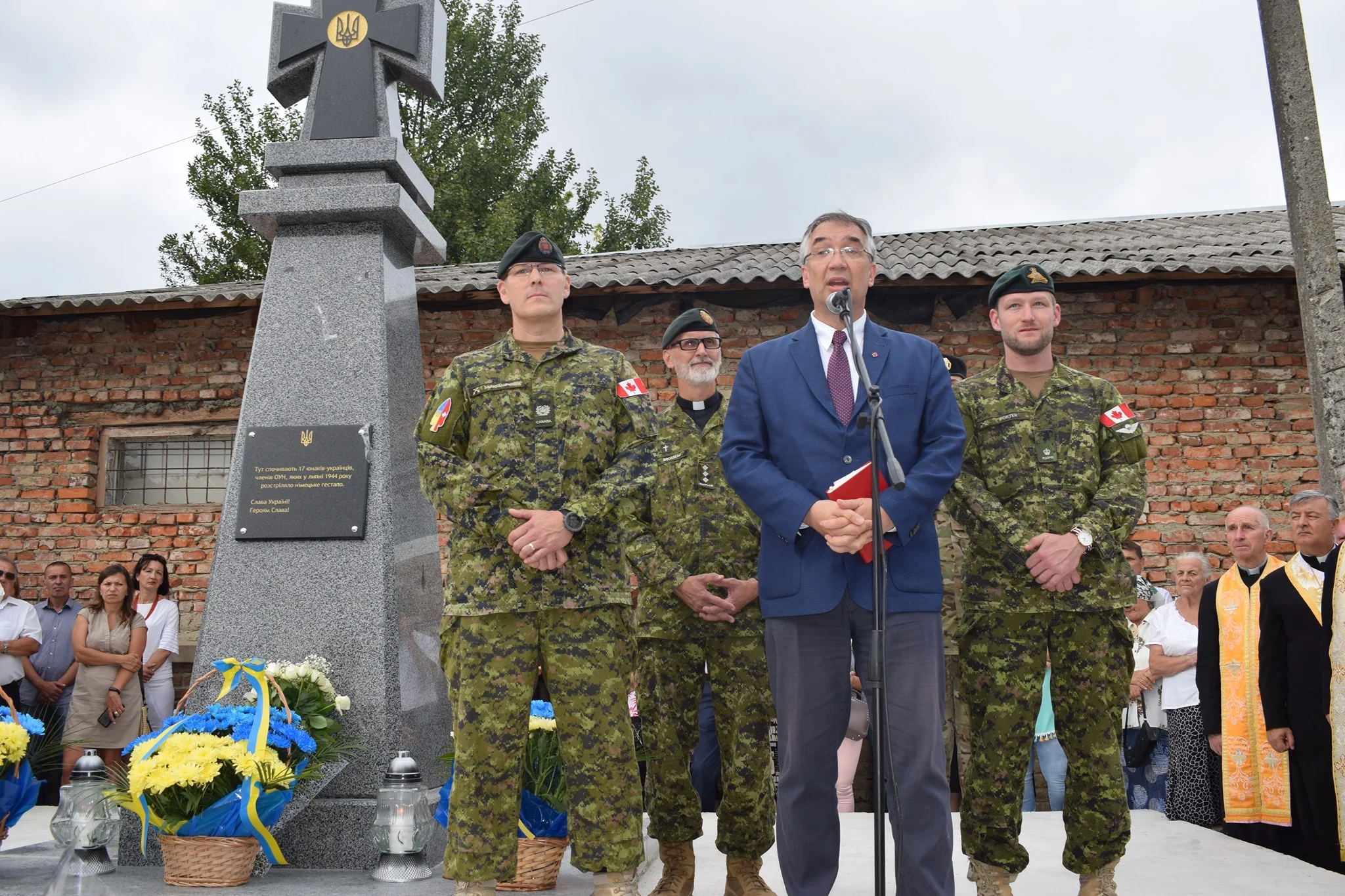
There was a bizarre little story last week out of Ukraine, which was picked up by Radio-Canada International. It centered on Canada’s official participation in the dedication of a monument at a Jewish Cemetery in the town of Sambir.

Canada’s Ambassador to Ukraine, Roman Waschuk and at least three uniformed Canadian military personnel took part in the formal ceremony. The promise of this event was to promote a reconciliatory path forward for Ukrainians and Jews. This of course is a very delicate subject given the history of violent anti-Semitism in this region of western Ukraine.

In fact, the August 21 memorial dedication in Sambir itself served to clearly illustrate these divisions.

While the site of the ceremony was on the edge of a Jewish cemetery, which also served as a mass grave for some 1,200 Jews slaughtered in 1943 during the Holocaust, the monument was not dedicated to those victims.

Instead it featured a large granite cross and was erected in honour of 17 members of the Organization of Ukrainian Nationalists (OUN) who were allegedly executed by the German Gestapo in 1944. For the record, the OUN were Nazi collaborators who were responsible for the deaths of thousands of Jews and a 100,000 Poles.

By the end of WWII all of the approximately 6,000 Jewish residents were dead or expelled and during the decades of Soviet communism the eradication of this community went unrecognized.

Fast forward to year 2000, and under the initiative of Canadian Jewish philanthropist Jack Gardner a stone monument was erected in Sambir to commemorate these Holocaust victims. In a shocking turn of events local Ukrainian nationalists tore down the monument and instead erected three ten-metre tall wooden crucifixes. These three crosses were claimed to honour the 17 executed OUN members, which are now immortalized by the new granite monument.

The exact circumstances surrounding the deaths of these 17 OUN fighters was questioned in the Times of Israel by noted Swedish historian Per Rudling. As an expert in the history of the OUN, Rudling found the Ukrainian version to be ‘dubious’ because while the OUN had briefly turned against the Germans, by August 1944 when the alleged executions occurred, the OUN was in full collaboration with the Nazis.

The August 21 ceremony also featured participation of Ukraine’s Chief Rabbi Yaakov Dov Bleich, which drew stern criticism from prominent Jewish leaders and Holocaust scholars.

Efram Zuroff of the Simon Wiesenthal Centre told the Times of Israel “It is incomprehensible how a Rabbi would participate in such a ceremony. This is clearly a white wash of the horrible crimes committed against Jews in Sambir and only reinforces the highly problematic tendency in Ukraine to hide Holocaust crimes committed by Ukrainians.”  

Rabbi Bleich claimed that his participation in the event was a ‘necessary comprise’, which will eventually pave the way to a monument recognizing the Jewish Holocaust victims as well.

This bring us back to the official participation in such a controversial ceremony by a Canadian diplomat, and even more disturbing the use of our soldiers in uniform being as symbolic props.

I’m sure none of the soldiers present that day were aware of the war crimes associated with the OUN. Whether or not the 17 executed members of the OUN actually committed crimes against Jews is irrelevant. The organization to which they belonged was responsible for horrific crimes against humanity. If local Ukrainian nationalists in the town of Sambir wish to revise their history and continue to exhibit blatant acts of anti-Semitism that should not be supported by Canada. It certainly should not be given the appearance of official sanction by having Canadian soldiers commemorate those who collaborated with Hitler’s Nazis in perpetrating the Holocaust. 

In WWII there were over 40,000 Ukrainian Canadians who proudly wore the Canadian uniform and bravely fought to defeat the Nazi’s. They are the ones deserving of official Canadian commemoration.

ON TARGET: Canadian Armed Forces Member Outed As An Alleged Neo-Nazi Recruiter

12.jpg

By Scott Taylor

The saga of Master Corporal Patrik Mathews continues to be a puzzler, with a plethora of unanswered questions. What we do know for sure is that Mathews joined the Canadian Army reserves eight years ago as a Combat Engineer. He was promoted twice to his current rank, and received training in the usual Combat Engineer skill sets like basic firearms handling, construction, demolition and explosives training.

Thanks to the intrepid, and courageous investigative journalism of Ryan Thorpe with the Winnipeg Free Press, it was recently revealed that Mathews was also the Manitoba based recruiter for a Neo-Nazi hate group known as the Base.

The founder of the Base is an American who goes by the public name of Roman Wolf. Their manifesto is based on white supremacy and they are actively arming and preparing themselves for the “coming race war”.  Recruiting posters for the Base began to appear on Winnipeg streets in July. With slogans like ‘Save your race – Join the Base’ and Nazi style images these flyers attracted the interest of Thorpe and the Free Press.

Thorpe was very quickly able to convince his Base interviewers that he was a legitimate volunteer who possessed the anti-Semitic, anti-immigrant mindset, which they were seeking.

After speaking with none other than head honcho Roman Wolf, Thorpe was granted a face-to-face meeting with Mathews. Although Mathews bragged to Thorpe that he was a member of the Canadian Armed Forces, Thorpe could not confirm this fact with the military prior to publishing his first story.

Once it was confirmed the MCpl Mathews and the Base recruiter were indeed one and the same person, DND went into full damage control mode. The problem was that nobody seemed to be singing the same song sheet.

Mathews’ Brigade Commander, Colonel Gwen Bourque told the media that the CAF had been blissfully unaware of the young Combat Engineer’s extra-curricular Nazi activities. This was quickly contradicted by Chief of Defence Staff General Jonathan Vance, who told CBC that Mathews has first been placed under suspicion for his viewpoints back in April. Vance said that at that juncture Mathews began to receive counseling. However, following an undisclosed escalation in Mathews activities in July, the alleged Neo-Nazi was placed “under full fledged analysis investigation by our national counter-intelligence unit” said Vance.

So, Mathews’ local Brigade headquarters knew nothing, but the feds in Ottawa had it fully under control? Got it.

Then there is the question of Mathews’ actual status in the CAF at the time the story broke. One version had it that Mathews had requested a voluntary release back in April; presumably around the time he was ordered to take counseling.

It was explained by DND spokespersons that these releases could take up to one year to process. Given the revelation by the Free Press that Mathews was in fact a recruiter for the Base, this process was being expedited so that he would not return for duty in the fall.

Further official clarification explained that the Reserve Combat Engineer unit to which Mathews belonged was stood down for the summer between May and September.

On Friday, August 23, after the story broke and his identity was confirmed, Mathews apparently asked his employer for time off so he could return his military gear.

I believe now that Mathews is indeed ‘essentially suspended’ as General Vance has claimed, but it is unclear whether or not Mathews indeed requested his release prior to this story breaking.

Although the RCMP subsequently raided Mathews home and seized what were admittedly legally registered firearms, no charges – either military or civilian have been filed in this case. So why then did Mathews disappear from sight?

This will no doubt play out in the days ahead, but one of the bigger questions we should be asking is why did it take a newspaper reporter endangering himself in order to surface the truth about these Neo-Nazis?

A few phone calls and some gutsy role-playing and Thorpe was able to get inside the Base. We have agencies with trained personnel and weapon permits that are supposed to be doing that sort of thing to protect all Canadians.

ON TARGET: Canadian Armed Forces Sexual Misconduct Stats Don’t Lie….But They Can Be Misleading

Screenshot 2019-08-26 10.46.00.png

By Scott Taylor

On August 13, the Canadian Armed Forces tabled a report which reflected some progress is being made towards reducing rampant sexual misconduct in the ranks. The official spin is that the military is seeing a ‘steady decline’ in complaints of inappropriate and criminal behaviour.

The yardstick used to determine this short term trend is based on the sexual assault tracking system which was put in place four years ago. The genesis for implementing such a tracking system stemmed from a scathing report written by former Supreme Court Justice Marie Deschamps, wherein she concluded the CAF was rife with a male dominant culture of sexual misconduct.

Last year there were a total of 302 reported complaints which is down 25% from the previous year, and 33% fewer cases than in 2016-2017 which was the first year DND began tracking sexual assaults.

Any downward trend is to be commended, but that figure of 302 reported sexual misconducts in a single year seems alarmingly high given the relatively small numbers involved, and the very nature of the institution in which these personnel serve.

It needs to be noted that females represent just 15% of the Canadian military and that women would constitute nearly 100% of the complainants. A previous Statistics Canada survey conducted last November reported that 1.6% of regular force members had been the victim of a sexual assault during the previous 12 months. That percentage adds up to approximately 900 serving personnel, but when one adjusts that figure to reflect the 15% female ratio, that percentage jumps to a staggering 10%.

The large discrepancy in numbers between the Stats-Can survey and the military’s tracking system could in part be explained by the fact that the vast majority of incidents of sexual assault go unreported.

Some feel that what appears to be progress in terms of fewer complaints being filed is in fact reflective of female service members losing trust in the system that their complaints will be properly dealt with.

Marie-Claude Gagnon is a former naval reservist who founded ‘It’s Just 700’ – a support group for military victims of sexual trauma. The title of the group represents the approximately 700 women who participated in Justice Deschamps external review in 2015.

In responding to these latest DND tracking system results, Gagnon told the Canadian Press “Since 2015 the CAF has been enticing victims to report sexual misconduct yet not providing then with adequate support and not consulting with them when they made very important changes that impact victims.”

Another theory on why the ‘steady decline’ in reported cases may in fact be a false positive,  was a significant spike in those cases that were reported by the victim’s supervisor. Last year, 15.2% of the recorded complaints came from a supervisor as opposed to the previous year when only 9.2% of cases logged were initiated by a third party.

Military regulations make it very clear that service members are responsible for reporting misconduct to which they have been made aware, and failure to do so could result in sanctions against them for negligence.

Under such circumstances, some have theorized that victims are therefore hesitant to come forward as it will oblige their supervisors to take action.

One camp believes the numbers are under-reported because victims feel nothing will be done, while the other camp thinks victims are now afraid to come forward  because official action will be taken.

As confusing as this may be, it remains crystal clear that the Canadian military has a huge problem with sexual misconduct.

I want to believe there is in fact a ‘steady decline’ in incidents. I do not buy into the theory that the CAF is simply a representation of Canadian society as a whole.

Yes, the individuals who wear the uniform are human and therefore fallible, but the institution is dedicated to defending Canadian values at home and abroad. Those values are not reflected by sexually assaulting a fellow soldier.

ON TARGET: Symbolic Body Art Signifies Bigger Problems

From Pinterest

From Pinterest

By Scott Taylor

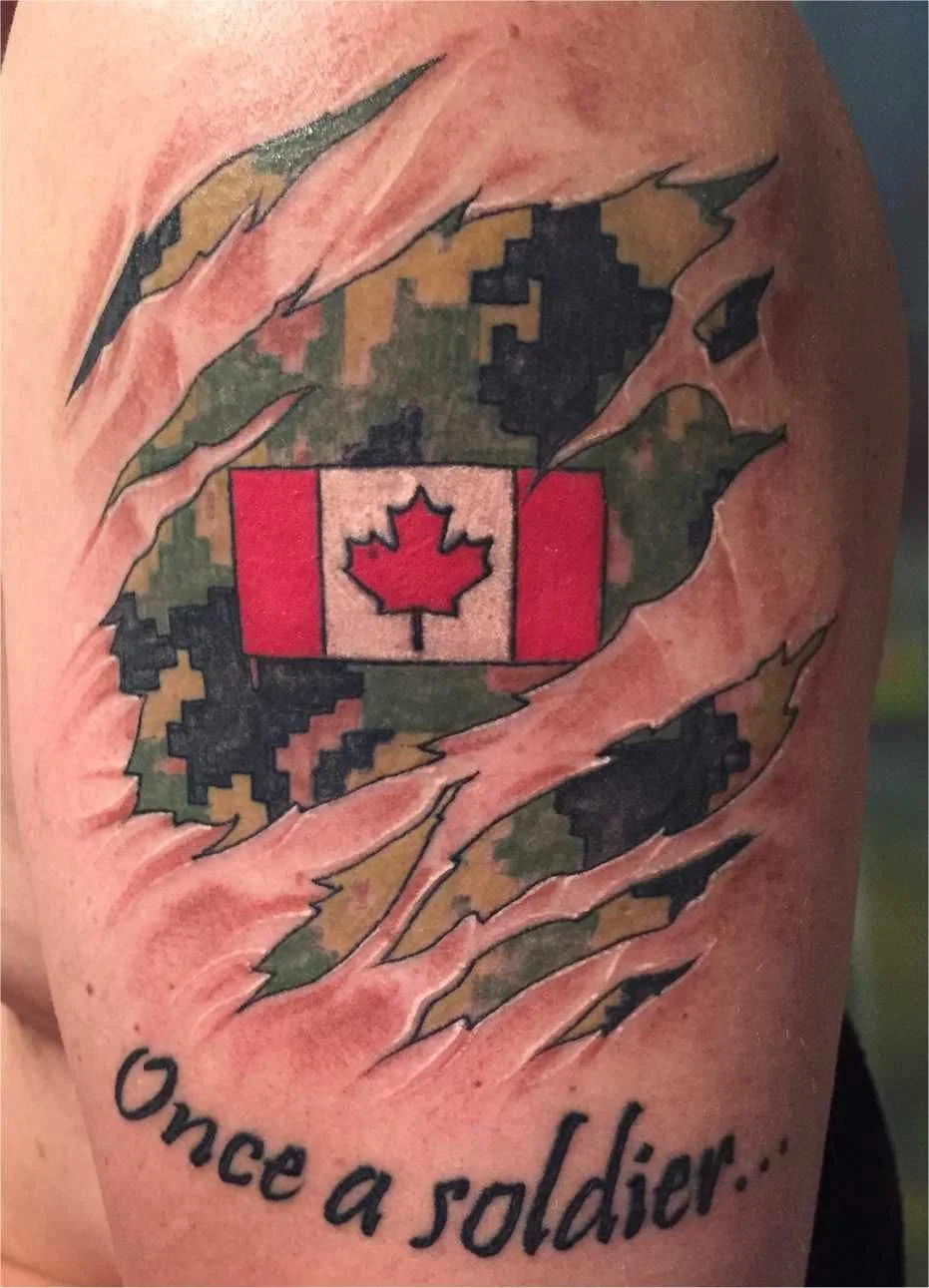
What started out as an almost comical, albeit embarrassing incident in Halifax has led the Canadian Armed Forces to once again amend their policy on individual service members’ deportment.

This whole saga began last June in a Tim Horton’s outlet when a member of the Royal Canadian Navy was observed displaying a contentious tattoo on his right forearm. An offended civilian patron quick-wittedly snapped a photo of the tattoo, which had the word ‘infidel’ graphically, altered into the shape of an assault rifle.

As the sailor was in work dress uniform, complete with a ball cap displaying the name of the ship to which he was assigned, this did not require the detective skills of Sherlock Holmes to identify the culprit once the images were made public. The sailor was subsequently questioned by his superiors as to the symbolic meaning of his inked image. According to the official RCN response, the sailor meant no offense to any religion or culture. However, in light of the commotion caused by the social media coverage of this incident, the sailor has agreed to tattoo over the contentious image at his own expense.

So case closed: Chalk another one up to the fact that the CAF is an organization composed of fallible human beings capable of poor judgment on occasion?

Not so fast. Although they insist that the timing is purely coincidental – and definitely not in response to the Tim Horton’s incident - the CAF have just brought in a whole series of new directives regarding tattoos.

The new guidelines were issued on Monday 12, August, by the office of General Jonathan Vance, Chief of the Defence Staff. Military members were warned that anything considered to be sexually explicit, discriminatory, racist, extremist, homophobic, misogynistic, sexist or evidence of membership in a criminal organization, should not be permanently tattooed on their bodies.

The new policy also makes a point of stating that tattoos are forbidden on the face and neck. However, members are allowed to request special consideration if they wish to have their face or scalp tattooed for religious or cultural reasons.

I am blissfully unaware of any religion or culture, which requires a face tattoo, but I am assuming in their efforts to embrace inclusion, the CAF policy planners felt it prudent to include that particular clause.

As an institution the CAF have been grappling to deal with widespread sexual misconduct throughout the ranks. In 2015, General Vance announced the implementation of Operation Honour as a concentrated effort to eliminate such misconduct.

As such, it would be very surprising if anyone in uniform would be so unaware of the career consequences of getting a sexist image or slogan tattooed anywhere on their person.

However, the real concern lies with images which could be associated with criminal organizations such as motorcycle gangs, and more alarmingly white supremacist groups.

Military Intelligence officials report that at least 30 CAF members were discovered to have been associated with hate groups in the past year.

Forbidding such members from displaying symbolic tattoos will prevent future embarrassment for the institution, but it does not remove the criminals or white supremacists from the military.

Maybe policy makers should have taken the opposite tack when dealing with tattoos. If members harboring such deep sentiments regarding sexism or racism that they wish to permanently brand themselves with a vulgar message – that says a lot about their true character.

Instead of ordering members to cover over offensive images, why not use these symbols to identify personality disorders? I’m not saying that any service member with a questionable tattoo be discharged, but it is safe to say that if someone is sporting “the Mayor of Boobtown” on his forearm he might need a little counseling regarding sexism in the workplace.

Symbols of racism, criminal entities, or white supremacy on the other hand have absolutely no place on those who wear the uniform in defence of Canadian values.

ON TARGET: Liberal’s Broke Promise to Make Peacekeeping Great Again

Members of the CH-147 Chinook medical team practice exiting the helicopter under the watchful eye of the force protection team in support of Operation PRESENCE - Mali around Gao, Mali. (Photo: MCpl Jennifer Kusche)

Members of the CH-147 Chinook medical team practice exiting the helicopter under the watchful eye of the force protection team in support of Operation PRESENCE - Mali around Gao, Mali. (Photo: MCpl Jennifer Kusche)

By Scott Taylor

Last Friday was National Peacekeepers’ Day and in honour of this momentous occasion Prime Minister Justin Trudeau tweeted out the following message: “Canadian Peacekeepers put themselves in harm’s way to protect Human Rights, lay the foundations of peace and help rebuild societies after war. Today we honour them for their tireless work.”

This sentiment certainly echoes the Liberal Party’s 2015 election campaign promise to make Canada a great peacekeeper again.

That pledge to get Canadian soldiers wearing the U.N. Blue berets again, rather than sending our military to participate in U.S. initiated global conflicts, seemed to resonate with the electorate, and Trudeau swept into power with a majority government.

In the summer of 2016, less than one year into their mandate, the Liberals announced that Canada would be committing a force of 600 military and 150 police for a twelve month deployment, at a budgeted cost of $450 million, to an unnamed U.N. mission in Africa. That was first announced by Chief of Defence Staff, General Jonathan Vance, and subsequently confirmed by Defence Minister Harjit Sajjan.

Then nothing happened. Despite the fact that the U.N. had several missions involving ongoing peacekeeping efforts in Africa it seemed that the Canadian government could not decide where to commit their promised resources.

Fast-forward to November 2017 and Canada played host to a U.N. Defence Minister’s conference in Vancouver. At that juncture Canada had so few actual military personnel assigned to U.N. missions that were we not the host nation, we would not have been allowed to participate in the conference.

Trudeau announced at that meeting that Canada was prepared to commit 200 ground troops, transport and armed helicopters, cargo planes and military trainers for future U.N. peacekeeping operations.

This pronouncement led to a round of mild applause, but keen eyed pundits were quick to ask what happened to the original 2016 pledge of a 600 strong force in Africa?

General Vance was quick to reaffirm “We will be deploying up to 600,” but that this figure would include soldiers not actually deployed to the foreign peacekeeping operations.

In the end, Canada settled on providing the medical airlift capacity for the U.N. mission in Mali. This effort included the deployment of two CH-147F Chinook helicopters – one of which is configured as a mobile air ambulance complete with a surgical suite, four armed CH-146 Griffon utility helicopters and approximately 250 military personnel.

The mission was to be twelve months in duration, and as such it was to have been concluded on July 31 of this year. Unofficially, this termination date has been extended until at least the end of August. The Romanian Air force, which is to replace our contingent, is not yet ready to deploy. Despite repeated pleas from U.N. authorities for Canada to remain until at least October, when the Romanians will be in place, the Canadian government has steadfastly refused to officially extend our solitary peacekeeping effort.

This is in stark contrast to the rapidity with which Canada has been extending all of our current non-U.N. foreign military deployments. We presently have two separate missions in Iraq totaling up to 850 personnel and at least four Griffon helicopters. The Special Forces train, advice and assist role, and the NATO training mission have recently been extended to 2021 and 2020 respectively. The commitment of 200 trainers to Ukraine was recently extended to 2023 and the provision of a battle group 500 strong to Latvia is open ended.

No matter when exactly our last chopper departs the Mali mission, it will certainly be prior to the federal election on October 21. So after a four-year term, Canada under the Liberals will be back to contributing zilch to the U.N., while we continue to deploy considerable forces on U.S. or NATO led military adventures.

Will this impact the election results? I doubt it.

Unlike the mission to Afghanistan, our soldiers are thankfully not returning to Canada in coffins on a regular basis. Canadians did not relate to the mission in Mali, they did not debate it, and according to recent polls the majority of our population do not even know what purpose our Canadian Armed Forces serve.

At least Trudeau thought enough to thank the peacekeepers for their tireless work. Happy International Peacekeepers Day indeed.

ON TARGET: Kandahar Cenotaph Dedication Ceremony: Paying Tribute To War We Could Not Win

By Scott Taylor

On Saturday, August 17, the Department of National Defence will host a dedication ceremony for what has come to be known as the Kandahar cenotaph. The original structure had been a personal peer tribute erected by Canadian soldiers still serving at the Kandahar Airfield to commemorate their comrades who were killed in Afghanistan. By the time Canada concluded its combat mission in 2011, and packed up the cenotaph, it included plaques representing 161 fallen Canadian soldiers and civilians.

Once it was repatriated to Canada there was much discussion as to where the cenotaph should find a permanent residence, as it is a moving symbol of Canada’s sacrifice in the Afghan mission.

With various government agencies doing what they do best – blocking all proposals regardless of their merit – DND finally decided to handle the problem within its own sphere of control. Thus, it was decided that the Kandahar cenotaph would be placed within the Nortel Campus of National Defence Headquarters in Ottawa.

For anyone familiar with the geography of our nation’s capital it is readily apparent that far from being in a central location, the Nortel Campus is well off the beaten path. Furthermore, as a functioning military headquarters facility it is a secure premise with no public access.

So, while the new permanent location is far from ideal, DND went one step beyond when they held the original dedication ceremony on May 13, without inviting or even notifying the families of the fallen. Word of the event first surfaced through social media posts three days after the VIP ceremony. Naturally enough this sparked an emotional backlash from many of the grieving families. This being an election year, Prime Minister Justin Trudeau vowed to make things right. As a result of Trudeau’s public pledge, we now have the upcoming ceremony, which will allow for travel costs and accommodation for up to six guests for each of the 161 individual soldiers and civilians who are represented on the cenotaph.

There are to be an estimated 1200 invited guests in attendance on August 17, with a projected catering bill alone in the range of $50,000.

I have no doubt that this time around the Kandahar cenotaph will be well and properly dedicated with all the pomp and ceremony worthy of such an occasion.

However, it will also inevitably be a bitter and sad experience for all of those assembled mourners who will be grieving the loss of a loved one.

It needs to be remembered that the dead were not the only sacrifice made by Canada’s sons and daughters in Afghanistan. There were over 2,000 soldiers wounded or physically injured during that decade long conflict and there are countless thousands more who continue to suffer from the invisible wounds caused by Post Traumatic Stress Disorder (PTSD).

Like the families of the fallen, the families of the wounded continue to struggle with the realities of the Afghanistan conflict’s aftermath on a daily basis.

When Canada concluded its combat mission in 2011 and then completed the military training assistance to Afghanistan in 2014, the die-hard hawks in the media who had blindly cheerleaded the war effort, said it was “too soon to calculate whether the sacrifice was worth it.”

They held on to the faintest of hopes that somehow the seeds of democracy, which we had helped to sow, would suddenly sprout into a peaceful utopia of prosperity and we could all rejoice.

Well now it is clear that this will never transpire. The U.S. has been negotiating directly with the Taliban in Doha, Qatar. In exchange for the promise that the Taliban will not harbour any future terrorist threats in Afghanistan, the U.S. will begin drastically reducing the level of American troops.

Trump recently quipped that he could still ‘win’ the war in Afghanistan, but would not do so because he “doesn’t want to kill 10 million people.” Threatening to wipe Afghanistan off the face of the earth is simply macho buffoonery by the Donald in the face of the humiliating reality that the Afghan insurgents have after eighteen years of resistance beaten the world’s greatest superpower.

Yes, August 17 will be a sad commemoration of lives lost in a war we could never win. And for the record, no, that sacrifice cannot be justified.

ON TARGET: Do We Really Need An Iranian Sock Puppet To Tell Us Trump Is Dangerous?

8.jpg

By Scott Taylor

For years now we have been told by various western intelligence agencies that Russia is using social media platforms to interfere in foreign elections and referendums. We are to believe that it was the Russians who manipulated the Brits into voting for Brexit, infused the American populace with bigotry which led to Trump’s election win, confused Ontario voters into making Doug Ford premier, and now they somehow seduced the British card-carrying members of the Conservative Party into making Boris Johnson the U.K.’s prime Minister.

Since the internet, and in particular social media platforms are chock-o-block full of fake news and conspiracy theories I was always puzzled as to exactly how the Russians were able to navigate through a sea of misinformation in order to play the Pied Piper leading us all so far astray.

Thankfully, last week the Washington Post ran a story outlining how not only Russia, but now Iran as well is planting the seeds of social discord via the internet. According to the Post, it was an Iranian ‘sock-puppet’ – the term used for fictitious online persona – who sent a tweet at a Hawaiian Congressman. The alias used by the Iranians was that of ‘Alicia Hernan’ whose fake identity purported her to be a “wife, mother and lover of peace”.

The message sent to the Congressman was a reference to President Trump: “That stupid moron doesn’t get that by creating bad guys, spewing hate filled words and creating fear of ‘others’, his message is spreading to fanatics around the world. Or maybe he does.”

Wow, pretty harsh words and some name-calling to boot? It would seem that Iranian intelligence services are going to great lengths to portray the Donald as a danger to world peace in order to make Americans vote for the Democrats. According to the Post, Alicia Hernan was one of 7,000 phony Iranian accounts that were shut down by Twitter this year alone.

Meanwhile, in the non-fake news category, last Monday Trump blew up a storm of controversy during an Oval Office meeting with Pakistan’s Prime Minister Imran Khan. In typical Trump fashion, the U.S. President told reporters that he could win the war in Afghanistan within a week by simply blowing it “off the face of the earth.”

Given that Trump actually has the codes to the U.S. nuclear arsenal, and the fact that in 2017 America dropped the world’s largest – Mother-of-All-Bombs aka MOAB (Massive Ordinance Air Blast) non nuclear bomb on Afghanistan, officials in Kabul were quick to demand clarification.

According to Trump “If [the U.S.] wanted to fight a war in Afghanistan and win it, I could win that war in a week. I just don’t want to kill 10 million people… Afghanistan would be wiped off the face of the earth. It would be gone.”

While it is certainly true that the American military possess the combined firepower to blast Afghan cities into rubble and kill millions of innocent civilians, what is not clear is how that would in any way be considered a ‘win’. 

Afghanistan is an impoverished, underdeveloped nation with largely illiterate and unskilled workforce. The U.S. military and their Afghan allies toppled the Taliban and declared victory in 2001. That was eighteen years ago and despite the expenditure of nearly one trillion dollars, and countless lives, Afghanistan remains defiant to U.S. rule.

In response to Trump’s threat to wipe Afghanistan “off the face of the earth”, a Kabul regime spokesperson stated, “The Afghan nation has not and will never allow any foreign power to determine its fate.” History has proven this to be the case dating back to the Afghan defeat of Alexander the Great. It is not a baseless claim that Afghanistan has become the graveyard of empires.

What Trump did not explain was how his “victory” would be cemented over the 20 million Afghans who would – according to his numbers – survive his threatened apocalypse. One has to imagine they would be pretty peeved to find themselves in a smouldering crater. But I digress.

What I have to question is why foreign state actors – like Iran and Russia would expend such energy creating ‘sock-puppets’ to fabricate the impression that Trump is a dangerous moron.

Just roll the cameras and let Trump prove that point himself.

ON TARGET: Examining The Khadr Case

4.png

By Scott Taylor

There was a news story earlier this month detailing how the widow of a U.S. soldier killed in Afghanistan could lay claim to the $10.5 million payout which was awarded to Omar Khadr. Naturally enough this set social media platforms abuzz with the usual hate frenzy aimed at Khadr.

The online arguments are heavy on emotion but often fall wide of the actual facts in the case. It is therefore probably a good idea to recap the main points of the entire Khadr saga.

Khadr was born in Canada to immigrant parents from Egypt and Palestine. His father Ahmed was undeniably an Islamic extremist with links to al Qaeda. Khadr would have been influenced by his father’s religious beliefs.

Ahmed Khadr brought his son to Afghanistan to fight against the Americans, but at the time that Omar was wounded and captured he was only fifteen years old. For him to have been a boy in a war zone is the sole responsibility of his father. Even in civilian courts any crime committed would have him tried as a minor and Khadr could best be described as an exploited boy soldier.

In order to secure his release from U.S. custody at Guantanamo Bay after eight years of captivity, Khadr plead guilty to “murder in violation of the law of war.”

After being returned to Canada, Khadr claimed this confession to murder was a coerced statement made under the duress of alternately facing continued custody.

I have always been perplexed at the fact that the U.S. authorities could consider a soldier killed in battle to have been murdered.

The details of the July 22, 2002 firefight in the Afghan village of Ayub Kheyl show that it was a set piece battle, planned and executed by U.S. Special Forces. They were aware that this hamlet contained foreign fighters and Taliban. They called in several airstrikes from Apache helicopter gunships and an A-10 Warthog attack aircraft, which dropped a 225 kilogram bomb.

As the U.S. Special Forces teams began mopping up, a grenade was thrown, killing Christopher Speer and wounding his comrade Layne Morris. No eyewitness has ever claimed to see Khadr throw the grenade, but he was the sole survivor – and barely a survivor at that.

Khadr was so badly wounded in the clash that he would have died without the skilled treatment by a U.S. medic on the scene.

Deemed an illegal combatant, Khadr was taken to Guantanamo Bay despite the fact he was an underage Canadian citizen. There he would endure eight years of brutal captivity before pleading guilty in exchange for his release to Canada.

It was Canada’s failure to protect Khadr’s rights, which the Supreme Court of Canada determined in 2010, “offended the most basic Canadian standards of treatment of detained youth suspects.”

It was that ruling which in turn led to the 2017 decision to pay Khadr a $10.5 million settlement for the government’s failure to prevent his detention and torture by American authorities. For the record, Khadr was not awarded the settlement because he was a terrorist.

For their part, Christopher Speer’s widow Tabitha and Layne Morris who lost an eye in the 2002 skirmish, took Khadr’s murder confession before a Utah court. That court ruled that Khadr is to pay the pair a total of $134 million USD in compensation.

It is this State Court judgment with which Speer’s widow and Morris intend to use to lay claim to any of the compensation cash paid out to Khadr.

Again, I cannot understand the rationale behind the Utah court’s judgment in this case. Speer and Morris were soldiers in combat at the time of their respective death and injury. Why would they, in this instance be compensated such a massive amount of money when the lump sum death benefit paid to the family of a Canadian soldier killed in battle is only $400,000?

Whether he confessed to the murder or not, it is difficult to label it a homicide when at the time the ‘victim’ was himself shooting at and attempting to kill the ‘murderer.’

That is called combat.

ON TARGET: Getting the Kandahar Cenotaph Dedication Ceremony Right

These plaques, with images of Canadians – and Americans under Canadian command – killed in Afghanistan, are part of the Kandahar Cenotaph now on display at National Defence Headquarters (Carling) in Ottawa. Photo: Master Corporal Levarre McDonald, C…

These plaques, with images of Canadians – and Americans under Canadian command – killed in Afghanistan, are part of the Kandahar Cenotaph now on display at National Defence Headquarters (Carling) in Ottawa. Photo: Master Corporal Levarre McDonald, Canadian Forces Support Unit (Ottawa). ©2019 DND/MDN Canada.

By Scott Taylor

Back in mid-May, the Department of National Defence blew up a media storm of controversy when they held a private dedication ceremony for what had become known as the Kandahar cenotaph. Three days after the May 13 dedication, DND simply posted up some photos on social media, alerting people to the fact that there had been no media advisory, no media present and most importantly, no inclusion of the families of the fallen.

Naturally enough this sparked outrage, and in the face of the public backlash Prime Minister Justin Trudeau vowed to get to the bottom of this blunder. Ironically, Defence Minister Harjitt Sajjan – who had attended the private ceremony inside DND’s Nortel Campus – was standing behind Trudeau as he made his statement to the media.

While responsibility for this error in judgment would not be much of a mystery, the decision has now been made to hold a dedication ceremony only this time they will invite the families. The plan is now for DND to pay the travel expenses for up to six family members of each of the 161 Canadian soldiers and civilians commemorated on the cenotaph.

The original structure at the NATO airfield in Kandahar, Afghanistan had begun as a sort of impromptu tribute to fallen comrades. Regretfully, it continued to grow in size and scope as Canadian casualties steadily mounted. Following the cessation of Canada’s combat role in 2011, the cenotaph was crated up and repatriated to Canada.

Plans were tossed around for a suitable public location in Ottawa, including one proposal to place it at the Navy Reserve facility at Dow’s Lake. Personally, I still think it would be best suited for permanent placement at Beechwood, Canada’s National Military Cemetery.

However, in the end, possibly owing to the inability to get all involved governmental agencies to agree to a single plan – it was decided to place it inside the DND Nortel campus.

This remote site is not central to Ottawa and as a functioning military headquarters, only accessible by military personnel and DND civilians.

Following the clamour raised back in May, arrangements were made to allow the public to set up pre-arranged, escorted visits – which I’m sure is not without its own administrative hurdles.

Commemorating the fallen is a noble and necessary exercise as these were Canada’s brave sons and daughters who went into harm’s way on the orders of the Canadian government.

Beyond simply honouring their sacrifice it is also incumbent upon us as citizens to question whether the price paid was worth the cost. In World War One Canadian soldiers helped defeat the German Kaiser and preserved the British Empire. In the Second World War, Canada and the Allies defeated Nazi Germany and Imperial Japan. Those who fought in Korea successfully kept the south free from communism.

The war in Afghanistan was not a victory. It was Canada’s longest war to date. We ended the combat mission in 2011 and concluded our military training mission in the spring of 2014. However, the war continues to rage in that country and there is no longer even any talk of a possible victory. The Taliban now control more territory than at any point since the U.S. declared them ‘toppled’ back in 2001.

More importantly, the U.S. is now seemingly giving up on the corrupt regime which they installed in Kabul to replace the Taliban. That would be the same corrupt regime that those 161 Canadian names on the Kandahar cenotaph died while attempting to prop up.

In recent peace talks held in Qatar it was announced that the U.S. are close to a deal with the Taliban. The basis for this deal would be the withdrawal of U.S. forces in exchange for a Taliban pledge not to allow Afghanistan to become a safe haven for foreign terrorists.

Not included in these talks are either President Ashraf Ghani or his ridiculously titled sidekick, Chief Operating Officer Abdullah Abdullah, the dubious duo that ostensibly rule Afghanistan.

This signals the U.S. is giving up on them and realizes that without U.S. troops in theatre, the Taliban will eventually prevail.

Since this will bring us full circle to the situation back in 2001, how can anyone justify the expenditure of so much blood and gold over the past eighteen years?

If Canada really wanted to honour the fallen, we would conduct a full parliamentary inquiry into how and why we were drawn into a war we could not, and did not win.

ON TARGET: Rank Has It's Privilege: 7 Years Imposed Restriction For VCDS

Lieutenant-General Wynnyk, Commander of the Canadian Army

Lieutenant-General Wynnyk, Commander of the Canadian Army

By Scott Taylor

Last week Postmedia broke the story that Canada’s Vice Chief of the Defence Staff has been collecting benefits known as Imposed Restriction (IR) allowance for the past seven years.

Lieutenant-General Paul Wynnyk was first posted to Ottawa as the deputy commander of the army back in 2012. At that juncture in his long military career Wynnyk chose not to move his wife to Ottawa from Edmonton, and instead he made the choice to live and work on his own in the nation’s capital.

By keeping Edmonton as his primary residence, Wynnyk was entitled to collect $1600 in rent allowance per month and an additional $100 for parking in IR benefits. More importantly under this arrangement his wife could retain her job as associate clinical professor in the Department of Dentistry at the University of Alberta.

So far, so good. The policy of IR benefits is designed for exactly that purpose of avoiding the trauma and cost of uprooting entire families in the short term. However as Wynnyk’s career progressed, he was promoted and appointed to a series of positions, which were all based in Ottawa.

Thus the short term evolved into a full seven years and the tab for Wynnyk’s ongoing IR allowance is now over $140,000 in total.

For the record, the average timeframe for a service member to collect IR would be about six months, and the military admitted that it is extremely unusual for that allowance to be paid in excess of five years.

That was the gist of the news story. At no point was it ever even insinuated that Wynnyk had done anything illegal. It was simply noted that the general’s choice comes at a substantial cost to taxpayers.

What was bizarre was the statement issued by the Department of Natural Defence to justify Wynnyk’s extended IR benefits. “The bottom line is that LGen Wynnyk has graciously agreed, time after time, to support the Canadian Armed Forces in its Ottawa HQ so that we can all take benefit from his experience, guidance and leadership while serving well past his eligibility for a full pension at 35 years in the CAF. He has sacrificed his own needs to benefit the institution, for which we are grateful.”

This official statement makes it sound like Wynnyk was volunteering his time to serve Canada out of the goodness of his heart. For the record, a LGen makes in the neighborhood of $250,000 a year. Hardly chump change, and by not moving his wife to Ottawa she retained her job at the University. That was their personal choice.

As for noting that Wynnyk had served his maximum pension eligibility of 35 years, that is a bit of an attempt to mislead.

Service members accumulate their pension at a rate of 2% per year served to a maximum of 35, which equals 70%. That percentage is then based on the average annual salary for the service member’s five highest paid years. So while Wynnyk cannot increase his percentage, he can, and has, added to his actual pension payout by increasing that five best year average total.

In the interest of full disclosure, I have known Wynnyk for many years and consider him to be a highly capable and well-respected senior officer. That being said, the insinuation in DND’s statement is that the Canadian Armed Forces is depending upon Wynnyk’s expertise, guidance and leadership. The problem with that comment is that it does a disservice to the equally professional and equally talented 130 General Officers and Flag Officers currently serving. That’s correct folks, Canada has a total of 130 Generals and Admirals.

It should also be remembered that for the past year Wynnyk was serving as VCDS in place of the suspended Vice Admiral Mark Norman, another individual who embodied expertise, guidance and leadership, but I digress.

The simple truth of the Wynnyk story is that he followed an existing policy and stretched the rules without breaking them. If he had to make any sacrifice to his lifestyle this was purely due to his own personal choice. It was not like he was deployed on a seven year posting to Afghanistan and deprived of being with his family.

The military lifestyle is considered to be a nomadic one. It is also understood that extended separations from family are a hardship, and that is why benefits like IR exist.

Wynnyk played both sides of that coin at the taxpayers expensive and to his own benefit.