

Honouring women who lead, innovate, serve and break down barriers across Canada’s defence community
Since 2015, the Esprit de Corps Top 20 Women in Defence “Breaking Down the Barricades” Awards have annually recognized women whose achievements, commitment, leadership, and impact have made an exceptional contribution to Canada’s defence, military and security community.
About the Awards
First presented by Esprit de Corps Magazine in 2015 under the banner “Breaking Down the Barricades,” the Top 20 awards were created to recognize the extraordinary contributions of women across Canada’s historically male-dominated defence sector.
What began as a feature highlighting visible role models has grown into an established national recognition program celebrating women who strengthen Canada’s defence community, enable others to succeed and help remove institutional and cultural barriers.
Their stories show the many ways women advance defence through military and public service, industry, innovation, research, policy, education, community leadership and advocacy.
Who Is Eligible?
Nominees must be individual women who have made an outstanding contribution to Canada’s defence, military or security community.
Nominees may come from any relevant stakeholder group, including:
· Industry and innovation: Defence-sector employees, executives, contractors, entrepreneurs and technology innovators.
· Canadian Armed Forces: Serving or former Regular Force and Reserve Force members.
· RCMP: Serving or former Regular Members and Civilian Members.
· Public service: Employees of DND, VAC, Public Safety Canada, Global Affairs Canada and other government organizations whose work contributes to defence or security.
· Parliamentarians: Members of Parliament, Senators, their staff, and policy advisers
· Research and education: Academics, researchers, educators and other professionals advancing defence- or security-related knowledge.
· Media: Journalists, publishers, communicators, and other media professionals whose work contributes to understanding Canada’s defence community.
· Community and advocacy: People working in Veterans’ organizations, non-governmental organizations, or community groups that strengthen the defence community or support those who serve or have served.
Canadian citizenship is not required, but the nomination must demonstrate a meaningful contribution to Canada’s defence community. Eligibility is based on self-identification as a woman.
The awards recognize individual achievement. Group and team nominations are not eligible.
Previous award recipients are not eligible to receive the award again, but are encouraged to nominate or co-nominate other deserving women.
Who May Submit a Nomination?
A nomination may be submitted by:
· an individual;
· up to two people acting as co-nominators; or
· an organization through an authorized representative.
Past award recipients are particularly encouraged to nominate or co-nominate other deserving women.
Self-nominations are not permitted.
The nominee must know she is being nominated and consent to the submission of her information.
Previous nominees who have not received the award are strongly encouraged to be nominated again. A new form must be submitted so the Selection Committee receives current information.
How Nominations Are Evaluated
Each nominee is assessed primarily on the evidence provided under five award criteria: achievements, commitment, leadership, impact and additional information. Nominators should not assume the Selection Committee already knows the nominee or her work. Specific examples and demonstrated results are more persuasive than general praise.
Provide a concise narrative addressing each criterion:
1. Achievements
Describe the nominee’s most significant accomplishments, qualifications, awards, affiliations, initiatives or project milestones.
Explain what she accomplished and why it matters to Canada’s defence community.
2. Commitment
Describe the significance, consistency or sustained nature of the nominee’s contribution.
Examples may include dedication to service, contributions beyond her formal responsibilities, perseverance through challenge or change, or continuing commitment to the defence community.
Length of service alone is not determinative; exceptional contributions made over a shorter period may also demonstrate outstanding commitment.
3. Leadership
Show how the nominee leads, mentors, enables or inspires others.
Leadership may be demonstrated through formal authority or through influence, initiative, collaboration, role modelling, team building or advocacy.
4. Impact: Breaking Down the Barricades
Explain how the nominee’s actions have produced meaningful change within the defence sector.
Examples of impact may include:
· removing institutional or cultural barriers, including opening a pathway as a “first”;
· advancing diversity, equity, inclusion or belonging;
· challenging outdated assumptions or practices;
· improving policies, programs, workplaces or operational capability;
· creating opportunities for others;
· amplifying underrepresented voices; or
· inspiring broader organizational or community change.
Where possible, describe tangible outcomes rather than intentions.
Additional Supporting Information
Each nominee is assessed primarily on the evidence provided under the five award criteria: achievements, commitment, leadership, impact and additional information. Nominators may however also provide additional supporting information.
Include relevant community service, volunteer work, extracurricular contributions or other information that helps the Selection Committee understand the nominee’s overall contribution and impact.
Final Selection: Breadth of Representation
The five published criteria are the primary basis for selection. When nominations are comparably strong, the Selection Committee may also consider the overall composition of the annual group so that recipients collectively reflect as broad a spectrum of Canada’s defence community as possible.
Additional factors that may be considered for tie-breaking between nominations include:
· geographic and regional representation;
· representation of Indigenous peoples, members of visible minorities, persons with disabilities, LGBTQ2+ communities and other equity-deserving groups;
· English- and French-language communities;
· military service environment, including Army, Navy, Air Force and Special Operations;
· Regular Force, Reserve Force, Veteran, RCMP, civilian, government, industry, academic and community perspectives;
· military rank;
· occupation, trade or professional field;
· length and type of service;
· volunteer contributions beyond formal employment, especially in support of women and girls;
· mentorship and development of others, especially women and girls; and
· service to organizations and initiatives supporting women, equity and inclusion in defence.
These considerations are used to distinguish among comparably meritorious nominations—not to replace the assessment of achievement, commitment, leadership and impact.
Any consideration of personal identity is based only on information voluntarily provided with the nominee’s knowledge and consent. The Selection Committee will not infer a nominee’s Indigenous identity, sexual orientation or other personal characteristics.
Before You Begin
Have the following information ready:
· the nominee’s name, position, organization and contact information;
· confirmation that the nominee knows she is being nominated and has consented;
· the primary nominator’s contact information;
· the second nominator’s information, if applicable;
· concise responses addressing the five award criteria;
· a summary of up to 400 words describing the nominee’s background, career, contributions, and accomplishments, which will provide the foundation for her profile in Esprit de Corps magazine if selected; and
· any relevant links or optional supporting information.
Submitting a nomination does not guarantee selection. The awards regularly attract more exceptional nominations than available places, and many recipients were nominated more than once before being selected. Non-selection should not be interpreted as a judgment that the nominee’s contribution was unworthy of recognition. Strong, updated nominations are encouraged in future award cycles.
Allow approximately 30–45 minutes to complete the form once you have gathered the required information. Google Forms may not reliably save an unfinished response, so consider drafting longer answers separately before beginning.
How to Submit
Complete the online nomination form
Submit nominations through the official online Google Form.
Nominations may be submitted in either English or French. Supporting materials are also accepted in either official language.
Les candidatures et les documents à l’appui peuvent être soumis en français ou en anglais.
Submit one form per nominee. If two people are nominating, identify both on the same form.
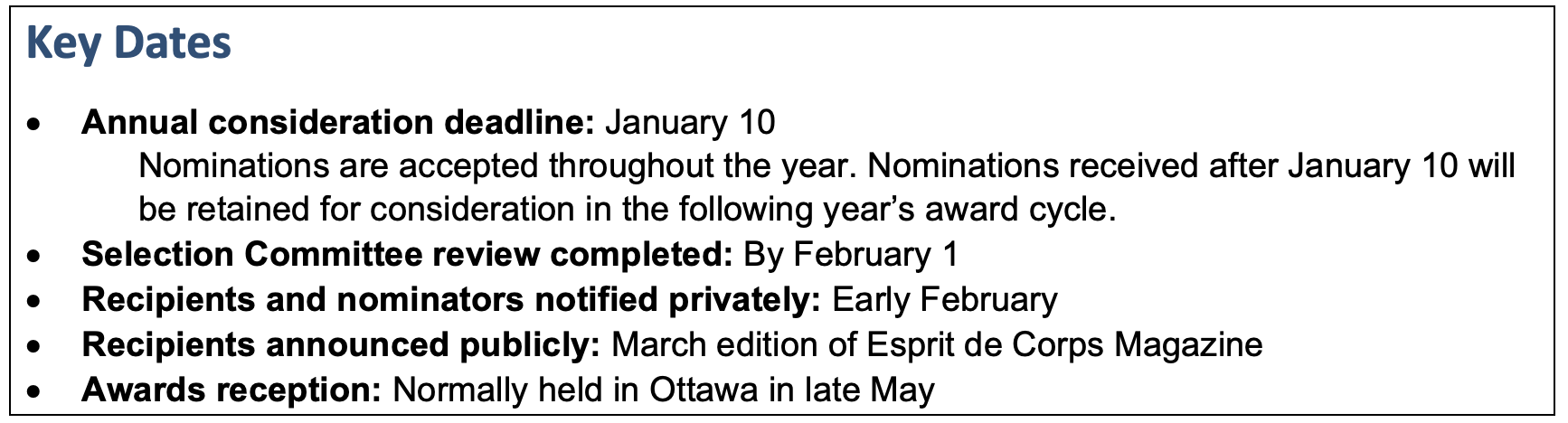
Nominations may be submitted at any time. Submissions received after January 10 will be retained for consideration in the following year’s award cycle.
Questions, corrections and supplementary material
For questions, corrections, updates or supplementary material, email:
Include the nominee’s full name in the subject line.
Optional supporting material may include a CV, biography, relevant links or other evidence supporting the nomination. Do not include unnecessary sensitive personal information.
If submitting a photograph, ensure you have permission to share it. Selected recipients will be contacted before any photograph or biographical information is published.
Selection and Notification
Nominations are reviewed comparatively by the Esprit de Corps Top 20 Women in Defence Awards Selection Committee using the published criteria. The committee is composed of previous award recipients and operates independently of Esprit de Corps management.
Selected recipients and their nominators are contacted privately before recipient profiles are published in the March edition of Esprit de Corps Magazine.
Information submitted will be used for award administration, evaluation and recipient communications. The online form provides further information about consent, privacy and use of submitted material.
Celebrating Women Who Make a Difference
In 2025, Esprit de Corps created a video overview explaining the history, purpose and impact of the awards. Watch the Top 20 Women in Defence by clicking here.
Lists of previous recipients appear below, organized chronologically and alphabetically.


