
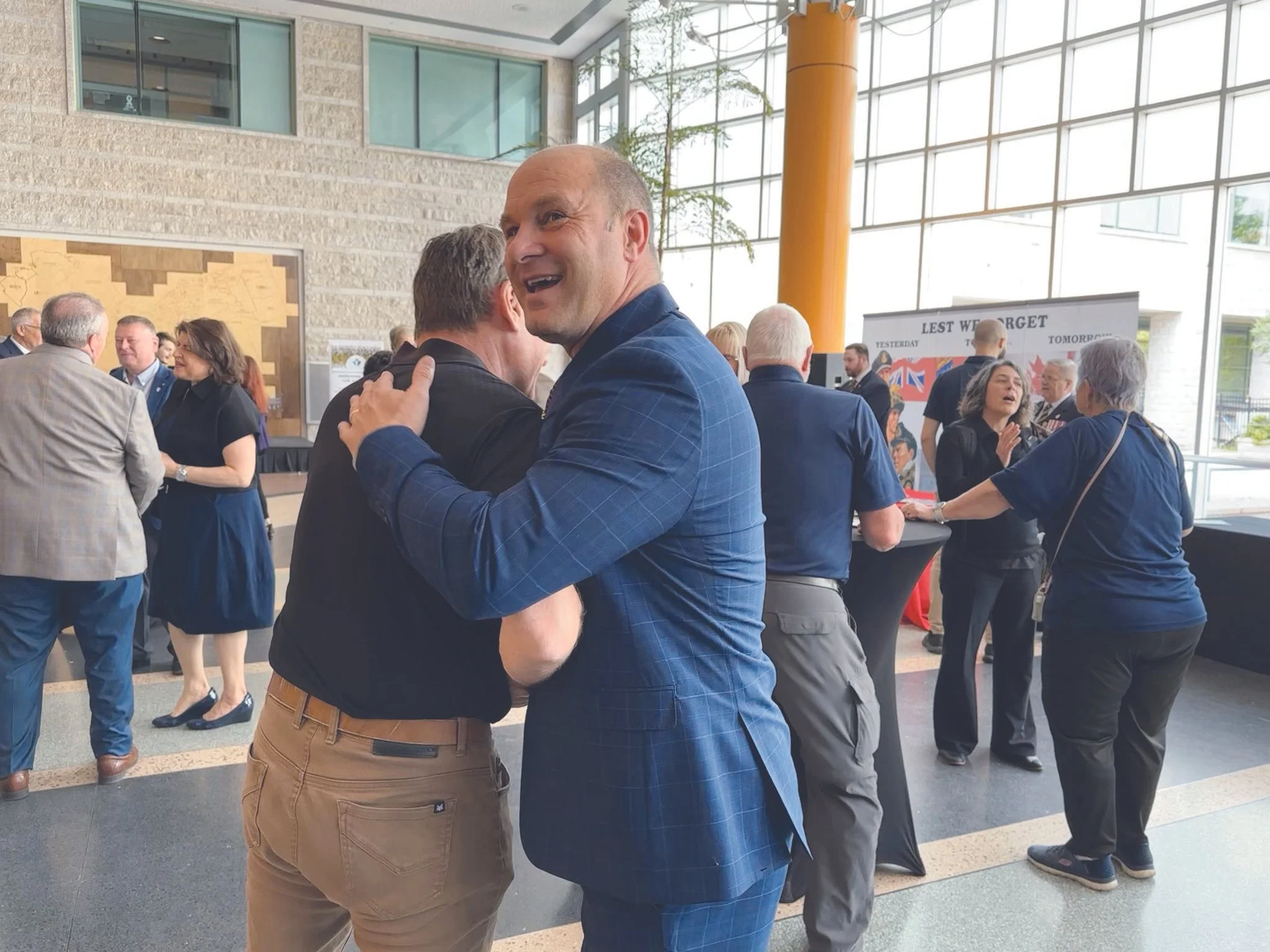
Ottawa Veterans Task Force (OVTF) hosted a networking reception at Ottawa City Hall.
By David Hill
As Canadians, we rightly emphasize the federal responsibility to those who serve. Veterans Affairs Canada, the Canadian Armed Forces, and national institutions play indispensable roles. But after 25 years in uniform and now serving at the municipal level, I have come to understand a critical reality: many of the challenges veterans face are not federal in nature. They are local.
Finding a family doctor. Securing affordable housing. Translating military skills into civilian employment. Being recognized and remembered within one’s own community. These are not abstract policy files; they are lived experiences shaped by municipal systems, local partnerships, and community capacity.
That is why the Ottawa Veterans Task Force (OVTF) matters, and why its work extends beyond Ottawa.
Established in 2020, the OVTF is Canada’s first municipal task force dedicated specifically to veterans and their families. It was created to address a persistent misconception: that because federal and provincial programs exist, veterans are therefore fully supported at the community level. In practice, this assumption has led to silos, gaps, and a quiet deflection of responsibility: “Someone else is taking care of veterans.”
At the municipal level, we see the consequences of that fragmentation every day.
The Ottawa Veterans Task Force brings together veterans, civilians, community leaders, and supportive elected officials as volunteers united by a simple objective: improving access. Not creating new programs for the sake of visibility, but connecting existing ones, removing barriers, and ensuring veterans and their families are aware of and can actually navigate the systems meant to support them.
The Task Force focuses on four priorities: access to primary healthcare, access to affordable and supportive housing, access to meaningful career transition support, and access to proper recognition through commemoration. These priorities are informed by data, lived experience, and direct engagement with veterans across the city.
In 2025-2026 alone, the OVTF is advancing fifteen active projects across those pillars. They include piloting a scalable primary care clinic model tailored to veterans’ needs; developing supportive housing for women veterans and their children; reconnecting family physicians willing to accept veteran patients; and mapping Ottawa’s healthcare, housing, and employment ecosystems so veterans are no longer left to navigate them alone.
Importantly, the Ottawa Veterans Task Force has been somewhat of a municipal pilot. One that demonstrates how cities can play a constructive, coordinated role in veteran support without duplicating federal or provincial responsibilities. The intent from the outset has been to build something practical, evidence-based, and replicable.
We already have a clear example of how that kind of model can scale: Veterans’ House. Established in Ottawa as a locally driven response to ending veteran homelessness, Veteran’s House was purpose-built as permanent, affordable housing with on-site services to support mental health, addictions recovery, and reintegration into the community. It opened its doors to its first 40 residents in 2021.
Today, construction of a second Veterans’ House is underway in Edmonton, with active options being explored in Toronto and Halifax. What started as a municipal initiative is now informing solutions across the country.
That trajectory matters. It shows that when municipalities lead responsibly – grounded in data, partnerships, and lived experience – the results can travel.
The Ottawa Veterans Task Force is built with that same philosophy. Its structure, its project-driven approach, and its emphasis on coordination over control are all designed to be adaptable by other cities. Veterans live in every municipality in Canada.
The gaps they encounter may differ in scale, but the underlying challenges are remarkably consistent.
For readers of Esprit de Corps, none of this will be surprising. Veterans are trained to operate within clear systems. When those systems are fragmented or ambiguous, progress stalls. The OVTF exists to bring clarity and coherence at the community level where veterans actually live.
As someone who has spent a career in uniform, I am mindful that veterans do not seek special treatment. They seek fair treatment and systems that recognize their service, understand their experiences, and respond accordingly. My involvement with the Ottawa Veterans Task Force is rooted in that principle. It is not about profile; it is about stewardship.
One area where this work has been particularly important is the experience of women veterans who have historically been under-recognized and under-served. Targeted efforts in housing and employment are long overdue, and they reflect a broader commitment to ensuring no veteran is overlooked because they do not fit outdated assumptions.
Municipal leadership will never replace federal obligation. Nor should it. But it can, and must, ensure that national commitments translate into local outcomes. The Ottawa Veterans Task Force demonstrates what is possible when a city accepts that responsibility and treats it as a mission, not a gesture.
If Veterans’ House has shown us that local leadership can scale nationally, then the OVTF offers a roadmap for how municipalities across Canada can do the same - deliberately, collaboratively, and with veterans at the centre.
Supporting veterans is not only a federal duty. It is a civic one. And the Ottawa model has demonstrated results worth exporting.
