
By Richard Lawrence
The 2026 edition of the Aero Gatineau-Ottawa Airshow has come and gone, having had outstanding and perfect weather during the 18th-20th September, 2026, weekend. The ground was dry, the temperature just right in the high teens, clear blue skies (I would’ve liked a puffy cloud here and there), and the company in the photo pit was friendly and collegial (Sean, Robert, Claude). All in all, a perfect weekend for the airshow.
To see all the pictures from the airshow EXCEPT the Snowbirds, CLICK HERE
https://www.richardlawrencephotography.ca/rlpgalleries/aircraft/ago2026
To see only the Snowbirds pictures, CLICK HERE
https://www.richardlawrencephotography.ca/rlpgalleries/aircraft/ago2026-snowbirds/
There were, of course some early disappointments as the de Havilland DH-98 Mosquito and the Canadian Warplane Heritage Museum’s Grumman Avenger had to pull out due to mechanical problems. Although not a disappointment, it was sad to be the last Canadian show for the CF Snowbirds (431 Air Demonstration Squadron) after 55 years of performances where they became the iconic symbol for not just the Canadian Armed Forces but also for all of Canada. At the time of the airshow, they had two performances left in California, a flyover for the Grey Cup, and a final home show at CFB Moose Jaw set for October 16th before standing down.
Notwithstanding the sadness of watching the Snowbirds for the last time, there was plenty to see, both static and airborne. There were aerobatic performers such as the Northern Stars, Kyle Fowler, Yellow Thunder, Time Flies and others. It was fun to watch the ConAir Dash 8-400AT Aerial Firefighter drop its load of water as well as the WWII warplanes of the Victory Flight which became the Heritage Flight with just the addition of a CF-118. And let’s not forget the Skyhawks, the CAF Parachute Team who open the show every year.
Now, I attended two out of the three days: Friday, which was media day until 1700 hrs when the grounds opened to the public, and Sunday, the day of the last Canadian show by the Snowbirds. Friday was great as you got aircraft arriving for the show as well as performers going up to practice their shows, all with no crowds - just media and photographers. Some performers went more than once as the Yellow Thunder Harvards went up three times on Friday (counting the dusk show) and twice on Sunday (once in the morning before the show and their show in the afternoon), so provided plenty of opportunity to get pictures, of which, over the two days, I took around 23,200. It seems like a lot but I can explain at the end if you get that far. So, let’s talk about a couple of the acts.
The really great thing this year with the CF-118s is that there were two CF-118s airborne at the same time and it’s not often you get to take pictures of two-ships. That was great. But I find the CF-118 show to be boring in that all they do is passes: dirty, high speed, slower speed, etc. There is no entertainment value like there is with the aerobatic acts. Yes, it's fast, it's loud, and it's a fighter jet, but from a photography point of view (or really my point of view) even the challenge of getting a good picture is easier because you can just bump up your shutter speed as fast as you want. Not so with our little propeller buddies. I understand that they are not aerobatic qualified like the CF-118 Hornet Air Demonstrations Teams of past and are only allowed to show non-aerobatic tactical demonstrations BUT, who wouldn't like to see two CF-118s do a head-to-head or a knife edge pass?
Now, in past years there has always been a CL-415 water bomber to demo aerial firefighting. However, this year a DHC Dash 8-400AT firefighting air tanker made this demo and it was quite different. It is a HEAVILY modified Dash 8-400 turboprop (modified by Conair Aerial Firefighting) that can carry 10,000 litres of water/fire retardant at 360 knots airspeed and drop its load at 125 knots. It’s land based requiring a 5,000 foot runway and can reload the retardant in five to seven minutes. It can get to fires much faster than other aircraft and has very good handling at low altitudes and in mountainous terrain. Just where you might find a fire.
This thing is massive and not something you want starting up and taxiing by itself around a tarmac of static aircraft. For a couple of the runs, it was towed off the tarmac to the taxiway where it then went out to the runway under its own steam. While exciting to watch, it doesn’t put on much of an aerobatic performance.
On the small plane aerobatic side, we got the homebuilt Burt Rutan Model-61 Long-EZ flown by Kyle Fowler Aerosports from Alberta. He did two types of shows with the first being a daytime show full of dazzling aerobatic moves (which the aircraft was not originally designed for), and the second being a nighttime show with pyrotechnics lighting the sky as he cruised through the dark.
The Long-EZ prototype first flew in June, 1979, and plans were offered from 1980 to 1985. This particular aircraft did its first flight on August 30th, 1996, so is not a new airplane, despite its futuristic look and, as of 2021, there were 833 registered in the United States.
It’s a two-seat, tandem aircraft just under 17 feet long, 7 feet – 10 inches high, with a wingspan of just over 26 feet. It has a max speed of 298 kph and cruises at 40% power (232 kph) with a range of 3,200 km on 197 litres of fuel. It can fly 2,600 km in ten hours and has flown 7,700 km with a rear-seat fuel tank (world record for aircraft under 1000 pounds - December 1979).
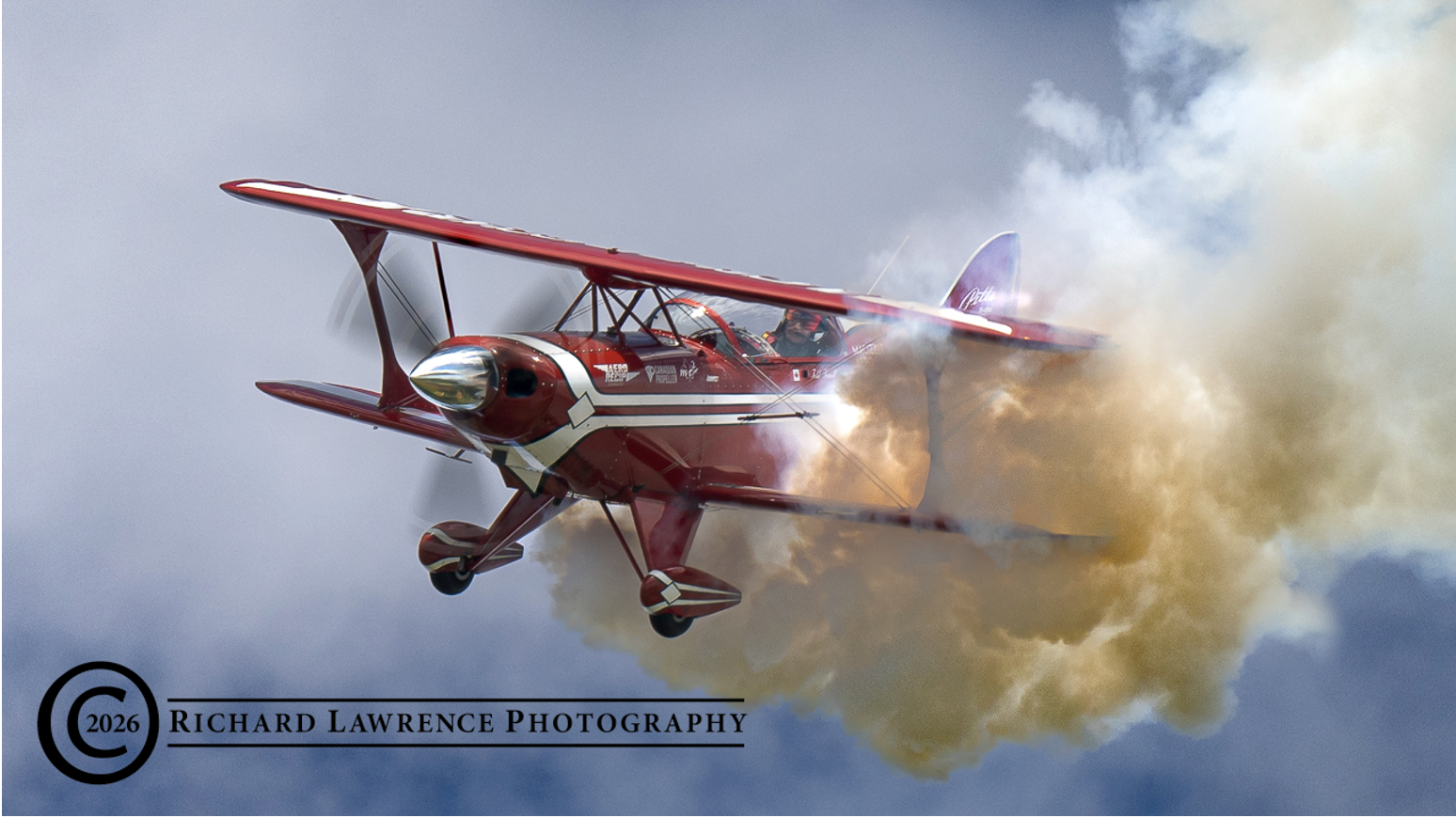
Another aero team was The Northern Stars Aeroteam, a group of ex-RCAF pilots flying three Pitts Specials, based primarily in Collingwood, Ontario. They put on an excellent show that started with a single Pitts take-off followed by the other two Pitts in formation. While you’re watching the second two take off, what you miss is that the first Pitts has turned around and is now doing an opposing pass at the two Pitts just lifting off. It’s not often that you see aerobatics just as the performers are getting off the ground. I saw the show three times and missed the picture each time because I wasn't prepared for it.
There’s lots of three plane formation flying, some with one of the Pitts upside down, and lots of solo action and lots of smoke. So much smoke that picture taking can be a challenge as they dart in and out of smoke trails that haven’t cleared the show line yet. These little buggers are small and fast and do maneuvers at distance as well as low along the show line.
If you’re a WWII aircraft fan, then the Yellow Thunder may be the aerobatic team for you as they fly two N.A. Harvard Trainers (Mk IIs by the look of the canopies). Flown by David and Drew Watson of Alberta (and I saw Wendy Watson's name on the back seat canopy), they fly solo and formation aerobatics and managed to get airborne five times in the two days I was there. They went up Friday at 1015 hrs, again at 1250 hrs, and did a dusk show at 1800 hrs. On Sunday, they were up again at 1100 hrs, and around 1300 hrs for the airshow. If you notice a bunch of pictures that look the same, that’s why
There were a couple of non-aerobatic formation teams flying as well to give just a bit of a change. One of them was the Victory Flight, courtesy of Vintage Wings of Canada. This is a trio of WWII warbirds, specifically a Hawker Hurricane Mk XII, a Supermarine Spitfire Mk IX, and a North American P-51D. They go up in formation, do a couple of passes in formation (echelon, trailing, line abreast for example), and then break out to do single plane passes in trail before coming across the show line in a triple trailing formation with a break left in line to end the performance. Ahh, the sound of the Merlin engine.
This is not to be mistaken for the Heritage Flight which is a four plane formation consisting of the Victory Flight trio along with a more modern aircraft such as a CF-118. And, as a little surprise, the Snowbirds went up and prior to starting their performance, did a pass in the Maple formation with a CT-157 Siskin II tucked up behind #1 (Boss) and between #4 and #5.
The Time Flies team added a little something different to the show in that it consisted of a Nanchang CJ-6 towing a Start + Flug H101 Salto glider into the air where, once the glider detached, put on two shows: one for each aircraft. They also went up at dusk on Friday evening where the glider did its show in almost total darkness spewing pyrotechnics off the wing tips all the way down.
The CAF Parachute Team, the Skyhawks, also celebrating 55 years as a team, opened the Friday evening show as they do every year. They went up in a C-130J Hercules instead of their normal Short SC-7 Skyvan, perhaps to get higher faster than the Skyvan could manage. Jumping in tandem this year was the Commander of the RCAF, LGen. Jamie Speiser-Blanchett, who made her way down all smiles and giggles as she came to a skidding stop on her bum with her tandem jumper (this is normal).
On Sunday, they again opened the show at noon with their standard formations but I noticed one group of three jumpers who did transitions on the way down that I’d never noticed before. When I picked them up they were in a formation with two parachutes above a single ‘chute . The two-‘chute jumpers were situated in front of the single-’chute jumper hanging horizontally with their legs intertwined. So the two side-by-side ‘chutes were only marginally above the single ‘chute as the duo-jumpers were locked together just in front of the single-jumper hanging from his parachute..
They went from this configuration to one where the single-jumper now entwined himself with the other two and the three ‘chutes now formed a half circle, all edges touching, as they skated across the sky. What came next, I hadn’t seen before. They now moved their ‘chutes from the half-circle, edges touching, formation to a formation that had their ‘chutes now at the 12, 5, and 8 o’clock positions (from where I was) and no longer skating across the sky, but pointing and flying down towards the earth. Now, it’s bad enough that they jumped out of a perfectly serviceable aircraft but to have the ‘chutes oriented so that they’re flying towards terra firma just seems like a bad idea. Regardless, they broke apart in time to all land safely and everyone cheered.
There were lots of other aircraft as well from the new CT-157 Siskin II, a Yak 52 TW, a Westland Lysander III, the Vintage Wings Yellow Birds (Fleet Finch, Fairchild Cornell, N.A. Harvard, and DHC-1 Chipmunk), Cessna L-19A Bird Dog and a host of static aircraft to look around, both on the Gatineau Executive Airport tarmac and the Vintage Wings of Canada collection at the Vintech hanger. Add the chance to meet the Snowbirds and get autographs, lots of food trucks, and a few souvenir stands and you’ve had a full day.
I’ve left the Snowbirds out of this report as they deserve and article to themselves as this is their last Canadian public performance. Next post
Aero Gatineau-Ottawa always puts on a good show but they have always relied on the Snowbirds to be the one big draw if they had nothing else and the show closer. And believe me, they’ve almost always had something else like the Thunderbirds, the Red Arrows, the Patrouille de France, F-35, A-10, Mig-19 and a myriad of other draws. The Snowbirds won’t be available for 2027 so it will be interesting to see what they come up to be the show closer next year.
How did I take 23,200 pictures in two days? Well let’s start with a camera that takes 20 frames per second. Assume an aircraft does one pass and, from start to finish, the pass lasts five seconds. That’s 100 pictures and you’re lucky if one is a keeper (how to shoot aircraft is a book unto itself and a discussion for another day). Say that one aircraft does 10 passes, that’s now 1,000 pictures just for the one aircraft. There were over 25 flying acts, most of them doing more than 10 passes each, especially the Snowbirds which have nine, seven, and five plane formations as well as two-plane and four-plane solo passes. You want topside pictures and belly-side pictures of each maneuver along with trying to get the solos into a single frame as they pass. The Northern Stars also have single plane passes and triple-ship passes as do the Yellow Thunder, Victory and Heritage Flights.
So, the fact that I ONLY averaged 11,600 pictures per day, to me, shows a lot of restraint in the pictures that I took
