
By Richard Lawrence
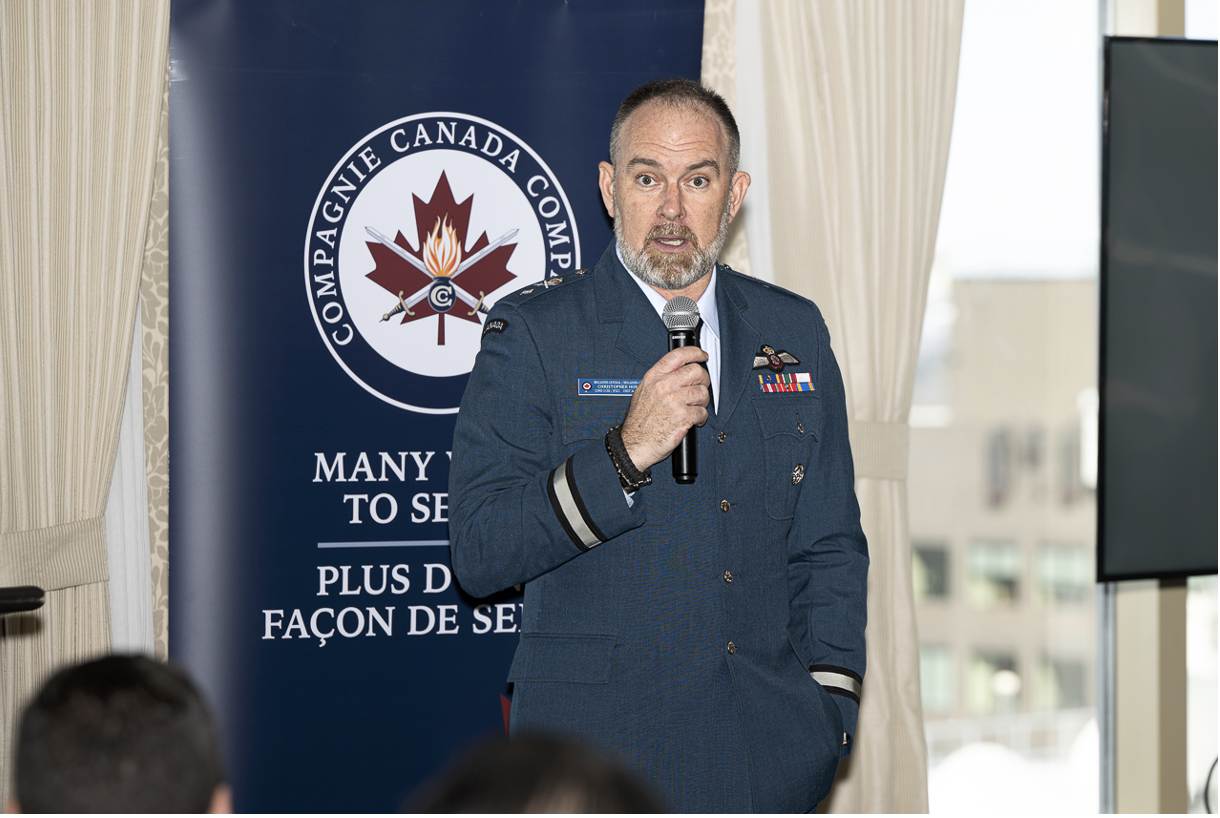
Most people’s concept of space come from Star Trek, Star Wars, Stargate, or other space related movies such as the 1978 movie Space Force. The minute you start to talk about real space and how to protect a country’s sovereignty, security, and economic prosperity, most people just zone out. At least that’s the opinion of BGen. Christopher Horner, Commander of 3 Canadian Space Division, who, on February 19th, gave a lunch time talk at the Rideau Club in Ottawa, courtesy of the Canada Company CAF Speaker Series and sponsored by Accenture.
BGen. Horner has been in the CAF since 1998 and became Commander of 3 Canadian Space Division in 2024. His accomplishments are many and can be found in his official CAF bio but not mentioned is that he has an easy, relaxed, speaking style, moving around the audience rather than tethered to a podium, and he’s funny. When he spoke of losing GPS and the apocalypse that would follow if all financial transactions stopped and the following economic collapse, he said, “I’m not telling you to go home and stuff money under your mattress (not all of it), but I have chickens and chickens produce food. … they have space names … Obi-Wan Hen-obi … Princess Lay-a …”. He even had one named Hen Solo, but he died (just like in the movie). This is good stuff when the topic is how to keep Canada secure in space.
WRITER’S NOTE: Although this talk was held under Chatham House Rules and direct attribution of statements is frowned upon under that convention, as the talk was given by BGen. Horner, and he was the only speaker, I feel that direct quotes/attribution to the General are obvious as they can’t come from anyone else. Therefore, I have attributed quotes to the General but no other individual has been identified. Most of what BGen. Horner said has been paraphrased/reorganized by me as well as I’ve added some detail from references mentioned in BGen. Horner’s talk. Additional references are usually hyperlinked. Quotes from BGen. Horner are taken directly from his talk. Anything that I couldn’t verify through a second public source has not been repeated here.
Requests for images should be directed to Serena Goldring at Canada Company at Serena.Goldring@canadacompany.ca
The Talk
The loss of control of a country’s space assets is a serious issue that is now being recognized and discussed in government and political circles and has recognition allotted to it in the recent Canada’s Defence Industrial Strategy. So, as part of the education process about what space and control of space assets is about, BGen Horner took time out to address this group. He covered a diverse set of topics and to cover them all would be better handled by providing his talk as an audio link. However, for expediency I will cover the main points here.
BGen. Horner first asked, “Why do we care about space?” His answer is that right now, about 20% of Canada’s economy runs through space and utilizes a GPS or satellite communication set of networks that enables precision farming, logistics supply chains, communication, sovereignty and security. Every financial transaction in this country is underpinned by the space domain. If we lose space as the enabling controller, then it’s a billion dollars, or more, loss of GDP PER DAY. Forget the inconvenience of not being able to watch Tik Tok, use your computer, having driverless cars crash (what idiot lets a car drive itself anyways), being left with only the physical money you have in your pocket to survive on, Uber Eats can’t deliver your food, you can’t pay bills, etc. Think of having all air and sea transportation grounded.
Remember when Rogers went down a year or two ago and the panic that caused throughout the entire nation? That was just cellular service, nothing else. We, as a nation, survive on financial transactions and communications and when taken away, security and sovereignty are at risk as well economic prosperity.
That’s the civilian side. From the military standpoint, all navigation of military equipment would come to a halt without GPS (unless you know how to use a sextant or, god forbid, a map and a compass). All fire control of missiles, drones, etc., would cease as well as the munitions ability to find their targets. The war fighting capabilities are instantly taken away from frontline troops. Space is enabling our armed forces and it needs to be protected. You could say the loss of the ability to wage a modern war would be a good thing but my guess is we’d just go back to sticks and stones.
Protecting Space Assets
What is there to stop hostile space-based intelligence, surveillance, and reconnaissance (ISR) right now? BGen. Horner says the short answer is –“ nothing”. There is nothing to stop a bad actor satellite from coming next to a Canadian satellite and capturing signals or parking itself over Canada and looking down. The military has their data all encrypted, of course, but how does one defend space-based ISR constellations from adversaries who want to temporarily or permanently degrade or disable them? (NOTE: an ISR constellation is a networked group of satellites designed to provide near real-time, persistent monitoring of Earth for defense and intelligence purposes)
Why, then, don’t we put weapons in space to blow-up hostile countries space assets? Well, we can do that but the problem is you just turned one large piece of controlled, trackable, space technology into thousands of miniscule uncontrolled pieces of debris travelling at 28,000 kph. While not an issue on earth, it means that anything else in space, for example, astronauts on the ISS or other satellites, are now in danger from these hurtling bits of metal. You’ve created a different, larger, problem.
So you can’t go around shooting everything in space (according to lawyers and the policy makers) and you can’t put weapons of mass destruction in space according to the Outer Space Treaty of 1967. Nothing, however, is written about degrading an adversary’s ability to use their satellites that are threatening our capabilities. So, in short, the reality is there are no defensive systems other than encryption to prevent other satellites from intercepting our signals on our satellites.
The same is true with surveillance satellites with cameras that can read a cell phone on Earth’s surface from space. There are many “weather” satellites that are gathering information that are conveniently in geosynchronous orbit over some sensitive economic or military installation gathering “weather” information (about 36,000 km above Earth’s surface in a rotation that makes it appear in the same position relative to a point on Earth). Some are in Low Earth Orbit where they can attain a better resolution with cameras (LEO – between 160 and 2,000 km above earth).
There is nothing that can be done about it. Those discussions on a defensive infrastructure and the capabilities to do that have just started. The prime mover is to ensure that Canadians and the CAF have the equipment or access to resources or access to the infrastructure required to support the economy, security and sovereignty. The infrastructure needs to be protected the same way one would protect a forward operating base and do force protection. What that is has yet to be determined.
Well, then, can’t everyone else’s satellites be tracked? If one references the movie Armageddon (space movie reference) there is a scene where the President asks Billy Bob Thornton about why NASA didn’t see the giant planet-killer comet sooner. His response was, “Our object collision budget is a million dollars and that allows us to track about three percent of the sky and, begging your pardon sir, it’s a big ass sky.”.
Not only is it a big ass sky, BGen Horner indicates there are about 16,000 satellites in space (12,000 active). Even with input from our partners that feed into the Space Surveillance Network, you can maybe track some objects once a day but you can’t maintain full custody of all things that are in space. Also some research or weather satellites (officially) are launched and once in space, split into smaller microsatellites that just disappear from tracking, or a single launch vehicle goes up with 40 satellites to deploy. Throw into the mix that there aren’t enough dedicated earthbound tracking devices (telescopes, radars, etc.) to track everything and you begin to see the problem.
So Canada will focus on things like space domain awareness so that we can determine exactly what the threat is to OUR capabilities in space. How does Canada wean itself from full/partial dependence on other global partners for this info? One possible project is called Surveillance of Space 2 (SofS 2).
From the Gov’t of Canada website, we get, “The aim of the Surveillance of Space 2 project (SofS 2) is to address national Space Situational Awareness (SSA) requirements, strategic relevance and allied burden sharing. SofS 2 will enable the RCAF to continue to perform deep space surveillance for the protection of Canadian deep space assets, mission assurance for space-based capabilities that support the CAF, and to ensure that Canada is an active contributor to the operations of the Space Surveillance Network (SSN).” Its funding is between $250-$499 million dollars and project is to be finished by 2031/2032
Part of SofS 2 is the building of three ground-based telescopes across Canada to look up into space by 2026/2027. That will give Canada sovereign capability of being able to see threats to satellites that it controls and satellites that just happen to hang out over Canada that don’t have a technical reason for being there. Canada can use radar, cameras, passive radio frequency or other technologies for tracking
Another interesting challenge is getting satellites up into space as Canada has no launch capability. BGen Horner noted that Canada’s last significant satellite launches were carried out by Russia and India and Canada has never had a launch capability other than the Black Brant sounding rockets from Magellan Aerospace. But now the federal budget is allocating $182.6 million towards “a sovereign launch capability” over the next three years, although details on what it will be spent on are not yet set.
There is also work started on a P.A.C.E. plan (Primary Alternate Contingency and Emergency Communications). These are common in military planning but BGen Horner is pretty sure that there is not a societal PACE plan and it is concerning. The military can move away from [space-based] GPS to QPNT (Quantum Precision Navigation and Timing) using atomic-level measurements to provide navigation, positioning, and time that is 20 to 200 times more precise than GPS, operating effectively in GPS-denied or spoofed environments. These systems enable high-precision navigation for military, maritime, and aerospace applications without reliance on satellite signals (courtesy Google AI Overview, University of Adelaide). This would take time to implement but, as BGen Horner so eloquently put it, it’s necessary to “put warheads on foreheads” when GPS goes down in the battle space.
Resilience
Having all this space domain awareness, satellites, communications infrastructure and everything else is great BUT it must be resilient. According to BGen Horner, “Space control is creating resilient capabilities to enable what we in the military would call freedom of action or freedom of maneuver, which allows you to do the thing you want to do while suppressing the enemy's ability to do the same. It is the creation of systems that provide temporary or reversible effects. … you only have resilient space capability if you could recreate it in two weeks and so, ideally, if we're serious about space and we're serious about space command and control, you would have the ability to launch a constellation of micro satellites that are on the shelf right now and get it up there as soon as that dump truck of gravel is produced in the lower orbit”. (NOTE: “dump truck of gravel” was used earlier in BGen. Horner’s talk as a reference for how easy and how much it would cost to take out existing low earth orbit systems).
So, as it stands now, Canada needs more of everything but more ISR platforms are not the immediate requirement. What is more urgent is the capability to protect the ISR platforms already in place or the resilience in the face of attack. If they can’t be protected, then Canada needs the capability to replace them within a defined period and Canada can’t do that now as we have no launch ability. Canada needs to put its own things back into space in a timely manner. It needs a launch capability.
To that end, there are Canadian companies and start-ups that can build these things and given a little government money, can build them faster. Money is in the budget for Spaceport Nova Scotia (near Canso) and Canadian companies are trying to build access for Canada to space so we don’t have to rely on third parties who may or may not be friendly at the time of need (Elon Musk anyone?). In BGen Horner’s opinion, “you can’t be resilient if you have no way to replace things that are broken. …from a phone call to orbit in 96 hours … that gives us the assured access to space”.
Only in passing was it mentioned that hardening our systems to attack, be it electromagnetic, cyber, kinetic, or other, is another discussion that needs to be had. When asked about the current steps being taken to defend our space assets, the General declined to answer.
Moral Obligation
BGen. Horner believes that space professionals have a moral obligation to the joint force as part of the joint force, but who operate mostly in the background. Joint force means the soldiers, sailors, aviators who carry out the business of the CAF on behalf of the country and we wish for them to return home. They will not – not without space-enabled capabilities and being protected from space-enabled attack. “We have architected the capabilities of the future for the Canadian forces around having decision superiority enabled through real-time communications, long-range precision fires, and space-enabled infrastructure to survive, prevail, and come home.” says BGen Horner. “[Space is] enabling to our forces. It needs to be protected.”
I think I’ll end this little report at this point with a thank you to Canada Company, Accenture, and BGen. Horner for providing this interesting update on Canada’s position in space and how we need to move forward to protect Canada’s sovereignty, security, and economic prosperity. Hopefully the funds already promised to the CAF will come through and the projects currently underway will reach successful conclusions.
