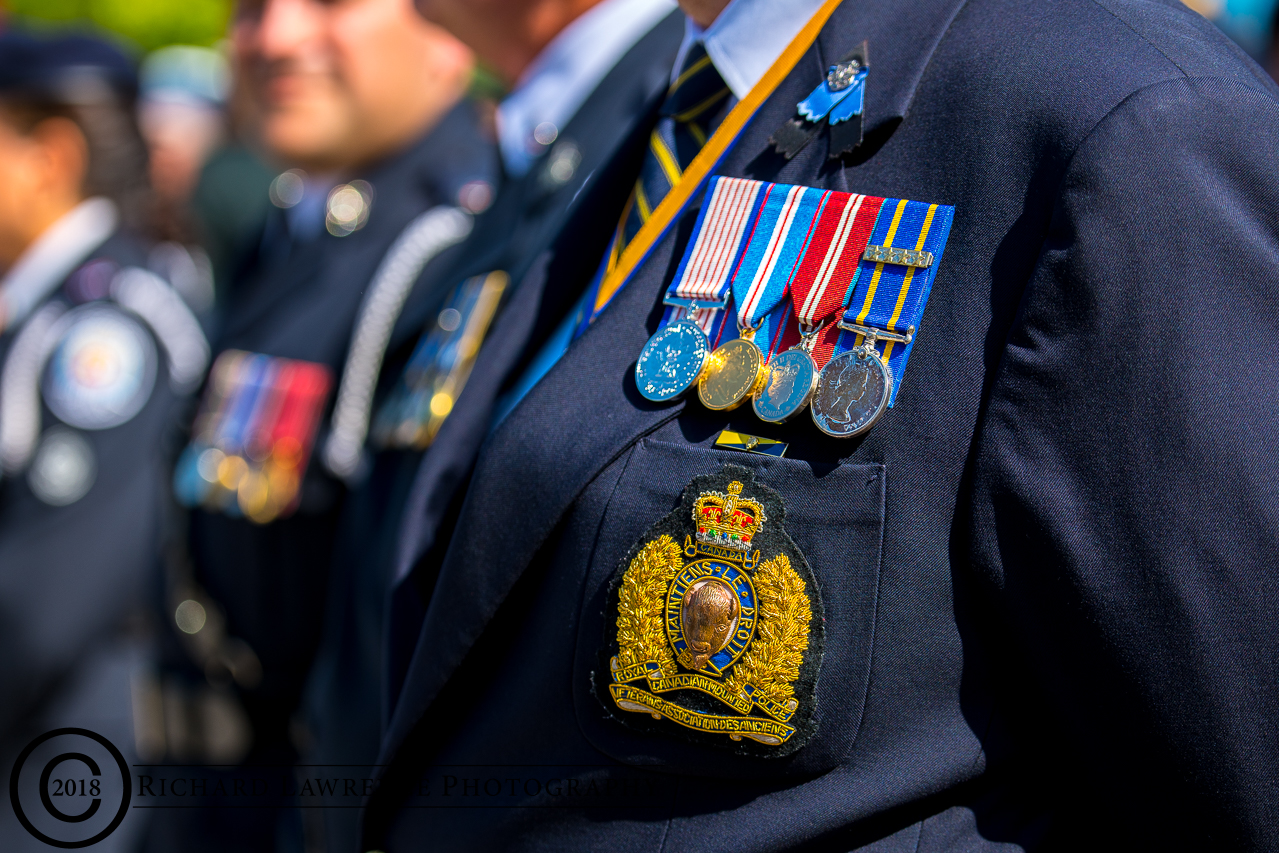
UN Peacekeepers Day

By Richard Lawrence

To see all the pictures, go to: https://www.richardlawrencephotography.ca/rlpgalleries/2019/unday2019/

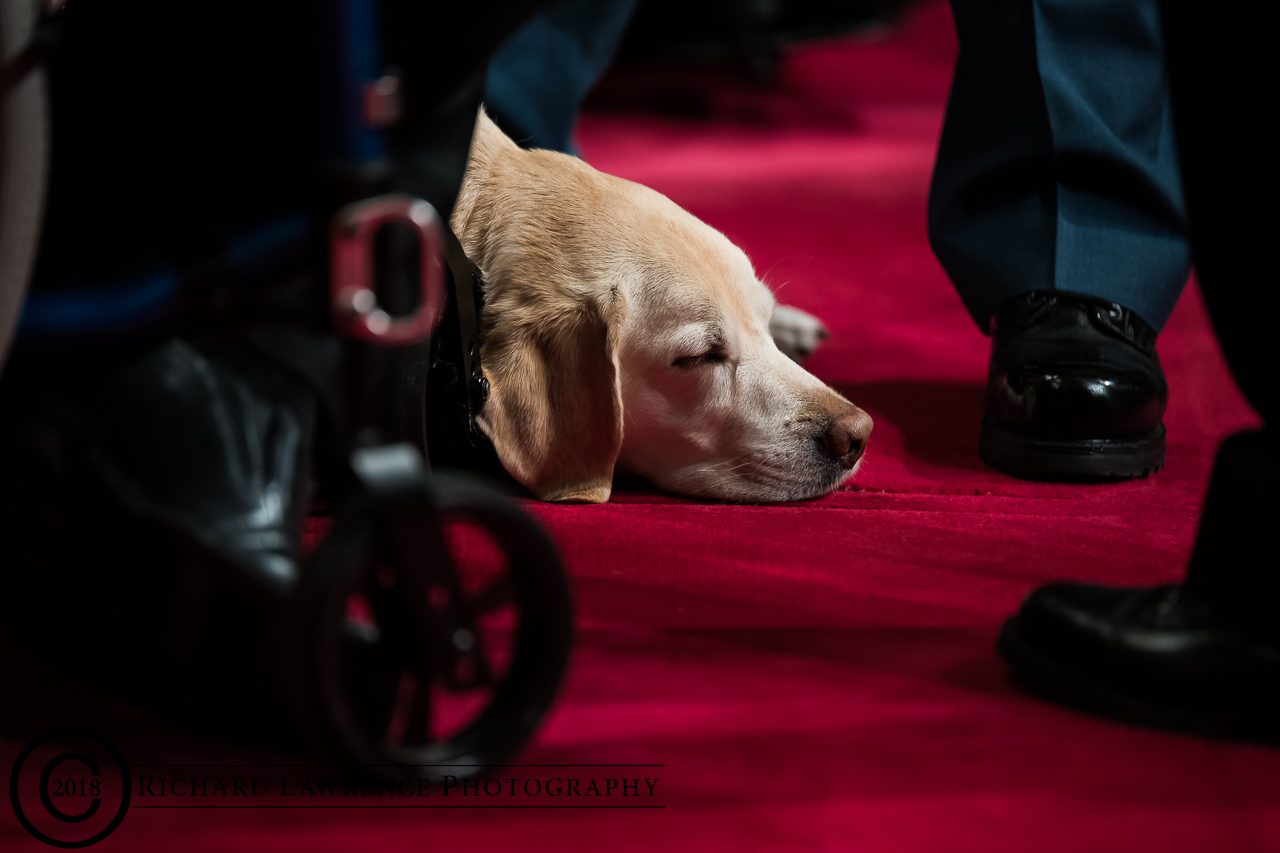
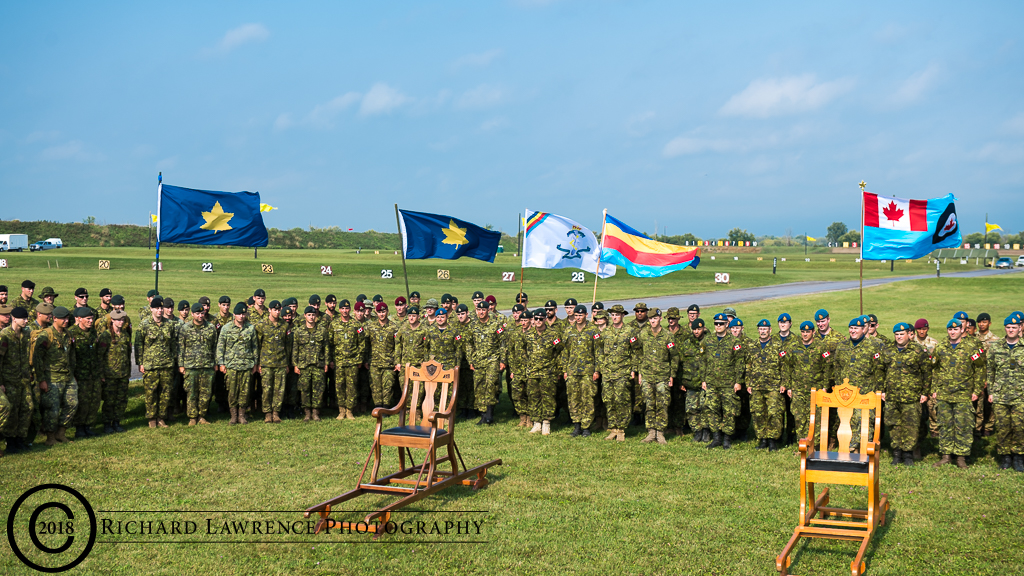
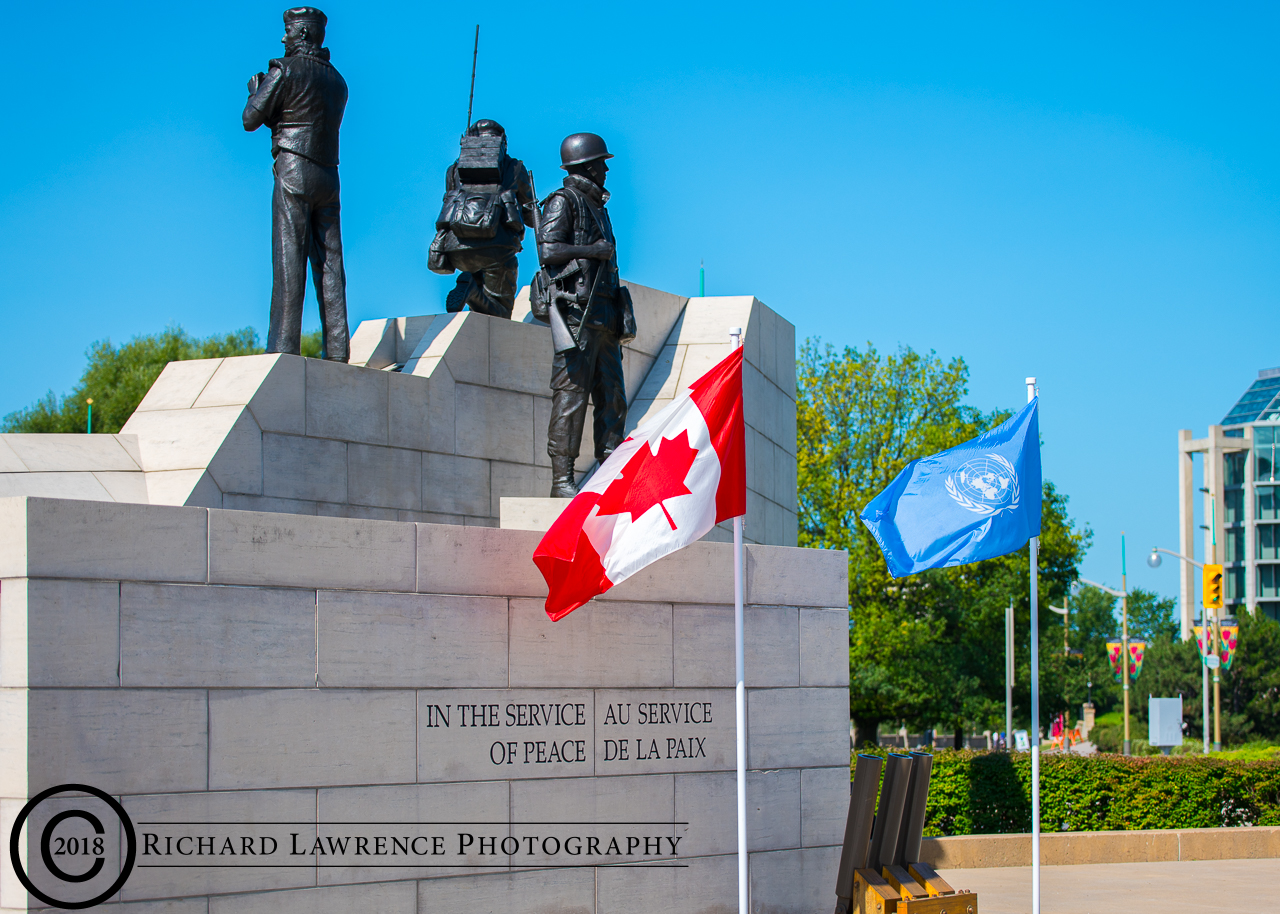
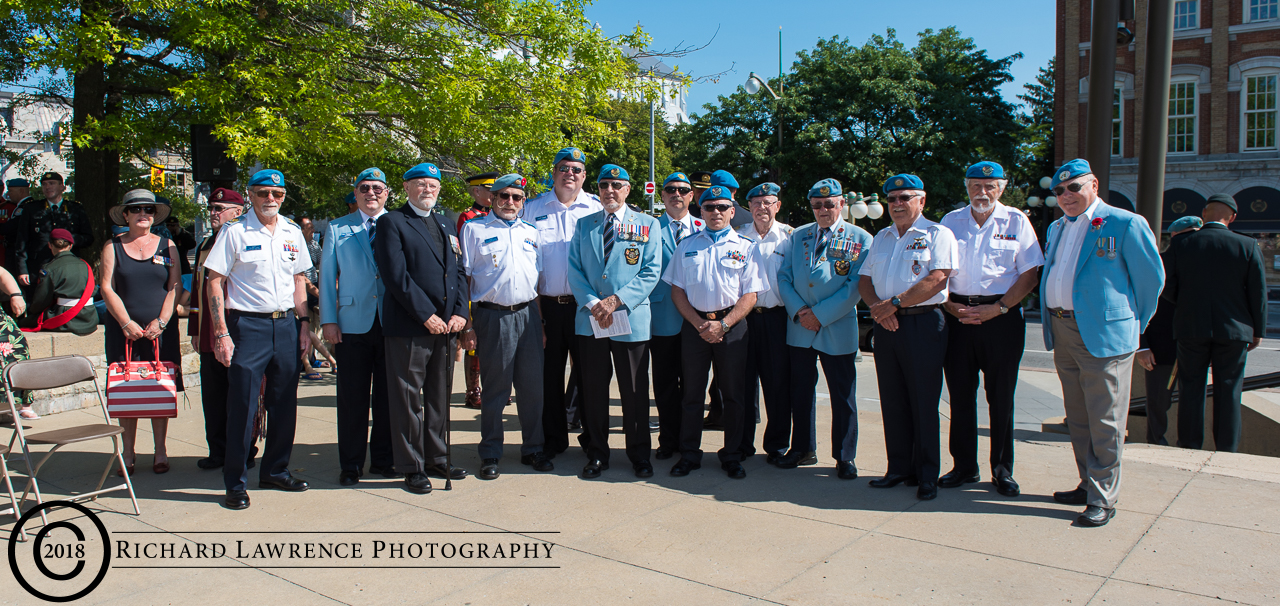
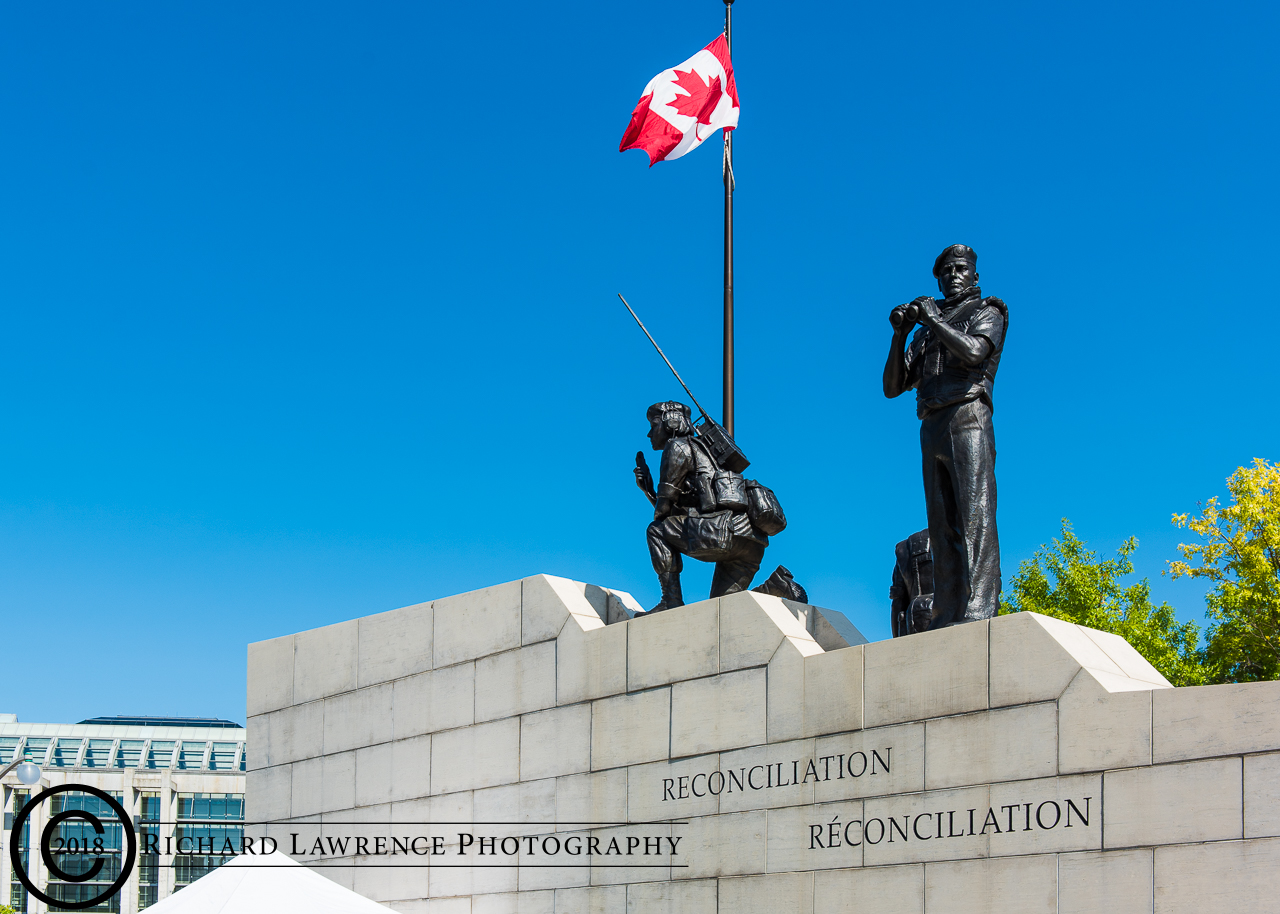
On the 9th August, 1974, a United Nations Buffalo aircraft flying over Egypt was shot out of the sky by a Syrian missile.  On that plane were nine Canadian Armed Forces personnel involved in a peace mission who were killed on what was supposed to be a routine resupply mission to the presence in the Golan Heights.  To this day, it is still the largest single loss of Canadian lives since Canada began participating in UN Peacekeeping missions in 1948.  That is why the closest Sunday to the 9th August is selected as United Nations Peacekeepers Day every year with this year’s remembrance ceremony being held at the Reconciliation Monument, Ottawa, on Sunday the 11th. 

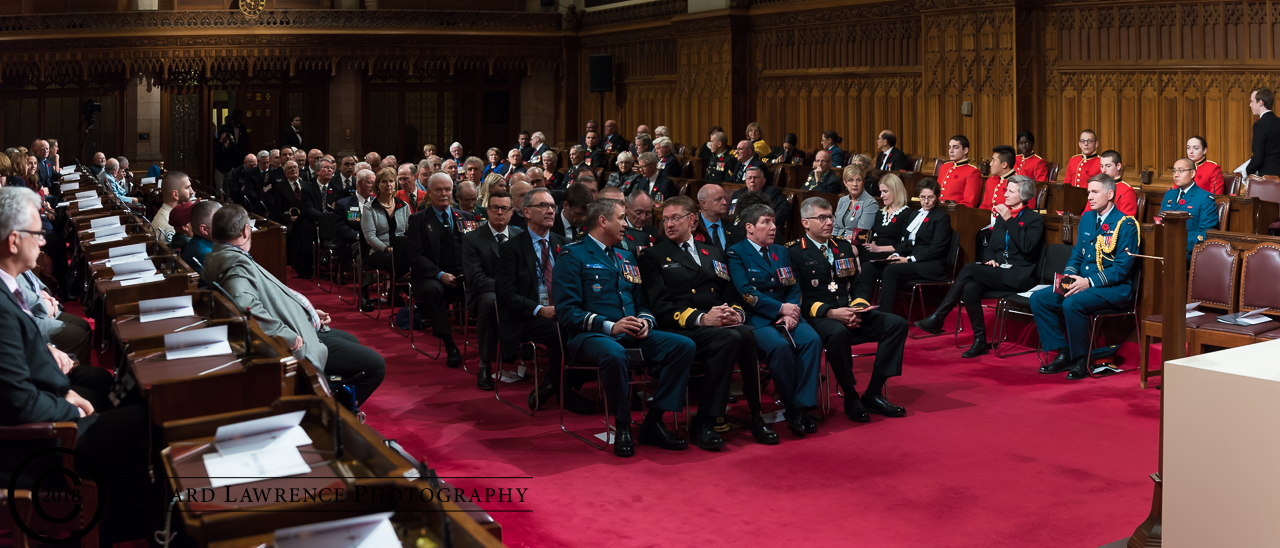
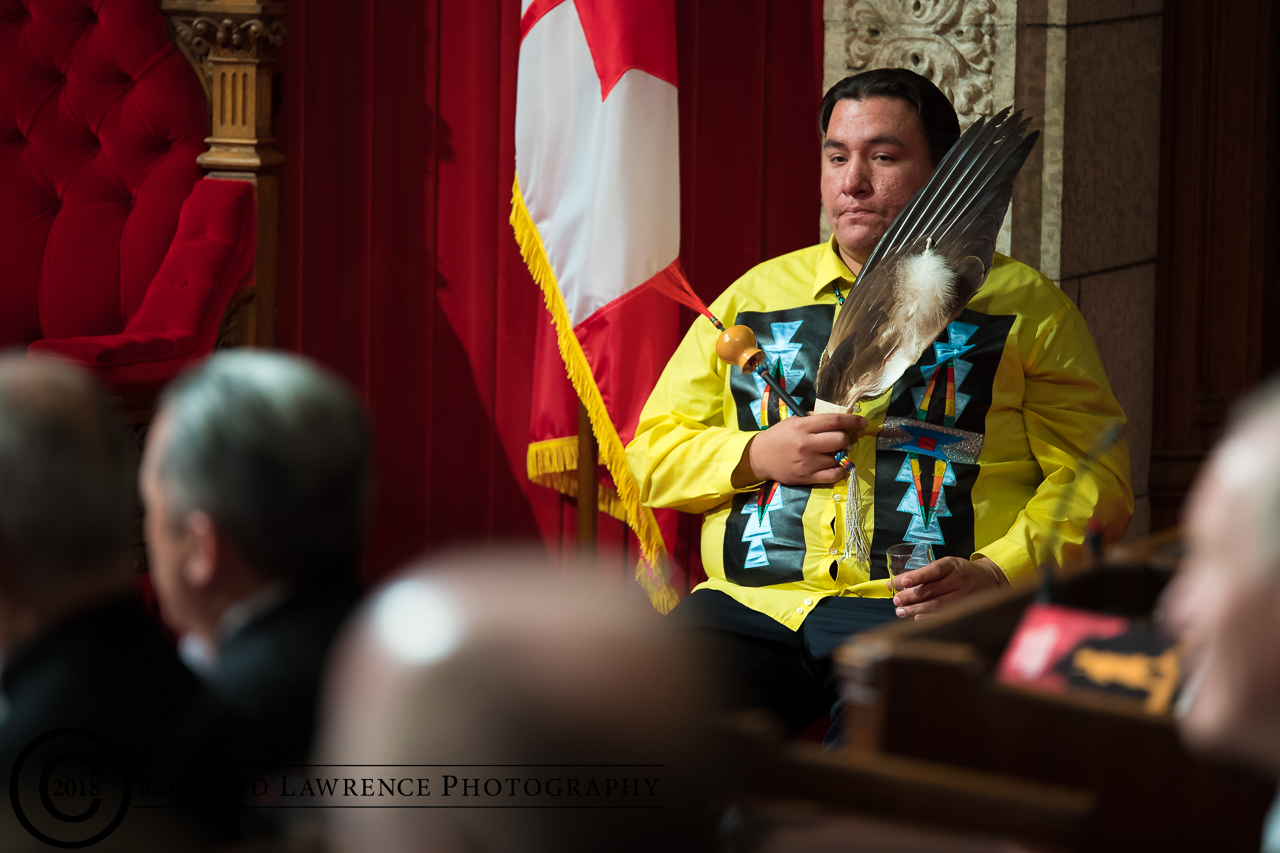
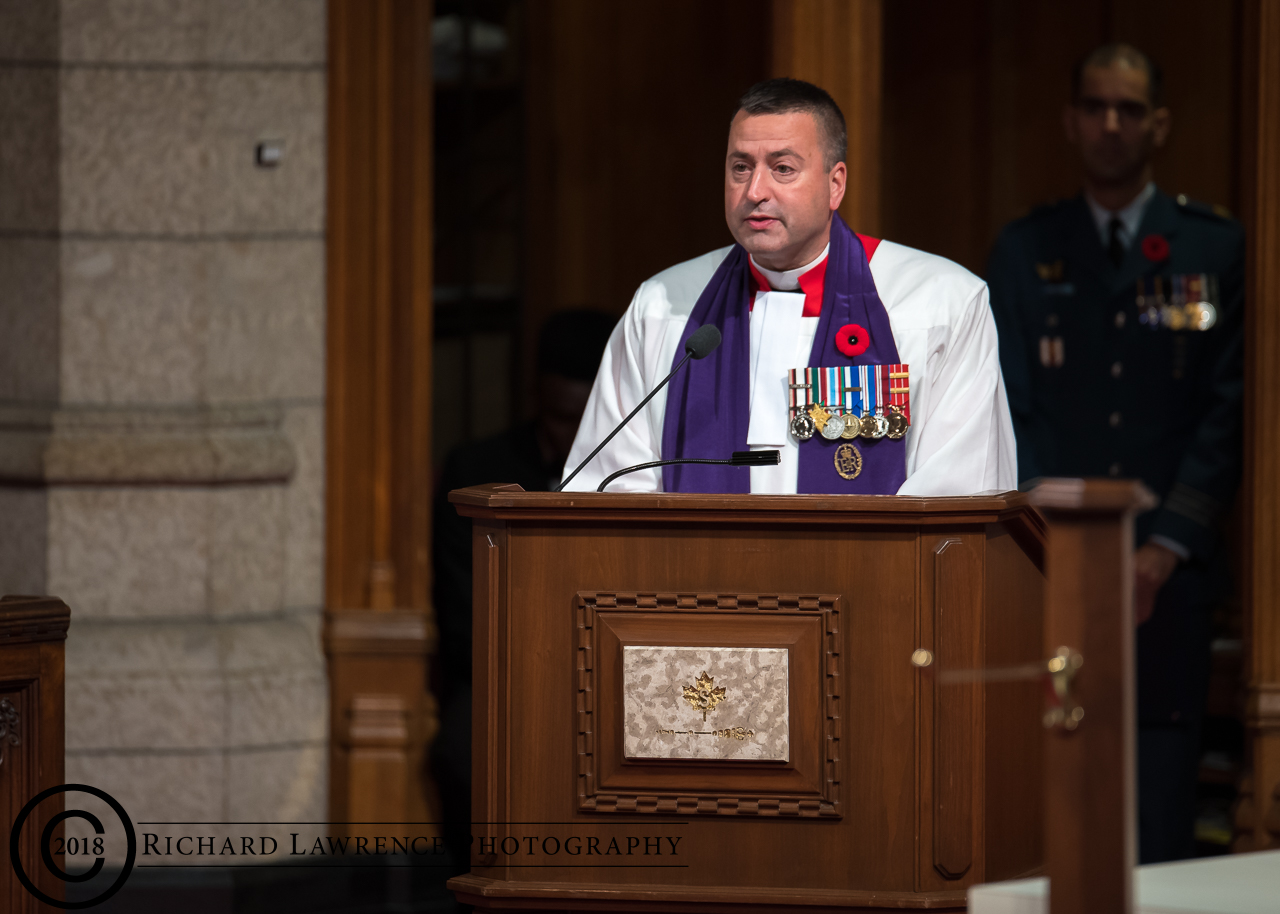
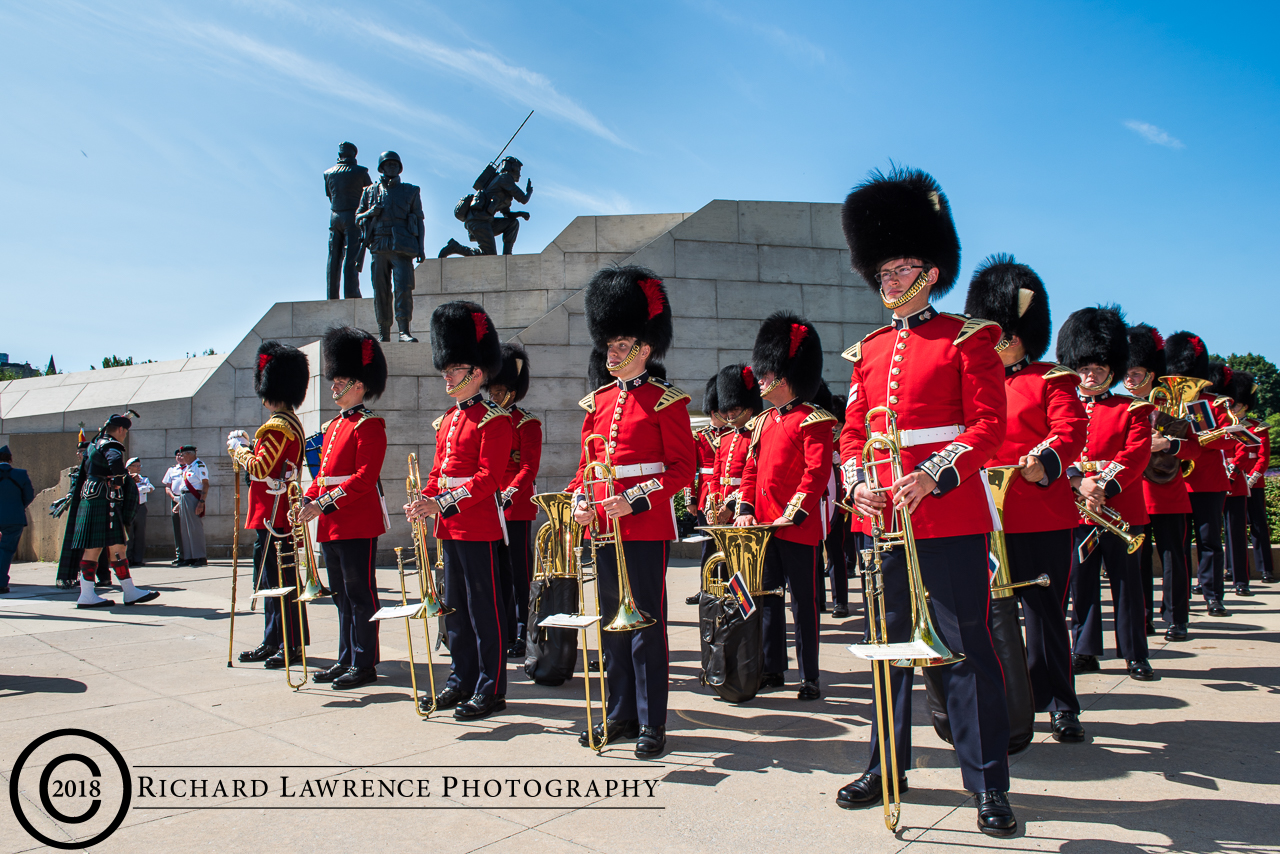
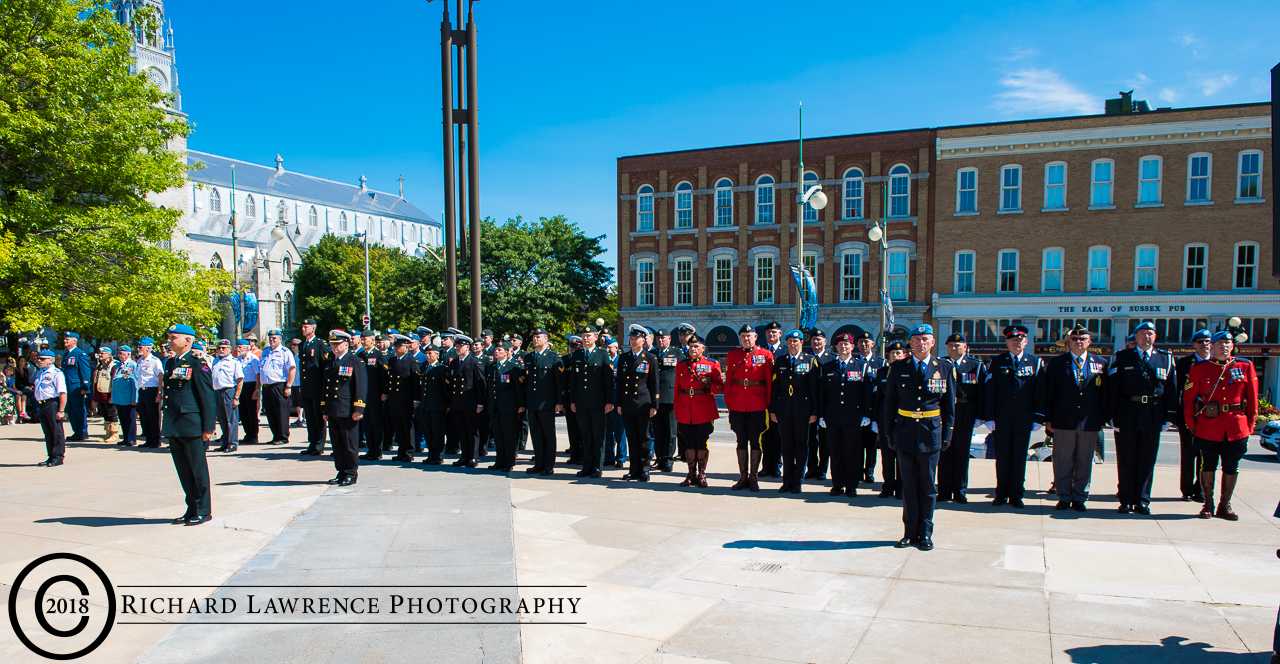
This year’s ceremony saw participation by 450 Tactical Helicopter Squadron from Petawawa, just back from a peacekeeping mission in Mali, UN Peacekeeping veterans, and police representatives from the RCMP, OPP, Ottawa, and Toronto police forces.  The Official Party consisted of MGen. (ret’d) Clive Addy, MP (Ottawa-West – Nepean) Anita Vandenbeld, Commodore Rebecca Patterson (Director General Professional Military Conduct – Operation Honour), RCMP Superintendent Kevin Lamontagne, and Ms. Deborah Mac Culloch representing veterans and families. Music was supplied by the Governor General’s Foot Guard Band with piping from Mr. Eric Booth. 

The event started with the Master of Ceremonies, Ms. Suzanne Serrault, outlining several anniversaries to be commemorated at the day’s ceremony.  Specifically that this year is the 25th anniversary of Canada providing humanitarian relief to Rwandan refugees where over 400 Canadians served.  It was also the 20th anniversary of the UN Assistance Mission to East Timor and the 20th anniversary of the start of the UN mission in Kosovo in which almost 2,000 Canadians served, along with RCMP investigators, in three different operations to assist in the safe return of over one million refugees/internally displaced persons.  Lastly she noted the 30th anniversary of RCMP participation in “Peace and Civilization Operations” in which almost 4,000 police and worked in 33 countries.  Now, one can argue the success/failure of any or all UN operations and the politics involved, but this is not the day to do that.  It is the day to remember all those who served and continue to serve, under bad to horrific conditions, and especially those that did not return.

Mr. Wayne Mac Culloch, representing the President of the Canadian Association of Veterans in United Nations Peacekeeping (CAVUNP), was the first speaker of the morning where he reiterated why this date was chosen for remembrance and to thank not only the peacekeepers but their families who must endure long periods of absence with their spouses in harm’s way but who continue to support the member and the missions.  He was followed by the playing of the Last Post, a minutes silence, the Rouse and the Lament.  The Act of Remembrance was recited by Paul Greensides, Ray Paquette and Aurel Dubé and was followed by the Commitment to Remember by Cadet Sgt. Jeffery Lariviére and Cadet WO2 Madison Préfontaine.

For this ceremony, there is no laying of wreaths but instead three bouquets of flowers are placed into the barrels of three cannons, effectively turning the weapons into flower pots.  Ms. Vandenbeld, along with MGen. Addy, placed the flowers on behalf of the Government of Canada while Commodore Patterson, Superintendent Lamontagne, and CWO Guimond placed the flowers for the military and police organizations.  The last bouquet was placed by Mr. and Ms. Mac Culloch, representing the veterans and families. 

It was then Ms. Vandenbeld’s turn to address the assembly where she noted that 125,000 Canadians have served in UN peace support and that 123 have died in that service while “… putting yourselves in harm’s way to protect the world’s most vulnerable.”.  MGen. Addy followed with anecdotes of his terms as a peacekeeper where he “… saw how vile people can be to each other when on-one is looking at them” and noting some of the idiotic things that have happened to him, both at the command level and in the field.  He admitted that he didn’t always know what he was doing or what was going on but “… that he knew he was doing good.”.   

This pretty much ended the ceremony and the parade was dismissed but I think Ms. Vandenbeld put it best when she said, “Peacekeeping.  It’s what our country does.  It’s what we stand for.  It’s what other countries think of when they see our red maple leaf.” 

75th Anniversary of the 1944 Polish Uprising

3.jpg

By Richard Lawrence

To see all the pictures, go to: https://www.richardlawrencephotography.ca/rlpgalleries/2019/poland75/ 

On 1st August, 1944, the Polish resistance, along with the Polish Home Army (PHA), started what is known as the Warsaw Uprising (1944) to force the German Army out of Warsaw, Poland.  All that summer, the forces of the Soviet Union had been pushing westward and by end July were poised on the outskirts of Warsaw to clear them out.  The Germans were retreating and the Soviets were advancing and the time was ripe for the Polish people to make their contribution to the Allies in winning the war.  At 1700 hours largest act of resistance in the war began.

Now, some things should be put in context.  The first objective of the resistance/PHA was to expel the Germans from the city.  However, there was a second, political objective of installing a legitimate Polish government in power before the Soviet-backed Polish Committee of National Liberation could assume power and that is why it was important to launch the uprising prior to the Soviets actually getting into the city.  On the Soviet side, Stalin knew that he would have great troubles controlling the country after it was liberated so it was in his interests to see as much of the resistance/PHA destroyed before sending the Germans home.  Stalin said of the resistance that they were “…a handful of criminals” and “… enemies of the Soviet Union” and used this as justification for his inaction following the start of the Uprising.  While biding his time, he also decided that it was more advantages to occupy Eastern Europe than to thrust into Germany, so he left the Poles to fight and die. 

In effect, the Uprising started and the Poles, with little ammunition, food, or other supplies, were forcing the Germans back while capturing strategic infrastructure.  Then, they waited for assistance from the Soviets but none was forthcoming.  Soviet tanks were withdrawn, no supplies were offered, no air cover was provided, and radio pleas were ignored.  The Germans, in the meantime, managed to re-supply and reinforce and came back into the city with a vengeance, as destroying Warsaw had been one of Hitler’s objectives before the war and Himmler now saw the opportunity.  The fighting was brutal hand-to-hand, building-to-building, with the Poles losing irreplaceable soldiers and running out of food and ammunition while the Germans continued to reinforce.  Still nothing from the Soviets.

Churchill saw what was happening and pleaded with Stalin to allow the Allies to airlift in supplies but Stalin declined to allow the Allies access to airfields in Soviet held territory.  Churchill, undeterred, ordered the RAF to airlift supplies from bases in the UK and Italy and 223 low-level supply lifts were carried out during which the RAF lost 34 aircraft (the Warsaw Airlift).  From bases in Italy, the RAF left at night and flew over 1300 kilometers, to Poland where they had to do their drops during daylight and then fly home over German occupied territories, all without fighter escort.  The Germans knew they were coming and had fighters and AAA batteries lined up all the way.  There was also a night-fighter school along the incoming route that provided no end of problems.  In the end, the limited amount of supplies that got through, and the Soviet intransigence, spelled the end of the Uprising and a capitulation was signed on 2nd October, 1944. 

The Polish losses during the Uprising were large, in part because at the start the Germans decided not to take prisoners but to shoot anyone captured (until an agreement was reached to treat the Poles as combatants).  About 25% of the city was destroyed during the uprising with estimates of up to 16,000 resistance/PHA killed, 6,000 wounded, and 15,000 prisoners of war.  After the capitulation, the entire civilian population was expelled from the city with an estimated 90,000 sent to labour camps, 60,000 sent to death/concentration camps, and the rest relocated.  Once emptied, the Germans destroyed another 35% of the city which, with previous damage during the war, left Warsaw approximately 85% destroyed. 

Once Poland became independent again (1989), all of the lost Canadian airmen were located, except for one aircraft – a Halifax bomber.  In 2002 information led to its location near Tarnow, Poland, where it had been shot down on its way back to southern Italy after delivering its load of ammunition and arms.  It was crewed by four Canadians and two British airmen.

In Confederation Park, Ottawa, there is a large plaque, erected in 1964 by the Polish Home Army Ex-Servicemen's Association of Canada, dedicated to the memory of 26 Canadian airmen who flew with the Polish Home Army while flying support missions during World War II, including the Uprising. In 1993, when the airmen were posthumously awarded the Polish Home Army Cross, a bronze replica and a small plaque with inscription were added.  All this is preamble to the remembrance ceremony that was held on 1st August, 2019, in Confederation Park in front of this plaque, to commemorate the 75th Anniversary of the Warsaw Uprising. 

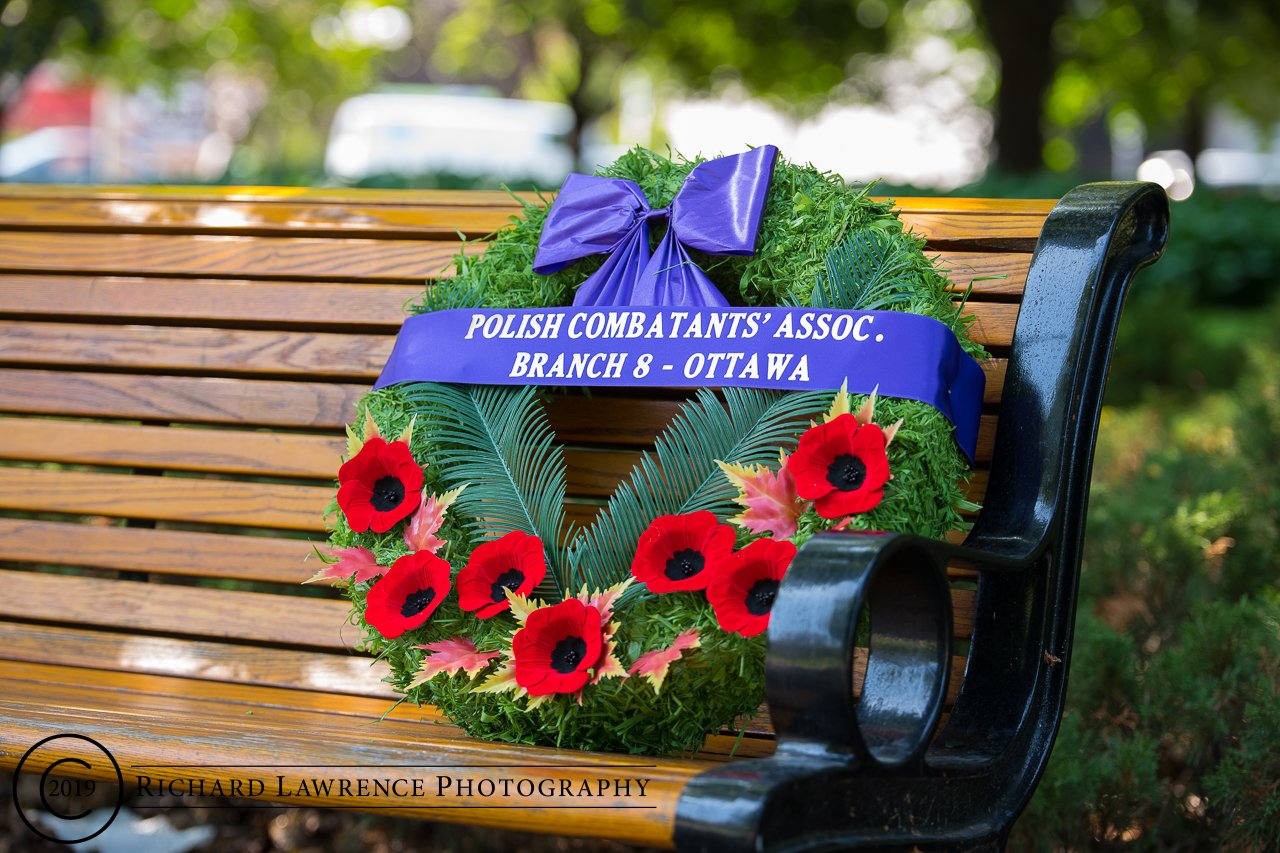
Attending was the Polish Ambassador of the Republic of Poland, H.E. Andrzej Kurnicki, his Defence Liaison Capt(N) Krzysztof Ksiazek, representatives from the Polish Boy Scouts and the Girl Guides, the Polish Combatants Association (Chapter 8-Ottawa), and most importantly, Ms. Ewa Konopacki.  Ms. Konopacki, a small, slight woman, fought with the Polish Home Army during the Uprising and is the recipient of Poland’s highest military decoration (Virtuti Militari) for “… heroism and courage in the face of the enemy at war” and may be the oldest surviving member of the conflict. The Ambassador, Ms. Konopacki, and Veterans Affairs laid wreaths in commemoration of both those lost in the Uprising and those Canadian airmen who risked so much to aid the Poles.   

CF Appreciation Night - Ottawa RedBlacks vs Calgary Stampeders

7.jpg

By Richard Lawrence

To see all the pictures, go to: https://www.richardlawrencephotography.ca/rlpgalleries/2019/cfappreciate/

The Calgary Stampeders were in town last night (25th July) to do battle against Ottawa’s RedBlacks in a Thursday night CFL contest, but more importantly, it was also the annual Canadian Forces Appreciation night which highlights the men and women of the Canadian Armed Forces.  It was a beautiful night, clear with only a few clouds, warm, but not unbearably so, with only light humidity.  The field of combat was set. 

As per normal, it started with the teams coming out and doing a few warmups and some stretching which got both the players and the crowd warmed up.  The RedBlacks’ Cheer and Dance Team took the field next and was warmly received for their opening routines. Make no mistake, this is not just a group of pretty girls (and guys) but hard core athletes in their own right who take to the skies in a number of gymnastic routines which, if they go wrong, can cause serious injury.  And finally, it was time to bring on the military, and this is where it was a bit of a letdown.

The Royal Canadian Dragoons were represented by a three man colour party that marched about 15 yards onto the field, counter-marched, and stopped facing the south stands.  With them came a member of the Central Band of the Canadian Armed Forces (CBCAF), WO Grenon, to sing the national anthem.  That’s it!  In my mind, there should have been a larger colour party, perhaps with sentries and other flags, and they should have marched all the way across the field, counter-marched, and stopped on center-field where they could have had part of a larger colour party facing both the north and south stands.  Perhaps a circle of sentries facing outwards with the colours in the center would have had more impact.  At that point, the singer could have come out with a contingent of the CBCAF who would have accompanied WO Grenon rather than having him sing to recorded music. 

And nothing says military power like a fly-by of two (I say again two) CH-146 Griffon helicopters, widely spaced and 1,000 feet up.  Woo woo. I understand that maybe it’s tough to always get a couple of CF-18s and local residents get upset by the noise, but they make a statement.  If I was using helicopters, then I’d like to have seen a tight formation of at least one Chinook with two Griffons in trail, have the Griffons peel off as they start over the field, and then have the Chinook let go with the anti-missile flares, all from a level of 500 feet.  That would get an ooh ahhh from the crowd.

At last it was time for the coin toss and the military’s representatives were the newly minted Commander of the Royal Canadian Navy, Vice-Admiral Art McDonald, and the Command Chief of the Royal Canadian Navy, CPO1 Dave Steeves. Both men waited patiently on the sidelines, talking to whomever was around them and were very friendly and I think excited to be representing the military at the game.  Out they went with the referees and players to center field where the VAdm tossed the coin which Calgary called correctly.  Once congratulations and good lucks were given to all, the coin party retired to the sidelines, with VAdm. McDonald joking with the referees all the way in.

The game started on time but it seemed that both teams had trouble getting going.  There were turnovers right from the outset as well as a higher than normal number of penalties.  In fact, it seemed that turnovers and penalties moved the ball more than the teams did.  The first quarter ended in a 6-6 tie with all scoring done by field goals. The second quarter was not much better and they went into half-time tied at 9-9.  There were some good runs and some good individual efforts, especially one by Ottawa #17, DeVonte Dedmon, who was tackled but kept his knees off the ground, balancing himself on his free arm while he regained his balance and took off again for a substantial gain. 

When half-time started, I waited for the Canadian Forces part of the programme but there was none.  In the past, there have been events where they would make teams of military members from both the north and south stands and then pit them against each other for the glory of their own side.  That way the civilians got to see the military in a very unmilitary setting.  This year, the only thing was the introduction of the aircrew from the fly-by who were from 430 Tactical Helicopter Squadron in Valcartier, Quebec.  That was it.

The third quarter turned out to be much the same as the first two with Calgary scoring another field goal to end the quarter at 12-9.  But finally in the fourth quarter, things turned around and Ottawa marched down the field to score a touchdown (Brad Sinopoli) at about the 13:23 mark to take the lead at 16-12.  Ottawa conceded a safety near the end of the game bring the score to 16-14 for Ottawa and there was more excitement as Calgary looked but missed to score a touchdown and they also missed a field goal.  However, as time was expiring, another field goal by Calgary ended it for Ottawa giving Calgary the 17-16 win.


103rd Nijmegen March Departure Parade

4.jpg

For more photos: https://www.richardlawrencephotography.ca/rlpgalleries/2019/nijmegen103/

By Richard Lawrence

On the 9th July, 2019, the Canadian contingent for the 2019 Nijmegen March held their departure parade at the Canadian War Museum. This is the 103rd Nijmegen March, in which Canada has participated since 1952 (67 years), where participants march in teams for a distance of 160 km over four days carrying a ruck sack of at least 10 kilograms. It covers much of the area liberated by the Allies, and more specifically Canada who lost 7,600 dead here, during WWII. Overall there will be more than 47,000 marchers from over 50 countries covering 70+ nationalities. This is the 75th anniversary of the liberation of the Netherlands and the 22nd year that the departure parade has been held at the Canadian War Museum. The Canadian team of 175 members in 14 teams of 11 will also pay respects by visiting Canadian war cemeteries at Groesbeek, Bergen-op-Zoom, and Vimy Ridge.

Speakers at this year’s parade included LGen. Lanthier, Commander of the Canadian Army, Ms. Frederieke Quispel, Deputy Head of Mission for the Embassy of the Kingdom of the Netherlands, Mr. Tom Irvine, President of the Royal Canadian Legion, and Dr. Peter MacLeod, Director of Research at the Canadian War Museum.  After the opening of the ceremony and inspection of the members present of the contingent, LGen Lanthier spoke of the honour of participating in this event and challenged all to “reflect on the great legacy that you now carry as members of this contingent.” 

Ms. Quispel, a historian, briefly covered the history of the area the marchers would see, noting that the first march in 1909 had 306 members (10 civilian, remainder military) but it wasn’t until 1925 that Nijmegen was chosen as the start/finish point for the march.  Nijmegen is possibly the oldest city in the Netherlands having officially obtained its Roman city rights in 100 A.D.  The area is also the scene of Operation Market Garden in September, 1944, when the Allies tried to secure the bridges over the Maas, Waal, and Rhine rivers, and almost succeeded. In recognition of this, on the last day of the march, military engineers will build a special pontoon bridge to take the participants over to the opposite side of the Maas, the home of the Black Watch during the winter of 1944/45. 

LCol Quirion, speaking as the contingent commander, noted that there were some anniversaries that made this year’s march special.  For example, the 30th Field Regiment of the RCA is celebrating 164 years in existence, The Royal Canadian Electrical and Mechanical Engineers are celebrating 75 years, and a combined team of 2nd Combat Engineer Regiment and 2nd Service Battalion celebrating their organizations’ parts in the NW Europe campaign.  He also noted that there were nine VIPs on this year’s team including representatives from the Dutch Embassy (Paula Martin),  two female RCMP officers (the first female officers to participate), Veterans Affairs, the Commissionaires, the Royal Canadian Legion, and three CAV members representing Soldier On. Lastly he announced that the fund raising effort of this year’s team has raised $26,000 for the Soldier On and Families First funds 

When Mr. Tom Irvine took the podium, he stopped to identify Mr. Lee Harrison, a participant representing the Royal Canadian Legion this year.  Mr. Harrison is a firefighter from Peterborough, a member of RCL Branch 52, and veteran of Bosnia and Afghanistan. 

He also mentioned that Canada has a historical connection to the Dutch royal family in that the Royal Family found sanctuary in Canada after the Nazis invaded the Netherlands.  A royal daughter, Princess Margriet was born in Ottawa, which is well known, but Mr. Irvine also noted that Princess Margriet’s son, Prince Floris, is the god-son of the Royal Canadian Legion and its honorary Vice-President.

Following the last of the speeches, wreaths were presented to LCol Quirion to be laid in the Canadian War Cemeteries in the Netherlands.  Ms. Quispel provided a wreath to be laid at Groesbeek Cemetery on behalf of the Embassy of the Kingdom of the Netherlands, Mr. Irvine provided a wreath to be laid at Groesbeek on behalf of the Royal Canadian Legion, and the last was provided by Dr. MacLeod and Mr. Hamilton to be laid at Vimy Ridge on behalf of the Canadian War Museum and Friends of the Canadian War Museum.

This ended the parade and the official party departed, followed by the contingent as they were dismissed and marched off.  But everyone soon reappeared to enjoy some time together as a luncheon was provided for the contingent, attendees, friends and family.

Highland Warriors Exhibit Opening

4.jpg

By Richard Lawrence

To see all the pictures, go to: https://www.richardlawrencephotography.ca/clients/cwm/highlander/

No-one can doubt the contributions made by the Scottish settlers who came to Canada when the country was just starting out.  One only has to look at the place names around the area such as Perth, Tay River, and others to see the foothold that Scottish culture has in Canada.  At every remembrance ceremony, there is a piper playing The Lament and who hasn’t seen a head table piped into a dinner.  And it is an interesting fact that the Canadian Armed Forces has more Highland Regiments than Britain.  This is the point of the new exhibit that has opened at the Canadian War Museum, Highland Warriors.

On 6th June, 2019, the Canadian War Museum (CWM) opened its new exhibit of the Highland Warrior and how that culture has permeated the world.  The opening ceremonies started with the skirl of the pipes as twelve pipers and five drummers of the Ceremonial Guard Pipes and Drums came down Commissionaires Way to Lebreton Gallery with the sound echoing off the concrete wall to fill the hall below. Once they were in formation and finished playing, Yasmine Mingay, Manager of Communications and Public Affairs at the CWM, took the time to acknowledge the presence of Mr. George Fouchard who was an RCE Mapper (cartographer) for the 1st Canadian Army for the Normandy campaign. This was of special importance as this day was also the commemoration of the 75th Anniversary of D-Day and the start of the Normandy campaign. 

First to the podium was the Honourable Kirsty Duncan, Minister of Science and Minister of Sports and Persons with Disabilities.  She noted that the Scots came to Canada and brought their culture with them and in doing so, helped to settle Canada.  They also formed regiments with her own family a part of the 48th Highlanders and she takes great pride in having danced for the regiment for more than twenty years.  To her, the regiments “… taught me the importance of history, of remembering, tradition, and what it means to serve”.  Speaking of her love of bagpipes, she noted that her father’s family comes from Aberdeen and were members of the Gordon Highlanders, but that it was her Polish-Ukrainian mother who played the pipes. 

Next up was Mr. Glenn Ogden, Acting Director – Exhibitions, Creative Development and Learning for the Canadian Museum of History.  He spoke of the remarkable legacy of the Scottish immigrants to Canada before speaking about the exhibit itself.  He told of the 200 plus artifacts from various private collections but also those from the Glasgow Museum and Highlander Museums in Scotland.  Everything from broadswords to the Victoria Cross awarded to a Canadian Piper during WWI (James Cleland Richardson, 72nd Seaforth Highlanders of Canada).  He then gave a brief overview of the extensive work of the exhibits curator, Mr. Alan Carswell, who has come all the way from Edinburgh, Scotland.

Mr. Carswell spoke of his time in the various Museums and collections that he has cared for and how esteemed the Scottish warriors and their traditions have become.  As an example, he brought up pipers playing The Lament at remembrance ceremonies and how it has become an accepted part of every remembrance ceremony in Canada, the United Kingdom, and throughout much of the world.  But mostly he spoke of the warriors as part of their community and the role they played within it.  He said, “the Highland Warrior … is a very old and long standing figure of respect within Gaelic culture and in the Highlands. … The warrior was a respected figure as the protector of the clan, the protector of the people.  So that tradition and that sense of honour transfers into military service very smoothly”.

He spoke of the peacetime drawdown of the regiments in Great Britain and with it the loss of some of the Highland Regiments.  On a happier note he spoke of the Royal Regiment of Scotland (formed in 2006) which, along with the Rifles, is the largest infantry regiment in the British Army.  The Royal Regiment is unique in that it is a merger of several Highland Regiments into one regiment of seven battalions.  One battalion is a merger of the Royal Scots and the King’s Own Scottish Borderers and the six other battalions are formed from the remaining single battalion regiments of the Scottish divisions.  While having only the one uniform for the regiment, each battalion retains their former titles and distinct hackles on their headdress.  The Pipes and Drums of each regiment also continue to wear the ceremonial tartans and uniforms of their former regiments.  After some re-organization in 2012, the Regiment consists of five regular and two reserve battalions.

The exhibit has many things to offer from weaponry to regalia and the history of it all.  There is some multimedia to watch and one can even pick up a sword or learn about kilts in the interactive area.  All this to show how much people are invested in the Scottish heritage and their regiments and the truths and myths of the Highland Warrior.  If you love all things Scottish, then the exhibit runs until 20th January, 2020.

D-Day Remembrance Ceremony

3.jpg

By Richard Lawrence

View photos here: https://www.richardlawrencephotography.ca/rlpgalleries/2019/dday75/

The 6th of June, 1944, or D-Day as it’s best known, was the culmination of years of planning, training, and stockpiling of supplies that allowed the Allied forces to regain a foothold on the European continent and open a second front to relieve the Russians, who had been fighting the Nazis since the summer of 1941.  It was a huge invasion, the largest amphibious assault in history, and the Canadians were given a sector of their own to control: Juno Beach. Approximately 14,000 Canadian troops hit Juno Beach that morning and by the end of the day, 340 were dead, 574 wounded, and 47 captured.  The RCN contributed 110 ships and 10,000 sailors and the RCAF had 15 fighter/fighter-bomber squadrons in the air to provide air cover and ground support.

It was good to see the Canadian government take the time to go to the Juno Beach in Normandy and commemorate and remember the sacrifices of the soldiers.  It was good to see some of the veterans who had actually fought in that battle go back. With the Prime Minister and senior ministers over in France, I feared that there would be little done to commemorate the battle in Ottawa, as has occurred with the Vimy Ridge remembrance.  However, I’m pleased to say that I was worried for naught as Veterans Affairs stepped up and did indeed hold a full blown remembrance ceremony at the National War Memorial.

The Honourable Andrew Leslie (MP Orleans) represented the government and laid a wreath with MP Karen McCrimmon, both who are ex-military.  MGen. Allain Pelletier represented the Canadian Armed Forces while the British High Commission had Brigadier Nicholas Orr (Defence Attaché) handle the wreath and Ministre Conseiller Jérȏme Bresson and Liaison Officer to the CAF, LCol. Guilhem de Tarlé laid the wreath on behalf of France.  

Of special interest to this ceremony was that there were actually five D-Day/Battle of Normandy veterans in attendance as Lucien Beauchamp and Jack Commerford (95 years old) handled the Act of Remembrance and Gerry Bowen laid a wreath on behalf of the veterans.  Also with the guests were Victor Norburn and Sam Jamieson who also participated in this battle in 1944.

The remarks presented by Mr. Leslie, Mr. Bresson, and Brig. Orr, all had a common theme which centered around how young these men were, the odds that they face and overcame, and the horrors which they saw and endured on the beaches.  None of the speakers forgot to mention how much we owed to these men, and their comrades who didn’t come home. 

One of the more poignant elements of the ceremony also provided a little comic relief and probably was missed by most present.  On the steps up to, and just below, the Tomb of the Unknown Soldier, were placed a pair of combat boots with a poppy affixed to the top.  In itself, it is a stark reminder of those who never came home.  However, when the photograph of these boots is examined, one the inside at the very top lip in black ink, is the boot’s owner’s name: Wynnyk As it turns out, this is an old pair of LGen Wynnyks boots that he turned in some time ago and they have resurfaced, unbeknownst to him, at this ceremony.

OSAA Lame Ducks vs DND GOFOs

By Richard Lawrence

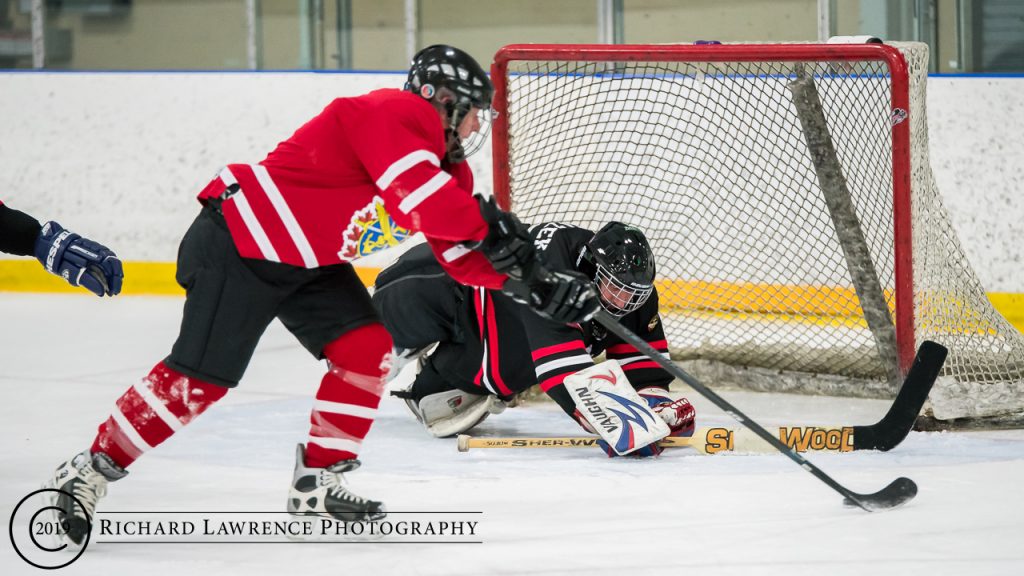
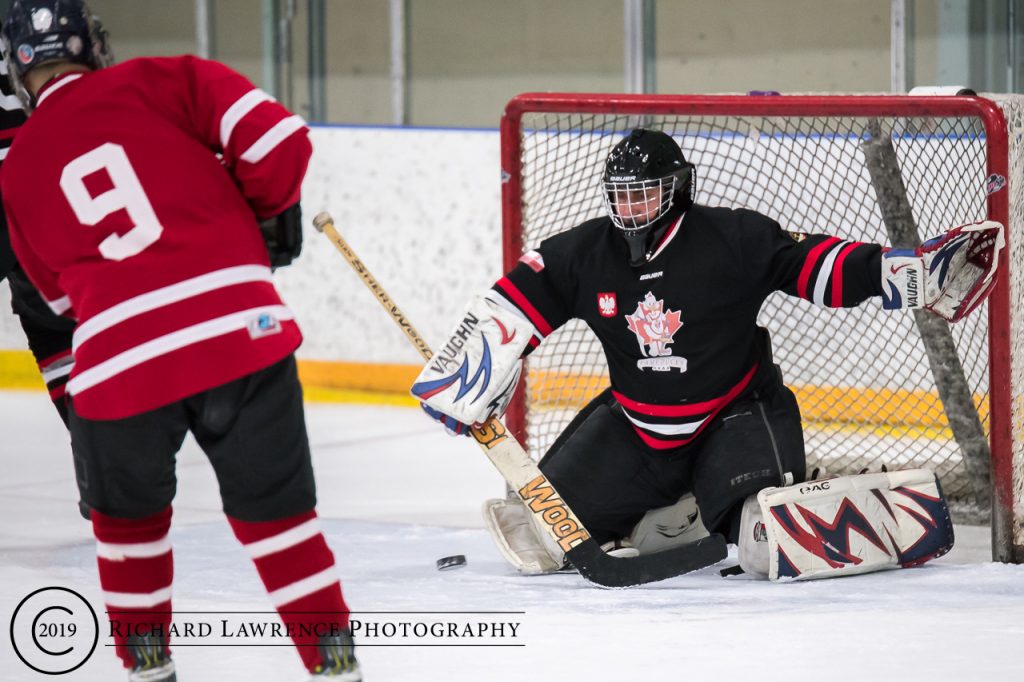
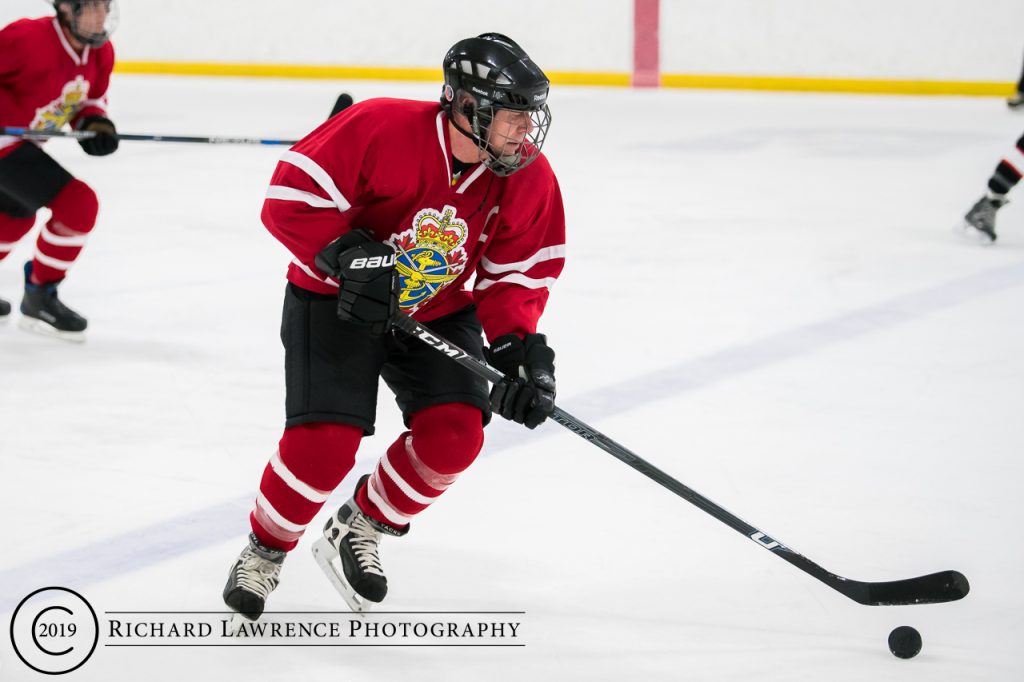
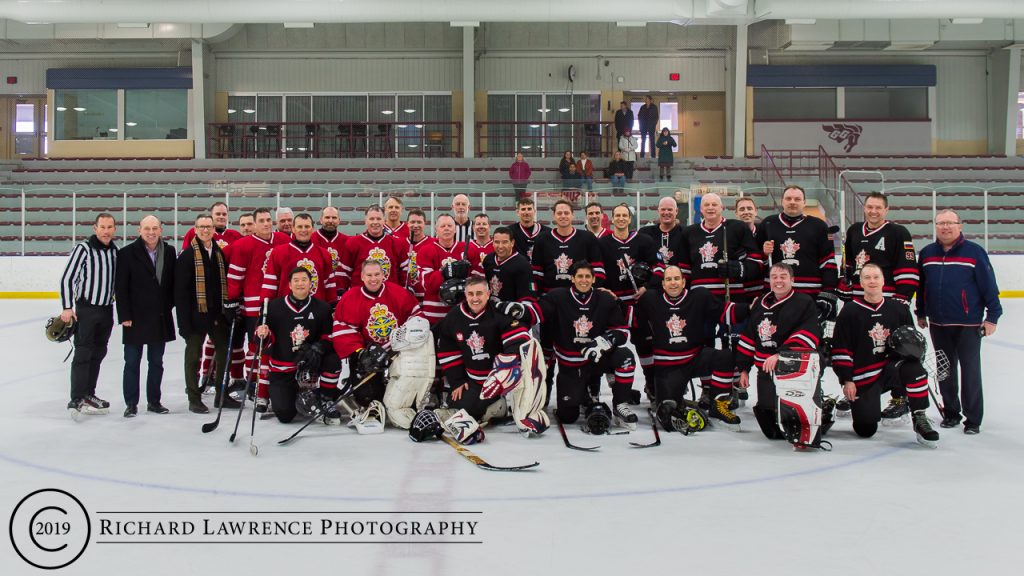
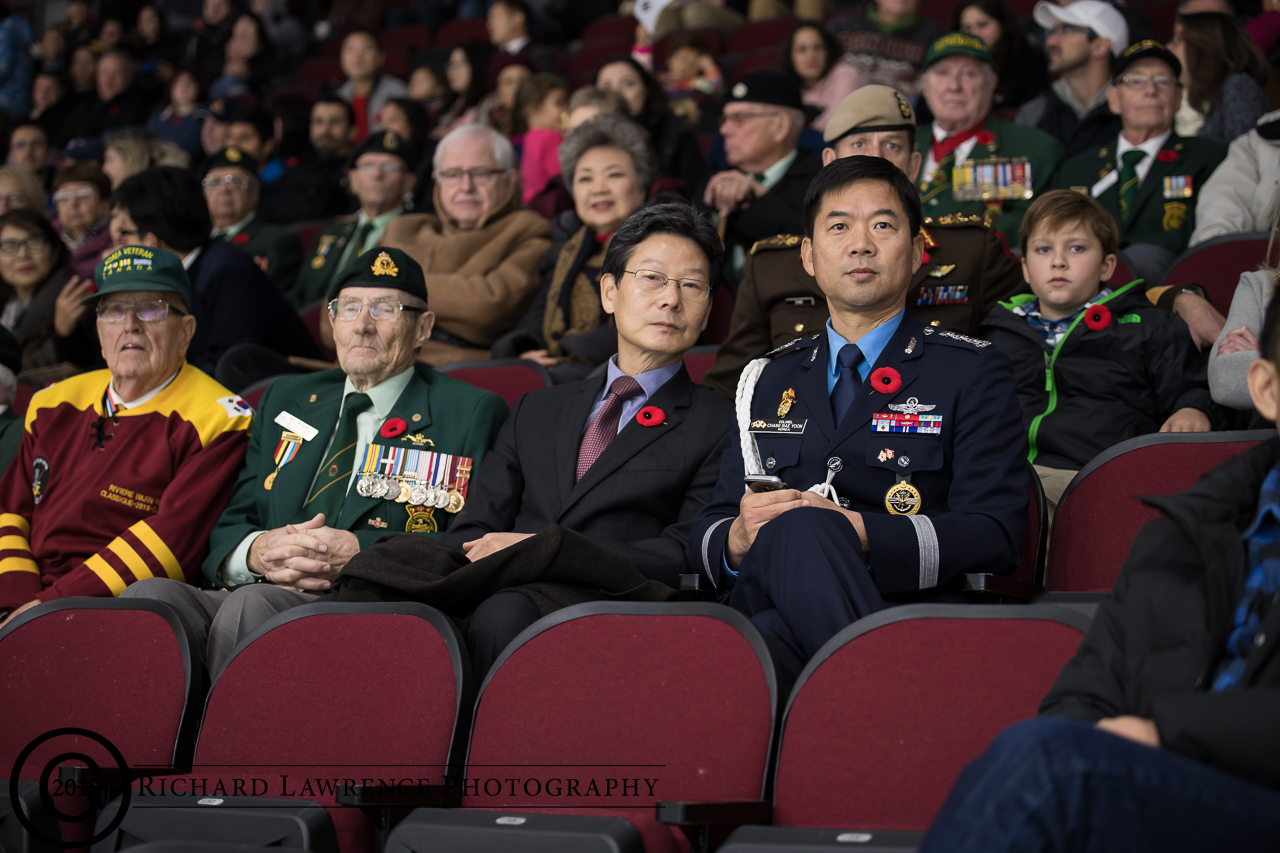
The OSAA Lame Ducks took to the ice again this week against their Canadian Armed Forces foes, the General Officers and Flag Officers, or the GOFOs. It was a match that clearly showed the Canadian dominance of the game of hockey over the multi-national defence attachés posted to Ottawa, who, although showing improving skills in the game, were not a match on this day for the GOFOs, led by Chief of the Defence Staff, Gen Jonathan Vance, Commander of the Royal Canadian Air Force, Lt-Gen Al Meinzinger, Rear-Adm Scott Bishop, and Rear-Adm Couturier. The Ducks have some skills, especially in Col. Igor Starkov (Russian Federation) and Col. Chang Bae Yoon (Korea), and the effort put out by the others given their short time in Canada, learning to skate, and learning the game, is impressive.  Especially when you consider that one of the goalies is from Georgia, USA, doesn’t skate well, yet still volunteered to stand between the pipes and have pucks whipped at his head.

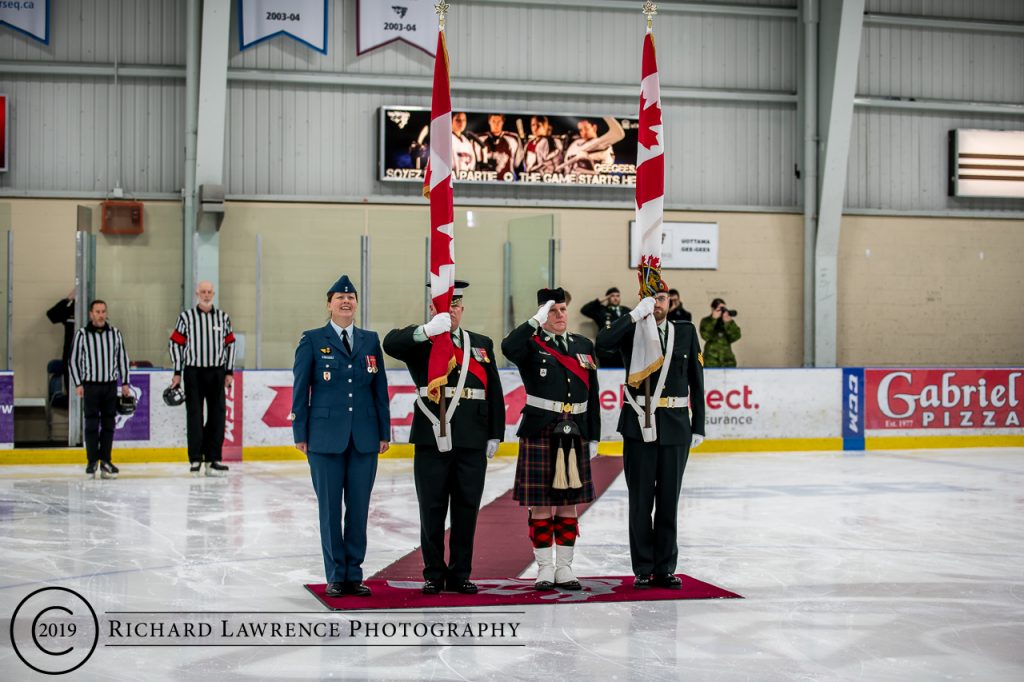
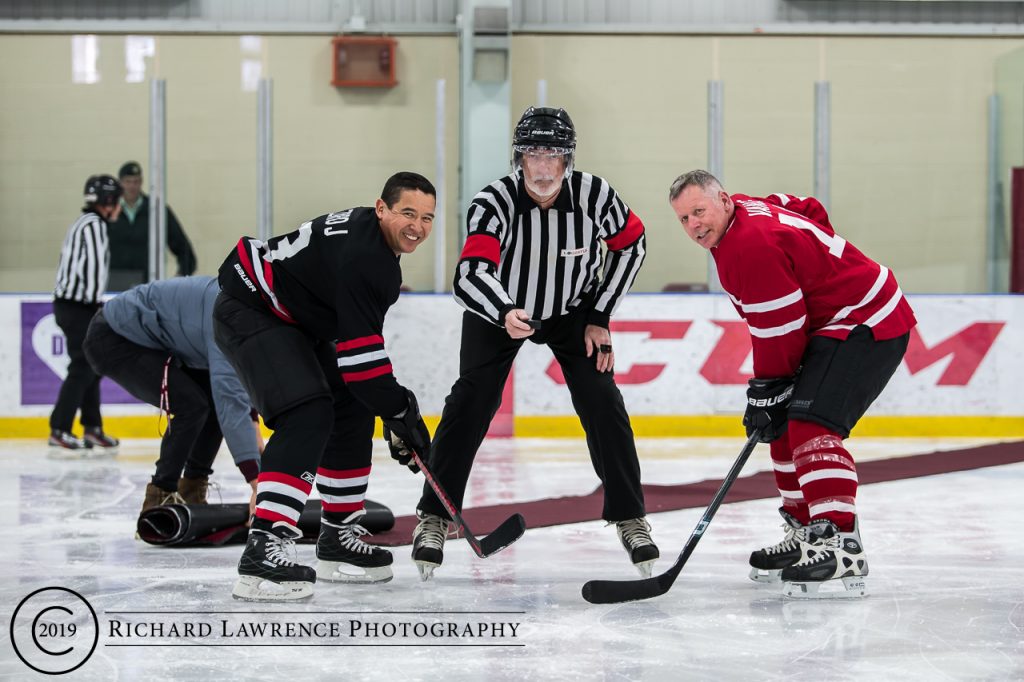
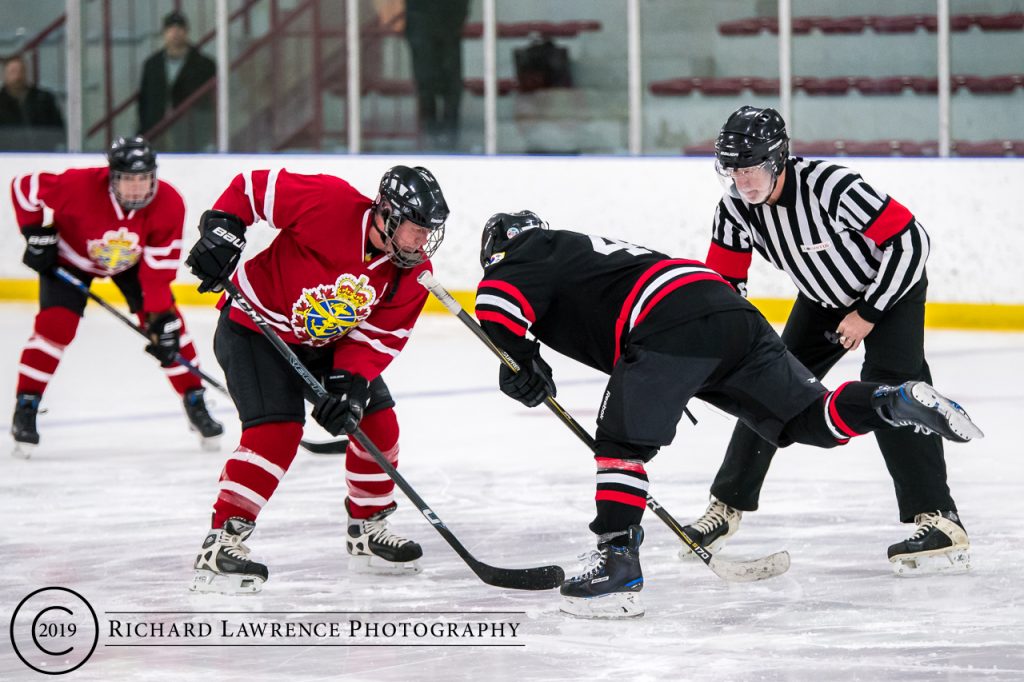
 The game started off with the colour party coming on to the ice and singing the national anthem followed by the ceremonial puck drop.  Referees Doug Thomas and Denis Rouleau then got things underway and it was clear that most of the action was going to take place in the Ducks end of the rink.  In the first period, the GOFOs took the lead with goals at 11:56 and 10:32 ending the first period ahead 2-0.  It was 12:34 into the second period when the Lame Ducks got their first mark but the GOFOs got their margin back at 9:10 and increased it at 0:42 to end the second period ahead 4-1.  The third period was more even as the Ducks scored at 12:08 and the GOFOs at 10:49 which ended the scoring for the game at 5-2 for the GOFOs.

As there was still time on the ice rental, it was decided to hold a shoot-out dual where every player on each team would get one chance to skate in on the opposing goalie to try and score.  Between the goalies and the attackers, the goalies came out on top, stopping almost all attempts to score.

At the following reception, the Most Valuable Players were named, with RAdm. Scott Bishop selected as GOFO MVP and Maj. Scott Bryan (USA) selected as the Lame Ducks MVP.  After that, it was pizza, wings, and beer. 

To see all the pictures, go to:

https://www.richardlawrencephotography.ca/clients/osaa/20190327/

Opening of Hill 70 Victoria Crosses Exhibit

By Richard Lawrence

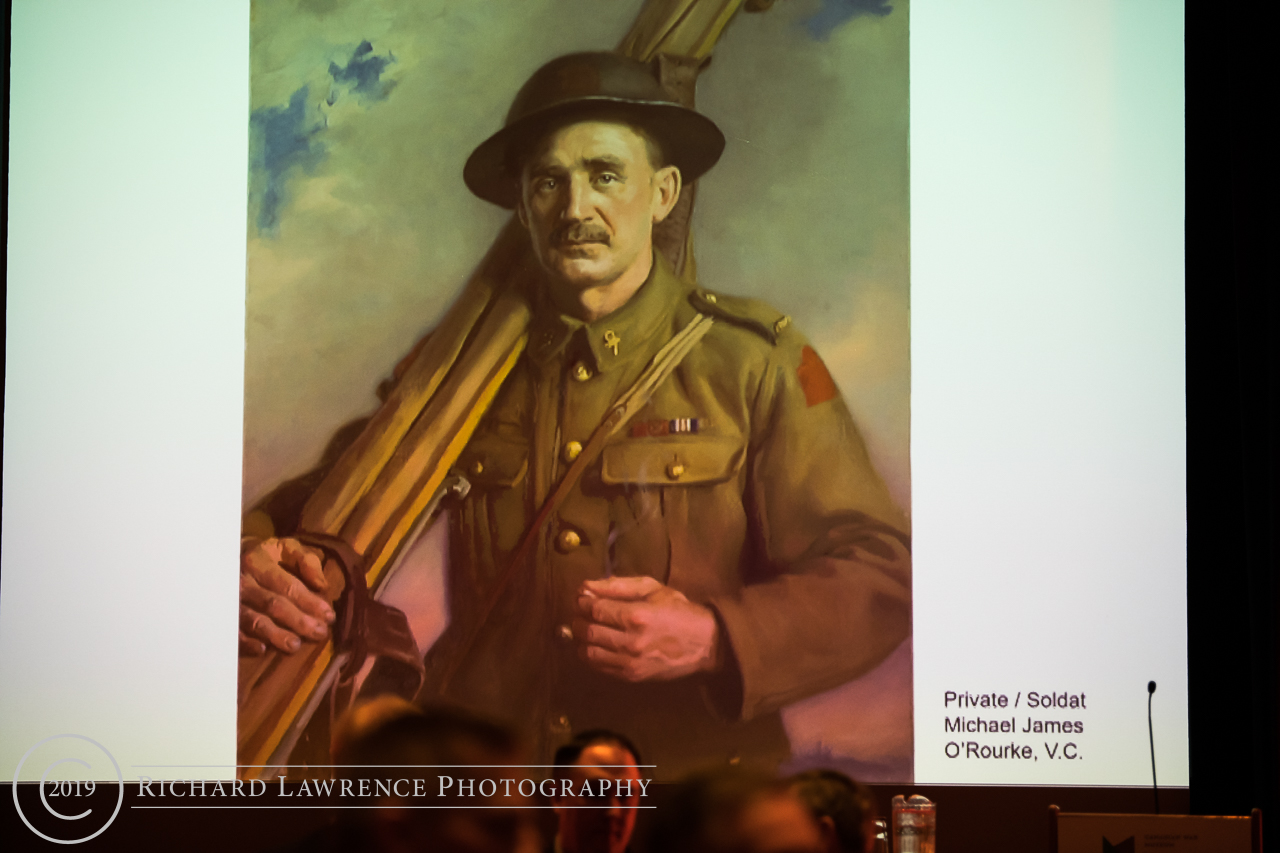
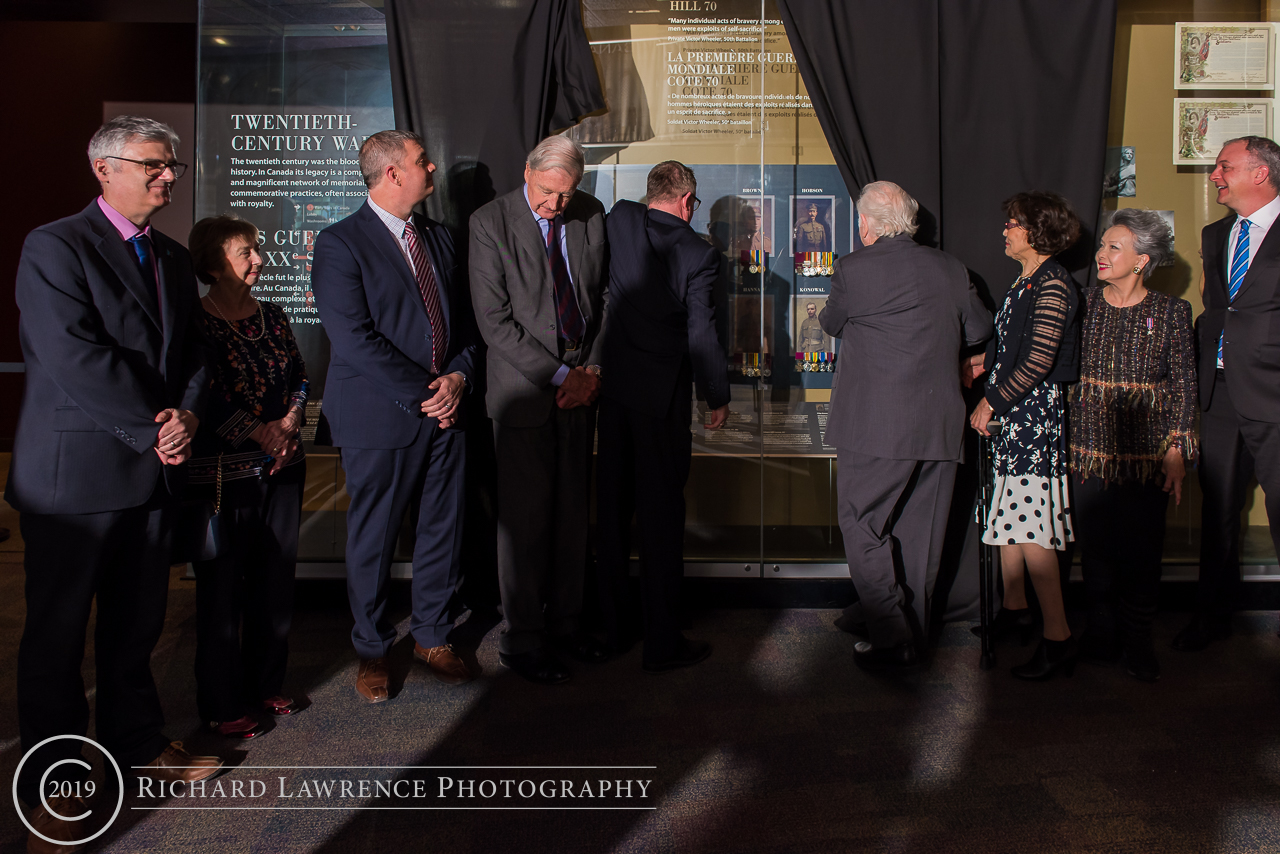
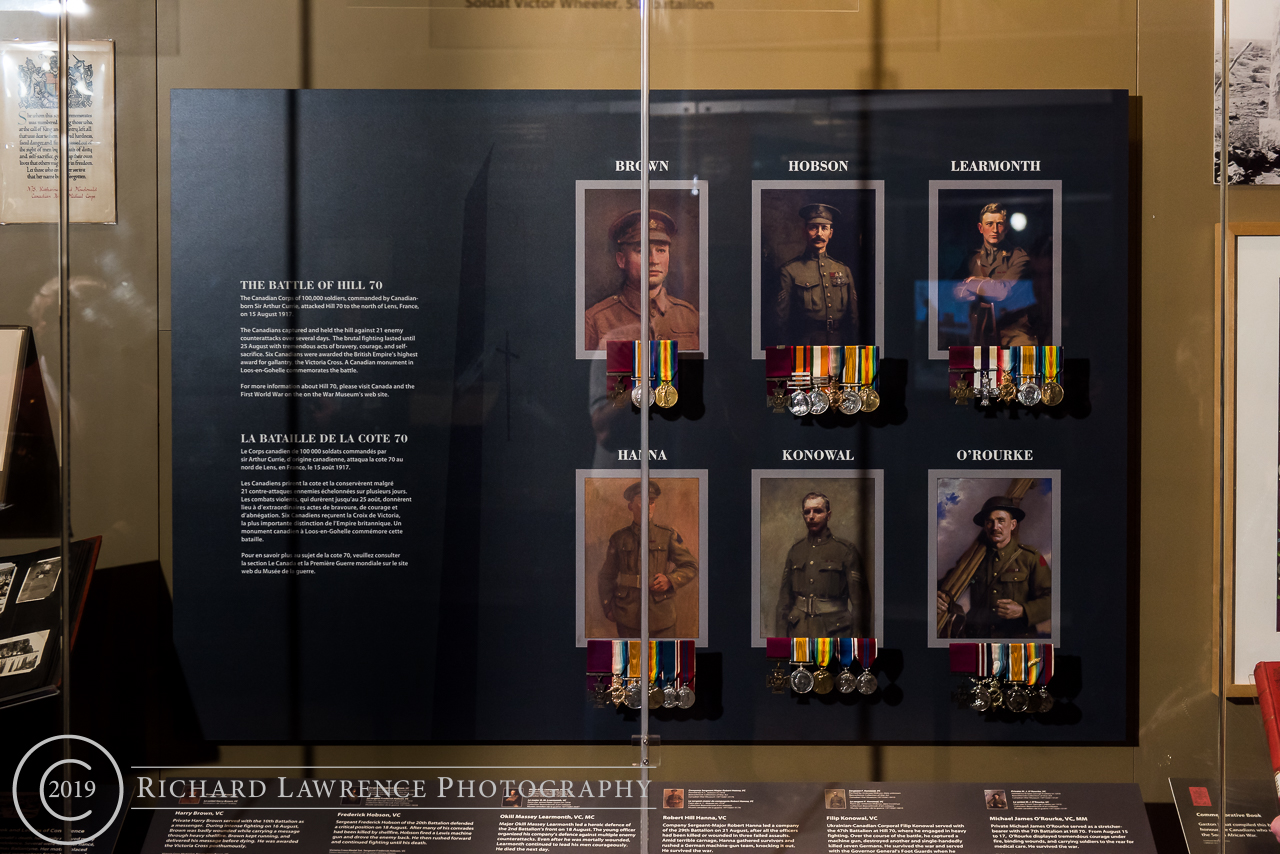
The Canadian War Museum has opened up a new exhibit in the Royal Canadian Legion Hall of Honour showcasing the six Victoria Crosses awarded to Canadian soldiers for the Battle of Hill 70 during World War I.  Hill 70 is often referred to as the “forgotten battle” as it falls between the major battles at Vimy Ridge and Passchendaele but it is every bit as important, arguably more so, than those battles. Notwithstanding, it was a battle fought by the Canadian Corps, this time led by a Canadian commander in Lieutenant-General Arthur Currie (unlike Vimy Ridge which had British commanders), with objectives selected by Canadian command (against the initial objectives selected by High Command).  Hill 70 was taken in hours on 15th August, 1917, and held against 21 German counter-attacks, providing the allies with the high ground in front of Lens, France, as well as providing a much needed diversion at Passchendaele causing the Germans to divert their troops from that battle.  Over the period of 15th -25th August, Canadian casualties ran to over 9,000 with almost 1,900 killed, while the Germans are estimated to have lost 25,000. 

During the battle, Canadian soldiers distinguished themselves and were awarded six Victoria Crosses. (NOTE: I use the term “awarded” rather than” won” as medals are not handed out for winning a contest but are awarded to people who have shown exceptional courage).  Those soldiers were: 

·       Private Harry Brown (Ontario)

·       Company Sergeant Major Robert Hanna (Ireland)

·       Sergeant Frederick Hobson (England)

·       Corporal Filip Konowal (Russian Empire, now Ukraine)

·       Major Okill Massey Learmonth (Quebec)

·       Private James Michael O’Rourke (Ireland)

The Museum already had four of these medal sets, the last acquired through the generosity of Mr. Cyril Woods and the Hill 70 Memorial Project with a fifth set on loan from the Governor General Foot Guards Regimental Museum (Learmonth) and O’Rourke’s on loan from the British Columbia Regiment (DCO) Museum Society. 

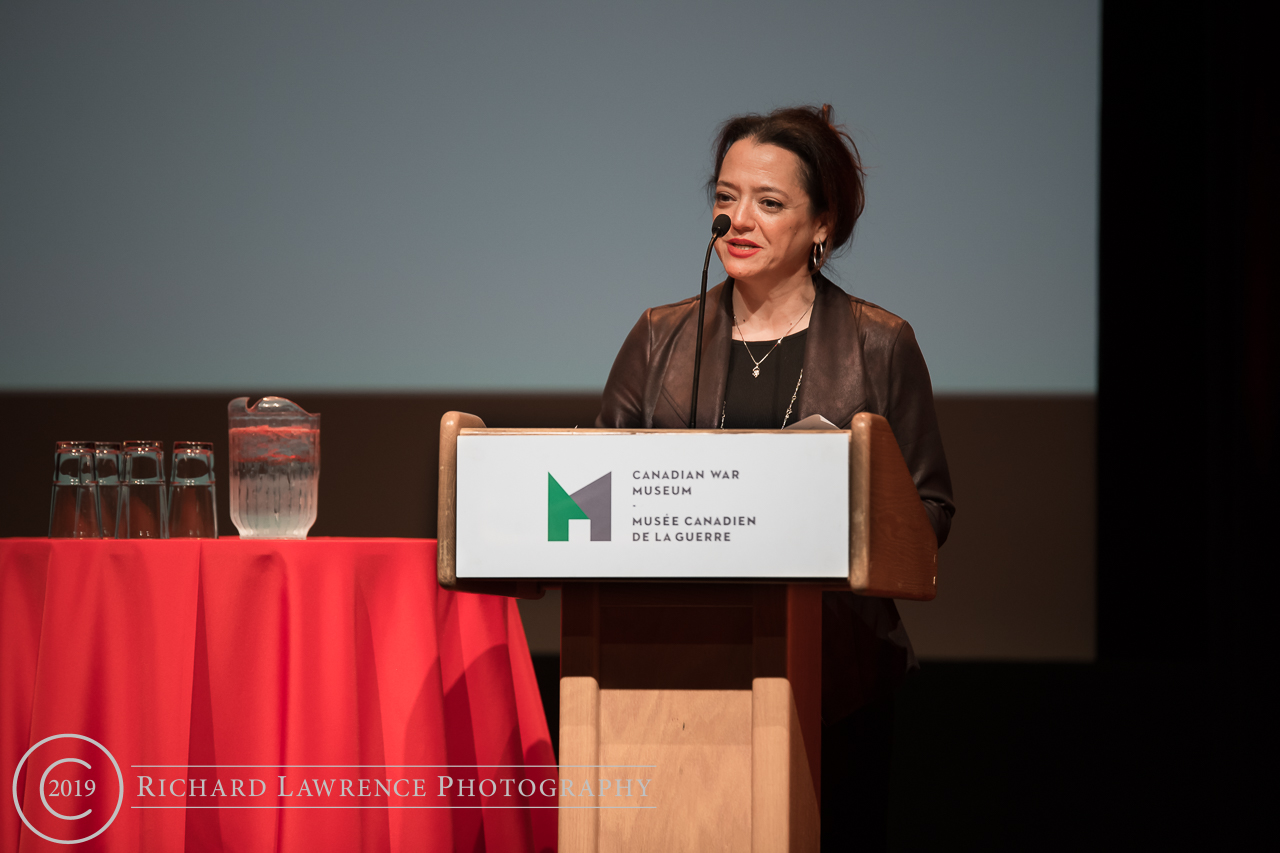
Speakers at the exhibit opening included Col. (ret’d) Mark Hutchings, chair of the Hill 70 Memorial Project, and His Grace, James Hamilton, 5th Duke of Abercorn, who had come all the way from Ireland for the opening because of a connection to his country of two of the VC recipients. One of the six was from Ontario, one from Quebec, and the four others were immigrants to Canada.

If at the Canadian War Museum, take a moment to browse through the RCL Hall of Honour and view the stories of these extraordinary men.

Other pictures of the exhibit opening are at:

https://www.richardlawrencephotography.ca/clients/cwm/hill70vc/

THE WOUNDED

By Richard Lawrence

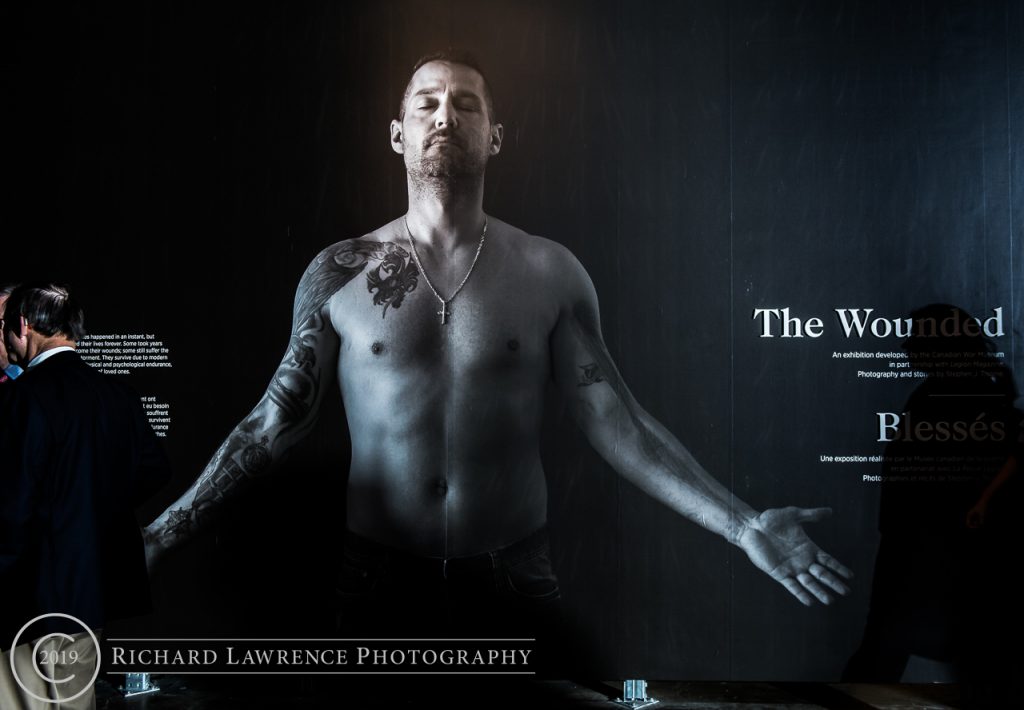
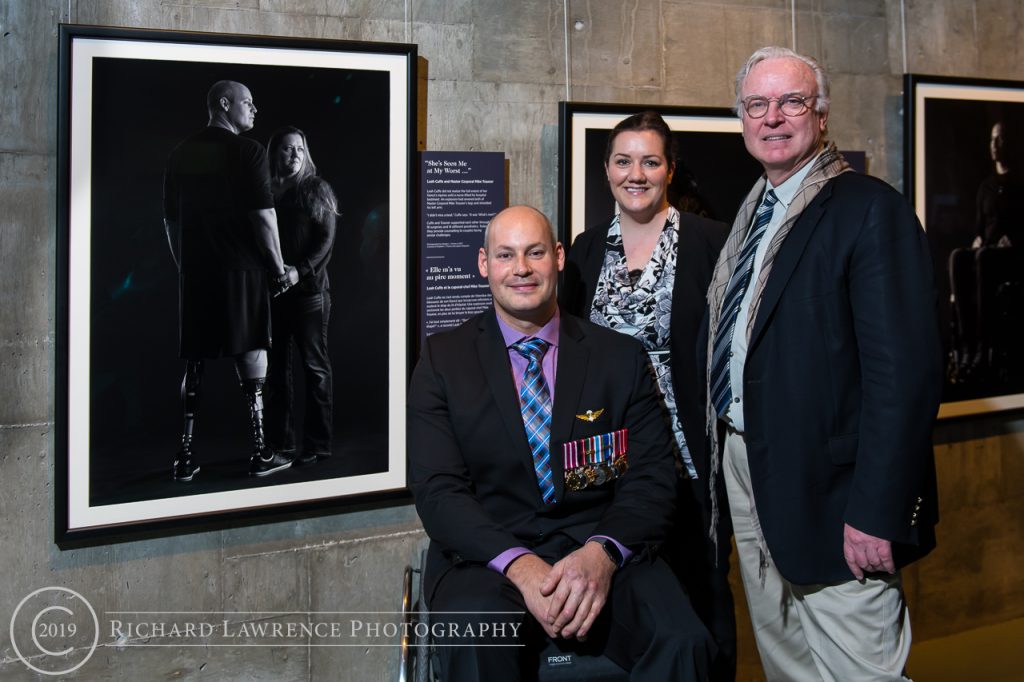
On February 14th the Canadian War Museum opened a new exhibit entitled “The Wounded” in which it displayed 18 black-and-white portraits of Canadian men and women who served and were wounded in Afghanistan, taken by photojournalist Stephen J. Thorne.  Sixteen of the portraits were originally featured in a series by Legion Magazine in 2017 while two are new.  This exhibit, which is presented in conjunction with Legion Magazine, illustrates stories of loss, but more importantly, the will and determination to stare adversity in the face and to rise above it. At the opening, 10 of the 18 soldiers portrayed were present in the audience and talked to the guests about their experiences before, during, and after their woundings. 

Mr. Thorne completed three assignments covering Canadians in Afghanistan from 2002 - 2004 and noticed that press coverage for the war dead was extensive but that the wounded were rarely mentioned.  And when they were, they were referred to as “injured” – a vague term at best.  In 2016 he decided to photograph and interview these dedicated, courageous soldiers.  They didn’t necessarily want the attention but co-operated and collaborated out of an ongoing sense of duty and public service. 

Mr. Thorne took this series of photographs using very low light, short lighting, and a lot of shadow, finally deciding to print them in black-and-white as he felt doing so made the images much stronger

for the viewer.  While Mr. Thorne’s work is exceptional in its posing, lighting, and presentation, the deeper story is of the subjects of the photographs.  Each one of these images tells of tragedy and show people overcoming adversity. And make no mistake, all of these stories affect not just the injured but those closest to them as well for while the world in turned upside down for the soldier, it is every bit the same for their partners.   

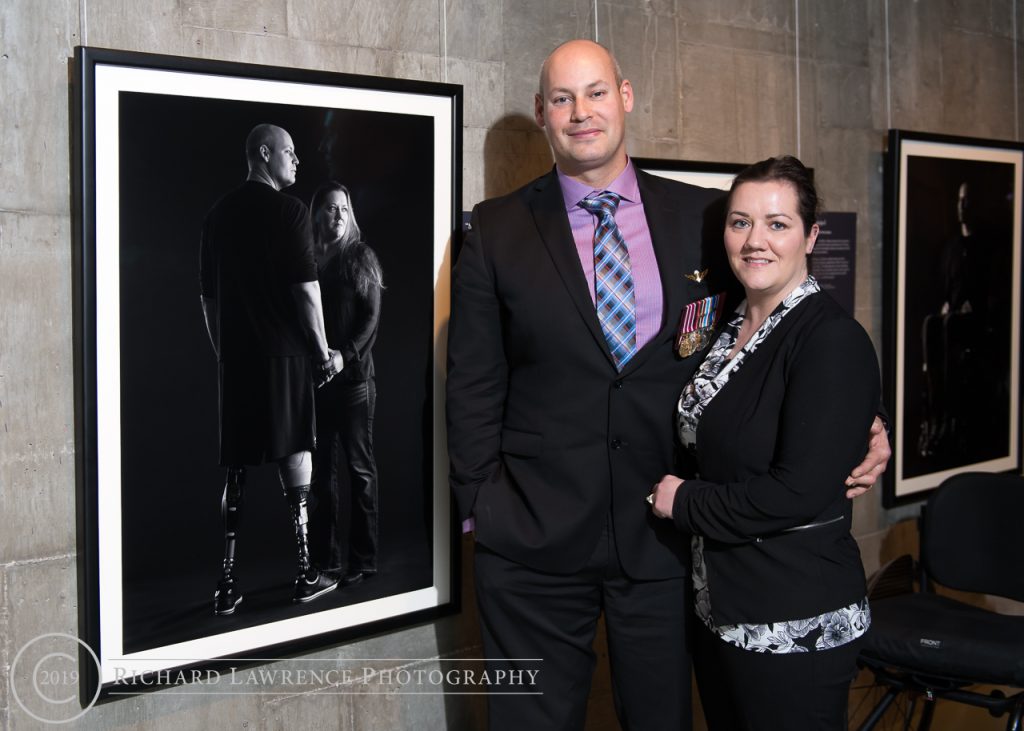
Particularly inspiring is the story of MCpl. Mike Trauner and his wife Leah Cuffe.  In December 2008 and IED detonated underneath Mike and took both legs and damaged his hands and arms.  The damage was so bad that he was not expected to live (in fact died once on the battlefield and once in surgery).  He was in Landstuhl, Germany, for 11 days and was then repatriated to the Civic Hospital where he continued to recover and then undertake rehab for the next 14 months.  He has been through 18 surgeries and 14 different prosthetics. 

Mike and Leah persevered and Mike decided that he was never going to wallow in pity.  He has been asked by many if he ever thought about “Why me?” and his response has always been, “Why not me?  If it hadn’t been me, then it would have been someone else so why dwell on it.”

Today he still moves around in a wheelchair but is able to use his prosthetic legs to walk as well.  He stated that he is able to move around for hours if he is in his sports gear but in a tie and jacket with dress shoes he tires much more quickly and standing becomes an issue.  I personally wouldn’t have thought that shoes would make a difference in how the prosthetic legs perform but he assured me that the dress shoes very much limit his ability to use the prosthetic legs.  When asked about pain, he stated that there is always pain, every day, every minute.  It’s all about managing the pain and moving forward.

As if getting to this point was not enough, Mike has become an international calibre athlete in rowing having won two golds in indoor rowing events in the 2017 Invictus Games.  Getting into this type of physical shape is demanding for normal people but even more so for someone so badly injured, not just in the legs, but the continuing injuries in his arms and hands.  Notwithstanding, after meeting Prince Harry and being challenged to compete, he knew he could do it.  And his physical prowess extends further than challenging other physically disabled athletes as he recounted in a story about when he decided to try distance rowing.

Mike decided to go to the Hudson Regatta (outside Montreal) never having rowed a distance race and decided to participate in an 18 km row.  Upon registration he found out that the 18 km was fully booked but there were still spots available for the 30 km race.  His thoughts were just to do a distance race so 30 km was just as good as 18 km to see if he could do distance.  He prepared himself and got into his boat without anyone noticing his condition and off he went.  Eventually, he crossed the finish line, so pleased with himself for completing such an exhausting course but was confused by the lack of competitors around him.  His first thought was that he was near the end of the field but, in fact, the opposite was true in that he had finished in second place against a field of 51 able-bodied (and I use this term both reservedly and sarcastically) men.  It was only upon docking and having his prosthetics brought to him that the onlookers realized what had happened and the physical accomplishment that Mike had achieved.

There are other stories as well such as Natacha Dupuis who was a co-captain of the Canadian contingent of the 2017 Invictus Games.  Unfortunately, these people will not be at the exhibit when you come through so the totality of their experience will not be able to be shared.  This exhibit, while simple in its presentation, shows the beauty of the photography of Mr. Thorne, as well as the inspiration of those pictured and runs until 15th June, 2019.

For more photos: http://www.richardlawrencephotography.ca/clients/cwm/wounded/

First Special Service Force Congressional Gold Medal Unveiling

By Richard Lawrence

“We honour all those who gave the supreme sacrifice, but we also honour those who, daring to die, survived.” 

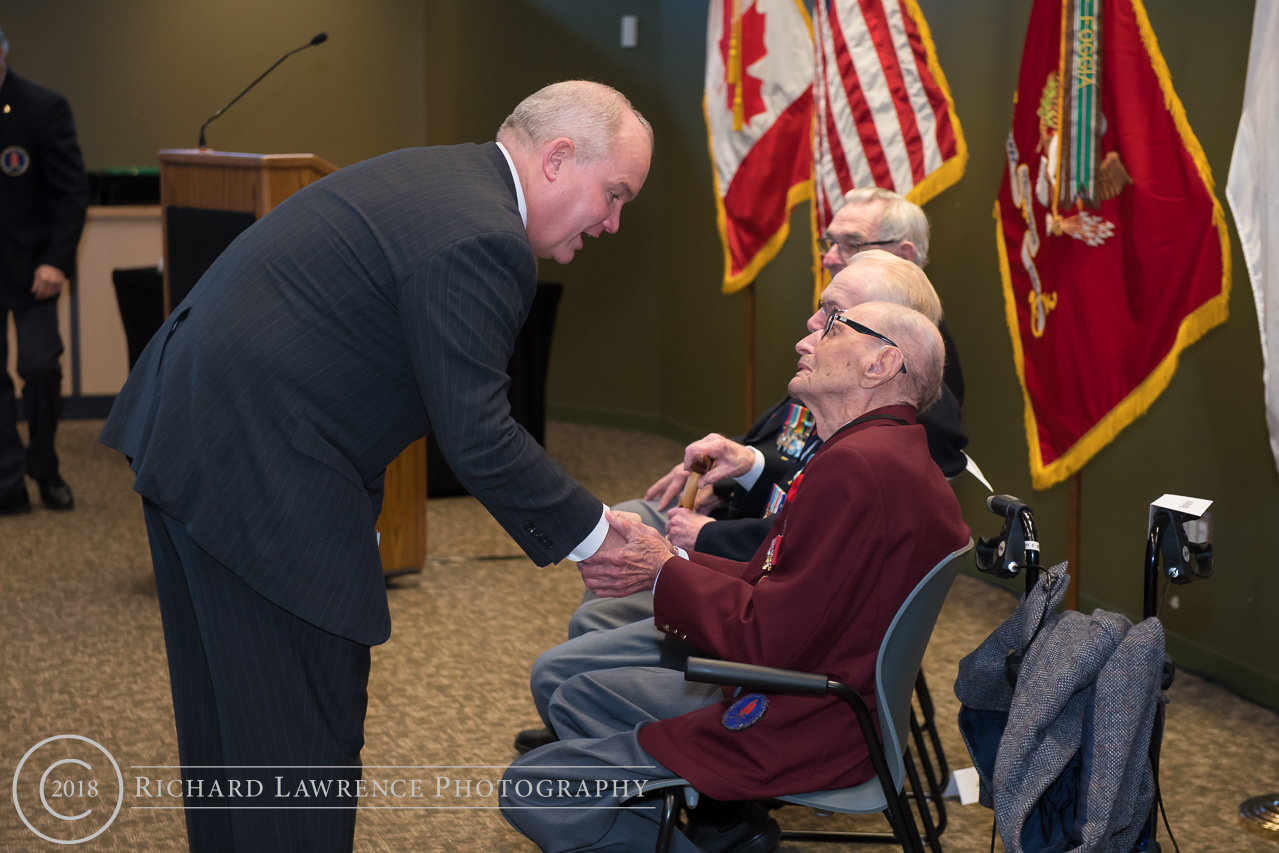
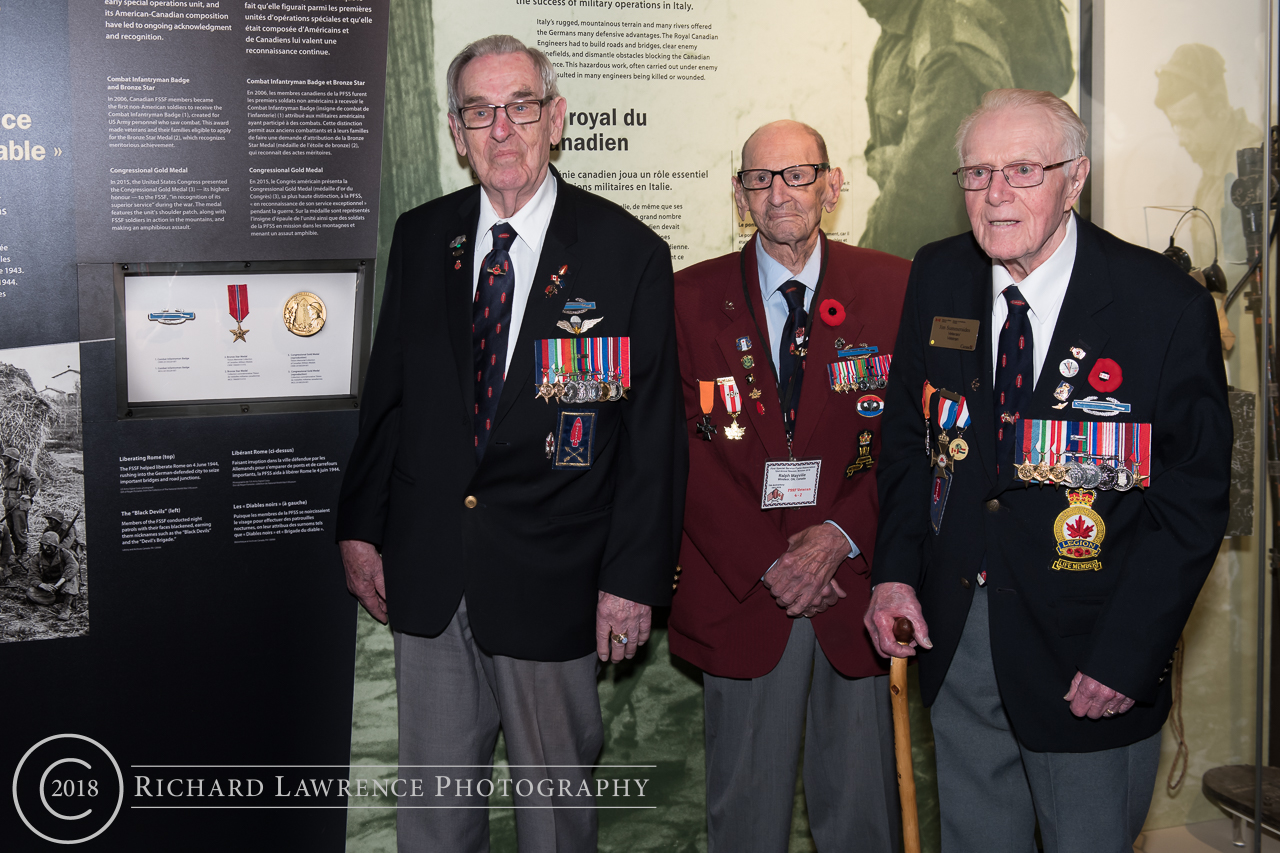
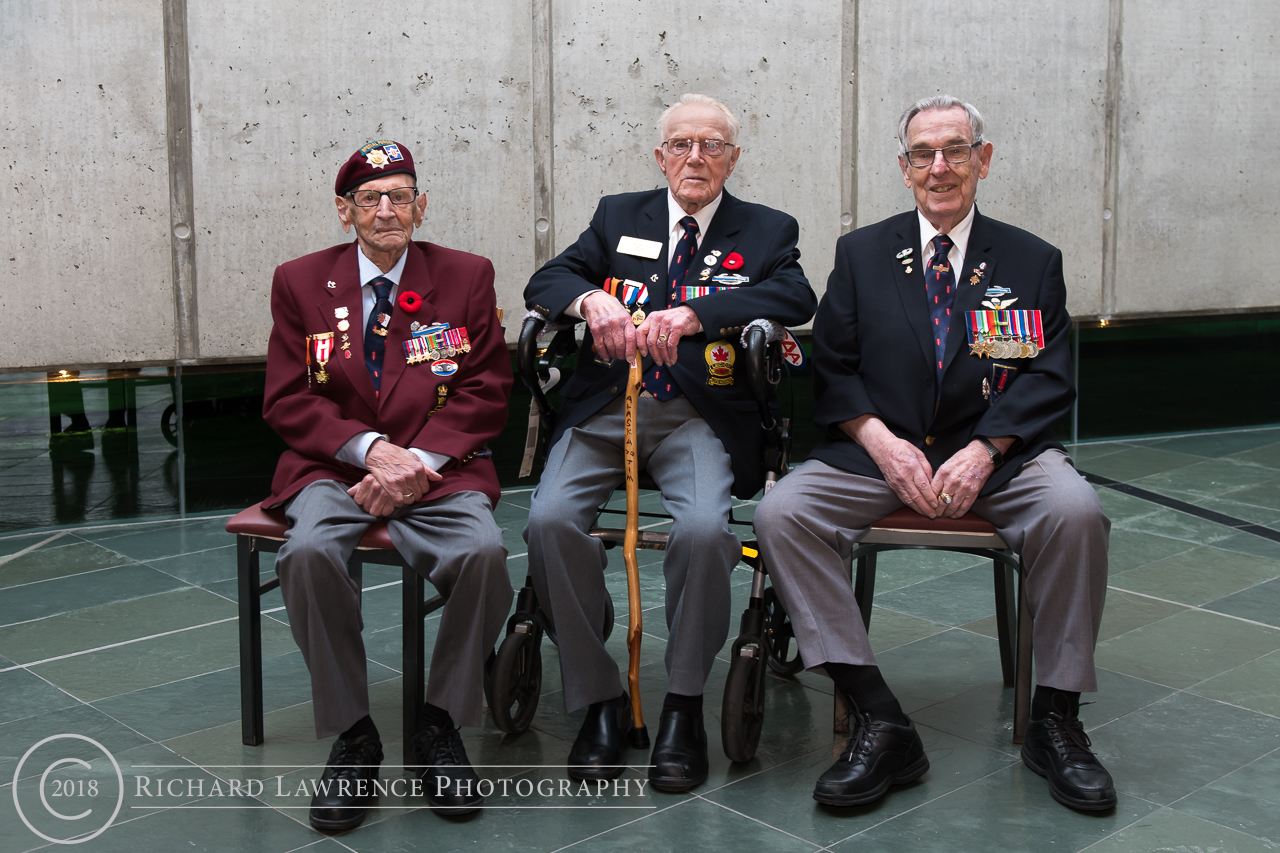
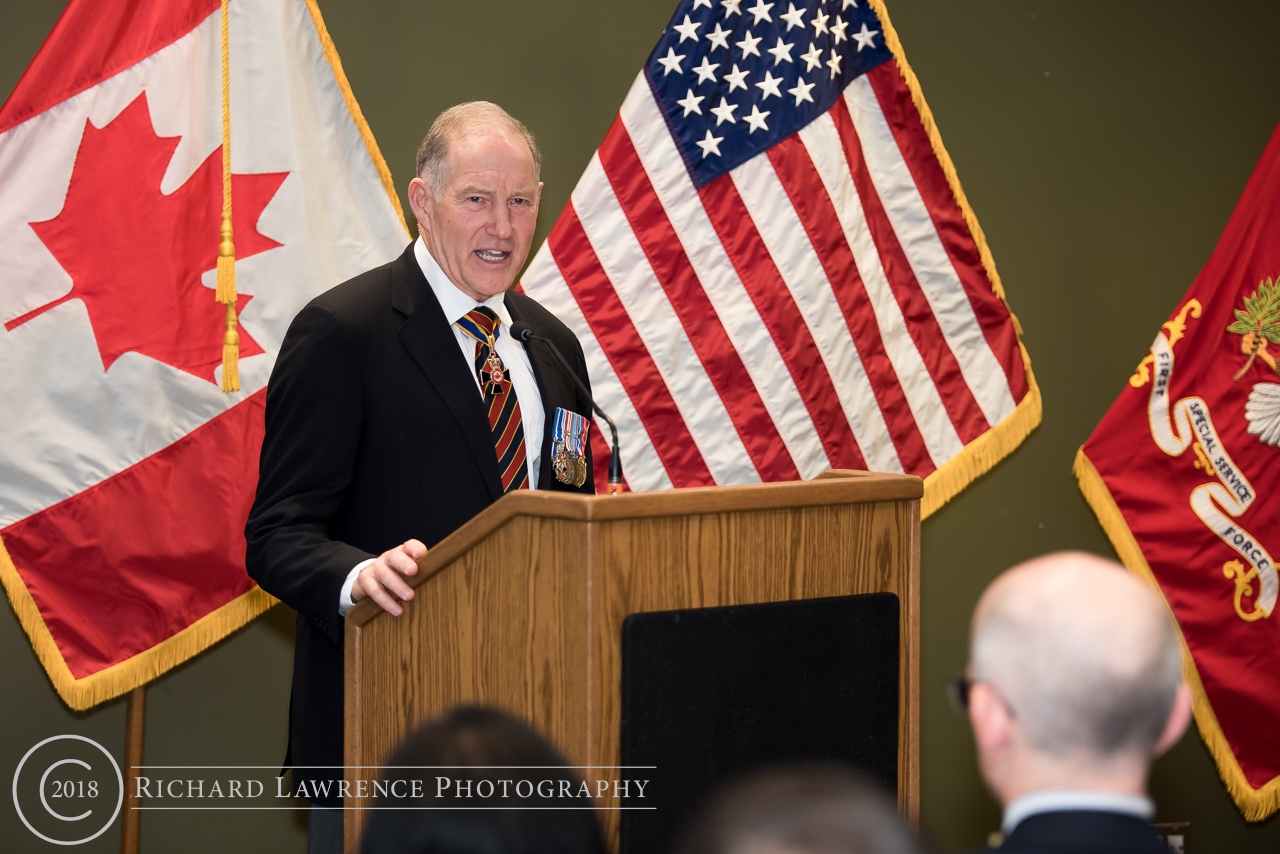
These were the parting words from Mr. Jack Callowhill, WWII veteran and member of the First Special Service Force (FSSF), at the Canadian War Museum on Wednesday, 22nd November, 2018, where the replica Congressional Gold Medal, awarded to the FSSF in 2015, was unveiled in a display to the Devil’s Brigade.  Speaking at the ceremony were Mr. Walt Natynczyk, Deputy-Minister of Veterans Affairs, Colonel Steve Hunter, Director of Special Operations for CanSOFCom, and a military member of US Special Forces attached to the US Embassy  and in attendance were three members of the original 1942 FSSF: Mr. Jack Callowhill (95), Mr. Jim Summersides (94), and Mr. Ralph Mayville (97).

The First Special Service Force, better known as the Devil’s Brigade because of the 1968 movie of the same name, was a unique organization pulled together from elite Canadian soldiers and American troops who volunteered to train for winter/mountain guerilla warfare behind enemy lines in Norway, specifically for Operation Plough.  The unit was activated on 9th July, 1942, as three small regiments and a service battalion with the second in command (LCol. McQueen), half the officers, and one-third of the men being Canadian, and eventually came under the command of the US Fifth Army.

 On the Canadian side, the Minister of National Defence, James Ralston, authorized 697 officers and men be trained under the guise of becoming the 1st Canadian Parachute Battalion as the FSSF was a secret at that time. In late 1943 Operation Plough was abandoned and the FSSF was sent to Italy in November where they would undertake their first operation with the attack on Monte La Difensa and Monte La Remetanea.  These two peaks were part of the Bernhardt Line, a bulge in the Gustav Line of German defenses which crossed Italy and had stymied the Allies.

Monte La Difensa was no easy assault as the Germans were positioned and dug in on the mountain top and commanded all approaches. After careful reconnaissance, it was decided that the only way to successfully attack the position was the scale the almost vertical face of the mountain and attack with surprise.  To that end, on 1st December, the 2nd Regiment was trucked to within six miles of the mountain where they disembarked and marched six more hours to the mountain base.  After one nights rest the 2nd Regiment of 600 men began the ascent at dusk as the mountain was barraged by artillery to give them some cover, albeit they were under fire as well.  By midnight they started the ascent of the final cliff of 1000 feet straight up, in the freezing rain, tied to each other.   Once on top, they positioned themselves for the final assault to start at 0600 hours but they were discovered earlier and the fight was on.  The attack was expected to last 4-5 days but within two hours, Monte La Difensa was secure in FSSF hands. 

This was not the end but only the start of the Italian Campaign for the FSSF.  Through the next year they fought 22 battles in Italy, France, Germany, and the Aleutians , never losing a battle or pulling back, once spending 99 days without relief on the Anzio Beachhead.  They compiled a 25:1 kill ratio and captured over 25,000 prisoners even though, at its very best, FSSF strength was less than 2,000. That kind of success does not come without its losses as the FSSF lost 576 killed with a casualty rate of 134% (many soldiers were wounded more than once accounting for the greater than 100% figure) in its two year history. The FSSF was disbanded on 5th December, 1944. 

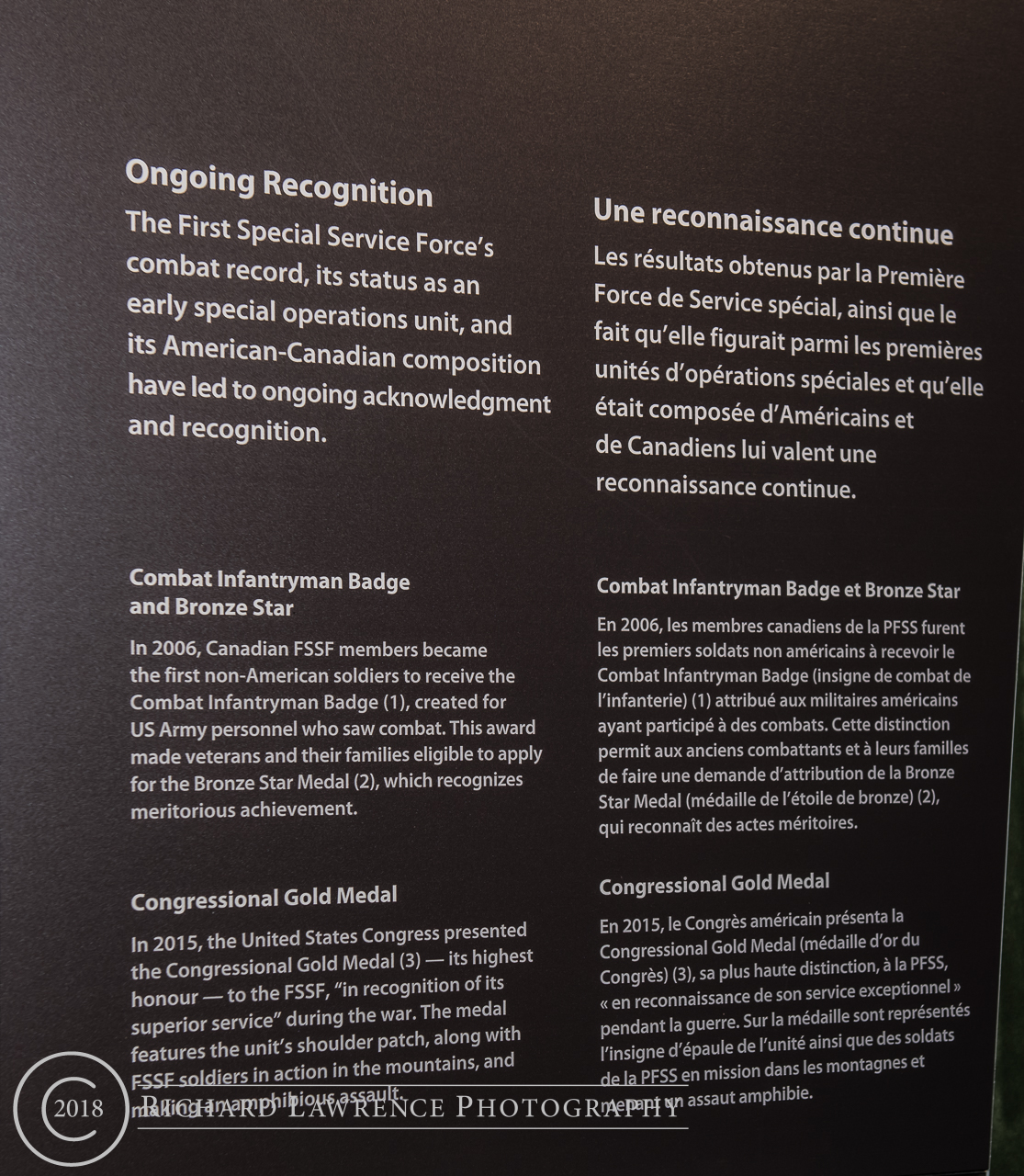
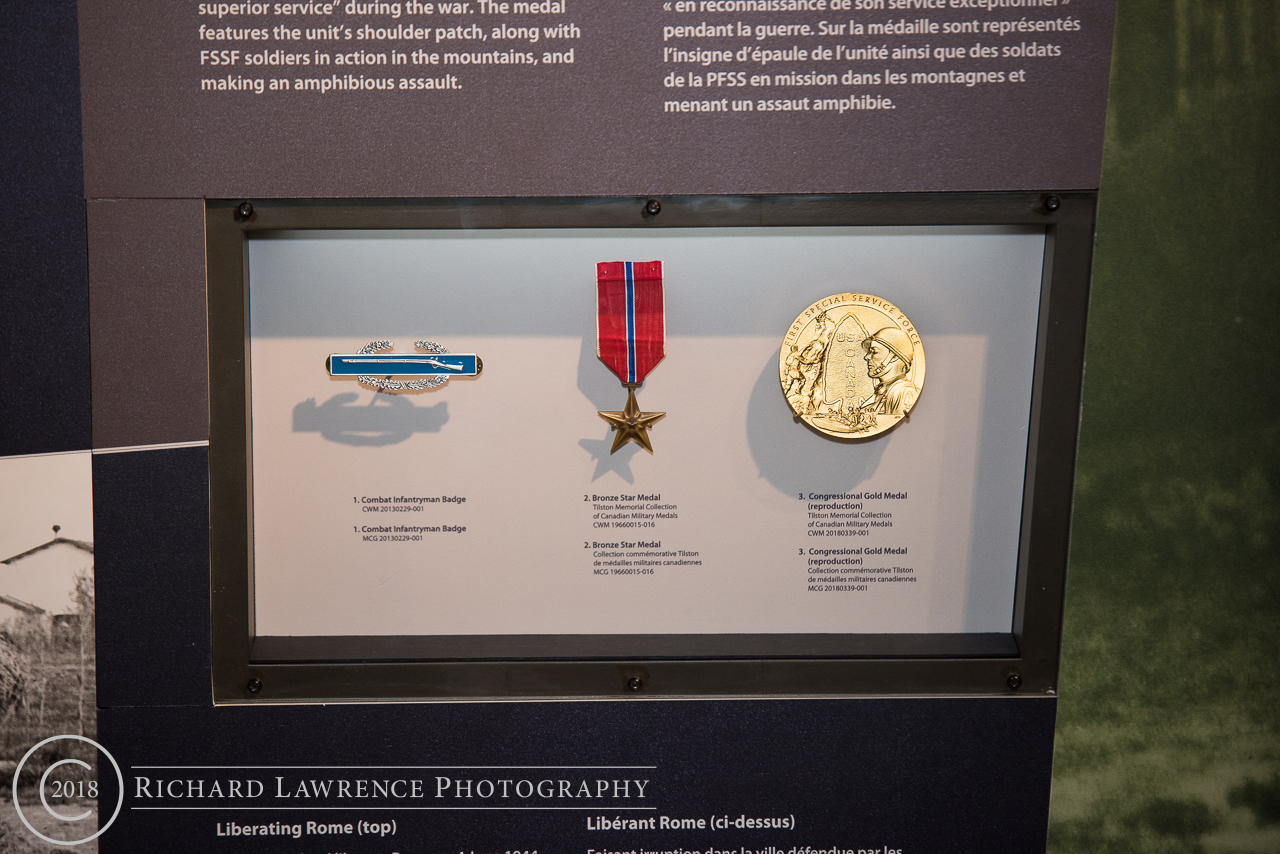
In 2015 the United States Congress passed a bill that conferred the Congressional Gold Medal, the highest award that can be given to civilians by Congress, to the First Special Service Force.  A single medal was awarded to the group and remains at Fort Bragg in the USA while bronze duplicates were allowed to be made for 16 surviving members of the Devil’s Brigade. Mr. Don Shelton, President of the First Special Service Force Association, donated a gold plated duplicate of the medal to the Canadian War Museum earlier this year.

As Col. Hunter, Director of Special Operations, noted, the FSSF was the foundation for contemporary special operations forces with the Canadian Special Operations Regiment (CSOR) tracing direct linage back as well as American special forces groups such as the Green Berets.  The US Special Forces representative noted that it normally takes decades for organizations to achieve such levels of competence and that the FSSF should “ … reach such a level of excellence in such a short time is nothing short of amazing.” 

The medal is on display in Gallery 3 (World War II) with the Devil’s Brigade display just after you pass under the Spitfire.


To see all the pictures go to:

http://www.richardlawrencephotography.ca/rlpgalleries/2018/fssf/

Kipnes Lantern and Edge of Peace

By RIchard Lawrence

Traditionally, remembrance ceremonies are traditional, predictable, and pretty much the same regardless of the group or organization putting it on.  This holds true from the small town ceremonies at the local cenotaph to the National Remembrance Ceremony held at the National War Museum in Ottawa.  This is why I was quite pleased to find two remembrances that have marched into the 21st century with the full use of multi-media: one from the Royal Canadian Legion and the other from Veterans Affairs Canada.

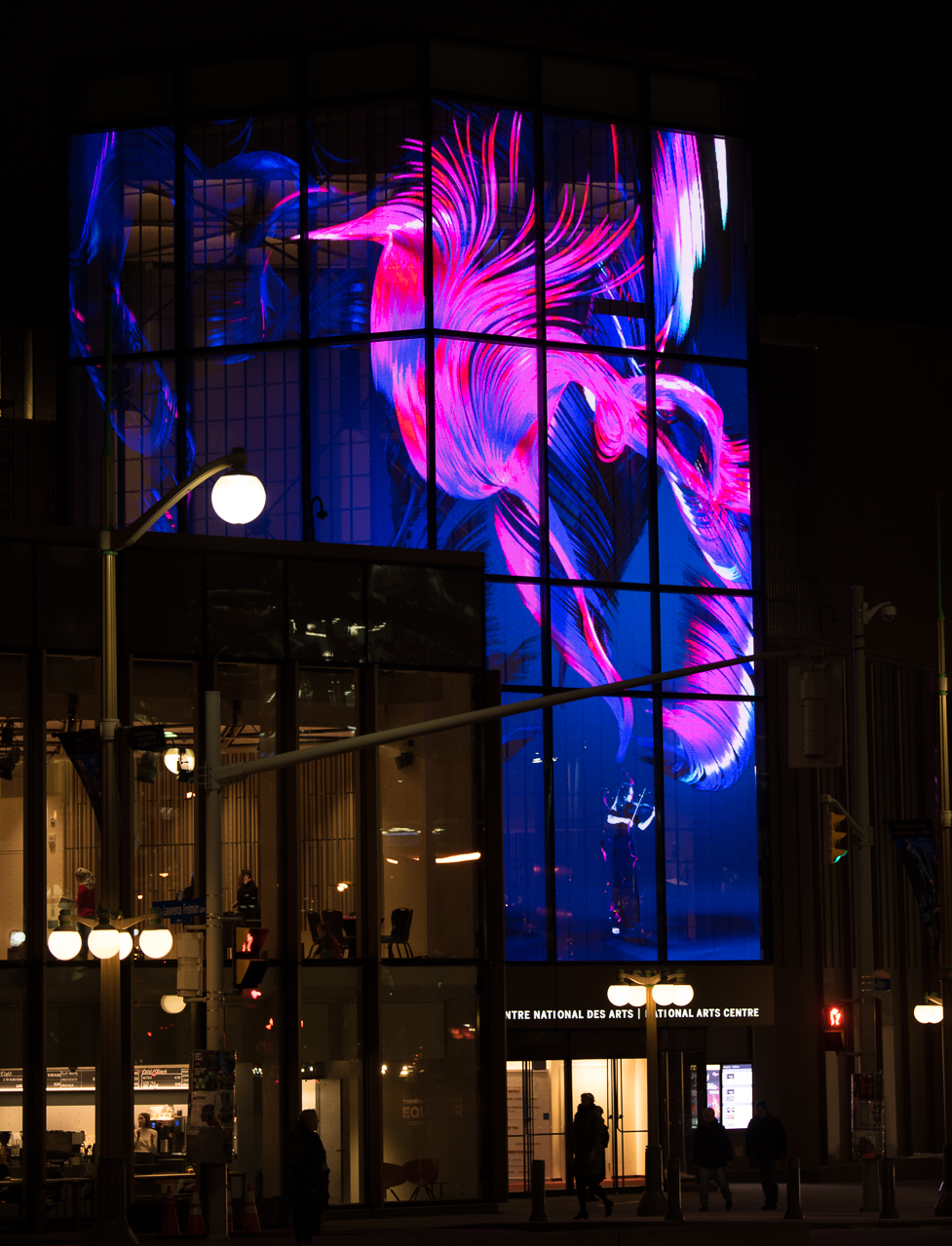
It is not a well-known fact that the Royal Canadian Legion (Legion) is the organization behind the National Remembrance Ceremony in Ottawa and not the government of Canada. It is steeped in tradition and reverence for those who sacrificed themselves for their country and it needs to be the pomp and ceremony that it is.  But this year, the Legion has added a new twist with a multi-media production hosted on the National Art Centre’s (NAC) Kipnes Lantern.

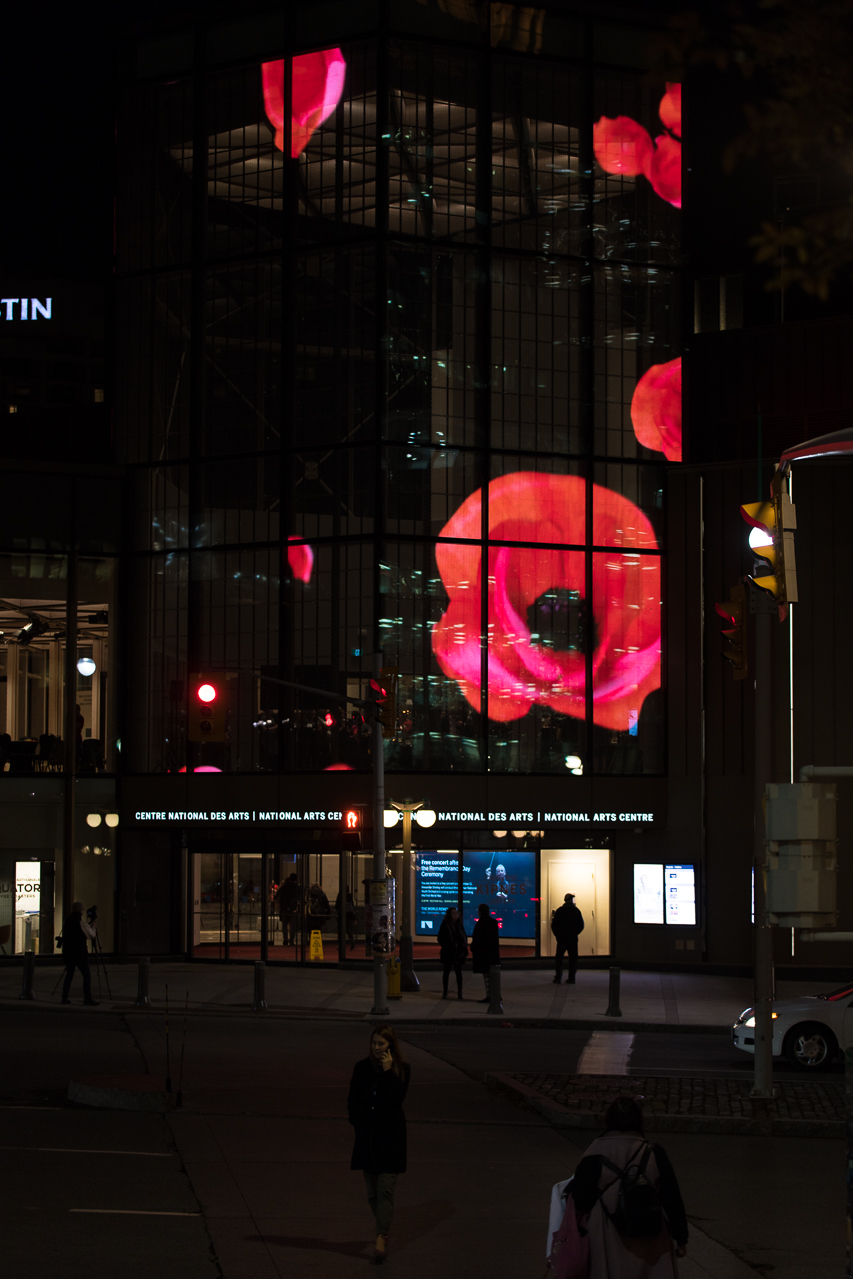
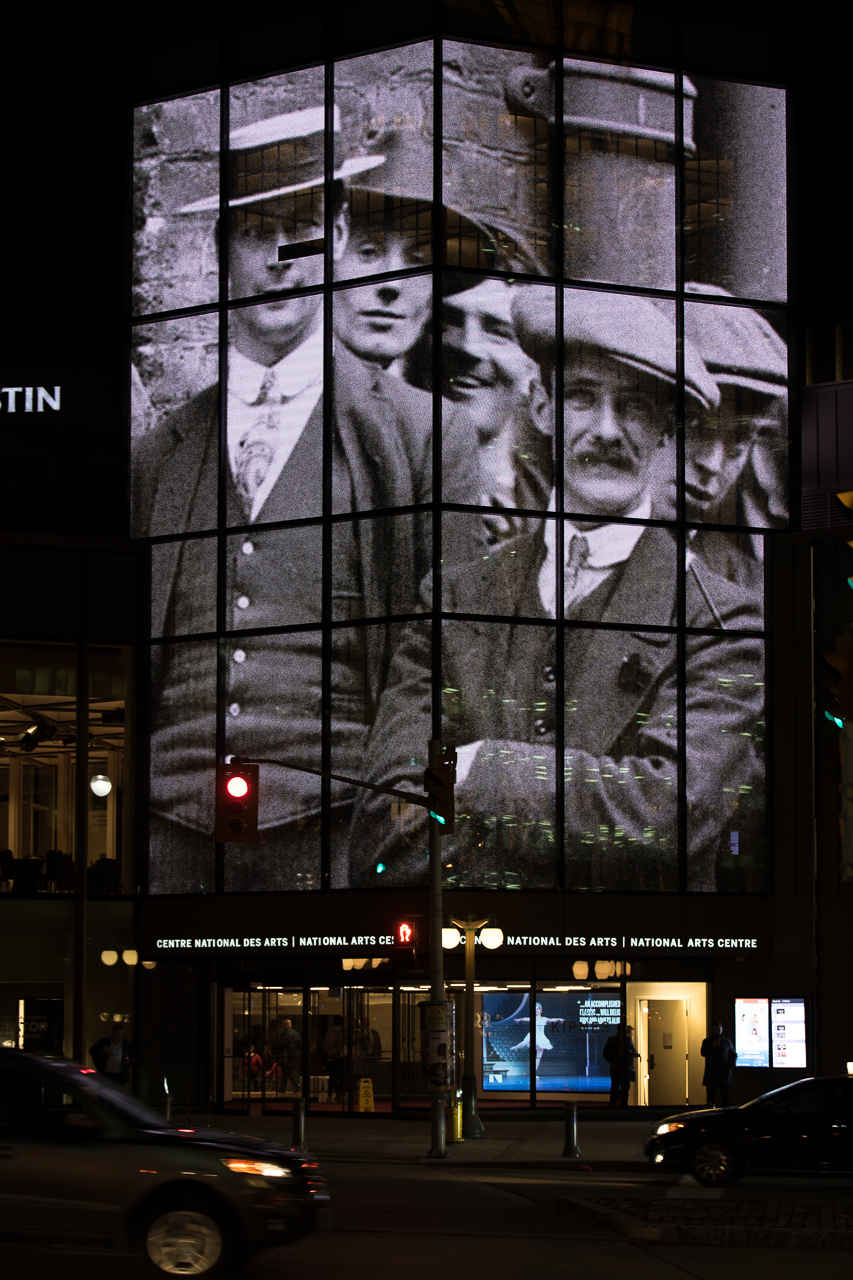
What is the Kipnes Lantern?  It’s the new all glass entranceway to the NAC that is listed as three stories tall but considering that each of those stories appears to almost double height, it actually towers about five stories into the night sky.  On four sides of this tower transparent LED panels have been installed which are practically invisible when it’s not in use.  When it is in use, it transforms the tower into a multi-sided, high-definition video wall and this is what the Legion has taken advantage of.   

Starting at 7 am on 11th November, the Kipness tower will light up and show images from WWI and then the famous “Poppy Drop” which is a cascade of poppies falling from sky to street.  Now, I’m sure this will be interesting during the day but I’d suggest going after sunset to really get a sense of what it is.  The Lantern is bright and colourful and showcases in a spectacular manner the images of soldiers and people left back home, surely visible for miles (albeit blocked by buildings downtown).  And there is some serenity in just watching the Poppy Drop portion of the production which will allow you to reflect on the day.  

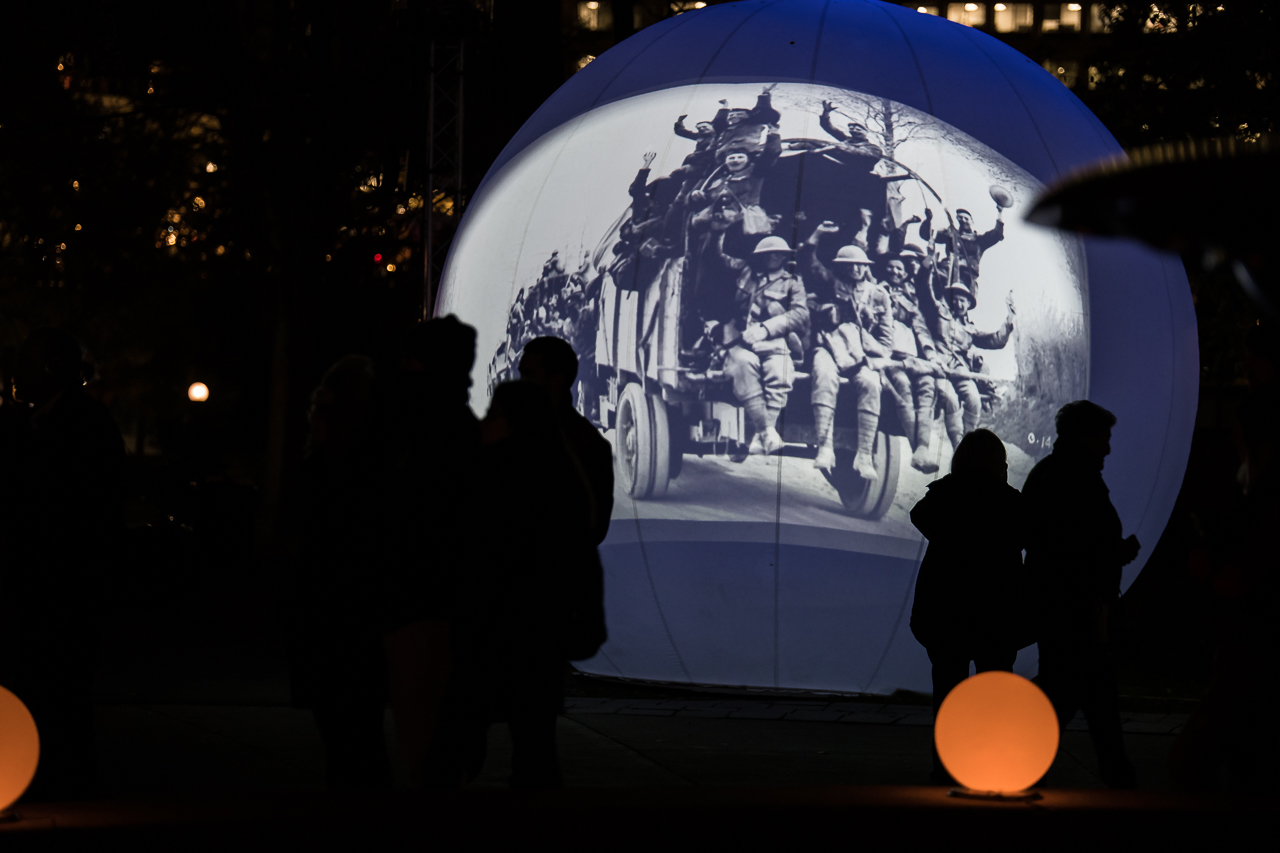
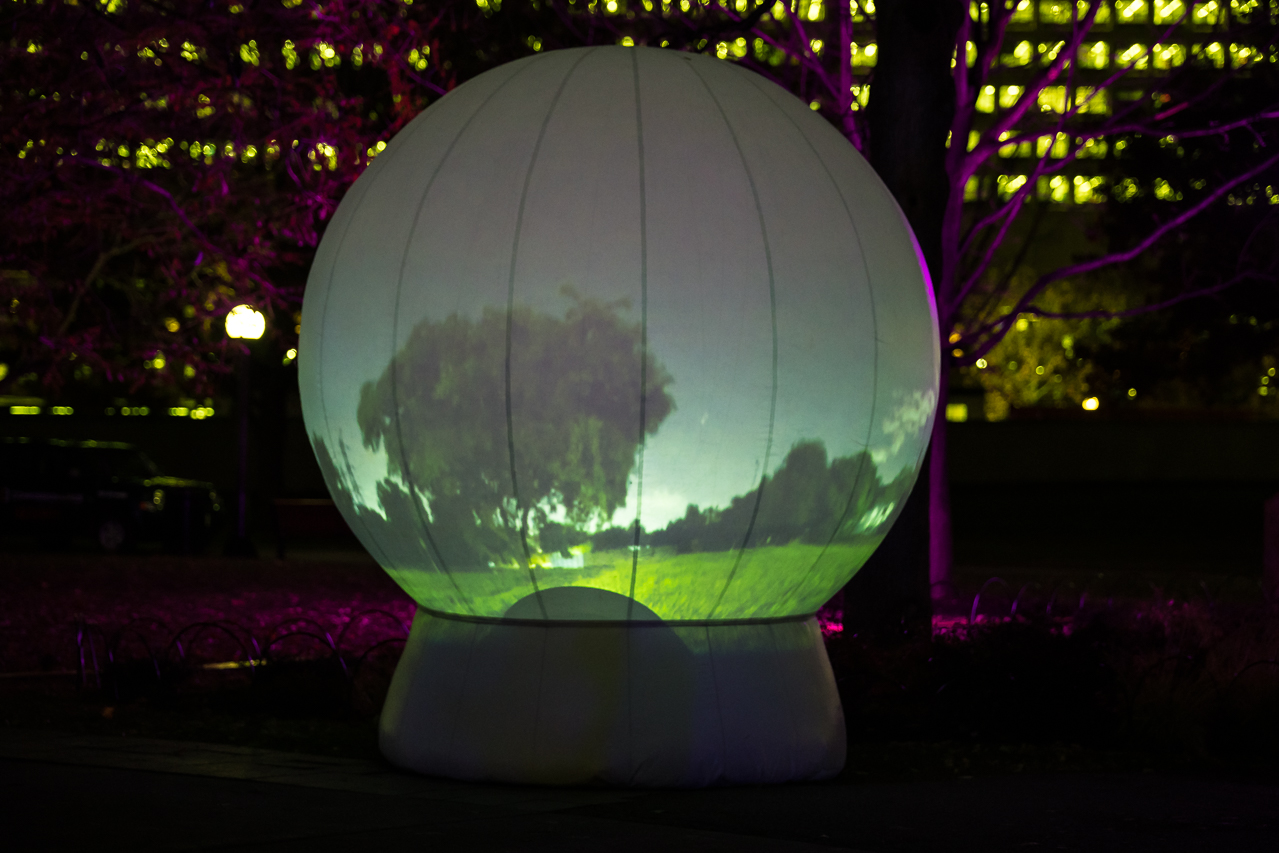
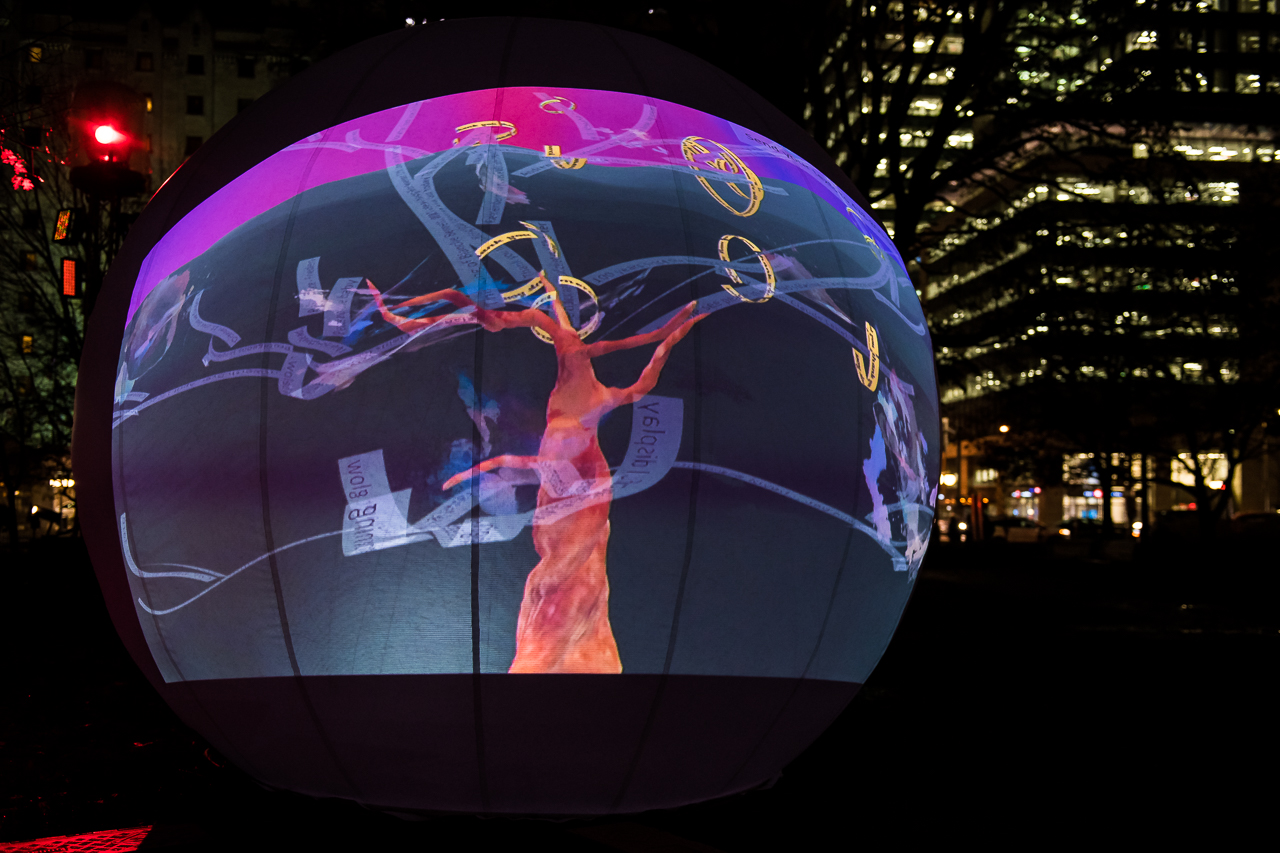
Not far away, in Confederation Park, Veterans Affairs has set up the “Moon Garden” which is a series of inflatable spheres showing a 14 minute multi-media production titled “the Edge of Peace”.  On the various spheres four WWI soldiers reflect on their service during the last 100 days of the war and a recently bereaved singer tries to find meaning and consolation by performing a new song.  There are also images from WWI projected onto the spheres and other bits of artwork.

As well, there is one sphere, the SpeakTree sphere, dedicated to showing messages from Canadians texted to a phone number and then redirected to this sphere in near-real time (all messages are vetted first).  The way this works is that a person texts a message to 438-800-0471 and then it appears on the sphere as branches on an ever growing 3D tree.

It’s good to see these organizations starting to think in the vernacular of youth and attempt to get the message out about Remembrance in a more modern manner, really attempting to engage a younger audience that historically are less interested in traditional remembrance ceremonies.  The Poppy Drop production from the Royal Canadian Legion starts at 7:00 am on the 11th November and will continue on a loop until midnight at the Kipnes Lantern entrance to the National Arts Centre on Elgin Street.  The Edge of Peace will continue to run daily in Confederation Park until the 11th November from about 4:30 pm to 10:30 pm.  They’re close together and neither runs very long so take them both in.


To see all the images, go to:

http://www.richardlawrencephotography.ca/rlpgalleries/2018/kipnes/

Candlelight Tribute

 By Richard Lawrence

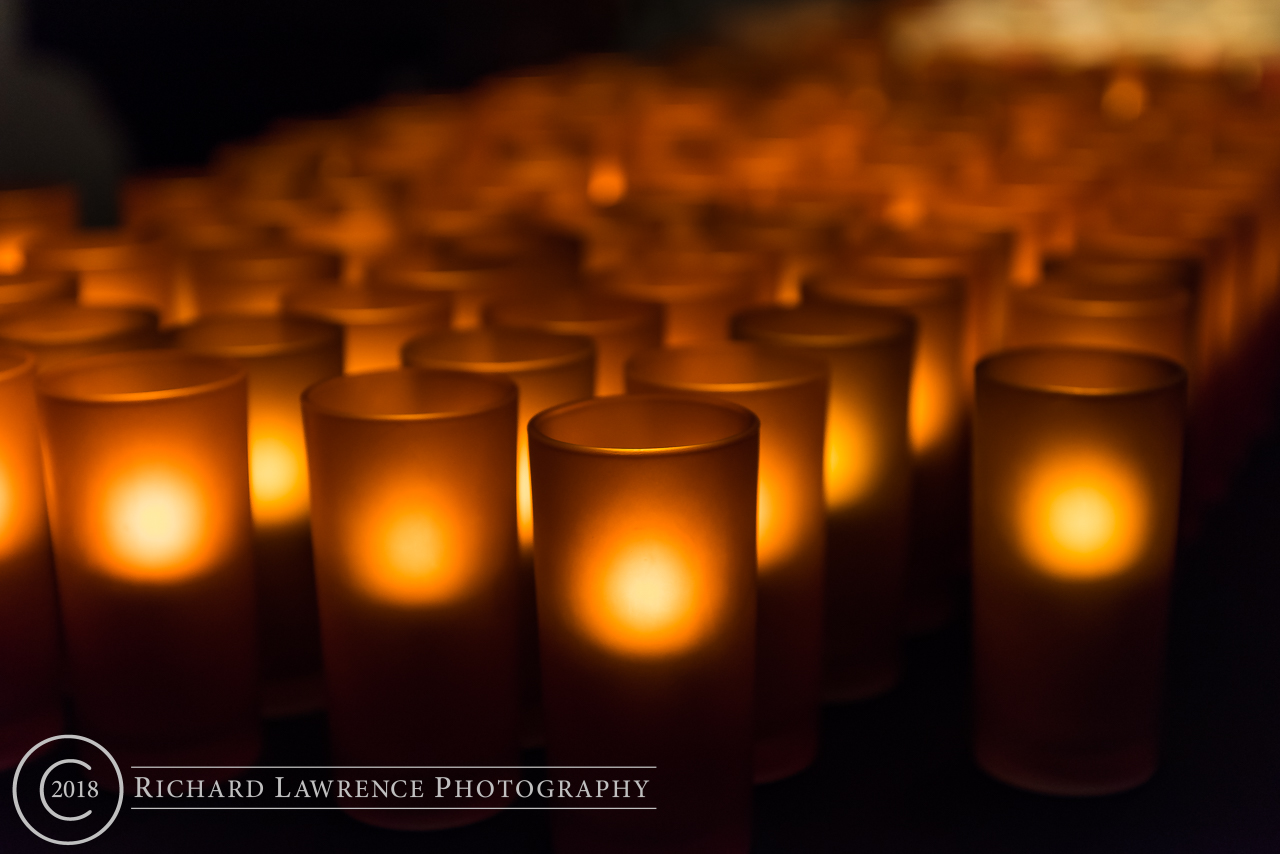
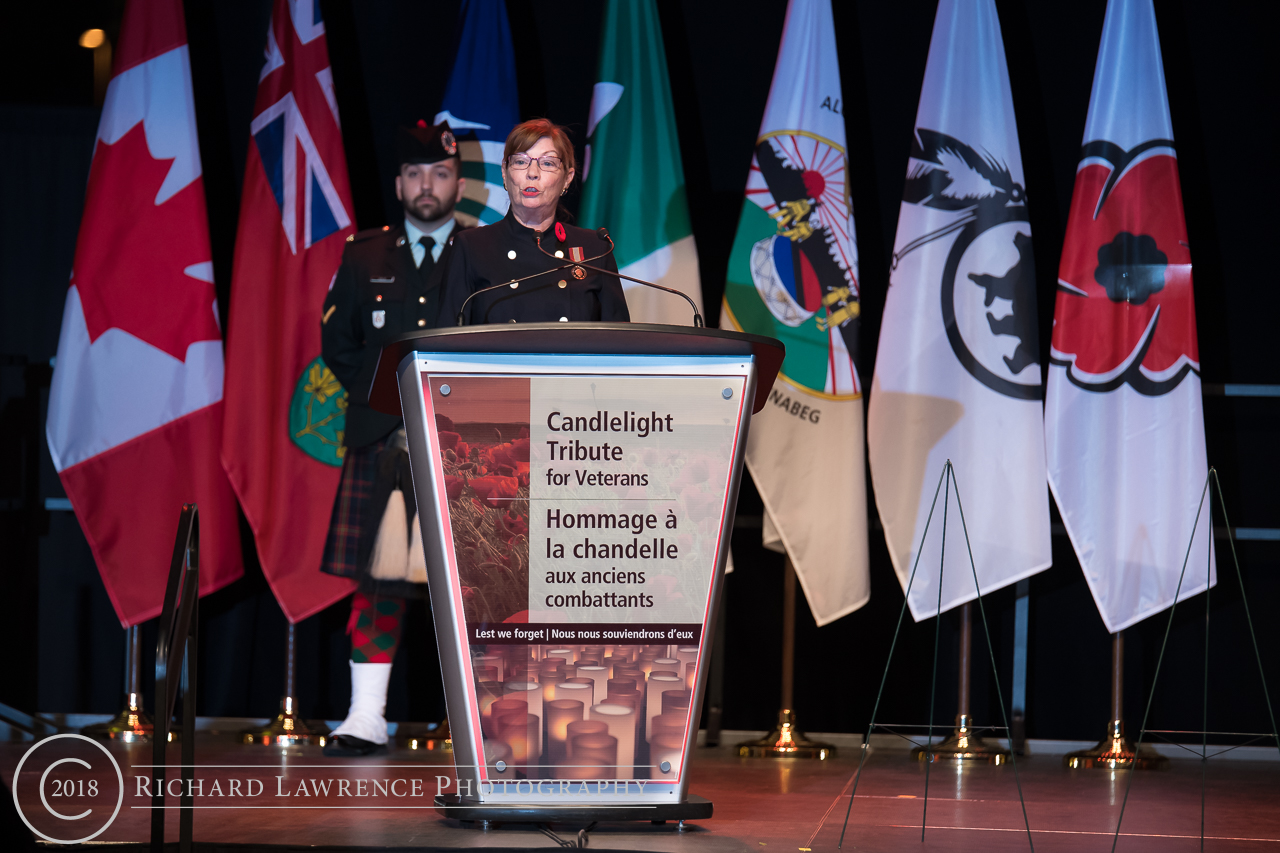
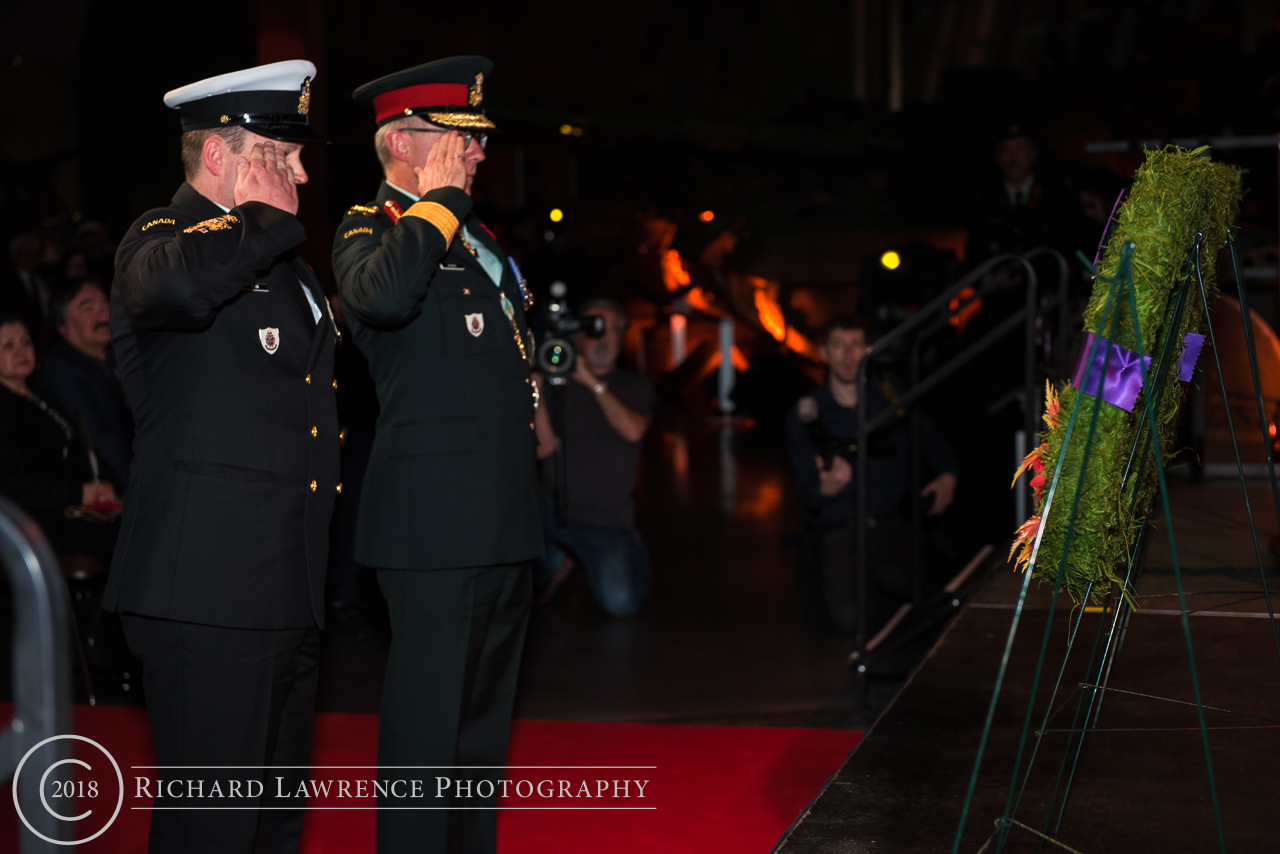
 The Candlelight Tribute for Veterans is a service marked by the passing of the torch from the veterans to the youth of Canada as a symbolic gesture and of the remembrance of the sacrifices of the elder generation for the younger. This is the 17th year for this event and was held at the Canadian War Museum on the evening of 5th November, 2018, to an almost packed Lebreton Gallery. The official party included the Honourable Seamus O’Regan, Minister of Veterans Affairs, His Worship Jim Watson, Mayor of Ottawa, Lieutenant-General Paul Wynnyk, Vice-Chief of the Defence Staff, Mr. Mark O’Neill, President and CEO of the Canadian War Museum, as well as representatives from the various cadet corps and the youth of Canada.

The ceremony started with an indigenous blessing from Elder Claudette Commanda after which the wreaths were laid by the official party. Following this the cadets and youth of Canada passed down between the rows of veterans who passed their candles to the cadets to be placed amongst the wreaths. Remarks were then made by Mr. O’Neill and LGen Wynnyk after which the Act of Remembrance was spoken by veterans and the reply given by the cadet representatives

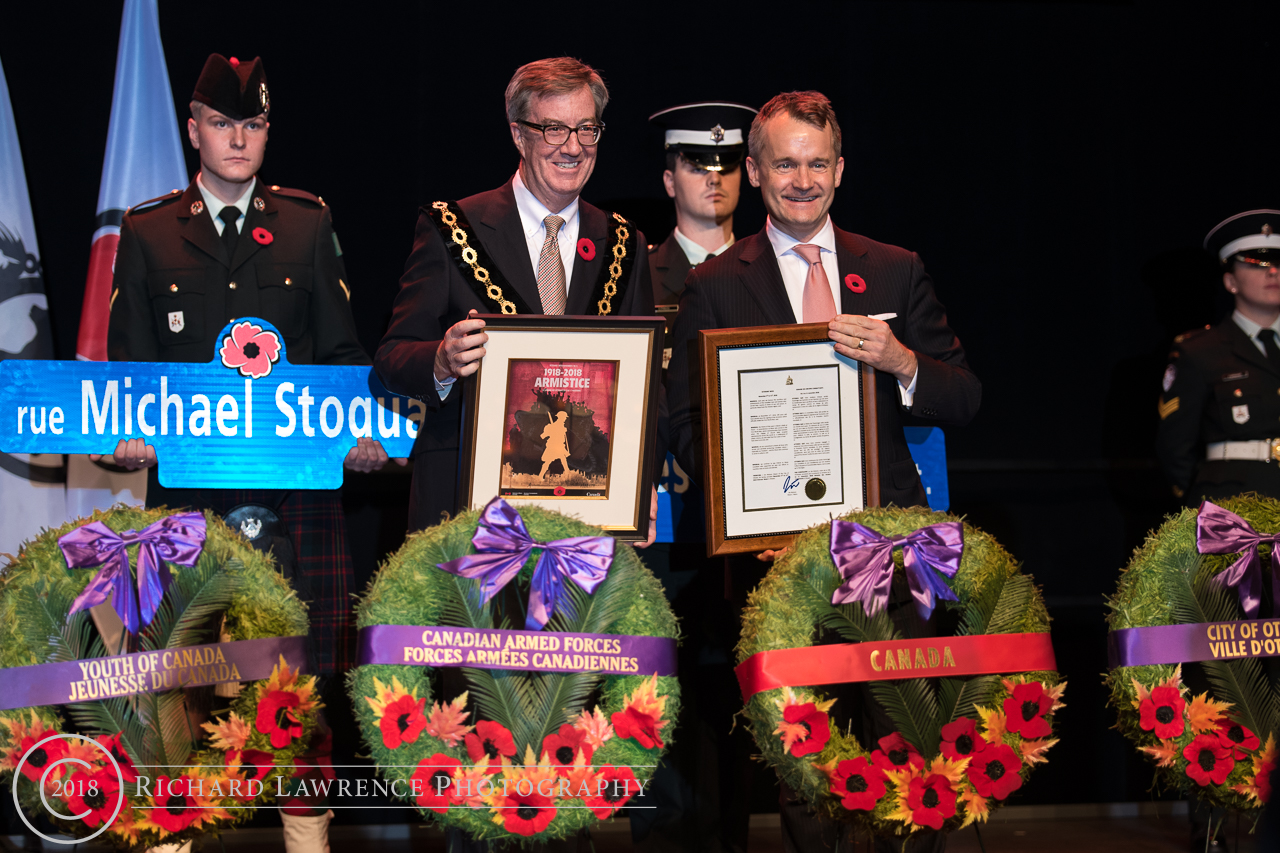
The one thing that sets this ceremony apart from all others is the City of Ottawa’s Veterans’ Commemorative Street Naming Program which serves to honour local Canadian veterans by naming streets in new developments after them. This program is run in co-operation with the City of Ottawa, the Royal Canadian Legion, Veterans Affairs, and developers within the city. The street signs bear the name of the person being honoured as well as a poppy.

This year Mayor Watson announced two local indigenous individuals, killed in WWI, who were so honoured this year: Private (Pvt) Michael Stoquo and Private Moses Tennisco, both of the Golden Lake Band, Algonquins of Pikwàkanagàn First Nation, Ontario. Pvt Stoquo joined the Canadian Expeditionary Force at the age of 22 and succumbed to his wounds on 15 April, 1917, in a hospital in Boulogne, France. Pvt Tennisco died in action on 27 June, 1917, and rests in the Brookwood Military Cemetery, Surrey, England. The streets bearing these two names will be in Wateridge Village on what used to be CFB Rockcliffe.

The honour of receiving the street signs, which usually goes to surviving family, was given to Chief Kirby Whiteduck, Chief of the Algonquins of Pikwàkanagàn. In his address he noted some the history of the Algonquins fighting for Canada, even though, he noted, in the War of 1812, they fought on the other side. In commenting on the recognition of indigenous soldiers, he said, “It’s very positive now that the Aboriginal and First Nations veterans are also being recognized for their contributions to what we have today and continue to have.”

Following the remarks of the Honourable Seamus O’Regan, and music from the Governor General’s Foot Guards Band, the ceremony concluded and guests were invited to a reception in the main hall of the Museum.

To see all the images, go to:

http://www.richardlawrencephotography.ca/rlpgalleries/2018/candlelight2018/

Imjin River Hockey Classic

 By Richard Lawrence

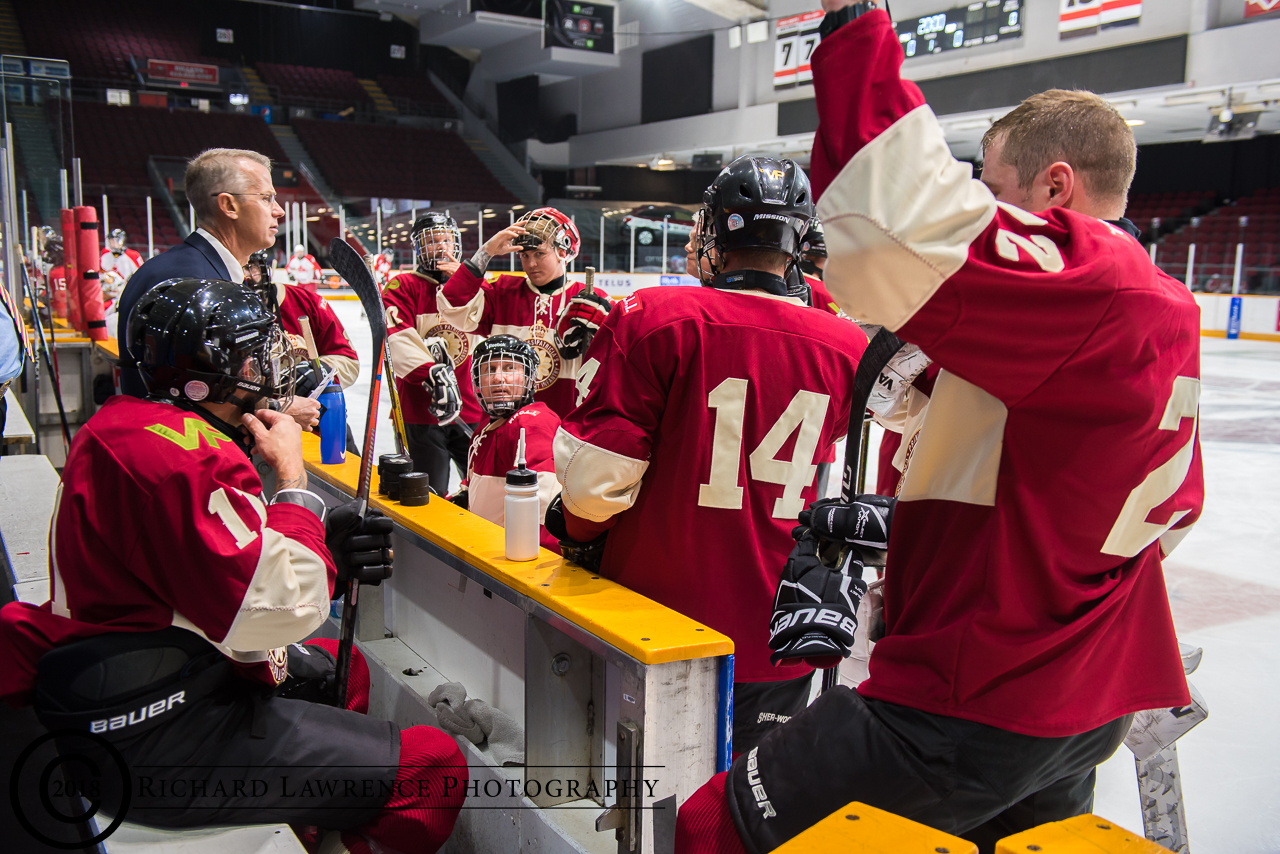
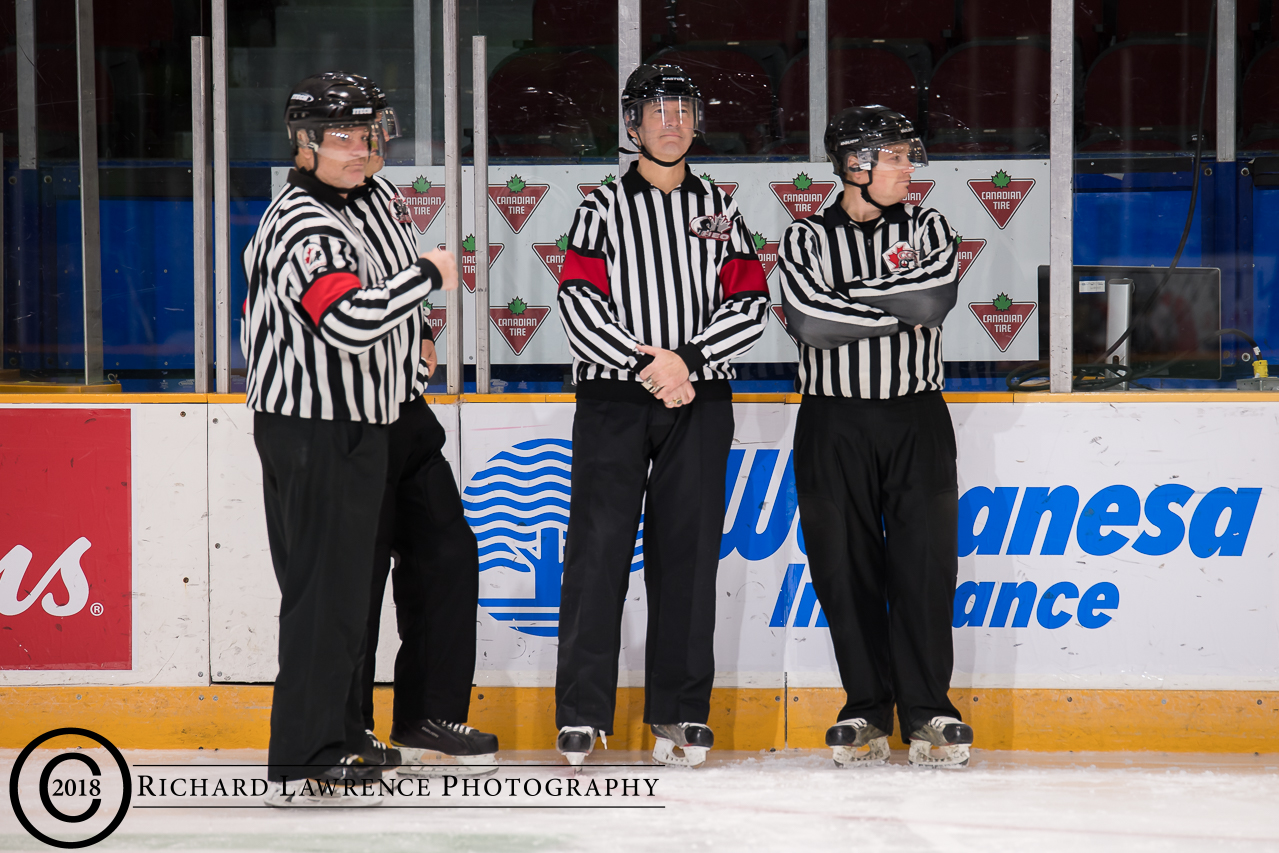
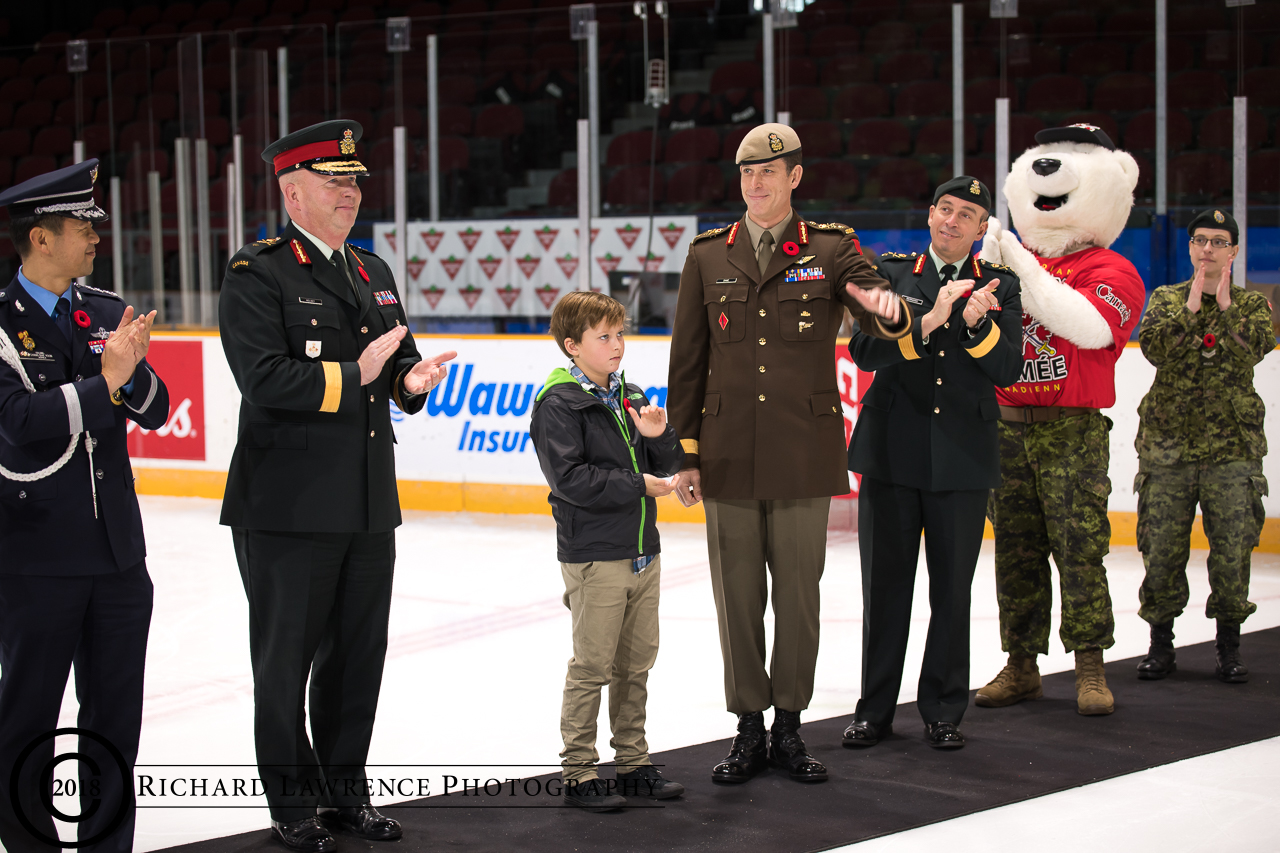
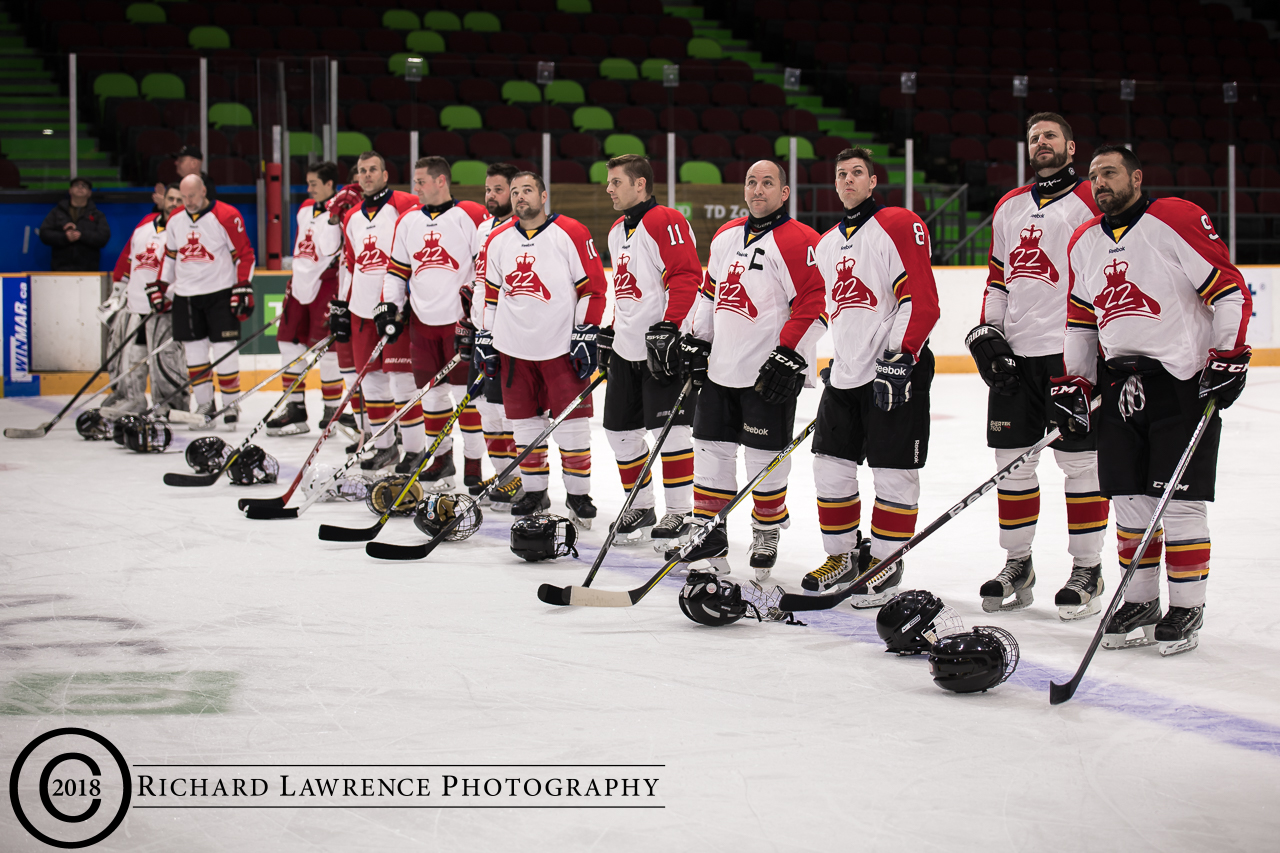
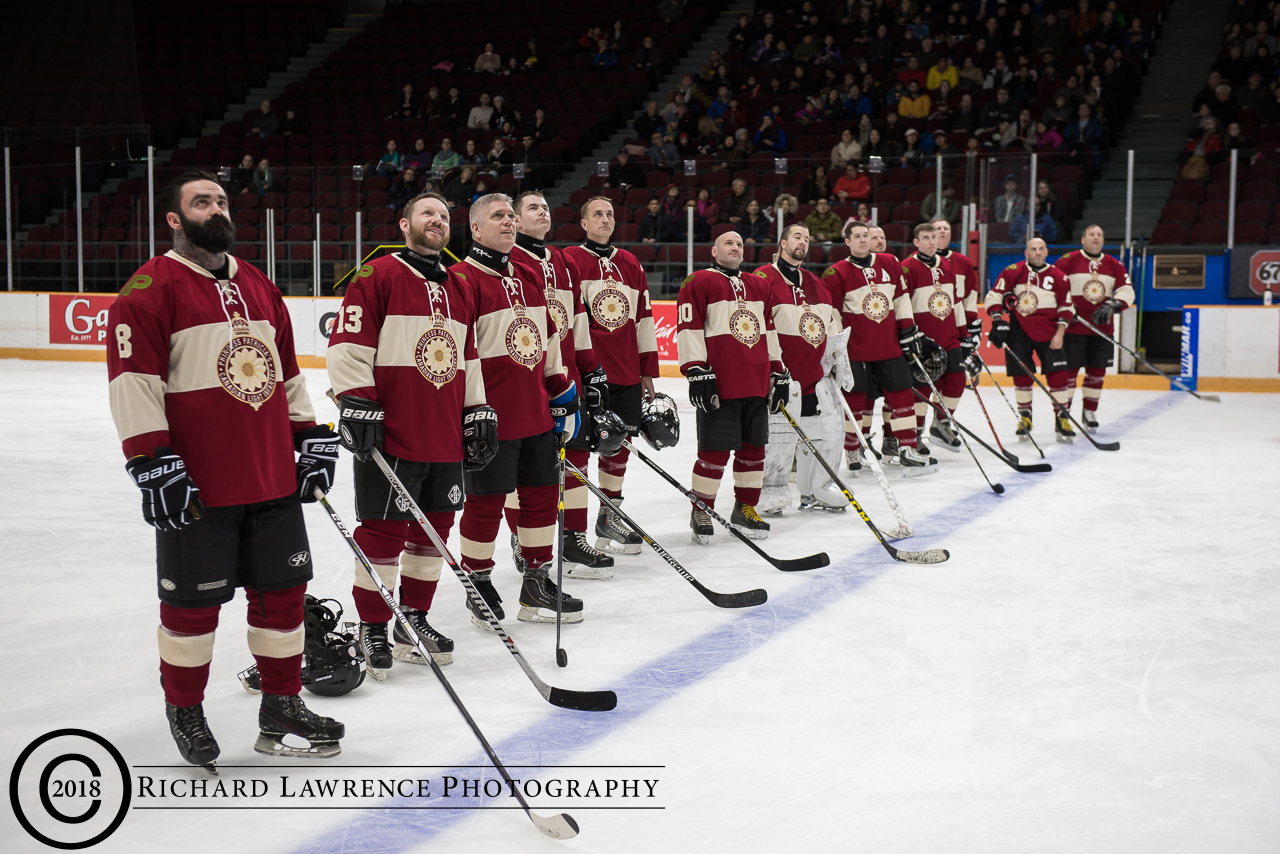
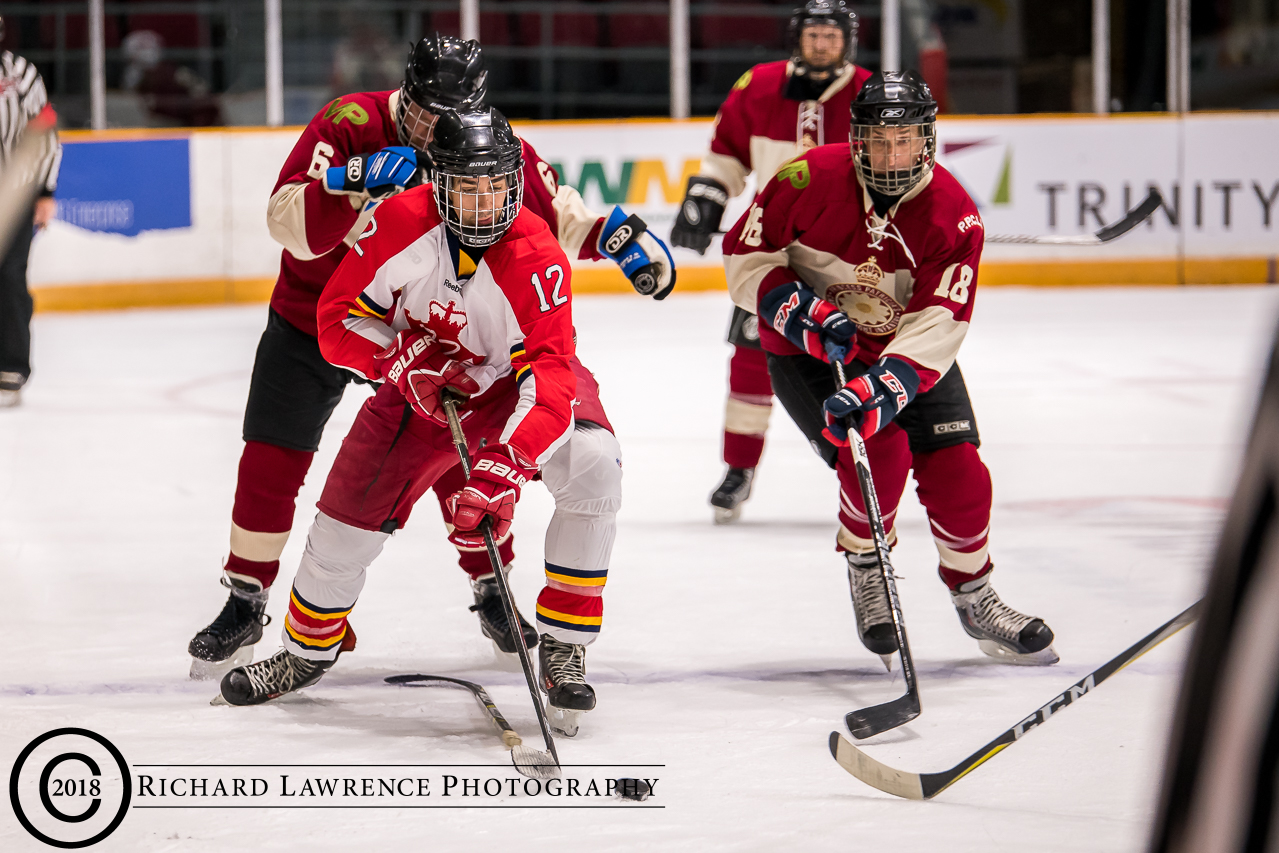
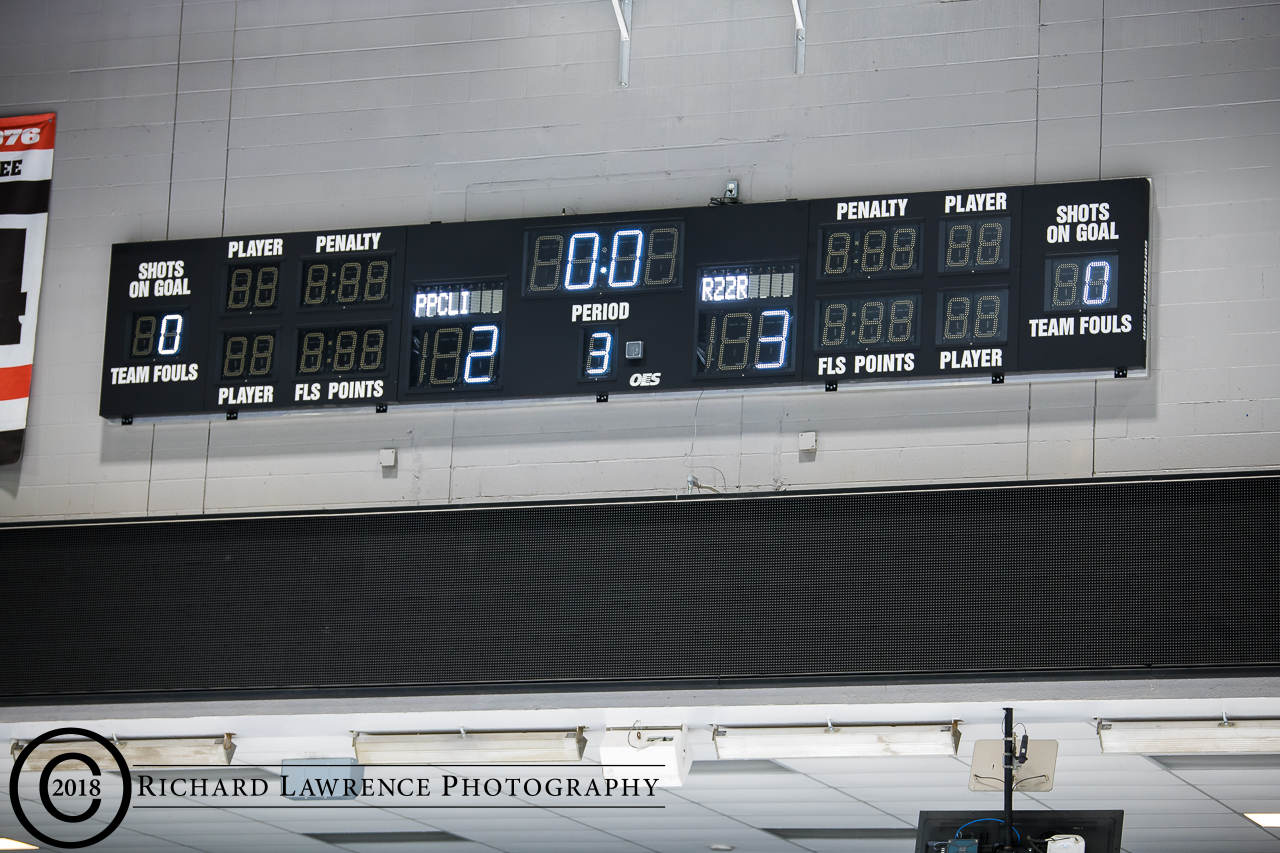
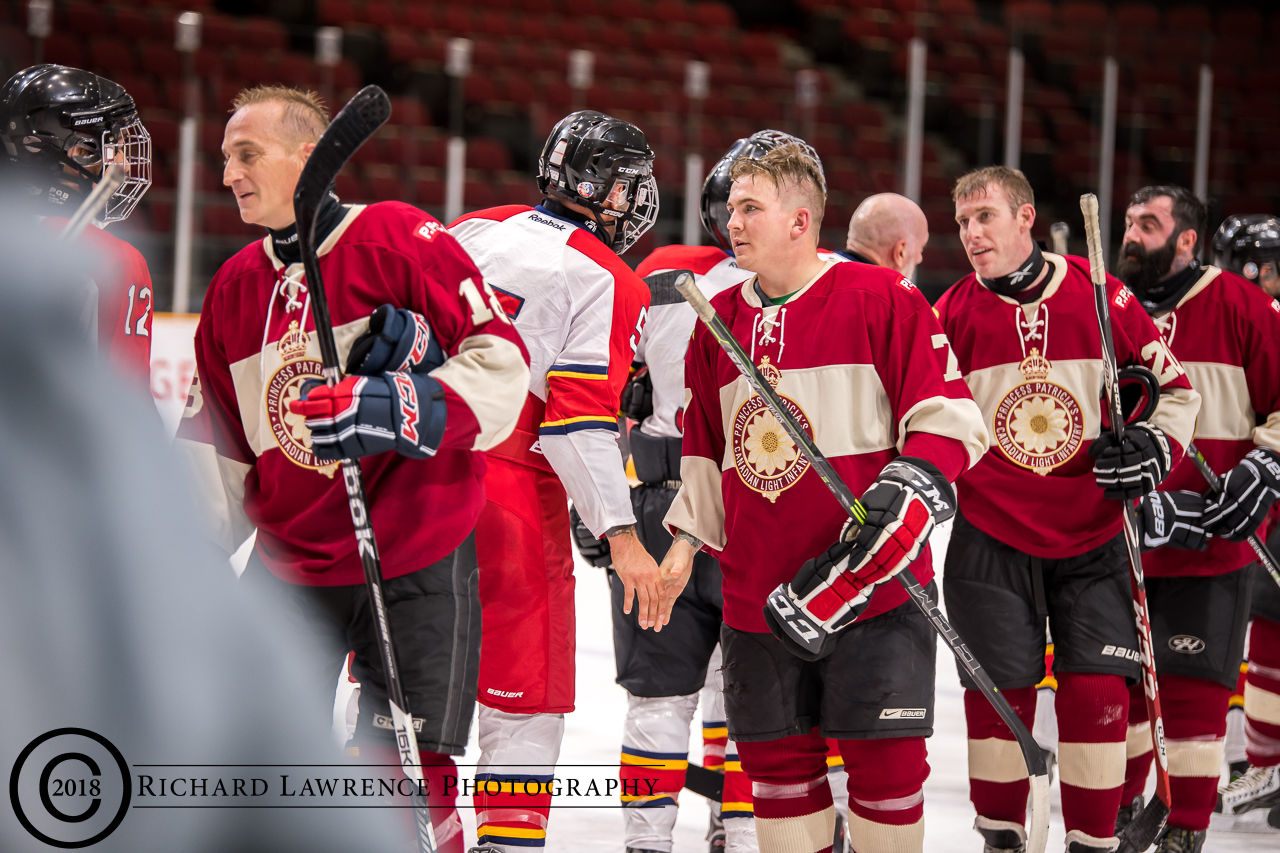
 Once again the Princess Patricia’s Canadian Light Infantry (PPCLI) suited up to play hockey against the Royal 22e Régiment (R22eR) in the annual Imjin Classic Hockey match. This match is sponsored by the Embassy of the Republic of Korea in Canada and commemorates the original Imjin Hockey game played on the Imjin River in Korea in 1952 by the R22eR and the PPCLI. This year the game took place on the 3rd November, 2018, at the TD Place arena, home of the Ottawa 67s hockey team, and turned out to be a classic battle. Both teams came ready to play and did not disappoint the crowd.

The skating was fast and the puck handling crisp as the teams traded ends for the first half of the first period. The stalemate was broken when the R22eR scored the first goal at 10:52 of the first but they didn’t hold the lead long as the PPCLI answered with a goal of their own at 8:08. The second period was just all out skating with both teams holding the other at bay. It wasn’t until 16:44 in the third period that the PPCLI pocketed their second goal and took the lead. Undeterred the R22eR came back at 7:22 to tie it up again and finally went ahead at 4:21 with their third goal. With a minute and a half to go, the PPCLI pulled their goalie to get the extra attacker but it was to no avail as time ran out giving the R22eR the match 3-2.

At the reception that followed, the Ambassador of the Republic of Korea to Canada, Shin Maeng-ho, stated that, “It is my sincere hope that the Imjin Hockey Classic will continue as an annual tradition. Each year we will come together like we did today not only to celebrate the strong alliance between Korea and Canada but also to remember the enduring legacy of the Korean veterans who brought freedom and democracy, and hockey, to the people of Korea.” He also added that, “It is my dream that in the near future the Korean Hockey team will become the 2nd best hockey team in the world.”

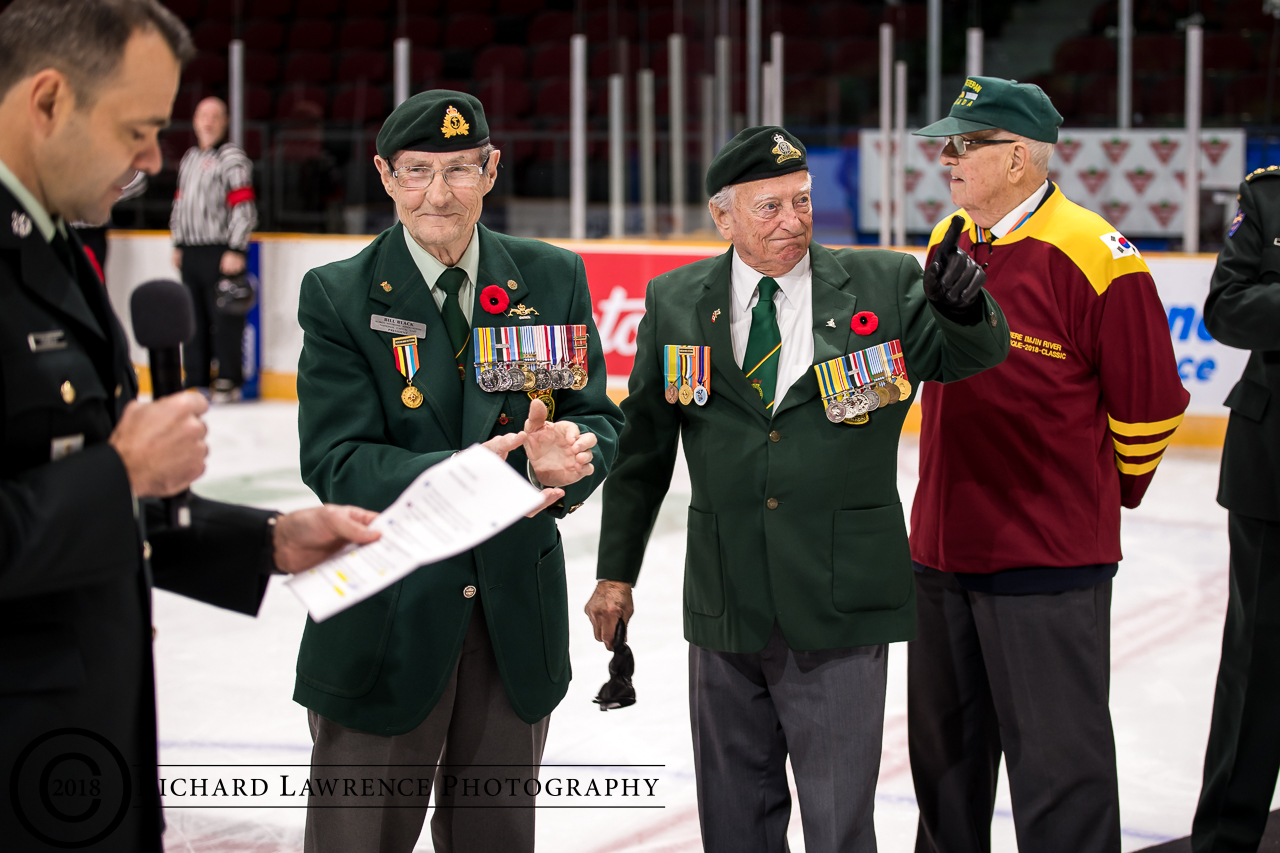
Other remarks were presented by Colonel Evraire on behalf of the R22eR and by Major-General Peter Dawe, Commander of the Canadian Special Operations Forces Command, on behalf of the PPCLI. The most interesting remarks were presented by Mr. Bill Black of the Korean Veterans Association, Chapter 7, who took the time to bring up three Korean veterans who actually played in the original hockey game on the Imjin River in Korea in 1952. Mr. Peter Dillon (taking a face-off) and Mr. Denis Moore were each given large pictures showing them playing hockey in Korea in 1952 and Mr. Claude Charland, although he played, managed to do so without getting a picture taken.

Further to that, Mr. Black introduced Mr. Delphis Cormier, at the time a Corporal in the R22eR platoon led by then Lieutenant Claude Charland. He recounted the story about how Lt. Charland’s platoon was returning from a patrol one night when they were ambushed by the Chinese and 17 year old Cpl. Cormier (he lied about his age to get in) saved the platoon and was awarded the Military Medal by Queen Elizabeth II in 1953 for his actions that night. Or as Mr. Black so eloquently put it, “He saved their asses!”.

With the official remarks concluded, the Korean War Veterans grouped together with members of both hockey teams from CF Recruit and Leadership School in St. Jean, Quebec, for pictures and then returned to the reception.

To see all the images, go to: http://www.richardlawrencephotography.ca/rlpgalleries/2018/imjin2018/

Senate Remembrance Ceremony

 By RIchard Lawrence

 Friday, 2nd November, marked the start of the Remembrance Week with the annual remembrance ceremony held in the Senate Chambers in the Parliament Buildings. This year’s theme is the 100th anniversary of the signing of the armistice ending the Great War and the last 100 days from 8th August to 11th November, 1918, where 30 Canadians and Newfoundlanders were awarded Victoria Crosses, accounting for nearly one third of all the Victoria Crosses awarded to Canadians in our entire military history.

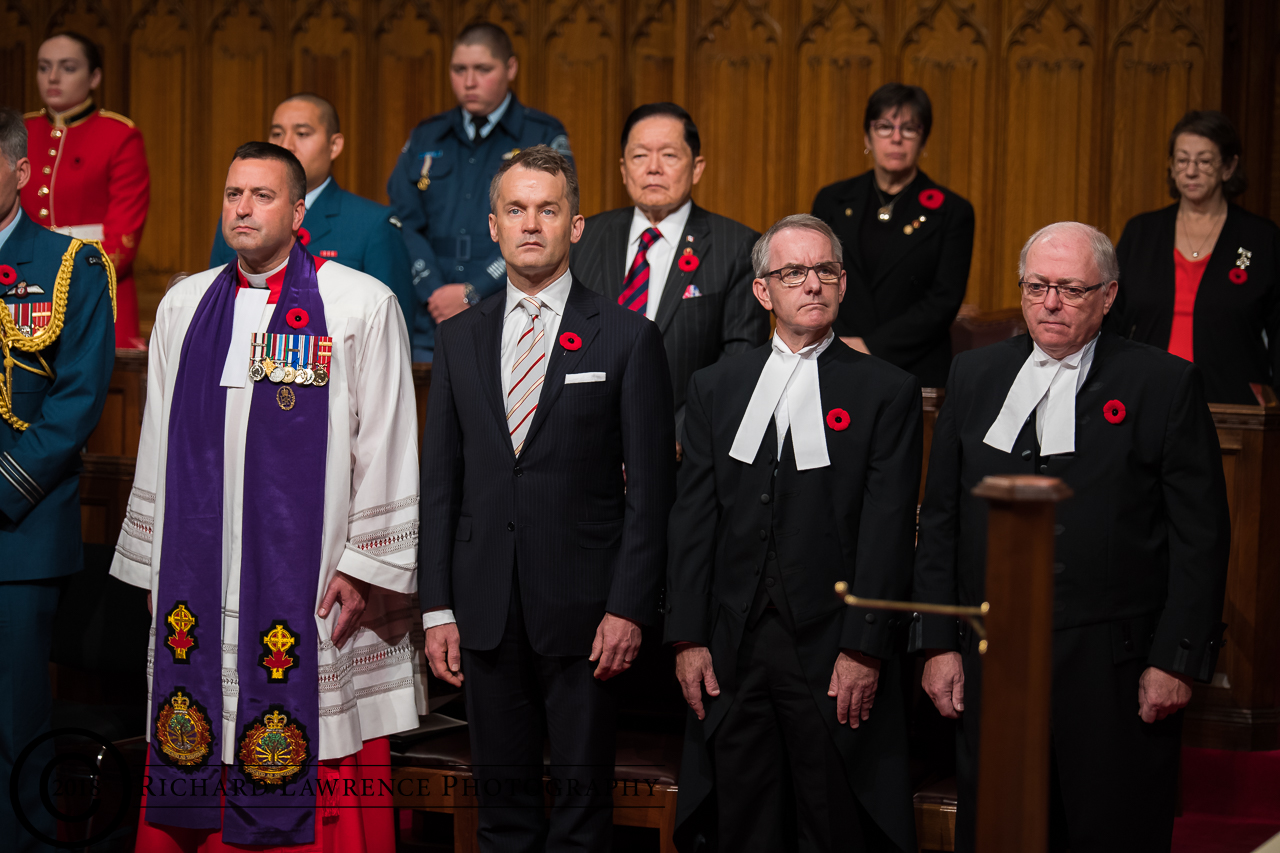
This ceremony is attended by representatives of many of the veterans’ organizations, some members of both the Senate and House of Commons, selected individual veterans, senior military representatives, and many others involved with veterans affairs. Of note was Deputy Minister of Veterans Affairs, Mr. Walt Natynczuk, Mr. Thomas Irvine, Dominion President of the Royal Canadian Legion, Lieutenant-General Paul Wynnyk, Vice-Chief of Defence Staff of the Canadian Armed Forces along with representatives from veterans organizations, the Royal Military College, the RCMP, and other police forces. The official party was comprised of the Speaker of the Senate, the Honourable George Furey, the Deputy Speaker of the House of Commons, Mr. Bruce Stanton (MP Simcoe-North), the Minister of Veterans Affairs, The Honourable Seamus O’Regan, and the Chaplain-General of the Canadian Armed Forces, Brigadier-General Guy Chapdelaine.

All of the speakers carried a similar theme in that they emphasized the tremendous sacrifices during World War I with special prominence given to the last 100 days where Newfoundland soldiers and the Canadian Corps suffered over 45,000 killed and wounded and for which 30 Victoria Crosses were awarded. They also made mention of the 75th anniversary of the invasion of Sicily and the 300 kilometre march up Italy during which there were over 26,000 casualties, 6,000 fatal. As well, the audience was reminded of the 65th anniversary of the Korean Armistice, and the 10th anniversary of National Peacekeepers Day and the work done by the Armed Forces and Police Services in more modern conflicts and continuing peacekeeping missions.

They also reflected on the memorials right in the Center Block, starting with the Peace Tower, which is a monument to the soldiers of World War I and where construction was started even as the war raged on. Minister O’Regan stated that the Peace Tower Bells will ring 100 times at sunset on the 11th November to mark the 100th anniversary of the signing of the armistice.

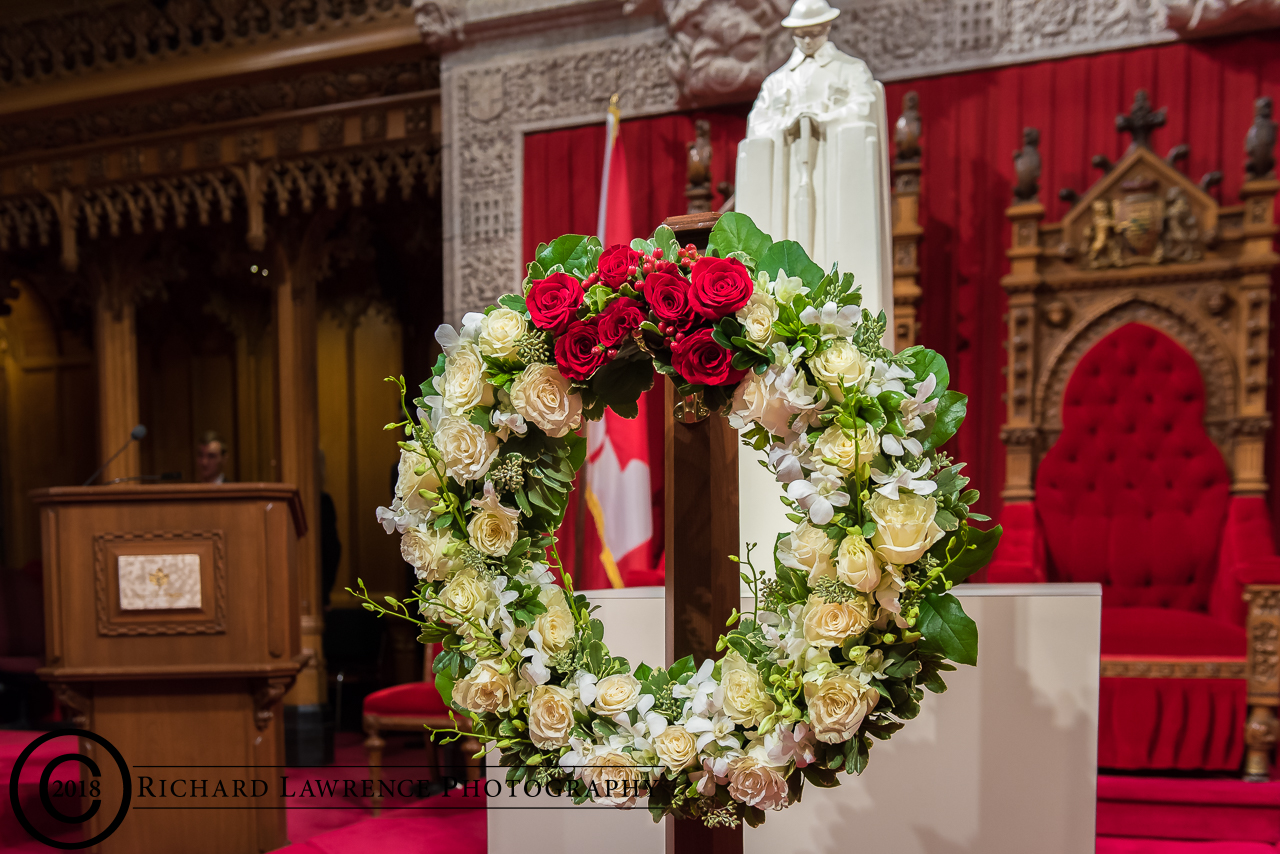
Other reminders included the sacred memorial chapel and the Hall of Honour. Even in the Senate Chamber there are eight huge paintings, commissioned by Lord Beaverbrook and hanging high on the walls since 1921, depicting scenes from WWI showing the brutality, hardships, and the ravages of armed conflict. As noted by Speaker Furey, these memorials remind us that, “So many fought and so many died so that we could do this here in an open, free, and democratic society. Indeed the contributions of Canadians in uniform, not only to this nation’s defence, but to its foundation and identity cannot be overstated.”.

This will be the last ceremony held in the Senate Chambers in the Center Block of the Parliament Buildings as the chamber will be closed down for ten years as the Center Block undergoes renovations (maybe longer as it is a government project). The Senate will be moving to the newly renovated Government Conference Centre in the new year and hopefully this traditional kick-off to Remembrance Week will continue in the new venue.

To see all the images, go to:

http://www.richardlawrencephotography.ca/rlpgalleries/2018/senate/

Veteran Build Day - Habitat for Humanity

By Richard Lawrence

Everyone has heard of Habitat for Humanity (HfH) and at some level is aware of the good works they do in trying to provide home ownership for people by building homes through the use of volunteer labour, donated materials, their ReStore outlet, and financial donations. But one aspect that is not well known is that Canadian Armed Forces (CAF) members, both active and retired, participate in helping to build these homes and so much so that Habitat for Humanity acknowledges it with an annual Veteran Build Day (VBD). Today was the second annual Veteran Build Day in Ottawa with over a dozen active and retired CAF members participating at the Jean D’Arc Blvd., Orleans, location with the Habitat for Humanity Greater Ottawa (HfH-GO) organization. This site has four completed units with families already in them, four currently being built, and another eight on the drawing board when the current four are finished.

Now, one may ask how does one get a home from HfH? It’s not free and it’s not social housing so what is it? As Alexis Ashworth, CEO of HfH-GO, stated, “ [It’s a] bridge between social housing and market housing …”, where HfH helps people get that extra little step to home ownership. As explained by Gavin Liddy, a Director on the Board of HfH and also a CAF veteran in the artillery for 21 years, there is a specific audience that HfH is looking for to qualify for these homes which are people who have jobs, pay rent, and are financially making ends meet, but can’t get ahead enough to put together a down payment for a home or may not qualify for a conventional mortgage because the interest payments put it out of reach. Essentially they are looking for people with a solid financial foundation but still not able to get ahead.

As explained by Liddy, the HfH acts as a developer and builds the new home. They then take a qualifying family and provide an interest free mortgage where HfH becomes the mortgage holder and the family pays the mortgage. Every cent of the mortgage payment goes to the principle of the interest free loan which, without the extra cost of interest, makes the home affordable and builds equity quickly. The homes are sold at market value with the title going to the families as soon as they move in and the money that is paid back to HfH goes 100% back into the pot for the next build. As with any mortgage, once it’s paid off, the family owns the home outright.

Liddy also noted that it’s not just about owning a home. He said, “… [it’s] great for families as often they’re paying rent in areas that aren’t as nice to live in. It helps them develop a sense of community and become part of the community, it’s generally a safer environment for their kids, so it’s more than just an interest free mortgage, it’s also about making a transition to generally a better neighbourhood.”

To highlight the participation of veterans and CAF members in providing this housing was the purpose of today’s event. Several local politicians dropped by to offer thanks, including Orleans MP Andrew Leslie, who actually picked up some tools and helped out but had to leave before the photo-ops (I believe a vote was called in Parliament).

Newly elected city councillor and veteran Matthew Luloff stopped by to offer his support and congratulations noting that, “A lot of people think that Remembrance Day is the only time of year where we celebrate our veterans but our veterans are in our communities every single day making life better for people either through their service in the military or through this kind of volunteer work … I know that a lot of veterans, after their service, look for ways to serve their community.”.

Ottawa Mayor, Jim Watson, also toured the site and was here a year ago when the first four units opened. “One of the great things about HfH is that it really is a group of strangers that come together and in many instances they become friends … and come back year after year for different builds and they look forward to it.”, stated Watson.

Also noting the military participation was Darcy Elder, Director of Development for Wounded Warriors Canada, looking at a partnership with HfH-GO with the ultimate goal to “… hopefully identify a veteran family in that need and do a build for a veteran family”. This does not mean to actually fund the build but Wounded Warriors has many national/regional partners who could assist along with the HfH broad networks of resources. Wounded Warriors Canada is about delivering mental health programs for veterans, first responders, and their families across Canada as a national charity.

One would think that the waiting list for Habitat for Humanity built housing would be long but this is not the case, according HfH-GO CEO Alexis Ashworth. She feels that the program is not well known and that they may be targeting the wrong audience. They really want to target people who can pay rent with a solid financial foundation but still can’t see to accumulate a down payment or the interest puts the load out of reach. They are currently investigation new ways to make themselves visible to people they can help.

For more photos: http://www.richardlawrencephotography.ca/2018/11/01/veteran-build-day/

Operation Nanook - Exercise Soteria (Major Air Disaster - MAJAID)

By Richard Lawrence 

Operation Nanook is an annual Canadian Armed Forces (CAF) exercise held across the Yukon, Northwest Territories, Nunavut, and Labrador with the goal to show sovereignty in the north, improve its ability to operate in the Arctic, improve coordination with indigenous, territorial, and federal governments and partners, and work with mission partners to respond to safety and security issues in the north. It is the latter, safety issues, that are of interest this year as exercise READY SOTERIA 2018 (RESA 2018) was put into action as part of Op Nanook to validate whether this particular contingency plan is appropriate and meets the needs for which it was developed. For interests sake, SOTERIA is the Greek goddess of safety and deliverance from harm.

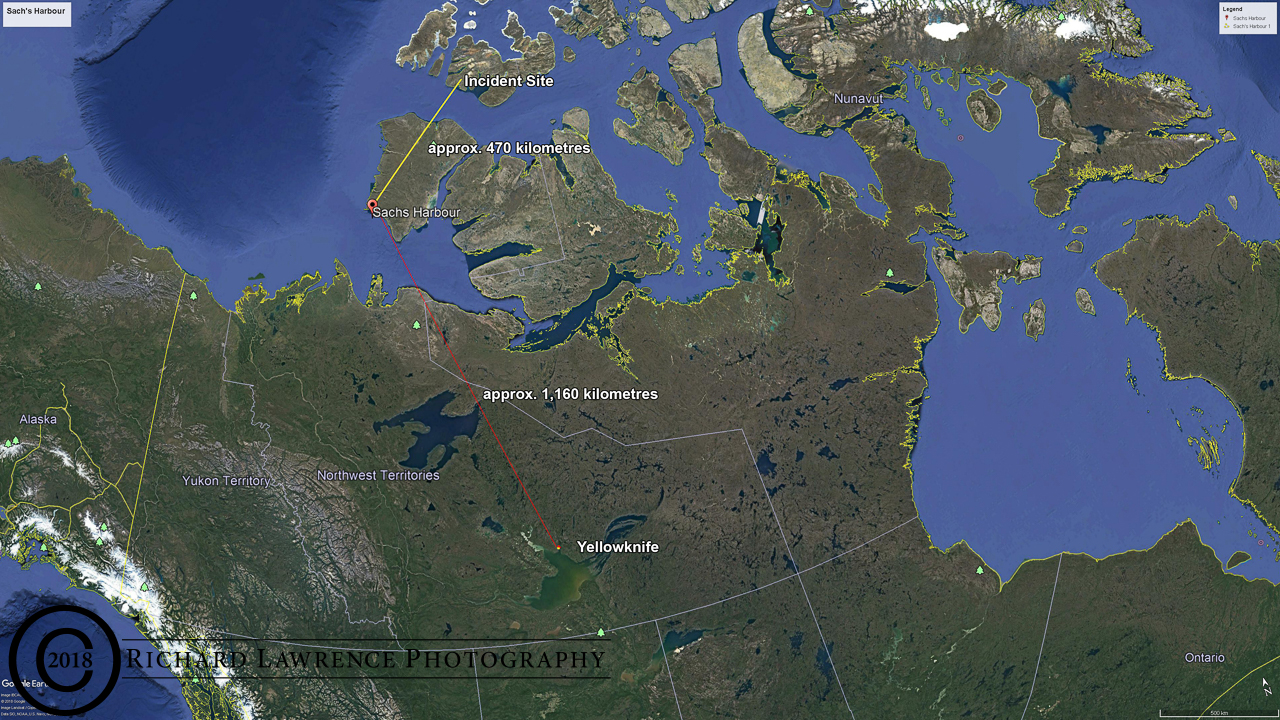
RESA 2018 was held in Yellowknife, N.W.T. from the 17th to 21st September, 2018, to test the contingency plan for dealing with a Major Air Disaster (or MAJAID) in the far north with the actual simulation held further south. For the purposes of the exercise simulation, the MAJAID scenario was an airliner crash with 199 persons on board with the forward base in Sach’s Harbour on Bank’s Island (about 2130 km north-north-west of Edmonton) and the crash site about 470 km further north-east on Melville Island. In reality and for exercise purposes, the forward base was setup in the Yellowknife Airport with the incident site at the territorial gravel pit on the Dettah Road about 19 km from Yellowknife by road, or 6.2 km by air.

RESA 2018 was never meant to be a test of the overall, whole-of-government response, as parts of that dynamic had been tested prior to this exercise. RESA 2018 was only meant to be a tactical exercise for the CAF to test the Air Task Force piece of a MAJAID response to a major crash, independent of any other factors, so that they could streamline their processes to fix anything that didn’t work according to plan as well as practice the plan. To that end, the critical pieces are the initial response by search and rescue and their Canadian Army Advance Warfare Centre (CAAWC) security teams as well as the deployment of the MAJAID Kit along with the deployment and workings of the HSS.

The MAJAID Kit is a palletized set of equipment that consists of tents, sleeping bags, food, water, heaters, generators, and a couple of ATVs. It can be deployed by air insertion within 24 hours from Trenton and has enough equipment and supplies to support 320 people for 72 hours. It is accompanied by SAR techs and a security team from the CAAWC who jump in with 24 hours of personal supplies. As a note, the transit time from Trenton to Sach’s Harbour would have been eight hours.

THE THEORY

In such a disaster, the first notification would be to one of three Joint Rescue Coordination Centres (JRCC): Halifax, Trenton, or Victoria. The JRCC would then launch the primary Search and Rescue (SAR) assets, such as Search and Rescue technicians (SAR techs), helicopters, and/or CC-130 aircraft. Normally there would be two SAR techs to an aircraft but in this type of emergency all SAR techs would be recalled and as many as could fit into the aircraft with their equipment would be sent. So, instead of two SAR techs the initial response could be 6 – 10 with equipment. Other primary squadrons from around the country would fly in their assets in a second wave of response as soon as they could be gathered and moved.

Once the initial response has started it would be recommended to the SAR Regional Commander that contingency plan Soteria be activated. This recommendation would then go to the Commander of Combined Joint Operations Command and then to the Chief of Defence Staff for approval after which Soteria would be activated. An Air Task Force commander would be appointed as well as a forward base

location identified (locations are already identified in the plan so it’s more of a selection) and the wider response would start. The Air Task Force (ATF) commander for RESA 2018 was Maj. Rich MacEwan who commanded the exercise with Maj. Carly Montpellier (2 Field Ambulance, Petawawa) commanding the 35 medical personnel of the MAJAID Health Services Support (HSS) unit, both operating from the Yellowknife airfield. The HSS unit was capable of handling 100 casualties.

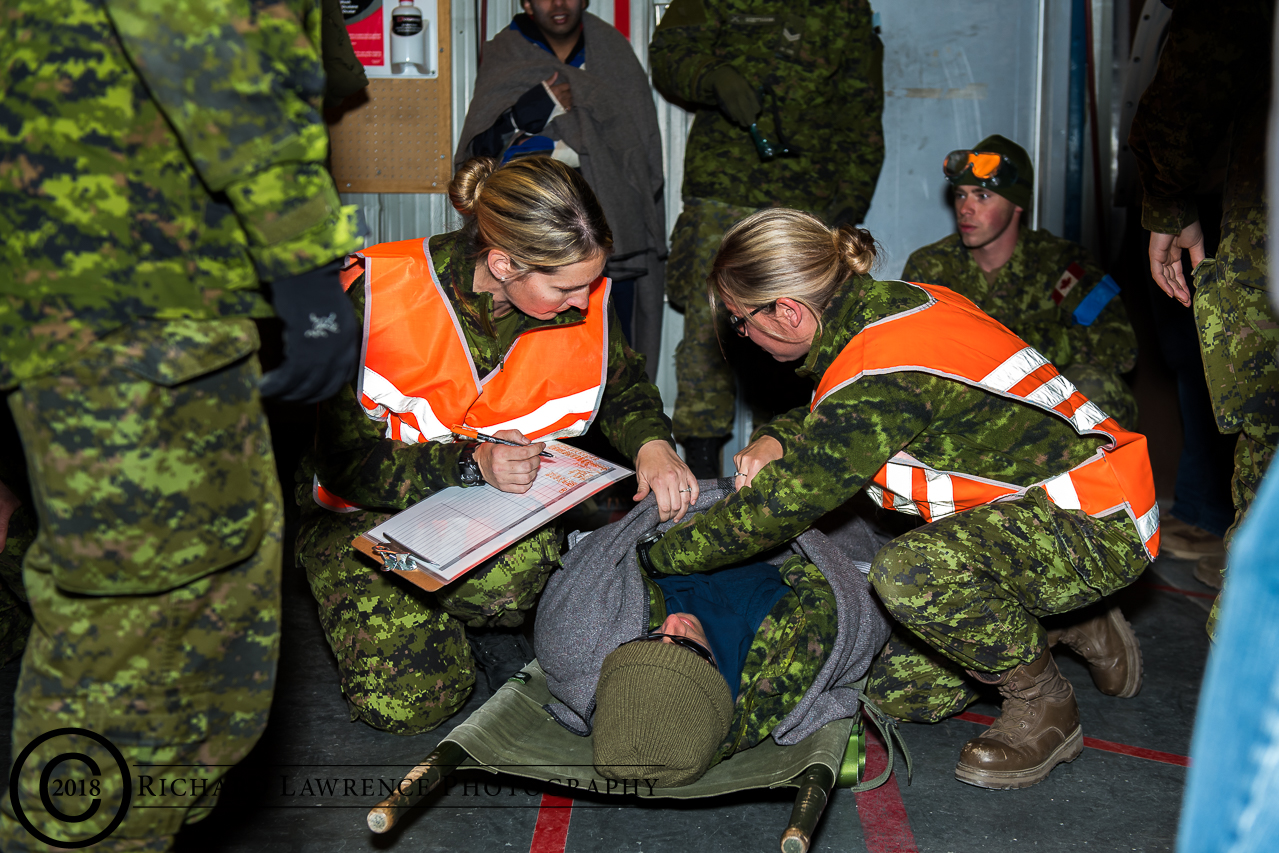
Once on the ground and setup, the SAR techs would do initial triage, separating the victims into green, yellow, red, and black categories, depending on the type and severity of the injury (green = good, black = dead). As this is happening, air resources are brought to bear to evacuate the injured to the forward base where they are again triaged (ratings may have changed during the time between initial triage and arrival at HSS). The HSS responsibility is to setup at a forward base and keep people from dying (triage and treat), and manage pain before onward evacuation to regional hospitals or medical facilities better suited to treat the injured.

It was noted by LCol. Jay Steele, Search and Rescue Advisor at the Combined Joint Operations Command (CJOC), that in all likelihood, the CAF will not be the first responders on scene but rather Canadian Rangers, hunters/trappers, mining company staff and/or local communities will be first to the site. He further stated that one thing you cannot do in the north is stop people from helping because it is in their nature to do so. It doesn’t matter what the problem is or how severe, the people of the north rush to the cause to provide whatever assistance they can. And because they know the area and are used to any weather conditions, that help can be invaluable. However, the CAF “may be the only ones that can come with that much force or that much material to help out”.

BGen Dave Anderson, Deputy Chief of Staff - CJOC, made the point that this type of scenario is not a CAF problem but a problem for the province/territory in which the disaster occurs and that the CAF works with them. It is not the job of the CAF to come in and take charge of everything, as that is not helpful, but to co-ordinate with the local/regional authorities and provide whatever assistance that they require. In essence the CAF is in a support role to the governmental authorities and other agencies.

THE EXERCISE

DND has a tradition of inviting media up north to view some of these exercises and this year was no different as a group of about 6-10 media types and about 30 VIPs (government officials mostly with a couple of defence attachés and Coast Guard) were at the Canada Reception Centre in Ottawa at 0930 hours to catch a RCAF CC-150 leaving at 1100 hours for Edmonton. We arrived in Edmonton (actually Nisku about 20 km south of Edmonton and not near anything) about 1300 hours local time where we checked into the hotel for the night (not at DND’s expense). At 0700 hours the next morning we were on the shuttle bus back to the aircraft for the final leg up to Yellowknife, leaving at 0830 hours and arriving 1030 hours. I was excited to be in Yellowknife as I’ve always wanted to visit but coming from Ottawa to Yellowknife was a bit of a weather change from 28 degrees and sun to -2 degrees with overcast and wind.

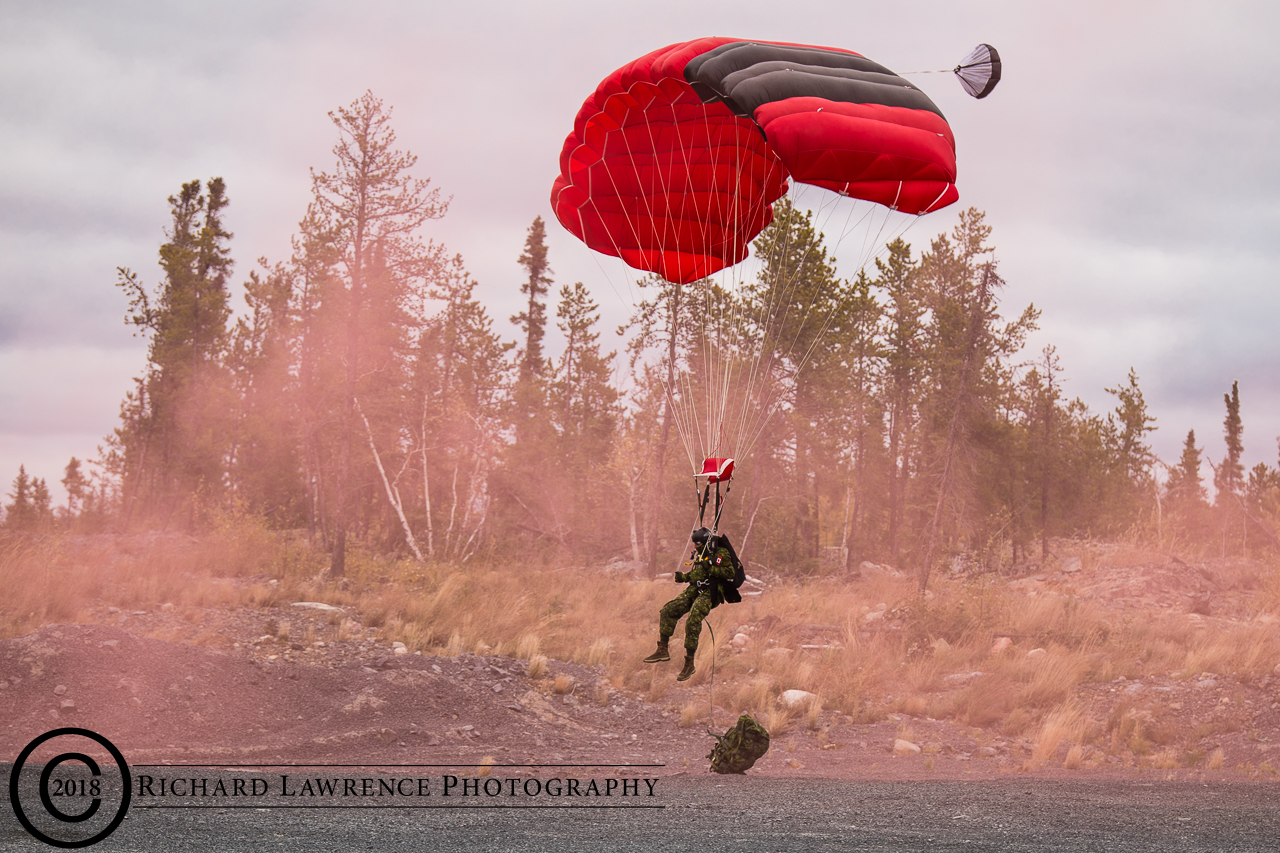
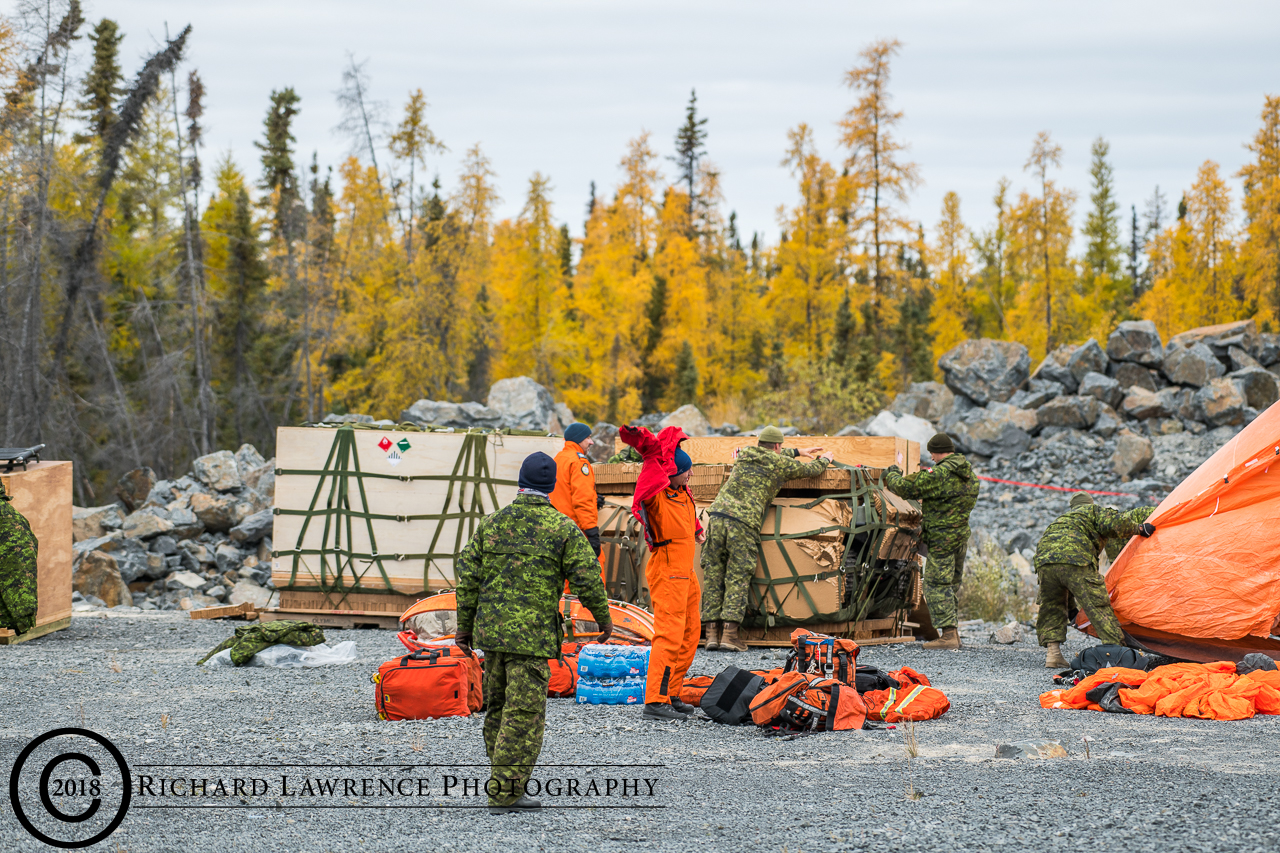
Upon arrival in Yellowknife on the 18th, we were immediately bused out to the incident site (gravel pit) as the initial response SAR techs and CAAWC security teams were being parachuted in from a CC-130J. It was easy to tell the two groups apart as the security team was dressed in camouflage and carried rifles whereas the SAR techs were dressed in orange and carried big kit bags with them. The MAJAID Kit was in the process of being deployed as it was previously air inserted, followed by security and SAR techs, and

then broken apart for setup. It is important that the tents get setup immediately and heaters started so victims can be brought in from the elements which, that far north, can be harsh on a good day. It seemed from the exercise that security put up their perimeter on the site and setup the MAJAID kit while the SAR techs started to triage the victims. Once available for occupancy the less serious cases (green, yellow) were moved into one tent and the more serious (red) into another where the SAR techs continued to provide medical care to the injured. While it seems unemotional and cold, the dead were left on stretchers outside and covered up as there was nothing to be done for them other than to protect them from animals.

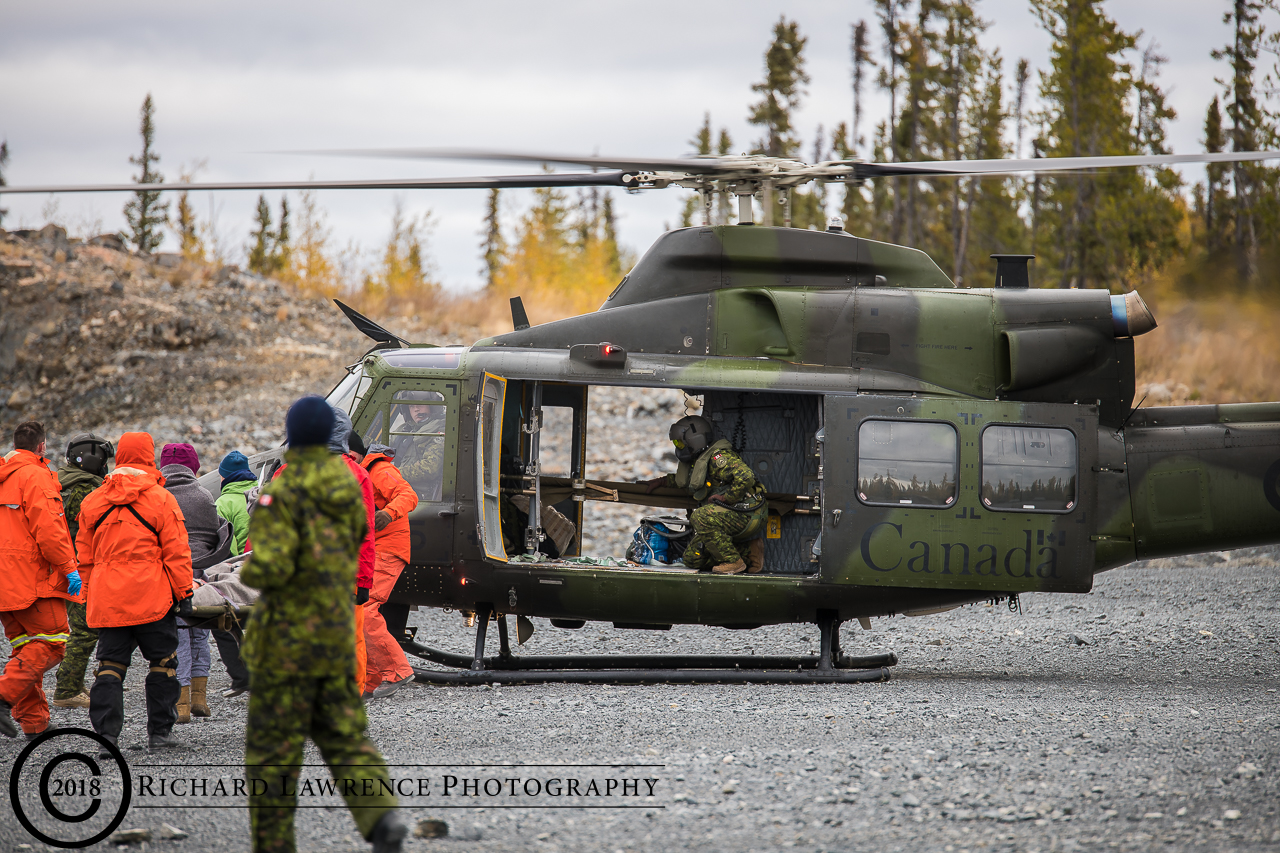
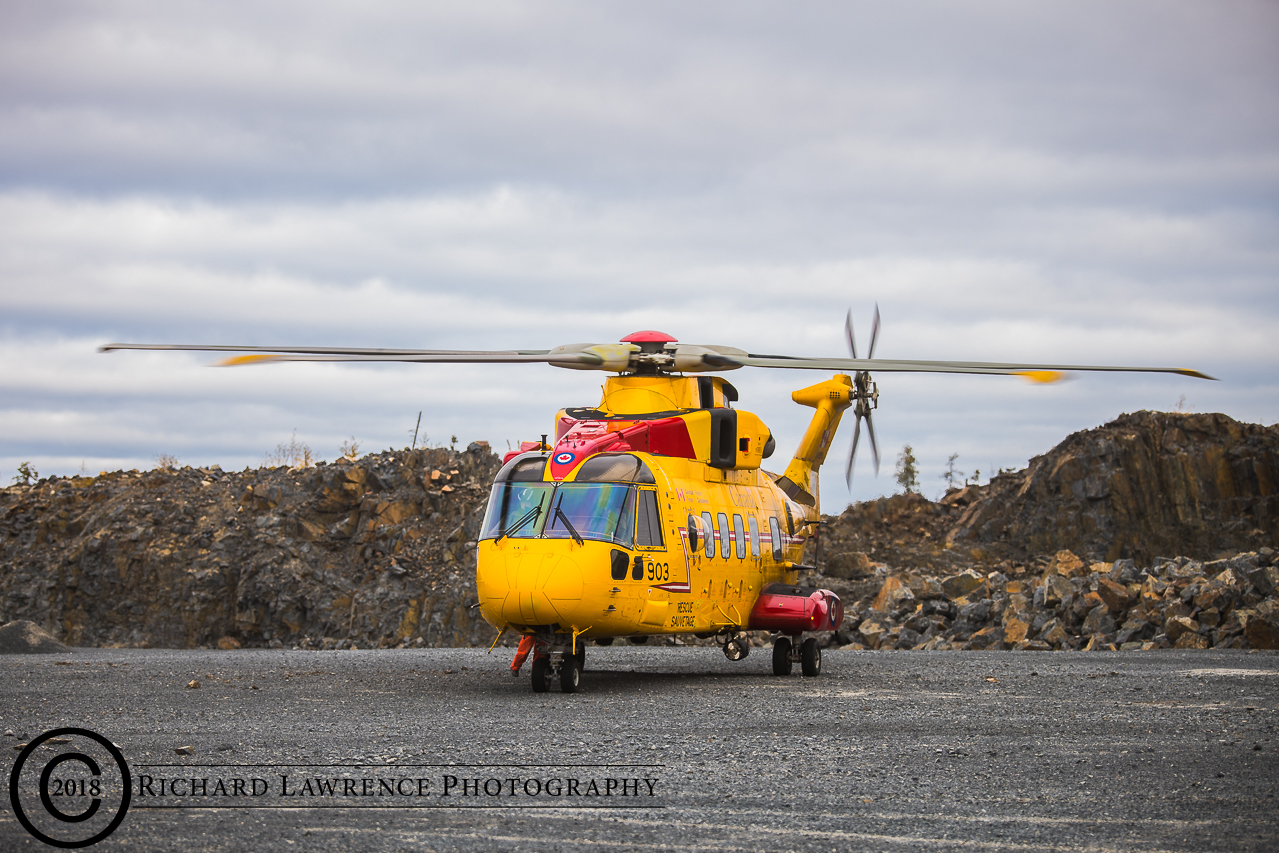
As this initial response was well underway, a second wave of SAR techs parachuted into the site simulating the arrival of resources from other than the primary SAR response units. After a time, a CH-146 Griffin helicopter arrived and a couple of stretchers were flown out but this is a small aircraft and of limited use because of the small load it carries. Still later, a CH-149 Cormorant came in and evacuated a larger number of casualties back to the HSS.

All in all we spent about 90 minutes observing the scenario as it unfolded. Everyone was very committed to the exercise, including the simulated victims who moaned and cried and complained. Only the dead were stoic but even they looked up occasionally to see what was going on or to adjust their blankets to keep warm. The SAR techs/security teams dutifully attended to all victims and got the MAJAID Kit setup in short order and started moving the victims to a more hospitable environment out of the cold. Once the helos arrived, they were very quick to get people loaded and away from the site to the HSS.

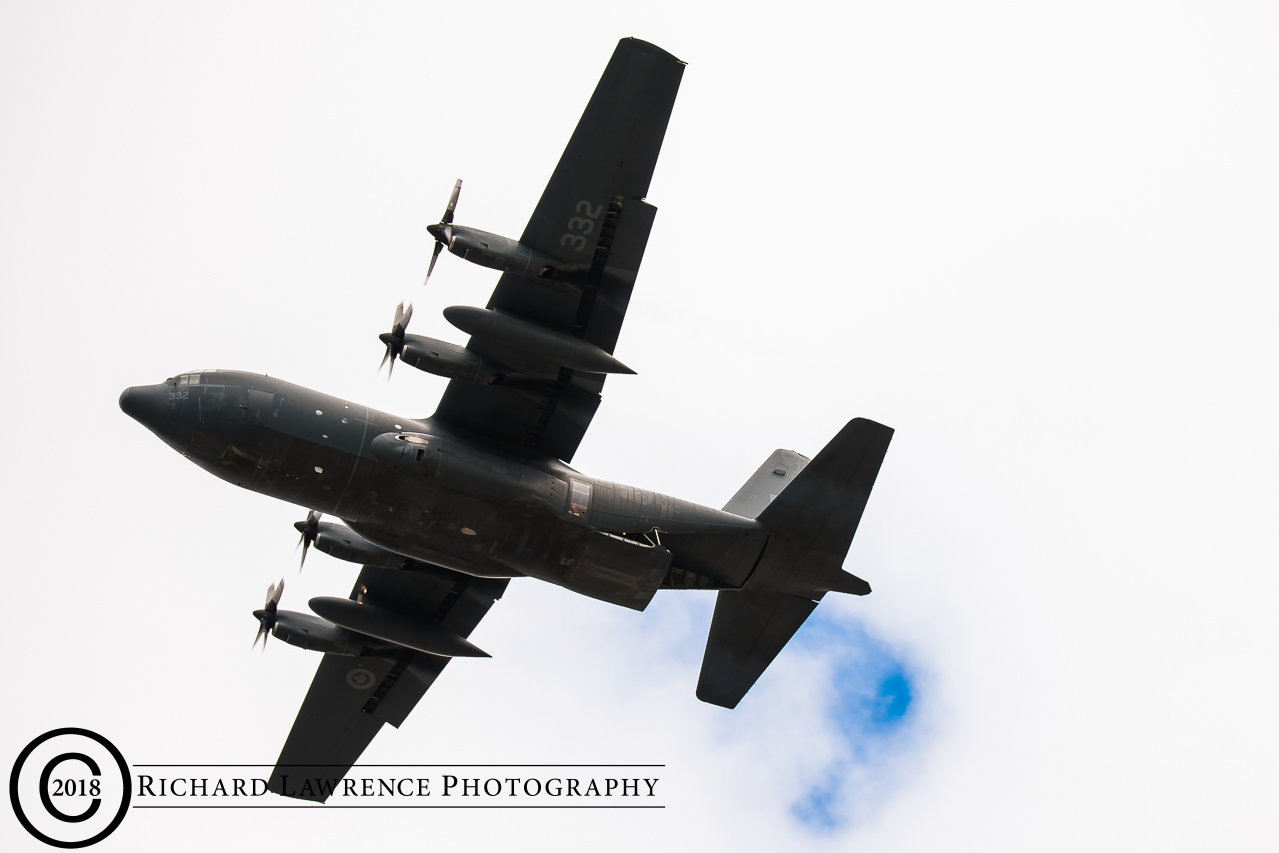
The only real hiccups at the incident site came with the initial parachute drop and later with an equipment drop from the CC-130J. In the initial parachute drop of SAR techs/security teams, the wind kicked up a bit and a couple of people found themselves heading for the trees and power lines by our bus. Everyone managed to “shorten sail” as it were and landed short of the trees and cars so this was possibly more real-life than they were hoping for. Later, a CC-130J was doing a parachute drop of supplies and the directing staff thought that it would be a good idea for everyone to vacate the lunch tents to observe. They also instructed everyone to identify and watch the package all the way to the ground in case the wind caught it and it came near them or the tent. This was a good idea as the package did get caught in the wind and landed closer to the lunch tent than I’m sure staff would have liked.

After our time at the incident site, we were bussed back to the Yellowknife Airport to observe the HSS team in action. This team was situated in the old fire hall and commanded by Maj. Carly Montpellier of 2 Field Ambulance, Petawawa. The HSS consists of medical officers, nursing officers, medical technicians, preventive medicine technicians (look after camp hygiene, water, food, etc.), a pharmacy tech, and two members with an aero-medical evacuation specialty. The primary role is to provide life-saving intervention and pain management prior to evacuation to a higher level of care as well as rearward tracking of the patients.

We were able to observe patients on the tables being assessed and attended to as well as watch new patients just off the CH-149 from the incident site be re-triaged and moved into the building. The HSS building was small and everyone was packed in. It seemed well organized although we were told that they had been almost overwhelmed earlier because the short transit time from the incident site (5 minutes) allowed the patients to be evacuated to the HSS in a much shorter time than would have been normal in a real disaster.

The last stop was to the Air Task Force Command Centre where we were briefed by Maj. Rich MacEwan, the task force commander. His role was to coordinate the CAF air assets to provide the rescue and evacuation to medical care at the forward base and subsequent airlift to higher medical care. They also look after all liaison with regional and territorial organizations, and logistics and administration. At its basic level, the command centre is a room/tent with a bunch of computers and comms equipment with groups of officers handling all aspects of coordination, liaison, logistics, and administration.

As stated by Maj. MacEwan, initially at a forward base, there may be nothing on the ground for an ops centre and they need to get in with ops officers, communications (telephone or sat phone) and whatever else may be needed. If required, they can go in with a more army setup with modular tents, generators, and cots but there is a need for some basic infrastructure to support re-supply and HSS as well as a way for a CC-130 to take off and land. As the SAR response starts, a list of already vetted forward bases is reviewed and one of those would be a first choice, depending on the proximity to the incident site.

BGen. Anderson talked about some of the take-aways from this exercise with his first comment regarding the amount of time it takes to reset the MAJAID Kit once it has been deployed. In short, it takes 90 days before the MAJAID Kit can be used again and should another disaster occur during that period, the kit is not available. The easiest fix to this is to have a second MAJAID Kit ready to go. As well, the tactical operators are looking at the kit during this exercise to make sure its components are appropriate to the job, especially if the CAF is going to purchase a backup kit.

He also felt that the command and control of the scenario was overcomplicated with the ATF commander working for the MAJAID Task Force Commander who works for the Commander 1 Cdn Air Div (Winnipeg) who is also the air component commander for MGen Rouleau who works in Ottawa. He suggested that as the Joint Task Force North (JTFN) has already established links to governmental and other agencies that perhaps the MAJAID Task Force could deploy liaison officers who would then go in and meet their counterparts in the territorial or provincial operations centre thereby taking some of the workload off the MAJAID Task Force, who are already busy.

Lastly, BGen. Anderson commented on the lunch supplied to the group which was military IMPs served in an unlit tent at the incident site. He said, “ … poutine in a bag – that’s an abomination! It’s an offence against humanity … it never should have happened.”. BGen. Anderson is from Montreal so I guess he’s entitled to an opinion.

THE END

In the end I can only comment on the seriousness with which everyone undertook to do their jobs despite this only being an exercise. And it wasn’t just those directly involved in the scenario but those who provided support to the exercise, right down to the stretcher bearers lined up inside the HSS hut waiting for the next inflow of casualties and the victims categorized black (dead). Although some may shy away from the expense of doing an exercise like this in the north, just think of the expense if the CAF wasn’t ready to respond or the plan actually had serious flaws that hadn’t been worked out prior to a real disaster. And just because this exercise is in the north, the MAJAID Kit and all the associated personnel are capable of being deployed to any area in Canada, not just the north and not just for an airplane crash. The equipment and lessons learned here can be applied to any multi-victim disaster such

as train derailments, boating disasters, bridge collapses, floods, etc. Training in a harsh environment only makes sense if one “plans for the worst and hopes for the best”.

At 1530 hours we re-boarded the aircraft, after five hours on the ground, and headed back to Ottawa. After two days of travel, and seeing an airport and a gravel pit, I can still say I’ve never been to Yellowknife.

All images from the trip can be found at:

http://www.richardlawrencephotography.ca/rlpgalleries/2018/soteria

CAFSAC 2018

By Richard Lawrence 

 The Canadian Armed Forces Small Arms Concentration (CAFSAC) is an annual shooting match for CAF and foreign military teams using rifles, pistols and light machine guns, held to help improve marksmanship and small arms proficiency. In 2018 the competition was held at the Connaught Ranges and Primary Training Centre from 10th to 22nd September with teams from the CAF Regular Force, Primary Reserve, and the Canadian Ranger Patrol Groups (CRPG) as well as international teams from Australia, the United Kingdom, the United States of America, and the Kingdom of the Netherlands.

This event has been taking place, in one form or another and under differing organizations, since 1868 when the Dominion of Canada Rifle Association (DCRA) was founded as a response to possible external threats. The federal government thought that as the primary weapon of the day was the rifle and invasions would be met by militiamen from the civilian population, it was incumbent upon them to support an organization whose mandate was to “promote and encourage the training of marksmanship throughout Canada”. The result was that the DCRA brought 33 independent rifle associations from several provinces under a single organization. In return for the government’s support (which was free ammunition and military range access), the Militia Act (1904) stipulated that the DCRA had a legal obligation to the defence of Canada and its members were required to serve in the militia in times of emergency. CAFSAC, as it is now known, is now run by the Canadian Army Doctrine and Training Center Headquarters
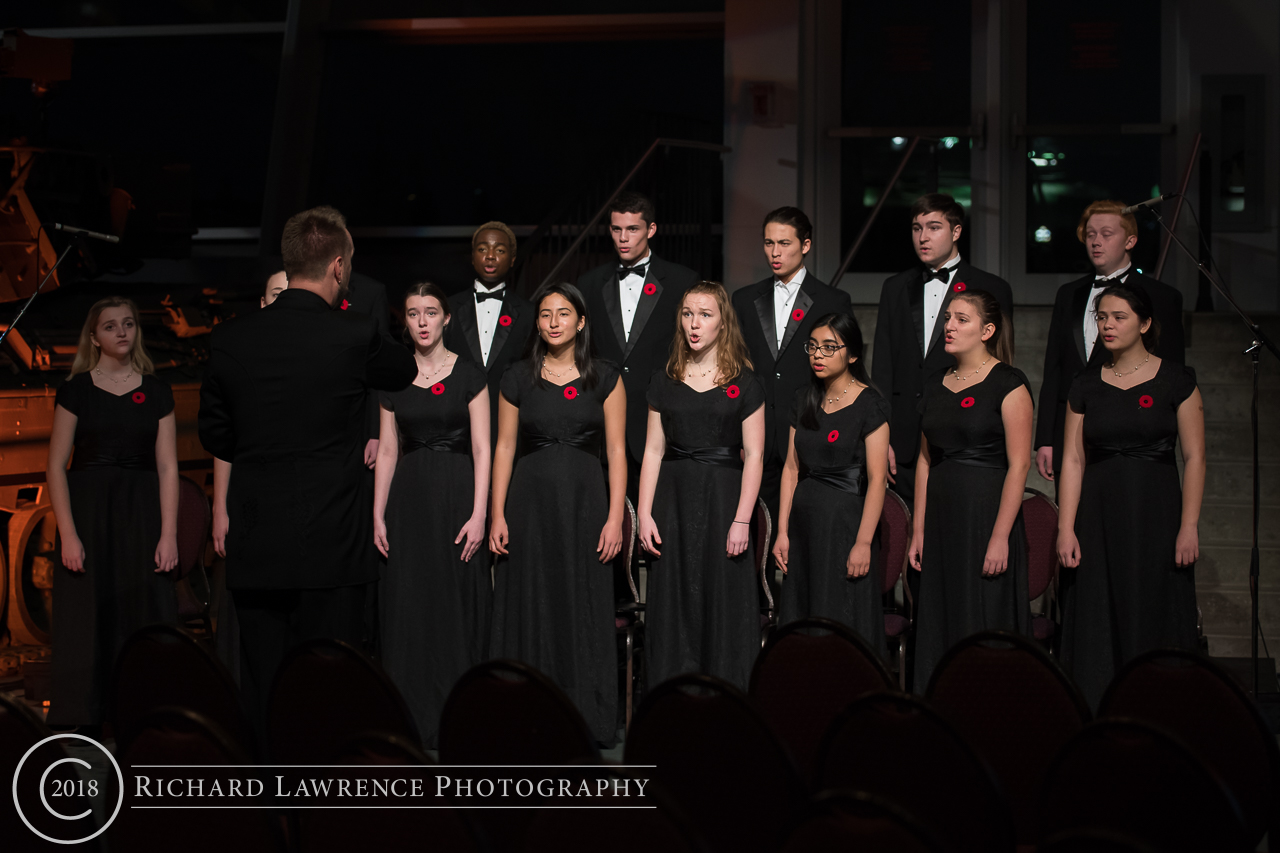
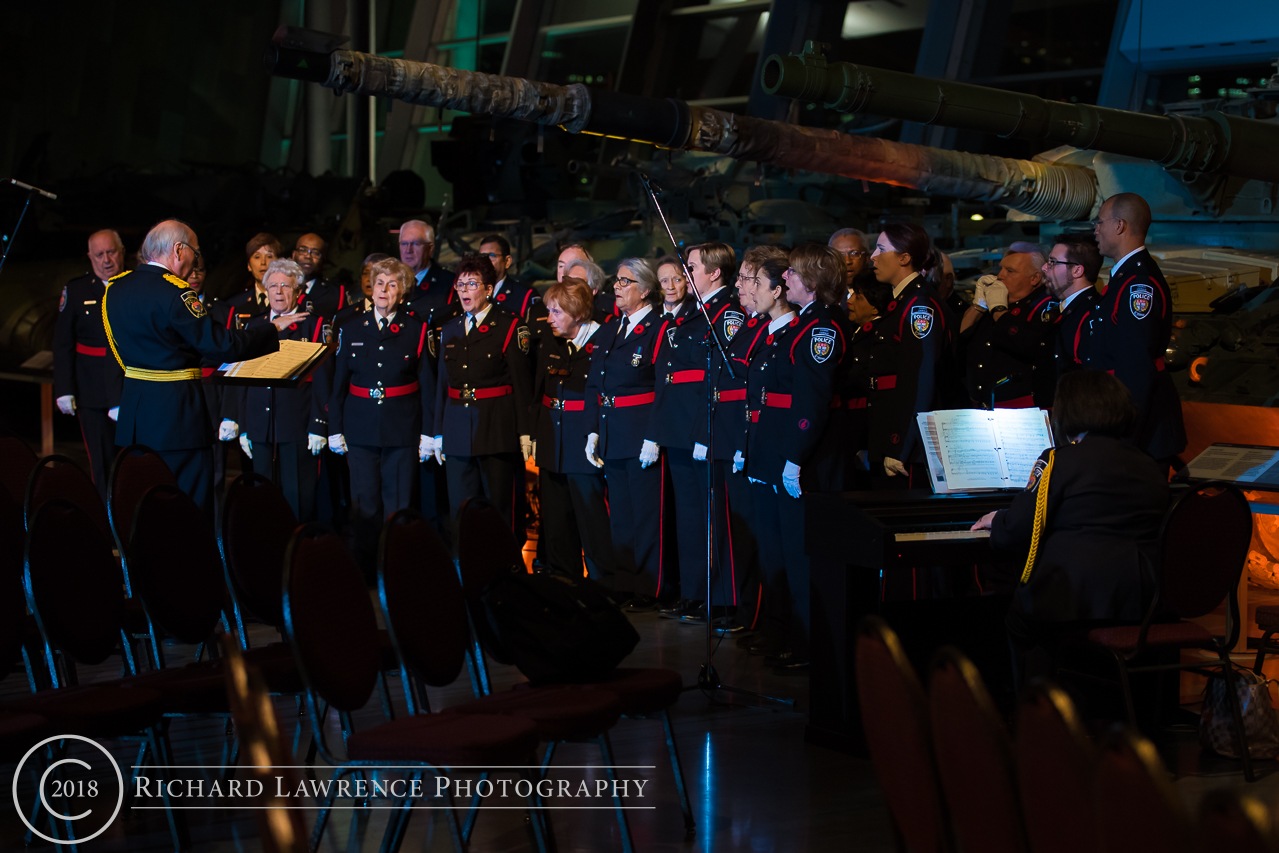
During CAFSAC, there are 25 different matches using different weapons, differing distances, and differing goals. And lest you think this is an ideal environment for shooting and bears no resemblance to real world conditions, think again. The participants are in full tactical kit, including body armour, ammo loads, rucksack, etc., and go despite the weather conditions. For the first week of the competition, they endured 30 degree direct sun with humidity added (up to 38 degrees) while on the 21st for the Queens Medal for Champion Shot event, they endured 10 degree temperatures in a downpour of rain with increasing winds (note that the evening of the 21st was when the tornados hit Ottawa). Nor are the positions static as some of the events require rundowns starting with firing positions at the 500 metre mark and then sprinting down to 400, 300, 200, and finally 100 metre positions, all in full kit, while shoot at stationary and moving targets at the different distances from prone, kneeling, and standing positions, with targets exposed for varying durations. It’s a test for sure. One of the matches, M31 – Soldier’s Cup Service Rifle and Light Machine Gun, required a three kilometre march followed by a full obstacle course before getting to the live fire section attack.

The final competition is for the Queen’s Medal for Champion Shot for the Regular and Primary Reserve members held in conjunction with the Captain Shannon Wills Trophy for the Canadian Rangers and the two are run as a single match – M15. This is the event noted above that starts at the 500 metre mark, in full kit, with four 100 metre sprints down to the 100 metre firing positions, firing from various positions at various targets with varying durations. One Queen’s Medal for Champion Shot is awarded to a member of the CAF Regular Force and another to the Primary Reserve or Royal Canadian Mounted Police member who has shot the highest scores in the qualifying matches at CAFSAC. The Shannon Wills Trophy is awarded to the Canadian Ranger with the highest score in the Canadian Ranger Open Match. The match was held under cloudy skies and intermittent rain with enough wind to move the shots around. This year, the winners are:


 Queen's Medal for Champion Shot for top Regular Force shooter

1st  Lt. B.P.J. Hordo 1198 with 90 Vs*  RCAF 

2nd Cpl P.B.J. Simard-Brodeur  1187 with 98 Vs 3 Can Div Reg 

3rd  MBdr R.C. Seawright  1183 with 75 Vs 5 Can Div Reg 

Queen's Medal for Champion Shot for top Reserve Force shooter 

1st Cpl T.W. Nault 1198 with 92 Vs 3 Can Div Res

2nd Cpl J.T. Roy-Gauvin 1189 with 88 Vs 2 Can Div Res

3rd Cpl B.G. Hunko 1180 with 78 Vs 3 Can Div Res


Shannon Wills trophy for top Canadian Ranger

1st Ranger Elijassiapik 859 with 39 Vs

2nd Ranger Barfoot 853 with 32 Vs

3rd Ranger Jaaka 800 with 17 Vs


It should be noted that the Queen’s Medal for Top Regular Force shooter went to and Air Force Lieutenant which I’m sure is being discussed by the land types. As well, the Rangers continued to shoot with the old Lee Enfield because not every Ranger has yet been issued with the new C-19 and it wouldn’t have been fair for everyone not to be using the same weapons.

*Vs stands for bulls-eye. As we use a 5-point target in Canada a bulls-eye is referred to V-bulls or Vs with the V coming from the Roman numeral for 5, or V.

For more photos: http://www.richardlawrencephotography.ca/rlpgalleries/2018/cafsac2018/index.html

Peacekeepers' Day

By Richard Lawrence

On the 9th of August, 1974, a Canadian Armed Forces “Buffalo” aircraft, while landing in Damascus, Syria, was shot down by a Syrian Air Defence missile killing all on board, including nine Canadian military on the United Nations Emergency Force in Egypt and Israel peacekeeping mission. This was the largest single loss of life for Canadian peacekeepers in history and it is this reason that the Sunday closest to the 9th of August was chosen for the annual National Peacekeepers Day Ceremony. The ceremony is organized by the Colonel John Gardham Ottawa Chapter of the Canadian Association of Veterans in United Nations Peacekeeping (CAVUNP) along with the RCMP, CFSU(O), the RCMP, and Veterans Affairs Canada (VAC). This year also commemorated the 70th anniversary of the start of the United Nations Truce Supervisory Organization, started in 1948,

The ceremony was held at the Reconciliation Monument in Ottawa on Sunday the 12th August, 2018, under the heat and clear blue skies of Ottawa. And it was warm with a heatwave in progress and no shade for the troops on parade. The Ceremonial Guard, dressed in their scarlets and bearskin hats, had just come from the Changing of the Guard ceremony on Parliament Hill so had already stood in the heat for a bit before being bussed to this ceremony to do it again. Deputy Minister of Veterans Affairs Canada (DM/VAC), Walt Natynczuk, the reviewing officer, even made mention of it during his remarks and hoped that the battery operated cooling vests were working underneath their uniforms.

The first speaker was Mr. Wayne Mac Culloch, National President of the CAVNP, who noted that, “Ceremonies commemorating Peacekeepers Day are about recognition and commemoration of peacekeepers past, present, and yet to come and their families. Recognition and thanks to those who help make peacekeeping duty less arduous and remembrance of our fallen comrades who died in the service of peace.”.

Following his remarks were the traditions of remembrance ceremonies with the last post, silence, rouse and lament then followed by the Act of Remembrance. The Commitment to Remember was spoken by air cadet Sgt. James Chettle in English and by army cadet Sgt. Claire Demers in French.

After the Prayer for the Peacekeepers, came the laying of flowers, which is different from most remembrance ceremonies because, instead of laying wreaths at the foot of the monument, bouquets of flowers are placed into the mouths cannon barrels, cut down and positioned for this purpose. This year the first flowers were placed by the Honourable Greg Fergus, MP Hull-Aylmer, and the DM/VAC Walt Natynczuk and the second set of flowers were placed by MGen. Alain Pelletier (Canadian Armed Forces) and RCMP Assistant Commissioner Paula Dionne. The third set was much more poignant in that they were placed by Mrs. Elizabeth Fournier-Law and her daughter Kathleen, who had lost their husband/father, Clive Law, suddenly last year. Clive had served as President of the John Gardham chapter of the CAVUNP and was also a driving force for the creation of a fourth figure to be placed on the Reconciliation Monument to represent police forces and first responders.

The Honourable Greg Fergus was first to address the parade where he noted that over 125,00 Canadians had participated in peacekeeping all over the world and included members from the Canadian Armed Forces, the RCMP, Police forces, both municipal and provincial, diplomats and civilians, of which over 130 had lost their lives. When DM/VAC Natynczuk took the podium, he promised to follow advice that he received in Cypress many years ago when addressing a medal ceremony during a hot day there – “keep it short!”. He spoke of the professionalism and dedication of all those who undertook peacekeeping duties and that “ we mourn the losses of our shipmates, squadron mates, battle buddies, and colleagues in operations … both the physical injuries and the invisible mental injuries our men and women endured. … and we gotta support those who are hunkered down somewhere to come forward

and get help and get treatment.”. He also noted that the Canadian contribution makes a difference due to the education, professionalism, training, and discipline of the people and that they “… represent the very best of Canadian values and ethics”. With that, he closed and the parade carried on to its conclusion and dismissal.

No-one fainted on parade because of the heat so it was a good day all around, although some of the Ceremonial Guard made note that their knees were a little stiff as they’d been standing still for so long.

After the ceremony, there was much picture taking of UN Veterans and their families at the monument before adjourning across the street to the pub for after ceremony snacks and refreshments.

For more photos:

http://www.richardlawrencephotography.ca/rlpgalleries/2018/cavunp2018/index.html

Arizona Commemorative Air Force Museum B-25 "Maid in the Shade"

By Richard Lawrence

Once again the Commemorative Air Force is visiting the Ottawa area as the Arizona Airbase’s North American B-25J Mitchell bomber, “Maid in the Shade”, set down at the Gatineau Executive Airport and taxied over to the Vintage Wings of Canada ramp as part of the “Flying Legends Of Victory Air Show Tour”. This specific aircraft flew fifteen actual combat missions (13 x Italy, 2 x Yugoslavia) from Seraggia Airport on the island of Corsica in November and December 1944 as Battle 18 with the distinctive blue tail and blue ring cowls she now displays. She also participated in America’s first large-scale bombing offensive in the Philippines where “the Maid” is credited with eight ships sunk and five planes shot down. After she retired from the military in 1959 she was used as an aerial pest spray aircraft until 1980 when she arrived at the Arizona Airbase of the CAF (AZCAF) and was in restoration for almost 29 years until her first flight in May 2009.

The B-25 bomber, built by North American Aviation and named after Major General William “Billy” Mitchell, was one of the best known and versatile bombers of the second war. It was a heavily armed medium bomber which served in every theatre of war in roles from bombing, anti-shipping, to tactical ground support. It was an exceptionally sturdy aircraft that could withstand tremendous punishment. One B-25C (nicknamed "Patches “) of the 321st Bomb Group, had the aircraft's holes patched with the bright yellow zinc chromate primer. At the end of over 300 missions Patches had been belly-landed six times and had over 400 patched holes. The airframe was so distorted from damage that straight-and-level flight required 8° of left aileron trim and 6° of right rudder, causing the aircraft to "crab" sideways across the sky.

Of the nearly 10,000 B-25s produced, there were many variants with this “J” version having over 4,300 siblings. The “C” version (known as the Mitchell Mk II in the RCAF/RAF) would have been most familiar to Canadians, the “G” version had the nose plexiglass replaced with skin and two additional .50 calibre machines added PLUS a 75mm (3 inch) cannon, and the “J” version as a Strafer variant was outfitted with most of its 14 to 18 machine guns facing forward for strafing runs (8 machine guns in the nose position, 2 fixed on either side of the fuselage below the cockpit, and 2 in the dorsal turret). In short, there was no shortage of variations of this aircraft or job it couldn’t be thrown against.

One of the techniques for which the B-25 was known was “skip bombing”. This entailed the bomber to fly between 200-250 feet above ground at 200-250 mph and then drop a stick of two 1,000 pound or four 500 pound bombs that would then skip off the water (like skipping a stone) before hitting a ship and exploding (4-5 second delay fuses) or sinking below the ship and exploding next to her. Mast-height bombing was similar where the B-25 would come in at a slightly higher altitude and faster speed and then drop down to 10-15 feet about 600 yards back of the target. At about 300 yards, the bombs were released into the side of the ship.

The B-25 is most notably known as the bomber selected to make the first air raid against the Japanese home islands in April, 1942. For that raid 16 B-25B Mitchell bombers were stripped down of all unnecessary equipment, including most of the defensive machine guns and ammunition, and launched from the aircraft carrier USS Hornet (for which they weren’t designed) without a fighter escort. LCol. James Doolittle led the 80 man raid for the six hour, 800 mile flight after which they were to go to China to land, another 7 hours. However, one aircraft had issues in flight and diverted to Russia where they were interned and eventually escaped to get home. The 15 other aircraft successfully carried out the raid creating minor damage but a huge success as far as damaging the morale of the Japanese civilian population and boosting the morale of American Troops.

All 15 bombers made it to China where they had to crash land, bailout or ditch and all but two crews (10 airmen) made their way home. Not all crew members made it back with three KIA and eight taken as POWs (3 executed, 1 died). There were also reprisals against the Chinese who assisted the downed airmen with one city, Nancheng, burned to the ground for rendering assistance.

There is a Canadian connection to the B-25 as Canadian aircrew served on them when they served in RAF units which flew the B-25. The RCAF did fly them during WWII but Canadian usage was mostly after the war. The first B-25s for the RCAF were originally destined for the RAF but were diverted to the RCAF and redesignated using the Mark system. These included 1 x B-25B (Mitchell Mk I), 42 x B-25C (Mitchell Mk IIs), and 19 x B-25J-NC (Mitchell Mk IIIs).

No 13 (P) Squadron was formed at Rockliffe in May of 1944 where they operated Mitchell Mk IIs on high altitude aerial photography sorties and became No 413 (P) Squadron in April 1947, flying the Mitchell until October, 1948. In January, 1947, No 418 (Auxiliary) Squadron received its first Mitchell Mk IIs, operating a mix of Mk IIs and Mk IIIs until March, 1958. No 406 (Auxiliary) Squadron flew Mitchell Mk IIIs from April 1947 to June 1958 with No 12 Squadron of Air Transport Command flying Mitchell Mk IIIs from September 1956 to November 1960. No. 5 OTU (Operational Training Unit) at Boundary Bay, British Columbia and Abbotsford, British Columbia, operated the B-25D Mitchell in the training role together with B-24 Liberators for Heavy Conversion as part of the BCATP.

In 1951, the United States Air Force provided the RCAF with an additional 75 x Mitchell Mk IIIs (B-25J) so that second-line units could be equipped and to help alleviated shortages caused by attrition. In all, 164 B-25s served with seven RCAF squadrons in light bomber, navigation training, photo recon, and transport roles.

On a personal note, I had the good fortune to be selected to go for a ride in the “Maid” as part of a media flight and because I’m a veteran. My position was as the left hand waist gunner. From the pictures you can see that there were four of us in this space which normally accommodated two. As well, we had seats which the gunners would not have had, having instead to sit on their parachutes for the entire journey. After a flight briefing by AZCAF’s Ted Lloyd we got into the aircraft’s waist via a ladder just aft of the bomb bay and then wrestled into seats and seatbelts and waited … and sweated … and waited and sweated. It was a hot day with high humidity and there is no air movement in the waist until the engines start and the B-25 starts to taxi. As the engines turned over, we all put on ear protectors as the B-25 is noisy, so much so that just ear plugs are not deemed sufficient. The first smell is that of exhaust as we are seated just behind the engines but that clears soon enough as you start moving and you start to get some airflow into the cabin. The taxi out to take-off position is not much different than any other aircraft, other than it is 74 years old.

Once the take-off roll started, I was surprised by how much I was pushed into the back of my seat as I expected something gentler. After passing V1 and Vr speeds she jumped up in to the air and started a gentle climb for a couple of seconds and then did what felt like a 60 degree turn. Again, more abrupt than I would have expected. What I gathered from this little bit of experience is that this aircraft handles very nimbly and that the pilots have no compunction about throwing it around the sky.

A couple minutes into the flight, Ted gave us the OK to unbuckle and I was allowed to crawl from the waist position to the rear gunner position in the tail. And that’s the only way you can get there is on your belly. It’s a small little seat about 12-16 inches off the floor with the machine guns at knee level. Your head sticks up into a blister so you can see targets but your field of view is limited, especially if

you’re shorter than six feet. The others moved about standing at the waist gun positions tracking whatever they could see with the guns. A few minutes of this and all of a sudden, we’re bidden back to our seats by Ted as we’re starting to setup for landing. It’s surprising how fast a 25 minutes flight goes by.

I must say that the experience is not a lot different than flying in any other airplane EXCEPT that when you think of it in a historical perspective. You see how these young men, 18, 19, 20 years old with no worldly or life experiences yet, were crammed in together and sent up into the air to bomb another country – to execute government sanctioned killing. Imagine being airborne for hours, knowing that fighters were going to come at you for hours and that you only carried a limited supply of ammunition. Knowing that they could weave all over the sky at double your speed and that you were essentially a sitting target travelling straight and level. Knowing that anti-aircraft fire could bring you down in seconds. Put that together with an uncomfortable working environment, whether it be heat on the ground or cold in the air, and machine gun cartridges bouncing all over the aircraft’s inside as you blazed away hoping to hit a moving target and not even having enough room to fully traverse your gun without hitting your buddy on the opposite side. Take a look at the structure of the aircraft from inside and realize what a flimsy vehicle this is to do the job that it has been assigned. I can only commend the courage of any man who would go up and do this a second time. Most went up dozens of times without a second thought. Many didn’t return.

As a last historical note, I noticed that the bomb bay doors had a lot of graffiti on it and upon closer examination saw that it was inscriptions from men who had actually flown B-25s. It was pointed out to me that two of the signatures were of aircrew of the Doolittle mission, Ed Sayler (crew #15) and David Thatcher (crew #7). It’s worthwhile just to sit there a read the names for a minute or two.

I’d like to express my thanks to Corey Paul and her staff for their excellent service and response times in providing information to me and for thinking to include me in the media flight as a veteran. I’d also like to thank Ted Lloyd for getting me to the tail gunner position in flight, something I’m sure he didn’t have to do, and also thanks to Paul Hlavaty for letting me up into the cockpit once she was on the ground, again something he didn’t have to do. The Arizona Commemorative Air Force Museum (AZCAF), based in Mesa, Arizona, is one of 86 different airbases, wings, squadrons, and other unit types comprising the Commemorative Air Force organization that fly and house the largest collection of flying vintage aircraft in the world. The CAF is the nation's leading organization devoted to preserving American military aviation history through education, flying and exhibition.

For more photos: http://www.richardlawrencephotography.ca/rlpgalleries/2018/maid/index.html

Commemorative Air Force B-29 "FIFI"

By Richard Lawrence

Every weapons system is composed of three parts: the weapon, the delivery system, and the operator. For handguns the weapon is the bullet, the delivery mechanism is the gun itself, and the operator is the person who makes the decision to fire the bullet. During World War II (WWII) the most destructive weapon of the war was the atomic bomb. That was the weapon. The operator was the President of the United States and the delivery system was the Boeing B-29 Superfortress bomber. For the last week, one of only two remaining flying B-29 bombers was in town at the Gatineau Executive Airport and, with the assistance of Vintage Wings of Canada, was open to the public for viewing. For those with a little extra cash a half-hour flight could be purchased as well.

The B-29 is called “FIFI” and belongs to the Commemorative Air Force (CAF) from Texas and, as mentioned, is one of only two examples of this aircraft left flying in the world today. The B-29 was first flown in 1942, entered into service in 1944, and was retired in 1960. It was used in the Pacific theatre during WWII but also in Korea later. The B-29 project cost over $3 billion dollars and was the most expensive military project of the war, exceeding the cost of the atomic bomb by approximately $1.5 billion dollars. At the end, they had created a high-altitude bomber that was not very good at high-altitude bombing and was plagued by engine problems.

It could carry 20,000 pounds of bombs (at low altitude) or be modified to carry an atomic bomb (Silverplate variant), had a service altitude of 33,000 feet cruising at 190 knots (max speed 310 knots), for 3250 miles combat range or 5600 miles ferry range with a crew of 11. The B-29 was state of the art in its time and brought interesting innovations to the bomber world. Of those innovations, the most important are that it was pressurized, that it used analogue computers for firing computations, and had a remote controlled firing system controlling five turrets of dual .50 calibre browning machine guns.

During WWII bombers were unpressurized meaning that the crews were subject to the cold of high altitude and had to wear oxygen masks above 10,000 feet. This made flying uncomfortable and the risk of hypoxia high. Once the airframe was pressurized, the crew could work in a better environment and not have to wear oxygen masks. The only problem was how does one open a bomb bay for the bomb drop or use machine gun turrets, which are all open to the outside, and still maintain the pressurization?

The answer to the first issue, the bomb bays, was to divide the aircraft into compartments with the fore and aft bomb bays open to the air and the flight deck, rear aircraft, and tail gunner positions pressurized and separated from the bomb bays by pressure bulkheads. This maintained the integrity of the pressurized areas while allowing the bombs to be dropped from high altitude. The flight deck and aft pressurized compartments were linked together by a pressurized tube which spanned the gap of the bomb bays and through which aircrew would have to crawl if they needed to get to the other area. The tube is very small (rough guess about 24 inches wide) so you couldn’t be very big if you wanted to get through.

The second problem of the machine guns needing access to open air was solved by two systems: unmanned .50 calibre machine gun turrets and a computer controlled remote fire control system utilizing advance sighting systems and analogue computers. It worked by having low profile gun turrets, unpressurized and separated from the pressurized compartments, on the aircraft with gunner positions in the nose, tail, and three blisters in the centre fuselage at which gunners sat with gun sighting systems integrated with the computers. When the B-29 was attacked, the gunners would use the sighting systems to track their target aircraft and the computer would then figure out a firing solution compensating for airspeed, gravity, temperature, humidity, and distance to lead the target, automatically move the machine guns into position, and the gunner would fire. On top of this, the

control system allowed a gunner to relinquish control of his turret to another gunner so that the second gunner could bring more fire to bear on his targets allowing for idle guns to be more effective. For example, if the left side gunner had no targets but the right side gunner was heavily involved, left side could give right side control of his gun and right side would double his fire power. The computer would figure out the firing solution for both so bullets from both guns converged on the target. It was so effective that they stopped sending fighter escorts with the B-29s with one report from a mission over Kyushu, Japan, indicating that one crew had beat off 79 fighters and killed 7 of the enemy.

The Russians also had a B-29 variant, the Tupolev Tu-4. During WWII, some American pilots on missions against Japan had to make emergency landings in Russia and, although the aircrew got home (not easily) the airframes were never returned. The Russians took the airframes and reversed-engineered the aircraft to become the Tupolev Tu-4.

FIFI’s history, unfortunately, was not that glorious. She was built in 1945, served as an administrative aircraft for a while and was then put into desert storage. She was reactivated from 1953-1958 until she was again retired, this time being placed in the China Lake Naval Air Weapons Station, Calif., with 35 other B-29s. During her stay at China Lake, she was subjected to desert heat, sand, vandalism, and was used for gunnery practice. By accident, it was noted that there were B-29s on station and the Commemorative Air Force (then called the Confederate Air Force, or CAF), once notified, went into action. In March, 1971, they acquired the best airframe of the 36 and then spent nine weeks scavenging parts from the other 35 B-29s to make her airworthy enough to ferry the 1,250 miles, six-hour and 38-minutes flight to Texas. Once down in Texas with the CAF, she underwent extensive restoration for three years joining the CAF in 1974. She flew until 2006 when she was grounded for a three million dollar engine overhaul that lasted until 2010. She has been flying and touring since 2010.

During the tour of the airplane Stuart Watkins, of the B-29 aircrew, noted that the ailerons of the bomber were still made out of fabric even though the rest of the aircraft was metal. He also pointed out the flaps on this monster stretch over a third of the wing length, including the rear of the engine nacelle, and comprised over 20% of the wing surface. He stated that this allowed the B-29 to be landed at under 100 mph. When looking at the cockpit, he asked guests to look out the forward glass of the distinct B-29 nose. Then he asked people to think back to the Star Wars movies and envisage what it looked like when the Millennium Falcon jumped into hyperspace and asked them to compare the visual of the movie to looking out the B-29 nose. It is the same visual as the Star War movie makers used the B-29 nose structure for the concept of the hyperspace jump. As a last piece of information, Don Boccaccio, also with the FIFI team, mentioned that FIFI itself was not pressurized due to costs and weight, and while not a problem for most flights, crossing the Rockies or other high altitude flights were an issue and they had to be very careful.

So, like all veterans, the numbers of veteran military equipment is slowly disappearing. The Arizona Branch of the Commemorative Air Force will have a North American B-25 Mitchell bomber at Gatineau during the week of 5th – 8th August, 2018, with static display and flights for sale. The B-25 was an aircraft that was used by the RCAF so it’s a rare chance to see a part of history, to see a part of Canada’s history, and make a little of your own history.

For more photos go to: http://www.richardlawrencephotography.ca/rlpgalleries/2018/fifi/index.html