
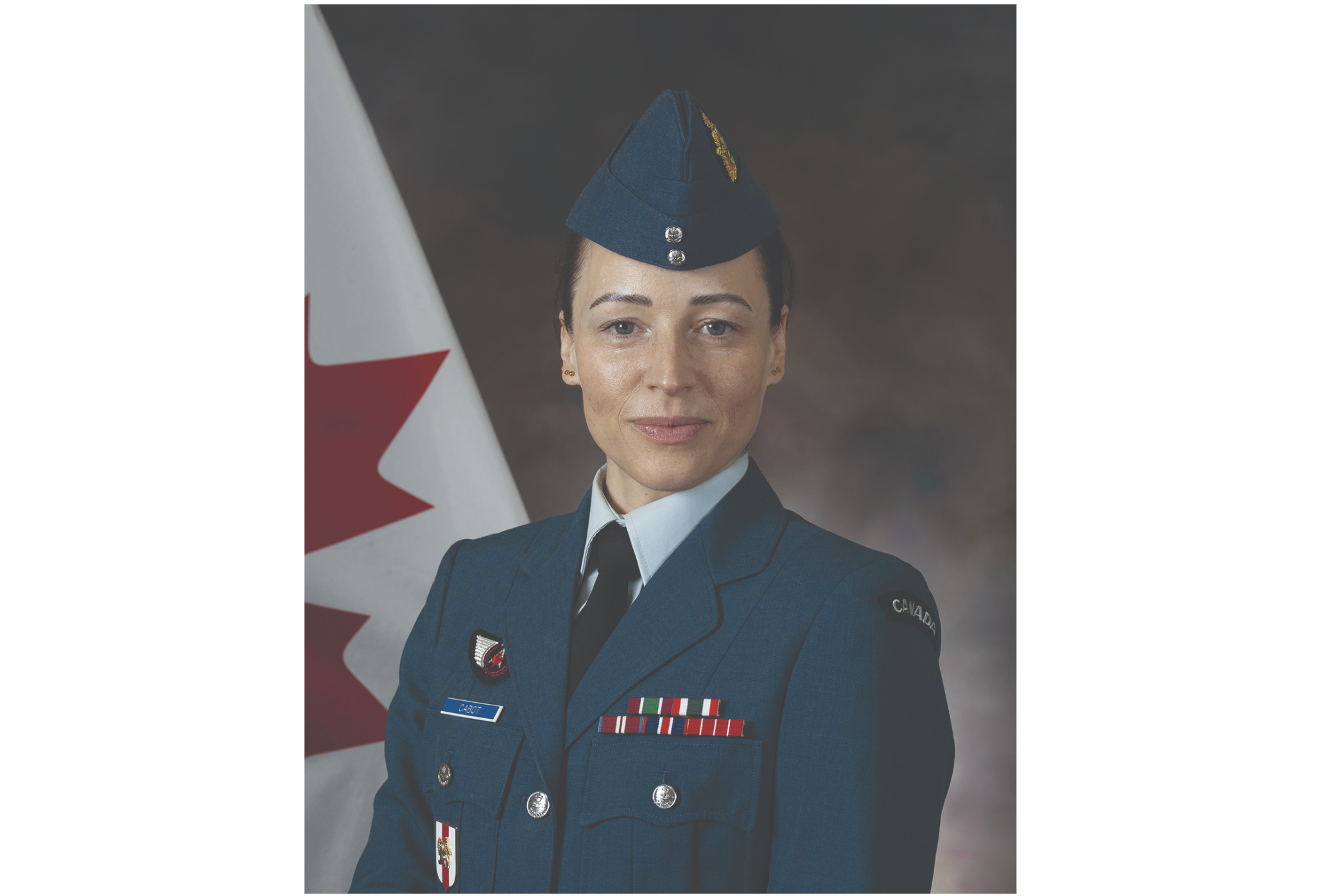
Major Catherine Cabot is currently a student on the Joint Command and Staff Programme at the Canadian Forces College in Toronto, where she is completing a Master of Defence Studies. Raised in an Air Force family, with her father, brother, uncle, and aunt all serving in the Royal Canadian Air Force, Cabot saw military service not only as tradition but as a profession that demanded continuous learning and accountability. Cabot joined the Canadian Armed Forces (CAF) shortly after university without a fixed long-term plan, choosing instead to build experience deliberately. Early in her career, she sought varied postings and leadership responsibilities, developing a reputation for reliability and adaptability.
Over time this approach evolved into a pattern: accept unfamiliar challenges first, then build expertise through practice rather than specialization alone. As Deputy Commanding Officer of 3 Air Maintenance Squadron at CFB Bagotville, Cabot oversaw more than 150 personnel responsible for maintaining CF-18 airworthiness during periods of personnel shortages and fleet aging pressures, directly supporting Canada’s NORAD and NATO commitments. The role required balancing technical risk, operational readiness, and personnel management, reinforcing her focus on practical leadership over positional authority. Among her most visible assignments was her two-year appointment as Senior Aide-de-camp to the Governor General of Canada. In that capacity she supported national ceremonies and engagements focused on mental health and reconciliation with Indigenous Peoples.
She also served as Equerry to His Majesty King Charles III during his visit to Canada for the Speech from the Throne, an experience that highlighted the intersection of military professionalism and national institutions. Her most personally significant experience, however, occurred during Operation REASSURANCE in Romania in 2022. While deployed, Cabot partnered with a local organization working to prevent child trafficking, mentoring young girls and providing a visible example of women in military leadership roles.
The experience reinforced for her that operational deployments influence communities beyond their immediate military objectives. Cabot acknowledges that women in operational environments often feel pressure to demonstrate competence quickly in order to establish credibility. Rather than confronting the dynamic directly, she focuses on consistency and mentorship, helping normalize women’s presence in technical and leadership roles through performance and support to junior members. Her advice to young women entering the profession reflects that perspective: bring your full identity to the role and contribute ideas rather than adapting silently.
Confidence, she emphasizes, grows from preparation and participation rather than seniority. Looking ahead to 2026, Cabot serves as the military co-founder on the board of the newly formalized not-for-profit Canadian Women in Aviation (CWIA) organization and is helping prepare its Montreal conference, scheduled for May 11–14, 2026, continuing her commitment to encouraging women to pursue careers in aviation across both military and civilian sectors. Cabot was nominated by Mr. Neil Rodriguez.
