
By Michael Nickerson
Not to brag, but I rarely make mistakes. In all honesty I’ve been batting almost a thousand since I started to walk (on the first try, I might add). School: perfect. Driving: perfect. Guitar playing: almost perfect, save for playing Stairway To Heaven at a high school party…poor choice that. And my string of critically acclaimed columns here at Esprit de Corps have been one masterpiece after another for over twenty years…well almost.
You see, it was brought to my attention that I might have made teeny tiny error in a column I wrote back in April. Shocking, I know. But here at Esprit de Corps we are sworn to maintain the highest of standards, and well dear reader, when we don’t manage that we step up and admit our mistakes. Well there’s a first time for everything, so here it goes (though no doubt I’ll nail this too).
Right then, April 2026 (Vol. 33, Issue 3). I wrote a piece providing some mild criticism (little things like questioning the level of intelligence/education of officers and such, nothing overboard) concerning how well equipped the 3rd Battalion Royal Canadian Regiment (3 RCR) was during Exercise Global Resolve 2026 last February in Alaska. Now it might be that I went a just a little overboard, perhaps leaving the impression that our soldiers were issued speedos and suntan lotion and little else. As I learned, that was definitely not the case.
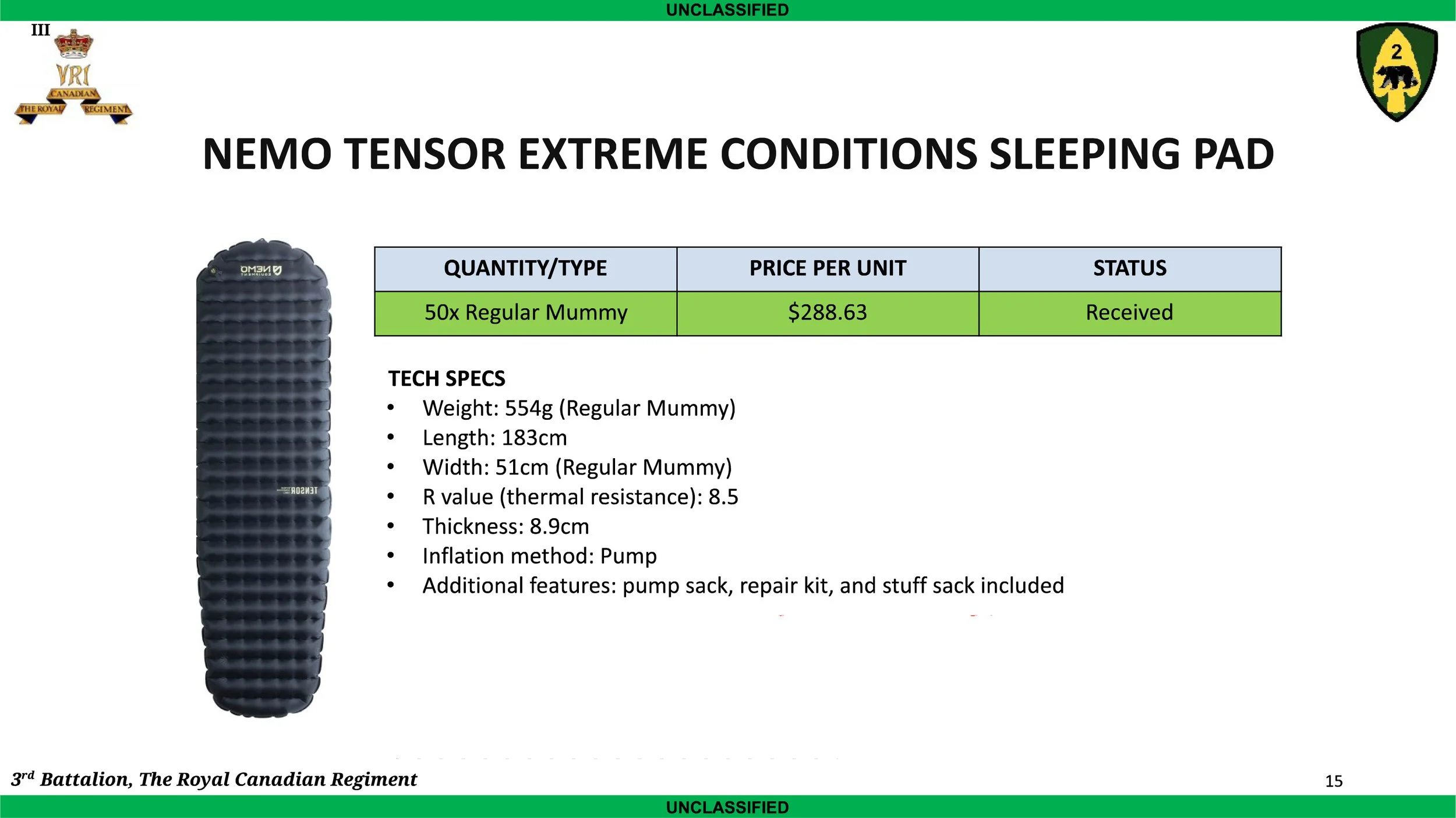
An October 2025 PowerPoint presentation obtained by Esprit de Corps makes it rather clear that they were kitted to the gills. They were provided with off-the-rack Arctic gear (such as high R-value extreme condition sleeping pads and bags) purchased just for Exercise Global Resolve (to the tune of $1.5 million) to augment their existing Arctic kit. And to be clear I’m not referring to the General Purpose Sleeping Bag System (GPSBS) procured two years ago, more suited to operations in New Delhi than Nunavut, but the old (yet still functional, if heavy) Arctic kit of yore. As one source who was there during the exercise put it: “3 RCR possessed the best cold weather equipment ever fielded in CA history.” As hard (and alien) as it is for me to write this: oops, my bad.
So how, you may ask, did some 30 soldiers get frost bite when they were swaddled in the finest Arctic gear known to man? In part (according to the same source) it was because they didn’t actually use the kit provided, or if they did, they didn’t use it properly. Leadership was apparently more concerned with traveling light and fast than with observing proper cold weather operational discipline and using what was needed. And as revealed in a recent article by Murray Brewster with the CBC, evaluation reports stated that at least one company “consistently demonstrated a lack of preparations needed to live in Arctic conditions” with some units demonstrating a "lack of emphasis on basic winter soldiering skills." Ouch!
A rather damning picture of what went on that month, but you wouldn’t know it listening to the military mouthpieces waxing eloquent on how well 3 RCR was prepared and trained for the exercise. When this story first broke last March, Jackie Carmichael reported in The Edmonton Journal that there was “no indication that negligence, poor military tactics, techniques, and procedures or equipment deficiencies led to above-normal injury rates,” at least according to military spokesperson Maj. Stacie Nelles. And in response to the reporting by the CBC and the questioning of 3 RCR’s “basic winter soldiering skills,” the regiment’s commander, Lt.-Col. Aaron Corey, stated that “every soldier to go up on that exercise had to be a cold weather operator qualified,” and that they had “put a lot of effort into preparations for this exercise in the year preceding.”
Now to be fair, the commander made clear that 3 RCR learned from the exercise, that they “had to slow down” and “make sure that our troops had warming cycles” amongst other things, and I have no doubt lessons have been learned, hopefully leading to necessary improvements for future Arctic operations (we are supposed to defend it after all). But if the military wants the buy in and tax dollars of Canadians to go all in on Arctic defence, perhaps a little more candour about making mistakes and how they’re being rectified would go a long way towards that goal.
Not that admitting such thing has ever been easy for them. But if I can admit to a (very rare) mistake, surely military brass can do the same
