
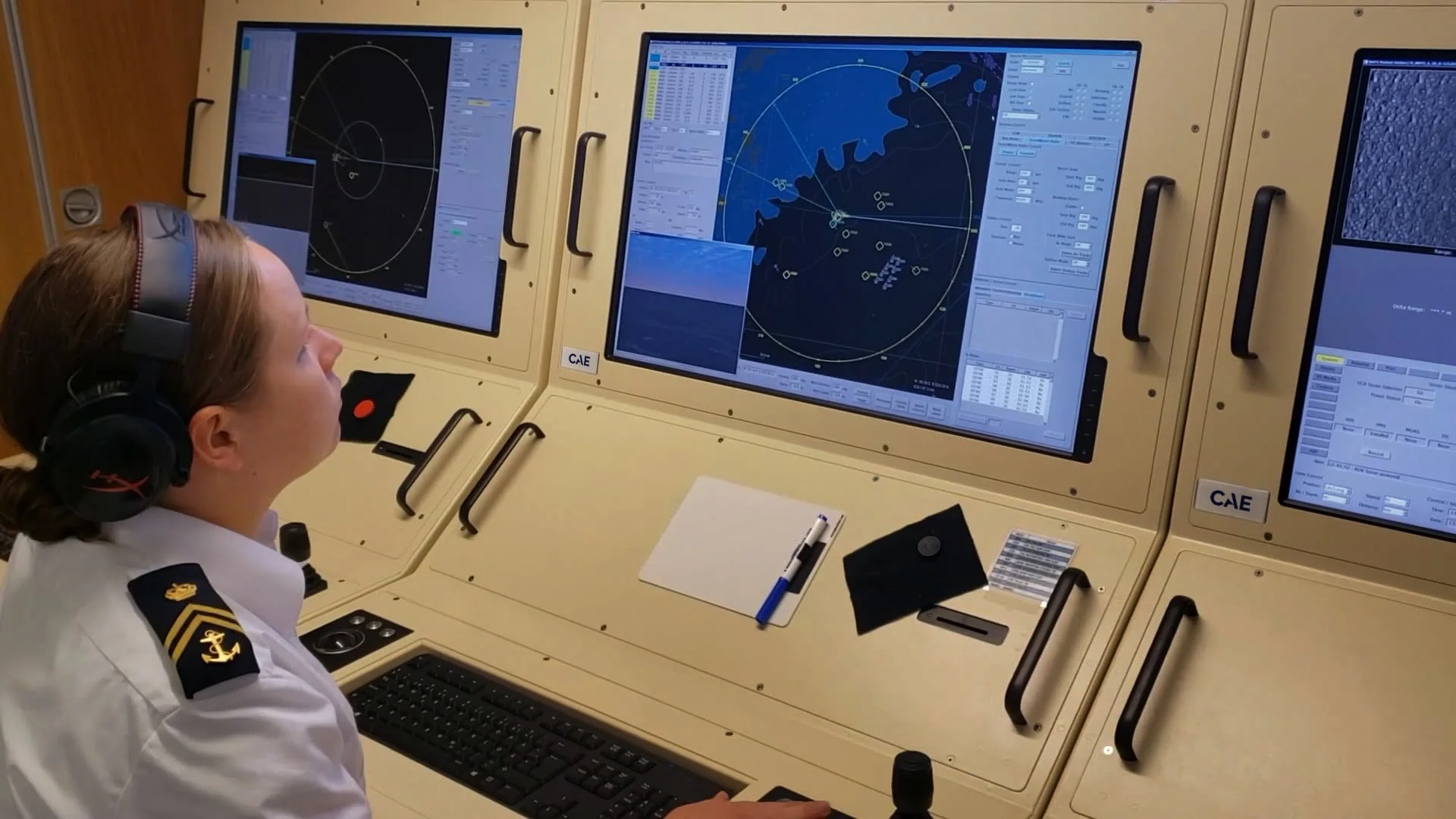
A sailor undergoes training at a Tactical Mission Trainer (TMT) workstation as part of CAE's Naval Warfare Training Solution (NWTS).
By Matthew Crawley
Canada is undertaking one of the most significant naval modernization efforts in its history. The River-class Destroyers will introduce a new generation of systems and technology, while the Canadian Patrol Submarine Project will shape the Royal Canadian Navy’s undersea capability for decades. Understandably, much of the conversation is about the platforms: what Canada will buy, what they will be able to do, and when they will enter service.
There is another question worth asking much earlier: how will Canada build the skills and expertise needed to operate them?
Traditionally, training considerations have followed major platform and systems decisions: define the platform, build the system, develop the technical documentation, and then determine how to train people to use it. That approach makes less sense as warships become more integrated, software-driven, and complex. Training requirements need to be considered throughout the design process, so that as the ship and its systems take shape, there is a clear understanding of what sailors will need to know, practise, and master to operate them effectively.
CAE is seeing that first-hand on Canada’s River-class Destroyer program. We are leading the development of training solutions for the ship’s Integrated Bridge and Navigation System (IBNS), and the Integrated Communications Systems (ICS), including Training Needs Analysis (TNA), courseware development, and advanced training. CAE is also providing human factors engineering services to inform the design of critical spaces aboard the ship, helping ensure that the operator needs are considered in the design of those spaces.
That matters beyond a single program. If Canada is investing in a new generation of ships and submarines, there is an opportunity to consider the human element at the same time as the platform, rather than designing the training enterprise around decisions that have already been made.
The same thinking should extend throughout the life of the fleet. Force generation does not end when the first crew qualifies. A warship may remain in service for decades. Software will be updated, systems and missions will evolve, and new sailors will arrive with different backgrounds and levels of experience. The training system needs to keep pace, developing successive crews while maintaining the skills and readiness of those already serving.
CAE brings this perspective from supporting naval training around the world. Our experience spans naval warfare training for the Swedish Navy, the United Arab Emirates’ Naval Doctrine and Combat Training Centre, bridge training for the U.S. Navy, and platform and systems training for the Royal Australian Navy. Across these programs, we support training from individual skills development through team and collective training and mission rehearsal, using simulation and integrated training environments to prepare sailors and crews for increasingly complex operations.
An Integrated Learning Environment, for example, brings training resources, assessment, and performance data together, helping instructors and training leaders track progress and identify where the training approach may need to adapt. That connected approach can also support a broader workforce development challenge: understanding where sailors are progressing, where additional support is needed, and where training may need to adapt to support sailors in reaching the required level of proficiency.
Simulation helps extend that training environment beyond individual systems and procedures, giving sailors and crews opportunities to practise complex situations that would be difficult, resource-intensive, or impractical to reproduce at sea. Synthetic environments can also evolve as platforms, systems, and operational requirements change, helping training stay aligned with the capability throughout its life.
For Canada, the opportunity is larger than any individual training technology or program. As the country invests in its future surface and undersea fleets, it can build a naval training capability that supports force generation and workforce development as those fleets evolve. The expertise, training systems, and infrastructure being developed today can also inform how Canada considers future submarine training, support its existing fleets, and prepare sailors for increasingly integrated operations.
That requires thinking about training earlier and sustaining that thinking for longer. The question should not be how we train sailors once a new ship arrives. It should be how we build the training system alongside the capability and keep the two aligned over decades of service.
Canada is making a generational investment in highly capable ships. Making those ships operationally effective, year after year and crew after crew, requires the same long-term thinking about the people who will operate them.
You can buy a warship. Readiness must be built.
