
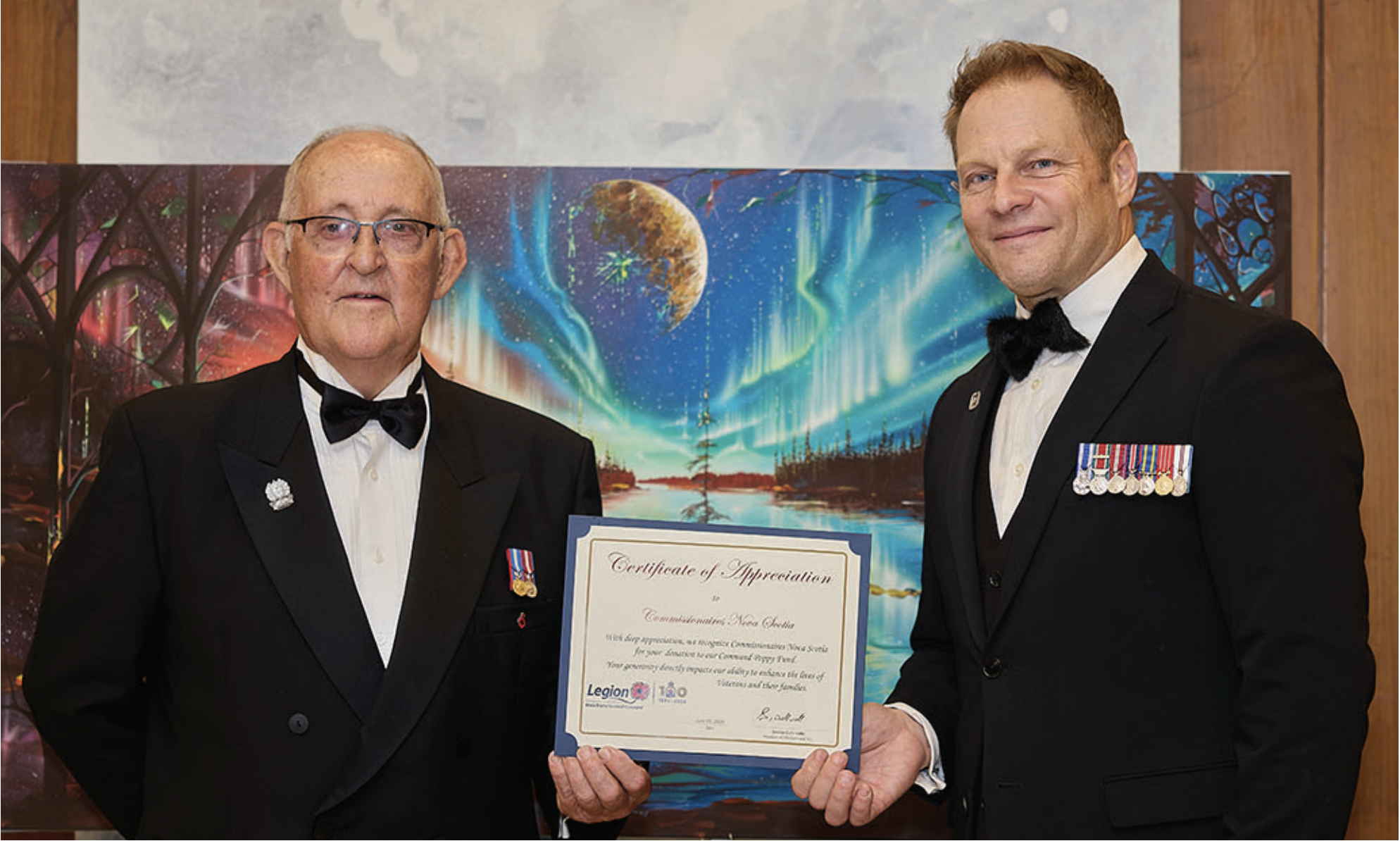
By Jill Smith
In June, Halifax settles into a rhythm all its own. The harbour softens under early summer light, patios begin to fill, and a steady salt breeze threads its way through downtown streets. Just above the waterfront, the Westin Nova Scotian hums with quiet energy: its historic halls and modern meeting spaces alive with conversation as delegates arrive from across the country. For one week, it becomes the national gathering place for Canada’s only not for profit security provider, the Canadian Corps of Commissionaires, and its Annual Meeting of Divisions (AMOD).
Founded in 1925, Commissionaires was built on a singular idea: to provide meaningful employment for veterans returning from service. Nearly a century later, that purpose continues, expanded to include veterans of the RCMP, reservists, allied forces, military families, and others wishing to contribute to the safety and wellbeing of Canadians. Operating as a federation of divisions across the country, Commissionaires delivers security, identification, and consulting services, but always through the lens of its social mandate. As Anne Espenant, vice-chair of Nova Scotia’s Board of Governors, would later reflect, “Our strength is not just in what we do, but in why we do it.” And AMOD is where that mission meets strategy, bringing together division leaders to chart the path forward.
Inside the Westin, the week unfolds with a steady cadence. Mornings begin with governance, updates, and reports that anchor the organization in the realities of performance and accountability. Afternoons shift into dialogue, where divisions exchange ideas on workforce development, technology, and the evolving security landscape. Across sessions, one theme remains constant: how to grow and adapt while staying firmly rooted in purpose.
“AMOD provides a great opportunity to better assess the security landscape and connect dots,” notes Mark Breslauer, delegate and CEO of the Victoria, the Islands and Yukon Division. “We come together as individual divisions but leave as a national organization further aligned in how best to provide our clients with quality service and an array of products.”
Halifax/ Kjipuktuk, this year’s host city, feels like more than just a backdrop. With its deep naval history and enduring ties to Canada’s military community, it echoes the very origins of Commissionaires. That resonance was intentional. Months of planning by the Nova Scotia Division and national organizers ensured the meeting would not only function seamlessly but also reflect the character and warmth of the region.
That spirit came fully to life during the host reception, an evening designed as a classic “Halifax Kitchen Party” located at the National Museum of Immigration at Pier 21. Tables were set with lobster and all the fixings, a shared Maritime experience that encouraged conversation as much as celebration.
The evening opened with a traditional Mi’kmaq welcome delivered by Raymond Sewell, Indigenous singer-songwriter and professor at Saint Mary’s University. Accompanied by three traditional dancers, the performance grounded the gathering in the deep cultural history of the region. What followed was a full musical set featuring renowned Nova Scotia artists, from Theresa Malenfant and Jamilah to Mike Cowie and Liz Rigney. The room transformed, leaders and colleagues becoming, if only briefly, a community bound by music and place.
“We wanted people to feel Halifax,” said Steve Graham, chair of the 2026 AMOD Planning Committee and Governor on the Nova Scotia Board of Governors. “Not just see it but experience it together.”
That sense of connection carried into one of the most anticipated events of the week: the National Board Chair’s Gala. Held annually, the gala is both a celebration and a recognition of excellence across the Corps. National Board Chair, Gord Winkel, was honoured to host the Nova Scotia Division’s patron, His Honour, The Honourable Mike Savage, ONS, the Lieutenant Governor of Nova Scotia, his wife, Her Honour, Ms. Darlene Savage and representing The Honourable Tim Houston, Premier of Nova Scotia, Chris Palmer, MLA for Kings West. Guests and delegates were ready to celebrate those making a difference across the organization.
The gala shone a spotlight on those whose contributions embody the values of Commissionaires. Elinor Clark of the Nova Scotia Division, whose work and volunteer service, both prior to and during her time with Commissionaires, have left a lasting impact, was named the 2026 Commissionaire of the Year. In a notable moment, two individuals were recognized as 2026 Supervisors of the Year: Carey Deschamps of the Northern Alberta, Northwest Territories & Nunavut Division, and Hugh MacDonald of the Nova Scotia Division.
In addition to their awards, each recipient was presented with an original painting by Cree artist Jasyn Lucas, who created all three pieces live during the gala, an experience made possible through the support of Friends United Foundation, a valued partner of the Nova Scotia Division. Each announcement was met with warm applause, reflecting not only achievement, but the deep respect of peers from across the country.
“These awards remind us what excellence looks like in action,” Rebecca Landry, Chief Operating Officer of the Nova Scotia Division remarked. “They reflect the very best of who we are.”
As the week drew toward its close, the conversations turned toward what comes next. There was a noticeable sense of alignment, one that had built steadily across sessions, shaped by both formal discussion and the quieter moments in between.
With the end of the Right of First Refusal framework on the horizon in March 2027, there was a shared understanding that the organization is entering a pivotal period. What emerged from those discussions was not just a plan, but a commitment: to explore new ways of working together, to strengthen coordination across divisions, and to shape an organizational structure that is both more agile and more competitive, while staying firmly anchored in the values that define Commissionaires.
“While the environment in which we operate is changing, our mission does and must remain constant,” said Barry Pitcher, CEO of the Nova Scotia Division.
There was also a growing recognition of where opportunity lies. Conversations turned to emerging areas of business and investment, particularly those tied to Canada’s evolving defence and security landscape. For many in the room, this was more than a strategic shift, it was familiar ground, as many participating in the meetings have served.
Set against the backdrop of Halifax/Kjipuktuk, those discussions took on added relevance. “Across Atlantic Canada, unprecedented investments in defence, shipbuilding, and critical infrastructure are beginning to reshape our regional economy,” adds Pitcher. “For the Atlantic divisions, the opportunity is clear: to work collectively, to contribute to that growth, and to ensure it translates into meaningful employment for veterans and their families.”
By the end of the week, there was a sense that something had taken hold; a shared direction, grounded in both ambition and purpose. AMOD had reinforced what many already understood: that the future of Commissionaires will be built not in isolation, but together.
Yet beyond the formal outcomes, it is the quieter moments that seem to linger. Conversations between sessions, introductions that turn into partnerships, and a shared sense, felt most strongly in places like the Kitchen Party and gala, that Commissionaires is more than an organization. It is a community.
As the final sessions conclude and delegates begin their departures, Halifax carries on in its easy summer rhythm. The harbour glints in the afternoon sun, and the Westin Nova Scotian returns to its usual pace. But for those who gathered here, the week leaves something lasting: a renewed sense of purpose, a clearer direction, and a stronger connection to one another
“Bringing everyone together like this matters,” Bryn Weadon, chair of the Nova Scotia Division’s Board of Governors reflects. “It reminds us that no matter where we come from, we’re all part of the same mission.”
In Halifax, that mission felt not only discussed, but lived.
