
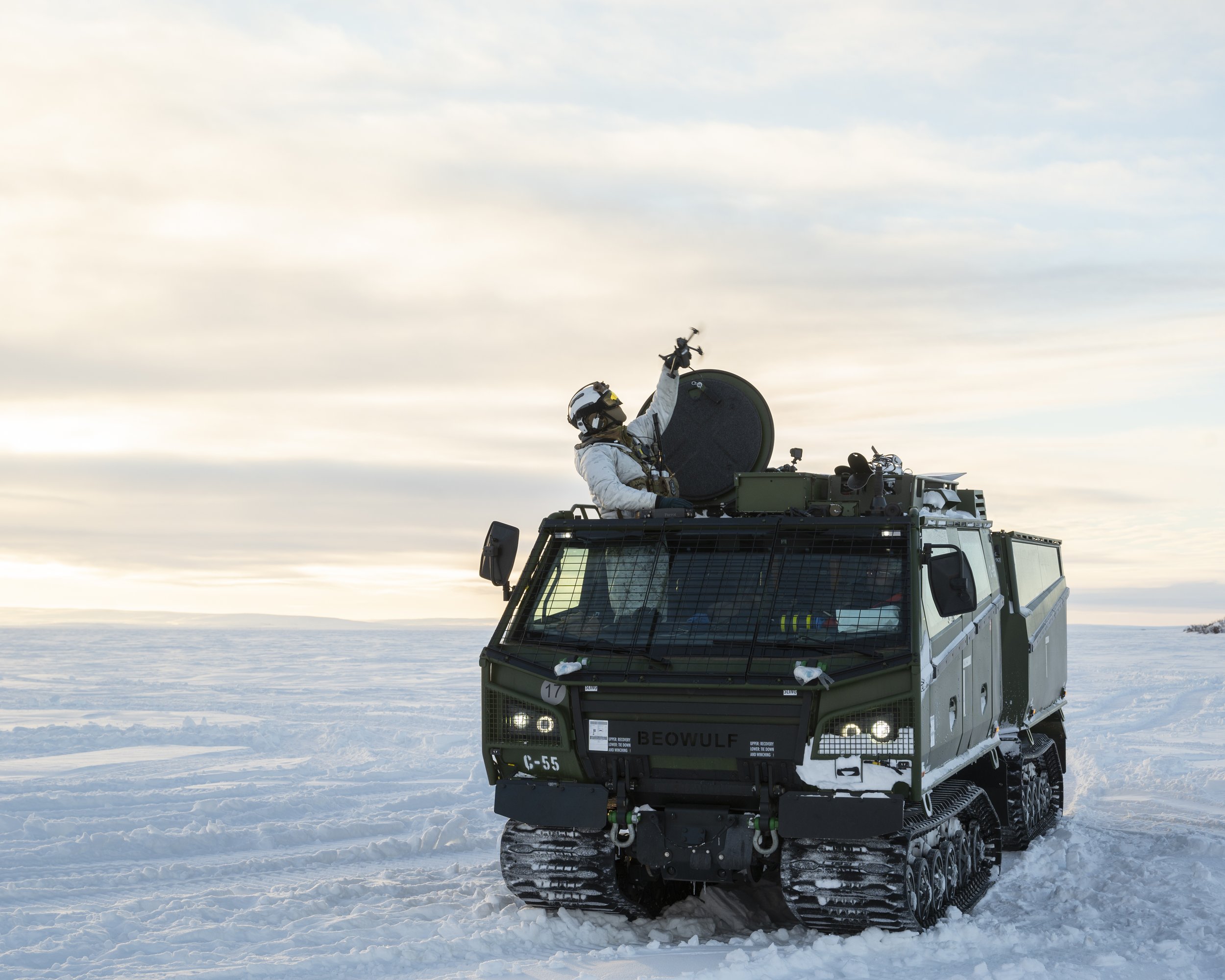
General Dynamics Land Systems (GDLS) and BAE Systems are now in a teaming agreement to offer the BvS10 Beowulf platform for the Canadian Army's Domestic Arctic Mobility Enhancement (DAME) project. (Canadian Forces photo)
By Tim Ryan
The Canadian Army’s Domestic Arctic Mobility Enhancement (DAME) project is starting to gain attention from industry.
General Dynamics Land Systems (GDLS) and BAE Systems are now in a teaming agreement to offer the BvS10 Beowulf platform for the Canadian Army's Domestic Arctic Mobility Enhancement (DAME) project. Under the teaming agreement, BAE Systems Hägglunds will provide the all-terrain vehicle design while GDLS handles in-service support capabilities across Canada.
“Arctic capability is critical for Canada, and the Beowulf will drive both current and future strategic objectives due to its ability to operate in extreme temperatures and unforgiving landscapes,” Tommy-Gustafsson-Rask, managing director of BAE Systems Hägglunds said in a statement. “With a hot production line and a unified supply chain, the platform ensures long-term availability of spare parts and support for the Canadian Armed Forces, while offering seamless interoperability with military units across North America.”
Beowulf is a dual-body all-terrain vehicle that provides mobility in extreme Arctic environments, and maneuverability across mud, sand, muskegs, snow, ice, and deep water due to its amphibious capabilities, according to the company. It noted the vehicle boasts a battle-tested drivetrain derived from the BvS10 family, which is currently in operation in eight nations, six of which are NATO member countries.
The two companies see their offering as a low-risk, proven platform with demonstrated performance that can deliver the military capabilities needed for the defence of Canada’s sovereignty in the Arctic. “GDLS is proud to bring BAE Systems Hägglunds’ Beowulf to Canada to satisfy requirements for the DAME project,” Dave Haggerty, vice president and general manager of GDLS-Canada said in a statement. “With nearly 50 years of working closely with the Canadian Armed Forces in complex project delivery and in-service support we will ensure that the platform remains supported and relevant wherever it is stationed.”
In May 2025, Rheinmetall Canada announced it was partnering with UTV International in pursuit of the DAME project. Rheinmetall would offer the Canadian Forces the “Voyager” from UTV International. Built in Canada, the Voyager D12 Personnel Carrier is an amphibious, articulated, hybrid-electric offroad transport vehicle designed to transport 12 people or equipment in the harsh environments.
UTV has noted that since 1995, its tracked vehicles have excelled in challenging off-road environments across the US, Canada, and beyond. With unique track and suspension systems, they ensure better terrain handling, smoother rides, and reduced stress on the vehicle. “These vehicles offer extreme all-terrain mobility, low ground pressure, and full ground contact, allowing them to climb better and drive through 3 feet of water, swamps, or mud. Safety features include wider tracks, better balance, seatbelts required to start the engine, and protected controls,” according to the company.
https://www.utvint.com/voyager-d12-carrier/
MDA Space Ltd. announced Jan. 8 that it had received an indefinite delivery/indefinite quantity (IDIQ) contract from the U.S. Missile Defense Agency for the Scalable Homeland Innovative Enterprise Layered Defense (SHIELD) program.
https://mda.space/article/mda-space-selected-by-missile-defense-agency-for-shield-program
The firm sees the contract award as positioning itself to bid on future work for U.S. defence initiatives. “As a long-time trusted mission partner to space and defence organizations worldwide, MDA Space is committed to delivering mission-critical solutions and strategic operational capabilities,” Mike Greenley, CEO of MDA Space said in a statement. “Our selection for the Missile Defense Agency SHIELD IDIQ is a recognition of the technology, talent and expertise MDA Space offers to meet defence, security and sovereignty requirements.”
The aim of the SHIELD program is to modernize U.S. defences across land, sea, air, space, and cyberspace. It is also part of the broader Golden Dome missile defence strategy, noted the publication SpaceQ, which covers Canada’s space industry.
SHIELD has a budget of $151 billion U.S. to be spent over a 10-year-period.
Yahoo Finance reported that the announcement of the contract saw MDA Space shares jumping, a sign that the investment community is seeing the U.S. move in a highly positive way.
MDA did not release details on the value of the U.S. contract.
Saab has a contract with the French General Directorate of Armaments (DGA), and has received an order for two GlobalEye Early Warning and Control (AEW&C) aircraft. The deal includes ground equipment, training and support. Deliveries will take place between 2029-2032. The contract also includes an option for DGA to purchase two additional aircraft.
"Today's order underscores the robust partnership between Saab and France,” Micael Johansson, President and CEO of Saab said in a statement. “This choice reinforces France’s commitment to sovereignty and strengthens Europe’s overall protection, with both Sweden and France operating GlobalEye.”
GlobalEye is an advanced multi-domain AEW&C aircraft with an array of active and passive sensors that provide long-range detection and identification of objects in the air, at sea and over land. By providing real-time information to air forces, armies and navies, GlobalEye enables enhanced situational awareness of the surrounding areas and early detection of threats, according to the company.
GlobalEye could become the centre-piece of a deal with Saab if Canada proceeds with the purchase of the company’s Gripen fighter jet.
Saab AB has delivered new proposals to Ottawa that forecast the creation of 12,600 jobs if the Swedish company’s two main military aircraft, the Gripen fighter jet and the GlobalEye surveillance plane, are built in Canada, the Globe and Mail newspaper has reported.
Industry Minister Mélanie Joly confirmed to the newspaper that the industrial-benefits packages arrived in recent days and that the Saab pitch included building Gripens for Ukraine.
GlobalEye uses a Bombardier 6500-series business jet.
Saab estimates building Gripens in Canada would create 9,000 jobs in the country while building GlobeEye would create 3,600 jobs.
The Canadian government has announced the establishment of Canada’s first Maritime Defence Innovation Secure Hub (DISH) at COVE in the Halifax Regional Municipality.
Canada will invest $29.4 million, to establish the Maritime DISH, a new hub focused on resilience and collaboration.
This pilot initiative marks the beginning of a national network of secure, purpose-built spaces, where Canadian researchers and scientists and their trusted partners can co- develop, test, and validate emerging technologies requiring classified handling, according to the federal government. These hubs will focus on critical areas of defence research and development essential to a resilient Canadian innovation industry. These areas include quantum technologies, artificial intelligence, biotechnology, autonomous systems, Arctic research, space, and— in Atlantic Canada—the Maritime DISH will focus on ocean technology.
