
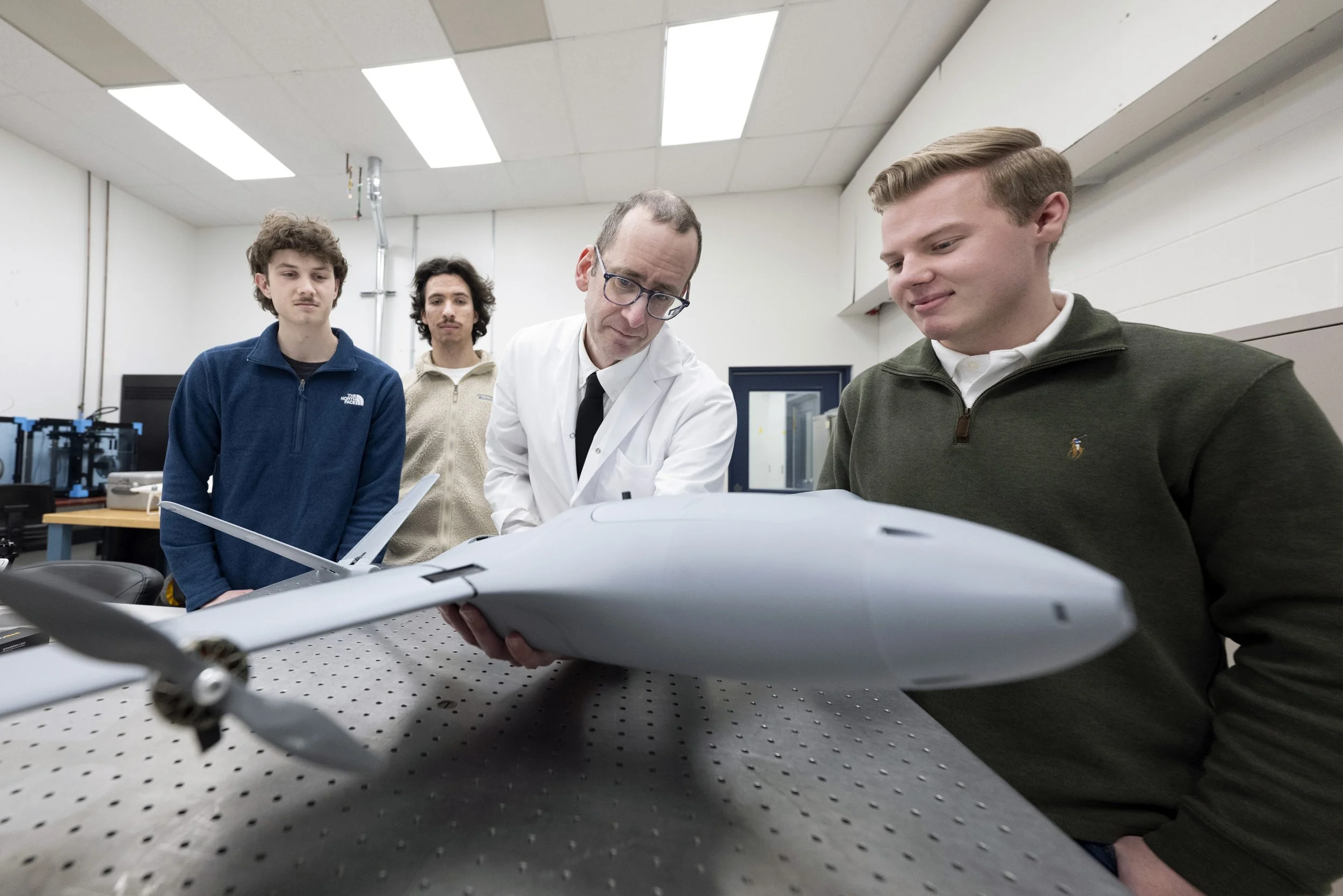
New programs at Niagara College will give students hands-on experience building drones, instrument payloads, and autonomous systems. (Niagara College photo)
By Jason Davis
The influx of new defence spending has industry gearing up new contracts. But that defence boost has at least one college preparing to support industry and the domestic equipment needs of the Canadian Forces.
New programs at Niagara College will give students hands-on experience building drones, instrument payloads, and autonomous systems, preparing them for what the institution hopes will be sought-after careers in defence, security, aerospace, and emerging technologies.
“As autonomous systems including drones play an increasingly important role across industries, Niagara College’s new Defence Systems Engineering Technology programs respond to Canada’s need for skilled innovators,” said Duane Bender, Dean of NC’s School of Media, Trades and Technology. “The program will prepare students for careers in a rapidly evolving field that is shaping the future.”
The Defence Systems Engineering Technology (a three-year program) and Defence Systems Engineering Technician (two-year program) offer experiential learning in mechatronic and photonic (optic/laser) systems for the development of real-world aerial, terrestrial and marine drones, according to the college.
“Niagara College is committed to delivering innovative programming that aligns with industry needs," said college president Sean Kennedy. "By launching the Defence Systems Engineering Technology programs, we are once again responding to a national call – preparing skilled graduates to work with drone technologies that are increasingly critical to national defence and public safety."
Demand for Canadian-made drones is rising, fueled by security and cybersecurity needs best met through domestic development, the college and industry representatives believe.
"Today's industry demands a skilled workforce capable of manufacturing defence products in Canada,” said Dwayne Charette, President at Airbus Helicopters Canada. “Building a local ecosystem with expertise and capacity to fulfill the requirements of Canada's defence interests would be a game changer right here in Niagara.”
The new programs build on 25 years of Niagara College’s leadership in photonics education and address evolving industry needs and emerging technologies.
The college has also launched a new, one-year Cybersecurity Graduate Certificate program, which equips students with the practical and theoretical expertise needed to secure digital systems and data.
Calian Group Ltd. announced a strategic initiative to help accelerate the development and deployment of sovereign C5ISRT (Command, Control, Communications, Computers, Cyber, Intelligence, Surveillance, Reconnaissance and Targeting) capabilities through what the firm has called Calian Ventures.
Under the initiative, Calian will advance technology collaboration and mobilize funding to accelerate capability development across Canada. Funding will be drawn from multiple sources, including capital investment from VENTURES, co-development of new intellectual property from Calian alongside multiple Canadian small to mid-size enterprise, contributions from regional investment agencies, and federal programs.
The first initiative, according to Calian, will establish a national network of regional development labs to accelerate the testing, validation and scaling of defence technologies developed through VENTURES. These labs will convene small and medium-sized enterprises, the Canadian Armed Forces, NATO, government, academia, and industry partners to advance innovative, interoperable solutions from concept to operational capability, the firm added.
“Canada is facing a fundamentally different security environment and meeting the moment requires sustained investment, trusted partners and long-term commitment,” said Patrick Houston, Chief Executive Officer, Calian. “This investment reflects Calian’s confidence in Canada’s defence future and our responsibility as a Canadian company to help strengthen Canadian sovereignty as well as help build the Canadian defence industrial base.”
The Royal Canadian Air Force has begun preparations to receive its newest aircraft, scheduled to arrive in the summer of 2027.
In December the Canadian government announced it would buy six Canadian-built Global 6500 aircraft for the Royal Canadian Air Force under the Airlift Capability Project – Multi-role Flight Service.
The purchase is one of the initial procurements under the new Defence Investment Agency (DIA). The new planes will replace the current CC-144 Challenger fleet to perform worldwide utility flights and support missions such as aeromedical evacuations, disaster relief, humanitarian aid and national security operations. The estimated value of the contract is approximately $753 million, with the first aircraft expected to be delivered by summer 2027.
Initial operating capability is expected to be reached by the end of 2027. The contract also includes training for aircrew and maintenance personnel as well as and military modifications.
More than 60 Canadian suppliers are involved in supporting the production of the aircraft.
The aircraft will be built at Bombardier’s Global Aircraft Assembly Centre in the Toronto area. Interior completion work on these aircraft will be done in Montreal.
The Royal Canadian Air Force has operated Bombardier Challenger aircraft since 1983.
Stephen Fuhr, Secretary of State for Defence Procurement, said the purchase of the Global 6500 aircraft under the Defence Investment Agency “is a turning point in how Canada equips its military. By streamlining processes and cutting red tape, the Defence Investment Agency is accelerating the delivery of the versatile capabilities the Royal Canadian Air Force needs. Canada has a world-class aerospace industry, and this investment will harness that strength to create good-paying jobs, drive innovation, and bolster our security.”
Bombardier Defense is also involved with the PEGASUS (Persistent German Airborne Surveillance System) program. In December Lufthansa Technik Defense and Bombardier Defense announced they had reached another key milestone in PEGASUS as the first aircraft had successfully arrived in Germany. Following its transatlantic flight from Bombardier’s facility in Wichita, Kansas, the aircraft landed at Lufthansa Technik’s headquarters in Hamburg, where the next major phase of the program will now begin.
Led by national electromagnetic warfare firm HENSOLDT and using the extensive special mission aircraft capabilities of Lufthansa Technik, the German MRO (Maintenance, Repair and Overhaul) specialist, and of Bombardier, the Canadian aircraft manufacturer, the PEGASUS program will provide the German Armed Forces with a state-of-the-art airborne signals intelligence capability.
Hanwha Aerospace signed a contract with the Norwegian Defence Material Agency (NDMA) to provide the Chunmoo Multiple Rocket Launcher System (MRLS) to the Norwegian Armed Forces. The firm noted that this marks a significant milestone as the company’s first major defence contract of 2026.
While the total scale of Norway’s acquisition project is budgeted at $2 billion, this specific agreement for the Chunmoo system is valued at approximately $922 million. Under the contract, Hanwha Aerospace will deliver 16 Chunmoo launch vehicles, a precision-guided missile package, and Integrated Logistics Support.
