
By Jason Davis
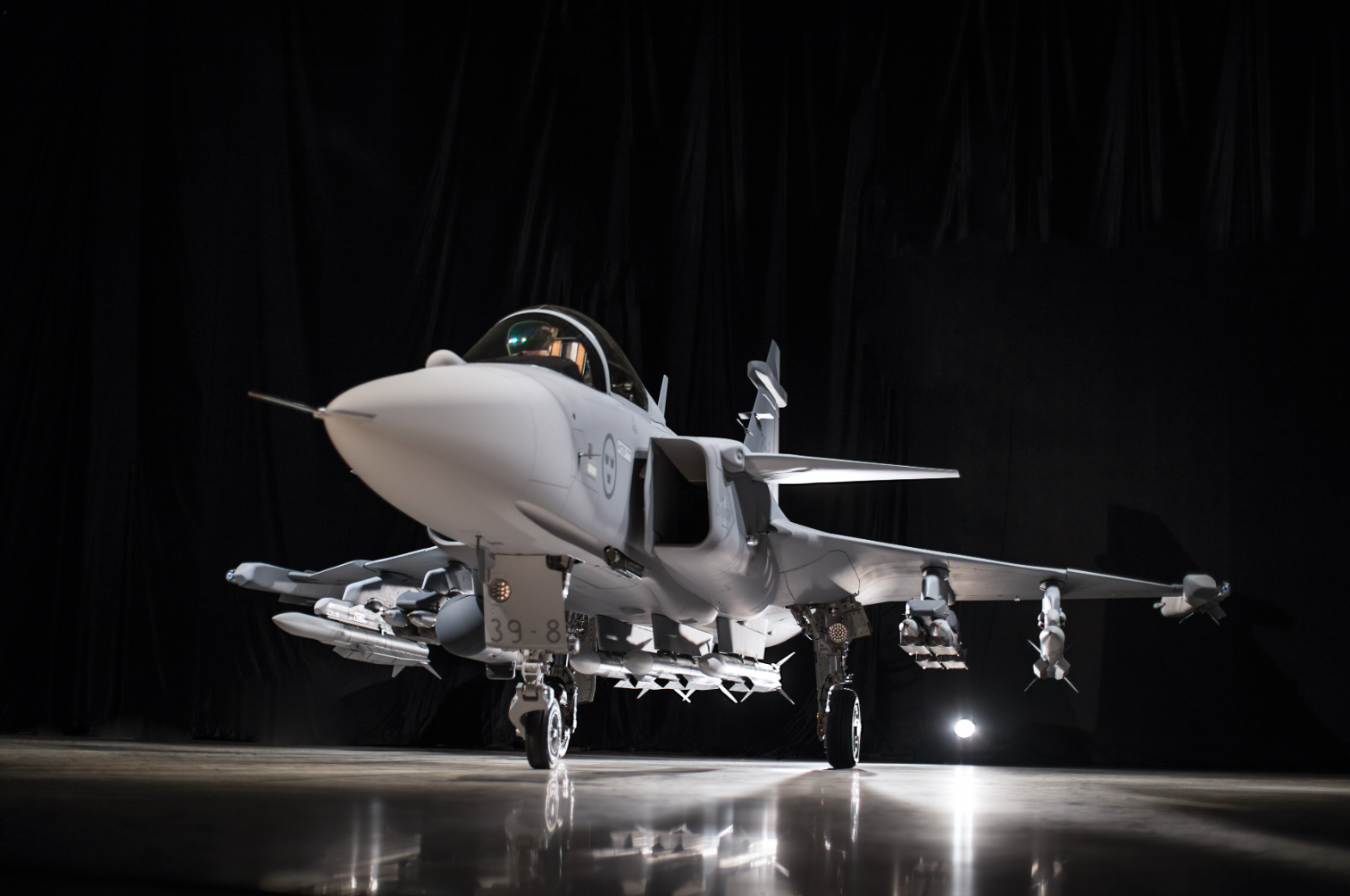
Saab says it plans to work with CAE, IMP and Magellan Aerospace as its principal Canadian industry partners if the Gripen E fighter jet is selected by the Canadian government.
If selected, Saab says it and its Canadian partners will establish a comprehensive, in-country capability for the production, final assembly, support and further development of airpower capabilities. The collaboration would also include in-service support (ISS), training and long-term sustainment capabilities.
“Canada's fighter capability is a long-term national investment. Together with CAE, IMP and Magellan Aerospace we are prepared to establish a strong Canadian industrial ecosystem around Gripen that delivers operational effect, national sovereignty and lasting industrial and technological benefits," Micael Johansson, President and CEO of Saab, said in a statement.
Saab has signed a new Teaming Agreement with IMP to establish a new final assembly line, for the Gripen fighter in Canada, if Canada decides to acquire the aircraft. IMP will also be responsible for electrical assembly production and ISS for Canada’s Gripens.
Saab has signed a new Memorandum of Understanding with Magellan Aerospace to provide local manufacturing of advanced aerostructures, composite structures and structural assemblies in Canada, if Canada decides to acquire the aircraft.
Saab has previously signed a Memorandum of Understanding with CAE to deliver advanced fighter pilot and technician training, mission systems engineering and support/sustainment capabilities in Canada, if Canada decides to acquire the aircraft.
Meanwhile, 49North, a wholly-owned subsidiary of MDA Space, announced it has awarded a contract in support of Canada’s Remotely Piloted Aircraft System (RPAS) project to Airborne Sensing Lab, a consortium led by TerraSense Analytics in collaboration with the University of British Columbia Survive and Thrive Applied Research initiative and KF Aerospace.
ASL will provide 49North with a high-quality airborne data-collection platform to capture electro-optical and infrared (EO/IR) imagery of maritime vessels over the Strait of Georgia, according to the company. The imagery will support the development of the RPAS project’s automated target-classification capability.
This contract award to ASL is part of 49North’s $78.2 million RPAS contract with General Atomics Aeronautical Systems, Inc. 49North is a key member of Team SkyGuardian Canada, alongside GA-ASI, CAE, and L3Harris WESCAM. The companies are responsible for delivering 11 CQ-9B Guardian aircraft to the Royal Canadian Air Force by 2028. The CQ-9B Guardian is based on GA-ASI’s MQ-9B.
Bombardier has signed a strategic Memorandum of Understanding with UK-based BAE Systems to explore opportunities to develop complementary industrial and technology capabilities that may support future combat air programs.
Under the MOU, Bombardier and BAE Systems will identify areas of collaboration across key technological and industrial capabilities. These include R&D, systems integration, workforce and supply chain development, industrialization and in-service lifecycle management. Both companies will now work to build a framework that incorporates practical areas of cooperation and assess future opportunities aligned with future capability requirements, government priorities and industrial objectives, according to their statements.
“This MOU with BAE Systems provides a clear framework to explore how these capabilities can support next-generation defence programs, while strengthening industrial capacity, high-value jobs and long-term aerospace leadership,” said Stephen McCullough, Executive Vice President of Engineering, Product Development and Bombardier Defense.
Bombardier says this MOU between itself and BAE Systems marks an important step in exploring how Bombardier’s aerospace expertise, advanced manufacturing capabilities and defence integration experience could contribute to the development of next-generation air combat capabilities. This MOU also supports broader efforts to strengthen the defence industrial base through highly skilled engineering, manufacturing, and systems integration capabilities. Canada announced its observer status in the Global Combat Air Programme (GCAP), alongside partner nations Japan, Italy and the UK, in July 2026.
Calian Group Ltd. announced that it has been awarded a five-year contract valued at approximately $47 million to continue providing scenario development support to the NATO Joint Warfare Centre (JWC) in Stavanger, Norway.
The contract extends Calian’s long-standing relationship with JWC.
Under the contract, Calian will support the design, development and maintenance of complex training scenarios that underpin NATO’s strategic and operational-level exercises. These scenarios create realistic and evolving operating environments that challenge commanders and staff to make decisions, coordinate across domains and prepare for the increasingly complex security environment facing the Alliance. The NATO Joint Warfare Centre is a key part of NATO’s collective training enterprise, supporting the preparation of NATO headquarters and forces for current and future operations.
Calian currently serves as a prime contractor supporting JWC and provides subject matter expertise for operational and strategic-level exercises.
The Canadian Commercial Corporation signed a Memorandum of Understanding with Kuwait's Ministry of Defence that establishes a government-to-government framework to help Canadian companies support Kuwait's defence and security modernization priorities. As part of the MoU, CCC will provide Kuwait access to a full range of proven Canadian capabilities.
CSG has invested in a 9.5% stake in MDA Space. The investment forms part of CSG’s long-term strategy to develop space capabilities to complement its existing defence and aerospace businesses.
EVIO has unveiled the Battery Box, part of its Portable Power family—a Canadian-designed, modular battery energy storage system advancing toward prototyping for dual-use defence operations in remote, demanding environments. Drawing on high-energy-density lithium-ion battery packs developed for the EVIO 810 aircraft, this product is designed to support dual-use customers who need substantial electrical power in a compact, rugged and transportable system, according to the firm.
The EVIO Battery Box delivers reliable, ruggedized, deployable power for defence and security applications, from Arctic and tactical operations to naval, land and air platforms, disaster relief and remote mining. Its modular design supports extended silent operation, powering communications, sensitive sensors and essential equipment while reducing acoustic and thermal signatures, generator run- time and fuel requirements.
Designed around a 147E standard military pallet, each EVIO battery box has an unparalleled energy storage capability that is 3 to 5 times higher than any other option on the market. This configuration can accommodate four EVIO battery boxes on a 463L standard military pallet, substantially reducing logistics costs to bring power to remote points of use with unprecedented megawatt power capability.
