
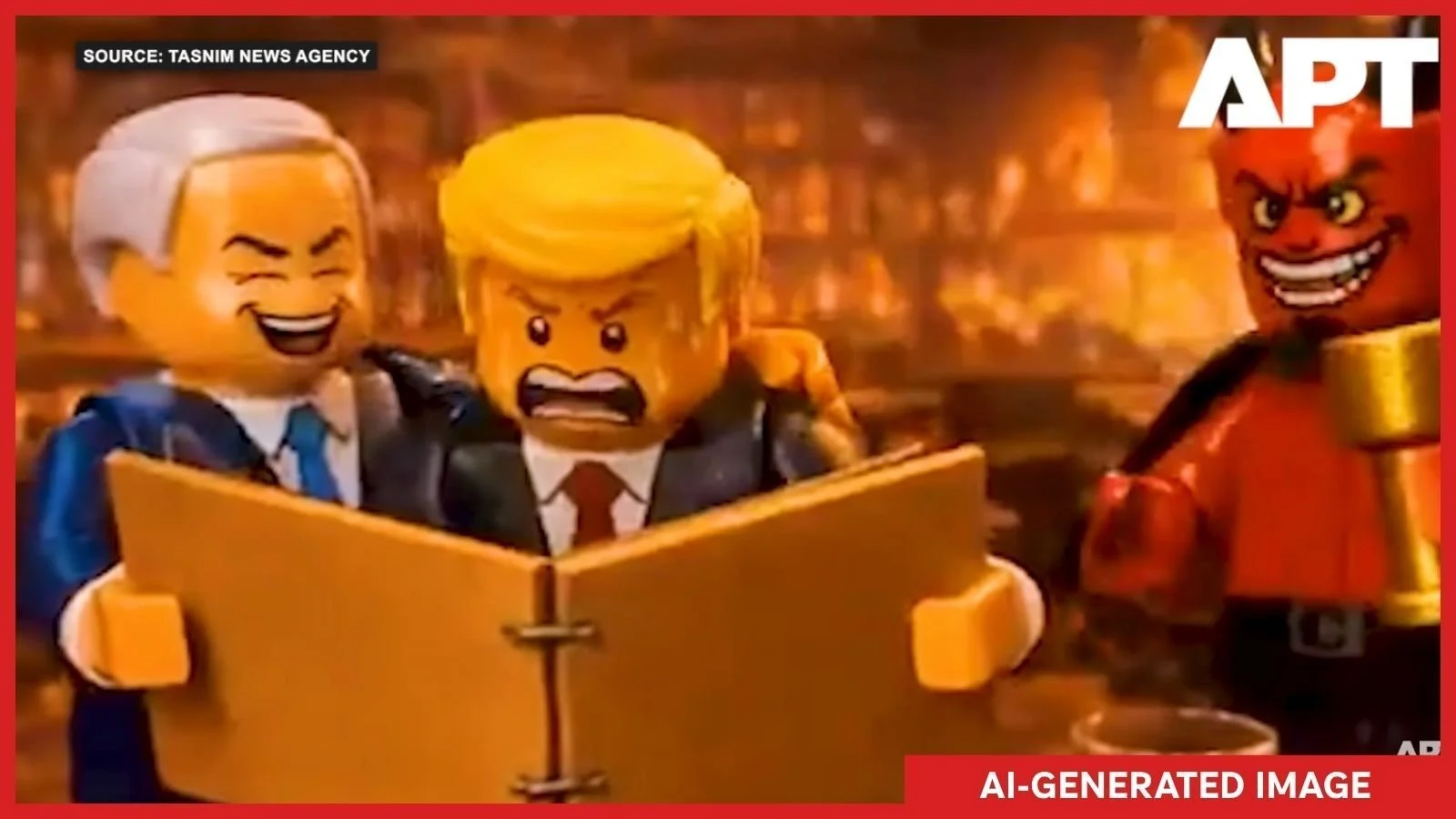
AI generated Iranian propaganda videos mock the U.S. military and U.S. president Donald Trump’s war on Iran. (Images courtesy Explosive Media)
By Tim Ryan
Iran has hit propaganda gold with its videos using Lego-like figures to troll U.S. President Donald Trump.
The AI-generated clips have been viewed hundreds of millions of times on social media. Often set to a rap song, they portray Trump as a loser, and make a direct link between the Iran war and Trump’s efforts to direct attention away from his failure to release the files related to his pedophile friend, financer Jeffrey Epstein.
As the BBC recently reported, one of the videos shows Donald Trump falling through a whirlwind of "Epstein file" documents as rap lyrics tell the viewer "the secrets are leaking, the pressure is rising".
"Slopaganda" - coined in an academic paper last year as a play on 'AI slop' - is too weak a term to capture how powerful this "highly sophisticated" content is, propaganda expert Dr Emma Briant told the BBC.
https://www.bbc.com/news/articles/cjd8jrd1vnyo
The videos emerged early in April and have since become a key component to Iran’s propaganda campaign against the U.S.
The U.S. and Israel began large-scale attacks on Iran starting on Feb. 28.
The AI Lego-style videos, which run about two minutes in length, are able to be created and posted on social media within 24 hours.
Other individuals featured in the videos include Israeli leader Benjamin Netanyahu and Secretary of War Pete Hegseth. Hegseth is portrayed as a drunk, often lying in his own vomit, as well as a wife beater. One of the videos shows Hegseth as kissing Trump’s ass while another suggested he has performed fellatio.
The content is being created by a group which calls itself Explosive Media or Explosive News. One of the group’s organizers acknowledged to the BBC that the Iranian government commissioned the videos.
U.S. news outlets such as Wired and the New Yorker have also reported on the videos.
News reports, including in the Middle East Eye, have revealed that Google, the owners of YouTube, have now removed a channel on the platform that had been posting the Iranian videos. "Upon review, we’ve terminated the channel for violating our Spam, deceptive practices and scam policies," a YouTube spokesperson told Middle East Eye. "YouTube doesn’t allow spam, scams, or other deceptive practices that take advantage of the YouTube community."
Social media commentators noted that Google’s actions are in support of U.S. foreign policy. The videos remain on the social media platform X.
Meanwhile, getting information out of the Department of National Defence these days has become almost impossible.
But nothing compares to the absolute gong show that involved Defence Minister David McGuinty in March, 2026 as he squirmed in trying to explain his conflicting statements regarding allegations the Canadian Forces and his department were involved in trying to coverup details about an attack on Canadians in the Middle East.
The fiasco started when La Presse newspaper first reported on March 12 that an analysis of satellite imagery suggested the small Canadian section of the Ali Al-Salem airbase in Kuwait sustained damage in an Iranian attack on March 1.
A London Free Press journalist asked McGuinty at an event in Kitchener, Ont., when he had “first learned about this attack.”
McGuinty stated that he was “first informed about the situation in the Middle East while abroad with the prime minister on a global tour in the Indo-Pacific.”
That prompted the reporter to ask a follow-up question, in which he noted the minister “knew about this before La Presse reported on it 11 days later.”
“No, I didn’t know about it before La Presse reported on it,” McGuinty responded. “I saw the La Presse story while I was overseas.”
That, in turn, prompted questions about why McGuinty was unaware of the attack on a Canadian military location and whether he was being properly briefed on the war.
A short time later, McGuinty backtracked, claiming in a new statement that he knew immediately about the attack. “I receive intelligence and security briefings regularly. I am made aware of incidents relating to (Canadian Armed Forces) members and assets around the world. That was the case immediately following the strike, and that continues to be the case,” McGuinty said.
The Defence Minister refused to confirm whether the attack struck or damaged any Canadian equipment or infrastructure at the base. “This is something we do not talk about,” a testy McGuinty claimed. “I don’t know why this is a difficult thing to get through. We do not put the men and women of the Canadian Armed Forces in harm’s way or at risk. We do not share operational information.”
Journalists had a field day with the minister’s statements. National Post reporter Chris Nardi tweeted March 18: “Defence Minister David McGuinty yesterday: revealing the fact Camp Canada in Kuwait was struck by missile(s) could "compromise" security.”
Nardi then included a video clip of Australian Prime Minister Anthony Albanese the same day confirming that an Iranian projectile hit the same air base where Australian personnel were stationed.
Albanese didn’t hide behind some bogus “operational security” claim but confirmed all Australian personnel were safe and stated that the projectile landed on a road leading to the base.
Predictably, Conservative MP James Bezan accused the Liberals of being too secretive about the war (somewhat ironic considering the secrecy of the Conservative government when it was in power).
McGuinty fired back, accusing the Conservatives of trying to put Canadian troops in danger. “I think it’s up to the Conservative party to explain why they might want to pursue information or reveal information that would compromise that security,” said McGuinty.
That ploy was taken right out of the Conservative playbook from the Afghanistan war time period - during that conflict members of the Stephen Harper government often accused the Liberals of putting troops in danger for asking too many questions.
