
By Scott Taylor
With the recent Liberal government promises to dramatically boost defence spending, there has been renewed public interest in what equipment and weapon systems should be prioritized for purchase.
This increased scrutiny quickly lays bare the fact that almost the entire arsenal in all three major combat branches need urgent renewal.
For instance the current debate over a choice of fighter jet to replace the Cf-18 Hornets makes one realize the RCAF has been operating the current fighter fleet for over four decades.
The ongoing competition to acquire up to 12 diesel-electric attack submarines from either Korea or Germany, highlights the fact that the RCN struggles mightily to keep even one of our four old Victoria Class submarines operational.
Last week the Ottawa Citizen reported that the Canadian Army is pushing ahead with a procurement project to acquire up to 170 Domestic Arctic Mobility Enhancement (DAME) vehicles.
The proposed timeline would see a request for proposal go out this year and a contract issued by 2027. Actual delivery of the fleet of DAME vehicles would begin in 2032.
When discussed in April 2025, industry representatives were told by DND that the budget would be between $100 million to $249 million. However that project price tag has mysteriously ballooned to an estimated $500 million to $1 billion on the DND website.
The specifications for the DAME project are that the vehicle have a crew of two and be capable of carrying at least 8 fully equipped soldiers. They need to have a range of 300 kilometres and be able to operate without support for 72 hours.
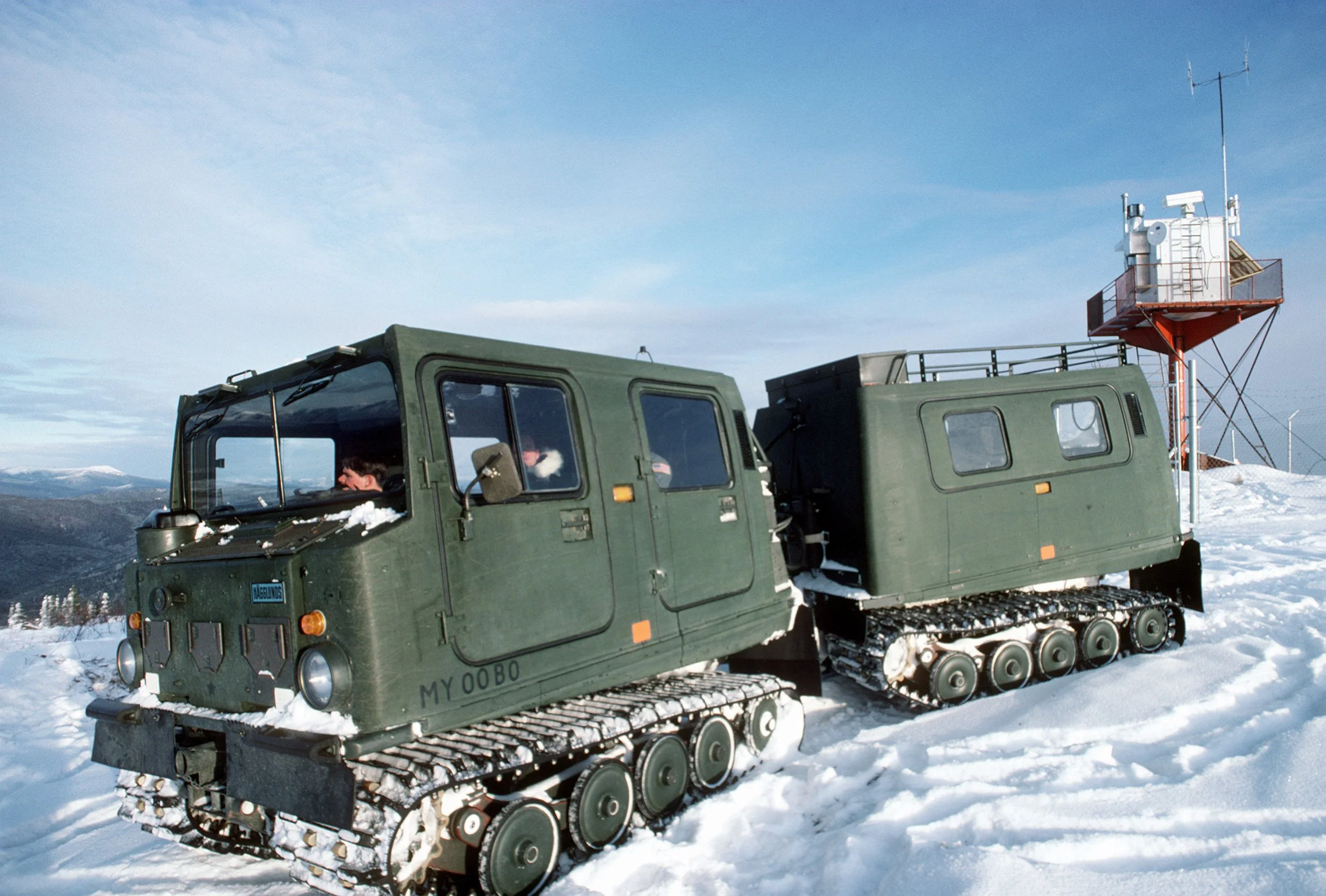
Bidders will need to offer four separate variants of the DAME; a troop carrier, a command post, a cargo carrier and an ambulance. Technically the new DAME fleet will be replacing the Canadian Army's current Arctic capable fleet of Bandvagn (BV) 206's.
Back in the early 1980's Canada acquired 78 of these vehicles from Swedish manufacturer AB Hagglunds and Soner.
As an all-terrain amphibious carrier, designed for crossing wetlands and soft snow, the BV 206 is an excellent vehicle. Its design is based on a split cab single-drive-train system, which allows it to negotiate tough cross-country conditions without increasing the ground pressure beyond that of a walking man.
To achieve this, the BV 206 relies upon a light-weight fibreglass chassis and extra wide rubber tracks. The primary rationale for Canada buying the BV 206's was to operate them in the high Arctic, not so much in Canada but in Norway.
Back in the 1970's at the height of the Cold War, Canada was pressured by NATO allies to a larger commitment to European security than the mechanized brigade and three fighter squadrons based in West Germany. The compromise solution was to create the Canadian Air Sea Transportable (CAST) brigade.
In theory, in the event of a Soviet invasion of Norway, Canada would airlift a rapid reaction force to northern Norway while Norwegian Roll-On-Roll-Off transport ships would convey the bulk of the CAST brigade across the North Atlantic.
The core element of the CAST brigade was 5 Canadian Mechanized Brigade Group based in Valcartier, Quebec. The RCAF also pledged to deploy a couple of squadrons of CF-5 fighters to the airfield at Bardufoss, north Norway. It was an ambitious plan which failed miserably the few times that full scale exercises were attempted.
To expedite the rapid deployment of the air transported advance guard of the CAST brigade, the bulk of Canada's BV 206 fleet were pre-deployed in storage facilities in Norway.
Unfortunately, with the dissolution of the Soviet Union and the end of the Cold War, Canada let the BV 206 fleet more or less lapse into oblivion. There are presently 47 of the original 78 still on the books but only about 18 of those vehicles are still in running order.
The remainder of the BV 206 fleet are cannibalized for parts.
A little remembered fact is that at one point Canada planned to build and operate a massive fleet of 800 of a Canadianized version of the BV 206. It was part of a major policy plan to create a 'Total Force' mix of regular and reserve units.
At that juncture the Canadian militia numbered around 20,000 and the plan was to grow that to 40,000. The BV 206, renamed the Northern Terrain Vehicle was to be the transportation workhorse of this expanded militia.
Hagglunds of Sweden partnered with a Canadian company called Foremost Inc. and the 800 NTV's were to be built in Calgary. That all got scrubbed with the post Cold War budget cuts by the Mulroney Conservatives in 1991.
The $200 million budget for the NTV was cancelled but not before the government forking out roughly $45 million in cancellation costs to Hagglunds-Foremost who had already begun construction on the assembly facility in Calgary.
Let's hope that this time around, the Canadian Army actually acquires a much needed capability if we are serious about operating in the high Arctic.
