
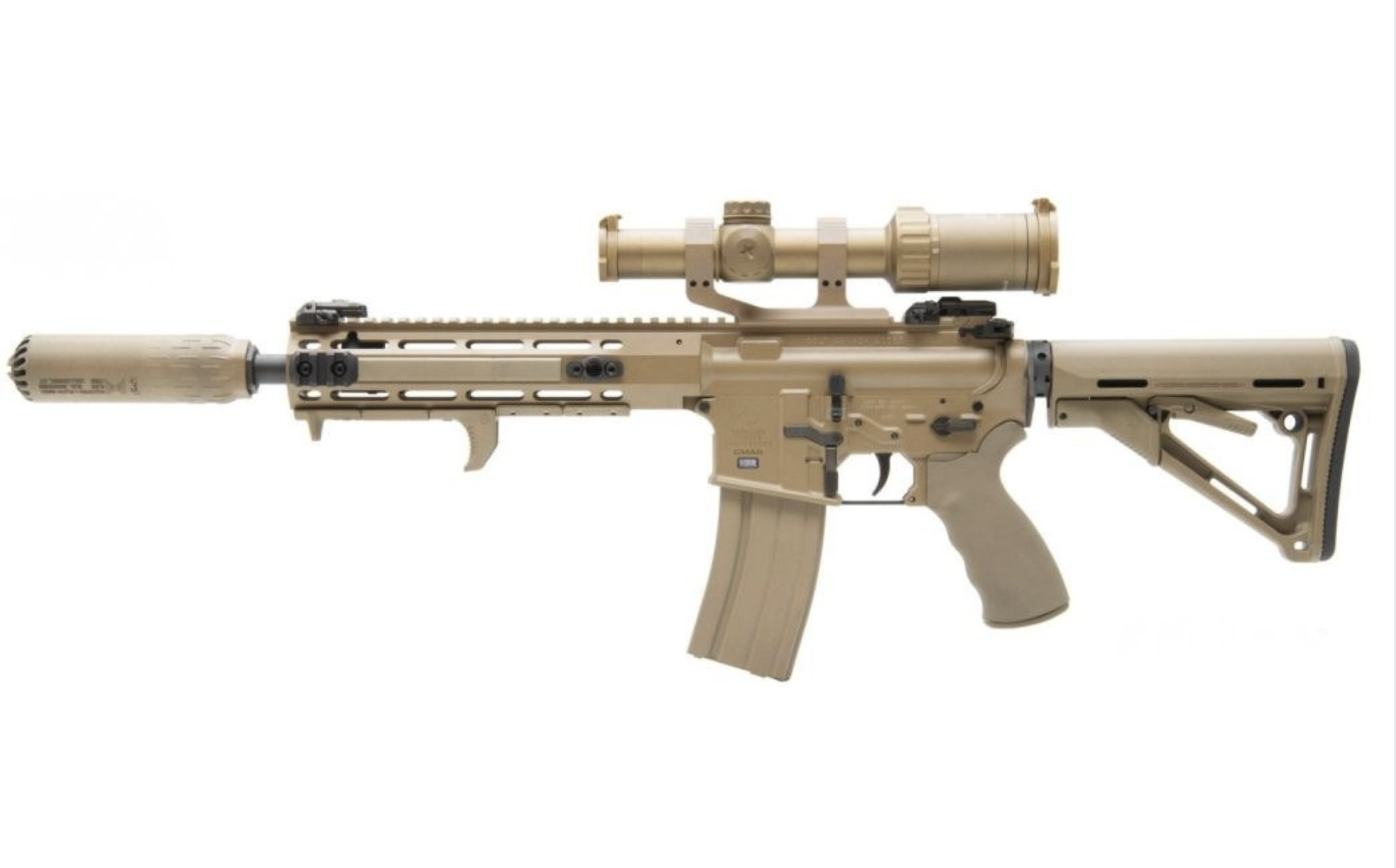
Photo Credit: Colt Canada
By Scott Taylor
On March 19th, just ahead of the federal government's fiscal year deadline of March 31st, the Department of National defence announced a major purchase of new assault rifles for the Canadian Army.
The $307 million dollar price tag for the first batch of what are known as Canadian Modular Assault Rifles (CMAR) will help push last year's defence spending to the NATO alliance's goal of 2 per cent of Gross Domestic Product (GDP).
Close observers of the Canadian military will know that although former Prime Minister Stephen Harper had promised at a NATO summit in 2014 to reach the 2 per cent of GDP on defence spending, that goal was never met. In fact, under the Harper government defence spending dipped below one per cent.
Following the election of the Trudeau Liberals in 2015, additional funding was allocated to DND. However at the start of the 2025-2026 fiscal year, it was only planned to spend 1.3 per cent of GDP on national defence.
That was prior to the inauguration to a second term for US President Donald Trump. To justify a tariff war and support his threats of annexing Canada into becoming his 51st state, Trump bemoaned a lack of border security and highlighted our 'shirking' when it came to our defence spending.
Newly elected Prime Minister Mark Carney spoke defiantly of getting Canadian 'elbows up' with regards to the tariffs.
However as an act of appeasement to Trump the Carney Liberals leased a couple of helicopters to demonstrate their willingness to secure an already secure border.
On the issue of defence spending Carney vowed mid-June 2025 that Canada would balloon defence spending to $93.3 billion to reach the 2 per cent of GDP within that fiscal year. It was a tall order for a dangerously under strength Canadian Armed Forces that already struggles to administratively procure already contracted hardware.
Thus, Carney made some clever moves to boost the defence ledgers.
One major move was to simply transfer the Canadian Coast Guard from the Transportation Ministry to National Defence. While this did not actually increase Canada's defence capability, it made sense to add this expenditure to our defence budget. The US and many NATO allies consider their Coast Guard as a branch of their armed forces.
In my opinion this was a long overdue re-structuring. Whether or not Canada chooses to actually arm the Coast Guard with some serious weaponry remains open to debate.
Another boost to the defence budget was a sizeable pay increase for all personnel with the largest per centre increases being made to the lowest ranks. Once again, this did not add a single bayonet or bullet to Canada's defence but it did improve the sagging morale of our understrength combat forces.
As for the March 19 assault rifle purchase announcement, this was long on the wish list of the Canadian Army. Squeezing it in before the fiscal year deadline was only a matter of bringing the project forward by a few years.
In total the Army intends to purchase 65,402 Canadian Modular Assault Rifles to replace the existing stocks of C-7 rifles and C-8 carbines presently in service.
The C-7 and C-8's first entered service in the mid-1980's. Thus, there will be very few who would argue against our military modernizing their basic personal weapons after four decades.
The $307 million contract is for the first 30,000 CMAR's and these will be general service (GS) rifles.
The delivery timeline will see the new weapons entering service over the next 3 years. The remainder of the contract goes into effect in 2030 and this will see the purchase of 19,207 additional (GS) variants along with 16,195 full spectrum (FS) models.
The full spectrum versions are designed specifically for front line combat and urban warfare.
The second tranche of this rifle procurement will bring the total dollar figure closer to the $1 billion mark.
The good news is that these assault rifles will be built by Colt Canada in Kitchener, Ontario.
According to the DND press release over 80% of the components used in these rifles will be produced in Canada.
There is also the caveat that this contract could still be expanded by an additional 300,000 units if plans move forward to create a Supplementary Reserve.
That plan was first reported in the Ottawa Citizen back in November 2025. According to an internal briefing note, Chief of Defence Staff Jennie Carignan and then Deputy Minister Stefanie Beck had created a Tiger Team to study the creation of a 300,000 strong supplementary reserve based on a core element of civil servants. The proposed force would have one week of basic training and an annual one week refresher course.
While there is no plan to issue uniforms to these reservists, it is expected that they will be armed.
In which case that will be good news for Colt Canada.
Not so much for the untrained 'volunteer' reservists who will be expected to handle these new weapons.
