
(Screen capture via CPAC)
By Scott Taylor
The Liberal government’s long awaited and much delayed Defence Industrial Strategy was finally unveiled last week.
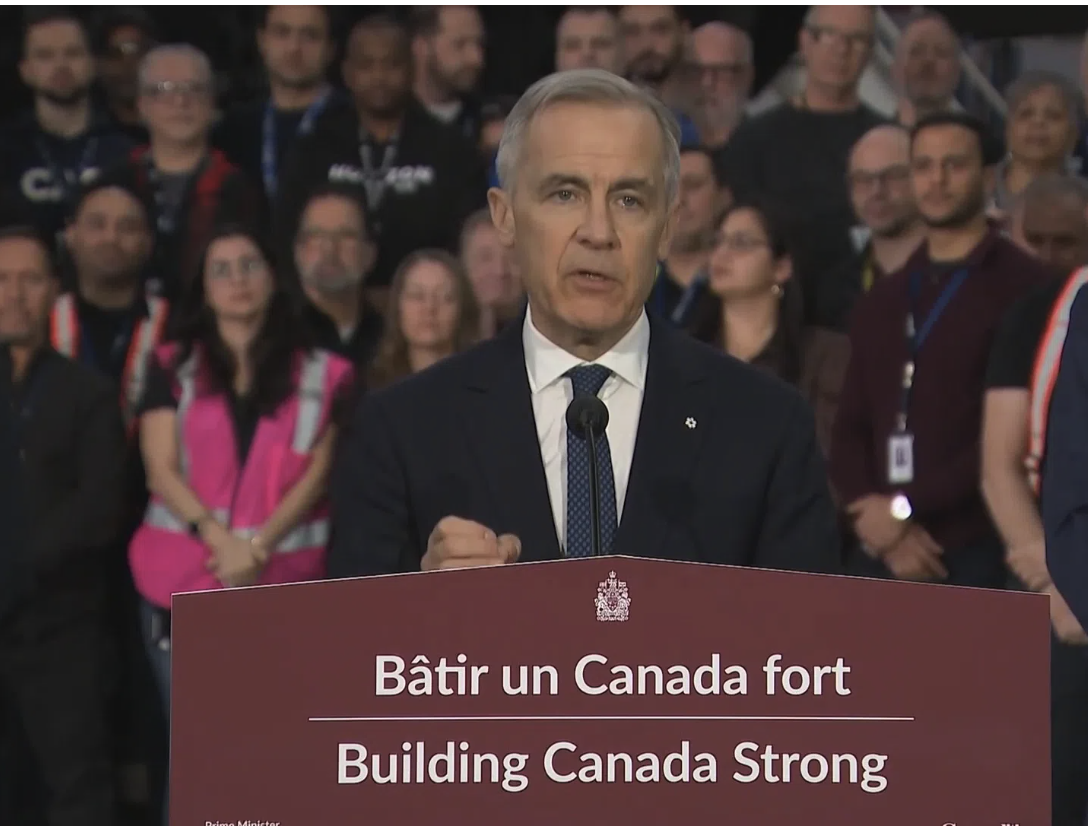
To hammer home the gravitas of this major announcement, Prime Minister Mark Carney delivered the remarks himself while dutifully flanked by Defence minister David McGuinty and Industry Minister Melanie Joly.
The driving force behind all of this is of course US President Donald J. Trump. From the moment he was elected to his second term in November 2024, Trump began with the wild threats of annexing Canada.
The minute he was sworn into office, Trump unleashed his promised trade war with the imposition of punishing tariffs. His trumped up justification for targeting Canada was the unfounded allegation that fentanyl crossing into the US across the Canadian border was the cause of hundreds of thousands of US citizens' lives.
Trump also repeatedly referred to Canada as a 'shirker' when it came to our defence spending.
Reading the general mood of Canadians, Carney called on us to collectively get our 'Elbows up' in response to the trade war. However, Carney also promised to immediately boost defence spending to reach the previous NATO stated goal of member states spending 2 per cent of Gross Domestic Product on defence within this current fiscal year. While that promise seemed more like caving in to Trump's pressure than defiance, Carney also vowed to wean Canada off of our near current total dependency on US suppliers for our military hardware. The quote was something to the effect that Canada will not continue to spend 75 cents of every defence dollar in the US.
Which brings us to last week's release of the Defence Industrial Strategy. The numbers are in, and those numbers are staggering. The numbers are also often contradictory or simply unsubstantiated.
According to the Defence Industrial Strategy, Canadian industry is poised "to take advantage of $180 billion in defence procurement opportunities and $290 billion in defence-related capital investment opportunities in Canada over the next 10 years, with an anticipated $125 billion downstream economic benefit by 2035."
Furthermore the Defence Industrial Strategy claims it "will create 125,000 high-paying careers, increase our defence exports by 50 per cent, raise the share of defence acquisitions awarded to Canadian firms to 70 per cent, and grow Canadian defence industry revenues by 240 per cent."
In total, the Defence Industrial Strategy outlines investments worth over half a trillion dollars. When you realize that Canada currently spends only roughly $40 billion annually on defence, those numbers are mind blowing.
If the creation of 125,000 high paying careers in the defence sector sounds a little high that is because that entire sector currently employs fewer than 80,000 workers at all levels.
Also to be kept in mind is that the Defence Department recently announced the creation of a Tiger Team to draft a plan for a 400,000 member reserve force. This is to consist of 100,000 primary reservists and 300,000 supplementary reservists.
The former would be actual part-time soldiers fleshing out existing units which have a present strength of 23,000. The Supplementary Reserve currently consists of about 4,000 poor souls whose name and address are still on the list.
To meet their objective DND will need to enlist 375,000 reserve personnel at the same time defence industry will be hiring 125,000 skilled workers. That seems like a steep challenge.
The basic premise of this new 'Strategy' (it is not a policy or a budget) is essentially that of 'Buy Canadian". Where Canada can we will build it. Where we cannot build it we will seek to partner with an allied nation to produce it. Only if both those options are unavailable will Canada resort to buying from a foreign source.
Which brings us to the basic flaw in this strategy. The Canadian military are in desperate need of all sorts of modern weapon systems, few of which are made in Canada.
Two of the major acquisition projects which garner constant public scrutiny is the CF-18 fighter jet replacement and the second is the Canadian Patrol Submarine project. At present it seems that the RCAF are adamant on moving forward with the purchase of 88 F-35 fighters to replace the CF-18. That project is now estimated at roughly $29 billion, and while there are some related aviation jobs created in Canada for the F-35, President Trump has directed manufacturer Lockheed Martin to repatriate those jobs back to the US.
For the purchase of up to 12 diesel electric attack submarines for the RCN, these boats will be built in either Germany or South Korea. The cost estimate on that program is around $100 billion.
Buy Canadian indeed.
