
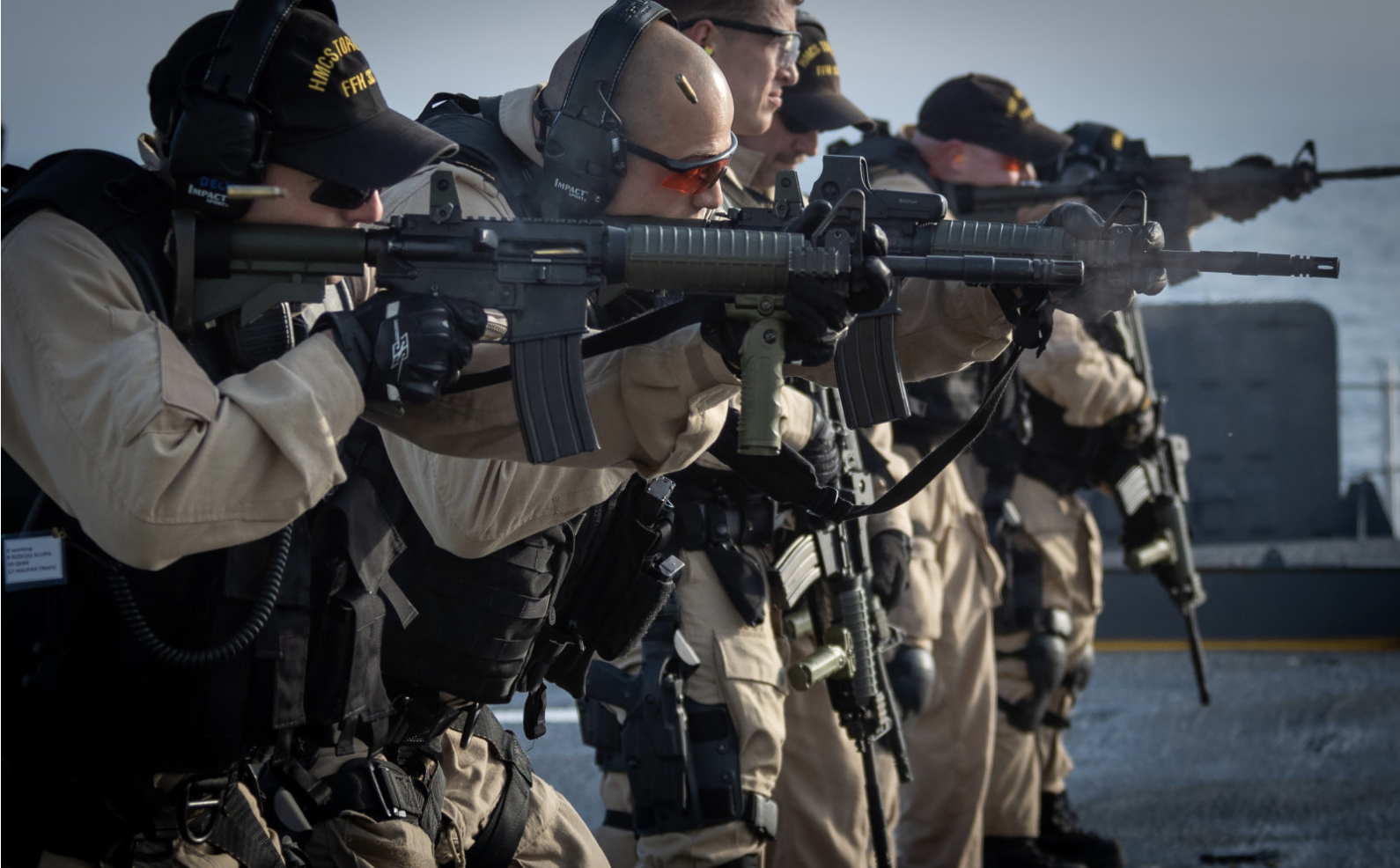
"Her Majesty's Canadian Ship TORONTO's Naval Boarding Party fire the C8A2 assault rifle during weapons training on the flight deck during Operation REASSURANCE, April 8, 2019. Photo: MCpl Manuela Berger, Formation Imaging Services Halifax RP23-2019-0142-010
By Scott Taylor
Last week CBC reported that a Department of National Defence internal presentation outlines a plan to rapidly move forward with a procurement to replace the Army's current inventory of assault rifles.
Known as the Canadian Modular Assault Rifle program, this purchase aims to replace the 65,401 C-7 rifles and C-8 carbines which first entered service back in 1985. This replacement program has been on the books for some time as part of the Trudeau Liberals, Strong Secure Engaged policy on defence.
However, with the new Prime Minister Mark Carney directive to massively increase Canada's defence spending in the short term, this contract was brought forward by nearly two years.
The scale of this purchase may also be massively increased to produce over 300,000 of the new rifles if recently proposed mobilization plans proceed to create a 400,000 strong supplementary reserve force of Canadian citizen soldiers.
Based on the original order of 65,401 modular assault rifles, the project is worth an estimated $500 million to $1 billion.
As military defence procurements go, this one is something of a no-brainer. Colt Canada, the manufacturer is based in Kitchener Ontario and therefore this will bolster domestic defence industry capability, and replacing 40 year old rifles for the army should not cause consternation among even the most ardent peace advocates.
Presumably the existing arsenal of 65,401 C-7 rifles and C-8 carbines would be placed into storage as part of an emergency war stock.
Given that the new modular assault rifles will also be of the same calibre as the current weapons, it would make sense to keep a war time emergency stockpile.
This was not done in the case of the predecessor to the C-7 rifles and C-8 carbines. From 1955 until 1985 the standard Canadian assault rifle was the Fabrique Nationale (FN) C-1. This robust 7.62 mm rifle was beloved by those of us who had the privilege to be issued with them. In total the Canadian Armed Forces had an inventory of 72,470 of the C-1, and the C-2 variant which had a heavier barrel and served as a light machine gun.
After their replacement with the C-7 and C-8's, the decision was taken to not keep the FN C-1's as a war stock. A few thousand were transferred to the armed forces of Papua New Guinea -which consists of just 4,000 service personnel - and the remainder were scrapped. A few remain in private collections or museums, but Canada divested itself of the ability to rapidly mobilize a reserve force.
In that regard, the post Cold War mentality among Canada's defence planners also allowed the once substantial Supplementary Reserve list dwindle down to nearly nothing. For those not familiar with the term, the Supplementary Reserve List contained former regular and reserve veterans who upon release from the CAF signed a voluntary pledge to return to active duty in time of a national crisis such as a war.
In 1995 there were 47,000 names on that list, my own included. By 2011 there were still 19,000 members of the Supplementary Reserve but the current total stands at just 4,400.
The 'Tiger Team' which was stood up by Chief of Defence Staff General Carignan and Deputy Minister of DND Stefanie Beck, to develop a mobilization plan for the CAF envisions a regular force of 85,000, an active reserve force strength of 100,000 and a supplementary reserve of 300,000 citizen soldiers.
I emphasize the 'civilian' in civilian soldiers as the current plan is to give these volunteers one week of basic training and a one week refresher course annually thereafter. The kicker is that these future supplementary reservists will not be issued uniforms.
However, if the Canadian Modular Assault Rifle program is indeed ramped up to purchase 300,000 weapons and the existing 65,401 C-7's and C-8's are placed into war stocks, Canada will actually have the genesis of a national defence force worthy of the name.
Domestically produced combat uniforms and cold weather gear would bolster enlistment in the supplementary reserve as would lengthening the initial basic training course to create at least rudimentary security personnel. In Afghanistan we gave illiterate teenagers two weeks of training before we issued them with their police badges and uniforms. Surely we have learned something from the folly of those failed practices. There is an old Chinese proverb that 'a journey of a thousand miles begins with a single step.'
In the case of the Canadian Armed Forces rebuilding themselves into a modern capable fighting force, that journey may be metaphorically longer than a thousand miles, but in replacing their inventory of assault rifles they are indeed taking a first step.
