
By Scott Taylor
In a year-end interview with the CBC, Vice Admiral Angus Topshee, floated the notion of the Royal Canadian Navy acquiring a Canadian built amphibious support ship.
While many allied navies operate such a class of naval vessels, what Vice-Admiral Topshee envisions would be the only such craft specifically designed and built to be ice-capable and therefore be able to operate in the Arctic.
While still at the purely conceptual stage, preliminary discussions have been had with Davie shipyard in Quebec and Seaspan Shipyard in British Columbia. Both of these firms are currently contracted to build the Canadian Coast Guard's new fleet of ice-breakers as part of Canada's National Shipbuilding Strategy initiative.
“We talked to a couple of our shipbuilders, and they've said that theoretically a Polar Class 2 amphibious ship would be possible,” Vice-Admiral Topshee told CBC News. “The key value proposition of an amphibious ship is it can deliver capability from sea to shore without prepared port infrastructure, and that describes our North perfectly."
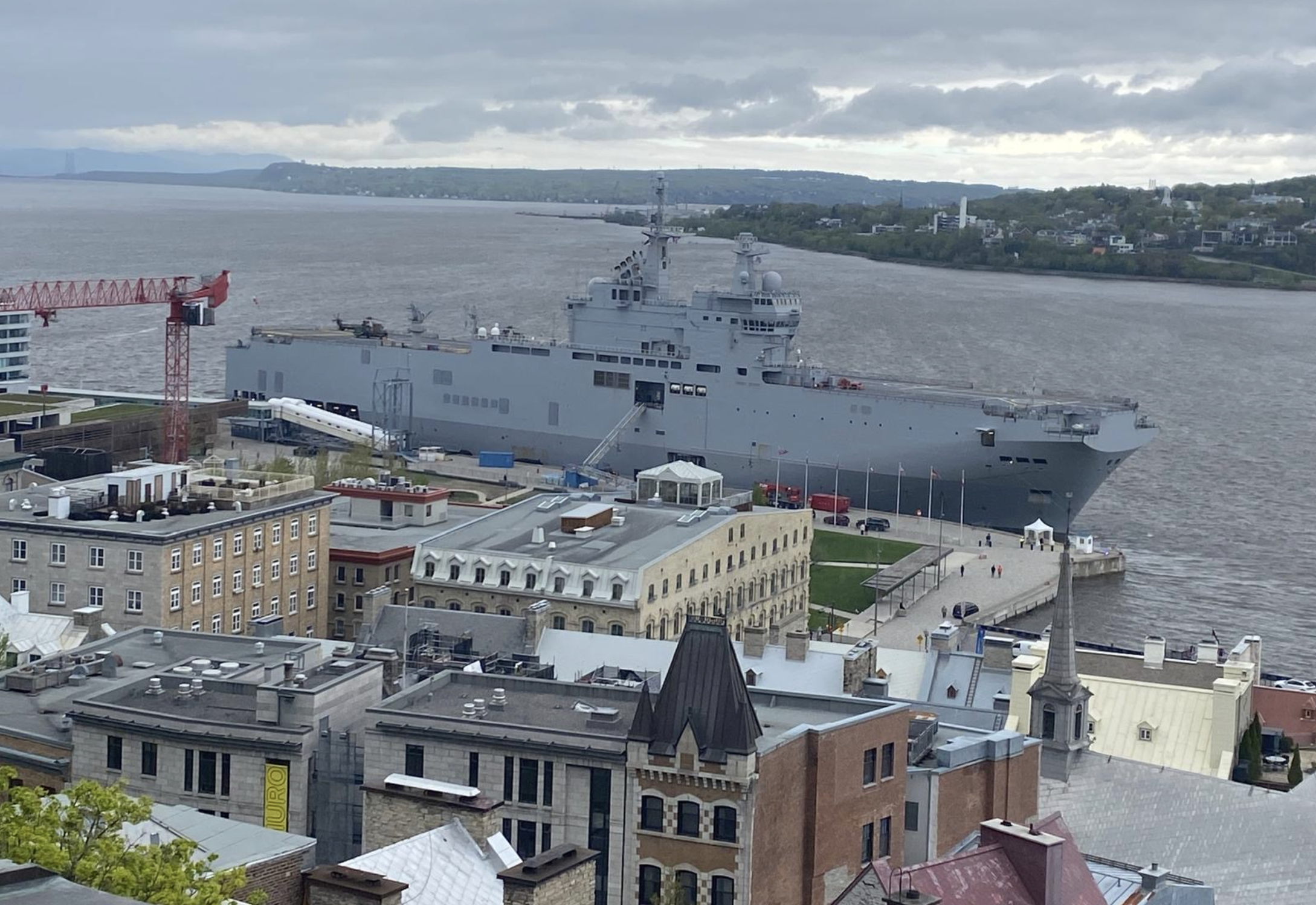
For those not familiar with the term 'amphibious class' warship, the name may be somewhat misleading, as the vessel itself does not operate on both land and water. They are instead large support ships which have flight decks for air operations and integral landing craft to allow for ship-to-shore deployment of troops and equipment. By definition these are purpose-built combined arms assets. They would be operated by the Navy to deploy Air Force and Army resources.
While Vice-Admiral Topshee's latest comments may have set social media abuzz with speculation as to how, why, where and when the RCN could acquire such a capability, it is sadly not a new concept being floated out of the blue. It is, in fact, something which has been seriously considered by the Canadian Armed Forces and successive Conservative and Liberal governments of the day, for quite some time.
For those who closely follow Canadian military affairs, you will recall that back in 2012 the Royal Canadian Navy had shown great interest in acquiring two of the French designed Mistral class amphibious ships, with an option to purchase a third. These ships were to be constructed in Canada with a total project cost of $2.6 billion. Upon reflection, the Harper Conservatives thought that this was too steep a price tag to invest in a capability that the RCN wished to acquire.
Two years later, the deal was made even sweeter. Russia had ordered two Mistral class ships that were being built by France. Following Russia's 2014 annexation of the Crimea, NATO imposed an arms embargo against Russia thereby putting these two Mistral class ships into limbo.
Given Canada's earlier interest in these ships, it was only natural that France would look to us to unload these two nearly completed warships.
In June 2015, Defence Minister Jason Kenny held face-to-face discussions with French officials at a NATO summit. Once again, the Harper Conservatives declined the offer due to budgetary concerns and the fact that such a bargain deal would not create any Canadian jobs in shipyards.
In the end it was Egypt that acquired the two warships at a cost of just $1.5 billion (CDN) which included a training package for their helicopter crews. Canada could have made that same deal and had these ships in service as early as 2016.
Here is a detailed run down on what we passed up: The Mistral class is a class of five helicopter carriers, which since 2019, have been referred to as "projection and command ships". A Mistral-class ship is capable of transporting and deploying 16 heavy lift helicopters or 32 lighter helicopters. In addition the Mistrals carry; four landing craft in an internal well-deck, up to 70 assorted vehicles including 13 Main Battle Tanks, or a 40-strong main battle tank battalion, along with 450 combat soldiers.
The Mistral displaces 21,500 tons and is 199 metres long. The ships are equipped with a 69-bed hospital, and are capable of serving as part of a NATO Response Force, or with United Nations or European Union peace-keeping forces.
Such an acquisition back in 2015 would have changed Canadian military doctrine and opened up a wide range of combined arms integration. All at a cost of just over $750 million a ship.
While the Mistral class is not ice-capable and therefore not the answer to Topshee's current proposed acquisition, failure to jump at the French government's offer back in 2014 has denied the RCN, and for that matter, all branches of the CAF, the opportunity to develop and exercise combined arms command and projection doctrine.
Even if Vice-Admiral Topshee's concept for a floating base in the high Arctic does attract the interest and support of the Carney Liberals, it will be at least a decade before Canadian shipyards would be able to begin cutting steel on any future ice-capable amphibious landing ships.
