
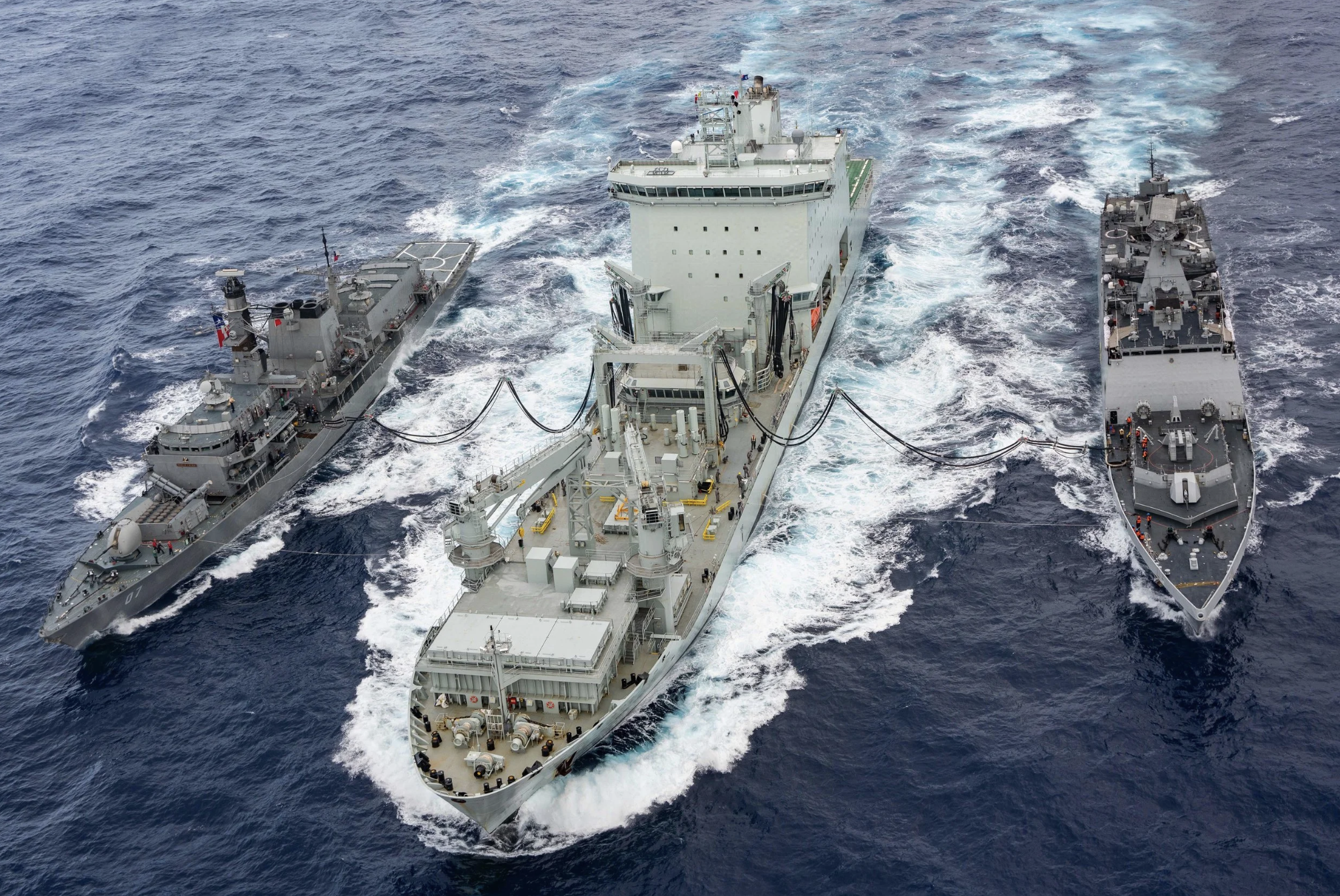
Chilean Navy frigate CNS Almirante Lynch (FF 07) and Indian Navy stealth multi-role frigate INS Sahyadri (F49) perform a replenishment-at-sea with Royal Canadian Navy supply ship MV Asterix (centre) off the coast of Hawaii during Exercise Rim of the Pacific (RIMPAC), July 28, 2018. (U.S. Navy photo by Mass Communication Specialist 1st Class Arthurgwain L. Marquez/Released)
By Scott Taylor
A recent headline in the Ottawa Citizen caught my attention. It read 'Company calling on Canadian government to keep Asterix re-supply ship: Asterix has supported the Royal Canadian Navy since 2018'.
As someone very familiar with the MV Asterix saga it is not surprising that the owners would want to continue the leasing arrangement with the Royal Canadian Navy beyond the current end date in 2028.
What is surprising is that the Canadian government is preparing to walk away from this proven asset, while the Joint Support Ships being built to replace the MV Asterix are yet to be completed.
For those not familiar with this story, the MV Asterix is a privately owned commercial vessel that was reconfigured into a navy resupply ship as a stop gap temporary measure.
The contract was signed with Davie Shipbuilding in 2015 and following her conversion MV Asterix began supporting the RCN in 2018.
For the record, it was delivered on-time and on-budget, which at $659 million was considered a rare bargain. At that juncture the RCN had been operating without a single Auxiliary, Oiler Replenishment ship (AOR) since October 2016 when HMCS Preserver was paid off after 46 years in service.
Two years earlier her sister ship HMCS Protecteur was retired following a catastrophic fire at sea. In order to conduct any blue-water operations during that interim two year period had meant that the RCN had to borrow and beg replenishment at sea support from the Spanish navy in the Atlantic and the Chilean navy in the Pacific.
Desperate times call for desperate measures and the idea of a private dockyard converting a commercial ship which they subsequently operate on a leased basis to support the RCN sounds incredibly novel. That is because it is indeed without a Canadian precedent, and the crazy thing is that it has been a resounding success to date.
A 26,000 tonne behemoth, Asterix is capable of refuelling the RCN's warships at sea, hauling ammunition, food supplies and has a limited on board hospital capability.
The Asterix has a flight deck and hangars to accommodate up to two Cyclone helicopters but has no permanent air detachment assigned to her.
As a non-RCN auxiliary, Asterix does not fly the white ensign but has designed and proudly flies their own copy-cat blue ensign. During the crisis in the Sudan in the spring of 2023, Asterix was in the right spot at the right time to assist NATO allies in the effort to remove foreign nationals from that war torn region.
As such Asterix gained plaudits for Canada and the RCN albeit being a commercially owned and operated auxiliary ship.
While the success of the Asterix is unquestioned, the same cannot be said for the problem plagued Joint Support Ship (JSS) project which led to the Asterix as a stop gap solution. This particular JSS saga begins with a request for proposals to shipyards in 2004. The plan was to build three Joint Support Ships to replace the aging AOR's HMCS Protecteur and Preserver.
It was projected that a contract would be signed by 2008 and the first of three JSS would enter service in 2012. At that point in time the RCN wanted to retire the Protecteur and Preserver in 2010.
This would have meant the RCN would be without an AOR capability for nearly two years.
The navy analysts blew their lids at the thought of this loss of blue water capability but it was all for nought. The money was simply not in the budget to proceed with the JSS in 2009.
The two old AOR's had to keep afloat until HMCS Protecteur caught fire (2014) and HMCS Preserver's hull simply wore out (2016).
In 2010 the Harper Conservatives announced they would build two JSS at a total cost of $2.6 billion, with an option to build a third. In 2011, as part of the National Shipbuilding Procurement Strategy program, Seaspan Shipbuilding of Vancouver was awarded $8 billion in contracts which included the building of two JSS.
The original timeline would have seen the first JSS delivered by Seaspan in 2018 and the second JSS delivered in 2019. That of course never transpired as work did not begin in earnest on the first JSS (the future HMCS Protecteur) until 2021. The RCN now expect delivery of this JSS in 2027 with the future HMCS Preserver to follow suit in 2028.
Which, if we follow the bouncing ball is when the lease on the Asterix is set to expire. On the surface this might seem like a seamless transition. However here's the rub.
The two new JSS are designed to have a ship's complement of between 199 -239 sailors each. The Asterix, being a commercial vessel is crewed by just 36 civilian personnel. The RCN augments that total with navy specialists while on replenishment operations.
But given that there is still a crippling shortage of trained personnel in the RCN, the necessity to find nearly 500 sailors to crew the two new JSS will be a challenge.
Here's a suggestion based on the success of the Asterix to date. Instead of cancelling the lease with Federal Fleet (the Davie subsidiary company that manages the Asterix) extend it indefinitely.
In fact, instead of commissioning the HMCS Protecteur and Preserver, keep them as civilian-commercial Motor Vessels with an MV designation. Let Federal Fleet manage both them as they do the Asterix and make all three truly merchant marine fleet auxiliaries.
This would mean Canada would have three replenishment ships on two coasts, thus allowing for a regular refit rotation and uninterrupted operational capability.
This is what Canada had in the 1980s and 1990s when the RCN boasted HMCS Protecteur, Preserver and Provider.
