
By Scott Taylor
Last Monday there was a national news story to the effect that the Liberal government is leasing 10 firefighting aircraft in advance of this year's wildfire season.
At present firefighting efforts and assets are controlled and managed by the individual provinces.
This will be a federal asset which can be deployed where it will be needed most across the country. Eleanor Olszewski, the federal minister of emergency management, announced that provincial and territorial wildfire agencies can now request this leased aircraft fleet through the Canadian Interagency Forest Fire Centre (CIFFC).
What this deal entails is the lease of four Dash 8-400 AT air tankers which have a 10,000-litre capacity for either water or fire retardant. There is also five rotary aircraft and one bird dog spotter aircraft included in the overall lease package.
Two additional mobile forward attack tanker bases round out the list of leased assets. These support assets can be quickly installed at airports near the site of the wildfires and be used to rapidly refuel and upload the aircraft with fire retardant.
Minister Olszewski told reporters that her department chose to lease the fleet of aircraft as it meant there would not be a delay of three to five years if they were to purchase similar aircraft. The contracts were issued to Conair Group Inc, Coldstream Helicopters and VIH Helicopters. Included in the lease is the cost of the pilots to fly them and the maintenance of the aircraft.
So far so good. It sounds like the federal government is getting out ahead of the growing wildfire crisis by acquiring a cost effective, private sector reserve asset.
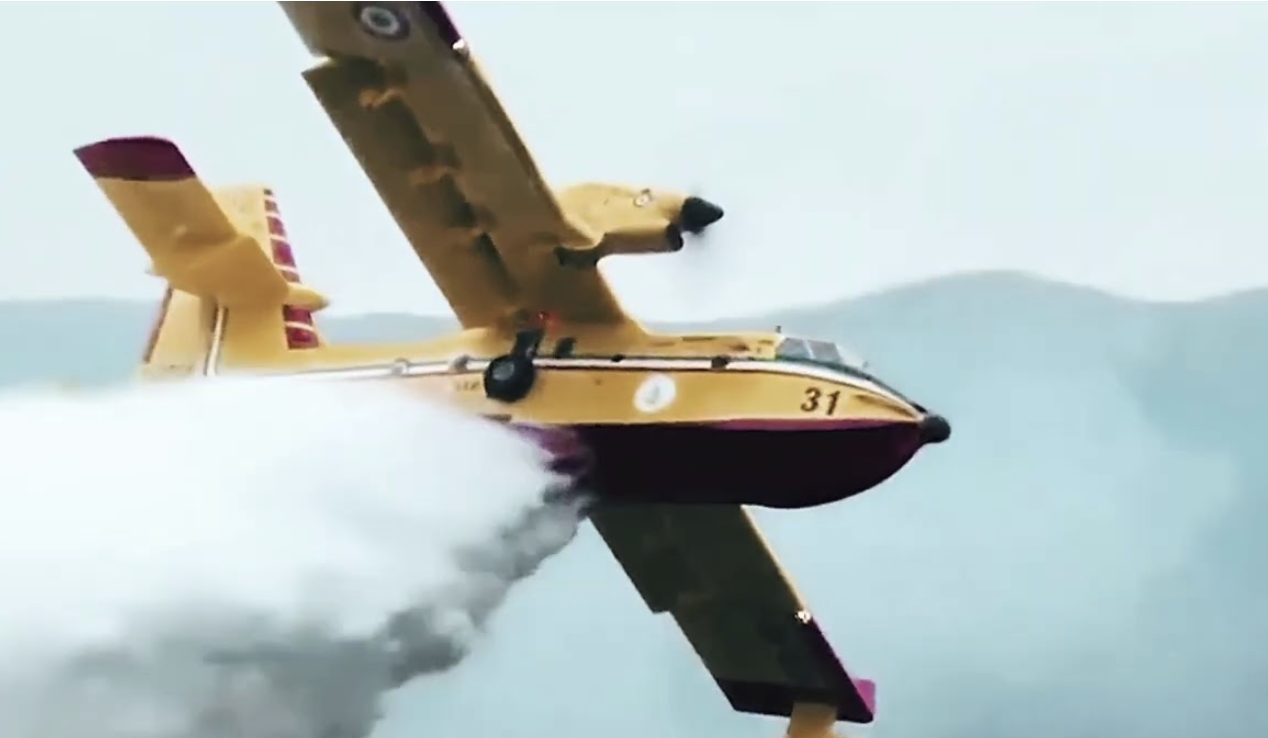
However the question begs, why not simply task the RCAF with the role of combatting wildfires and provide them with the proper aircraft to do the job. Canada currently makes what is considered to be the finest water bomber in the world, the De Havilland-Canadair 515, aka the 'Super Scooper'.
Originally designed and built by Canadair, the DHC 515 was built by Viking Aircraft in Victoria and they are now produced by De Havilland in Calgary. The beauty of the DHC 515 design is that it can skim lakes like a float plane and literally scoop nearly 7,000 litres of water into its bomb-bay in just 12 seconds.
The four Dash 8-400's just leased by CIFFC have a 10,000 litre capacity but then they need to land at an airport and be manually reloaded with water or retardant. Essentially they are commercial passenger aircraft re-configured into a rudimentary water bomber.
The DHC 515 is custom built to do just one job and that is to fight fires.
As for those Air Force Colonel Blimps who are no doubt readying their tubs for a good thumping over the very idea that our RCAF pilots be relegated to fire fighting duties, I say 'stow it'.
The order book for DHC 515 Super Scoopers is replete with foreign Air Forces such as Portugal, Spain, Greece, Italy and Indonesia. That's right folks, other allied Air Forces are tasked with the role of protecting resources and lives from natural disasters.
For the record, with an estimated 318 billion trees, Canada ranks second in the world behind Russia for forest density.
Yet the RCAF senior brass obstinately resists taking on the formal responsibility of standing up a squadron of water bombers, even though this current lease arrangement illustrates the urgent necessity to possess such a national resource. Talk about short sightedness.
Think about the public relations value of such a squadron. You could not get a more high profile means to endear the RCAF to the Canadian public then having them fly to the rescue to save threatened communities and protect vital resources.
Not to mention doing so in the world's premiere water bomber designed and built here in Canada.
Furthermore, as wildfires are hemispherically seasonal in nature, when required or requested we could deploy this crack water bombing squadron to allied nations during their winter wildfire season.
It is a win-win-win, but the RCAF brass covet their new F-35's and only the F-35's. Pity.
