
By Scott Taylor
On Monday July 6th, Prime Minister Mark Carney stood on the flight deck of HMCS Hampton Gray in Halifax harbour to make a major announcement about the future of the Royal Canadian Navy.
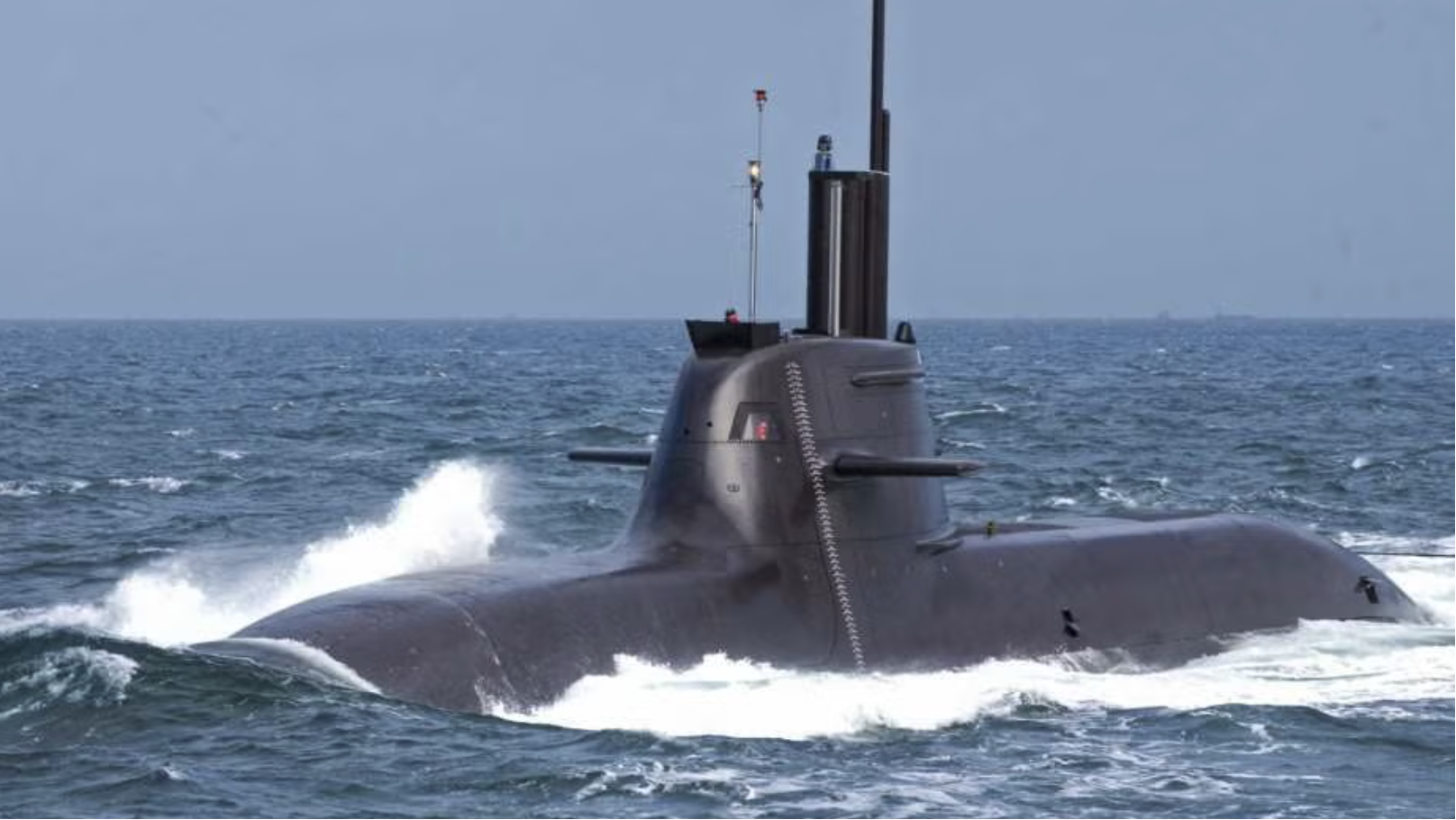
After months of negotiations and deliberation, Carney announced that Canada had officially chosen the German-designed TKMS 212CD attack submarine as the preferred bidder for the RCN's Canadian Patrol Submarine acquisition project. This deal will see Canada acquire up to 12 diesel-electric attack submarines built by the German-Norwegian TKMS consortium.
These new subs are ostensibly to replace the RCN's aged out, problem-plagued four Victoria class submarines. However, given that only one of these submarines -HMCS Corner Brook- remains operational, adding 12 new attack submarines will give the RCN a capability it has never previously had.
There were few details at the press conference about actual costs of the project. There is an estimate of a $100 billion total lifetime cost with the upfront purchase price of $20 - $30 billion to actually construct the subs.
The reason for this is that TKMS has only been named as the 'preferred bidder' in this competition. Hanwha of South Korea remains the 'reserve bidder' with their offer to build 12 KSS-III submarines still on the table.
Canada will enter contract negotiations with TKMS and the hope is to sign an actual deal sometime in 2027. Under the terms of their offer, TKMS would deliver the first 212CD submarine to the RCN by 2033 with another 3 submarines delivered by 2034.
In order to achieve this ambitious delivery schedule there has been reports that both Norway and Germany agreed to suspend their own deliveries to put Canada first in the queue. Norway and Germany have each ordered 6 of the 212CD's for their respective navies.
There are currently two 212CD's under construction at the TKMS shipyard in Kiel, Germany with the first hull expected to be in the water by 2029.
As both the German-Norwegian TKMS 212CD submarine and the Hanwha KSS-III met all the RCN's operational requirements, the decision came down to which bidder could offer Canada the best industrial benefits package. What TKMS has offered is the development of port infrastructure in Churchill, Manitoba to facilitate the shipping of LNG exports to Europe, the creation of a space launch capability in Canada and a total of 650,000 job-years of employment over the duration of the submarines' life cycle.
For those who closely follow military procurement in Canada, history has shown that many major such acquisitions get far beyond this point in the process and end up never seeing the light of day. Given that Prime Minister Carney made this announcement as he was literally on his way to attend the NATO Summit in Ankara, Turkey, there is no question that this was intended to signal to our European allies that Canada is indeed seeking to strengthen our ties with Europe.
A $100 billion project goes a long way to signalling commitment.
For those that questioned whether Canada choosing a closer alignment with Europe would mean moving away from our Indo-Pacific strategy, Prime Minister Carney was adamant that this is not the case. “Absolutely not,” Carney told reporters. “I spoke with President Lee of [South] Korea over the course of the weekend; there are a series of other initiatives Canada and Korea are pursuing that build our economic resilience and our security footprint.”
If that is indeed the case then Canada could swiftly mend fences with the Koreans by fast-tracking several much needed military purchases which companies like Hanwha are already producing on a massive scale basis for many of our European NATO allies.
Both Poland and Romanian have purchased large quantities of the Hanwha K-9 Self Propelled Armoured Howitzers along with the attendant K-10 self propelled armoured ammunition vehicle. The Canadian army retired their fleet of venerable M109 self propelled howitzers back in 2005 and never replaced this vital combat capability. Close followers of the ongoing war in Ukraine will note that armoured self-propelled artillery pieces are as vital as drones in any near-peer conflict. Canada currently has exactly zero such assets.
Placing an immediate order for a fleet of K-9's and K-10's with Hanwha of Korea would not be a token compensation pity-party gesture. It would be a wise move that benefits the Army and sends a signal that the Indo-Pacific remains a part of Canada's future course.
