ON TARGET: Dumbfounded by Trudeau

CBC

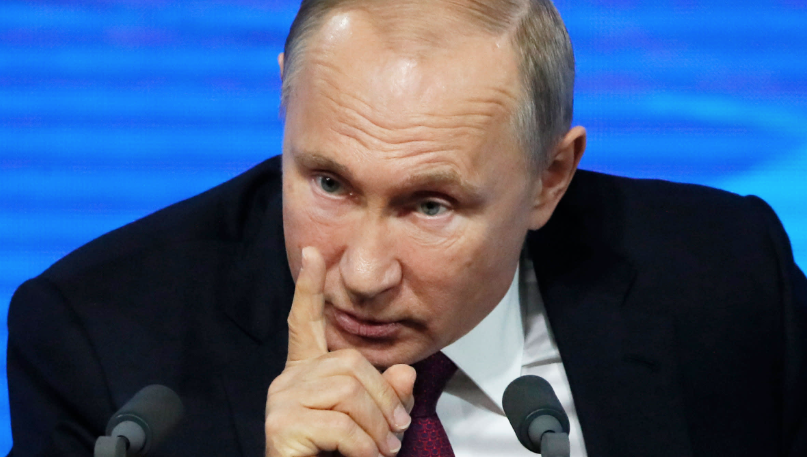
On Tuesday April 11, during the visit of Ukraine’s Prime Minster Denys Shmyhal to Ottawa, Prime Minister Justin Trudeau said something so quantifiably dumb that I had to replay the video clip to ensure I had not misunderstood his comments.

A reporter had posed a question to Trudeau asking if he was willing to “state publicly to Canadians, that Canada is now in a proxy war with Russia?” The journalist asked for a “yes” or “no” reply, plus a brief reasoning as to why or why not.

The response from Trudeau – and this, I assure you, is a verbatim transcript – was the following: “Russia’s illegal invasion of Ukraine upended 80 years of peace, stability and security around the world. One of the most prosperous eras the world has ever known — we have all benefited from that immeasurably everywhere around the world. Russia’s decision to end that peace, to violate the UN Charter, to overturn international law, to arbitrarily choose to redraw lines on a map, is of course of deep concern to Canada.”

While I am certainly in agreement with Trudeau over the fact that Putin’s invasion of Ukraine is illegal, to claim this act of aggression shattered eight decades of world peace is just dumb.

Using the starting point of the end of hostilities in WWII, there have been no fewer than 74 interstate wars since 1945.  

That list does not include internal civil wars or the US invasion of Grenada in 1983, or the US invasion of Panama in 1989.

Surely Trudeau is aware that Canadian troops fought in the Korean War, the first Gulf War, Afghanistan, Libya and Iraq?

 In 1956, Canadian Prime Minister Lester B. Pearson was credited with the invention of the United Nations Peacekeeping when he deployed Canadian soldiers with Blue Helmets to defuse the Suez Crisis in the Middle East.

Since that juncture, Canadian peacekeepers saw action in Cyprus, the former Yugoslavia, Cambodia, Somalia, East Timor, Namibia, Eritrea, South Sudan, Western Sahara, Rwanda, Haiti and numerous other far flung global hotspots.

Since 2015, Canada has also been actively training and equipping the Armed Forces of Ukraine to battle a separatist rebellion in the eastern Donbas region.

Putin’s February 2022 invasion of Ukraine did not spark the violence in Ukraine, it simply poured gasoline on an already lit fire and turned a localized Ukraine civil war into an inter-state war.

Putin also has no monopoly on “violating the UN Charter” or “overturning international law.”

The US had no UN Resolution authorizing their 2001 invasion of Afghanistan. In 2003, the US famously tried, and failed, to get a UN Resolution authorizing the invasion of Iraq under the guise of self-defense.

The US went ahead, and invaded Iraq anyway and subsequently failed to find the trumped-up weapons of mass destruction which would have justified their illegal war. 

A conservative estimate would put the resultant death toll of Iraqi civilians at close to 1 million – and counting. So much for Trudeau’s world enjoying 80 years of peaceful harmony.

In 2011, Canada led the charge to use NATO airpower to assist Libyan rebels to oust President Muammar Gaddafi.

Only after NATO had achieved that goal did anyone closely examine the composition of the Libyan rebels that we were allied with.  When it turned out they were a fractious collection of thugs and Islamic extremists, the Western countries – including Canada – simply walked away from the violent anarchy that we created.

For the record, Libya continues to be a failed state with no light at the end of a long, dark tunnel.

The other talking point that Trudeau tossed out was the line about Putin not being able to change the lines on a map – particularly the map of Europe. In my lifetime, the map of the world has changed many times over.

When I was a soldier stationed in Europe we were in West Germany and East Germany was a separate country.

Czechia and Slovakia were a unified nation called Czechoslovakia. What was then Yugoslavia is now the seven states: Bosnia and Herzegovina, Croatia, Kosovo, Macedonia, Montenegro, Serbia and Slovenia.

For the record, Canada participated in the 1999 NATO bombing campaign against the former Yugoslavia which eventually resulted in the unilateral declaration of independence by Kosovo in 2007.

This was indisputably Serbian sovereign territory, so it seems it is possible to change the lines on a map as long as it is the US wielding the Sharpie.

The collapse of the Soviet Union in 1991 created 15 new republics. As a result, the map of Europe now includes Latvia, Lithuania, Estonia, Russia, Belarus, Moldova and Ukraine.

 Little understood by Western media is that in many cases, the creation of the former Soviet Republics as independent states led to many bloody territorial disputes.

To date there remains simmering armed standoffs in the territories of Transnistria, Abkhazia, South Ossetia and Nagorno-Karabagh.

Suffice it to say that Trudeau’s response to the reporter should have been a simple “yes.” By every conventional measure, Canada is involved in a proxy war with Russia.

 It is one thing to dumb down a complex conflict into simple soundbites – and with apologies to the film Tropic Thunder, Trudeau went “full dumb,” and you never go “full dumb.”

ON TARGET: RCN Recruiting Plan: Deja Vu All Over Again?

COMD_MARPAC/Twitter

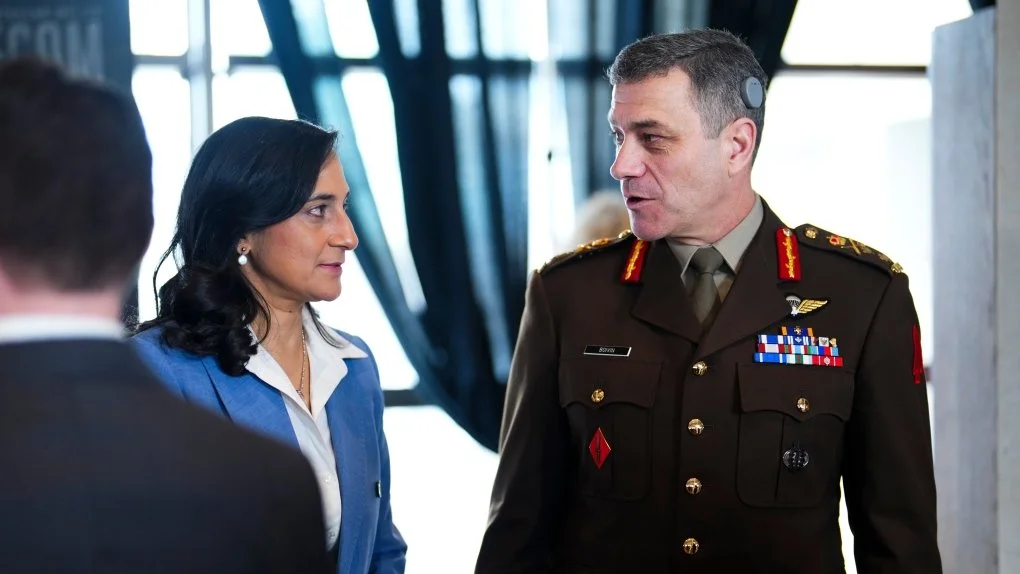
It is no secret that the Canadian Armed Forces are woefully under-strength. According to the Chief of Military Personnel, Maj.-Gen. Lise Bourgon, the Regular Forces and the Reserves are presently 16,500 short of their combined authorized strength of 105,000 service-members.

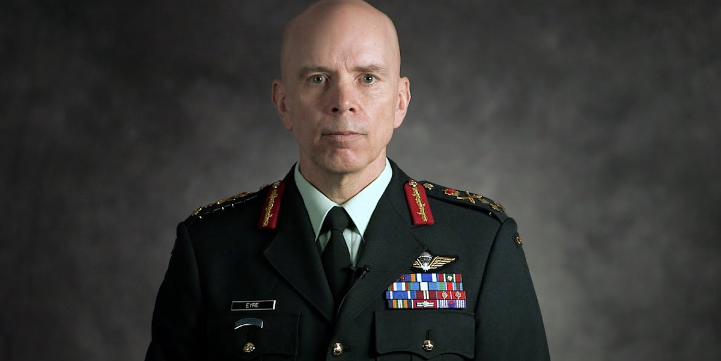
In 2022, Chief of Defence Staff, Gen. Wayne Eyre told a House of Commons committee that he is “very, very worried” about the military’s staffing crisis.

Eyre has subsequently issued a directive that makes recruiting and retention the CAF’s top priority. One of the first initiatives implemented was last year’s ground breaking decision to lift almost all grooming and dress regulations.

There are no longer restrictions on hairstyle, facial hair, tattoos or piercings.

Members still have to wear a uniform but there is no longer a gender specification. Men can wear women’s clothing items and vice versa.

In December 2022, in order to cast a wider recruiting net, the CAF no longer required recruits to be full-fledged citizens in order to join. All that is necessary now is to have permanent residency status.

On March 31, the Royal Canadian Navy announced that they are implementing a new initiative called the Naval Experience Program (NEP). This is a recruitment program intended to give Canadians the opportunity to experience the Navy as a sailor on a one-year contract that provides them with exposure to a variety of naval trades before deciding if a career in the Navy is the right fit for them.

According to the RCN press release, “through the new NEP, the Navy is rethinking the way it attracts, recruits and trains sailors. The aim of the program is simple: to reduce the amount of time it takes to train civilians as sailors, to foster the development of sailors who love their work, and to attract those who enjoy the unique lifestyle of that the Navy offers.”

In almost all other aspects, the NEP mirrors that of standard recruitment into the CAF.

Applicants can be as young as 16 if they have parental consent and you can enlist up to the age of 57. Admission is open to Citizens and permanent residents.

The pay and benefits are equivalent to those enrolled in the Regular Force. The one difference will be that NEP participants will be rushed through an 8-week basic military training course and naval environmental training in either Halifax, N.S or Esquimalt, B.C.

Essentially the only thing different from the new NEP and ordinary recruitment is that there is no contractual obligation to serve the long standard three-year basic engagement.

While Vice-Admiral Angus Topshee is to be commended for looking at unconventional methods to address the chronic manpower shortage, the fact is that the NEP concept is not without a CAF precedent.

Back in 1983 Canada faced a nation-wide employment shortage with the youth sector facing the most serious challenges. To solve this problem, the government created the Youth Training and Employment Program (YTEP). While it was a well meaning initiative to take unemployed youths and put them in a uniform for twelve months, in practice it did not work so well.

It may have taken these individuals off the list of the unemployed, but for the military it created a whole new tier of personnel. These YTEP’s were neither fish nor fowl in the eyes of the chain of command.

While subject to military discipline, their short term of service meant that commanders were reluctant to invest time and resources into developing their individual skills.

Priority for things like leadership advancement or parachute training courses went to those who had voluntarily signed up for a three-year contract. As such the YTEP experience became the opposite of what VAdm Topshee hopes the NEP will be: the YTEP soldiers rarely re-enlisted to become career soldiers. Hence that experimental program was quickly discontinued.

The other inherent risk of the NEP is that it may dissuade a large number of those who – without the one year option – would agree to commit to a standard three-year contract.

Given that there is no pay incentive to commit to a longer contract, why would a 19-year-old commit to three years instead of one? This could, in turn, exacerbate the manpower shortage in the years to come with additional trainers needed to deal with an annual influx.

Once signed up, it will be the responsibility of the RCN leadership to ensure that one-year experience does indeed make these individuals into lifelong sailors. That will be the real challenge.

ON TARGET: Canada extends Iraq mission: WHY?

Tech. Sgt. Jack Sanders

By Scott Taylor

March 19 marked the 20th anniversary of the US-led invasion of Iraq.

This milestone passed relatively unheralded by the US media for the simple reason that it was a complete and utter disaster.

Under the trumped-up claim that Iraqi President Saddam Hussein possessed weapons of mass destruction (WMD’s), the US invoked their right to self-defence as a justification to invade a sovereign country.

Militarily, the Iraqi army never stood a chance, and with a few notable exceptions, Saddam’s soldiers simply melted away.

To break the will of the Iraqi people to resist, US Secretary of Defence Donald Rumsfeld boasted to the American people that unleashed he had a campaign of “shock and awe.”

That this plan involved the widespread aerial bombardment of civilian urban centres, meant that Rumsfeld did not just admit to committing a war crime, he actually bragged about it.

In the end, the hostilities ceased briefly, and Saddam went into hiding without Iraq actually using their alleged WMDs. The reason for this is simple: Saddam never had WMD’s, and the US knew it all along.

President George W. Bush illegally invaded a sovereign country in order to replace Saddam with a US friendly puppet government.

Canada did not condemn Bush for his war crime, but we did pride ourselves on the fact that despite intense diplomatic pressure, Prime Minister Jean Chretien chose not to join the invading coalition. 

Since the US military’s quick battlefield victory turned into a bloody quagmire of an occupation, Chretien’s decision to sit this war out was validated.

However, that was not to remain the case.

In 2011, President Barrack Obama withdrew the last American troops in Iraq with the hope that the US trained and equipped Iraqi security forces would be able to prop up whatever regime happened to rule in Baghdad.

That pipedream went up in smoke in 2014, when Daesh (aka ISIS or ISIL) rolled across the Syria-Iraq border. As Daesh pushed forward, the Iraqi security forces not only didn’t put up a fight, but they also willingly handed over their vast arsenal of US-supplied weapons and vehicles.

The desperate regime in Baghdad called out the Shiite militias to stop Daesh’s advance. They also called on support from the Iranian Revolutionary Guard, and in desperation, the USA.

Having learned their lessons during their eight year occupation, the US cobbled together an alliance to assist them in the targeted objective of defeating Daesh.

This time around, Canada said yes. However, then Prime minister Stephen Harper knew that Canadians were averse to our soldiers waging a war on foreign soil – as we had just concluded a fruitless but costly 11-year combat commitment in Afghanistan.

For this reason, Canada’s contribution to Operation IMPACT was limited to a six-pack of CF-18 fighter jets, some transport and a reconnaissance aircraft plus a few hundred special forces personnel. The troops deployed were to conduct, advise, and assist missions, rather than engage in actual combat.

As Daesh possessed no anti-aircraft weaponry, our pilots were only at risk of equipment failure or an accident.

The hodgepodge anti-Daesh alliance that was assembled meant the Canadian military shared some strange bedfellows indeed. The overall commander of the ground forces was a general from the Iranian Revolutionary Guard. His disparate force consisted of Kurdish separatist militia – trained by Canadians – was well as Shiite militia and Hamas. By extension to those battling Daesh on the Syrian side of the border, this alliance also included Bashar al-Assad’s Syrian army and his Russian supporters.

The one thing linking all of these factions was the singular objective of defeating and eliminating the Daesh evil doers from their self-proclaimed Caliphate in the Levant.  For all intents and purposes that purely military objective was considered to be accomplished in 2019.

Given that Canada has no skin in the game in Iraq, that milestone should have meant a hard exit for the Canadian Armed Forces.

Yet on March 27, 2023, Minister of National Defence Anita Annand announced a further extension of Operation IMPACT until at least March 31, 2025 – two years from now.

The vaguely described official rationale is that, “This extension will allow the Canadian Armed Forces to continue to play an important role in supporting regional partners in the advancement of peace and security.”

On paper, Operation IMPACT authorizes up to 800 personnel to be deployed to the Middle East.

While the actual number currently deployed is considered to be well below that, the truth is that those trained, experienced troops would better serve as trainers here in Canada.

The Canadian military — regular and reserve — force are currently 16,500 personnel short of an authorized combined strength of 105,000.

With a battle group forward-deployed to Latvia and a contingent of trainers advising the Armed Forces of Ukraine in the UK, there is a serious shortage of qualified people left on the ground to train our own soldiers.

The last thing that the CAF needs is this further extension of mission in Iraq, a mission that has no clear aim and zero chance of success. It is a fools’ errand that in no way contributes to the security of Canadians.

ON TARGET: So If It Flies, It Spies?

By Scott Taylor

On Tuesday, March 14, Russian fighter jets intercepted a US military drone over the Black Sea, off the coast of the Crimea. According to US officials and the video footage released by the Pentagon, the Russian pilots aggressively buzzed the drone and twice doused it with aviation fuel.

The US claim that during one of the close encounters, the Russians actually made contact with the drone, damaging the propeller.

After determining that the drone was no longer “flyable” the US military remotely scrubbed any sensitive data from the drone’s software and then deliberately crashed the aircraft into the sea.

The Russian Ministry of Defence has denied the allegation that their pilots deliberately damaged the US drone but have also vowed to recover the wreckage.

The US talking points on this are that this was an unprovoked act of aggression by the Russian Air Force against an American observation drone, operating in international airspace.

Naturally, such an incident of martial provocation by Russia against the US has sent military analysts spinning on the fear of a nuclear conflagration.

While one can understand that the Americans would try to cover their embarrassment with the claim that they are the innocent victims of another crazy Russian provocation, it is difficult to fathom why Canadian media outlets unquestionably parrot the same US narrative.

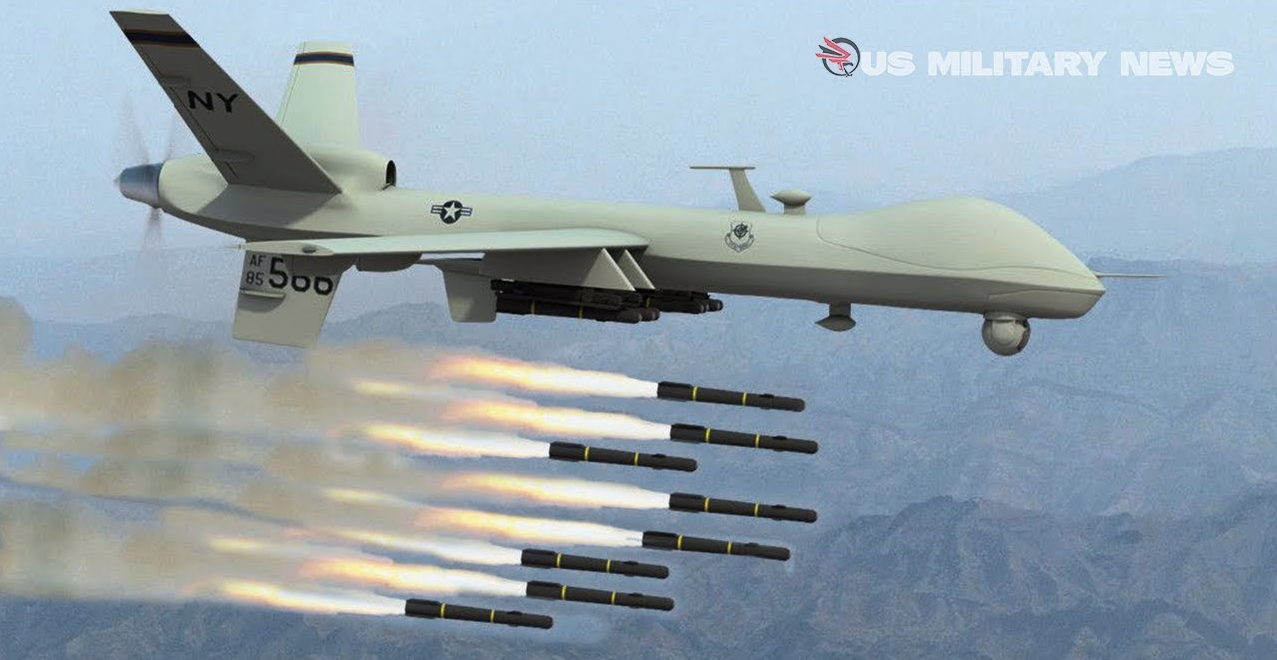
To begin with, it has been widely reported that the downed drone was a General Atomics MQ-9 Reaper. While it can indeed collect intelligence, the Reaper – as in “Grim Reaper” is designated as a “hunter-killer” unmanned aerial vehicle. In describing the newly acquired MQ-9 Reapers in 2006, United States Air Force Chief of Staff, General T. Michael Mosely said, “We’ve moved from using UAV’s primarily in the intelligence, surveillance, and reconnaissance roles before Operation Iraqi Freedom, to a true hunter-killer role with the Reaper.”

Hunting and killing are what the Reaper does best, with a lethal payload of Hellfire missiles. According to the sales brochure the Reaper is capable of “automatic detection of threats and can track 12 moving targets at once, and has the ability to ‘super ripple’ fire misses within 0.32 seconds of each other.”

The US military has never hidden the fact that the Reaper is an airborne execution machine.

On July 12, 2022, the Pentagon trumpeted the death of one Maher al-Agal in Syria. According to CIA sources al-Agal was one of the top five leaders of the fanatical Daesh (also known as ISIS or ISIL) movement. This extrajudicial killing came about thanks to a pair of Hellfire missiles fired by a US Air Force Reaper.

Just a couple of weeks later, on July 31, 2022, Ayman al Zawahiri bit the dust in Kabul, Afghanistan.

As a senior leader of the notorious al-Qaeda terrorist organization, al Zawahiri was alleged to be the mastermind of the 9-11 attacks against the USA.

Fittingly then, it was a made-in-America hunter-killer Reaper drone that ended al Zawahiri’s life with a couple of Hellfires.

To reduce any collateral damage the US reportedly used Hellfire R9X’s, which kill the target on impact with blades rather than an explosion. But I digress.

Suffice it to say that the Reaper is far more lethal than a simple observation drone.

Which brings us to the location of Russia’s alleged provocation off the coast of the Crimea in the Black Sea. Tensions have been heightened in this region since Vladimir Putin annexed the Crimea in 2014.

Following Russia’s invasion Ukraine on Feb. 24, 2022, the US turned up the heat with an increase in their surveillance flights in the vicinity of the Crimea. According to the US Department of Defense, the surveillance patrols along the conflict zone are used to gather information which helps improve security for Europe and supports “allied partners.”

Included in that support to “allied partners” would be the provision of the intelligence that allowed the Armed Forces of Ukraine to sink the Russian Navy flagship Moskva.

On the flip side of this equation, we had the almost farcical incident involving an alleged Chinese spy balloon that overflew Canada the US at the end of January.

It took a week to cross America, and when it was safely off the Atlantic coast, but still in US airspace, the Pentagon exercised their legal right to blow it out of the sky.

The US Navy has since recovered the wreckage, but to date has not offered any proof that this was anything but what China claimed it to be: a high-altitude weather balloon that was blown off course.

However, in the days following this incident, the US scrambled fighter jets to blow at least three more unidentified aircraft from North American airspace.

This we are told is the inherent legal right of any follower of the rules based international order.

As such, America cannot cry victim if China floats an empty balloon through their airspace and then be surprised when the Russian Air Force engages a hunter-killer Reaper drone on the edge of an active conflict zone.

Given that we all share the same planet, as Canadians, we can chastise our American allies for dangerously provoking a nuclear armed Russia on their own doorstep.

ON TARGET: The Sad State of The Canadian Armed Forces

Photo by Richard Lawrence Photography

By Scott Taylor

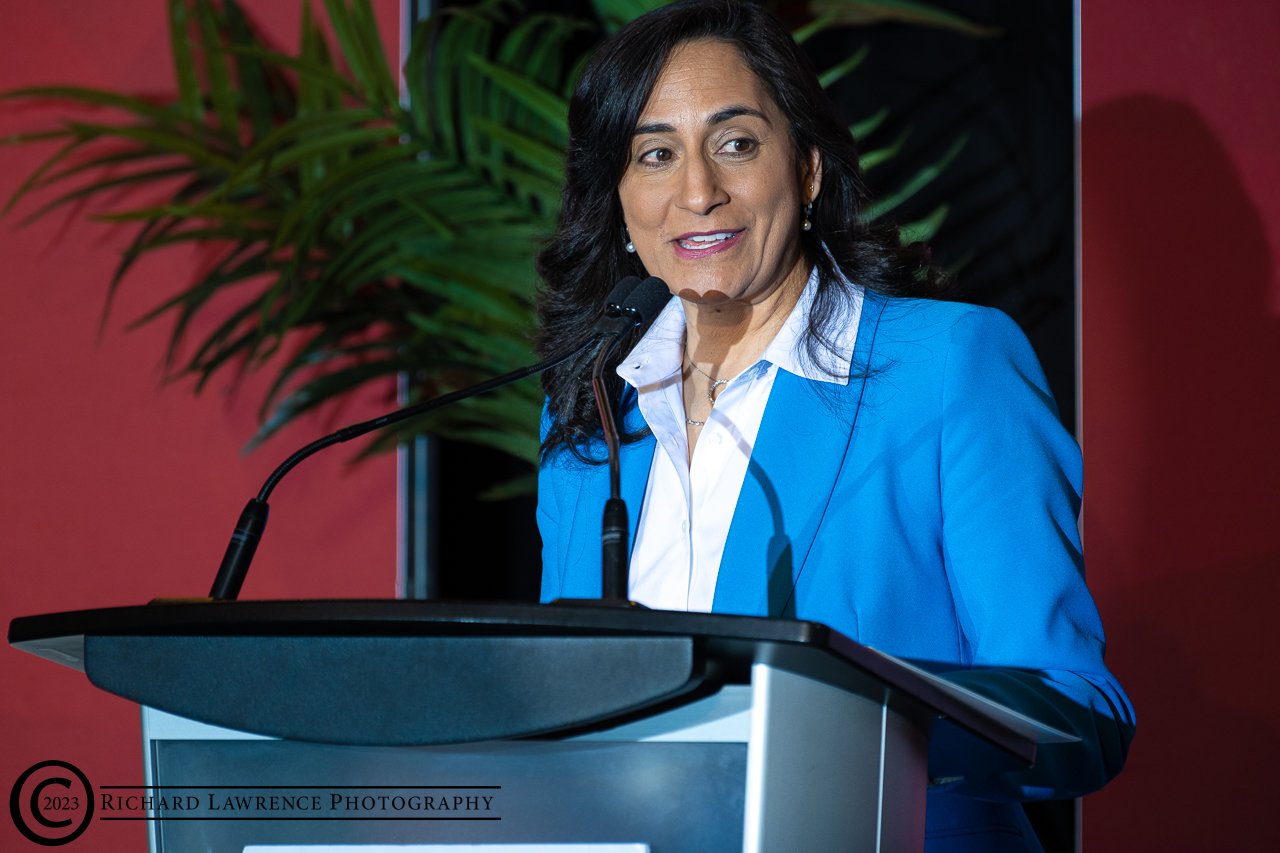
Last week at the Conference of Defence Associations (CDA) annual conference, senior military leaders painted a grim picture of the current state of the Canadian Armed Forces. In a bold attempt to put a positive spin on the situation, Minister of National Defence Anita Anand told the CDA attendees that the government will be fast-tracking three key military procurement projects.

According to Anand, the Canadian Army will purchase anti-tank, anti-aircraft and anti-drone systems through an urgent purchasing process that was last utilized during Canada’s decade long war in Afghanistan.

The rationale used for such a rapid acquisition of complex combat systems is the Russian invasion of Ukraine.

“Canada’s largest foreign military deployment, as I’m sure you know, is on NATO’s eastern flank in Latvia,” Anand told the crowd. “And our troops there must have the equipment that they need to protect themselves and to do their jobs, especially at this crucial time.”

For the record, Canada has had troops in Latvia since 2017 as part of NATO’s Operation Reassurance.

There are additional NATO battle groups assigned to Estonia, Lithuania and Poland as a physical deterrent to Russian aggression in the Baltic.

Russian forces invaded Ukraine on Feb. 24, 2022, which was nearly 13 months ago.

In those first shocking days as Russian armoured columns rolled towards Kyiv, nobody was giving the Ukraine Armed Forces a snowball’s chance in hell of turning back the invaders.

Most Western pundits were already playing the guessing game of which country that Russian President Vladimir Putin would invade next after he subdued Ukraine. 

In those first frightening days, the idea of the Canadian battle group in Latvia actually going to war against Russia seemed highly likely.
However, by the end of the first week of hostilities in Ukraine it was readily apparent that the mighty Russian military was a myth.

Years of corruption had turned what looked like a formidable fighting force on the parade square into a toothless tiger in actual combat.

The most astonishing shortfall in the performance of the Russian army was that of logistics.

After only a few days of battle, hungry Russian soldiers were scavenging food and armoured vehicles were simply abandoned for want of fuel.

Now that the conflict has settled into a bloody stalemate, it seems highly unlikely that Russia will be able to hold on to their meagre gains in the Donbas region, let alone start invading NATO countries in the Baltic.

Yet it is now, with an imminent threat averted, that the Liberal government is going to start looking to purchase these three combat capabilities for the protection of our forward deployed soldiers.

Even with the fast-tracking of these purchases, analysts believe it will still take another year before such capabilities can actually be acquired and fielded in Latvia.

Then there is the fact that over the past year, Canada has drained our arsenal significantly in order to keep Ukraine in the fight.

We have provided, tanks, armoured vehicles, anti-tank rocket launchers, artillery pieces, grenades and ammunition.

For those who closely follow the CAF, it will come as no surprise that these pieces of equipment and munitions were in no way surplus.

All of this kit will need to be replaced before the CAF can be restored to a state of full operational readiness.

But wait, the news gets worse. According to Major-General Lise Bourgon, the acting Chief of Military Personnel, Canada’s military is presently 16, 000 members short of its authorized regular force and reserve force strength of 101,500 personnel.

For those doing the math, that is close to a 16 per cent shortfall.

It is Bourgon’s assessment that due to the current recruiting shortage and a retention problem, “the rate of attrition is higher than it has ever been.” For the record, U.S. military doctrine states that any unit suffering a 10 per cent casualty rate can no longer be considered combat effective.

In recent months, the CAF have amended dress code regulations to no longer be restrictive to a specific gender. They have also removed restrictions on personal grooming, such as haircuts and facial hair. Also no longer prohibited are visible tattoos and piercings.

One of the most recent attempts to cast a wider recruiting net was the removal of Canadian citizenship to join the ranks of the CAF. As of Nov. 5, 2022, permanent residents of Canada are also allowed to enlist.

While I do not object to any of these amendments, I think the best way to address both the recruiting and retention dilemma would be to ensure our troops are equipped with modern weaponry. 

Giving away the army’s arsenal, and then fast-tracking defensive weapon systems a full year after our forward deployed soldiers should have had them in place is not something overlooked by the troops. It is not good for morale.

ON TARGET: What Constitutes Total Victory For Ukraine?

By Scott Taylor

With the war in Ukraine now into a second year, with no end in sight, it is high time that world leaders begin seeking a clear path to a resolution of this conflict. In the early days of the war Ukraine President Volodymyr Zelenskyy proclaimed that negotiations would be necessary to end the war.

However, as the Ukraine Armed Forces proved their mettle on the battlefield, and NATO countries – including Canada – continue to pour weaponry and training into the Ukraine defences, Zelenskyy has declared that total victory is now the ultimate objective.

Zelenskyy’s stated claim is to drive all Russian invaders from Ukraine’s territory. This includes both Donetsk and Luhansk, plus the Crimean Peninsula. While such a simplistic solution may sound plausible and just to a casual observer, the truth is that the situation is far more complex. Such an objective being achieved may in fact preclude any chance of a lasting peace in the region.

History buffs will recognize the fact that the Crimea has been part of Russia for some 250 years.

When the British, French and Turkish alliance fought the Crimean War in 1853, they did so against the Russians, not the Ukrainians.

It was not until February 1954 that an administrative directive of the Soviet Union transferred Crimea from the Russian to the Ukraine Soviet Socialist Republic.

Sevastopol on the Crimean Peninsula has long been the home port of the Russian Navy’s Black Sea Fleet.

Even prior to Vladimir Putin’s 2014 annexation of the Crimea, Russia had a long-term lease with the Ukrainian government for the Sevastopol Navy base until at least 2040.

It is not likely that Putin or any potential successor to Russia’s leadership would agree to forfeiting this strategic asset.

Then there is the fact that the population of the Crimea is predominately ethnic Russian – about 70 per cent with the other major ethnicity being Muslim Tartars.

Those in the peninsula who identify as Ukrainian are approximately 10 per cent of the total population, which numbers 2.5 million.

If NATO-equipped Ukrainian forces can eventually drive the last of the Russian military from Crimea, the question then becomes what to do with such a potentially hostile ethnic Russian population. 

An “ethnic cleansing” of that scale would not only cause massive human suffering, it would also deplete the region so completely of its workforce that Crimea would become unsustainable. 

The alternative is to deploy a permanent Ukrainian security force to keep the ethnic Russian civilians in a state of enforced submission.

From recent experience with the Afghanistan and Iraq military occupations, we should realize that this is unlikely to end in success.

The same equation can be applied to the two self-proclaimed Republics of Donetsk and Luhansk, collectively known as the Donbas.

Long forgotten in the popular refrain of “we stand with Ukraine” by Western politicians is the fact that the residents of Donetsk and Luhansk are by our stated definition, Ukrainian citizens as well.

The majority of the residents of these two oblasts (or republics) are either ethnic Russian or Russian speaking Ukrainians.

When the Maidan revolution toppled the pro-Russian regime in Kyiv in 2014, one of the first acts of the new parliament was to repeal Russian language rights within Ukraine.

Unsurprisingly the disenfranchised citizens of Donbas took up weapons and proclaimed their independence from the new pro-Western regime in Kyiv.

Both Donetsk and Luhansk held referendums in those early days, wherein the majority voted to join the Russian Federation.

At that stage, however, Putin was content with the annexation of Crimea, and he wanted Donetsk and Luhansk to remain as a buffer against NATO within a federated Ukraine.

On the eve of his Feb. 24, 2022, invasion, Putin formally recognized Donetsk and Luhansk as independent states. As the war dragged on Sept. 30, 2022, Putin announced Russia’s annexation of Donetsk, Luhansk, Zaporizhzhia and Kherson. All four are oblasts in Ukraine.

I have little doubt that with the right combination of NATO sophisticated weapons, training and munitions, the Ukraine Armed Forces will eventually drive the Russian invaders from these four regions.

However, it will also mean driving out those Russian-Ukrainian civilians who have long lived in this region and who have taken up arms to resist the regime in Kyiv.

Again, the choice is either a large-scale ethnic cleansing or a permanent fixed security presence sitting atop a hostile civilian population.

In a perfect world, Canada would be well suited to broker a peace deal that invoked the recognition of regional language rights within a bilingual, unified Ukraine. However, we forfeited that possibility long ago. 

ON TARGET: Canada's Two Token Gesture to Haiti

By Scott Taylor

Last Thursday, Prime Minister Justin Trudeau announced Canada would be deploying two navy vessels to Haiti in light of the worsening security crisis in the country.

 Trudeau made this announcement from the Bahamas – where he was attending the annual meeting of the 15 nation CARICOM trading bloc.

Shortly thereafter, the Minister of National Defence issued a more detailed press release clarifying that His Majesty’s Canadian Ships (HMCS) Glace Bay and Moncton will be deployed.

These two Kingston-class Maritime Coastal Defence Vessels (MCDV’s) have been deployed since mid-January on Operation PROJECTION off the coast of West Africa.

As such, it will be a number of weeks before these two vessels can redeploy to Haitian waters where they will patrol primarily off the coast outside of Port-au-Prince.

Canadians can be forgiven if they are not up to speed on the worsening crisis in Haiti. What with the war in Ukraine, the tragic earthquake in Türkiye and the farcical panic in the media over alleged Chinese spy balloons, Haiti’s woes have not exactly been front page news.

To summarize, in brief, for years Haiti has been gripped by an ongoing political and humanitarian crisis. The power vacuum among the political leadership has devolved into a situation where Haiti is considered a failed state. Criminal gangs control much of the country, and armed clashes with police and security forces are a common occurrence.

Haitian gang members have murdered up to 15 police officers in the past two weeks alone.

The Haitian police have in turn staged their own violent protests, attacking the private residence of acting Prime Minister Ariel Henry, whom they accuse of being connected to the criminal gangs.

For his part, acting Prime Minister Henry was named to this post in July 2021 by then-President Jovenal Moise.

However, Moise was assassinated on 7 July. Then, before Henry could be inaugurated, former prime minister Claude Joseph seized the office for himself.

Although international pressure would force Joseph to step aside in favour of Henry, Haitian parliament never confirmed Henry as the Prime Minister.

Haiti’s last parliamentary elections was in 2015, and the results were deemed to be marked by significant fraud.

Thus, the power vacuum created in the wake of President Moise’s assassination has emboldened the criminal gangs.

The result has been tremendous surge in killings, rapes and kidnappings. In the past year reported killings in Haiti increased by 35 per cent to 2183 victims and the number of reported kidnappings doubled to 1359 victims.

Up until recently, the gangs were small and localized. In addition to theft, racketeering and the drug trade, these gangs also terrorize civilians with sexual violence.

However, in recent weeks it has been reported that numerous small gangs have began organizing into two large rival coalitions. In addition to clashing with security forces these two coalitions battle each other in turf wars. The violence is estimated to have resulted in the death of at least 500 bystanders.

The most notorious gang leader is a thug who goes by the moniker “Jimmy Barbecue” Cherizer – “Jimmy Barbecue” is a former police officer.

The international community is well aware of the violent anarchy raging in Haiti. However, even after acting Prime Minister Henry appealed to the UN Security Council for an international military intervention last October, countries have been reluctant to mount such a mission.

The reason for this is that the risk will be high and the chances for long term success are practically nil, until Haiti can resolve its political turmoil.

Sure, UN Peacekeepers could battle their way into Haiti against the gangs in order to defend key installations such as port facilities, but to what end?

Over the past six months Canada has been furnishing Mine Resistant Ambush Protected (MRAP) armoured vehicles to the Haitian police with another delivery of three MRAP’s being announced last Thursday.

This is the same Haitian police force that just stormed the personal residence of acting Prime Minister Henry – whom they claim is in collusion with the gangs.

While it is hard to identify exactly who are the good guys at present in Haiti, the idea of giving a police force armoured vehicles to combat criminal gangs that terrorize and rape civilians, seems at least noble in its concept.

On the other hand, given that the crisis in Haiti is violent anarchy on the streets, dispatching two tiny RCN patrol vessels to sit off the coast of that island nation makes absolutely no sense to me.

I would label it a meaningless token gesture, but since there will be two MCDV’s, let’s call it two meaningless token gestures.

ON TARGET: Upping the Ante in the Ukraine War

By Scott Taylor

Last Thursday Defence Minister Anita Anand made the announcement that Canada would be donating four Leopard 2 tanks to the Armed Forces of Ukraine. This announcement came close on the heels of German Chancellor Olaf Scholz relenting to mounting international pressure and agreeing to provide Ukraine with 14 Leopard 2 tanks.

Just six days earlier at a NATO summit in Ramstein, Germany, Scholz had defiantly obstructed not only the donation of Germany's tanks but also any other NATO country from providing their own German-built Leopard 2's.

This reversal from Scholz came about after the UK and USA announced that they would be sending respectively their own Challenger and Abrams Main Battle Tanks to Ukraine. For the past two months Ukraine President Volodymyr Zelenskyy has been begging to have donations of western tanks to break the current stalemate in eastern Ukraine. At the top of Zelenskyy's wish list has been the Leopard 2 tanks. International media reports began a steady drum beat of stories which built an aura of the Leopard 2 being some sort of game-changing battlefield wonder weapon. 

For their part, the Russians warned that any country providing such heavy weaponry to Ukraine would be escalating the conflict and would therefore face reprisals. Poland and Finland were the first two NATO countries that offered to provide Leopard 2's to Ukraine, but Germany realized that since they ultimately had control over any second export licence for those tanks, Russia could single them out for any retribution. The UK and US cleared the way by making donations of their tanks. Ergo, if Russia does take punitive measures, Germany will not be alone.

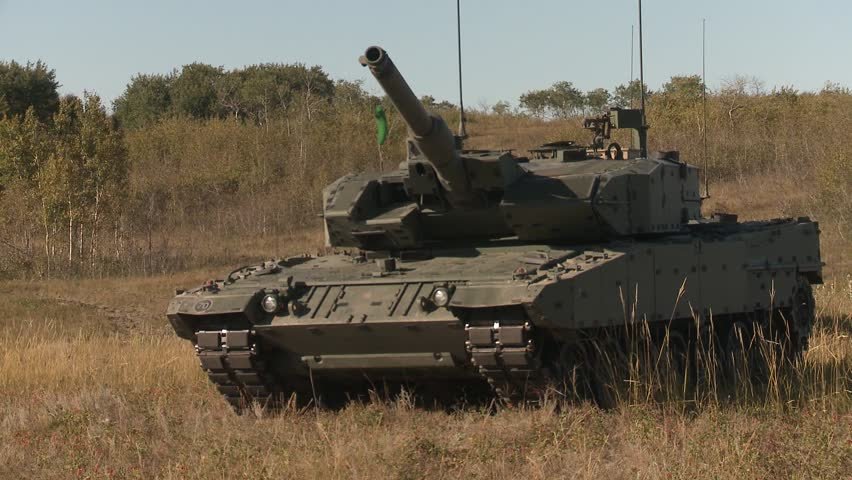
For the record, Zelenskyy and his generals were asking for 300 Leopard 2 tanks. Contrary to what the media would have you believe, the Leopard 2 is a capable heavy tank, but not a modern super weapon. The model which Canada is sending to Ukraine is the Leopard 2A4 which first entered service in the mid-1980's. As such they will be older than the Ukraine tankers manning them. Admittedly they are better than the Russian T-72 and T-80 Soviet era tanks of the same vintage. However as we have seen in the combat to date in Ukraine, the advent of drones and sophisticated anti-tank rockets have made the modern battlefield extremely dangerous for tanks.

Added to this is the fact that instead of a homogeneous force of 300 Leopard 2's, what has been pledged to date is just; 14 Challenger tanks from the UK, 31 Abrams from the US, 14 Leopard 2's from Germany and the additional 4 from Canada. Presumably Poland, Finland and a few other NATO members will add Leopard 2's to that list but we are looking at around 100 tanks in total. Worse yet is the reality that this donation includes three distinctly different types of tanks. This amounts to a stupidly wide spectrum of equipment for a Ukraine Army that is already trying to logistically support a huge range of weapon systems and vehicles already donated to them during this war.

The  Challenger tank for instance, was only ever used by the UK although a number were exported to Oman. The ammunition calibre for the main gun on the Challenger is not NATO standard. There is a good reason why armies strive to minimize the diversity of their combat equipment. In addition to the headache of re-supply, maintenance obtaining spare parts etc, there is also the challenge of training crews on a variety of platforms.  For those expecting these new tanks to be rushed into battle against the Russians, think again.

According to US doctrine it takes 22 weeks to fully train an efficient tank crew. Granted the Ukraine tankers have had 11 months of actual combat experience in their Soviet era tanks. However, if they are to understand and best utilize the advantages of these western standard tanks, they will still require weeks of intensive training.

The fact that the Canadian Army has 82 Leopard 2 tanks but is hard pressed to part with just 4 of them to Ukraine is indicative of how neglected our armoured forces have been since we quit the combat mission in Afghanistan in 2011. If main battle tanks still have a place on the modern battlefield, I would suggest that Minister Anand commits to more than simply replacing the 4 Leopard 2's that we are giving away to Ukraine.

ON TARGET: Military Aid to Ukraine Trumps Canadian Army's Needs

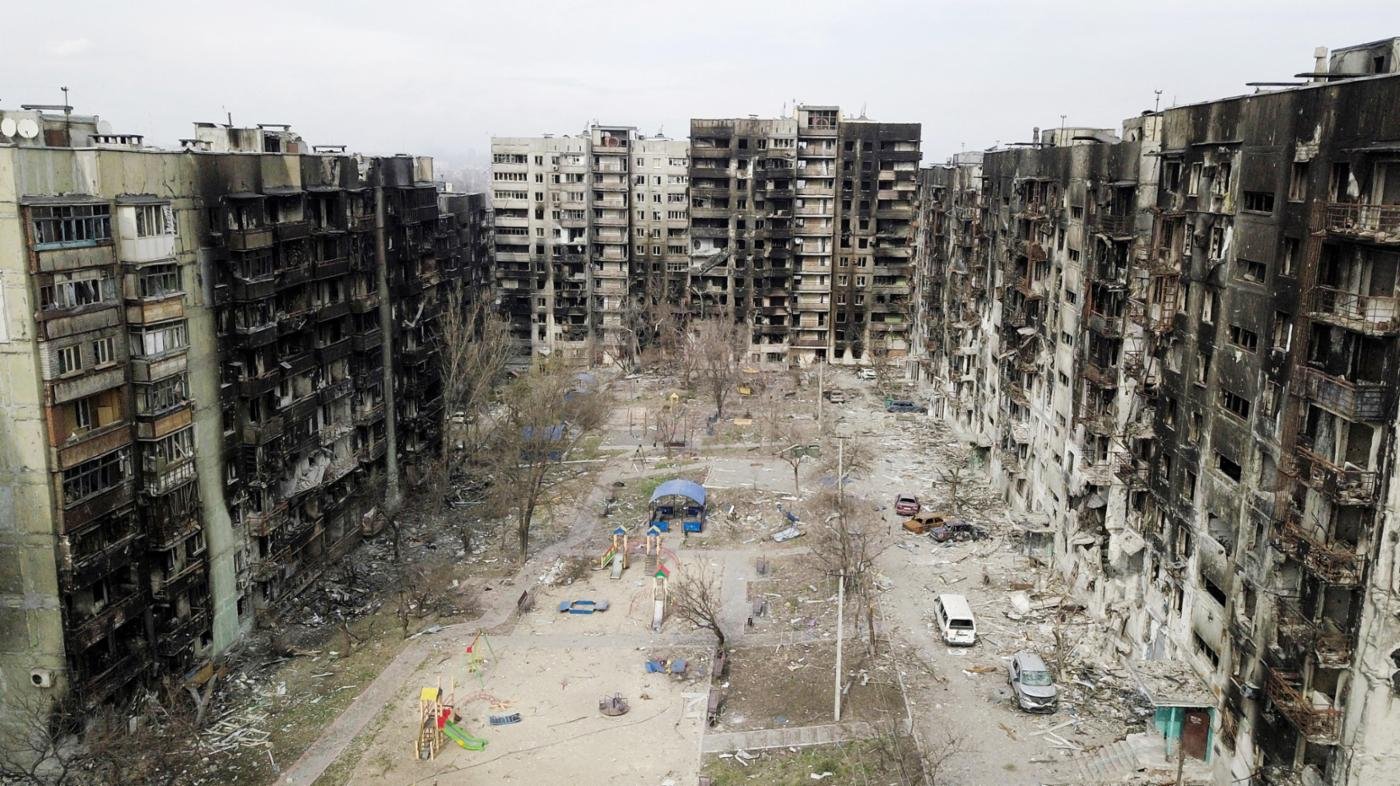
Pictured: City of Mariupol © CNN

On Tuesday, Jan. 10, Minister of National Defence Anita Anand announced that Canada would be donating a $400 million air defence system to Ukraine.

The National Advanced Surface-to-Air Missile System (NASAMS) that Canada will provide to the Armed Forces of Ukraine, is a state-of-the-art medium-range ground-based air-defence system that provides tactical protection against the threat of drones, missiles and aircraft.

For those closely following the war in Ukraine, it will be readily apparent that a weapon system such as these NASAMS will prove a vital asset to Ukraine’s combat troops.

In blunting the Russian invasion and the subsequent battles of attrition, it has become evident that the drone is the new master of the battlefield.

Denying the Russian foe the use of their drones through NASAMS will give Ukraine a decided advantage in combat.

It is also true that the vast majority of Canadians agree with Anand’s statement that “Canada stands in solidarity with Ukrainians as they fight heroically against Russia’s illegal and unjustified invasion.”

You might ask: So what is the problem? Afterall, Canada is giving Ukraine the means to defend itself against a foreign invader.

The problem is that the Canadian Armed Forces do not have NASAMS.

The donated systems are being purchased directly from the U.S. government, to be shipped to Ukraine.

In fact, for the past decade, the Canadian military has possessed absolutely zero tactical air defence capability.

During the Cold War, the Royal Canadian Artillery had air defence units equipped with 40mm cannons forward deployed at airforce bases in Germany.

In 1989, Canada purchased a small number of sophisticated weapons known as the Air-Defence Anti-Tank System (ADATS). However, after the Soviet Union collapsed in 1991, these ADATS were eventually mothballed.

Post 9-11, the Canadian government briefly used a handful of ADATS to protect the G-8 Summit in Kananaskis, Alberta in 2002. By 2012 the last of Canada’s tactical air defence assets were retired from service.

This was not a problem during Canada’s decade long military deployment to Afghanistan, as the Afghan insurgents possessed no airborne assets.

However, once armed unrest erupted in eastern Ukraine in 2014, the threat of Russian escalation became imminent.

Canada deployed combat trainers to Ukraine in 2015 and the nucleus of a forward based NATO battle group in Latvia in 2016.

Russia is not the Taliban, and following the Feb. 24, 2022 invasion of Ukraine it became clear that airborne threats on the modern battlefield are all too real.

Knowing they were deficient in tactical air defence, the Canadian Army have been trying to acquire new systems since 2017.

The kind of protection the Canadian Army was looking for was from drones, missiles and aircraft – in other words exactly what the NASAMS will be providing to the Ukrainians.

The fact that a $400 million purchase could be made so quickly and expeditiously by the Canadian government to outfit a foreign military, while Canada’s military still does without this same capability, must be a blow to our Army’s morale.

To date, Canada has provided nearly $1 billion worth of military aid to Ukraine. The majority of these vehicles, weapons and munitions sent were drawn from the existing stocks held by the Canadian military.

In the case of the 39 armoured vehicles shipped to Ukraine, these were assembled by General Dynamics Land Systems in London, Ontario.

This means that the donation to Ukraine could be offset financially by creating direct employment for Canadians.

While not all of the other gear and munitions shipped were made in Canada, the Canadian military procurement system is based on securing industrial offsets against the purchase price. This means that, while assisting Ukraine, Canada was not simply forking over cash to a foreign country.

The $400 million spent on the NASAMS will not benefit the Canadian economy.

Now I get the fact that those NASAMS will be very useful on the battlefield, but surely some other nation could pick up the tab?

Canada is rich in numerous resources and Ukraine is desperately in need of far more than just more munitions.

As for the Canadian Army getting a tactical air defence capability any time soon, the Defence Minister’s office issued this statement, “We continue to work towards the procurement of Ground-Based Air Defence Equipment for the Canadian Armed Forces – and Minister Anand is committed to getting this done, as outlined in our defence policy.”

She is just not as committed as she was to making sure the Armed Forces of Ukraine get them first.

ON TARGET: CANADIAN DEFENCE PROCUREMENT: FUBAR?

By Scott Taylor

Over the Christmas holiday there were three Ottawa Citizen reports on defence procurement projects. The net sum takeaway from these articles was an appreciation for just how much money the government is spending in return for almost nothing tangible in terms of increased defence capability.

The first story noted that Canada has already spent $4.8 billion on new warships, the construction of which will not even begin until 2024.

The genesis for the news story was the latest figures presented to the House of Commons detailing the spending so far on the Canadian Surface Combatant (CSC) project.

For those Canadians unfamiliar with this program, it is high time that you took note.

With the Parliamentary budget officer estimating the total cost to exceed $300 billion, the CSC acquisition is the largest federal purchase in history.

While that sum includes the life cycle cost of operating the 15 new warships, the estimate for the construction of these ships has already skyrocketed from an original $26 billion to the currently estimate of $84.5 billion.

That amounts to roughly $5.6 billion to build each of the 15 new 7,000 tonne frigates.

Although I will be accused of comparing oranges to pumpkins, the British Royal Navy recently completed the construction of HMS Queen Elizabeth, their new 65,000 tonne aircraft carrier, at a cost of just $4.5 billion (CAD).

While we are comparing the ‘bang for the buck’ that Canada’s receives in comparison to our allies, the Citizen’s second report was entitled “Analysis: Canada’s price tag for F-35 jets raising questions.”

The cornerstone of this article was the announcement that Treasury Board had approved the spending of $7 billion for the purchase of 16 F-35 Joint Strike Fighter Jets.

In March 2022, the Liberal government announced that Canada would acquire a total of 88 F-35’s to replace the RCAF’s aging fleet of CF18 fighters. That project is expected to cost between $15 billion to $19 billion for the aircraft acquisition, with a total life cycle cost of $77 billion.

However, this initial purchase contract worth $7 billion for the 16 F-35’s has raised some eyebrows among military procurement specialists. Even if you factor in the fact that this initial price tag includes spare parts and the construction of new hangars, the unit price is significantly steeper than what allied nations are paying for the same aircraft.

For instance, Switzerland just placed an order for 36 F-35’s at a cost of $8.5 billion (CAD). That works out to roughly $236 million per plane.

Finland ordered 64 F-35’s for the equivalent of $15 billion (CAD), or approximately $234 million per fighter. Germany’s purchased order for 35 F-35’s will set back German taxpayers $12 billion (CAD) which equates to $340 million per plane.

In all of those purchases, the individual deals do include provision for related systems and training. That said, Canada’s first batch of F-35’s works out to a comparatively expensive $438 million per jet.

The third Citizen report was headlined ‘Cost of new Arctic Patrol Ships jumps by $780 million.”

Once again, for those who closely follow such major defence procurement projects, it is not news that the Arctic Offshore Patrol Ship (AOPS) project has been plagued with delays and cost increases from the outset.

In January, 2015 the federal government awarded Irving Shipbuilding a $2.6 billion contract to build five AOPS. In 2018, that deal was expanded to include a sixth ship for the RCN. However by 2021, those initial cost estimates had increased to $4.3 billion, and the most recent figures have risen to $4.98 billion.

The reason given for the latest price hike is the extra costs associated with the additional safety protocols as a result of the COVID-19 pandemic. Also cited for the extra cost was increased transportation costs and increased expenses for labour.

Fair enough.

However, taxpayers should also take note of what exactly Canada’s Navy is receiving in return for $4.98 billion. Back in 2017, the Senate Defence Committee questioned the purchase of the AOPS. Their report stated “This (concern) is based on the fact that these ships cannot operate in ice more than a metre thick, are slower than a BC Ferry, can only operate in the Arctic from June to October and will require a Coast Guard escort in northern waters.”

As a result of their findings, the senators concluded “These limitations are troubling and raise the question of whether the taxpayers are receiving value for the monies spent.”

Let me answer that question, in a single word, ‘No’.

ON TARGET: Army Stretched Too Thin: Commander Warns

By Scott Taylor

In a year-end interview with the Canadian Press, Canadian Army Commander, Lt. Gen Joe Paul admitted that his soldiers are feeling squeezed. This is due to a current shortage of personnel coupled with increased demands both abroad and here in Canada.

The Army is not the only branch of the Canadian Armed Forces feeling the pinch in terms of personnel shortages.

With an authorized regular force strength of 67,000, it is estimated that the CAF presently has more than 10,000 positions unfilled.

This is a result of both a failure to recruit and train sufficient numbers, and also a fast-rising rate of attrition. Lt. Gen Paul believes that the Army shrunk by 1200 soldiers last year alone, and he predicts that 2023 will likely see an additional 800 vacancies in the ranks.

Since 2016, Canada’s largest overseas military deployment has been to Latvia. Canada provides approximately 600-700 soldiers and the command structure to a NATO force of roughly 2000 combat soldiers from ten NATO member states.

Following Russia’s invasion of Ukraine on Feb. 24, Canada slightly boosted the number of Canadian troops based in Latvia.

However, in June, Prime Minister Justin Trudeau signed an agreement to grow the allied force in Latvia to a full brigade.

Lt. Gen Paul is rightly concerned that Canada has little more to offer in terms of a sustained commitment to such a reinforced NATO brigade.

“So how much kit can I afford having pre-positioned in Latvia without impacting too much my training back home, without impacting my capability to do domestic operations”, Paul told CP. “If we were to generate two battle group in Latvia, sustained, we cannot do it,” he added. “The whole thing will break, especially when we need to reconstitute our ranks.”

As for the demands for domestic operations, the CAF -and the Army in particular- have seen a steady increase in responding to natural disasters across Canada over the past two decades.

While the sight of military vehicles and personnel assisting in sandbagging riverbanks during floods or carving up downed trees with chainsaws after a hurricane are excellent public relations gestures, the fact is this is not a responsible use of combat professionals.

Between the demands of sustaining the Battle Group in Latvia, ammunition shortages due to the provision of same to the Ukraine Armed Forces, or simply the lack of available personnel, it has become increasingly difficult for the Canadian Army to conduct large scale military training exercises. When you add to this the unpredictable demands on the Canadian Army to assist civilians in the wake of natural disasters, the professionalism of the individual soldiers is bound to be eroded.

The decision to expand the Latvia based Force to a full brigade was announced by Trudeau back in June, however the war in Ukraine has since taken some very dramatic turns,

Given the fact that the Russian military has suffered such crippling losses and battlefield reversals at the hands of the Ukrainians, it appears it is no longer necessary for NATO to boost troop numbers in Latvia or the other Baltic states.

If Putin had doubted NATO’s resolve to resist Russian’s military aggressions, I think that such skepticism has since been fully disproven.

Ukraine is not a member of the NATO military alliance, yet Canada and other NATO allies have provided Ukraine with training, weaponry, money, and intelligence.

This support has resulted in the crushing defeat of Putin’s military.

No one in their right mind would believe that NATO would not employ even more lethal resistance if Russia were to actually invade a NATO member state such as Latvia.

Given the battlefield losses in armoured vehicles and effective combat soldiers, Russia will not pose a threat to the Baltic States for decades to come. If NATO insists on beefing up the Brigade in Latvia, that increase in personnel should come from the other nine European NATO allies currently contributing soldiers.

Canadian politicians need to heed the warnings from our senior generals.

If indeed the Army is near the breaking point, then we need to give them an operational pause. That is especially true in reducing expectations among the civilian population that every time there is a forest fire or flood the Army will be riding to the rescue.

Wishing everyone a happy and healthy 2023.

ON TARGET: The RCAF is Still Not 'Woke'?

Photo credit: TOP GUN 2 Maverick

By Scott Taylor

At the end of August, there was a bizarre story about a military investigation into potentially offensive comments made by Air Force pilots at a call-sign meeting.

For those readers who have not watched Tom Cruise’s 1986 Hollywood blockbuster Top Gun or the recently released sequel, Top Gun: Maverick, call signs are an important element of the elite fighter pilot culture.

According to RCAF spokesman Col. Adam Thompson, “The call sign has a practical purpose and is used for brevity and quick identification while removing some flight leadership barriers that may arise by rank or position.”

The call sign selection takes place at the unit or squadron level and involves suggestions from fellow pilots. Once assigned, that moniker remains with the pilot throughout his career.

This all sounds rather innocuous, which is why the RCAF’s late August announcement generated such public interest.

In a statement from RCAF Commander Lt-Gen Eric Kenny, it was announced that pending the results of the call sign investigation, the scheduled change-of-command ceremony in CFB Bagotville, Quebec was being postponed.

It was revealed that the call sign assignment meeting in question had taken place at CFB Cold Lake, Alberta in June 2022. With no details released by the RCAF as to the nature of the allegedly offensive commentary, it was left to pundits such as myself to surmise that whatever was said must have been “incredibly offensive.”

The fact that two months after this call sign meeting took place, a senior officer’s assignment was put into limbo while military police investigators probed the incident, certainly added to the gravitas.

Myself and others questioned how any officers in the Canadian Armed Forces would still think it acceptable to utter any potentially offending remarks in the current socially aware climate.

At the time of the alleged incident, the CAF had been under a near continuous 19-month long, media crap storm for sexual misconduct at the senior level.

For that reason I opined that the offensive call sign comments under military police investigation were unlikely to have been sexual in nature. However, it turns out that our uniformed, commissioned officers with the skill set to fly a modern fighter plane, do not necessarily require common sense.

Despite the RCAF’s best efforts to keep the call-sign quiet, in this era of social media posts, it was only a matter of time before the offensive content surfaced.

As reported by David Pugliese in the Ottawa Citizen we now know that the call sign which would be used to identify a male pilot was based on a consensual sexual relationship with a female Canadian Forces Officer.

That female officer subsequently had a consensual same-sex relationship. Armed with this knowledge, the RCAF fighter pilots assigned their colleague the call sign FAWG. This is an acronym for “F***ed a Woman Gay.”

One can easily understand why the RCAF senior brass would not want the details of this call sign made public.

However, as long as the nature of the offensive content remained unknown, the usual apologists could safely claim that this was yet another ‘woke’ overreaction to some harmless jesting by a handful of fighter pilots.

Unfortunately, an estimated 30 RCAF personnel attended that call sign meeting when ‘FAWG’ was assigned and it took two months before any action was taken.

Only after a military member complained that this call sign was based on an abusive and derogatory comment against a female military member as well as the LGTBQ2+ community was the investigation initiated.

That someone in this current climate would think this call sign reference was in any way acceptable speaks to that individual’s lack of social awareness.

The fact that some 30 fellow officers either concurred with this call sign or failed to raise any objections, is clear proof of the toxic environment which still prevails.

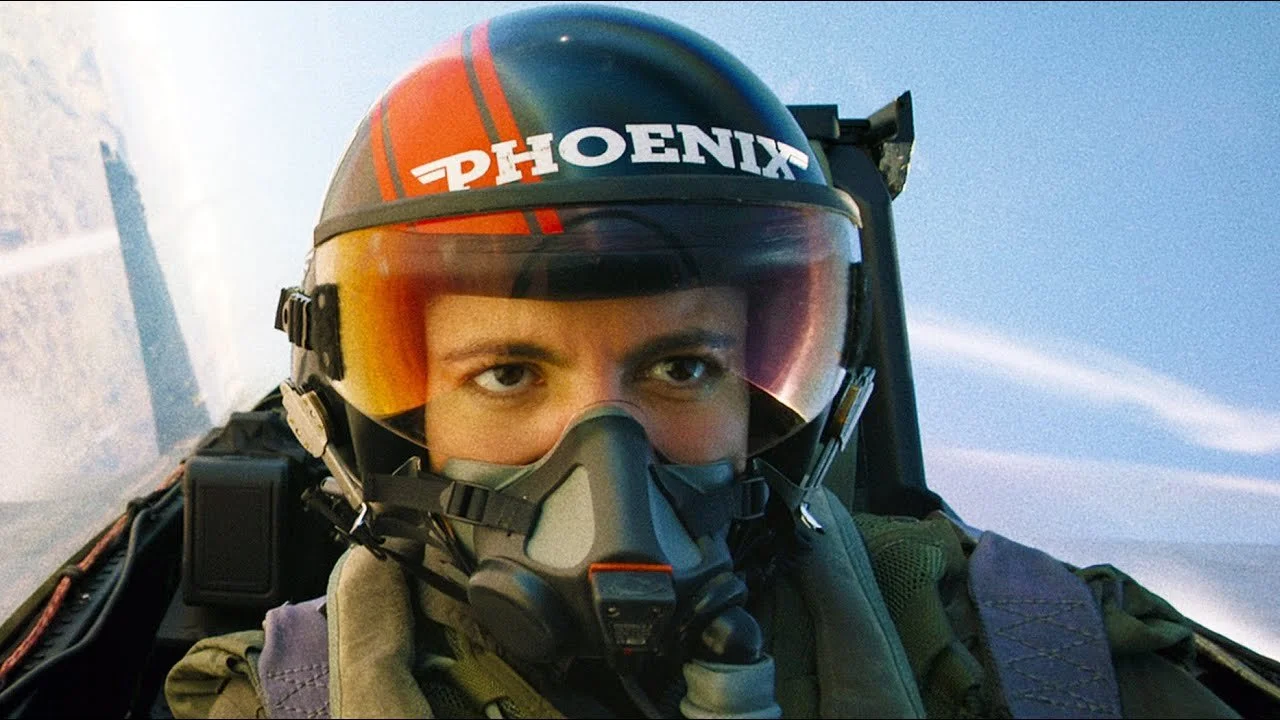
Even the producers of the Top Gun: Maverick sequel had the good sense to include a female pilot, call sign Phoenix, who proved her worth as a member of an elite squadron.

According to Col. Thomson, assigning call signs “is meant to foster esprit de corps.” I think it is safe to say that in this instance the opposite result was achieved.

In the end, two senior officers were charged for allegedly failing to stop the assignation of the ‘FAWG’ call sign and junior officers are reportedly facing administrative action.

The two senior officers were docked play. While a number of junior officers are also facing administrative action the RCAF has declined to provide details on numbers of individuals or the actions that have been taken against them.

ON TARGET: Canadian Armed Forces in 'Crisis'?

By Scott Taylor

The Canadian Armed Forces are facing a manpower crisis, which threatens their operational proficiency. At present, the regular force is short some 10,000 personnel from its authorized manning level of 67,000 service members.

That amounts to a 17 per cent shortfall. This may not sound significant but according to U.S. military doctrine, any combat unit that suffers a 10 per cent casualty rate can no longer be considered effective.

The worst part of this crisis is that the Canadian military continues to face a challenge in both recruiting new members and retaining trained soldiers.

Analysts claim that the COVID-19 pandemic combined with reputational issues stemming from the series of high-level sexual misconduct cases, are to blame for the current shortfall in personnel.

In an attempt to open recruiting to a wider cross section of society, Chief of Defence Staff General Wayne Eyre recently changed the CAF’s dress code regulations.

Under the terms of the new policy, members can choose their hairstyle, sport face tattoos and select which gender of uniform clothing to which they best identify.

Last week, it was also announced that you no longer need to be a Canadian citizen to enlist in the military. Permanent residents will now be eligible to apply to join the Canadian Armed Forces.

In the past there had been provisions made to allow immigrants with Permanent Resident status to enlist, but that was reserved for professional specialists who were already serving in a foreign military.

The advantage for those permanent residents seeking to obtain full citizenship is that immigration officials will be giving priority to those who have served in the CAF.

In theory, this widening of the pool of eligible applicants should help address two of the Canadian military’s current challenges at the same time.

They are presently woefully short of personnel, and those members that are in uniform are lacking in diversity.

While I wholeheartedly applaud these policy changes, I remain pessimistic as to the outcome in the short term.

I understand that some very qualified people may have been exempted from enlisting under previous dress and deportment regulations. A youthful decision to get a face tattoo or multiple piercings may have kept a few otherwise excellent candidates out of the ranks.

However, I do not think that since General Eyre revised that policy that recruiting centres have been swarmed by an eager horde of tattooed, pierced hipsters. The military, by the very nature of the institution remains a symbol of conformity and authority.

As for attracting new immigrants through the lure of fast-tracked citizenship, I fear the same equation might apply.

Service in the military is a pretty consistent experience worldwide. The uniforms, food and pay may differ but the basics of the soldiering lifestyle are generally universal.

Immigrants coming to Canada would have had the option of serving in the military in their home country, yet they were obviously seeking something different for themselves and their families.

I personally think that a Canadian military that reflects our society as a whole will benefit the institution.

It will better connect those presently under-represented factions and that in turn will generate an increase in diversity over time. However, I do not think there are any quick fixes in the offing through these two recent initiatives.

To meet the manning shortfall during the decade long commitment to Afghanistan, the CAF had to resort to a partial mobilization of the reserves. I think that this current manpower crisis calls for a similar call to arms for Canada’s militia and reserve units.

Over time the appeal of a career in uniform may start to attract those hipsters who visibly challenge authority through their appearance. Likewise, once a critical mass of under-represented groups flesh out the ranks, others from that demographic may be encouraged to enlist. That will take time.

Meanwhile, the CAF needs to take drastic measures to reverse the present course. Tasking the reserves to select part-time service members to temporarily become full time personnel would appear to be the simplest solution.

It worked in Afghanistan, it can work again.

ON TARGET: Lt. Gen (ret'd) Maisonneuve: Should he be Cancelled?

By Scott Taylor

In every good Hollywood boxing movie, there comes a scene when a pummelled boxer is instructed by his trainer to ‘stay down’ in order to avoid a further beating. If the boxer still attempts to rise, the trainers will mercifully ‘throw in the towel’ to signal the official to end the fight.

I fear that in the case of Lt-Gen (ret’d) Michel Maisonneuve, he either has no trainer in his corner or he is too punch-drunk to accept their sound advice.

The saga begins on November 9 when the Conference of Defence Associations Institute hosted their 30th annual Vimy Gala dinner in Ottawa.

The CDAI promoted this event as ‘one of the most formal dining evenings which unites the defence and security community.’

While the Vimy Gala did bring out a record number of well heeled guests – which included a Supreme Court Justice, senior military brass and top bureaucrats – the keynote speech proved to be far from unifying.

In accepting this year’s Vimy Award, Lt-Gen (ret’d) Maisonneuve criticized everything from the removal of historical statues and apologies to victims to the Trudeau government’s climate change policies.

Maisonneuve bemoaned the lack of unbiased media reporting and took particular offense to the recent changes made to the Canadian Armed Forces dress regulations which now allow members a freer expression of personal choices.

While Maisonneuve’s comments were rewarded with a standing ovation, it was clearly evident that many in attendance were not pleased. Realizing that such remarks from the recipient of what is intended to be an apolitical award from an apolitical organization, CDAI executive director Youri Cormier was quick to issue a disclaimer. “Many attendees were offended by [Maisonneuve’s] speech. His remarks do not reflect those of the CDA Institute” stated Cormier.

Some of those offended guests immediately posted their displeasure on social media outlets that evening.

The next day, November 10 the Chronic Pain Centre of Excellence for Canadian Veterans announced that Maisonneuve, who was already on their board of directors, was to lead that organizations’ fundraising efforts. So far, so good. It seemed that Maisonneuve was in the clear.

However, on November 15, Ottawa Citizen reporter David Pugliese published the Vimy Speech story complete with Maisonneuve’s anti-government policy statements, plus the fact that many senior, serving personnel had responded with a standing ovation.

Following the Citizen report, National Defence Minister Anita Anand and Lt-Gen Jennie Carignan, the Canadian Armed Forces Chief of Professional Conduct and Culture, both publicly criticized Maisonneuve’s comments.

Exhibiting a lack of bias which Maisonneuve claimed no longer exists in mainstream media, the National Post published a copy of Maisonneuve’s entire speech online. Like throwing fuel on a lit fire, the contents of the speech remained polarizing within the defence community on many social media platforms.

Maisonneuve’s self-proclaimed ‘anti-woke’ commentary was music to the ears of those who long for a golden era that never was, while to those who consider themselves progressive, Maisonneuve’s words were akin to dinosaur grunts.

As the controversy continued to bubble over, on November 25, the Chronic Pain Centre of Excellence for Canadian Veteran’s asked for and received Maisonneuve’s resignation from their board of directors.

It was at this juncture that the good general should have heeded the famous words of U.S. General Douglas Macarthur and simply ‘faded away.’ Instead, Maisonneuve decided to double down with a statement published once again by the National Post.

He claimed his words had been ‘misrepresented’ and ‘distorted’ even though they had been published in their entirety. For a guy who had loudly criticized those special interest groups who ‘fight over who gets to wear the coveted victim’s cloak’ Maisonneuve is now painting himself as a victim of cancel culture.

Responding to the allegations that his criticism of Chief of Defence Staff General Wayne Eyre’s new military dress regulations were out of place, Maisonneuve wrote “This is simply not true.” Pledging his respect for Eyre, Maisonneuve acknowledged that the current CDS is “navigating a difficult road.” However this was then followed by Maisonneuve stating that in his opinion “uniforms ought to be uniform.”

He also used his statement to double down on his criticism of the Trudeau Liberals. “The government does not seem to understand the requirements of military service and it’s unlimited liability clause.” wrote Maisonneuve.

The truly ironic part of Maisonneuve’s argument is that he repeatedly calls for leaders to be less divisive and more unifying.

I realize there are many loud voices who consider themselves to be in Maisonneuve’s ‘anti-woke’ camp and they will happily echo his sentiments.

However as a retired general, Maisonneuve should have had the good sense not to use the apolitical forum of the Vimy Gala to mount his soapbox and air his personal beefs.

If the CDA Institute truly feels Maisonneuve does not reflect their views, then they need to revoke the award which they bestowed upon him.

As for Maisonneuve, I suggest that it is high time to throw in the towel.

To paraphrase the old saying; “If you wish to extricate yourself from a crap storm, stop blowing hot air.”

ON TARGET: Canadian Military Must Adapt To Changing Battlefield

Genya Savilov/AFP/Getty Images

On Saturday November 19th, I was honoured to attend the Gala Ball celebrating the 150th anniversary of the Governor General’s Foot Guards. The event was held in the landmark Chateau Laurier Hotel’s ornate ballroom. Former and serving members of the Regiment were turned out in their scarlet mess kits while the band wore their scarlet tunics and distinctive bearskin hats.

Minus the preponderance of cell phones and the style of the ladies’ evening gowns, a black and white photograph could convincingly represent the Regiment at the time of its founding in 1872.

While it was a fitting tribute to Canada’s oldest reserve regiment, the visuals also served to illustrate just how much warfare itself has evolved over that span of a century and a half.

The bright scarlet tunics of the soldiers were meant to be seen by the enemy and the massive bearskin hats were intended to give the impression of greater height.

No thought was given to camouflage with white cross belts and metal trimmings polished till they sparkled.

Soldiers were meant to march in densely packed ranks and deliver volley fire at point blank range. The British empire – including Canadian regiments – were taught the lessons of concealment, cover and camouflage by the South African Boers at the turn of the last century.

The trenches, barbed wire and machine guns of World War One changed tactics one again and modern armies ditched the ornate headgear for helmets that actually protected soldiers.

For those closely following the current conflict in Ukraine it is readily apparent that the battlefield continues to evolve and with it the way in which we approach combat.

The current scourge of the battlefield is the unmanned aerial vehicles (UAV’s) more commonly known as drones.

While both sides are using drones extensively, it would seem that the NATO supplied Ukrainian forces have been far more successful in employing this technology.

There are lessons to be learned from this war for Canada. While we did employ a limited number of drones during our decade long counter-insurgency campaign in Afghanistan, we would need to massively increase our drone arsenal should we ever be drawn into a near-peer war.

The Taliban, unlike the Russians and Ukrainians, did not possess any effective anti-aircraft defensive measures to counter drones. In this regard, Canada is akin to the Taliban as our military possesses zero tactical air defence systems.

While many of the drones employed in Ukraine have their own direct fire weapons, or are of the ‘kamikaze’ variety, the remainder are used as spotter aircraft to direct the heavy artillery.

Canada has a limited number of modern M-777 howitzers which were extremely effective in the counter-insurgency role in Afghanistan.

These 155mm howitzers have a long-range precision guided capability. However, they are towed artillery which means the gun crew has no armoured protection.

Experience has shown that the Russians have an effective counter-battery artillery capability which makes the four M-777 towed artillery which we gave to Ukraine, a dangerous liability.

Again, if Canada ever expects to be involved in a near-peer conflict with an artillery equipped adversary, we should start investing in a fleet of modern, self-propelled, armoured howitzers.

In addition to the equipment proving successful on this new age battlefield, Canada should also look at what type of soldiers are emerging as the victors.

While there are still a large number of tough looking infanteers and tankers on the front line, the real scourge of the battlefield are the legion of drone operators.

These talented former video-gamers do not have to bench press 100 kilos or climb over a two meter wall, they simply have to manipulate a joystick and press buttons.

Given that the Canadian military is currently 10,000(+) personnel short of its authorized strength of 67,000 regular force members, perhaps we need to rethink who we believe would make a good soldier?

We have evolved body armour and camouflage to the natural limit, but perhaps it is time to evolve this even further. Maybe the future warrior is not seen by the enemy at all because they are able to employ remote weaponry via sophisticated drones.

If that becomes the case, then perhaps the old Colonel Blimp brigade can finally stop bemoaning the current relaxation of dress regulations and allowance of facial hair and tattoos.

ON TARGET: Railing Against the 'Woke Cancel Culture'

By Scott Taylor

On Wednesday Nov. 9, the Conference of Defence Associations Institute (CDAI) hosted their 30th annual Vimy Gala Dinner at the Museum of History in Ottawa.

In their promotional material, CDAI billed this event as “one of the most exclusive formal dining evenings in the country which unites the defence and security community.”

Indeed, the Vimy Gala did bring out over 600 attendees that included Richard Wagner, the Chief Justice of the Supreme Court of Canada, Jody Thomas, Trudeau’s National Security advisor, a bevy of senior military officers and the majority of the Ottawa Service Attaché Association (OSAA).

So far so good.

Then Lt-Gen (ret’d) Michel Maisonneuve took to the podium to give his acceptance speech as this year’s recipient of the Vimy Award. The CDA Institute selection committee sought to honour Maisonneuve for his life-long contributions in defence, including his work on military education, support for veterans and his commitment to bilingualism.

Fair enough. Maisonneuve served in the army for 35 years before retiring in 2007 at the esteemed rank of Lt-General.

However, rather than simply accepting his kudos, Maisonneuve chose to climb onto his soapbox to rail against everything from cancel culture to climate change.

He prefaced his speech with a recap of Canada’s past military victories, which oddly enough included the recent war in Afghanistan. Note to the good general, we lost that one.

His segue into crapping on the current state of affairs rang an eerily Trump-like tone. “Canada was a great nation and though we are faltering today, I believe we can be great again,” stated Maisonneuve. Then his tirade began.

His first target was social media and the rise of cancel culture. Then he turned to the state of actual journalism. “The line between “news” and op-eds has blurred and too often we are subjected to sermons written not by seasoned journalists but by first-year graduates of woke journalism schools,” claimed Maisonneuve, adding that “unbiased reporting seems to have died with Christie Blatchford and Matthew Fisher.”

For the record, both Blatchford and Fisher were both unrepentant cheerleaders of all things Canadian military.

It should also be noted that in attendance that evening were CBC’s seasoned defence reporter Murray Brewster and Global News’ Mercedes Stephenson who was recently recognized for her investigative reporting on senior level military sexual misconduct. They are both very much alive.

On the topic of climate change, Maisonneuve pulled no punches. “Canada’s prosperity is being sacrificed on the altar of climate change as opposed to being used to help the world transition to clean energy.” said Maisonneuve. As for those who protest climate change, Maisonneuve opined they should “be punished, not celebrated.”

On the topic of formal apologies to various groups for historical wrongs, Maisonneuve believes that “the phenomenon for collective apologies flourishes in our country” and that “individuals and groups fight over who gets to wear the coveted victim’s cloak.”

Even more specifically, Maisonneuve took issue with Chief of Defence Staff General Wayne Eyre’s recent changes to the military dress code. “I see a military … where uniforms have become a means of personal expression rather than a symbol of collective pride and unity: uniforms are no longer uniform.”

Not unsurprisingly, Maisonneuve’s words were a tonic to the old guards’ ears and the crowd rewarded him with a standing ovation.

However, the sentiment was not unanimous as was admitted in a subsequent statement from Youri Cormier, the executive director of the CDA Institute. “Many attendees were offended by LGen (ret’d) Maisonneuve’s speech. His remarks do not reflect those of the CDA Institute.”

Unfortunately for the CDA Institute and Maisonneuve, the division sown at the Vimy Gala did not remain within the exhibition hall at the Museum of History.
Ottawa Citizen reporter David Pugliese soon broke the story of the standing ovation by serving officers for Maisonneuve’s anti-government policy remarks.

As one would expect, Maisonneuve’s stance served as a lightning rod to polarize the defence community. Many felt that the general was speaking truth to power while many felt just as strongly that Maisonneuve is out of touch with the current social climate.

Minister of National Defence Anita Anand and Lt. Gen. Jennie Carignan, the Canadian Armed Forces Chief of Professional Conduct and Culture, both publicly criticized the speech after the Citizen article published.

It should be noted that Lt. Gen. Carignan was in attendance at the Vimy Gala when the remarks were made.

That said, if the CDA Institute truly thought this dinner would “unite” the defence and security community they could not have picked a worse candidate to give the keynote speech.

As a positive take on this incident, it is heartening to see that there are two separate camps. That means that while some still pine for the dinosaur era, there are progressives in the military community who get the fact that the times have changed.

ON TARGET: Is China the real threat?

By Scott Taylor

It has been nearly nine months since Vladimir Putin ordered the invasion of Ukraine. What was expected to be a lightning-strike armoured assault to capture Kyiv has turned into a long drawn out farcical rout of the Russian military.

Last week Putin’s senior defence officials went on Russian state television to announce they would be making a temporary tactical withdrawal from the Ukrainian city of Kherson.

With Ukraine having successfully destroyed or damaged the major bridges, the Russian military can no longer supply and sustain the roughly 40,000 soldiers in their Kherson bridgehead on the west bank of the Dnipro river. The fate of those Russian troops will be determined in the days ahead as Ukraine’s military continues to advance faster than the Russians can evacuate their forces back to the east bank of the Dnipro.

Of the original Russian invasion force of 120,000 combat troops, U.S. intelligence estimates that nearly 90,000 Russians have thus far been killed, wounded, captured or have deserted.

To make up the loss of frontline combat capable units, Putin reluctantly ordered the mobilization of 300,000 ill-motivated reservists.

In terms of equipment, Russian losses have been equally heavy with shattered armoured vehicles littering the Ukraine landscape from Kyiv to Kharkiv to Kherson.

To replenish this arsenal, Putin is able to tap into the vast fleets of moth-balled Soviet Union-era armoured vehicles. However, if the Russian first string of soldiers and weapons failed to defeat Ukraine forces, it is unlikely that these less trained, less motivated conscripts with antiquated tanks will somehow reverse the course of the war.

The best result Putin can hope for now is to slow the Ukraine counter offensive, dig in on the east bank of the Dnipro river and hope that crippling oil and gas shortages across western Europe force President Volodymir Zelenskyy’s allies to demand a negotiated settlement.

While much of the credit for Russia’s defeat goes to the Ukraine military’s courageous defence, their success would not be possible without the training, weapons, munitions and money supplied by NATO countries.

This is by definition a proxy war between Russia and NATO fought on Ukrainian soil. For the NATO cheerleaders, the good news for you is that western weapons and intelligence gathering remains vastly superior to the previously much-hyped Russian war machine. The bad news for the NATO cheerleaders is that any future fear mongering is likely to fall on deaf ears.

The standard talking point among the Colonel Blimp brigade is that Putin’s invasion of Ukraine has made the world that much more dangerous. They argue that if a madman can simply invade a sovereign state to overthrow the existing regime, then none of us are safe.

This narrow view of geopolitics conveniently omits the recent U.S. invasions of Iraq and Afghanistan and in the case of Libya, the western allies did not even bother trying to prop up a puppet regime. NATO simply bombed Libya into continual anarchy. But I digress.

On Feb. 24, 2022 as Russian tanks crossed the Ukraine frontier, it was admittedly a very scary development.

However, we now know that those vaunted Russian warriors are nowhere near a NATO standard.

Yet we still have fear mongers here in Canadian defence circles who point to the Arctic to remind Canadians that this dangerous rogue Russian regime is our northern neighbour.

Geographically that is true, and Russia has done far more to develop it’s Arctic resources than Canada. However, if Russian ground forces could barely advance a few hundred kilometres into Ukraine before their logistics and resupply collapsed into chaos, what chance could they have to conduct large scale military operations in the barren Arctic?

Likewise, the warmongers will then pivot and claim that Putin’s invasion of Ukraine has emboldened China to take action against Taiwan.

If that is indeed the case, I’m not sure exactly what example the Chinese would wish to follow.

The Russian military is being ground into oblivion by NATO’s sophisticated weaponry used in conjunction with its superior satellite intelligence gathering systems. While NATO has not declared war on Russia, members states – including Canada – have been quick to empty out their own arsenals to keep Ukraine winning the fight.

If China is watching this war, there are many lessons to be learned and the most important would be that a U.S – NATO backed adversary will still dominate the battlespace.

NATO countries may not have the political will to expend their own soldiers lives, but it seems they will happily supply weapons to a proxy nation to weaken their rivals.

ON TARGET: MND Needs a Reality Check on Armoured Vehicles

By Scott Taylor

Earlier this month, Defence Minister Anita Anand boasted that Canada is regarded as a ‘leader’ in the provision of modern armoured fighting vehicles to Ukraine.

In an interview with Global News, Anand stated “in terms of vehicles, I’ve told my colleagues across the NATO alliance to think about Canada as a leader in this area because what we are providing to Ukraine are brand new vehicles fresh off the [assembly] line to make sure that Ukraine has best-in-class technology.”

What Anand was referring to was the recent shipment of 39 Light Armoured Vehicles (LAV) directly from the General Dynamics Land Systems (GDLS) facility in London, Ontario to Ukraine.

While I have no doubt that the hard pressed Ukrainian military will welcome any donation of modern weaponry, I do not think that Anard quite grasps the scale and scope of the current conflict in Ukraine.

According to U.S. and UK intelligence sources, Russia has lost over 2000 main battle tanks in the first eight months of combat. While Ukraine’s losses are not reported, it is safe to say that Canada’s 39 Light Armoured Vehicles will make roughly one week’s worth of battlefield attrition in Ukraine.

Also, if NATO sources are accurate, to date Ukraine has captured and re-employed some 440 Russian main battle tanks and it is believed that Ukraine now possess more armour than the Russian invaders.

As for Anand’s point that Canada can lead the way in terms of providing armoured vehicles in the future, one has to politely ask “in what universe?”

The fact that Canada had these 39 brand new LAV’s to give away directly from the GDLS factory has it’s origins in a 2018 diplomatic spat between Canada and Saudi Arabia.

It is a little publicized fact that Saudi Arabia is Canada’s best customer for arms exports. Over the past two decades GDLS-Canada has produced over 1400 LAV’s for the Saudi Kingdom.

In August 2018, the Saudis had just placed a whopping $15 billion order for more LAV’s from GDLS when Global Affairs minister Chrystia Freeland publicly denounced the Saudi Kingdom for human rights violations. In turn the Saudis expelled Canada’s ambassador to Riyadh and cancelled all new trade deals.

Canada stood by Freeland’s position and shrugged off the Saudi rebuke as simply the cost of holding rogue regimes accountable.

That was not the sentiment at General Dynamics USA when Saudi Arabia stopped making payments for the Canadian built LAV’s.

Technically Saudi Arabia did not owe any money to GD-USA as military sales are run through the Canadian Commercial Corporation (CCC), which acts as the middle man.

However this was simply semantics, and GD-USA was indeed taking the hit as CCC could not pay for the vehicles if the Saudi Kingdom didn’t fork over the cash.

To resolve this impasse, the Canadian government hastily moved up its own plans to buy new LAV’s, doubled the purchase order and provided GDLS-Canada with an upfront $600 million interest-free loan.

This deal was for $3 billion and GDLS-Canada is to build a total of 360 new LAV’s for the Canadian Army.

The 39 we just shipped to Ukraine were available only because the Saudi dispute forced the Liberal government’s hand into bailing out GDLS-Canada and their parent company in the USA.

While this batch of new LAV’s never actually entered service with the Canadian Army, they are still slated to eventually replace our army’s existing worn out older armoured personnel carriers.

Given GDLS-Canada’s production track record, which assembles about 70-100 LAV’s a year, Anand’s promise to lead the way in arming Ukraine is a pipe dream.

Furthermore, while GDLS-Canada produces a world class quality LAV, to date this class of light-armoured vehicle has not played a major role in the static battlefields in eastern Ukraine.

The Russian Soviet era built LAV’s have proven to be extremely vulnerable to modern anti-tank weaponry. Even the heavier main battle tanks on both sides have been of questionable value.

What has proven effective in Ukraine is long-range artillery with precision munitions.

That is what Ukraine really needs and unfortunately Canada does not produce such ordnance.

While it is understandable that Anand would like to capitalize on the ‘Stand with Ukraine’ public sentiment by telling us we are ‘leading’ the way, we are not, nor will we be in the foreseeable future.