
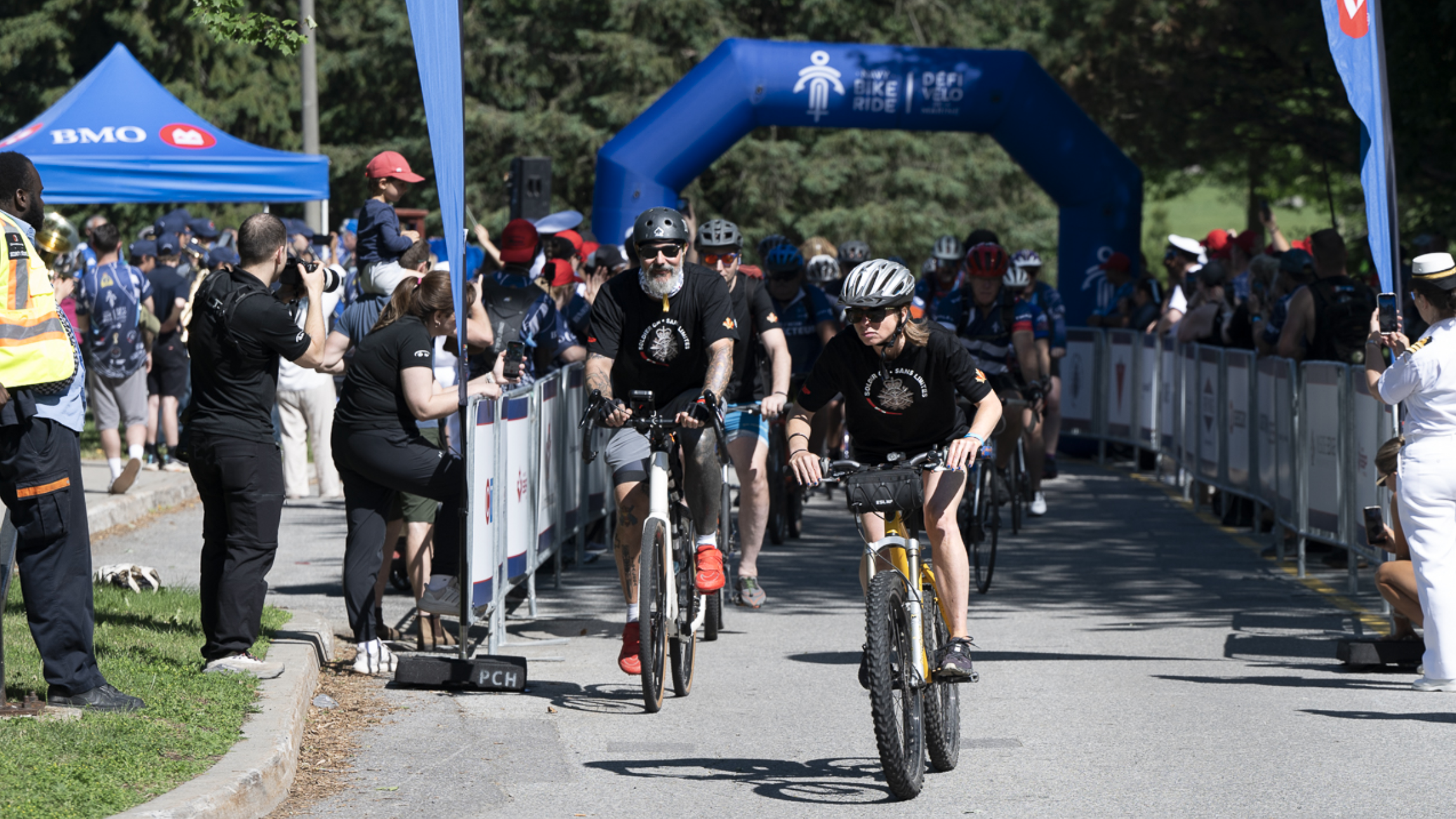
To see all the pictures, go here:
https://www.richardlawrencephotography.ca/rlpgalleries/2026/nbr2026/
Founded in 2016, the Navy Bike Ride (NBR) was designed as a fun, family friendly event, supporting the Royal Canadian Navy (RCN) community, with proceeds going to the Navalis Foundation, Support Our Troops, and Soldier On. The funds raised as part of the NBR go to providing assistance to Royal Canadian Navy members, Veterans, and their families and contributes to building family resilience, and to supporting the recovery, rehabilitation and reintegration of members with physical and/or mental health illness or injury, and supporting those who currently serve or have served our country. (paraphrased from NBR website).
This year, on June 13th, the NBR start/finish was at Hog’s Back Park with the 5km run/walk starting at 0830 hrs and the 18/36 km bike ride starting at 1030 hours. True to form, Vice-Admiral Angus Topshee, outgoing Commander of the Royal Canadian Navy (CRCN) and new VCDS, showed his support as he participated in both the run and the bike ride. The incoming CRCN, Vice-Admiral Dan Charlebois, also showed up to hand out commemorative coins to people as they crossed the finish line of the ride portion.
The run/ride was billed as a family friendly affair and that it was not a race. The attitude of the participants seemed to bear this out as everyone seemed to have a party attitude, not taking themselves too seriously and just happy being out on a nice day. There were children, some in prams, on the course, older runners doing well, and even a medical support Corgi dog trotted along. Now, I don’t know how many paces there are in 5 km, but when your legs are as short as a Corgi’s, that’s got to be multiplied some.
In the exposition area there were booths from sponsors, such as the Bank of Montreal (the official National Defence bank), Soldier on, Veterans Affairs, Federal Fleet Services, Commissionaires, Canadian Forces Morale and Welfare Services, SISIP, Costco, and the Canadian Coast Guard. Federal Fleet Services were handing out hats for “Retain the Asterix” (https://retainasterix.ca/) to bring attention to the Navy looking at moving away from the combat support ship CSS Asterix which has been in the RCN service for nearly a decade.
Music for the national anthems and throughout the day was provided by 75 and 742 Air Cadets National Capital Squadron – Music Programs which supplied pipes and drums, and brass and wind bands. As well, there were highland dancers. Now, I’ve never seen a dinosaur do a highland fling but there was one there on Saturday.
The participants of most note were a group of three WWII re-enactors, led by Colin Schlachta of the Canadian Active Service Force Living History Association (CASFLHA). They were dressed in WWII kit, complete with combat boots, paratrooper smocks, battle dress, packs, helmets and other accoutrement for the run in the blazing sun and 24 degree temperature. While not the hottest day on record, under an unrestricted sun, dressed in wool combat uniforms and packs, they were sure to break a sweat. And they did.
Notwithstanding the temperature, after completing the walk/run, Colin then got his vintage WWII folding bicycle to take on the ride. As he explained, he was dressed as a member of the Stormont, Dundas, and Glengarry Highlanders and when they landed on Juno Beach on D-Day, they carried transport on their backs in the form of a bicycle that could be folded in half. When the lack of pedals was noted, he decided to explain the operation of the museum piece bicycle as follows.
For the first part, one needs to understand how pedals are formed with the pedal axel being a piece of round metal, attached to a pedal crank arm which is attached to a toothed sprocket (aka a chainring). The pedal axel goes through a rubber pedal foot platform which rotates around the pedal axel as the rider pedals along. This is the pedal assembly (add bearings and other things as required) on which the rider places their feet. That’s the basics. You place your feet on the pedal assembly and ride away as the pedal platform rotates around the pedal axel connected to the crank and sprocket, driving the rear wheel via a chain attached from the chainring to the rear wheel sprocket.
So, for this WWII museum piece, there are no pedals, just two pieces of round metal posts (the pedal axels) in place of full pedal assemblies with which the rider placed his feet, making sure the pedal axels were placed where the boot heel meets the sole so the feet wouldn’t fall off. The positioning of the pedals axels was placed back of centre so when the bike was folded, they were not in the way. This makes pedalling more difficult as this is not an ergonomic position. There were no pedal platforms so that, when collapsing the bike, the pedal axels could be pushed through the pedal cranks into the centre of the bike rather than protruding and catching on stuff.
Next, there was a wing nut on the handle bars that, when turned, allowed the handle bars to be place flat against the bike. Finally, there were two wings nuts on the frame (top tube and down tube) which, when undone, allowed the bike to fold in half.
While I found this all very interesting, it has nothing to do with the Navy Bike Run. However, when it was noted that it was good of the Army (in this case Colin and friends) to support the Navy, he said that it was only fair as the Navy supported the Army in that the Army couldn’t have done its job without the Navy getting them where they needed to be and then providing fire support and other support to the beaches. Fair enough.
