
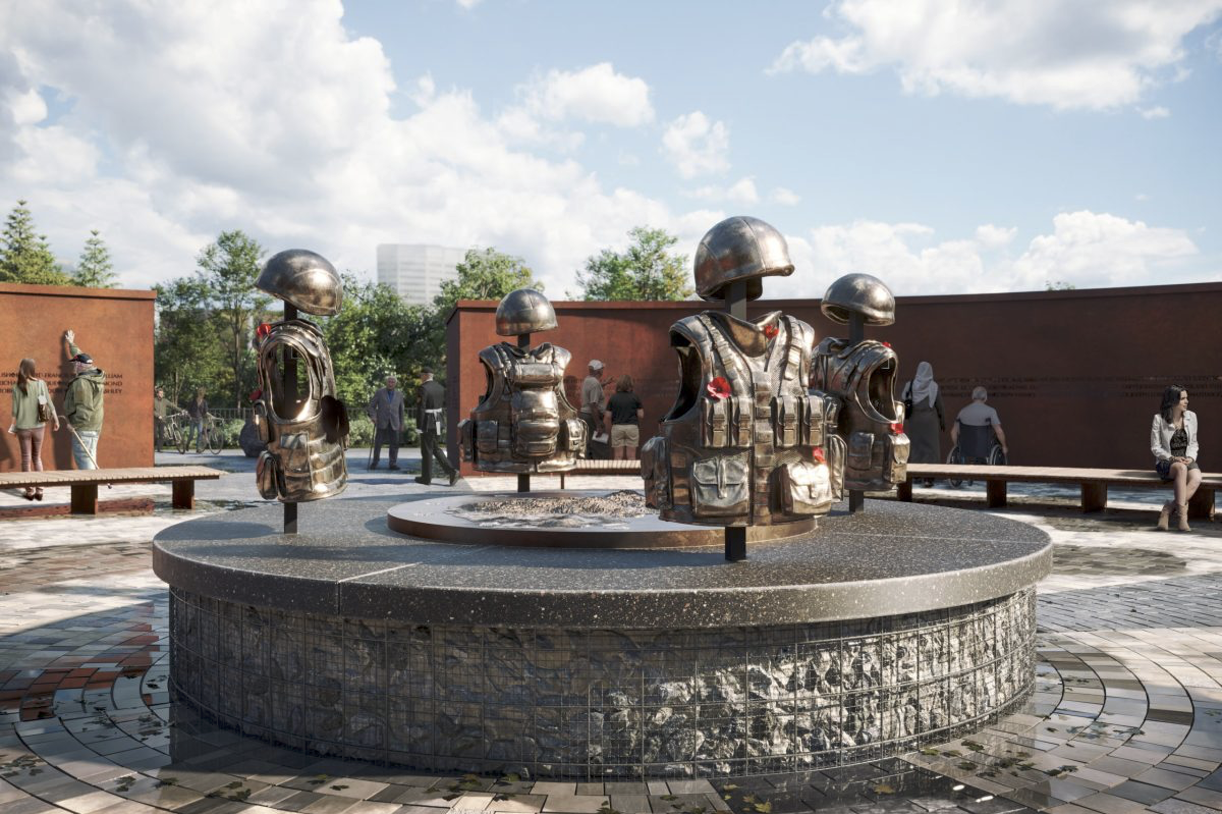
: artist’s conception of the National Monument to Canada's Mission in Afghanistan (courtesy of Veterans' Affairs Canada)
By Richard Lawrence
On a beautiful, warm, spring day, with the sky alternating between cloud and sun, a gathering met to break ground opposite (east) of the National War Museum. The ground breaking was for the National Monument to Canada’s Mission to Afghanistan in memory of Canada’s longest combat deployment since WWII lasting from 2001 to 2014 (combat ended 2011 but the last member left in 2014). More than 40,000 Canadians served in this conflict with 158 service members, one diplomat, four aid workers, a government contractor and a journalist killed and thousands wounded, both mentally and physically. The space was blessed two years ago, construction is expected to start this spring, and completion is planned for 2028.
To see all the pictures, go to:
https://www.richardlawrencephotography.ca/rlpgalleries/2026/afghan/
The ceremony took place on a plot of land east of the Canadian War Museum (across the street) and north of the National Holocaust Monument. The ceremonial ground was covered with an interlocking flooring so that people weren’t subjected to walking on the grass which is good as it had rained earlier. On this flooring, three rows of chairs were set in a large circular pattern with openings in the east, west, north, and south compass positions and in those openings stood small piles of earth, along with a longer pile of earth in the middle. These piles would come into play later in the ceremony. My guess is that the seating positions and setup mimic the final design of the monument which is circular with portals at the compass cardinal points.
Now, I did ask if the piles of dirt, which were going to be used symbolically for the ground breaking, were just some garden soil that they bought at a garden store or was it earth that had been actually dug up on the site and then placed on this floor. No-one could answer the question. In my opinion, it would have been more symbolic to use actual earth from the site but the piled earth was too consistent (no weeds, grass, or stones in the mixture) to have been dug up in a field so my guess is garden soil.
The design, developed by Team Stimson, draws on elements of healing from the Medicine Wheel and takes the form of a circular, sacred space of safety, a “home base” of reflection, memory and contemplation. It is made up of four portals, where an interior area is the sanctuary where the fallen are remembered. Inscribed on the walls of three of the quadrants is the year, names of the fallen and maple leaves, in several rows. The fourth southeast quadrant wall facing the direction of Afghanistan is dedicated to fallen Afghan Allies. In the centre, four bronze flak jackets stand draped on crosses—utilitarian yet poignant reminders of protection. (lifted from the VAC website).
Each portal has two walls presenting stories from both Canadian and Afghanistan perspectives, all within a landscape of Native plantings. Each portal also has its own meaning in respect to the memorial. The North Portal is designed to represent the intellectual aspects of the war: education on conflict, and understanding the Mission. The South Portal is about acknowledging our spiritual natures. It encourages visitors to think about the connection of the spirit and the importance it has in remembrance and recognition. The West Portal recognizes those who were wounded in the conflict, especially those who are continuing to deal with those injuries today. This portal encourages visitors to think not only about those who are lost, but also those who survived. The East Portal is dedicated to emotions and Afghan poetry. The East is where the sun rises and is often associated with childhood. It will focus on the emotional well-being of those who served, and continue to serve, and the families and friends who supported them from home.
Many people were in attendance, including 53 Glebe Collegiate Institute grade 10 students and 30 cadets who had spent the morning at the War Museum learning about the Afghanistan experience as well as being informed by the Monuments designer, Adrian Stimson, on behalf of Team Stimson, on the symbology of all the elements of the Monument. A few defence attachés showed up (Germany and UK specifically), the High Commissioner from the UK, various politicians and veterans groups as well as veterans themselves and some veterans’ families. Every seat was filled.
Words of welcome were provided by Chief Greg Sarazin, Algonquins of Pikwakanagan, followed by Anitia Tenasco, Council member, Kitigan Zibi Anishinabeg, both of whom acknowledged the importance of this land and remembrance.
A moment of reflection was led by Lt(N). Katherine Walker, CAF Chaplin. Now, I personally don’t listen too much to religious teachings or the musings of those who offer them, BUT, Lt.(N) Walker said a couple of things that made an impression on me as she noted with this mission,
“The mission evolves. Allies and adversaries are not always well defined. The course of action that seemed clear enough at one point becomes impossible. The service in Afghanistan has demanded from our members a discipline, humanity and extraordinary dedication in the face of unprecedented complexity. Over 150 Canadians did not come home. Thousands more returned, carrying wounds, visible and invisible, that remain with them today.”
She went on explaining the hope and aspiration of this monument to become,
“A place where the complexity doesn't have to be resolved. Where it can just simply be. A place where a veteran can stand in silence and know that the nation acknowledges what was asked of them. A place where a family can bring their children and say, this mattered. They mattered. A place where memory, grief and pride simply say, we don't forget.”
With all the words from all the speakers today, I think these are the most pertinent.
Minister of Veterans Affairs, Jill McKnight, next took the podium and again spoke of the sacrifice of the men and women in Afghanistan and their families at home with the hopes that this monument will be a place to remember those who served, those who supported the Mission from home, and those that didn’t return.
Lastly, Adrian Stimson, of Team Stimson, addressed the guests about the meaning of the Monument. “Our intention for this monument was to create a safe, sacred space that not only honours the fallen, but those who survived. A home base to remember, to heal, to give gratitude, and to connect with each other.”
So, with the speeches out of the way, it was time to move on to the ground breaking. As stated earlier, there were five piles of earth: one at each Portal (compass cardinal point) and a large one in the center. The Portal piles were symbolically done first with designated VIPs given shovels which they shoved into the earth and threw it forward of the pile. They went as follows:
North Portal – Parliamentary Secretary Romanado and BGen. Serge Ménard, South Portal – Minister Anandasangaree and Corps Sergeant Major Elaine Maisonneuve of the Royal Canadian Mounted Police, West Portal – Minister Marc Miller and Tobi Nussbaum, and East Portal – VAC Minister Jill McKnight and Telah Morrison. Once all the portals were completed, all moved to the center for the final ceremonial ground breaking, along with some students and cadets.
Everyone was thanked for attending and this completed the ceremony. People lingered for a while, took pictures with each other, and generally enjoyed a few more minutes of what turned out to be a lovely afternoon.
