
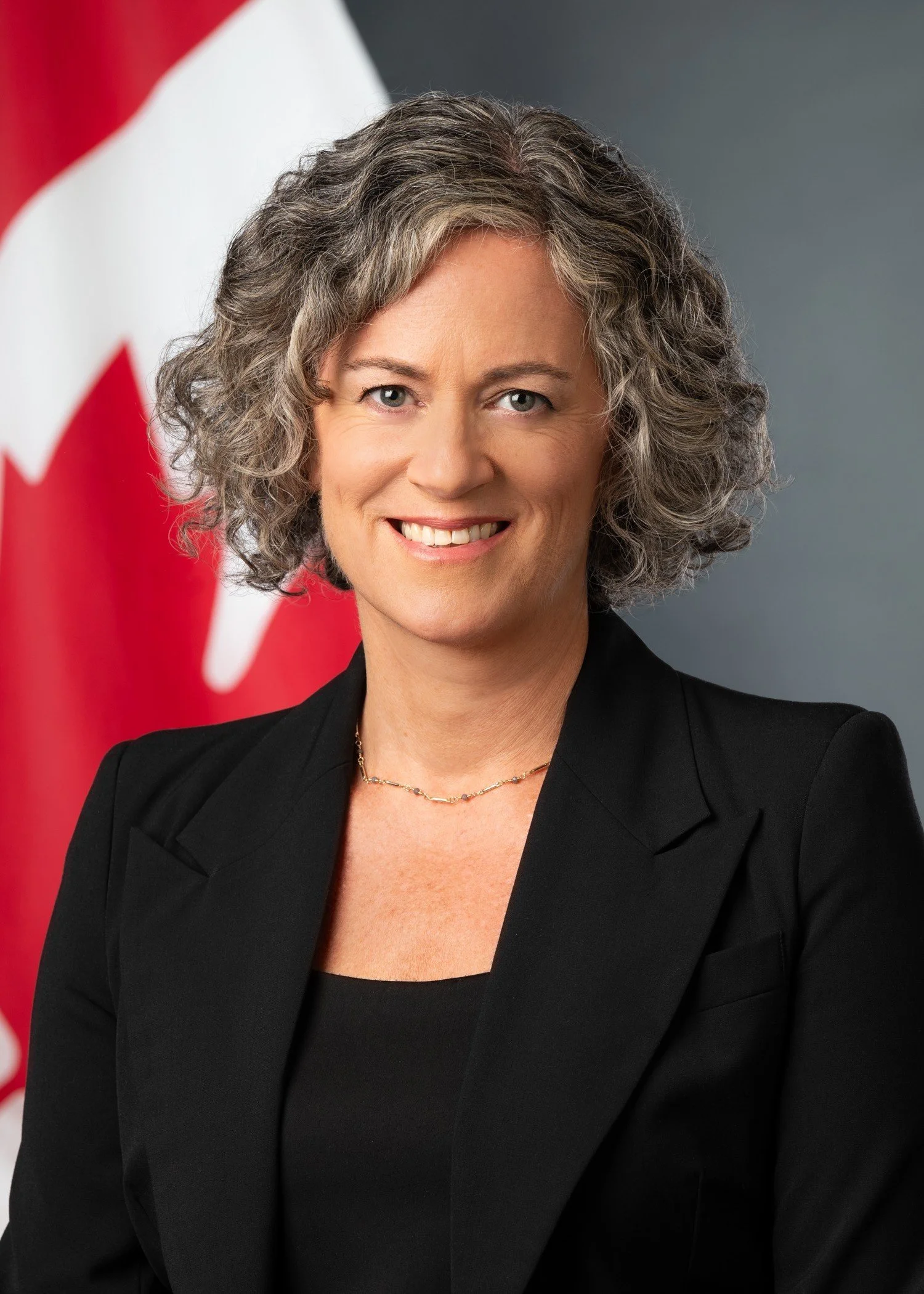
Ambassador Alison Grant has spent more than two decades shaping Canada’s role in international security. As Canada’s Ambassador to Austria and Permanent Representative to International Organizations in Vienna, she represents Canada at the International Atomic Energy Agency and related bodies, working with partners and adversaries alike on nuclear safety, non-proliferation, and international stability.
Grant’s career, which included foreign postings in Moscow, New York, Brasília, and now Vienna, has consistently crossed institutional boundaries. Rather than treating diplomacy, defence, and finance policy as separate lanes, she has worked to integrate them. As Director General for International Security and Strategic Affairs at Global Affairs Canada, she led the tri-departmental effort with National Defence and the Department of Finance to develop Canada’s roadmap toward NATO defence spending commitments, aligning operational requirements with fiscal and diplomatic realities.
Her interest in global security began early, shaped by the end of the Cold War and a fascination with geopolitics. After an internship at the United Nations (UN) in 1994, she joined the foreign service in 1999. Early assignments exposed her to environments where women were still rare in security negotiations. In one instance, while serving in Moscow, Russian officials refused her diplomatic convoy entry into Chechnya. She did not allow the incident to limit her work.
Later in the posting, during the Dubrovka theatre hostage crisis, she was the first Canadian diplomat deployed to the perimeter to help secure the release of a Canadian permanent resident. Experiences like this reinforced her view that diplomacy operates closest to crisis when it is least visible to the
public.
A defining chapter occurred in 2024 when she travelled to Kyiv to finalize the Canada–Ukraine Agreement on Security Cooperation. Negotiated in an active conflict environment, the agreement became part of the long-term framework supporting Ukraine’s defence and the CAF training mission. For Grant, the moment represented the culmination of years working at the intersection of policy and operational reality.
Her leadership style emphasizes knowledge sharing. Known within Global Affairs Canada for mentoring junior officers, she regularly meets with early-career diplomats, particularly women entering security fields, encouraging them to participate actively in discussions where they may initially feel outnumbered.
Grant has also advanced Women, Peace, and Security initiatives by directing Canadian funding toward independent media in conflict-affected states and supporting programs addressing disinformation and civilian protection. Her work at the Weapons Threat Reduction Programme and support for NATO Centres of Excellence in Canada further strengthened links between domestic capability and international engagement.
Her advice to young professionals reflects her own career: build networks intentionally, ask questions, and contribute ideas early. Influence, she believes, grows from participation rather than seniority.
In her current role in Vienna, Grant is focused on strengthening international cooperation on nuclear security and emerging transnational crime threats while promoting peaceful uses of advanced technologies, including space systems.
Grant was nominated by Ms. Jacqueline O’Neill, Esprit de Corps Women in Defence Award recipient (2023).
