
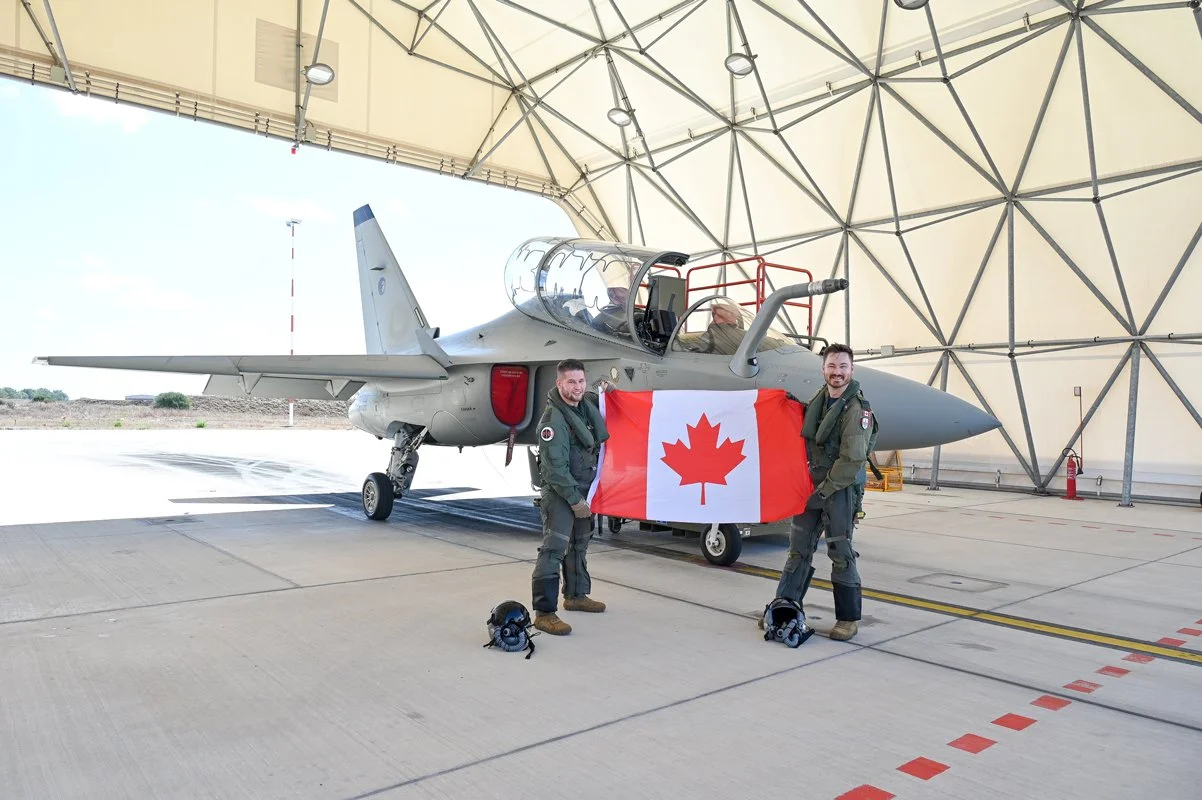
RCAF pilots are shown at the International Flight Training School in Italy where they train on the M-346 aircraft. (Canadian Forces photo)
By Jason Davis
Prime Minister Mark Carney has set in motion another sole-source deal, this one with Leonardo of Italy.
Carney made the announcement June 16 after a meeting with the Prime Minister of Italy, Giorgia Meloni, on the margins of the 2026 G7 Leaders’ Summit in Évian, France.
The move is part of the defence diversification initiative to try to reduce Canada’s reliance on the U.S. for defence products.
Carney pointed out that Italy and Canada are becoming increasingly close in defence and security, noting Italy’s intention to collaborate with Canada to stockpile critical minerals.
But the main thrust of the announcement was to highlight the beginning of negotiations to purchase the M-346 advanced jet trainer aircraft designed and produced by Leonardo.
Carney’s office stated that leveraging Italian expertise in aerospace and defence, “this agreement will enable the Royal Canadian Air Force to train in state-of-the-art equipment and build sovereign training capability.”
The Globe and Mail newspaper reported that the deal would be for around 30 of the jets.
Italy owns about 30 per cent of Leonardo.
No details were provided about the value of the upcoming contract or the delivery dates for the new aircraft.
Twenty countries – including Canada - already train their pilots on the M-346 or have selected the aircraft, in the multirole light fighter version. Thanks to its high-performance, capabilities and manoeuvrability, the M 346 has also been selected by the Italian Air Force as the future aircraft for the “Frecce Tricolori”, Italy’s national aerobatic team.
Leonardo has sold more than 160 M-346s.
The Italian jets would replace the RCAF’s BAE Systems CT-155 Hawk trainers, which were taken out of service in 2024.
Leonardo describes the M-346 Block 20 as a cutting-edge, advanced lead-in fighter trainer. Its avionics accurately replicate the experience of 4th- and 5th-generation platforms (such as the F-35 and Eurofighter Typhoon), allowing air forces to train pilots for complex, multi-asset, and electronic warfare scenarios while saving millions of dollars in operational and weapons integration costs.
The aircraft features an all-glass cockpit and an integrated helmet-mounted display. Leonardo also points out that its Embedded Tactical Training System (ETTS) is an advanced onboard simulation suite that allows the M-346 to replicate complex combat environments in real time. It blends real, virtual, and constructive elements to create highly immersive, cost-effective tactical training for modern fighter pilots.
Leonardo also announced May 26 that the International Test Pilots School of Canada ordered six M-346 fighter jets. The aircraft will support expansion of NATO and Allied tactical fighter pilot training at the International Tactical Training Centre in North Bay, Ontario. The contract includes six M-346 T Block 20 aircraft – with options for an additional six units.
The new trainers are expected to enter service at the company’s International Tactical Training Centre base in North Bay starting in 2029, providing a major contribution to the first capability enhancement project of the ITTC fleet, currently active in providing training to several international customers and to meet advanced tactical training service demand from in excess of ten different air forces globally.
ITPS Executive Chairman Giorgio Clementi signed a contract at a ceremony at Venegono in Italy which also included a final evaluation flight of the aircraft.
ITPS Canada is a Canadian corporation providing advanced military tactical training and flight test training as well as Engineering, Maintenance Repair and Overhaul services. It employs over 200 staff at facilities in London, Ontario and North Bay.
Meanwhile, work is continuing on future fighter pilot training.
In February 2025, the Canadian government identified CAE Inc., of Montréal, Quebec, as its strategic partner to work with the RCAF to develop and refine the Future FLIT (FFLIT) program, which will prepare and train pilots for the transition to the CF-35A.
During the interim period, until the FFLIT program is operational, Canada entered into agreements with allied nations to train fighter pilot candidates through the Bridge FLIT initiative, according to the Canadian government.
BFLIT is a temporary mitigation measure to maintain fighter force pilot training requirements, while bridging to the eventual introduction of the FFLIT capability, the Department of National Defence has pointed out.
It primarily leverages an existing 40-year partnership in the Euro-NATO Joint Jet Pilot Training (ENJJPT) Program at Sheppard Air Force Base, Texas. During the transition, most of Canada’s new fighter pilot candidates will train at ENJJPT.
Additionally, the RCAF has strengthened its existing relationship with the Italian Air Force by sending three instructor pilots and committing to train up to six FLIT students per year at their International Flight Training School (IFTS) in Decimomannu Air Base, Sardinia. This will provide diverse and valuable experience to Canada’s fighter force as it transitions to the CF-35A. In that case the pilots are training on the Leonardo M-346.
Meanwhile, more equipment is on the way for the Royal Canadian Air Force.
Carney has announced that Canada will spend $800 million to buy Joint Strike Missiles (JSM) for the RCAF. The missiles will be used for Canada’s F-35s; the first of those aircraft are expected later this year.
The deal with Norwegian firm, Kongsberg, makes Canada the sixth country to select the JSM. The others include Norway, Japan, Australia, the U.S. and Germany.
Kongsberg’s CEO Erik Lie said the company is “pleased to welcome Canada as the sixth country to select the JSM. The acquisition of the Joint Strike Missile can fundamentally improve the operational range and effectiveness of Canada’s fighter fleet. In addition to delivering world-class defence technology, KONGSBERG is committed to contributing to industrial growth in the country.”
No details were released on when the JSMs will be delivered.
There is also movement on an RCAF aircraft modernization program. On July 2, 2026 the Department of National Defence announced that the first CH-149 modified under the Cormorant Midlife Upgrade project completed its first flight. It stated that a modernized search and rescue helicopter will be delivered later in 2027. The Cormorant Mid-Life Upgrade project was initiated by the Commander of the RCAF in July 2012.
