
By Tim Ryan
The last several months have seen significant progress on improving the space capabilities of the Canadian Armed Forces.
Firstly, the Canadian government announced June 30 that it had awarded a $688 million contract to MDA Space Ltd. to build, test, and launch a replenishment satellite for the RADARSAT Constellation Mission (RCM).
Canadian industry will also be called upon to support design, manufacturing, and integration activities, ensuring a diversified supply chain across the country, according to the government announcement.
The RCM supports a wide range of services that the Canadian public and military rely on every day. Satellite data from the constellation is used to observe Arctic sea ice, track floods, support maritime safety, and study environmental change. Canada’s RCM is actively monitoring the Canadian North and providing critical data that helps enhance Arctic monitoring efforts by the Canadian Armed Forces.
The Canadian government says its approach uses an efficient way of acquiring the satellite. It relies on a commercial satellite design from MDA Space Ltd. based on next-generation MDA CHORUS synthetic aperture radar (SAR) technology and Canada’s previous RADARSAT program heritage. Government officials say this is a proven design that reduces risks, accelerates delivery, and ensures compatibility with the current RADARSAT Constellation Mission infrastructure.
The contract is part of the Government of Canada’s $1 billion, 15‑year investment announced in October 2023, to support immediate and future satellite Earth observation needs.
In December 2025, as a first step and in order to accelerate the delivery, the CSA purchased specialized parts to build the RCM replenishment satellite.
The replenishment satellite will help maintain uninterrupted access to RCM data, used by over 10 federal departments to deliver many essential services to Canadians.
The replenishment satellite is targeted for launch in the early 2030s.
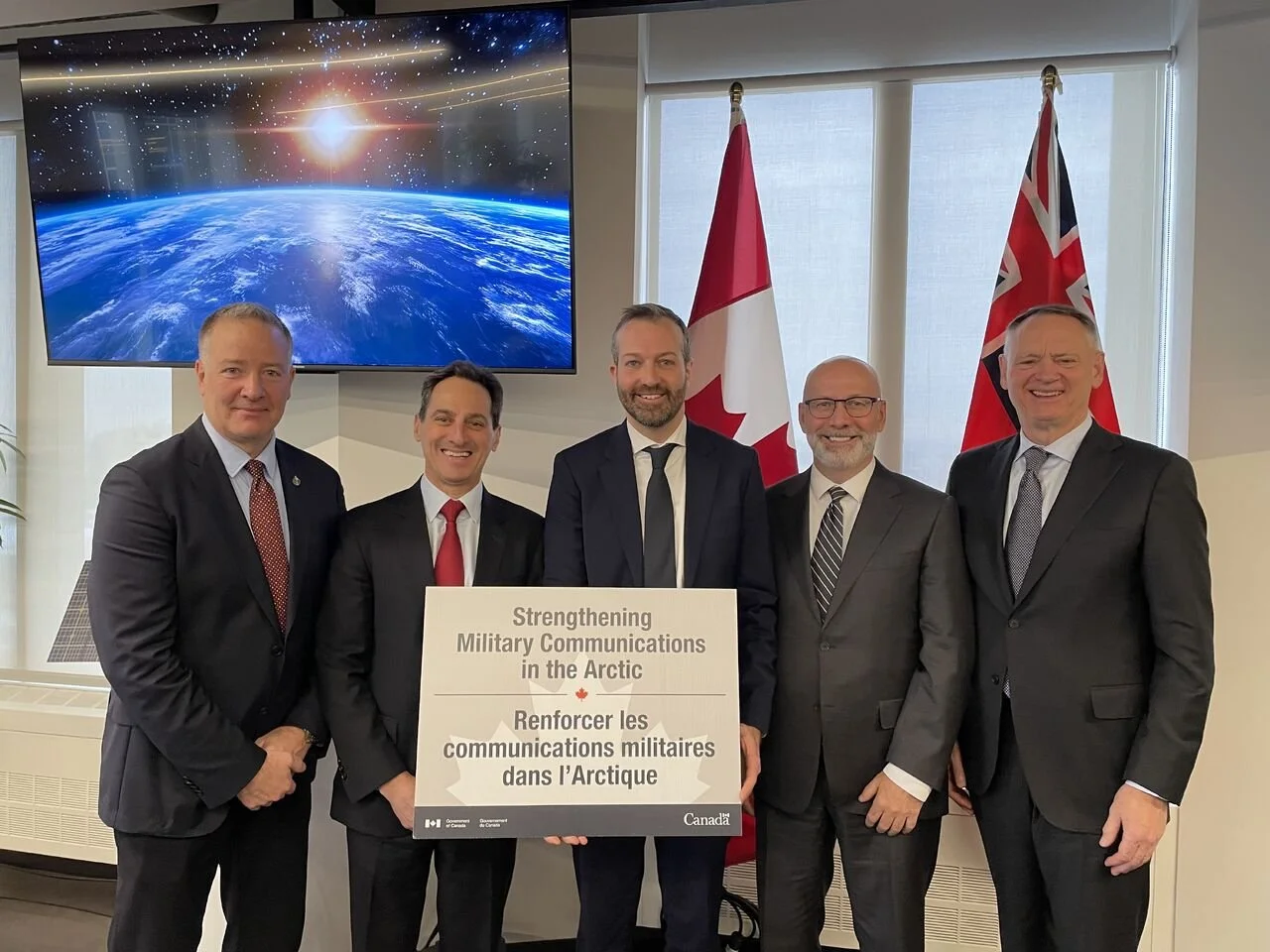
A couple of months later - on Aug. 4 - the Canadian government announced an even more significant contract to help the Canadian Armed Forces. The contract is to deliver the military Enhanced Satellite Communications Project – Polar (ESCP-P). The Defence Investment Agency (DIA) awarded an initial contract valued at approximately $2.3 billion to Telesat LEO ULC (Telesat). The contract also includes two option periods of approximately $214 million and $218 million.
The project is geared to improve Canadian sovereignty in the Arctic by delivering the first phase of next-generation military satellite communications capabilities for the Canadian Armed Forces through the Telesat Lightspeed Low Earth Orbit (LEO) constellation, government officials say.
Once complete, the military Ka-band satellite communications component of the ESCP-P will enable secure, resilient and reliable military communications in the Arctic and other high-latitude regions, according to government officials. This capability will support a broad range of CAF operations, including contributing to NORAD, supporting operations with allies, enhancing Arctic situational awareness, and supporting search and rescue missions.
This is the first contract awarded following the strategic partnership established in December 2025 between the Canadian government, Telesat and MDA Space.
It follows engineering and options analysis work that were undertaken by both strategic partners.
The project will allow Telesat to immediately expand its LEO constellation by 69 satellites, bringing the total number satellites from 156 already in production to 225. The satellites will be built by MDA Space at its high-volume satellite manufacturing facility in Montreal.
ESCP-P will also include a secure Ultra-High Frequency (UHF) and X-band constellation in Medium Earth Orbit (MEO). MDA Space will serve as the prime contractor responsible for end-to-end mission delivery.
Negotiations to advance the definition and development of the UHF and X-band services are also underway. Telesat will serve as a subcontractor to MDA Space on this component.
Stephen Fuhr, Secretary of State for Defence Procurement, said boosting Arctic sovereignty is essential to Canada’s national security. “The ESCP-P initiative will provide enhanced situational awareness and a strong presence in the North while empowering Canada to respond to evolving threats amid a shifting geopolitical environment,” he added.
The Canadian Forces list the Enhanced Satellite Communications Project – Polar (ESCP-P) as costing more than $5 billion. The project website states that first deliver and final delivery of systems is “beyond 2035.”
Fuhr told CBC in a Aug. 29 report that he was "thrilled" with the Telesat contract; the project reduces Canada's reliance on Elon Musk’s Starlink network, operated by U.S.-based SpaceX.
Telesat noted that the Telesat Lightspeed services contract with Canada’s Defence Investment Agency will deliver secure Military Ka-band (Mil-Ka) Arctic connectivity to the Canadian Armed Forces (CAF) under the ESCP-P) program.
The contract is for a period of 15 years of service, including the option years, with service under the contract beginning in 2028.
Telesat says this is the largest contract in its history and will significantly expand the scale and capacity of the Telesat Lightspeed network, positioning the company for accelerated growth. “This contract ensures the Canadian Armed Forces will have access to secure, resilient and sovereign connectivity years earlier than originally planned, at a great value for money, and with a scalable architecture designed to meet future global operational requirements and support interoperability with Canada’s allies and partners,” said Dan Goldberg, Telesat’s President and CEO. “High speed and low latency connectivity is critical for modern military forces, and Telesat Lightspeed is expected to be foundational for future CAF and allied governments’ operations.”
Goldberg added, “This contract also represents a step change in the scale and commercial potential of Telesat Lightspeed. The significant expansion of our constellation, combined with burgeoning demand for secure satellite communications worldwide, positions us to accelerate the growth of our business while serving the evolving and mission critical requirements of defence and commercial customers.”
This initial contract represents the first phase of the ESCP-P deliverables to meet the Mil-Ka service capability with Telesat Lightspeed. Under the agreement, Telesat will deliver Mil-Ka connectivity across Canada’s Arctic region to the CAF, spanning 65 to 90 degrees North latitude. The Mil-Ka portion of the ESCP-P program also includes end-to-end network integration services – including user terminals, ground and control infrastructure, training, and support services – which will be covered under a separate agreement between the DIA and Telesat.
