
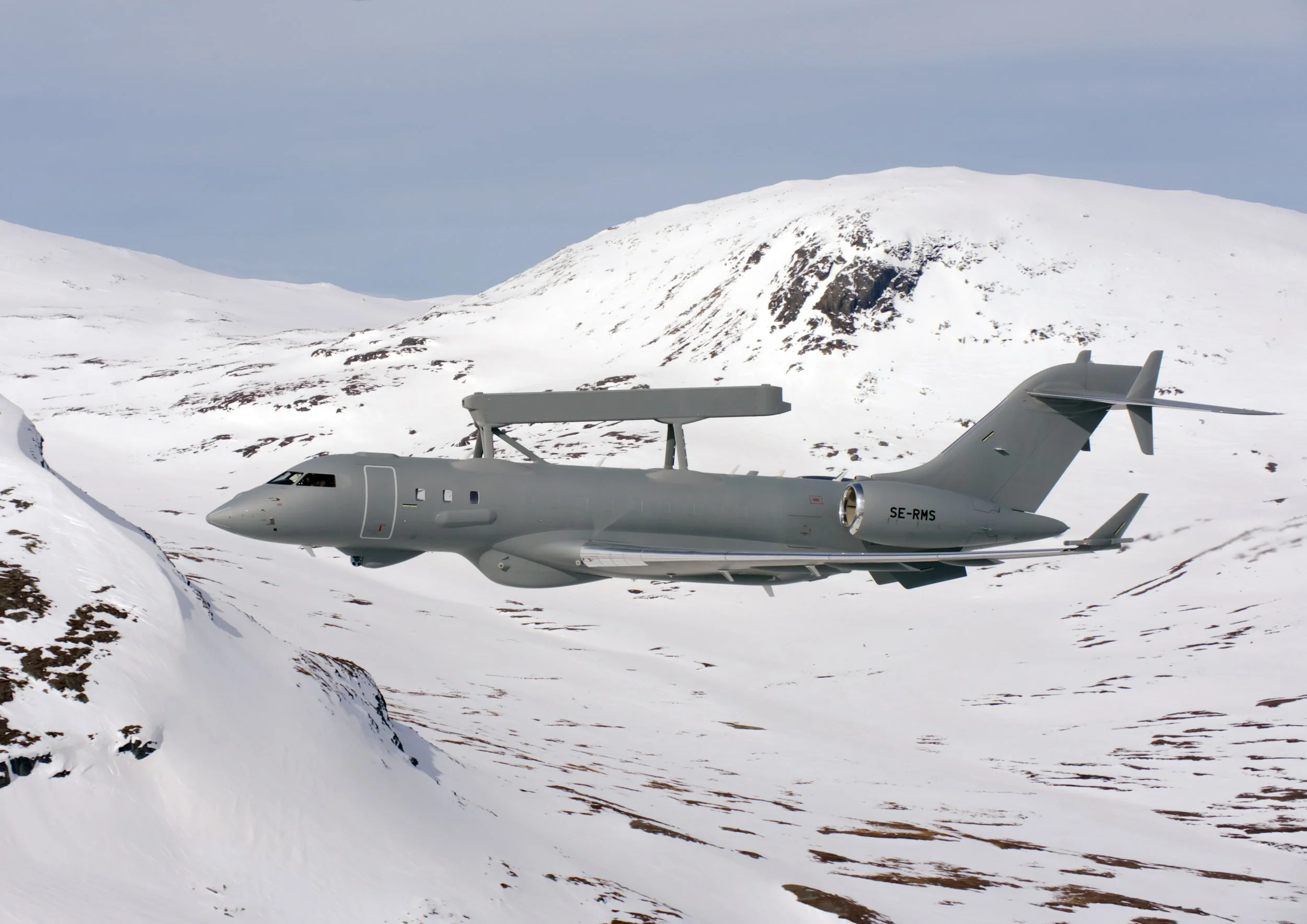
Canada’s purchase of Saab’s GlobalEye is under fire from those who don’t want the Canadian military to shift away from U.S.-built equipment. (Saab photo)
By Tim Ryan
The behind the scenes war against the Liberal government’s proposed purchase of the Saab GlobalEye aircraft continues unabated.
On Sept. 9 the CBC published what some in the defence industry describe as a hit piece on the GlobalEye deal. It’s well known in Ottawa that some Royal Canadian Air Force officers are not happy that Prime Minister Mark Carney pushed ahead with the purchase of the Saab surveillance and early warning aircraft.
Carney made the decision as part of his push to renew Canada’s defence capabilities. It comes at a time when U.S. president Donald Trump continues his threats to annex Canada and destroy the Canadian economy unless it gives into U.S. economic demands. Carney, as well as many Canadians, don’t believe the U.S. can be fully trusted anymore. And because of that Carney has also pushed to move Canada to be less reliant on U.S. equipment and weaponry, when possible.
Carney made the GlobalEye announcement on May 27 at the CANSEC defence trade show in Ottawa, saying the project would not only strengthen Canada’s military capabilities but also create jobs at home.
GlobalEye is based on a Bombardier executive jet built in Toronto. Saab, the Swedish manufacturer, is expected to negotiate an arrangement under which some aircraft ordered by allied countries would also be built in Canada. The Liberal government expects roughly 40 GlobalEye aircraft to be built in Canada.
“With a suite of advanced sensors and mission systems, Saab’s GlobalEye will be a key resource for the Canadian Armed Forces to detect and deter threats across the Arctic,” Carney said in his CANSEC speech.
The RCAF leadership was reportedly not advised the deal was being made. And some in the senior ranks are not happy. They want to further integrate with the U.S., not pull away from that country. Some former military officers have also called for closer integration with the Americans, including adopting a common currency between the two nations.
Inside National Defence headquarters, military leaders have also been fighting a rear guard action to slow down or prevent Carney’s shift away from the American-built equipment, sources tell Esprit de Corps.
The latest salvo against GlobalEye in the CBC report is a good example of what is happening behind the scenes. Anonymous industry representatives and air force officers claimed to CBC that the most recent military assessment of GlobalEye came to the conclusion that the aircraft meets only a portion of the RCAF’s requirements and that modifications will be needed to achieve operational readiness.
In a statement, the Defence Investment Agency, challenged the claims by the anonymous sources pointing out the agency was well aware of the aircraft's capabilities and what the military wanted. "The government determined that no aircraft currently available provides all of the specific capabilities described, and that the GlobalEye was the best choice for Canada," said DIA spokeswoman Sofiya Sapeha.
Liberal MP and former RCAF fighter pilot Stephen Fuhr, who heads DIA, pointed out to the CBC that sometimes, the government needs to opt for the "85 per cent solution," saying there is "nothing out there" that checks all possible boxes. "There's gonna be trade-offs everywhere," he said. "So it's a function of balancing all those things to meet the moment."
Carney’s decision to buy GlobalEye appears to be a winning solution. The RCAF will receive a surveillance and early warning aircraft much faster than if a lengthy competitive process was held. Canada receives significant industrial benefits with jobs and aerospace skills at a time when it is in the midst of a massive trade war with the U.S.
The debate over GlobalEye has been heated. Some online commentators saw the CBC piece as a planted hit-job and have labelled those in the RCAF fighting the move away from U.S. equipment as fifth columnists loyal to the Americans.
Some defence analysts, such as Richard Shimooka with the U.S.-backed Macdonald Laurier Institute in Ottawa claim GlobalEye can’t integrate with U.S. systems. Shimooka writes that the GlobalEye “purchase is sure to increase tensions with the United States.” With that you have to wonder if Shimooka has been following news of what has been happening – Trump has launched an all-out economic war against Canada. A GlobalEye purchase will hardly make increase tensions with a president that has vowed to economically cripple Canada.
Other defence analysts tied to the Americans claim GlobalEye can’t operate with U.S. aircraft. But Saab supporters deny that is the case and the latest developments with GlobalEye undercut the claim.
NATO, which has alliance nations operating U.S. aircraft including the F-35, announced several months it will purchase a fleet of GlobalEyes for its surveillance operations. And in early September the Netherlands, which operates the F-35 as its primary fighter jet, ordered the GlobalEye.
The United Arab Emirates is already operating the aircraft, while Sweden and France have also placed orders.
The Royal Canadian Air Force wanted to originally set aside five years to study and define various options for the project, which is worth more than $5 billion, according to 2026 military planning documents obtained by the Ottawa Citizen. Five years? That appears to be a symptom of a broken procurement system and incompetence among military procurement specialists.
But the Liberal government has moved to shorten much of that timeline by announcing that Canada would enter into direct negotiations with Saab for the GlobalEye aircraft.
Lindsey Ehman, a spokesperson for the Defence Investment Agency, acknowledged to the Ottawa Citizen that the process had been fast-tracked. “While the DIA cannot comment on ongoing procurement processes, the use of a preferred supplier approach is expected to significantly accelerate the progression of the project,” she to the newspaper in an email.
What then is behind all the in-fighting?
In short, the RCAF wants to operate a U.S. plane, in particular the Boeing E-7A Wedgetail.
In November 2023, NATO stated it wanted to buy six E-7s to replace their aging E-3 Sentry airborne warning and control aircraft. But then in 2025 that procurement was cancelled; NATO was worried about excessive costs associated with the E-7 program and news that the U.S. government was rethinking its commitment to the aircraft fleet because of financial costs and concerns about survivability. As a result, NATO committed to GlobalEye amid discussions that the E-7 program was cancelled.
Lobbying from U.S. politicians have put some new life into the E-7 program; in the spring of 2026 the U.S. Air Force committed to continuing with two E-7 prototypes. And in June the Trump administration committed to another five planes.
So what is the final outcome? The GlobalEye may not be 100 per cent solution for the RCAF but it is a Canadian-built plane being operated as well by NATO and other nations. It will allow Canada to move some of its capabilities away from overly expensive U.S.-built and controlled equipment.
But the Liberal government’s purchase of GlobalEye can expect more sniping from defence insiders who are intent on fighting Carney’s shift away from U.S. systems.
