
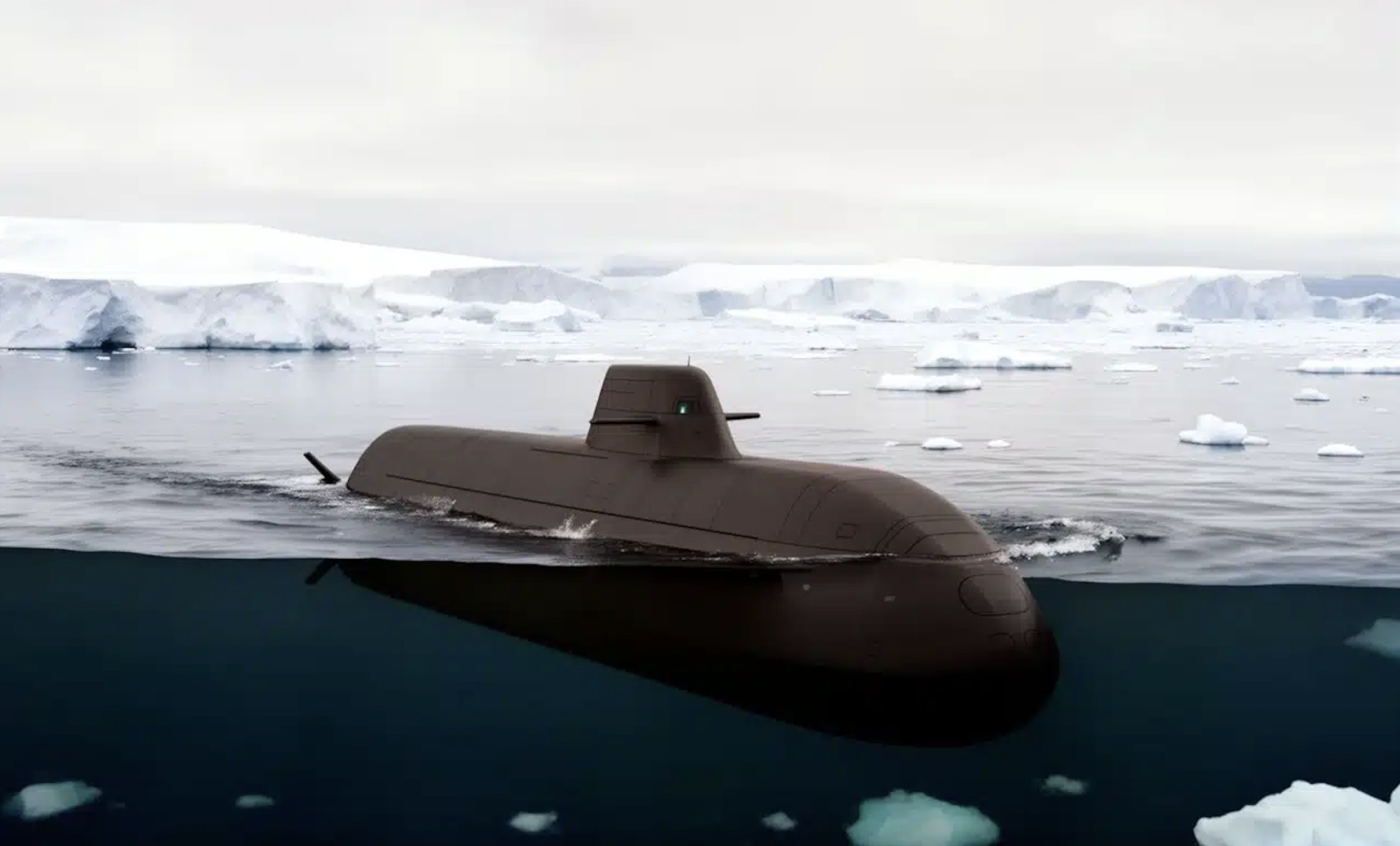
Sustainment of Canada’s TKMS Type 212CD submarine will be a hotly contested portion of the sub deal. (TKMS artist’s concept)
By Tim Ryan
The National Shipbuilding Strategy or NSS has been in existence since June 2010.
But only in the last several years has the NSS started delivering ships and solid returns for industry. More work in on the horizon, with the building of the new submarines and the River-class destroyers.
Here is Esprit de Corps status report on the NSS as well as potential other work for shipbuilders and their industrial partners.
SUBMARINES
Now that TKMS has emerged as the winner in what is being called the largest defence procurement in Canadian history, all eyes will be on the firm and how it proceeds to align with domestic companies.
Prime Minister Mark Carney announced July 6 that thyssenKrupp Marine Systems (TKMS) was selected as the winner of the heated competition to provide the Royal Canadian Navy with up to 12 submarines. It offered the RCN its Type 212CD which is being built for both Germany and Norway.
The new submarines will replace the RCN’s fleet of Victoria-class boats. The first Type 212CD is expected to be delivered to Canada in 2033-2034.
TKMS recognized that for Canada, the decision represented a significant long-term investment in maritime security and sovereign capability. Oliver Burkhard, CEO of TKMS, said in a statement that the company is ready to provide Canada with significant economic benefits. Negotiations are underway and there have been reports that the first part of the contract would cover the acquisition of eight subs, with a future contract for another four.
Carney said the purchase of the submarines will strengthen Canada’s defence industrial base and “will deepen our partnerships with trusted allies, and they will open new opportunities for Canadian businesses in European supply chains.”
The actual submarine purchase is estimated to cost $24 billion but with long-term maintenance and various other factors the project is expected to cost $100 billion over the life of the boats. Some estimates are putting long-term maintenance at around $60 billion over the decades.
The key part of the sub deal for Canadian firms will be the sustainment of the boats. At least two major companies have expressed interest.
Arcfield Canada appears to be positioning itself for such a role. It issued a congratulatory message for TKMS on selection as the preferred bidder for Canada's Canadian Patrol Submarine Project. But it also pointed out it is standing by to contribute.
The company noted that as the submarine program “advances toward contract award and fleet delivery, the focus will increasingly shift toward ensuring the submarines remain operationally ready throughout their service life.”
“As a leading provider of sovereign sustainment and mission-support services to Canada's defence enterprise, Arcfield Canada looks forward to continued discussions with TKMS to deliver a proven, low-risk, and integrated sustainment solution that ensures long-term operational readiness and aligns with Canada's defence and economic priorities,” the company added in its statement.
A sovereign sustainment capability, Arcfield Canada pointed out, would support Canada’s national security by creating high-value jobs, advancing technical expertise and strengthening Canada’s defence capacity for decades to come.
Babcock Canada is also pursuing the future sustainment work.
The RCN’s current Victoria-class submarine fleet will remain operational into the mid-to- late 2030s until the new TKMS subs can be delivered. That means that capabilities need to continue to be in place to keep those boats operating for at least another decade.
On July 20 it was announced that Babcock Canada, Prime Contractor of the Victoria In-Service Support Contract (VISSC), had been awarded a six‐year extension to continue leading and delivering in-service support for the Victoria-class fleet.
The six-year contract extension is valued at $1.1 billion.
The multi- year contract includes the potential to extend the contract up to the fleet’s end of life, enabling uninterrupted, continuous service, as Canada transitions to its new fleet of submarines.
Babcock pointed out it has been the Canadian government’s submarine sustainment partner for more than 18 years. In the process the company has built what it describes as Canada’s only sovereign submarine sustainment capability. During that period, Babcock and its network of Canadian partners completed three extended docking work periods on the Victoria-class fleet, integrating systems including the Mk 48 MOD 7AT torpedo, a modern Submarine External Communications System and a Universal Modular Mast capability.
Babcock has indicated its interest on being selected for the sustainment program for the Type 21CD submarines. It has highlighted how its work on the VISSC has contributed over $3.2B in GDP impact to Canada since 2008, maintained more than 1,500 jobs annually, and has built a robust Canadian supply chain with over 450 suppliers. Babcock has also strengthened Canada’s industrial base by working closely with Canadian universities, colleges, Indigenous communities, and small and medium-sized businesses to support skills development, training, and innovation.
Babcock Canada also announced it had awarded a six-year sub-contract extension to Seaspan Victoria Shipyards to continue supporting Babcock on the VISSC.
Meanwhile, Babcock and Larus are use cutting-edge AI to transform submarine maintenance capabilities and operational readiness. Building on Babcock’s work as the Prime Contractor of the Victoria In-Service Support Contract, the partnership combines Babcock’s operational expertise with Larus’ AI capabilities. The result, the companies say, is a highly secure and predictive system that enables faster and more informed submarine maintenance decision-making.
To further strengthen the partnership, the companies have signed a Memorandum of Understanding designating Larus as Babcock Canada’s preferred AI supplier and will join Babcock’s established pan- Canadian supply chain network.
RIVER-CLASS DESTROYER
Work is continuing at Irving Shipbuilding on the first of the Canadian Surface Combatants, now called the River-class. On June 12, 2026, Irving officially held a keel-laying ceremony for the first of the destroyers which will be named HMCS Fraser.
The River-class destroyer program is estimated to cost more than $80 billion and will produce ships to replace the current fleet of Halifax-class frigates.
At this point, the first batch of three destroyers will be constructed. Delivery for HMCS Fraser is expected sometime in the early 2030. The first nine vessels will be completed by 2040 and the entire fleet of 15 is expected by 2050.
Various companies are seeing work on the mega-project. Babcock Canada, for instance, has been awarded the River Class Destroyer Lifts contract by Irving Shipbuilding. Under this program, Babcock will design, build, support installation and commissioning of the food hoists and stores lifts systems across the first three River Class Destroyers. With a project value of $37.5 million dollars, this multi-year contract will see delivery of the lifts systems extending through to 2029.
The proposed design of the food hoists and stores lifts systems for the River Class destroyers is based on Babcock’s solution for the United Kingdom’s Type 26 frigate, which is also the baseline for Australia’s Hunter-class frigate program.
ICEBREAKERS
The Canadian Coast Guard received a significant boost on Aug. 24 when Prime Minister Mark Carney announced the government would spend $11 billion to fund the construction of six new program icebreakers at Chantier Davie Canada Inc.
Carney characterized the move as part of Canada’s ongoing efforts to reduce its dependence on other countries, in particular the U.S. “This historic investment grows Canada’s domestic shipbuilding industry, strengthens our ability to keep critical trade routes open, and reinforces our strategic autonomy,” the government noted in its statement announcing the deal.
All six icebreakers will be built in Canada at the Davie Shipyard in Lévis, Québec. Government officials say the deal will create nearly 5,000 jobs in the construction phase alone. As part of the government’s Buy Canadian Policy, the ships will be built with Canadian steel and other domestic materials.
The program icebreakers will replace the Coast Guard’s aging heavy and medium icebreakers – the ships that work Atlantic Canada and the St. Lawrence in the winter, and in the Arctic through the summer season.
Government officials say the deal also secures Canada’s position as the home of NATO’s largest icebreaking fleet.
Davie said construction of the first ship will begin in 2027. That first ship will be ready five years later, and the full fleet will be in service by 2038.
As Polar Class 3 icebreakers, the program icebreakers will be designed as modern, versatile vessels capable of carrying a wide range of missions in challenging ice conditions across Canada’s waterways, federal officials stated.
The Canadian government has been ramping up the program since August 2019 when it announced that it was establishing a short list of pre-qualified shipyards to submit a formal proposal to become the third strategic partner under the NSS (National Shipbuilding Strategy), joining Irving Shipbuilding Inc. and Seaspan’s Vancouver Shipyards.
In March, 2024 the government announced that it awarded its first NSS contract to Chantier Davie Canada for initial work related to the construction of new Program Icebreakers. Under that $19.6-million contract Davie began work to develop the initial design.
In 2025, under a separate program the government awarded a $3.25 billion contract to Chantier Davie for the construction of the Polar Max, which will be one of the most powerful and capable heavy icebreakers in the world.
JOINT SUPPORT SHIPS
The Royal Canadian Navy is expecting two Joint Support Ships (JSS) from Seaspan’s Vancouver shipyards. The RCN pointed out that delivery of the first JSS was delayed from 2026 to 2027 due to “continued challenges associated with outfitting a first-in-class, complex warship.” Production of the second ship is benefiting from lessons being learned and remains on track for delivery in 2027/2028, according to the RCN.
ASTERIX
The lease for MV Asterix, now known as Combat Support Ship Asterix, ends in January 2028 and Federal Fleet, the firm proving the ship for the Royal Canadian Navy, had been pitching Canada on either renewing the arrangement or purchasing the vessel outright.
The Royal Canadian Navy has rejected that proposal. It believes the Joint Support Ships to be delivered in the future will be ready to step in and take the place of Asterix. That situation could, however, change because of ongoing delays that the JSS program has faced.
CONTINENTAL DEFENCE CORVETTE
The Royal Canadian Navy is interested in receiving information from companies for what it is calling the Continental Defence Corvette. A new fleet of 16 to 20 corvettes is being proposed. The vessels would be designed as homeland defence warships capable of patrolling and protecting Canadian waters, including the Gulf of St. Lawrence and up to the Arctic ice edge.
According to the April 9, 2026 briefing for the defence industry officials, the Royal Canadian Navy doesn’t expect the contract for the corvettes to be awarded until 2030 and the first ship to be fully operational in 2039.
The Continental Defence Corvettes are being envisioned as ships that can free up the navy’s new River-class destroyers. The corvettes would allow the River-class to focus on high-end threats, missile defence and overseas deployments, the Ottawa Citizen newspaper pointed out.
The corvettes will be able to conduct anti-submarine warfare as well as fight other surface vessels. They are expected to have a range of 7000 nautical miles and be able to patrol for 30 days.
Ontario Shipyards in St. Catharines, Ontario is pushing the idea that it should get a piece of the proposed program.
Shaun Padulo, the president and CEO of Ontario Shipyards, used the latest tariff war between the U.S. and Canada as further proof his yard should receive the corvette contract. "We at Ontario Shipyards, and our supply chain, can give the Royal Canadian Navy and Coast Guard the ships they need while building Canadian capacity, strengthening our sovereignty, and creating durable, economic opportunity here at home," he told CBC News.
SMALLER VESSELS
The Canadian Coast Guard officially welcomed another modern, Canadian-built Search and Rescue Lifeboat into its fleet, in October marking the completion of the 20th Bay Class vessel in the fleet built under the National Shipbuilding Strategy.
The CCGS Baie de Gaspé is a high-endurance Search and Rescue Lifeboat built by Chantier Naval Forillon, in Gaspé, Québec. It improves the coast guard’s capability to respond quickly to mariners in distress.
In 2018, Chantier Naval Forillon Inc and Hike Metal Products Ltd of Wheatley, Ontario, were awarded the construction of four new Bay Class Search and Rescue Lifeboats each, in addition to the existing contract awarded in 2015 to build six Bay Class lifeboats each. The total value of the contracts for these 20 vessels was approximately $180 million.
The CCG’s new Search and Rescue Lifeboats are specifically designed, equipped, and crewed to respond to incidents at sea. These vessels are self- righting and can operate up to 120 nautical miles from shore, maintaining a maximum 30-minute state-of-readiness at all times with a typical ability to respond the moment an alert is received.
To date, 30 small vessels have been delivered to the CCG under the NSS. This includes the 20 Search and Rescue Lifeboats, two Channel Survey and Sounding Vessels, seven Hydrographic Survey Vessels and one Coastal Research Vessel.
